Blog Archives
Religulous (2008)
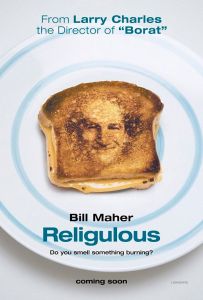 There is no topic in the world more volatile than religion. It dominates cultures, reshapes geography, inspires people to work with the poor, inspires people to attach bombs to their chest, and is as old as time itself. Most civilizations constructed a religion after they grew to a certain size. So who in the world would want to make a sacrilegious opinion-piece documentary that wants to open eyes as well as have a good laugh? Bill Maher is a comedian that respectfully never holds back his true feelings. He’s unflinching in his social commentary on his HBO TV talk show, and religion has often been a thorn in Maher’s side. He personally views it as a mental disorder. Religulous is his eviscerating and intriguing expose as he travels the holiest sites in the globe and asks, “Why?”
For the most part, Religulous doesn’t take a hammer to religion as it does the fundamentalist followers. There are several subjects that cry out for ridicule, like pastors living large and very un-Christ-like on the coffers of their congregations, egomaniacal televangelists that squeeze pennies out of lonely widows, those that babble in tongues, Joseph Smith, Scientologists, and people that celebrate scientific ignorance. Maher is attacking the hypocrisy of fundamentalism, but his condemnation isn’t only reserved for Christianity. He is an equal opportunity offender. In the most surprising venture, Maher takes a trip to the Holy Land and chats with Islamic practitioners about the double standard of its more ardent followers. I suppose repeatedly yelling “Death to Israel” is copacetic but an editorial cartoon that tweaks the religion over its extremist tendencies toward violence is an insult that cannot stand as freedom of speech? Maher really delves into un-PC territory and wants to know why he sees Islamic followers being so overly sensitive to criticism. I think given the fact that like 50 people died as a result of protests over cartoons, there may be room for discussion here. I credit Maher for not ducking away from provocative questions no matter the setting (he even got into the Dome of the Rock mosque!)
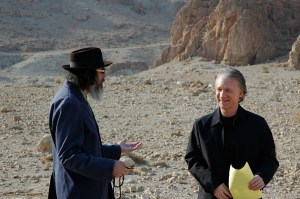 Maher and director Larry Charles follow the same documentary techniques Charles honed as he directed 2006’s Borat movie – a small shambling camera crew that ambushes rubes with tough questions and watches them sputter and squirm. This technique can be amusing when we feel that the harsh inquisition is deserved. Your regular Joe who believes that Jesus is his co-pilot is not deserving of Maher’s smug stares. There’s a moment where he asks a nice guy if he believes that he will reach heaven upon death. He believes he will. “Then why don’t you kill yourself?” Maher asks coldly. It’s uncalled for, and I say all this as a genuine fan of Maher. Still, the movie is regularly funny as it deconstructs religious traditions with quick-cuts to old Hollywood religious epics as cinematic rimshots. One of the better and more convincing moments is when the film compares the theological coincidences between the Egyptian god Horus and Jesus Christ, all set to the Bangles instructional song “Walk Like an Egyptian.”
I personally don’t believe that having faith in the unseen/unknown or being religious equals being stupid. Quite the contrary. However, it’s easy to gather a specious view of religion when all you talk to are ignorant yokels. Maher has perhaps one or two sit-down interviews with people educated in theology, but mostly he sticks to interview subjects that he can mock or those that share his opinion (his extended interview with the leader of Amsterdam’s pot-fueled “cantheism” is irritating). I think Maher is doing a disservice to his film’s target by not discussing theology with learned scholars, with people that can articulate lucid and complete thoughts, with people that have all their teeth. Did he seriously think he was going to able to find a defense for Biblical contradictions at the Holy Land amusement park or at the trucker church? I strongly doubt it. In many ways Religulous strictly sticks to the sideshow of Christianity, peering at the fringe elements. I’m all for grilling fundamentalists that cannot square science and God, but if Maher wants to expose all religious followers as wrong-headed, and not just the ones that think Jesus rode a dinosaur, then he needs to tackle more substantial figures in the field.
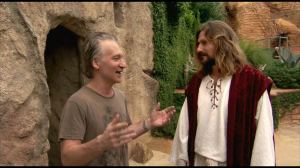 But then Maher fumbles his conclusion and loses me. It is in the closing five minutes that Maher attempts to string together his thesis statement, saying that in order for man to live that “religion must die.” Up until this point Maher has been irascible but committed to his ongoing ideology of “I don’t know.” He professes not to know what will occur after death and wants to press other people into a spirited discussion of the spiritual. But then comes the finish and Maher speaks with the same certainty that he castigated fundamentalists earlier. He is no longer preaching discussion but preaching immediate action to thwart belief. Maher becomes very agitated, his tone gets very sharp, and he steps on the soapbox to once and for all attest that religion of all shapes and measures is rubbish. It’s in these concluding moments that Maher sidesteps from his message of doubt and speaks in aggressive and alarmist hysterics. Maher spent most of [i]Religulous[/i]’ running time attacking hypocrisy but now he demonstrates his own.
I feel that Maher has many good points to make. Religion becomes extremely detrimental when it morphs into nationalism. The Founding Fathers did not envision the United States as a “Christian nation” and were mostly deists with little regard for traditional worship. Questioning and doubt are actually signs of a healthy relationship with faith, because it means that person is active with their faith. Maher showcases the well-known historical grievances caused by religion, or more accurately the followers of religion, but he brushes past the good of religion. It can be a unifying force that calls for people to love thy neighbor as thyself and to turn the other cheek (it’s amazing that the fire and brimstone Bible thumpers forget about the Be-attitudes). Religulous is an entertaining skewer of fundamentalism and close-mindedness, which is why it falls apart when it too turns close-minded.
Nate’s Grade: B-
Share this:

The Golden Compass (2007)
 Beloved by many and condemned by others, Philip Pullman’s fantasy series, His Dark Materials, is widely popular. New Line Cinema placed an expensive wager in adapting the first book of the series, The Golden Compass, with the express desire of having their own Narnia-style franchise. Chris Weitz (American Pie, About a Boy) was hired to adapt and direct the enterprise. The final tally had the budget somewhere around $180 million, add in an extra $60 million for marketing, and New Line was pretty much banking their studio’s fortunes on this would-be fantasy blockbuster. Trouble is, there is not built in audience for a Golden Compass movie. The books are more popular overseas and less than ten years old, so there hasn’t been enough time to build a sense of lore or greater anticipation, like with Narnia. As of this writing, it looks like The Golden Compass is going to tap out at about $70 million domestic haul, and while I have no doubt that figure will be much higher overseas, I do not think it is a coincidence that soon after The Golden Compass fizzled New Line buried the hatchet with Peter Jackson and started the process on engineering two Hobbit movies. You see, that’s guaranteed money in the bank unlike The Golden Compass.
On a parallel Earth, people walk around with their souls in the form of animals known as daemons. These creatures serve as conscience, servant, and protector. Until a child reaches adulthood the daemon will often change form until it settles on one creature, be it a cat or a hawk or a toad. Lord Asriel (Daniel Craig) has discovered an inter-dimensional hole around the Arctic Circle, and a magical substance known as Dust is seeping through. The all-powerful Magisterium feels that they know best for others and that people need to be told what to do, and they most certainly do not appreciate Lord Asriel’s scientific discovery. They have decided to silence him permanently as he travels to the Arctic.
 Meanwhile, Lord Asriel’s niece Lyra (Dakota Blue Richards) is investigating poor orphans that seem to be vanishing around her school. The Magisterium has taken an interest in Lyra and “asked” that she accompany Mrs. Coulter (Nicole Kidman), an icy woman with a wicked monkey as a daemon. She has great hopes for Lyra, but soon the child realizes she is a prisoner in the care of Mrs.. Coulter and that the Magisterium is responsible for abducting children and conducting experiments to remove their daemons from them forever.
She escapes and heads to the North, and finds help amongst nomadic people known as Gyptians, an air cowboy (Sam Elliott), a group of flying witches led by Serafina (Eva Green, as lovely as ever), and a scarred and grumpy polar bear named Lorek (voiced by Ian McKellen) who has been exiled from the Ice Bear kingdom after losing in one-on-one combat with the cruel current king, Ragnar (voiced by Ian McShane). Lyra leads this motley crew to the Arctic where the Magisterium is keeping the absconded children for experiments.
Most noticeably absent is a sense of wonder. The Golden Compass kind of plods along, and when new magical creatures are introduced they’re done so with such matter-of-fact complacency. If they can’t pretend to be impressed then why should I? There’s a difference between playing the fantastic straight and just shrugging it off. The structure of the screenplay doesn’t help things much. Many subplots feel rushed or grafted on to a lumbering plot that collects minor characters like static cling; it isn’t until the climax that the whole slew of people combines forces. As a result, some subplots are far more interesting than others, like the world of armored polar bears. This imaginative diversion, like much of Golden Compass, reveals itself as simply a side step in a plot littered with nothing but side steps. Just as soon as the storyline has started it’s pretty much over and the movie has moved on to new ground.
The movie fluctuates between the silly and the confusing. The hardest part of any fantasy film is establishing the rules and laws of this new realm, and The Golden Compass seems a tad overburdened in trying to explain its world. Weitz’s adaptation is heavy in lugubrious exposition without the benefit of drawn-out explanation. Often some character will explain something briefly and then the audience is left to orient themselves with this new morsel of information. Cosmic dust, alternate dimensions, Magesteriums, daemons, Gyptians, polar bears, witches, prophecies, it’s a bit much to decipher for an adult let alone a child (I’m convinced that the sluggish pace and confusing jumble of a story will totally bore kids). The golden compass itself is a very awkward creation and really has little purpose or connection to the events of the film. First off, in order to pose a question a person must align three hands to varying pictures to best describe what they will ask (how many pictures do you need to ask where you left your keys?).
The book’s anti-ideology stance has been severely watered down and replaced with half-hearted euphemisms. Gone are any overt references to the church or Christianity, instead the movie couches its ire in vague authoritarian terms, a giant entity that wants to separate children from their daemons (souls) to purify them from Dust (sin). I do find it amusing that the villainess is a tall, thin blonde woman named Mrs. Coulter, though this seems more coincidence than indignation. There is a brief scene in the film where a bunch of frowning, older white men (one of them Christopher Lee) sit around a table clucking their tongues and talking up their evil scheme; that’s about as provocative as the movie gets. But by sanitizing the book’s provocative nature, Weitz has produced a movie adaptation that feels too silly to be taken at face value and too bland to be taken as anything but.
 From an effects-driven perspective, The Golden Compass is admirable even if few of the CGI works manage to truly dazzle. The special effects are sturdy for a tale with such demands as talking animals and winter icescapes. The bear battle is the film’s highlight but a climax involving a sprawling brawl, which visually indicates a person’s death by a daemon vanishing into a cloud of gold smoke, is fun to watch. Sadly, an ongoing sense of fun or enjoyment is missing from most of The Golden Compass. It feels more dutiful when it should be wondrous and timid when it should be exciting.
The Golden Compass is a less spirited fantasy adventure that skimps on what makes the genre special. It has no sense of awe and wonder, and even worse the movie is structured in a rush with little time for clarification and growing characters. The film is crammed with cheerless exposition and the bulk of the plot is built around a lame rescue attempt. Weitz has sanitized the intellectual and religious provocations of the book to appeal to greater mass audiences, but by doing so he’s robbed the audience of substantial subtext. The Golden Compass even ends on kind of an unresolved, Fellowship of the Ring, “Oh, it’s over” kind of way, finishing before even reaching the climax of the first book it’s based upon. I have read that the studio shot these scenes, and you can even see them in the original trailer and access them via the video game tie-in. They wanted to save them for the start of a second movie. It may be painfully obvious to most, but allow me to say it: there is not going to be a second movie. The Golden Compass is a slightly entertaining but mostly charmless fantasy film. Someone figure out the right three pictures to ask, “How could we have made this movie better?”
Nate’s Grade: C+
Share this:

The Reaping (2007)
 Forgive me father for I have sinned… I think The Reaping is not a terrible movie. Now, that would be damning praise in most circles, but when it comes to the notoriously implausible and awful genre of religious-based horror, well then “not terrible” is worthy of being brandished in the film’s ad. All of my fellow critics need to take a step down from the pulpit and see The Reaping for what it is: mild harmless fun.
Katherine (Hilary Swank) is a professor at Louisiana State who specializes in debunking claims of religious miracles. “38 miracles and 38 scientific explanations,” she says matter-of-factly. Katherine has something of a grudge against the Big Guy, being that she used to be a minister before her husband and daughter were murdered on an overseas missionary trip. Doug (David Morrissey) has a case only that only Katherine can crack. In the sleepy town of Haven, along the Louisiana Bayou, is being beset by Old Testament style plagues. The river has turned to blood and the Bible-beating townsfolk are itching to blame a little blonde girl (AnnaSophia Robb) who they feel could be the spawn of Satan.
 The Reaping starts off with tiny amounts of promise and intrigue because of Swank’s character. She?s a globetrotting spiritual investigator and a skeptic that an audience can get behind. She has a checkered history and Swank uses glances and moments to make her seem convincing. The Reaping isn’t complicated when it comes to its spiritual message. It’s all about renewal of faith, and I?m not exactly certain how all the pieces add up but that’s the gist. The Reaping isn’t too deep when it comes to thoughts of any kind, but that doesn’t mean much from a genre that requires a healthy suspension of rationale thought.
As a horror movie The Reaping relies on routine jump scares and the occasionally jump cut to a dream or a flashback in Africa with a lot of loud, abrasive sound effects to jolt the viewer. The plagues themselves are kind of weak, especially when plagues of maggots and frogs are seen as being so contained and limited. For maggots, we see a grill loaded with fish now covered in maggots. We never get any other anecdotes of what may have been reaped by the maggot plague. The frogs fall for about ten seconds and only in one part of the swamp. These pathetically isolated incidents don’t do much to ratchet up any scares and they certainly belittle the powerful wrath of the Almighty. Then again, maybe God is trying to tell people in unorthodox ways to eat less meat, thus the ruined fish and diseased cows. The plagues lack some oomph when they just happen to a handful of people, especially when it comes to lice or boils. I think the small-scale plagues really say, “We blew our budget on that river of blood, but hey, that was pretty cool right?”
 I don’t think I’ll ever utter these exact words again but here goes. The Reaping is a rather so-so movie that is mostly redeemed by an implausible and foreseeable twist ending. Yes, as horror and supernatural thrillers are go, twist endings seem pretty common place and often times forced, like the studio is dictating that they need something just a little extra to fool the audience into thinking they got their money’s worth. We as a movie watching society are so attuned to twist endings now that we can sniff them out like bad CGI. Twists generally become worked into the advertising campaign. The Reaping has some last-second turns to it, and even though I had my suspicions, I was quite pleased the movie walked the path it did. In fact, I would even go as far to say that it turned a spiritually thin schlocky horror movie into a moderately enjoyable spiritually thin schlocky horror movie. This is far from a good movie, but as a dumbed down genre flick it will be like home cooking for the right audience. Now, I cannot defend the gaps in logic brought about by the twists in The Reaping, and you will be spending the rest of your day coming up with a new problem every minute (the line ?some people just don’t wanna go to heaven? takes new life). The film takes one step too far with trying to up the ante. Just know that the upcoming crisis in Katherine’s life has been solved by a little thing called Roe vs. Wade.
Director Stephen Hopkins has some stinkers to his resume, chief among them 1998’s abominable Lost in Space, so he will take kindly to having his latest film deemed “not terrible.” Swank struts around in a tank top in the balmy South, gets knee-deep in blood, and convincingly sells this nonsense as only a two-time Oscar winner can. The scares are clunky and the story is rife with lots of explaining for a 90-minute movie built around the simple concept that the devil is nasty. The Reaping will play best for fans of the religious horror genre as well as those willing to lower their expectations. This isn’t a good movie, but then again, it’s not terrible.
Nate’s Grade: C+
Share this:

Munich (2005)
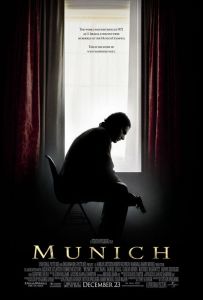 If 2005’s War of the Worlds was Steven Spielberg’s look at 9/11, then Munich should be considered his examination of the aftermath. What could be more relevant today than a film about combating terrorism, violent reprisals, and where a government leader says, “Every civilization finds it necessary to negotiate compromises with its own values?” Anyone seen the news lately? Spy eavesdropping, prison abuses, hemming and hawing on what the definition of torture is, it’s all compromised values in the name of security. This is our world and Spielberg analyzes the costs of war. Munich is visceral, haunting, thoughtful, and compelling as both an idea piece and as a mainstream thriller. It’s Spielberg’s most mature work in a decade.
In 1972, a group of Palestinian terrorists known as Black September took 11 Israeli athletes hostage during the Munich Olympics. The world watched as the standoff stretched for hours, finally ending in a firefight at the airport and the terrorists throwing grenades into helicopters housing their hostages. Every Israeli athlete and Black September member had been killed. “They’re all gone.”
But it doesn’t stop there. Israel Prime Minister Golda Meir (Lynne Cohen) recruits Mossad agent Avner (Eric Bana) to run a secretive counter strike. Avner is to assemble a team, track down the architects of the Munich massacre, and assassinate each one. Their mission is only known by a select few, and their only contact is via a handler (Geoffrey Rush) and a safety deposit box that fills up with money. Joining Avner are Steve (Daniel Craig), the South African with a hot-head, Robert (Mathieu Kassovitch), the toymaker turned bomb maker, Hans (Hanns Zischler), the document forger, and Carl (Ciarán Hinds), the clean-up man. The men crisscross the globe hunting down their targets, and with each successful kill there is escalating retaliation by Black September. Soon Avner’s group becomes a target themselves and he questions if the men they are snuffing out have any connection to Munich.
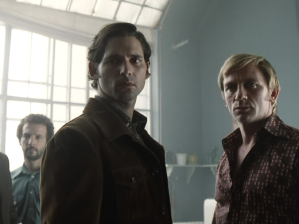 When I first heard about Munich I thought it would be a dramatization of the hostage situation, and Spielberg does revisit the sequence in horrifying and bloody flashbacks. The film’s focus is on the aftermath of Munich, though it does not pretend to be fact. This is a made up story based on rumors. As new evidence clears, it looks like the Munich retaliatory slayings were unrelated Palestinian men.
For events that began in 1972, Spielberg punctuates his drama with a gnawing sense of timeliness, closing his film with the very image of the World Trade Center in the New York skyline, connecting an invisible line from Munich to our world today. This is a mature, meditative examination on the retaliatory response to terror. Munich is even-handed in its views and dives into challenging territory where an easy answer is an insult. This isn’t a pro-Israeli movie or an anti-Palestine movie (though it’s already earned condemnation from fundamentalists on both sides), and every side gets a moment in the spotlight to effectively argue their case. The result is a movie that thoughtfully and reflectively looks at the cost of vengeance and compromising our values. Munich, even with its glut of important messages and mouth pieces, never forgets to be entertaining. The cameras are often handheld and Speilberg’s winding shot compositions give a visceral feeling to the events.
Bana (Troy) is the moral anchor of the film and gives a staggering performance. He begins proud and humbled, living in the shadow of his father’s name, an Israeli war hero. As the assassinations play out, each changes Avner and Bana expertly expresses his character’s turmoil, finally succumbing to paranoia and fear. The final act has relatives telling Avner he has done right, that his dead family is smiling with approval, and Bana’s sad, haunting eyes tell the full story of what he truly believes. He looks like he’s aged ten years in such a short time span. Each member of the hit squad fills out their role nicely, with Craig (Layer Cake) imparting tough, hip savvy, Kassovitch (the director of Gothika, oddly enough) is nebbish and the first to morally crack, Zischler is stoic button-lipped,and then there’s the fantastic Hinds (Julius Caesar on HBO’s Rome), an experienced man that?s so calm and knowing and wryly warm-hearted. He’s such a delightful onscreen presence. Rush is only onscreen in spurts but is brash, humorous, and unsentimental to the very end. He’s an actor that rarely misfires, if ever.
Too often we bandy about the term “evil;” our enemies are “evil,” atrocities are brought about by “evildoers,” but by painting in such broad, simplistic strokes, demonizing the enemy as “evil” (and conversely implying you are the side of good) you strip away the reality of the situation. The worst thing you could do in this war on terror is simplify the situation. These are not evildoers; these are people deciding to commit atrocious acts. If they are dubbed monsters or simply evil then we’ve reduced the argument to a kindergarten lesson. Munich doesn’t show the Palestinian targets as mustache-twirling evil doers (no one is spotted tying a damsel to railroad tracks). These are men with convictions, family, and humanity. “Evil” is too tidy a term, and Spielberg understands this. Are evil acts necessary to combat evil? Do we become our enemies when we resort to their ruthless tactics? Robert, shaken from a recent kill, pleads that Jews are supposed to be righteous, that’s what separates them from their persecutors. Assassination is not a righteous act, despite what Pat Robertson may spout off on TV. In the end, the only trustworthy people in the film may be a strange French family that sells information to the highest bidder, regardless of politics.
 There’s one moment in the middle of Munich that will stick with me forever. There’s only one pure vengeance murder in the movie and it involves a female killer (Marie-Josée Croze). It’s a kill the audience is thirsting for and demanding; the other assassinations were murky, men unknown to have any involvement in terror other than being a name on a sheet. This is an instance where the audience wants revenge and then Spielberg gives exactly what we want and disgusts us. The kill is so sharp, so uncompromising that the violence is startling and, more importantly, it hurts. The reality of it is painful to watch. Spielberg has masterfully turned our quench for violence and shown the ugly reality.
Munich also succeeds as a thriller, pulsing with immediate danger and drawing the viewer in. There were key moments that I was chewing on my knuckles because of how taut the suspense was. As a thriller, Munich briefs us on these men’s mission like all good spy movies, brings us into their fraternal order, and then we watch each assassination play out, many never going according to plan. What elevates Munich is how real everything feels and how dangerous every moment comes across. This is a thriller that it makes the heart pound but also courses with subtext, and exquisite dialogue by Tony Kushner (Angles in America), who magnificently frames his characters with the tiniest details, who crafts deft symbolism in moments of doubt and paranoia, and who, channeled with the film’s masterful acting all around, creates a stirring study of the cost of violence and the broken bodies it leaves behind, even those that live to ponder another day. Kushner’s writing is a perfect match for Spielberg’s effortless artistry.
This is Spielberg maturing as a filmmaker, despite some missteps here and there, mostly with the length and a late sequence where he juxtaposes the final Munich hostage flashback with Avner climaxing in coitus with his wife. The characters are sharp, the acting is resonant, and the thrills are palpably engrossing, giving the film a refined sense of danger where anything could happen. Munich is more than a thriller and more than a think-piece. It’s a close examination of the cyclical nature of retaliation and reprisal, dooming both parties into an endless bloodbath. Don’t be frightened by all this heady talk because it’s also a very entertaining movie. Munich isn’t the best film of the year; it’s pretty good but it’s definitely one of the more important movies of the year and worth seeing.
Nate’s Grade: B
Share this:

Constantine (2005)
 I’ll admit it; I’m a sucker for Christian mythology played against thriller and action settings. I may be the only person to have watched all of The Prophecy flicks, and probably the only person that eagerly chows down on the cheesy sequels to The Substitute, yet shy away from seeing the first film. I’m captivated by the imagery, the discussion of Heaven and Hell and its mythical logistics, and just the psychology of supernatural biblical beings. With this in mind, I was strongly anticipating the release of Constantine. What I got wasn’t exactly what I expected but I’d be lying if I said I wasn’t entertained.
John Constantine (Keanu Reeves) is a very troubled man. Since his youth he’s had to live with his gift that allows him to see through earthy disguises and witness angels and monstrous demons walking among us. He’s parlayed this ability into a modest side job of exorcising demons and sending them back to Hell. Constantine figures his loyal service should grant him passage into the pearly gates, but Archangel Gabriel (Tilda Swinton) reminds him that that’s not how it works. Constantine is doomed to go to Hell because he tried taking his own life, and if that’s not enough he also has terminal lung cancer from smoking like a chimney. “In other words, you’re f***ed,” Gabriel confides to Constantine.
 Police detective Angela Dodson (Rachel Weisz) is investigating the suicide of her twin sister (also Weisz). She swears her mentally disturbed sis wouldn’t do such a thing, and she seeks out the help of Constantine. He challenges her beliefs, stating that God and the Devil (Peter Stormare) have a wager over the souls of mankind but cannot directly interfere. But now something is breaking this rule and it looks like demons may be getting closer to entering our plane, and it looks like Angela’s dead sister may have known more than people would have thought.
The plot of Constantine is rife with contrivances, aborted subplots, underwritten and nearly forgotten supporting characters, and sketchy logic (staring at a cat can transport you to Hell? No wonder I’m a dog person). Often the film feels overwhelmed by good special effects, as they seem to be the crux of the film?s purpose of being and not, on the other hand, a theological playground of ideas. Constantine gives veiled glimpses of something smart, but routinely shuts that door to focus more on annoying jump scares.
In fact, Constantine seems rather old-fashioned with its theology, still clinging to the Roman Catholic belief that suicide is a one-way ticket to the fiery abyss. I understand its use as motivation for our lead, but will progressive audiences accept something they may find archaic? I suppose it could be worse. Constantine could have briefly gone to Hell for eating meat on a Friday.
It’s interesting that after spending two years making The Matrix sequels, Reeves would choose to attach himself to another big-budget theological action flick. His acting never really rises beyond morose loner but somehow he does make for a satisfying, brooding hero. Reeves? low-key monotone speaking voice allows him to spout cheesy dialogue with a straight face and mercifully keeps the audience grounded.
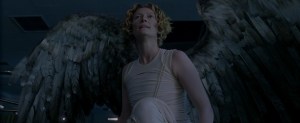 The true stars of Constantine are the memorable supporting players in this celestial smack down. Swinton uses her androgynous looks to forge what David Bowie might be like as an angel: angular, mysterious, waif, and somewhat creepy. Stormare delivers a performance so kooky and tic-heavy, that it could only be compared to the weirder moments of Christopher Walken. Both actors liven up the film and seem to be having the most fun by far with their cheeky roles.
The genius of Constantine is in its one-upsmanship game it holds with the audience. Granted, suspension of disbelief is needed to even go along for the ride, but when we start learning that Hell has its own line of bibles (and they’re longer) we’ve gone beyond suspension of disbelief and into wacky Anne-Heche-speaks-to-aliens land. While sitting through Constantine, we the audience think, “There’s no way this movie could get any sillier.” And then it does! We think, “Alright, that was crazy. Now there’s no way after that this film could get any sillier.” And then it does! Constantine is an amazing ascent into movie madness. After a while, I became drunk from the film’s insanity and wanted it to get even crazier, if possible. It almost seems like there’s a drinking contest between the movie and the audience, and Constantine isn’t afraid to piss its pants to win.
By the time Lucifer shows up, clad in all white like Tom Wolfe, and the Dark Lord appears to have Tourette’s Syndrome and/or a speech impediment, Constantine has hit the bottom of its Kool-Aid cup. Sure the film’s cinematography is slick, and the premise is intriguing, but the real draw of Constantine and the real enjoyment of the flick is how bat-shit crazy it is. I cannot even think of comparable films. I hope David Lynch was taking notes if he saw this.
For a while there, it seems director Francis Lawrence wanted Constantine to be a companion to Wesley Snipe’s Blade character. Maybe the two of them can set up a play date and go destroy otherworldly creatures. There’s a visually striking sequence late in the film involving Constantine in a room full of demons. He’s “contaminated” the water system by placing a giant cross inside, thus holy-fying the water before he can bottle it and sell it to the masses. He holds a lighter to the sprinkler system, demons growling all around him ready for their kill, and then water sprays down across the room. “Holy water?” one female demon says in a stunned voice, watching her flesh sizzle away. Then Constantine marches through the wet room blowing away demons into splashes of ash with his comically unwieldy cross-shotgun. It’s filmed wonderfully with dark hues and is a great idea; however, it’s a bit of a rip-off of the opening sequence in the first Blade.
 This seems to be a repeated sentiment in Lawrence’s direction. He has a sharp visual eye and several camera angles come from odd yet exotic places, but his film is borrowing so heavily from so many other films. What you’re left with is the impression of a stylish if very derivative looking action film. One exception is when Lawrence shows us glimpses of the blistering burnt orange world of Hell. It seems Hell is an exact model resemblance of Earth, only with the fire, brimstone, and crawling demons with their heads sliced open (there is a scary level beneath the surface where we witness a sea of people being tortured). The second or third time we traveled to Hell, I began to wonder what my house would look like and the logistics of upkeep for the homeowner in Hell. Surely the heating bills wouldn’t be the same.
Constantine is funny, frustrating, confusing, gorgeous, and just plain insane in the ole membrane. The film exhibits a rare and engaging form of insanity that may glue audience eyeballs to the screen to see what happens next. I’ve seen Constantine twice (don’t ask why) and even though I knew all the weird plot turns I still found myself getting an enjoyable contact buzz from the film. Who knows how long such a novelty can sustain itself, though. Comic book fans, especially those with a spiritual bent, should get a kick out of Constantine as will anyone else searching for a pristine example of how wonderfully out of control Hollywood moviemaking can be. Sometimes in a good way.
Nate’s Grade: B-
Share this:

Dogma (1999)
 In a time where simply having faith in anything, let alone religion, is scoffed at, Kevin Smith daringly and passionately expresses his personal search for answers and understanding. But while the zealots decree Dogma as blasphemy, what they truly miss is the biggest commercial for faith and God that American audiences have seen in decades of cinema.
The story of the religious epic causing all the hubbub begins with a pair of fallen angels (Ben Affleck and Matt Damon) spurned from the pearly gates of Heaven and banished to Wisconsin. One discovers a re-dedication of a church imploring a little used Catholic practice of plenary indulgence allowing whoever to enter through the church’s arches to have their slate cleaned of all sin. The two seize this opportunity of a dogmatic loophole to sneak back into heaven. The only slight problem is that by doing so they reverse a decree of God and disprove the Almighty’s unfallability, and thus will wipe out all of existence. The voice of God (Alan Rickman) recruits a lapsed Catholic named Bethany (Linda Fiorentino) for a Holy Crusade to halt the scheming angel’s plans for the good of the universe. Along the way she is aided by two unlikely prophets (the dynamic duo of Jay and Silent Bob), an racially discredited 13th Apostle (Chris Rock), and a shapely strip-teasing muse (Salma Hayek) as they engage with demons, seraphims, angles, and all sorts of celestial “who’s who” to stop the end of existence.
 Smith’s direction has taken strides since the point-and-click days of his earlier works; however, there’s still an awkward flatness to his framing and action. Fiorentino plays the role of a grounded character well. Rickman as the bitter Brit shows why he can still take anyone toe-to-toe for acting chops. Affleck and Damon have terrific chemistry together and play off one another for great comedy. Jason Mewes has never been funnier as the terminally stoned and foul mouthed Jay. Rock shows he can restrain his abrasive personality. Salma shows… well she shows she can dance. Jason Lee as an air conditioning-adoring demon and George Carlin as a used car salesman type Catholic Cardinal are so commanding in their presence and excellent in their performances that it’s a sin most of their scenes were cut during editing. Even Alanis Morrisette works as a humanly childish God. She’s given no lines but expresses great feeling and humor anyway.
Dogma is rambunctiously hilarious and a never ending joyride of fun as it jumps from jokes about demons made of excrement to “Buddy Christs” to insightful and sensitive thoughts on religion. Rarely does it bore even with the large plot it must always keep in successive movement. The only drawback Dogma suffers from is the amount of religious points it desires to make. The characters will reach a subject, chat, then directly move on to the next. The sporadic nature can easily keep an audience’s head spinning, but is brought back down to gentle rest from Smith’s Divine wit and sharp writing. Some of the opus’ many characters appear for only brief stretches as Hollywood’s A-list battle for valid screen time among each other.
 Smith is not one to shy away from controversy, or his quota of sexual innuendos and profanity. But the protestors for this film attacking its vulgarity are beyond missing the point; Dogma is reaching people the church hasn’t and can’t. It may be an audacious tweaker of a flick, but ultimately it’s bringing up religion into open debate and discussion amongst the masses where there was none before. And isn’t that in itself glorifying some type of achievement?
It would do well the opponents of Dogma to venture into a darkened theater sometime to see the movie and realize it is a humorous affirmation of faith and beliefs. The story of a crisis of faith is relatable to a society too jaded and cynical. Smith’s wrestle with theology is the public’s gain, and his halo only glows a little brighter for having the courage to do so.
Nate’s Grade: A-


 nathanzoebl
You must be logged in to post a comment.