Blog Archives
Silence (2016)
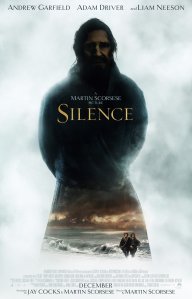 A nearly three-hour movie about Portuguese Jesuit priests facing persecution in 17th century Japan and struggling with the personal demands and costs of their faith sounds like a hard sell for your casual moviegoer. It may seem even stranger coming from the likes of director Martin Scorsese. This is a deeply personal film and perhaps the greatest movie about the nature of spiritual faith, both good and bad, I’ve seen. Two priests (Andrew Garfield, Adam Driver) sail to Japan in 1635 to find their mentor after hearing he has renounced his ties to Christianity and taken up a Japanese wife. Christianity has been outlawed and those caught practicing the religion can be turned in for 100 pieces of silver, and a priest for 300 pieces. The repression forces Christian converts to make difficult choices, especially when their refusal to recant their faith causes suffering for others. The Inquisitor (Issei Ogata) is a fascinating figure who argues that these misplaced missionaries never understood Japanese culture and that this foreign religion simply cannot flourish. The meaning of individual faith is explored beautifully with existential highs and lows. When the priests come across a village of secretly practicing Christians, it’s a powerful example of the goodness of faith, as these people are nourished body and soul, empowered. They can also finally confess their sins and garner a clean slate. However, much of the film is about the internal struggle to retain one’s faith in the seeming absence of confirmation. The priests are eventually caught and ordered to apostate, and their ongoing refusals are met with harder and harder challenges to bear. It’s an ongoing process for many people to square the concepts of a loving God and the horrors and general torment that do not merit said God’s intervention. At one point one of our priests, shaken by his experiences, asks if he is merely praying to silence. In some regard, I think the movie is about coming to terms with the fact that faith is often a relationship with a silent partner. Silence may be the greatest spiritual epic about doubt. It feels like a thriller at times and also the most Christian movie at other times. It puts the simplistic tripe starring the likes of Kirk Cameron to shame. Scorsese’s camera is unmistakably his and the movie is often dazzling to just experience. The pacing is very much a slow burn but the historical context felt increasingly intriguing for my tastes. Ogata is the real star of the movie, embellishing his antagonist with a magnetic power. Every time he was off screen I wished for his return. Silence is not going to be a movie for everyone or for many. It’s too long and airless, but it’s a deeply serious, deeply meditative, and deeply searching film about the power of belief and the price we pay to hold on.
Nate’s Grade: B+
Share this:

Kirk Cameron’s Saving Christmas (2014)
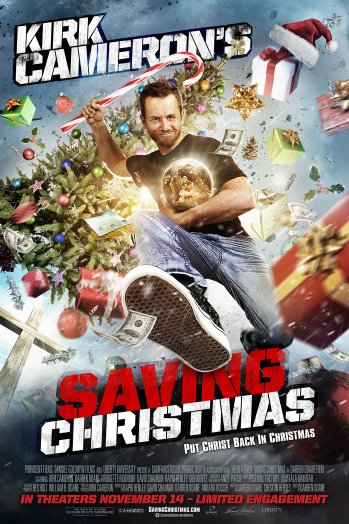
Given the title, Kirk Cameron’s prominent placement, and a poster involving Cameron with a background explosion of holiday paraphernalia, one would assume Saving Christmas would concern itself with the oft-repeated “War on Christmas.” I was expecting Cameron to lament our use of “Happy Holidays” and the like. Perplexingly, Cameron’s war is not with those outside Christianity but those within. Saving Christmas is a shoddy evangelical sermon with shoddier theology, straining to fill out a running time, and ultimately being pro-materialism and anti-empathy. Come again?
At Kirk’s (Cameron) family Christmas party, his brother-in-law Christian (Darren Doane) is a Grinch. He complains that Christmas has been co-opted by secularism. Santa Claus and other symbols with pagan origins dwarf the nativity and baby Jesus. Christian removes himself from the party and sits in his car. Kirk won’t allow this to stand. He gets inside the car and proceeds to explain why Christian is wrong about Christmas.
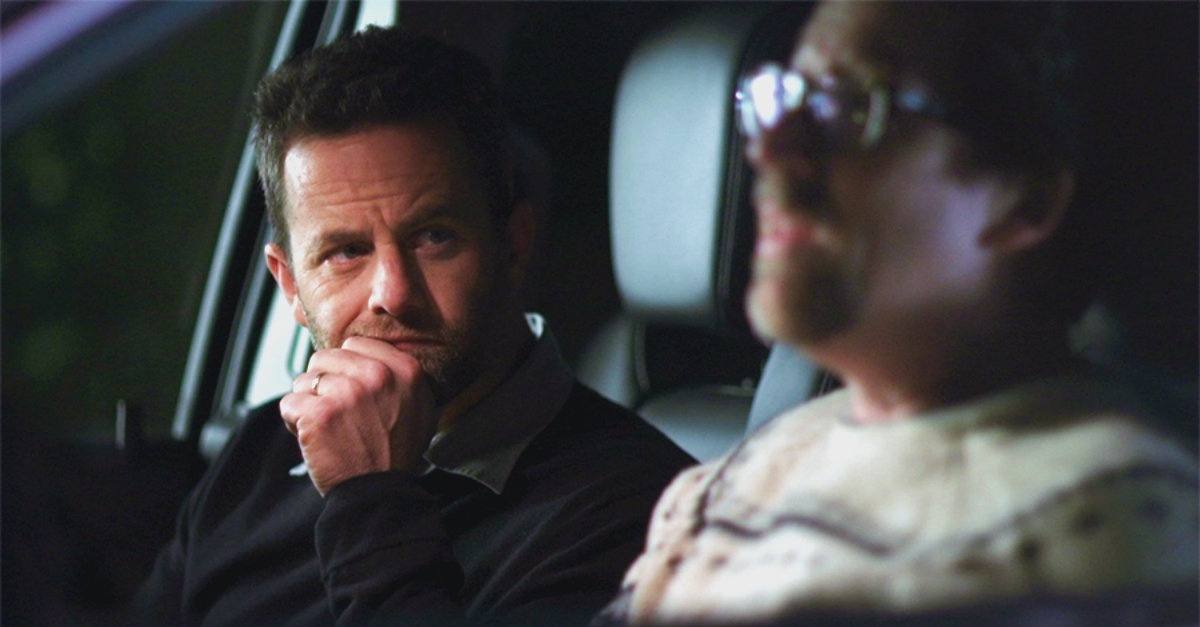
To call this a film is to be more charitable than perhaps even Jesus would be. Saving Christmas (or Kirk Cameron’s Saving Christmas as listed in certain places) is a smug sermon presented by Kirk Cameron lecturing his “bro”-in-law in a car. The majority of the film takes place in a parked car. If that sounds deeply cinematic to you, then stick with me. The film shambles its way to 80-minutes, exasperating to fill out a minimum feature-length running time. There’s about ten minutes of “hilarious” bloopers. There’s a five-minute opening where Cameron speaks directly into the camera and sips from his mug of hot chocolate three separate times. There’s a five-minute, though it feels tortuously endless, “hip hop Christmas dance” performance by a bunch of white people (it is powerfully uncoordinated, like you’re watching someone’s home movie of their kids). You do get to watch Cameron effectively do the Worm, though (his finest acting moment onscreen, in my humble opinion). There’s also the occasional, very tin-eared comedy break with supporting characters that skirt the line into stereotypes. When it all comes together, there’s maybe a total of 40 minutes of an actual movie here, laboriously stretched out. And when I say “movie” I mean Cameron and Christian talking back and forth in a stationary car. This is not a movie. At all.
Director and co-writer Doane is one of the most inept filmmakers I’ve observed. This is a horrible looking movie with many clueless edits and strange visual compositions. His onscreen wife is always seen looking wary and in slow motion, like her face has frozen. There’s also the annoying habit of not properly framing his subjects, who will get caught behind a pot of hot chocolate or some poinsettias. This is just bad filmmaking. The lighting is amateurish or overdone, like when Kirk spends about five minutes standing back-lit, as to communicate his inherently angelic nature. Doane will also keep focusing on repeating scenes like he’s filling time. The film has a very rushed and patched-together feel, as if they had a weekend to film it at Cameron’s place with his friends and family. The “comedy relief” is also terribly executed, with two characters having a conversation holding mugs to their face, the better to disguise the fact that one of them is not actually speaking his lines. The pacing is also dead. The movie keeps faking you out when it’s going to end but then continues on, overstaying its welcome so Cameron can have yet another victory lap to hear himself talk.
Cameron and his producers seem to subscribe to an all-or-nothing approach when it comes to recognizing the malleable symbolism of cultural artifacts. Is there any harm in acknowledging the past connections of certain ceremonial customs and artifacts we use today? While the origins of the Christmas tree can go back to the pagans, Cameron seems to forget to mention that it was Martin Luther who took the Christmas tree as a German holiday tradition and gave it a Christian spin. Of course acknowledging such would indicate that the Christmas tree wasn’t always the same symbol. But who cares? History is a melting pot as far as cultures are concerned, and we pick up many customs that become passed down for various reasons, often expanding and adapting. Is there any implicit harm in simply admitting that a Christmas tree has an origin that predates Christianity? Today it is a different symbol commemorating a different holiday. Just because we know history doesn’t somehow devalue our customs and traditions. Cameron and his cronies seem to disagree, which is why he presents flimsy arguments to reclaim historical authority. What he’s really doing is treating the symbols of the season as metaphors, applying deeper meaning to them. That’s fine and good. If Cameron wants to see the Christmas tree as a representation of the cross, or the trees of the Garden of Eden, that’s fine. But he shouldn’t pretend that this interpretation is gospel. That’s the thing about metaphors; they’re subjective and pliable. They are not absolute.
Amazingly, Saving Christmas ends up becoming a misguided and ludicrous defense of materialism and the commercialism attached to Christmas. In Cameron’s very narrow perspective, anything associated with the holiday has to be positive. Yes, Cameron literally argues that all the material excess and spending actually honors God. Instead of looking at the presents under the tree as just that, look at them as the outline of a skyline of a new Jerusalem, Cameron offers in one of the more head-scratching moments. He conflates the spending of money with celebration, admonishing people to buy “the biggest ham, the richest butter” as long as they just don’t “max out their credit cards.” That’s the limit he sets, so everything below that must be agreeable. Just to hammer the message home further, Cameron says that materialism is good because “Christ was made material.” That sure is a slippery slope of ethics there. It’s not much of a leap to then justify greed or to equate spending the most money with being the godliest. Why would any film, let alone a Christian one, choose to defend unchecked materialism?

I know Christian is more a foil for Cameron to helpfully inform, a straw man who cannot articulate his intellectual rationale, but Christian is the worst skeptic of all time. If he truly believed what he does then he should be able to provide evidence to support his stance. It wouldn’t be hard. The historical record is loaded with stuff ready-made to counter-argue Kirk’s cherry picking of relevant theology. The very concept of late December existing as a pagan holiday celebrating the winter solstice (Saturnalia) is backed up by a treasure-trove of sources, despite Cameron’s snide rejoinder that “last time I checked, God created the winter solstice.” The Romans would even exchange gifts on December 23 in celebration and feast. If Christian were a real skeptic, he’d at least have a cursory knowledge of this stuff before even approaching specifics. Instead he sputters and is proven to be a fraud, duped into believing these anti-Christmas thoughts. Every time Kirk finishes another of his rather unconvincing asides, Christian shakes his head, dumbfounded, and says he never looked at things like that. He is the most easily converted skeptic since the Spanish Inquisition.
I kept going back in my head to a vital point of Christian’s that is never referenced or challenged by Cameron: wouldn’t all this money better be spent helping the disadvantaged? Christian looks at the extravagant money spent on an ostentatious party and thinks of how many people could have been fed, how many wells could have been dug in villages. “You’re wrong,” Kirk says. “About everything. You’ve drunk the Kool-Aid.” Even as Cameron bends over backwards to defend materialism, he never addresses Christian’s fundamental point, which is that the money can be better spent elsewhere. To the movie’s worldview, Christian is a “jerk” and he’s “terrorizing” (I kid you not, they specifically use the word “terrorize”) his family with his negativity. This is a guy who wants to put the “Christ back in Christmas” and he’s setup as the bad guy. He’s not storming the party, aggressively challenging people, calling them names. He sits to himself, eventually leaving the space for his car. It doesn’t sound like he’s terrorizing anyone and is rather considerate of others. No matter, no one is allowed to have a different opinion than Kirk Cameron and so he will not allow one man’s empathy to bring everyone else down as they spend lavishly to celebrate the birth of a poor carpenter.
And that’s what’s most distressing for me when it comes to this poorly made and poorly reasoned movie; I’m concerned that others will use Cameron’s distorted teaching as a justification for excess over empathy. Cameron seems to use the film as a defense of his affluent privilege. He uses the Bible to back up his lifestyle and to defend materialism. Did we forget that part where Jesus said to sell all your possessions and help the poor? The film is packaged as a comedy and a family movie with a spiritually uplifting message, but what’s so uplifting about saying “SPEND SPEND SPEND” is how you show love? Just because Cameron says a nutcracker is representative of King Herod’s foot soldiers prowling Jerusalem for the baby Jesus doesn’t make it strictly so. To call this a movie would be too charitable and I am not in the season of giving. Saving Christmas is a lump of coal disguised as a open-hearted message. Skip this movie and donate your money instead to some charity. At least that will do some actual good.
Nate’s Grade: D
Share this:

Philomena (2013)
 A more family-friendly alternative to the wrenching The Magdalene Sisters, the drama Philomena is ostensibly a good movie, but woe unto thee if you thought you were in store for a crackling comedy. Philomena Lee (Judi Dench) was forced to work in a Catholic workhouse in Ireland when she became pregnant as an unwed teenager. Her child was placed into adoption into America and now, 50 years later, she wants to find her long-lost son and learn about him and his life. Helping her in her quest is Martin Sixsmith (Steve Coogan, co-writer as well), a recently unemployed journalist. Their odd couple pairing should inspire comedic repartee, as so the ads would also have you believe. The film is funny, in spurts, but it’s much more effective as an illuminating drama on the abuses of the church-run workhouses that guilted poor girls into, sometimes lifelong, slave labor. At the thirty-minute mark, when Martin comes across a makeshift graveyard of dead teen mothers, who were forced to give birth on the workhouse premises as punishment for their sins, you can pretty much abandon any hope of a ribald road trip comedy. Once your expectations are realigned, you can enjoy the film for what is has to offer: an intriguing mystery, solid characterizations, a terrific Dench performance, and an ending that doesn’t pull punches. Be warned, you will walk away from this movie wanting to punch nuns in the face. Coogan’s role is one of anger and outrage, and there’s plenty to go around with church corruption, scandals, and cover-ups uncovered. But it’s Philomena herself who is the life lesson for us all; her church fails her but her forgiveness is the model we should all strive for. It’s a moving film with as much compassion as it has criticism. Just don’t watch it in the company of a nun.
Nate’s Grade: B+
Share this:

Paradise (2013)
 You’re courting irony when you name your movie Paradise, as well as pained movie critic puns, but I had faith that Diablo Cody, stepping into the director’s chair for the first time, would entertain, especially after her best screenplay yet, 2011’s Young Adult. The problem with Paradise is that it goes just about nowhere and it’s shockingly bland, a criticism I never thought I’d have for a Cody-penned work. The premise starts off strong, with Lamb (Julianne Hough) as a devout Christian living a sheltered existence until the day she becomes the sole survivor of a plane crash. Her body covered in burns, her faith shaken to its core, she embarks on journey to Las Vegas to sin it up big time. It’s snarky and satirical, and then she gets to Vegas, she meets some nice new pals (Russel Brand, Octavia Spencer), and they hang out and… that’s about it. The Lamb character is meant to be a naïve but ultimately nice person, but she’s portrayed as vaguely racist thanks to Cody’s simple skewering of fundamentalism. Where are the sharp characters and incisive wit of Cody’s past efforts? The comedy almost dissolves as it goes and you realize that intriguing premise is never going to be realized. And then the third act happens and it feels like the film just gives up, unearned sentimentality takes control, and the characters all find unsatisfying conclusions. The characters aren’t given enough material, often left adrift in a plot-free environment of self-discovery. A misguided scene where Lamb pours her heart out to a former prostitute could work as a summary of what tonally doesn’t work with this movie. There are some funny moments, even some affecting ones, but Paradise doesn’t feel like it has a sophisticated voice and clear direction. Coming from Cody, I wouldn’t have expected those two chief complaints.
Nate’s Grade: C
Share this:

The Master (2012)
 Writer/director Paul Thomas Anderson met with great resistance when he was shopping his script around for The Master. It was dubbed the “Scientology movie” and reportedly based upon the controversial religion and its leader, L. Ron Hubbard. It looked like Hollywood was spooked by the prospect of a movie that appeared to take on Scientology. Eventually Anderson got his financing and made the movie he wanted to make. Calling it the “Scientology movie” is misleading. I wish The Master was a Scientology expose because that would be far more interesting than the exasperating film I got, which is one nutty guy who dabbled in a Scientology-like cult. Maybe the resistance Anderson experienced wasn’t an indication of the subject matter. Perhaps it was only an indication that The Master just wasn’t a compelling story, a charge I can agree with wholeheartedly after viewing this disappointing film.
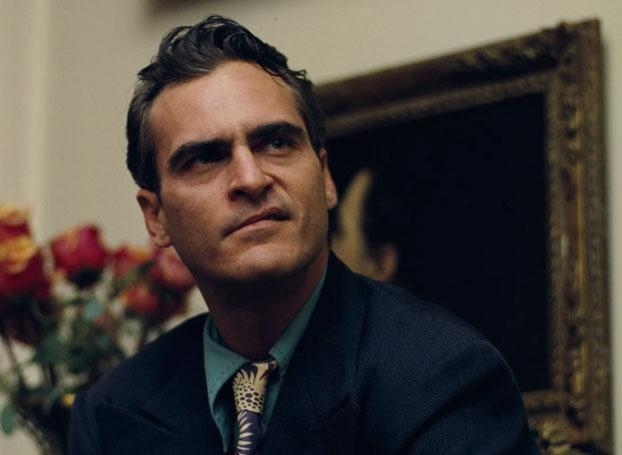
Freddie Quells (Joaquin Phoenix) is struggling to adjust to life after World War II. Fresh out of the Navy, he works as a department store photographer, until his rage and social awkwardness lead to him being fired. He’s drifting about and hops onto a ferry leaving town. Onboard is Lancaster Dodd (Phillip Seymour Hoffman) who describes himself as “a writer, a doctor, a nuclear physicist, a theoretical philosopher, but above all, a man.” Dodd has gathered a revered following. He believes that people can regress to past lives trillions, yes you read that right, of years into the past. Dodd’s own children admit that dear old dad is “making it up as he goes along.” His movement, known as The Cause, has been called a cult by detractors, the will of one man, and the followers don’t take kindly to challenges from the outside. Dodd adopts Freddie as a project. He’s on the verge of completing his second major treatise and Freddie seems to be an inspiration for him. Freddie finds some measure of acceptance within Dodd’s community of followers, but his erratic behavior keeps people on constant edge.
I found The Master to be boring; uncompromisingly boring, hopelessly boring, but worse than all that, pointlessly boring. Was this really a story that needed to be told? I cannot fathom why Anderson chose to tell this story or, in particular, why he chose to tell it through the character of Freddie Quell. A story about a huckster exploiting people with a religion he made up is a fascinating story with or without the Scientology/L. Ron Hubbard connections. That’s a story worthy of being made. Now, instead of this, we have two hours of a guy acting nuts. I would better be able to stomach the Freddie character if I felt like anything of significance was happening to him. He’s a broken man, clearly mentally ill in some capacity, and prone to outbursts that turn violent. Does he change? Does he grow? Does he do anything? Does his life have anything of significance happen to him over the course of 137 minutes? Not really. He’s pretty much the same guy from start to finish; his arc is essentially that he’s crazy at the start, meets Dodd, and then is crazy at the end. We get it, the guy is messed up. He makes a drink out of paint thinner for crying out loud. I didn’t care about him at all. I don’t need to see static scene after static scene of this guy acting out. I wasn’t a There Will Be Blood fan but at least Daniel Plainview was a strong central character with enough dimensions to carry a film. Freddie Quell just isn’t that interesting or entertaining. He’s actually a tiresome character because you get a perfect sense of who he is in just 10 minutes. The rest of the movie just seems to remind you what you already know.
 It is a disappointing realization but I feel like the Paul Thomas Anderson I enjoyed is slipping away, as his flashy, propulsive, plot-heavy early work has given way to opaque, reserved, and plotless movies. It’s like I just watched someone with the verve of Martin Scorsese transform into a poetic film somnambulist like Terrence Malick; not a good move. I don’t know what Anderson’s message is or what he was trying to say, and I’m unsure why he decided to use a limited character like Freddy Quells as his prism. It almost feels like Anderson is compensating for his plot-driven films of his early career, like he has to balance the scales in his mind. I shudder where this recompense might take Anderson for his next film. I like to think of myself as an intelligent moviegoer who enjoys being challenged by movies. But that doesn’t mean I’ll accept anything challenging as quality. Case in point: Jean-Luc Godard’s Film Socialism, which was contemptuous of its audience. I don’t mind doing work but you have to give me a reason. There has to be a reward, either with the narrative or with the characters. I found no rewards with The Master and it’s not because I didn’t “get it,” film snobs, it’s because the movie was too opaque to say anything of substance beyond simplistic observations about the abuse of power and influence.
When I say plotless I don’t mean that we’re simply watching paint dry, though there are stretches of The Master where I would feel that could be a suitable test from Dodd. There are events. There are scenes. There are changing relationships. It’s just that none of this seems to matter, or at least it never feels like it does. There’s no build, no increase in urgency, and The Master just sort of drifts along to the detached rhythms of Freddie. The movie can feel interminable, and you may ask yourself, on a loop, “Is this going anywhere?” There are two scenes that stand out because there are so few that seem to matter. One is shortly after Dodd and Freddie have been arrested. The two men are locked in opposing cells and they explode in venomous anger. It feels like Anderson can finally allow his characters to vent out what they’ve truly been feeling. Another memorable scene, just for weirdness, is when we jump inside Freddie’s head. All the women, young and old, at a social gathering suddenly lose their clothing (think: Choke). It’s one of the best scenes at exploring Freddie’s sexual compulsions, plus it’s just peculiar. I wanted more scenes like this where we try and get inside the man’s mind. The rest of the characters are underwritten, especially Amy Adams (Trouble with the Curve) as Dodd’s wife and fierce protector. This is a movie about two strong-willed men and everybody else gets relegated to minimal supporting positions. I miss the sprawling humanism of Boogie Nights and Magnolia.
From a technical standpoint, the movie is very accomplished. The 1950s era setting is lushly recreated, aided by cinematography that seems to present this bygone age in a colorless manner. By this I mean that the world feels muted, repressed, the colors are there but they don’t pop, and I think this look fits the movie marvelously. Anderson shot the film in 70mm, which would offer startling detail to his images. I did not see the film projected this way (as will most) but you could sense the time and effort put into getting the details of his world right. The musical score by Johnny Greenwood is minimalist but effective, with a few key strokes of a guitar to note rising tension.
 The true draw of the film is the performances, which are excellent and at least provide a reason for staying awake. This is Phoenix’s first role since his two-year performance stunt documented in I’m Still Here. It feels like his off-putting, confrontational, bizarre antics for that faux documentary were all just training for playing the character of Freddie. The man has sad, droopy eyes, a fixed sneer that denotes his permanent displeasure and cocksure attitude. He speaks in mumbled sentences, he walks with his arms pinned out, donning the posture and behavior of a chicken. It’s at once an odd and striking performance, and Phoenix does his best to make the character worthy of your attention. He gives it his all, but sadly Freddie just doesn’t merit prominence. Hoffman (Moneyball) is equally alluring as the charming huckster who seems to come alive under a spotlight; the man exudes an oily presence, and yet there are a handful of moments where he lashes out, venting the roiling anger that seems to be barely contained at times. Hoffman’s performance is one of willful self-delusion rather than rampant self-destruction, which makes him far more compelling in my opinion. I would have preferred a Lancaster Dodd movie rather than a Freddie Quells movie.
The Master is a confounding, airless, opaque character study that is far from masterful. The faults of the film and its stilted ambitions lay squarely at the feet of its flawed central character, Freddie Quell. The movie adopts Freddie’s demeanor, managing a distant, standoffish, defiant attitude that thumbs its nose at audience demands. Don’t you know entertainment has no place in art, silly filmgoers?
Anderson is still a vastly talented filmmaker but I lament the path his career has taken. I adored the first four movies of Anderson’s career, but now I wonder if I’ll ever get something along the likes of Boogie Nights or even Punch-Drunk Love again. At this point Anderson has earned enough artistic latitude to tell whatever stories he so chooses. This is why my frustration has mounted because I am at a loss to why he feels compelled to tell this story and in this manner. The Master is an artistically stillborn affair. You want to believe there’s more under the surface but I don’t see it. The main ideas and themes are hammered with little variation, the slight plot drifts aimlessly finding no sense of momentum, and the characters are kept at such distance that the film feels clinical, like we’re observing creatures under glass for study. It just so happens that none of these characters warrant the attention. The Master will be praised by a plethora of film critics. Peter Travers of Rolling Stone said it renews your faith in American cinema. I had the opposite reaction. The Master made me lose faith, mainly that I’ll ever enjoy a Paul Thomas Anderson film from this point on.
Nate’s Grade: C
Share this:

Courageous (2011)
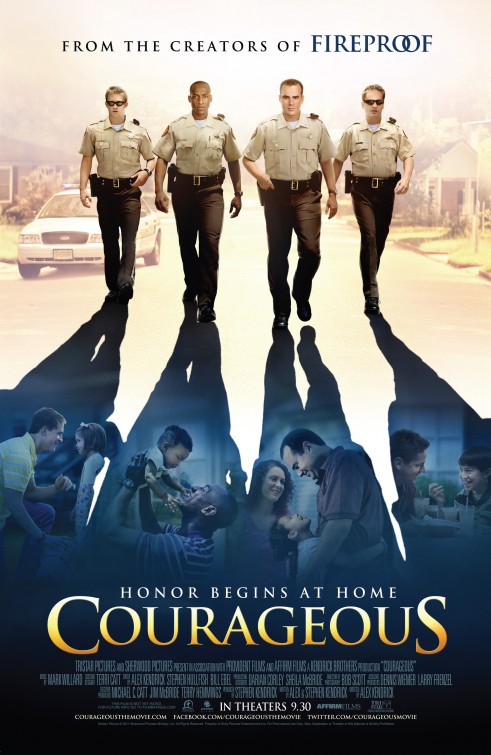 Last fall, Courageous opened to sellout crowds, but unless you or your family is plugged in to Christian media, you probably missed it (you know a movie’s got to be good when it has a quote from former football coach Tony Dungy). This is the latest film from the Kendrick brothers, a pair of pastors that started their own production company and have been making low-budget Christian-themed dramas that score big profits. What they really create, in my estimation, are two-hour film components to go along with a ready-made Bible study/lesson package (and you bet you can purchase your own Courageous companion book). As you’d expect, from an objective standpoint, these films, intended for a select audience of the converted, aren’t paragons of film artistry. And the Kendrick brothers’ last movie, 2008’s Kirk Cameron vehicle Fireproof, was awful on just about every level of filmmaking. Courageous is a better film on every front, but “better” and “good” are not interchangeable descriptions.
In the small town of Albany, Georgia, a group of police officers have al come to a personal crossroads concerning fatherhood. Adam (Alex Kendrick, director and co-writer) has recently lost his 11-year-old daughter in a tragic car accident. Nathan (Ken Bevel) is trying to come to terms to forgive the absent father he never knew. He also has to protect his teen daughter from going out with a young boy who happens to be part of a gang. David (Ben Davies) is the rookie in the group with a shameful secret of his own, namely that he has a small daughter he abandoned with her mother. Javier (Robert Amaya) is struggling to find a stable job to support his wife and children. His wife fears they’ll have no choice but to go back to their home country. Shane (Kevin Downes) is feeling the pressures of the job as well and making bad decisions that will catch up with him. The five gentlemen decide to make a public pledge and sign a written contract promising to be involved, loving, and responsible fathers for their families. But saying it and doing it is another matter.
 As with most of the Christian-funded film efforts, the movie is secondary to the message. Unlike Fireproof, the filmmakers package their wholesome message in a far more easily digestible package. There are moments in the movie that work really well and ring true, mostly the struggle of overcoming grief at the loss of a child. Adam is told that losing a child has been compared to losing a limb (look out if you lose a limb and a child). It’s not going to give Rabbit Hole a run for its money as far as psychological implications, but there are glimpses that feel like genuine and powerful drama. Whether Adam performing a dance with the memory of his deceased daughter is corny or emotional is up to you. Unfortunately, given the scatter-shot nature of the story, these moments only stay as moments, fleeting in their impact. But I was wholly surprised to even have anything genuine after the ridiculousness of Fireproof. Kendrick has improved as a filmmaker and his grasp on characterization is sharper; there are some nice moments of wry humor like when Adam keeps accidentally telling his chief he “loves him” (those declarations were intended for his wife on the other phone line). There’s an amusing bit akin to a “who’s on first?” routine as Adam mistakenly thinks Javier is another Javier he hired for some construction work. The struggle of an immigrant family hovering above the poverty line is a welcome storyline to a pretty middle-class point of view that dominates the story. I don’t know if the Javier character completely works in the context of this story, but he’s an amiable presence as he becomes an adopted member into the boys’ club. The opening even has a rather exciting flash of action with Nathan holding onto his carjacker from outside the speeding vehicle. There’s a foot chase that is crisply edited and filmed with a bit more flair than is normally accustomed to with these movies. It’s something of a small miracle that Courageous seems to exist in a modestly recognizable universe.
While being easily the best movie yet to bear the Kendrick name, Courageous still has enough faults to limit its execution, likely only reaching those already converted to its Christian values. Subtlety is rarely a tactic employed in Kendrick’s wheelhouse. As a result, everything can become rather ham-handed and message-laden. There are far too many different elements that just don’t jibe together to form a cohesive whole; the movie feels like a series of anecdotes that occasionally collide together. The narrative is stuffed with the death of a child, the struggle of immigrant workers to find a foothold, parental abandonment and reconciliation, gang recruitment, and police corruption (if you’re going to steal drugs from the evidence room, at least replace the weight value). They could have easily lost one of these guys from the plot, particularly the corrupt cop. There’s too much going on for real narrative momentum to get going. Structurally, most of the movies conflicts are resolved before we even get into the meat of Act Three, leaving the movie to finish with a hasty shootout with gang members that feels arbitrary. I suppose the Kendrick brothers might argue that the gang members represent the tragic results of boys raised without strong paternal role models, but that’s a rather simplified implication. And why does no one indignantly reject the idea that the death of a little girl was meant to prosper greater goodness in the world? I would imagine a grieving parent, no matter their closeness with God, would feel some modicum of anger at the idea that their daughter needed to die for them to be a better person. Kendrick is not nearly a strong enough actor to sell the various ups and down his lead character endures.
But the biggest problem I have with the movie is that it posits that “Christian values” and “ethics” are synonymous. I have no beef with any religious belief that people rely upon to choose to be better, more caring, conscientious, and active people. However, I bristle with the notion that ONLY religion can give people the tools to achieve these ethical realizations. The group of characters sits around a barbeque and talk about religion, parenting, their own negligent fathers, but they present religion, and specifically Christianity, as the only solution to being a better person. I would argue that mankind can realize moral good and hold to a code ethics without the direct tutelage of Christianity. If this was the case, would this logical argument not suggest that portions of the world that favor other religions are wayward in any sense of moral reasoning and value? What about before Christianity came into being, all that B.C. part of the timeline? Surely Jews would kvetch that they didn’t need Christianity to adhere to a moral order.
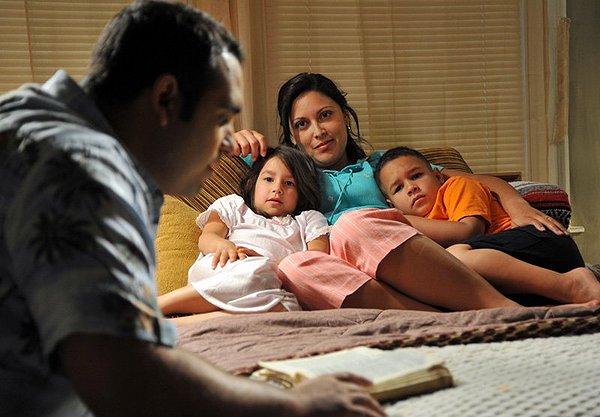 The movie’s patriarchal insistence that men are the only guardians of their family seems ignorant. The women presented in Courageous are pretty much the doting types who wrap their arms around their husbands and remind them what good Godly men that are. The movie puts all the pressure onto the men, somehow missing the point that women can and should be a contributing force when it comes to rearing a family. While the Kendricks have plenty of statistics at hand about the significance of a father, the movie tacitly paints a portrait that a family is doomed when it falls under the complete stewardship of a mother. I’m not going to rip open a feminist rant because I don’t find anything in Courageous to be insidious or malicious, though its depiction of black gang members seems a bit sketchy. I just think the overemphasis on spurring men into taking responsibility doesn’t need to be at the expense of women giving up something. Parenting should be a shared responsibility and not something tagged to whomever holds the title of head of household. And as presented, the movie gives the fathers questionable levels of control. Nathan takes his teen daughter out to a fancy restaurant where he presents her with a fancy ring as a gift in exchange for dad being granted veto-power when it comes to potential boyfriends with no expiration date. I understand it’s meant as a father caring for his daughter, but buying her a ring to celebrate her chastity seems incredibly creepy.
Courageous is an improved effort from the Kendrick brothers and their Sherwood Pictures production house. The movies may improve but they still remain subservient to a message, and the ticket-buyers who look forward to a positive affirmation of that message have fewer demands when it comes to characters, plot, direction, etc. The core audience has a high demand when it comes to spirituality, but I wish they had just as high demands for artistic quality. Why can’t the faithful find inspiration from a movie that isn’t so on-the-nose? Are my only choices when it comes to depictions of spirituality the bludgeoning type (Fireproof, Left Behind, anything with Kirk Cameron really) or the esoteric (The Tree of Life)? Good intentions can only get you so far, and while its core message that men need to be responsible and step it up when it comes to parenting is valid, the rest of the movie jangles with some questionable representations and moral simplification. If people feel truly inspired by these movies to better themselves, then that’s a commendable effect but it doesn’t make the movie any better. At one point a character says that his father was “good enough.” Adam responds, “Well, I don’t want to be just a ‘good enough’ father.” Well, to many Courageous will be a “good enough” Christian drama. To me, mediocrity knows no one faith.
Nate’s Grade: C+
Share this:

Red State (2011)
 Kevin Smith, love him or hate him, you can’t deny the man is a natural promoter. Earlier in the year, the indie filmmaker self-distributed his first foray into horror films, Red State, on a nationwide tour of screenings. I first saw Red State way back in March when Smith visited Springfield, Ohio to screen the film and then answer questions afterwards. I’ve been trying to wrestle with my critical opinion in the ensuing months. Fortunately for me, Smith has made it extremely easy to revisit my thoughts. Red State eschewed the traditional theatrical release pattern for a new digital-age model. It was available on demand through cable systems, available for download, and even broadcast in special theaters for a one-night only event. A month later the film hit DVD. In its better moments, Red State is the unholy union of Quentin Tarantino’s love of language, and penchant for jolting violence, and the Coen brothers’ nihilistic, cock-eyed sensibilities. This is strange new territory for the man. I wish I could say Red State is worthy of all the attention, though this sinister, messy, gritty little movie can work its wicked mojo, at least for a while.
The Five Points Church is a notorious family-operated cult. Under the guidance of their shepherd, Abin Cooper (Michael Parks), this fundamentalist Christian group pickets the funerals of dead soldiers, haranguing the grieved that their loved ones are dead because “God hates fags” (excuse me for failing to put two and two together). A group of teenage boys (Michael Angarano, Kyle Gallner, Nicholas Braun) is lured to Sara’s (Melissa Leo) trailer with the promise of sex. The middle-aged woman plies her young bucks with drinks and they are knocked out. The boys awaken to find they are inside the Five Points compound and witness to Abin Cooper’s solution to sinners. Rather than railing with signs, the family has decided to take a more hands-on approach and execute them. While this is going on, a sheriff’s deputy alerts the authorities and the ATF rolls up to the compound. Lead by Agent Keenan (John Goodman), the government agency engages in a firefight with the rightwing cult. Ordered to take down the compound, and all witnesses, the various characters will try and escape with their lives, never knowing when that fateful moment of atonement may drop.
 What Smith does well for a genre novice is to keep his audience constantly upended. Just when we think we’ve settled on a protagonist and a plotline, suddenly Smith switches gears. The surprises are sudden and often merciless, leaving the audience little room to adjust. In a genre usually beholden to formula, the consistency of Smith’s surprises makes for a darkly satisfying viewing. Watching Red State demands due attention. Naturally, not all of these tonal shifts work to the movie’s best interest. The final shift, to all-out action thriller, is the most leaden. The Ruby Ridge/Waco-style standoff allows for a lot of gunfire but very little action. We mostly just cut back and forth between the two sides firing and, inexplicably high numbers, being shot in the face. It can get repetitive and seem like all the mounting tension gets squandered. There is a nice storyline within of one family member, Cheyenne (Kerry Bische), forming a plan to save the compound’s children and escape. Bische (the lead on the last season of TV’s Scrubs) makes fantastic use of her limited screen time to render the anxiety and fear of her character. She’s second only to Parks in the performance department as far as I’m concerned. Then the climax comes along and Smith teases being audacious, going in a fire-and-brimstone angle that would completely obliterate audience expectations. And just when it seems like we’re about to get something radical… Smith falls back to what he knows – dialogue. For the final five minutes, Smith concludes his narrative with two government officials explaining what happened in florid detail. It’s a fairly big letdown.
The setup of luring teens to their doom is an old horror staple, though usually the ones doing the sacrifices are card-carrying Satanists. And when exactly would a Satanist be in a situation needing to prove their validity with a membership card (“I’m sorry Mr. Darkseed, but we can’t give you the ten percent discount on all those goat skulls unless we see some valid photo ID.”)? Smith flips the switch religious allegiance. Instead of Satanists or some other misunderstood fringe religion, the cult is a group of pious Christians. There’s plenty of room to work here and Smith refrains from making easy associations; the Five Points nutjobs aren’t meant to represent Christians as a whole or Christianity. They are extremists, and they will go to extreme measures. Ostensibly based upon the Westboro Baptist Church and Fred Phelps, you keep waiting for Smith to satirically carve up the clan, but this never really occurs beyond the superficial. Smith’s writerly instincts give Abin Cooper a ten-minute sermon/platform where the guy just unloads a hate-filled diatribe against homosexuals and progressives. For many, this will be the make it or break it point of the film. There are some genuinely tense moments to the first half of Red State. There’s one scene where the camera holds on Gallner (The Haunting in Connecticut) inside a wired cage. He rattles and screams and generally comes unglued, and we too piece together what he hears, dreading what is to come. The many escapes and narrow calls are also harrowing and finely edited to ratchet up suspense.
 It seems, though, that Smith’s bleak screenplay does not present any characters we can truly root for. Horror has been shifting this way for the past twenty years. Thanks to the rise of the slasher flick, audience empathy has shifted from being with the running/screaming victims to being with the gruesome yet personable killers. Red State has a high body count but you won’t feel much when those bodies hit the floor. You’ll feel a jolt of shock, but from an empathy standpoint the needle barely registers. Sure, we don’t want people to be tortured and we want the abused to escape torment, but that’s not the same as characterization. The closeted sheriff (Stephen Root) feels like the start of an idea more than anything else. The trio of teen boys is presented with as little care as any other throwaway slasher flick. They are but meat for the grinder, our entryway into this hidden and spooky fundamental world. These aren’t so much characters as bodies waiting to be slain. The people are set up so they can be knocked down. This issue can become troubling when Smith wants us to rethink our loyalties, especially once the siege has begun. He wants us, dares us, to start feeling empathy for members of the Five Points Church. The problem is that the plot’s adherence to shock value and the underbelly of human nature has desensitized our empathy. When the ATF starts firing most in the audience will probably just cheer, not reflectively question the moral relativism. I doubt anyone will be switching allegiances midway through.
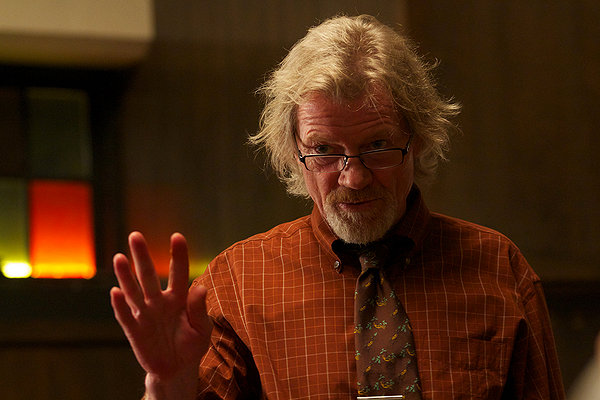
Cults are usually held together with a charismatic leader, and Red State has that in spades with Parks. The man just dissolves into his twisted character, a preacher that uses the Word of God to indoctrinate and arm for his own holy war. Parks has done fine supporting work before in the stable of Tarantino and Robert Rodriguez movies, but Red State is the actor’s biggest modern showcase yet. The man makes your skin crawl the way he can wrap hate into a honeyed, easily digestible product. Abin holds sway over his flock and likewise Parks commands the screen. He provides grandeur and menace to Smith’s words. It’s not a scenery-chewing performance; Parks doesn’t go for the obvious notes when he can hit something deeper and more unsettling. You get a sense that this man fully believes the dogma he teaches, and that makes him all the more terrifying. The other actors peopling Red State are fine, though Leo (Oscar-winner for The Fighter) seems a bit unrestrained especially in contrast with Parks. Goodman (TV’s Treme) gets to talk on the phone a lot to his unseen superiors. The end of the film just descends into frenzied yelling on everyone’s part.
Credited as a horror movie, though I view it more of a survivalist thriller but I suppose genre specifications are subjective, regardless, Red State is miles away from Smith’s usual output. The movie has its share of creeping dread and menace, thanks to Parks’ transfixing performance. The screenplay is unrepentantly dark, cruelly cutting down lives with shocking acuity. The constant surprises and upheavals are a way to keep the audience guessing, though the shock value starts to wear off by the noisy, repetitive gun battle climax. It’s hard to nail down exactly what kind of commentary Smith is presenting. Obviously he doesn’t side with the hateful fundamentalists (this is probably why he pulls back at the end), but he also shows the government’s reaction to religious zealots to be morally queasy at best. It’s hard to get a read what the commentary is, and with horror, if you don’t take a stab at commentary then you’re just watching high-gloss snuff films. Red State resembles a snuff film in several ways and not just in its grimy aesthetics. You feel a little dirty after it’s over, and you can’t help but question your motives for watching it. Plus you can’t help but think it could have been better done (note: I have never watched an actual snuff film, you sickos, but the point remains).
Nate’s Grade: B-
Share this:

A Serious Man (2009)
 The Coen brothers, Joel and Ethan, have been making stupendous movies for three decades, but they have never really gone too introspective. Usually their movies follow quirky characters making poor decisions and getting in too deep in a cruel world. A Serious Man is the first Coen film that feels personal. Set in the same landscape of the Coen’s own upbringing, 1960s Minnesota, A Serious Man gives a few insights into how these two remarkable men became who the filmmaking geniuses they are today. But if that isn’t enough for film fans, the movie is also hilarious and brilliant.
It’s 1967 in suburban Minneapolis. Larry Gopnik (Michael Stuhlbarg) is a meek physics professor up for tenure. Larry is beset at all sides, from his redneck neighbor encroaching on his land, to being bribed by a Korean student unhappy with his grade, to the news that his wife, Judith (Sari Lennick) is leaving him for his colleague, the more dignified Sy Ableman (Fred Melamed). Sy suggests that the best course of action is for Larry to move out to a hotel: “The Jolly Roger is eminently habitable.” The tenure board is having second thoughts because of anonymous letters, Larry’s daughter is stealing money from his wallet for a nose job, his son spends more time getting high than practicing for his bar mitzvah, and Larry’s unemployed, socially awkward brother (Richard Kind) is sleeping on his couch. Larry seeks counsel from three rabbis and tries to find meaning as to why his life is spinning out of control.
 This is a bleak comedy with almost all of the laughs coming from how much worse things get for Larry. Now, it’s not a pitch black comedy, something akin to being loathsome and eager to push an envelope; you simply can’t help but laugh at how he universe is ganging up on this poor man. His life is spiraling out of control and he is helpless to stop it, and his search for some sort of theological wisdom just leaves him more confused. The various rabbis don’t really have an answer to explain his suffering, and instead they each give comically nonsensical answers or stories. The junior rabbi, projecting his own low stature, asks Larry to seek God in small things, like the parking lot highlighted by his office’s lone window. “Just look at that parking lot,” he gushes hopefully. One rabbi gives a fantastic story about a Jewish dentist discovering a strange Hebrew message carved on a patient’s (a goy’s) teeth. The story eventually goes nowhere and the rabbi’s advice is merely a shoulder shrug and this bit of feeble wisdom: “Helping others? It couldn’t hurt.” To the Coens, Larry is the modern-day equivalent of Job, befalling misery and looking heavenward to ask, “Why me?” He could easily be any one of us. In the face of turmoil, it feels like the Coens prescription is to laugh, the only way to remain sane in this world. And so we do laugh, dubiously, and this is how we cope with life and its ongoing uncertainty.
And A Serious Man is seriously funny. I snorted out loud three times, unable to control my growing guffaws. The supporting group of characters is all wonderfully utilized, popping in for a perfectly timed plot development or a joke. This movie is relentlessly funny, structured like a runaway car that picks up momentous speed. Not a single frame feels at waste. The conversations between the supporting characters are priceless; every character has their precise place in this narrative, and the Coens manage them brilliantly. The writing is intricate and the Coens again showcase their magnificent ear for local color. Each of these people has a different speech pattern, from one Hebrew school kid’s abundant use of the F-bomb, to Larry’s daughter insisting she has to use the bathroom to always wash her hair, to Larry’s bathroom-hogging brother’s conditional response of, “Out in a minute.” It’s almost like a musical how well the various comedic elements harmonize. The mostly unknown cast of actors is all superb; I love how the Coens select actors with such great, easily recognizable faces. These people stand out just visually. Stuhlbarg, a theater veteran, is a terrific lead, and his performance is steeped in pursed-lip incredulity. I loved every conversation with the powerfully unctuous Sy Ableman, a character who hides his distaste in pompous vocabulary. I loved Larry’s interactions with his South Korean blackmailer and his broken English. I loved how Larry’s son will interrupt important occasions just to complain about the TV picture quality of F-Troop. I loved that the only person concerned for Larry’s well-being is the Columbia records salesman who signed up Larry for a subscription because he failed to reject their offer.
 I haven’t done extensive research on this one, but A Serious Man may be the most Jewish film ever, or at least since Barbara Streisand cross-dressed in Yentl. I’m not talking movies that explore a significant chapter in Jewish history, like the Holocaust, but I can think of no other movie so steeped in the minutia of Jewish culture. A Serious Man even opens with a seemingly unrelated anecdote with a 19th century Eastern European Jewish couple arguing, completely in Yiddish, whether a guest is alive or a dybbuk (demon). Not only do we get notable religious events and observances like bar mitzvahs, sitting shiva, counsel from rabbis, the concept of a religious divorce known as a get so that a “serious man” could remarry in the faith, but the Coens get everything right down to the tiniest detail, like the exact sound of soup slurping. Even the overall tone, perseverance in the face of struggle, is an extremely Jewish perspective given what has transpired historically to the Jewish people.
The abrupt ending will likely win no favors from the people that thought they were shortchanged by No Country For Old Men‘s anticlimactic close, but it certainly fits the movie’s bleak worldview. Larry is, by his own accounts, trying to be a “serious man” in an ever-changing community, so beware what happens if he compromises his moral values. The pessimistic finale leaves much to the imagination and whether you want to connect the events as uncoordinated random plot points, or as an ongoing celestial judgment, well the Coens are canny enough to let you figure it out. They don’t have any more answers than the rabbi and the goy’s teeth.
This will not be a movie for everyone, especially considering 90 percent of the laughs come from one man’s unrelenting misery. Larry isn’t exactly the deepest character, making it spotty to emotionally invest in his troubles. However, I found him to be an everyman cipher allowing the audience a safe entry point into the Coen spectacle of doom. The Coen brothers have always been technical marvels, but they seem to have raised their inconsiderable talents at the close of this decade. No Country for Old Men was a genre masterpiece, Burn After Reading was an entertaining farce, but perhaps A Serious Man is the most lasting picture. How do we explain bad things and bad things happening to people striving to be serious men and women in the world? I?’m not sure if the Coens have an answer or even think the answer is important. I think their viewpoint is to enjoy the ride and laugh while you can. As the Korean student’s father puts it, “Accept the mystery.”
Nate’s Grade: A
Share this:

The Invention of Lying (2009)
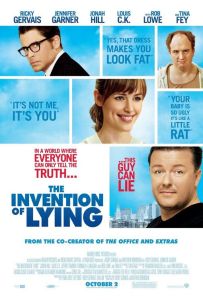 Imagine a world where people could only tell the truth. Sounds scarier than anything in horror movies today.
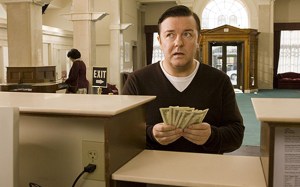
Mark (Gervais) is trying to romance Anna (Jennifer Garner) but even the waiter tells him she’s out of his league. She tells him upfront that she finds him unattractive and he will never have any hope of having sex with her. She’s more interested in Mark’s snide but handsome co-worker, Brad (Rob Lowe), who she feels is a better genetic match. Mark is about to be fired from his job, writing historical screenplays about the 13th century, and his secretary (Tina Fey) delights in telling him that she loathed every minute they spent together. This is a world without a filter. Until one day Mark goes to take out money from the bank, and something inside his brain switches. His balance is $300 but he asks for $800, and the bank teller apologizes for the computer error and gets Mark his full $800. He explains to his barfly friend Greg (Louis C.K.) that he said something that wasn’t. Nobody understands. “I’m a black Eskimo,” Mark says. Everybody takes him at his word. Mark is the only human on earth who has the ability to tell a lie, which he uses to his great advantage whether it be gambling, getting out of a traffic ticket, or unearthing a “lost” historical chapter about ninjas and aliens that makes for a stirring “non-fiction” film. Mark can’t even explain what he’s done, since the world lacks even a word for “lie.”
Gervais and co-writer Matthew Robinson concoct some interesting and inspired ideas of what a world bereft of lying would be like. Naturally, advertising would be completely different if people had to tell the truth, the whole truth, and nothing but the truth; imagine prescription drug ads that only said, “This is a placebo. Your penis won’t ever grow bigger.” The slogan for Coca-Cola is, “It’s very famous,” and the slogan featured for its rival, Pepsi, is, “When you can’t have Coke.” No one has any concept of fiction, of people pretending to play parts, so movies only consist of an older man sitting comfortably and reading a historical account with some minor dramatic inflection. Movies have become book reports. The sign in front of a retirement center says, “A Sad Place for Hopeless Old People,” and a motel sign reads, “A Cheap Place to Have Intercourse with a Near Stranger.” However, I’m puzzled by how forcefully open every person is. Just because you can only speak the truth doesn’t mean you have to be talking constantly. I understand Gervais’ point about the need for lies to protect people’s feelings, but just because you think someone looks fat doesn’t mean you have to blurt it out. When Mark greets Anna at the door for their date she reveals, “You’re early. I was just masturbating.” It’s funny, sure, but did she feel compelled to link the two statements? It seems in this world, everyone is incapable of keeping their mouths shut.
 The premise of the movie is terrific, and I’m honestly shocked no one has thought of it before. But the premise wears a little thin after the first 30 minutes of people speaking with no filter. You begin to expect outrageous comments that will be hurtful and blunt, and because you expect them it takes away the shock value and lessens the humor. But then The Invention of Lying takes a sharp right turn at about minute forty and becomes a radical and subversive and much funnier movie. Mark is comforting his dying mother (Fionnula Flanagan) who is afraid of leaving existence. She’s afraid of a cold nothingness. So Mark explains to her that there is an afterlife, a world beyond our own, where everybody gets to be around their loved ones in a mansion, and there’s no pain. She closes her eyes and dies in peace with this new knowledge. The doctors and nurses are amazed and beg to know more. Mark has created the idea of religion and God! He’s mobbed by people and camera crews demanding him to explain what he knows. Mark then works up the courage to establish a system of 10 rules to follow, which he tapes onto old pizza boxes. He then addresses his flock and has to explain the complicated minutia of religion, with hilarious questioning from the acolytes. Mark explains that there is a “man in the sky” who watches everything we do and is responsible for everything that happens. “Does that mean the Man in the Sky gave my sister cancer?” someone asks. Mark tries to explain the nature of a loving, all-powerful deity who willingly allows bad things to still happen. “Screw the Man in the Sky,” someone yells, “He’s going to kill us all. We need to fight back!” You try explaining the nature of the unknown to people.
It’s at this point that the movie transforms into a biting satire on belief and belief. I was cackling but I noticed that my theater seemed to get awfully quiet the longer the religious satire went on. I almost spat out my drink when I saw a spinning newspaper headline that said, “Man in the Sky Continues to Give Children AIDS.” It’s offensive but completely within the bounds of religious questioning. Gervais and Robinson aren’t ridiculing religious belief; in fact they seem to prove that it has a definite place of significance within society and can be beneficial psychologically. The satire isn’t savage and still manages to play with the amiable, fable-like nature of the story. Gervais isn’t laying out an argument that believing in an unforeseen deity is stupid. The movie isn’t condescending or hectoring, like Bill Maher’s anti-religion documentary Religulous, but it does take some slyly subversive swipes at the nature of faith and its reliance upon the unproven.
 The Invention of Lying suffers from trying to be a romantic comedy. Too much of its conflict is spent on whether the chubby guy can get the pretty girl. The movie gets a tad sentimental for dealing in bitter-truths, and Gervais and Robinson steer the film to the ultimate romantic comedy setting: objecting at a wedding. I wouldn’t have minded the rom-com asides if they didn’t feel like they kept striking the same chord. Mark wants to be in a relationship with Anna. She points out that he’s fat, has a snub nose, and not a good genetic match. He persists. She points out that he?s fat, has a snub nose, and not a good genetic match. This goes on and on until the inevitable break at the end. Mark, and especially Gervais, is an appealing guy, self-effacing and witty, even downright cute at turns, but when Anna keeps repeating the same looks-first mantra, it makes her seem increasingly shallow and him seem like a glutton for punishment. Garner is a fabulous comedic actress and packs a lot more emotion into her character than I would have expected given the conceit.
Ricky Gervais is catching fire as of late, and it seems that America is finally waking up to the charms and brilliance of this squat comedian. He created The Office, the standard for squirm-based comedy, and appeared in the underrated supernatural comedy Ghost Town last fall. Gervais shows the necessity of lies in our world, from sparing hurt feelings to making mass-market entertainment. The world needs dishonesty. When The Invention of Lying is on-target, it is a hilarious, almost brilliant, comedy, with its best gags saved for taking on “the Man in the Sky.” It’s too bad then that the entire movie doesn’t live up to these flashes of comedic brilliance. Still, the movie is sweet enough and ends on a satisfying level, even if The Invention of Lying begins as one movie and ends as another. Gervais is an appealing lead, though he doesn’t prove much in the way of a director, and he has some real dramatic acting chops too, nicely put to use during his mother’s deathbed scene. I hope more Americans wake up to this man’s charms. Gervais continues to show audiences the sharp wit that has made him one of the world’s foremost funnymen.
Nate’s Grade: B+
Share this:

The X-Files: I Want to Believe (2008)
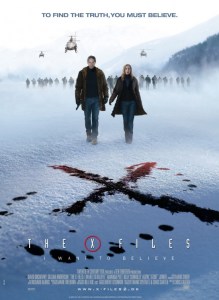 To all fellow X-Files fans out there, the movie is not nearly as bad as you may have been lead to believe. That said, it’s pretty much a so-so standalone episode of the TV show needlessly expanded. And yes, for all concerned fans, Mulder (David Duchovny) and Scully (Gillian Anderson) kiss on more than one occasion. The plot that reunites the characters is fairly mediocre, something about a ring of mad scientists that want to be a modern-day Dr. Frankenstein. You don’t need a two-headed attack dog to know that plot is way too hokey. The most intriguing aspect of the film is a priest (Billy Connolly) who also receives psychic visions, cries tears of blood, and, oh yeah, is a convicted pedophile. Could God be responsible for his special abilities as well as the abhorrent sexual urges? There is so much great conflict and human drama in this character worth examining, so it’s a pitiful shame that he just gets shoved off so the third act can concentrate on the lame mad scientists. A majority of the flick occurs in snowy West Virginia, which doesn’t translate into anything too special to look at. I’ll admit, my rating is inflated because I was an ardent fan of the TV show until the last years when it felt like they weren’t even trying any more. If you stripped away my allegiance, I’d say that the second X-Files movie serves little purpose other than to add a tiny coda to a TV show that went off the air in 2002. The characters are worth revisiting, just not in this tepid tale.
Nate’s Grade: C+


 nathanzoebl
You must be logged in to post a comment.