Blog Archives
The Ice Harvest (2005)
 Imagine my surprise when I found out that a small crime novel I read years ago was getting the big Hollywood treatment. I read Scott Phillips’ The Ice Storm in one sitting back in 2003 during a plane trip from Ohio to San Diego. It was deliciously dark down to the very last page and I loved it, but then I am a sucker for a good crime story (check out Jason Starr’s Tough Luck and Hard Feelings if you are the same). The movie looked to be on the right track with names like John Cusack to star and Harold Ramis to direct. Ramis is responsible for starring, writing, or acting in or directing some of the most beloved comedies of the last 25 years including Ghostbusters, Groundhog Day, Stripes, and National Lampoon’s Vacation. That’s one illustrious comedic pedigree. So how could the movie go wrong?
It’s Christmas Eve and Charlie Arglist (John Cusack) is a self-loathing attorney that works for some of the shadiest folks in Wichita, Kansas. One of those bad customers is mob boss Bill Guerrard (Randy Quaid) whom Charlie and his partner Vic (Billy Bob Thornton) have just swindled over $2 million from. Unfortunately for them, Wichita is hit by an ice storm that makes the roads haphazard to travel. The two will wait until the morning thaw and then hit the road with their booty. Vic reassures Charlie to just, “act normal.” This means many ventures to some of Wichita’s finest strip clubs with alluring names like Sweet Cage and Tease-O-Rama. Charlie has a sweet spot for Renatta (Connie Nielsen), a bombshell and the operator of the Sweet Cage. He’ll also have to drive his plastered friend Phil (Oliver Platt) around, who is regretting having married Charlie’s cold ex-wife. Charlie would love to sail off into the sunset with Renatta by his side but first he’ll have to survive the night and a mob enforcer (Mike Starr) is already on his trail.
 The Ice Harvest feels like an episodic collection of ideas, too many of which have too little significance. The titular ice storm seems all but forgotten, only serving as a cheap plot device to keep our characters bottled up in the city. It has no bearing elsewhere on the plot. The reoccurring “As Wichita falls” passage has no payoff. The nosy police officer plotline looks like it might be building to something important but then is quickly disposed of. The Christmas setting has little impact except for giving the strippers something to complain about. The Ice Harvest wants to benefit from the juxtaposition of Christmas cheer with all these tawdry, violent asides and it just seems small and shallow. The movie also shifts the story’s time from 1979 to modern day one suspects just for the cheap out of cell phones.
Credit goes to Cusack for making his character as likable as he is. His character is a mob lawyer, a deadbeat dad, an increasingly drunk driver, and a man with his nose in whole lot of sleazy ventures, and yet you still pull for him to somehow succeed. Cusack, forever youthful, seems overly numb to all the horror around him and downplays the danger to a negative degree. Charlie seems like he’s in the wrong movie. Thornton plays yet another hedonistic louse and is quite good though not at his Bad Santa apex. He seems the most at ease with the physical comedy. Nielsen plays your typical femme fatale with a Veronica Lake haircut and breezy voice, which should both be instant red flags for students of film noir. The two men that steal the show are Platt and Quaid. Platt gives a brilliant uninhibited performance as quite possibly the drunkest man in movie history. Quaid is an honest surprise as a menacing mobster ruing the day he chose a criminal enterprise in Kansas. He chomps scenery with a violent exasperation that truly seems larger than life. This is a bad guy to fear and Quaid makes the most of his very limited screen time.
Ramis is out of his league here. The man cannot competently direct tension or action. Ramis doesn’t let the audience build suspicion because he’d much rather have characters just point-blank say, “Don’t trust this person” instead. He doesn’t give us time to piece clues of betrayal together so instead characters just keep running forward until they get smacked in the face by something made obvious. Ramis’ mishandling of tone really sinks the movie. The Ice Harvest doesn’t know whether it wants to be a thriller of a dark comedy and therefore just really sputters at both. The comedic elements and the thriller elements butt heads; because of the comedy the character never feel in danger, and because of the thriller/noir elements the characters and their situations never really seem funny. The Ice Harvest turns into some kind of two-headed beast that snaps at itself. I think maybe Ramis was watching Blood Simple and taking notes and then he accidentally taped over it with a Charles in Charge marathon and was at a loss.
P art of this problem is that the screenwriters don’t fully commit to the nastiness. Phillips’ novel is unrelentingly dark, cynical, and unsentimental and doesn’t give a damn if you like its characters. The movie, on the other hand, wants to get its hands dirty but is more interested in playing it safe. The film seriously reminded me of last year’s Surviving Christmas, another movie that wanted to be sweet and nasty and wound up just being really bad. You can feel The Ice Harvest reeling back several times to set up Charlie as a likable lad in over his head, going so far as a slightly contrived yet predictable finale. At least Bad Santa had the gusto to approach a happy ending on its own crude, unsentimental terms. Ramis needs to stick to broad comedies and leave the bleak neo-noir humor to the Coen brothers.
There are some plot elements from the book that just don?t work with this half-hearted adaptation. (Spoilers to follow for paragraph) At the very end of the movie Charlie has left the city with all the money and stops along the road to help a stalled camper. In the book, the camper backs up over him and kills him, thus ending with the ringing endorsement that crime doesn’t pay. It made sense, especially for a book that was dark to the very end. In the movie, the camper backs up and knocks him to the ground but doesn’t run him over. Charlie dusts himself off and that’s that. The scene feels pointless without fulfilling the end of the book. It doesn’t provide any last-second tension. Charlie just hops back in his car, dear hung over Phil pops up, and the two are set for one most excellent adventure. Unearned and misplaced happy ending? No thank you.
The Ice Harvest is only a mere 88 minutes long and yet the film still feels padded and draggy. The drunken Oliver Platt-heavy middle is a generously paced muddle, and though it’s rather funny it’s also rather extraneous. The Ice Harvest is really a handful of great moments that don?t add up to a satisfying whole. The movie is really episodic and too many of those episodes have little bearing on the plot. Character betrayals are spelled out to us and Ramis seems to lose interest in his own film as it slides further and further into dangerous territory. The Ice Harvest can’t commit to whatever it wants to be and the audience is the one to suffer. Read the book instead. It’s only 224 pages.
Nate’s Grade: C
Share this:

Not Another Teen Movie (2001)
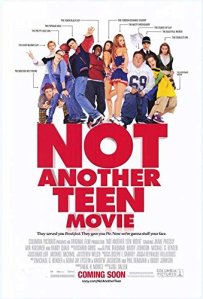 Spoofing is often believed the cheapest and lamest form of comedy. One runs jab after jab, and gag after gag relentlessly hoping that some hit but content that if they don’t more will follow with the potential to. But many of the jokes in a spoof aren’t textured; there’s nothing below their surface. Spoofs can be done well or they can be embarrassing and wretched to sit through. Count Not Another Teen Movie in the latter category.
At John Hughes High School (can you feel the parody, can you?) it’s life as we know it for stereotypes and clichés. The Bitchy Cheerleader has just dumped the Popular Jock and the Cocky Blonde Guy has initiated a bet that PJ cannot turn anyone into prom material. The men size up their choices, including an albino girl singing about her lost pigmentation (one of the few funny gags), and decide on the Pretty Ugly girl who is beyond all hope with her glasses and ponytail. Meanwhile, the Cruelest Girl is trying to find a way to seduce her brother, the Popular Jock, a trio of Virgins try and, what else, lose their virginity, and the Best Friend with Hopeless Crush tries to work his klutzy charm.
 In a genre full of Freddie Prinze Jr.’s greatest hits (or misses, however you want to look at it) a parody wouldn’t be too difficult to prescribe. All too often the film has no edge and falls back on scatological humor as its savior once too often. An exploding toilet and a flying vibrator can only do so much. There has to be things behind it. Alas, there is nothing. For every one part funny (a character tries to find the right moment to start a slow and building applause) there are three parts inane, satirically flaccid, crudely useless, or bordering on exploitative (the foreign exchange student who drapes around completely nude the entire film). The jokes arrive many times cold and require a good deal of familiarity with the subject material it’s spoofing. NATM seems to not think too greatly of the audience for it. The film continually seems to explain jokes after they happen or reacquaint the audience with the source for spoofery. The worst example may be that the movie has to SHOW a character watching a scene from ‘Pretty in Pink’ mere seconds before it spoofs that very scene.
The movie, as a whole, has about six good gags and bits but the rest is watch-checking time. Some comedic threads don’t even get the proper treatment to become good jokes. The Token Black Guy’s introduction is rather funny, but then all he does in the film is repeat the words he said he could only say. Now, if the other characters had begun to question this law of teen movies, and asked him questions then this idea could have been ripely handled. As it stands it’s another joke in a line of jokes that go nowhere but we keep going back to repeatedly.
 The flick was directed by Joel Gallen, marking his film debut after years as an MTV producer. Gallen shows no finesse when it comes to comedy as everything is rammed into the ground. His film is a spoof with nothing to do, much like the bad but better Scary Movie 2 earlier this year. Jokes come and go but they serve no purpose in moving things along or setting up greater jokes. This is comedy lost in the woods.
NATM is an attempt to satirize the teen genre, which should have been a rather easy job to do but instead just becomes another sad addition to it. And a rather poor and limp addition at that. NATM doesn’t know that the audience isn’t laughing with it but at it.
Nate’s Grade: C-


 nathanzoebl
You must be logged in to post a comment.