Blog Archives
Watchmen (2009)
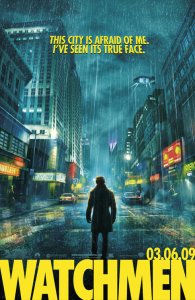 In the realm of comics, Watchmen is tantamount to the Bible. It consisted of 12 issues released between 1986-1987 but it arguable changed the medium forever afterward. TIME magazine listed the book, by author Alan Moore and artist Dave Gibbons, as one of the 100 greatest 20th century novels. Therefore, there has always been heavy trepidation within the geek community when Hollywood came courting the Watchmen property. Different directors have tried tackling the material, going back to the late 1980s when Terry Gilliam was hired to direct and producer Joel Silver was adamant about getting Arnold Schwarzenegger to portray Dr. Manhattan (back then, they totally just would have painted him blue — like they did when he was Mr. Freeze). The movie would seem like a tantalizing possibility and then the production would collapse, most recently in 2004 with director Paul Greengrass attached. Director Zack Snyder (300) understood all of the concerns from the notoriously vocal geek community and attempted to make the most faithful Watchmen film possible. He accomplished that goal. But was it the right goal?
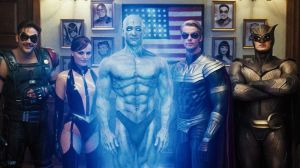
In this alternative account of history, masked crime fighters exist and were even bankrolled by the U.S. government. President Nixon is re-elected to a third term, thanks in part to superheroes winning the Vietnam War, and then he outlaws all masked vigilantes. Flash forward to 1985, and Nixon is on his fifth term and staring down Soviet aggression into Afghanistan. It appears that the world on is on the brink of nuclear annihilation by the dueling super powers engaged in a staring contest. Edward Blake, a.k.a. the Comedian (Jeffrey Dean Morgan), is thrown from his apartment window and killed. Blake used to belong to a second-generation superhero team in the 1970s called the Watchmen. The other members consisted of Dan Dreiberg, a.k.a. Night Owl (Patrick Wilson), Rorschach (Jackie Earle Haley), Adrian Veidt (Matthew Goode), a.k.a. Ozymandias, the glowing blue man Dr. Manhattan (Billy Crudup), who was transformed into a god-like figure of power after a laboratory accident, and then there’s Laurie Jupiter, a.k.a. The Silk Spectre (Malin Akerman), who was following in her mother’s (Carla Gugino) footsteps, the first Silk Spectre. The death of the Comedian brings the old team back together and rekindles some interest in putting on the super suits and fighting crime one more time. It seems someone out there is trying to knock off the retired superheroes, and Rorschach is convinced that a bigger conspiracy is unwinding.
 It’s difficult for me to formally express my feelings and reactions to the Watchmen film adaptation. Count me among the throng of fans that feels that Moore’s source material is a remarkably dense and witty deconstruction of the superhero mythos. Imagine a Superman that can’t be bothered to help out humanity because he feels life is overrated, or a group of super heroes that don’t necessarily do anything heroic; when they beat up the bad guys it’s because they get a sexual thrill from the rush of violence. My voice was among the cacophonous crowd screaming, “Don’t you dare butcher this great work! Keep it as close to the comic as possible!” And that’s pretty much what Snyder delivers. But now I’m left to wonder if a literal-minded interpretation is truly what I wanted all along. Watchmen is not like Sin City, a comic that was already a movie in panels. Frank Miller’s ode to film noir was ready and waiting to be a splashy action movie with style to spare. Watchmen is not a ready-made action vehicle, as it really only has about two extended pieces of action. Moore’s story examined what kind of people would become vigilante crime fighters if the government approved the practice. Surprise, it’s a bunch of sociopaths that are now getting checks from Uncle Sam! Watchmen is a nihilistic account of human behavior and far more cerebral than any superhero film that has ever graced the screen. Seriously, what other superhero movie opens with a fictitious episode of PBS’ political yak fest, The McLaughlin Group? So I suppose this paragraph is a sheepish way of admitting that perhaps Watchmen should have stayed place on the page unless, gulp, it was advantageously adapted for the medium of film.
It’s not that Snyder does a bad job or that the film itself is poor. While Snyder isn’t the best man to handle actors, he is certainly a skilled visual tactician and knows how to make some immensely pleasing imagery. He breathes great life into the images of the comic book and filled in the blanks nicely, and his one big artistic addition is one of the film’s best moments. In the opening credits we get a series of shots that perfectly establish this alternative universe, where JFK shakes Dr. Manhattan’s hand on the White House lawn only to be later gunned down by none other than the Comedian in Dallas. The segment is cleverly set to Bob Dylan’s “The Times They Are A Changin'” and is a terrific intro into a re-imagined America. I wanted to spend more time exploring the differences, like watching a giant Dr. Manhattan win the Vietnam War in one week’s time. In many ways, Watchmen is Snyder’s epic pop commentary on the history of the United States. Dr. Manhattan takes the first pictures of the astronauts on the moon. It is a female crime fighter that swoops a woman off her feet for that iconic celebratory kiss marking the end of World War II. The flick even has a period appropriate, synth-aided score, which is fine, though the use of period pop songs can be distracting. Watching Laurie and Dan make love to the raspy tunes of Leonard Cohen’s already overused tune “Hallelujah” is a deeply uncomfortable moment. Also, the aging makeup is horrendously bad. Gugino looks like she has a turkey waddle and the older Nixon looks like a freaking Halloween mask.
 At what cost did Watchmen make it to the screen? Wacthmen plays as an adaptation like the first two Harry Potter movies, like there was an assigned checklist rather than a fully developed script. I achieved a brief understanding with the characters and each central figure provides a glimpse of the trouble beneath the surface. Laurie is a girl with daddy issues who’s been pressured to follow her mother, a rape victim who still loves her rapist. Dan is a self-pitying putz who has never felt more alive than when he puts on a costume. Rorschach has the same pessimistic view of mankind that Travis Bickle did, viewing many people as vermin clogging the gutter. Yet Rorschach also is the most single-minded of all the characters and abides by an innate moral code and sense of duty, never mind the fact that he may have lost his mind. Dr. Manhattan has been turned into a supreme being and has lost his connection to humanity. The Comedian is a man of wanton desire who declares himself to be the epitome of the American dream: giving in completely to the id. Watchmen has been deemed as an unfilmable book, and perhaps they were right. It feels like Watchmen and looks like Watchmen, but the movie never seems to become anything grander than the sum of its parts. The Dr. Manhattan back-story, where we see him live life in the past, present, and future simultaneously may be one of the best moments in the movie, but it doesn’t add up to much more than an interesting aside. The trips to Mars and Antarctica provide nice visual landscapes but do little else. The other quandary is that everything Snyder cut from the comic (the side characters, the pirate comic, the alien squid) is something that ultimately was unimportant. All of the important and memorable moments from the comic are here, though abbreviated and truncated. Even a 2-hour and 40-minute movie feels like too much of a sprint through such rich material probably better suited to the more accommodating narrative confines of a glossy HBO miniseries. The movie ends up becoming a handsomely mounted and reverent homage to the source material, but I question if the movie serves any other purpose than as an advertisement to go read the book. Will people unfamiliar with the book enjoy a movie practically tailor-made to appeal to fans of the book? Who will watch the Watchmen?
Make no mistake, Watchmen is a hard R-rated movie and if any parent takes their child to this flick because it has men in capes, then that parent should have their child removed. Snyder has ramped up the book’s adult elements, which were originally a commentary on how comics flirt with sex and violence but never get their hands too dirty. Snyder has gotten his hands dirty all right. Instead of zapping others into poofs of smoke, Dr. Manhattan turns them into explosions of human goo that stick to the ceiling. Instead of the Comedian being thrown from the window, we see an extended fight sequence that seems to indicate that the Comedian’s apartment is full of nothing but breakable glass tables. When Dan and Laurie get into a street brawl where bones pop through skin. The sex scenes now involve an almost-agonizing level of thrusting. This is an adult tale in a very simple sense: there are boobs and blood. But the movie is also adult in the fact that it trades in complex political, psychological, and philosophic ideologies, asking hard questions that do not come with easy answers. Do the ends ever justify the means or is mankind destined to always destroy itself? Is humanity worth saving and at what cost? This is probably the most subversive studio-backed movie to come out of Hollywood since 1997’s pro-fascism melodrama, Starship Troopers.
 The three best performances in the movie all come from the three weirdest and most messed up characters. Haley (Little Children) fully inhabits the grisly character of Rorschach and growls his way through the movie. You can tell just by the man’s face how much he has weathered. Crudup (Big Fish) and his gentle voice make Dr. Manhattan an intriguing yet beleaguered super being. Morgan (TV’s Grey’s Anatomy) makes the Comedian one consummate bastard but a bastard that you cannot stop watching, nonetheless. The rest of the cast does suitable jobs and I don’t feel that Goode (The Lookout) or Akerman (27 Dresses) deserve the drubbings they’re getting through the critical community. I actually liked Goode’s portrayal of Ozmanydias, though he fails to express the heavy crown the smartest man in the world must bear. Gugino (Sin City) is terrific when she’s the young, spunky Silk Specter and the opposite of terrific when she’s the troubled, alcoholic older version on screen.
Snyder has served up the Watchmen that fans have been demanding for years, but is this really what everyone truly wanted? Snyder made an adaptation for the fans but what do the fans know except for lavish loyalty? The book utilized the medium of comic books to accentuated its story while commenting on the history of comics and superheroes, and when translated to the big screen as is Watchmen can feel like an artistic stillborn. I’m now more curious than ever to read the previous drafts out there, the ones that directors like Darren Aronofsky and Greengrass were going to film until the financing got pulled. One of the drafts transplants the world of Watchmen to modern day and replaces the nuclear brinksmanship with the Russians to the ongoing War on Terror. It may not be faithful to the fabulous source material, and it quite possibly would have made a terrible movie, but it would have been more interesting as a film project because it would have been an adaptation. Snyder’s Watchmen is reverent to a fault but I cannot complain too much. This is likely the most faithful recreation of a complex book that fans could hope for. I feel satisfied and yet unsatisfied with the finished product. It was everything I was looking for in a Watchmen movie and maybe, in the end, that was the problem. I think instead of buying the DVD I may just read the book again.
Editor’s Note: I have warmed up to this film much, much more on Blu-Ray, especially the 3-hour director’s cut. It’s Snyder’s best work to date.
Nate’s Grade: B
Share this:

Milk (2008)
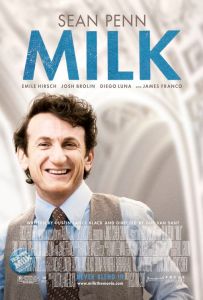 The biopic of America’s first openly gay elected official is stirring, thoughtful, and occasionally limited. Sean Penn gives a wonderful performance as the captivating and tragic Harvey Milk, assassinated in 1978 by fellow San Francisco councilman Dan White (Josh Brolin). He changes his look, his voice, how he carries his shoulders and moves his arms; it’s a terrific and transformative performance that only sometimes hits a few fey stereotypes. The movie mostly follows Milk’s path as a community organizer who successfully mobilized the gay rights movement. You’ll witness local politics in depth, and that’s my one reservation with this fine film – it focuses too heavily on the political formation of a movement and less on the man that kick-started it. You get little glimpses of Milk the man, and most of those glimpses happen to be his romantic relationships with annoying men. That said, director Gus Van Sant orchestrates real archival footage from the time including protestors and homophobic spokespeople, and it gives the movie an authentic relevancy. The deadly confrontation between Milk and White is played in a painful, very un-Hollywood approach that made me wince hard. It’s amazing to watch Milk and realize how far the American public has come since the 1970s and how much further we, as a nation, have to go.
Nate’s Grade: A-
Share this:

An American Carol (2008)
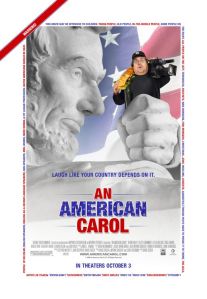 Being a conservative in Hollywood is like being a gay Republican – tough business. Director David Zucker has a notable history with comedy, having helmed Airplane!, the Naked Gun series, and the back half of the Scary Movies. He says that he converted to conservatism in the wake of 9/11, and Zucker actually wrote and directed a short for the 2004 Republican National Convention that was deemed too edgy for the Grand Old Party. Conservatives have also garnered the reputation for not having the best sense of humor, and Zucker’s An American Carol will do little to change this belief.
Michael Malone (Kevin Farley) is an egotistical, fat, liberal documentary filmmaker whose latest work is titled, “Die You American Pigs.” Catchy, ain’t it? Malone wants to abolish the Fourth of July (would we just skip to July 5th?) and plans to protest a Trace Adkins concert for the troops. A batch of inept Islamic terrorists want to bomb the concert and decide into tricking Malone into assisting their goal. He will score them media passes to get onstage at the concert venue. Following the Charles Dickens’ playbook, Malone is first visited by the spirit of his idol, John F. Kennedy (Chriss Anglin), who horrifies Malone by saying war is sometimes necessary (really, conservatives are trying to reclaim Kennedy?). Three spirits will visit him although he spends almost all of his time with the ghost of General Patton (Kelsey Grammer). The ghostly general takes Malone on a trip to see what the alternative versions of U.S. history had the country avoided war at all costs. Malone stays defiant until he meets up with the Angel of Death (also Trace Adkins, because?) and sees the error of his “America-hating” ways. I don’t want to spoil things too much but the movie ends with an expanded Trace Adkins concert saluting the brave men and women in the armed forces.
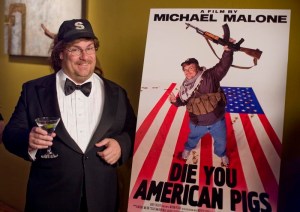 Some from the opposing political viewpoints will find An American Carol to be infuriating. To those angry few I say get over it, because this movie is simply too lazy to get angry over. It barely reaches 77 minutes before the credits roll. Zucker and company tend to stretch their canvas too broadly, to the point that they aren’t exaggerating to lampoon but setting up cheap jokes. Michael Malone is fat. Michael Malone smells. Michael Malone falls down. Liberals hate America and want the terrorists to win. It’s so easy to write this material because there’s nothing topical or nuanced or even socially relevant. The movie beats reliable figures of conservative agita. When the movie tries to slam college professors as being dippy hippies brainwashing teens about the insurmountable ills of America, it just gets dumb (those people spend 10-15 years studying in a specialized academic field). There is no teeth to any of this satire because it’s all just recycled caricatures with the wit ground down. There isn’t anything of true satirical substance here. I don’t even get some of the satire, like the ACLU is depicted as a cluster of zombies with briefcases. What does that mean? Needless to say, the skewering of Arabs is mostly cartoonish and offensive. The flick constantly makes fun of the documentary art form, saying they are inferior to “real movies.” Because Michael Moore has an Oscar does that mean that the history of documentary film has to be slandered as being nothing more than transparent propaganda (at an awards ceremony, the top documentary is honored with the “Leni Riefenstahl Award”)? Marginalizing an entire art form seems rash, especially considering that Moore’s Fahrenheit 9/11 grossed over $220 million worldwide. As of this writing, An American Carol, a “real movie,” has grossed seven million and counting.
The film deals in distasteful absolutes. Every idea is presented crudely in black and white. By the film’s standards, being anti-war and anti-troops are inseparably linked. In my mind, and this might be crazy, but it seems to me that the most pro-troops one could be would be hoping for them all to return home alive and healthy. An American Carol attempts to justify the ongoing War in Iraq, though it conveniently only ever flashes to combat in Afghanistan, the war that a majority of the public agrees with. It makes a case that war is sometimes necessary, though it has to flash back to Hitler and World War II to find a morally justified military engagement that everyone can feel god about. I agree that war is sometimes a reasonable option, but the movie paints all pacifists as wimpy appeasers. George Washington (Jon Voight) even steps in at one point to argue for the necessity of war in reference to the War on Terror. Did the filmmakers forget that Washington spent great expense to keep the nation out of foreign wars in his two terms? Isn’t it also condescending and objectionable to have Washington say freedom of speech is misused when it goes against the government? I think the Founding Fathers would realize the importance of freedom of speech, including offensive speech. Isn’t it also somewhat ironic to use slave-owners as mouthpieces for the merits of freedom? An American Carol says that disagreement is the same as dissent; so refusing to support one’s government blindly during a time of war is traitorous. Criticism is not anti-American. It’s insulting to all rationale human beings. Zucker and crew make their case look just as myopic and dismissive as those they choose to ridicule.
The acting neither hinders nor helps the material. Farley is a game comedian but he cannot do much with such lightweight material. There are several celebrity cameos including James Woods, Dennis Hopper, Bill O’Reilly, Mary Hart, David Alan Grier, Gary Coleman, Leslie Nielsen, Zachary Levi, Kevin Sorbo, and Paris Hilton. When Zucker is calling favors into the likes of Paris Hilton, you know things cannot be solid.
 Here’s the problem. It’s harder to satirize from a conservative point of view. Conservatism believes that the status quo is best or that things were better back in the day. Liberalism believes that society can always improve, so a liberal point of view would tweak the present situation in order to call attention to remaining improvements. A conservative point of view would make fun of that possible change. This is the same reason why documentaries, like it or not, typically have a more progressive bent, and it’s because the filmmakers are presenting a case for change or outrage. Why would anyone devote himself or herself for years to create a film that says the world is peachy? Now I’m not saying that conservatism and humor are conflicting concepts, but it just makes it harder to be smarter. Making fun of Good Night, and Good Luck is not trying hard enough. How dare George Clooney make a film about the media cowering and failing to question our elected leaders and have it be applicable to today’s world.
The Zucker gag-a-minute spoof style doesn’t necessarily translate well to political satire. I wasn’t expecting much with An American Carol. When they exploit 9/11, taking Malone to the wreckage of the World Trade Center to make its case, well the movie stops being a satire and just implodes. It hits its tired targets with a sledgehammer. The satire is extremely lazy, the slapstick is dumb, and the movie specializes in being obnoxious, coloring the world in two extremes. This isn’t satire. This is just cheap and petty. Seriously, making fun of Michael Moore is like four years too late. Moore is a figure worthy of satire but the best that the movie can come up with is he’s fat and hates America? That he’s angry because he couldn’t get girls when he was younger and all those studly military recruits did? That’s not satire, that’s just excessive name-calling. An American Carol presents a new low for Zucker and I think even he knows it. On the DVD commentary track, Zucker, co-writer Lewis Friedman (BASEketball), and actor Kevin Farley basically lambaste the final product, often criticizing their own movie. The derisive commentary track is more enjoyable than the film itself.
Nate’s Grade: C-
Share this:

Harold and Kumar Escape from Guantanamo Bay (2008)
 I was a big fan of the first outing to White Castle, a crude stoner comedy that also happened to be clever in its outrageousness. The Harold and Kumar sequel returns the same writers but what the hell happened? The first film separated itself from its class of juvenile jokesters because it had charm and wit, but this mediocre movie just stumbles from one uninspired comedic setup to another. The boys get mistaken for terrorists and then the movie becomes a ramshackle road trip through America. The gags are lame and easily telegraphed. Regrettably, many jokes are reheated from the first film, like Kumar’s fantasies involving an anthropomorphic living bag of weed. The presence of the hysterically gifted Neil Patrick Harris gives the film a boost but even NPH cannot save these less-than-stellar shenanigans. The comic set pieces don’t add up together into something greater, and the only scene worth remembering is when the boys smoke weed with President Bush. You know you’re in bad shape when even the gratuitous nudity feels tacky and boring.
Nate’s Grade: C
Share this:

W. (2008)
 Director Oliver Stone’s first draft at history is never boring but it’s rarely insightful. The film portrays George W. Bush (Josh Brolin) as a stubborn and simple man trying to live outside his abilities and the long shadow of his successful and emotionally distant father. George W. was not the favored son, as he is routinely reminded, and Ma and Pa Bush express their frustration. And yet the son who did not have his family’s support and acumen accomplished what no one else in the family had. He won reelection. He toppled Saddam Hussein. And then it all came crashing down. Ultimately, who was this movie made for? The detractors of Bush will view the film being too light, providing a psychological context that humanizes the man amongst his mistakes. You may even feel some sympathy as George W. repeatedly tries to earn his father’s approval. The movie is not a partisan or mean-spirited skewering. The fans of Bush will consider the film to be a cheap shot that restrings famous blunders and transplants Bush malapropisms into new settings. People may take offense at the idea of the current Iraq War being a result of unresolved daddy issues. Seriously, for a two-hour movie spanning the life and career of the most reviled modern day president, did Stone need to include the moment where Bush almost choked to death on a pretzel? Over the 2000 election debacle? Over the Air National Guard? Over 9/11?
W. lacks a strong point of view and the film’s timeline closes too soon, only going so far as January 2004, not even the halfway point for a two-term president who has only sunk lower in national approval from that moment. A miniseries would be a better medium to explore the failures and calamities and personalities of the Bush Administration. Brolin is terrific in the title role and he never dips into parody. The rest of the actors are hit-or-miss and the movie becomes somewhat of a game of identifying famous historical figures in their one-scene appearances. My biggest surprise was how much I felt emotionally connected to the first President Bush, played by James Cromwell in a performance that doesn’t even attempt to imitate the real-life figure. Stone and screenwriter Stanley Weiser (Wall Street) certainly don’t hide the characters they connect with (Colin Powell, often the voice of reason, is given a stirring speech calling for caution). Certain creative license is taken to provide dream sequences that can point toward the inner turmoil of Bush, like when his father admonishes him for destroying 200 years of the family’s name over the Iraq War. Overall, W. is an empathetic and sometimes dithering portrayal of the 43rd United States’ president that could have succeeded if it had more to say.
Nate’s Grade: B-
Share this:

Expelled: No Intelligence Allowed (2008)
 Ben Stein is best known as the monotone teacher in Ferris Bueller’s Day Off, but the man has also been a speechwriter for Nixon, a game show host, and popular figure of deadpanned irony. Expelled: No Intelligence Allowed follows Stein as he travels across the world interviewing scientists, authors, professors, and others about what he sees as a disservice to science and America. “Big Science,” as he refers, is so heavily entrenched in the theory of evolution and the teachings of Charles Darwin that they are unwilling to even broach alternative approaches. Intelligent Design believes that life is far too complicated to occur randomly, and thus must have been created by some powerful supernatural designer. The teaching of evolution is still seen as a controversial subject and I.D. proponents want their theory to be given equal time.
Stein tries to skew his argument into one about freedom. The Constitution calls for the freedom of speech and our nation is built upon the bedrock of being a marketplace of ideas. Stein compares the resistance in the scientific community to Intelligence Design to the Berlin Wall, and he argues that I.D. proponents just want to open up the dialogue. Detractors warn that I.D. is just Creationism in sheep’s clothing, and indeed the U.S. courts have ruled the same way. The problem with Intelligent Design is that it can’t really apply to science. Science can only test what exists in the natural world, and religion by definition deals with the supernatural and thus can’t be tested. It’s one thing to say, “The sky is blue because God made it so,” but what else do you do with that as a scientist? Where do you go from there as a teacher? Science textbooks would be awfully thin, since you would just need one sentence to sum up all of existence. Evolution begins with the start of life and no one has a strong feel for how life began, but I.D. runs into the same wall if you think about it. Saying, “God created life” leads to the question, “How was God created?” and now we’re back where we started. Personally, I don’t see why evolution and religion have to be seen as forces that cancel each other out.
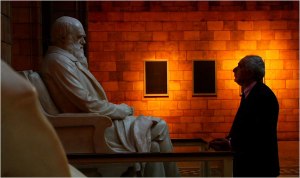 Ignoring the subject matter, Expelled just doesn’t even work effectively as an expose documentary. The movie continuously jumps to old newsreel footage as a visual resource even for mundane conversations. It happens again and again. Either the filmmakers thought their audience had ADD or was too stupid to sit through an interview without several jump cuts to visual reference points. Some of the clips are fun in a goofy retro way but the whole decision comes across like a narrative crutch and it makes Expelled feel erratic. Stein doesn’t try very hard to disguise his interview style, which includes him leading his interview subjects and lobbing softball questions like, “Intelligent Design is just Creationism, right,” and the audacious, “What was the purpose of the concentration camps?” I think it is telling that the interview subjects are not given lengthy reactions and are not pressed into actually presenting what Intelligent Design proof that exists. In contrast, the evolutionary scientists interviewed are intercut with clips of Nazis and Communists soldiers. I don’t even think Michael Moore would have chosen to go that obvious.
While I’m on the subject of Moore, Stein follows some similar ambush tactics and they are obvious and obnoxious. Stein tries to walk into the Smithsonian Center to get a statement as to why a prominent scientist was released and ends up getting kicked out. Did he expect anything different? Portions of Expelled come across as transparently staged, and upon some research I have learned that some were indeed staged. The film opens and closes with Stein addressing a full crowd of college students. They erupt in rapturous applause by the end of his speech and give the man a standing ovation. That crowd was nothing more than paid extras and Stein has never traveled the college circuit to speak on Intelligent Design. The scientists that were interviewed were also misinformed and told that they were being filmed for a documentary called Crossroads about the “intersection of science and religion.” The evolution scientists interviewed were then barred from free public screenings. That should tell you something.
Scientists being blacklisted by their peers seems rather unfair, but the movie takes their subjects strictly at face value. I am convinced there is more to the story than Expelled lets on. One woman off-handedly mentioned the phrase, and that was all, and was let go. I want to know more, but the film apparently doesn’t. Stein even cuts her interview off and dubs his own voice over as she continues her story. I would have appreciated some interviews with scientists who believe in evolution and God. Given that approximately 99.97 percent of life scientists believe in the theory of evolution, so statistically there must be a healthy slew of scientists who happen to be Christians that believe in the existence of evolution.
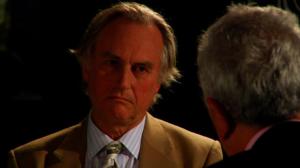 The film is heavy-handed propaganda, sure, but man oh man does it just take an ugly turn in its last third. Ben Stein eventually makes the leap from evolution to… wait for it… Nazism and the extermination of those less desirable. Stein and some of his interview subjects are making the case that Hitler was directly influenced by the tenets of evolution and that he used Darwin’s template to snuff out Jews, Gypsies, gays, the handicapped, and all those holding back the human race with their inferior genetics. There are many steps removed from Darwin to Hitler, but Stein is laying the blame of the Holocaust at the feet of Darwin’s ideas. Arguably, exterminating an inferior race could be applied to the idea of natural selection (though forcibly killing millions doesn’t seem very natural to me) but people were killing each other long before Darwin was ever born. Before Darwin, there was still genocide in the name of eliminating those deemed inferior, and mostly it was performed with the justification of religion. Surely historically religion has been the motivator for more death than Darwin (count the Crusades and the Inquisition). Even specifically Jews have been persecuted and put to mass death centuries before Darwin. And what about all the countries in the world that have embraced evolution as science and not gassed millions of people? But Stein persists in trying to attach the Holocaust and Nazism to evolution. To me, this is like blaming The Catcher in the Rye for shooting John Lennon in the head. Darwin posited ideas and cannot be blamed for others perverting those ideas for their own gain. The film also glosses over the fact that it was Herbert Spencer who introduced the phrase “survival of the fittest,”
And yet after spending a good deal of time linking Darwin and the Holocaust, Stein throws out this caveat: “But I know that Darwinism doesn’t automatically lead to Nazism.” Expelled is filled with other such contradictions. It argues that science and, specifically, evolution does not disqualify the existence of God, and to this I agree whole-heartedly. Science provides the “how” in life and religion can provide the “why” for people. Science does not disqualify God and vice versa; however, Expelled then trumps interview after interview of scientists that explain how evolution turned them into atheists. Huh? The film presses the irritating and confusing point that evolution will turn everyone into a bunch of atheists, but this conflicts with one of the film’s central points on the roles of religion and science. Stein never goes into great detail in this area and ignores the fact that a majority of the American public is both religious and believes in evolution.
 Expelled starts to become an ideological dartboard by the end of its experience. Stein says evolution is responsible for eugenics, which lead to the idea of population control, which lead to Margaret Sanger founding Planned Parenthood. My reaction is: so? Planned Parenthood promotes safe sex and performs legal abortions, yes, but they have nothing to do with eugenics and religion. Henry Ford and Walt Disney were also believers in eugenics. But the interview subjects all seem to repeat the phrase “euthanasia and abortion” like it was a talking point they were handed. The exact phrasing is so precise for several interview subjects that it seems deceptive. Why does this matter at all in a movie reportedly about Intelligence Design?
I cannot honestly see anyone being converted by Expelled. Skeptics and believers in evolution will fail to be swayed, and for the large Christian community the film is courting, well it will be preaching to the choir. I just discovered that there’s a website called expelledexposed.com intent to hold Stein’s film to review. I’m a firm believer in evolution and that Intelligent Design is religion; yeah they don’t specify “who” but how many I.D. proponents were the same ones pushing Creationism in schools earlier? If they stick to the tenets of Intelligent Design then I’d like them to accept the Raelians in their camp (Raelians believe that aliens seeded our planet). Expelled never makes the case for why Intelligent Design should be taught, merely that it is unfair to exclude it from the classroom. The movie presents contradictions, logic fallacies, and some disconcerting guilt-by-association arguments that border on exploitation. Even though I disagree with its ideology, from a filmmaking standpoint it falls apart. The topic of evolution’s relationship to religion deserves a thoughtful and intelligent movie. This is not it.
Nate’s Grade: F
Share this:

No End in Sight (2007)
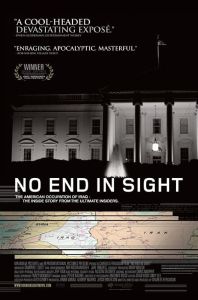 Director Charles Ferguson lived his life as a PhD political scientist, and then he felt compelled to make a movie. No End in Sight doesn’t focus much on the origins of the current Iraq War, which have been well documented and discussed in many other realms, instead the movie takes an exacting look into where the U.S. government fouled up the occupation after toppling Saddam Hussein. Because of this approach, Ferguson’s expose cannot be dismissed under false propaganda claims, and because his interviews mostly consist of the people on the ground who were responsible to stabilize the country, No End in Sight is blessed with plenty of hard-hitting first-hand accounts by the people given the hurried, thankless job of rebuilding a conquered nation.
General Jay Garner and his team, including Colonel Paul Hughes and Ambassador Barbara Bodine, were given 60 days to plan for a post-war Iraq. In contrast, FDR spent years planning ahead for an occupation of Germany. Planning was difficult because when they arrived in Baghdad the post-war looting made setting up a government a formidable task. They not only had to find means to contact people but they had to figure out ways simply to operate in an environment where looting had destroyed buildings and proper tools for communication. They were in charge of ORHA, the Office of Reconstruction and Humanitarian Assistance, which was not run through the State department, as would be normal, but run by the Defense department.
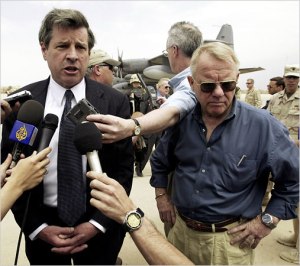 The film holds its harshest criticism for L. Paul Bremer, the man appointed to run the Coalition Provisional Authority, formerly ORHA. Bremer, like many who planned the post-war occupation and were placed in key positions within the occupation, had no military experience, no foreign policy experience with the Middle East, a notoriously tricky region, and he didn’t speak a lick of Arabic. In any other scenario, he would be judged unqualified for his heavy duty ahead. No End in Sight lays out three grievous errors that Bremer made in the summer of 2003 that gave birth to the ongoing insurgency and sent Iraq spinning out of control. The first was absolving any previous work to reach out and include Iraqis in helping to form a working provisional government. Bremer was more a my-way-or-the-highway kind of guy, which may be why he was esteemed in a presidential administration filled with these types. This alienated the Iraqi people and began Bremer’s calamitous habit of bridge burning. His second error was his decision to eliminate the Ba’ath party, Saddam Hussein’s ruling party, and bar members from any future government service. This stripped teachers, engineers, intellectuals, the very people integral to build the infrastructure of a nation, and made them permanently unemployed in Iraq. Many members had merely joined the Ba’ath party because it was the only way to secure a steady job.
But by far the most baffling and incompetent decision Bremer made was to disband Iraq’s army. This boneheaded move went against the recommendations of U.S. military figures, and in the blink of an eye, the 500,000-strong Iraqi army were without a job and an income. There were overtures from military leaders to ORHA; Paul Hughes recounts that one officer promised him 12,000 men in a week if asked. So, in a situation where the U.S. military did not have enough soldiers on the ground to even halt looting, Bremer disbanded Iraq’s best solution for restoring law and order. Half a million angry, disenfranchised, combat-trained, well-armed men were now left to fend for themselves, and if the U.S. didn’t care for their expertise then death militias would. It should come as no surprise that shortly after this colossal miscue is when Improvised Explosive Device (IED) attacks on the U.S. troops surged along with U.S. casualties. It seems like at that point the verdict had come against the U.S. occupation.
 Bremer’s decisions alienated, humiliated, and inflamed the people of Iraq, and they went against the recommendations by people that knew what they were talking about. The greatest tragedy that comes to mind is that, despite morally questionable, downright repugnant reasons for entering this conflict, the U.S. could have done this right. Saddam was indeed a bad man and the people of Iraq were initially receptive to see what the U.S. occupation would bring about. They weren’t expecting rampant unemployment, no tangible security force, being excluded from decision-making, having American private contractors bleed them dry, and an utter lack of basic human services like power and clean water. Add a long-standing religious feud into the mix and it’s no wonder the country has descended into a quagmire. No End in Sight makes the dots easy to follow and connect the cause-effect relationships into where we are today.
It’s hard to watch the film and not feel your blood boil. While No End in Sight is presented soberly and with clear-headed precision, watching the absurd miscalculations and naiveté prevail over the opinions of experts is infuriating. General Shinseki recommended to Congress that several hundred thousand troops would be required after toppling Saddam. Paul Wolfowitz, deputy Secretary of Defense, swiftly countered this assertion by claiming that it was unimaginable that it would require more troops to secure the peace rather than engage in war. “Unimaginable” is the key word here; Wolfowitz just couldn’t potentially fathom a reality that was known by most high-ranking military officials. Stabilizing a country is far more taxing than simply taking out an opposing force. Shinseki, who guided occupation forces in Bosnia and Kosovo, was ignored and pushed into “early retirement,” and Wolfowitz’s plan was followed (Wolfowitz also famously stated that the war would pay for itself thanks to Iraq’s oil revenues).
 No End in Sight does have a figure of amusement and it just so happens to be Secretary of Defense Donald Rumsfeld. The film opens with his farewell address after the 2006 midterm elections where Republicans lost control of Congress and Rumsfeld was shortly ousted from his job days later. He calls the Iraq War little understood and declares that Bush and his team’s accomplishments will one day get the full historical notation they deserve. Of course, the irony is that the designers of the Iraq War had little understanding of what they were getting into and ignored the warnings and advice of those whose opinions conflicted with the Administration line. Many clips of Rumsfeld news conferences are shown and the man comes across as flippant and disingenuous. He dismisses the looting as “stuff happens” and argues TV news is re-running the same image of a man absconding with a vase (“And you have to wonder, are there that many vases in the whole country?” he adds). The Iraq looting destroyed a museum that had artifacts dating back 7,000 years to the dawn of civilization and a library with hundreds of ancient manuscripts was burned to the ground; an entire country’s deep culture and history went up in smoke and Rumsfeld was using it as a setup to a vase joke. The clips further remind the audience that Rumsfeld, one of the chief architects of the war along with Vice President Dick Cheney and Wolfowitz, simply disregards information he doesn’t agree with, whether it may actually be right. The leaders of the Bush Administration demonstrate time and again a supreme disconnect from reality.
No End in Sight is one of the best documentaries yet on the Iraq War and a definitive indictment on the lack of substantial care given to post-war planning. No one can accuse this film of slander or pushing an agenda; this is an exacting autopsy on the current chaos in Iraq, and it has cold facts and hard truths to back up its convictions. Even if you feel that you know all the blunders tied to Iraq, this sensational film is not merely a repackaging of dogma. It’s eye-opening and intensely fascinating and one of the better films of the year; it’s an argument made on the merits of evidence and testimony, and it is damning. One soldier reflects upon the current conditions and flatly asks, “This is the best America can do? Don’t tell me that.” Then after a small pause he adds, “That makes me angry.” You are not alone, brother.
Nate’s Grade: A
Share this:

The Lives of Others (2006)
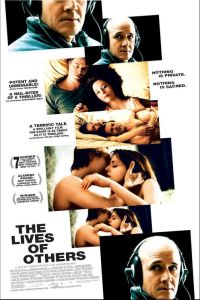 A mesmerizing and piercing human drama that burns into your memory long after it’s over. This Oscar-winner for Best Foreign Film actually deserved to beat out Pan’s Labyrinth. This vastly intriguing, dense, and extremely moving film explores life inside East Germany before the Wall fell, a life not often seen in the movies. The crux of the movie follows a career officer (Ulrich Mühe) in the secret police who has been assigned to eavesdrop on a playwright and his actress girlfriend. It is this assignment that shakes the man’s blind faith in his government, and The Lives of Others becomes nerve-wracking when our silent listener decides to become active in trying to protect his subjects from his boss. This is masterful, artistically illuminating filmmaking with a tight, deeply felt story and superb acting and direction. Germany has been crafting some of the world’s finest cinema as of late, including Oscar-winner Nowhere in Africa and Oscar-nominees Downfall and Sophie Scholl. See this film before Hollywood remakes it and ruins it. Tragically, Mühe died of stomach cancer in July 2007 just as American audiences began to see The Lives of Others and witness the depths of his talent. He will be missed by the world of cinema but his work in The Lives of Others is a lasting testament.
Nate’s Grade: A
Share this:

Evan Almighty (2007)
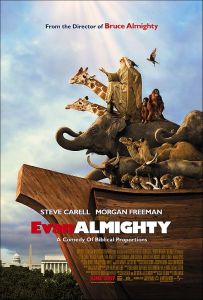 This big-budget sequel goes heavier on slapstick and poop jokes but also crams in environmental messages. I was wondering how the filmmakers were going to angle the whole Noah flood thing without it being world destroying, because nothing says funny like everyone drowning to their deaths. Steve Carell tries hard to make the material work and I give him points for trying. This sentimental comedy has some moments of lively levity, mostly from Carell being bewildered at what is happening, but the film eventually succumbs to some weak, half-hearted messages about treasuring family and producing acts of kindness (I won’t bother spoiling the regrettably inane acronym of ARK). The supporting cast is wasted, none more than Lauren Graham as Carell’s underwritten wife. The Lord works in mysterious ways and so too do movie executives. Upping the budget doesn’t mean the laughs have been super-sized as well. Evan Almighty is passable entertainment thanks to Carell. It’s hard to be preachy when you have so many jokes about poop.
Nate’s Grade: C+
Share this:

Across the Universe (2007)
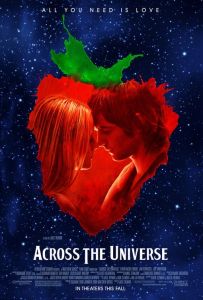 Julie Taymor is a one-of-a-kind artist. She made her name developing Disney’s The Lion King for the theater with highly elaborate and inventive costuming and staging. She then turned her vision to film and directed two strange yet visually splendid entires, 1999’s Titus and 2002’s Frida. Her latest is Across the Universe, a film constructed around actors singing Beatles songs. Hey, everyone likes the Beatles, so what could go wrong?
It’s the late 1960s and Jude (Jim Sturgess) has traveled from Liverpool (where else?) to Princeton to find his father. He makes friends with troublemaker Max (Joe Anderson) and they elect to travel to New York City and find their voice in these tumultuous times. They get a rather spacious apartment and their landlady, Sadie (Dana Fuchs), is a redheaded rock singer. Joe’s little sister, Lucy (Evan Rachel Wood) who just lost her boyfriend in the Vietnam War. JoJo (Martin Luther) and Prudence (T.V. Carpio) find their way to this apartment and into the increasing group of young, music-minded kids in the midst of a social revolution. Lucy fall hard for one another but their relationship is strained because Max has been shipped off to fight in Vietnam and Lucy is joining an increasingly violent radical resistance group.
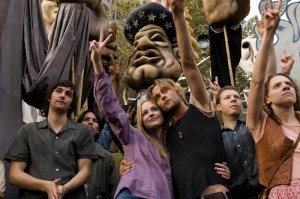 I can’t decide whether it is clever of simply lazy to structure a whole screenplay around 30-some songs by one band. Many of the tunes are used for pointless reasons like “Dear Prudence” is reduced to coaxing a character out of a closet literally, though she is gay so perhaps there’s a double-meaning there, but it’s still lame. In fact, the entire character of Prudence is pointless and grafted onto the story with no real care or precision. She disappears and then miraculously pops up again, with happy girlfriend in tow, and then that’s it. But what really chafes is that when Taymor uses the Beatles’ songs to tell the bulk of her story that means that little feels authentic. Lucy and Jude spout their love songs so quickly after their first encounter. Their romance doesn’t feel believable and, more importantly, it doesn’t feel worthy of our time and interest.
Across the Universe is dripping with Baby Boomer nostalgia and the film leaves no cliché left unturned in its account of history. This jumbled melting pot of every late 1960s cultural event feels as shallow as a junior high report on the subject. Everything from the Watts riots, to the assassination of Martin Luther King Jr., to the Columbia protests and LSD activist Ken Kesey and his colorful bus are elbowed into a story that feels empty and crowded at the same time. Across the Universe is a tad overextended and even goes to the trouble of climaxing with a rooftop jam similar to the Beatles’ last public performance together.
Taymor is a talented visionary but sometimes she lets her creative impulses take over her better judgment. The movie ultimately feels like 30-some music videos strung together by a flimsy boy-meets-girl story that will sink or swim depending upon the song-by-song visual follies. Sometimes Taymor excels with the sublimely surreal like some underwater canoodling to “Something,” Uncle Sam reaching out from a recruitment poster to the tune of “I Want You (She’s So Heavy),” and a spectacular rendition of “Happiness is a Warm Gun” where Max and other war vets cope with their trauma while multiple Salma Hayeks tempt them in sexy nurse outfits. But then Taymor gets a little too carried away with her runaway train of an imagination and her visuals can become simplistic (splattering strawberries = blood shed) or just way too funky, like a truly awful animated excursion where the wonderful Eddie Izzard speak-sings “For the Benefit of Mr. Kite” as a creepy circus ringleader. What does “Come Together” have to do with pimps and prostitutes and Joe Cocker as a bum? The worst moment may be when Taymor decides to visualize the parenthetical of “I Want You (She’s So Heavy)” by having underwear-clad soldiers hauling the Statue of Liberty over the jungles of Vietnam while they sing, “She’s so heavy.” I’m also uncertain about the flagrant jumps into theatricality like the synchronized acrobatic dancing; it’s a bit jarring at times.
 The cast is rather strong from a vocal standpoint and they recorded their performances live instead of within the confines of a recording studio. Wood has a particularly pure voice. Sturgess and his throaty pipes remind me of Ewan McGreggor in Moulin Rouge. Fuchs gives a favorable impression of Janis Joplin. Bono is great in his limited time on screen and hums one dandy version of “I Am the Walrus.” There isn’t a weak singer in the bunch and simply listening to them is one of the highlights of the film, but then I could accomplish this by plugging in the soundtrack. The new arrangements of the Beatles songs are a bit lackluster; they seem too bare and stripped down into vanilla ballads. “Something” sounds exactly note-for-note like how the Elliott Smith version sounded that hauntingly played over the closing credits of American Beauty. I seriously thought that Across the Universe just lifted Smith’s version.
Inherently goofy and occasionally garish, Across the Universe is a misguided trip through the back catalogue of the Beatles. There is a moderate level of fun with the concept and the quirky visuals, but the film plods on and on and eventually the appeal of the gimmick is long exhausted. The singing is strong and the visuals have a sense of whimsy when they work, but in the end the Beatles already had one failed movie constructed entirely from their songs (1978’s Sgt. Pepper’s Lonely Hearts Club Band starring Peter Frampton and the Bee Gees) and now they have one more for a new generation of fans.
Nate’s Grade: C


 nathanzoebl
You must be logged in to post a comment.