Blog Archives
Miss Sloane (2016)
 Miss Sloane is an intelligent and exacting political thriller that should appease fans of the genre who enjoy a good arm-twisting from a powerful manipulator, in this instance the towering and intimidating full force of Jessica Chastain. She plays the titular Sloane, the best lobbyist inside the beltway, and a woman who leaves the comfort of her firm for the challenge of taking on the gun industry to help pass a reform bill. From there it’s an underdog tale powered by the winds of moral righteousness and given a tough-talking yet flawed hero that will burn down whatever she can, including her own reputation, to win. The biggest draw is the performance from Chastain (Zero Dark Thirty) as she gets to yell at people for approximately two hours and look good doing it. It’s a game of persuasion and leverage and D.C. voter politics, and she makes the constant stream of information accessible while providing a focal point for our interest. It’s a pretty information heavy film with a minimal of supporting characters that stand out (Gugu Mbatha-Raw as a school shooting survivor-turned-team member is the notable exception). With her victory never in doubt no matter the odds, the movie establishes that it exists in a parallel world where actual gun control reforms can be advanced. In the wake of doing nothing from Sandy Hook, this must be a fantasy world. Director John Madden (The Debt) keeps the tone as cool and calculated as his heroine. The script by Jonathan Perera is plenty smart though the final act relies upon some unbelievable shenanigans that betray its sense of pragmatic realism. Still, the cunning gamesmanship of a pro working the levers of power for a worthy cause allows for some liberal fantasy indulgence. Miss Sloane is a suitably entertaining thriller that whisks you away and says even “bad people” have a purpose in our broken political system.
Nate’s Grade: B
Share this:

Hillary’s America: The Secret History of the Democratic Party (2016)
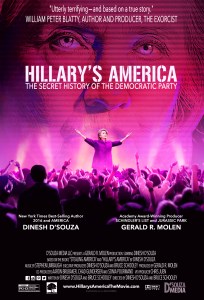 Conservative author and filmmaker Dinesh D’Souza is a man that has been uncharacteristically good to me, personally. He’s made two utterly abysmal political documentaries that are hatchet jobs and were my worst films of 2012 and 2014. However, the man has been a boon for me as far as my own exposure. My reviews for his 2012 and 2014 polemics exploded and became e-mail forwards. They were quoted in message boards, progressive websites, and all over. I still to this day have people that randomly message me to pat me on the back for my rational and methodical take-downs of this charlatan. I wouldn’t say I was looking forward to D’Souza’s next would-be documentary feature but I knew it would likely contend for the worst movie of that year and that I would profit from extra website hits and plaudits. Hillary’s America: The Secret History of the Democratic Party is the underwhelming Return of the Jedi of D’Souza’s trilogy of bad movies. They all exist in a galaxy far, far away from our own reality. Then again D’Souza has been catering to an alternate reality for the majority of his huckster career.
My first problem is that D’Souza tries to rewrite his own history (he has so much experience rewriting others’ history) and pretend that he’s a First Amendment victim instead of a man who knowingly violated federal campaign finance laws. He purposely donated $20,000 under a false name to skirt finance laws and lied about it to the FEC, and as a result was charged with a felony and served eight months in a halfway house. Even D’Souza said, “I knew that causing a campaign contribution to be made in the name of another was wrong and something the law forbids. I deeply regret my conduct.” However, in his own movie, his twists the facts to present himself as a free speech martyr facing a tyrannical president. “If you make a film criticizing the most powerful man in the world, “D’Souza intones with extra ominous relish, “Expect the empire to strike back.” I don’t think Obama needs to worry about a movie that made $30 million total. D’Souza’s deflecting his guilt as an act of imperial censorship and retribution, and not, you know, him committing a crime and pleading guilty. The fictional recreation of his halfway house experiences are resoundingly hilarious for how tone deaf yet ultra serious they are, as if D’Souza had to scrap for survival. What halfway house is also populated with murderers and rapists? I wish we had a scene of D’Souza giving himself a homemade tattoo from an electric toothbrush. His slimy misstatement of his own felonious failings sets the stage for his third cinematic expose that fails to advance a coherent, rhetorically sound case for his crackpot and disingenuous premises.
 Let’s tackle the man’s core argument and what gives his movie its subtitle: the secret history of the Democratic Party as one of blanket racism and oppression. D’Souza tries to make the leap that the Democratic Party is the biggest gang around, exploiting the vulnerable and naïve for nefarious, avaricious gain. He says the Democrats are planning to steal nothing less than American itself. His argument is that the Democrats have been conning the American public, and especially their contingent of minority and poor voters. He cites evidence that he feels is damning, though once again selectively removes context because it would undermine, or in many cases obliterate, his supposed point. D’Souza has to reach all the way back to the 1820s for his broadsides. Did you know that Andrew Jackson was responsible for the forced relocation of Native Americans, and, I hope you’re sitting down, that he was one of the first Democrats? Did you know that following the Civil War many Southerners resisted Reconstruction and joined the Ku Klux Klan and were Democrats? Did you know President Woodrow Wilson was such a fan of the 1915 movie Birth of a Nation, a film glamorizing the rise of the KKK, that he screened it at the White House? D’Souza feels like he’s stumbled upon his moral keystroke but he forgets that it wasn’t just the Democratic Party that was filled with racists during the nineteenth century and into the twentieth; the majority of America held racist views. To somehow suggest that those who registered as Republicans were immune from the casual racism of everyday society is preposterous. Case in point: at the time the Supreme Court rendered its verdict on the Loving case (tasteful movie coming soon), striking down miscegenation laws banning interracial marriage, a full three fourths of the American public disapproved. This was 1967, and the clear majority of the American public still held what could be charitably described as racially intolerant views. In the case of Birth of a Nation, an unquestionably repugnant movie, D’Souza is knowingly removing the fact that it was a groundbreaking piece of cinema and a global blockbuster. It wasn’t just President Wilson that enjoyed this newfangled moving picture, it was many, and it just so happened a majority of those people, Republican or Democrat, were racist.
D’Souza tries connecting the dots in a conspiratorial manner that demands painting mustaches on every former living Democrat just so they would have something to sufficiently twirl as they laugh maniacally. Jackson was apparently the progenitor of having slaves on plantations, as if this could be attributed to one person. D’Souza’s indictment of Jackson and abrupt empathy for the downtrodden Native Americans is in sharp contrast with his previous abhorrent documentary. In that movie, he argued that the Native Americans weren’t really doing much with their land anyway, that the pioneers were the ones who made it valuable, and that what happened to them should not be considered genocide. I don’t believe D’Souza’s phony crocodile tears over the Trail of Tears. If he’s going to decry Andrew Jackson for being a slave owner then why not the Founding Fathers as well? Why not George Washington? Because that would confuse his already confused argument. With D’Souza, the KKK wasn’t a grassroots organization of disaffected and angry Southern white men; no, it was a purposeful political arm of the Democratic Party. Wilson wasn’t just a fan of a popular movie; he and his cabinet were directly inspired to harass African-Americans. For him, the Democrats built ghettos, made sure to stuff them with immigrants, and wouldn’t allow them to leave. For him, Margaret Sanger wasn’t fighting for contraception for women’s health and equality but so she could stop black people from reproducing. For the record, Sanger spoke to whoever would listen to her cause, which did include the Klan at one point. For D’Souza, Planned Parenthood exists to wipe out minorities, and he even makes use of those undercover videos by conservative activists that got the activists charged with criminal activity, not Planned Parenthood, which was cleared for all outrageous charges. Everywhere he looks, D’Souza sees widespread conspiracy and the intent to do maximum harm. The shrill partisan attacks are amplified to the point that any points are muted. Not too many are going to defend Andrew Jackson to this day, but what about recent history, eh?
 It’s not long before you start to notice a hard cap on all of D’Souza’s historical anecdotes. They all seem to end just about the time of the signing of the 1964 Civil Rights Act, which is by no means a coincidence. When President Johnson signed the bill into law he said that the Democratic Party had likely lost the South for a generation. Almost sixty years later, I think he undershot that estimate. The party of Lincoln is no longer the party of Lincoln, judging by their policies and candidates. D’Souza has to reach back more than half a century to posit his case that the Democrats are the real party of racists. This line of argument is somewhat tainted with the 2016 Republican presidential nominee refuses to recant his excoriation of the exonerated Central Park Five, tells African-Americans they’re “living in hell,” and far too frequently retweets ugly messages from white supremacist groups. Which political history is more relevant to today, the actions of the last 30 years or over 200 years ago? The Republican Party doesn’t get a free pass because at one time certain members supported abolition and women’s suffrage. D’Souza even says, “As the South became less racist, they became more Republican.” Huh? The parties have held the same names for hundreds of years but their policies and platforms have shifted along with the nation and culture. To pretend that Democrats or Republicans today follow the exact same policies from hundreds of years prior is intellectually dishonest and thoroughly facile, which sums up the host of D’Souza’s feeble arguments.
D’Souza’s grandstanding and myopic personal crusade gets in the way of his larger message. You could easily construct a documentary about Hilary Clinton being unlikable or hard to trust. She is often her worst enemy and her penchant for secrecy can be reasonably unnerving. You can make an anti-Hillary doc without resorting to ad hominem attacks and worse. There are legitimate critiques over the Clinton Foundation and its lack of transparency, but D’Souza can’t help himself. He shouldn’t have to utilize bracingly absurd, offensive propaganda imagery like a young Hillary watching the bombs of the 1960s with unseemly fascination, the slow-motion horrors reflecting onto her youthful glasses, a fascination to her calculated expression. He shouldn’t have to resort to such incendiary charges like, “Now we know why Hillary let all those emergency Benghazi calls go. She couldn’t make a buck off of them.” Excuse me? She let Americans die because she couldn’t pad her wallet? “Hillary’s plan was to take over the institutions of government,” D’Souza intones, as if she was a Manchurian candidate who activated instead of a young political activist in law school. The main argument D’Souza musters against Hillary, well after 75 minutes of movie, is that her husband was a serial philanderer. In what may be the most outlandish accusation of the whole movie, D’Souza says that her husband’s infidelity is her fault and that “in many ways she orchestrated all of this.” Just take in that statement. It might take a while. Let it settle in. She “used his addiction to make him dependent on her.” Bill Clinton’s indiscretions have been well documented and are worth another examination in modern light, but this is new. And then this icky nugget took my breath away: “Bill, after all, is in a long line of Democratic ‘plantation owners’ who took power over women in their control.” We had earlier seen Andrew Jackson in bed with his slave, though again other Founding Fathers are left out of this charge, like Jefferson, because it would dilute the message. The level of projection and armchair psychology is staggering and often without coherent evidence.
The shady tactics and paranoid fear-mongering feel rather played out the third time around. Conservative boogeymen are thrown out there (Sanger, Alinsky, Daley, Chicago in general) but it feels like D’Souza cannot even be bothered to properly lambaste them. It’s like he’s checking the boxes of conservative agita and expecting that he doesn’t need to explain anything because of course Saul Alinsky was connected to Al Capone and ipso facto Hillary Clinton is a criminal. He sets them up and chiefly moves along, propelled by some other point that never fully materializes. He purposely blurs the line between archival footage and interview recordings and slanted fictional recreations. There’s a strange recreation where Obama’s father visits his classroom to present an African perspective on culture, including a spear and tales of killing lions. Why does the documentary even require a scene like this? D’Souza only deigns to say Obama learned how to “pitch” from his father. It’s an odious dog whistle to its core audience to remember that Obama is an “other.” There’s another strange moment when a fantasy Hillary leans into the ear of a dissatisfied man to whisper, “They are rich because they steal from you.” As the star of his trilogy of lunacy, D’Souza is the hysterically nonplussed face of his own madness. His interviews often set up his subjects with leaning questions and confirmation bias. It’s as productive as watching D’Souza interview himself, especially when there are perhaps only four interview subjects total, half of them partisans. D’Souza puts himself as the head of his own story of discovery as he wanders around and looks wide-eyed and forlorn over the symbols of America’s greatness, like a field of wheat he solemnly touches. It feels like D’Souza is going through the paces of what his audience is expecting and serves it up without mental taxation. The movie even ends on three straight musical performances, including one by D’Souza’s new wife, that sum up America’s greatness through stock footage montage of patriotism clichés.
 Hillary’s America wants to spare the nation at a critical moment in history, but D’Souza’s agitprop will only appeal to the converted or at least those viewers with an alarmingly low quotient for intellectual curiosity. “They can’t take America from us without our consent,” D’Souza rallies his crowd into mobilization (as a felon, he has lost his right to vote in the meantime). The reason I very much wanted to review this movie specifically today is because it’s Election Day and the country has been given a very stark choice. People talk about the deep divides in this country, and it’s men like D’Souza that are stirring those divisions, placating and agitating their audiences, and knowingly distorting facts and reality in a shameless attempt to milk money from the hapless. Here is a man who said Obama never truly lived the “black experience” because his mother was white. Here is a man who tried to mitigate the horrors of slavery in his previous documentary and termed it “theft of labor.” Here is a man who believes Christianity literally invented compassion. Here is a man who states that no Republicans owned slaves. He is not a man who tells truth to power but a man who willfully distorts the historical record in order to make people feel better about unhinged political takes that have no bearing in reality. It is people like D’Souza that have lead the way for the coronation of Donald Trump, and it should be people like D’Souza who are put to blame when that experiment crumbles. He couldn’t be an effective propagandist if he tried, and it really doesn’t feel like he’s even trying. Maybe at some level D’Souza is admitting defeat or at least sees the writing on the wall. He’s been on the wrong side of history and eventually history will judge him as well. Meanwhile, Hillary’s America is a disaster of a movie and the worst film of 2016.
Nate’s Grade: F
Share this:

Snowden (2016)
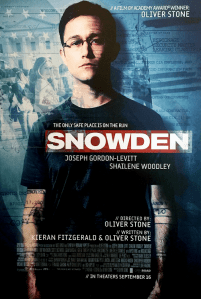 There’s quite a difference when director Oliver Stone actually gives a damn with a movie, and you can tell with Snowden that he is passionate about making a compelling and accessible movie for American audiences to understand why they should be angry. He wants to lead the righteous civil liberties mob against the right perpetrators while providing an appreciative moral context to the actions of Edward Snowden, America’s most famous fugitive. That sense of purpose and drive animates Stone in a way that his recent films have not, and even though it’s far less gonzo and experimental as Stone’s quintessential catalogue, the storytelling skill is still consistently engaging and the resulting 134 minutes inform as well as entertain.
Edward Snowden (Joseph Gordon-Levitt) wanted to serve his country and his expertise in computers landed him in various jobs working for U.S. agencies. He discovered the abuse of surveillance over everyday citizens rubber-stamped by a FISA court meant to provide oversight. Callous private contractors would surf through thousands of collected data points, and if pressed, could justify through terrorism connections, as it seems anyone in the world is perhaps three connections away from a person of interest (consider is the really unfortunate version of the Kevin Bacon game). Snowden risks everything to reach out to a team of journalists (Zachary Quinto, Melissa Leo, Tom Wilkinson) to tell his story and make sure the larger public will know these abuses of power.
 The best compliment I can give Stone as a screenwriter and director of Snowden is that he took a thoroughly challenging scenario with few cut-and-dry answers and made an accessible movie experience that effectively conveys moral outrage and dismay. It feels like Stone the educator is leading you by the hand, taking time out to explain some of the more delicate intricacies of the murky stuff that goes on behind closed doors. I won’t exactly declare it to be an intelligent examination on the moral implications of the material, but it’s certainly a movie that lands its goal of clarity. It produces a sense of clarity for the subject and a sense of clarity for why Snowden made the decisions he did. Gordon-Levitt delivers a steadily engrossing performance, even if it takes several minutes to adjust to his distracting speaking voice. Maybe my ears are just broken but it doesn’t sound like Snowden. Fortunately, my ears did adjust accordingly. Gordon-Levitt and Stone effectively kept my attention throughout the film. I was surprised how much I found myself enjoying long stretches of this movie, even if my own stance on Snowden is less clearly defined. He talks a good talk but the reality is messy.
Given Stone’s conspiratorial history, the plot definitely comes with a distinctive point of view over whether Snowden is a hero or a traitor. I don’t think inherent bias in a movie or the angle taken in storytelling is inherently misguided and that all stories should be as objective as possible. Sometimes the circumstances don’t permit objectivity. Stone’s film is clearly biased but it doesn’t fall into a hagiographical hero worship of its titular figure. This is a complicated subject and deserves a proper analysis to place the real-life people in the meaningful morally ambiguous context. Snowden ultimately makes the decision to become the world’s most famous whistle-blower for what he felt were systematic abuses of government surveillance, but before that climactic decision he comes across less than a spotless martyr. His character arc is a fairly recognizable awakening of alarm and horror at the great abuses of power in the name of security. He does start off as a lifelong Republican with family members who have served in the military and different governmental bodies. He’s devastated to be medically discharged from the Army and hungry to serve his country. He’s a patriot who becomes disillusioned with the system, but he’s also rather self-involved and excuses ego with civic duty. I didn’t know how gifted Snowden was in his field, and the movie has some amusement with the wunderkind training sequences where Snowden delivers shock and awe to his stunned superiors. However, the second act becomes more than a bit protracted because Snowden keeps quitting but eventually going back to government surveillance, whether CIA or private subcontracting. This is because of the pay, sure, but it’s mainly because nobody can do what he can do. He feels important. He feels needed. He convinces himself he’s making a difference in the War on Terror, but eventually the reality of the widening peripheral of the war zone is too much to ignore for him.
This is further epitomized through the romantic subplot with Lindsay Mills (Shailene Woodley), a liberal firebrand, photographer, and exotic exercise instructor. Woodley (The Fault in Our Stars) does her best infusing a warm personality into what is too often the underappreciated yet overly agreeable girlfriend role. It’s a storyline meant to further humanize Snowden as well as personalize the encroaching invasions of privacy and subsequent paranoia. After he discovers that the government can activate laptops and watch oblivious citizens through webcams, Snowden can’t help but stare down his open laptop during an almost laughably forced sex scene. My reaction as Lindsay climbed aboard Snowden was exactly this: “Oh, I guess this is happening now.” She would have a greater impact if the movie did more with her character, as she is the long-suffering girlfriend who keeps accommodating his life choices. They move three times across the country for his jobs and Snowden is always unable to fully explain why he feels the pull to these tech occupations, which further frustrates a woman who just wants trust and stability. There is one interesting conversation that Lindsay offers, typifying the blasé response to spying with a “well I have nothing to hide, so who cares” rationale. Snowden is quick to admonish this line of thinking, an opinion that many still share. The other regrettable reality is that the romance is inevitably going to be the least interesting facet of this story. By going behind the curtain of American secret surveillance, we’re indulging in our collective curiosity at how exactly all these moving parts operate. To then go home and watch a couple squabble is a consistent letdown of drama.
 There are a few other artistic miscues that weigh down Snowden, mostly Stone’s penchant for heavy-handed symbolism. The same instincts that allow Stone to carefully thread a knotty story are the same impulses that tell him that subtlety is for cowards. There doesn’t need to be a frame story here. I understand that select media outlets trying to break this story naturally allows for a question-and-answer framing system of flashbacks. However, very little is added besides a skeletal structure. The media members act as reactionary acolytes. It was all captured much more credibly in the Oscar-winning documentary, Citizenfour. There’s no earthly reason for Nicolas Cage to be in this movie except for drawing financing. He plays an old CIA code-breaker and admirer of outdated technology, but really he’s there to serve as an institutional nod to Snowden. At the conclusion, when Snowden’s identity and message becomes public, there’s a scene where Cage’s character literally toasts his pupil’s actions. I would say it’s a bit much but the character is a bit much for an actor that hasn’t generally been known for restraint. When Snowden is leaving the CIA offices in Hawaii for the last time, he steps out into the light (get it? get it?) and the scene is practically rendered in slow motion as the enveloping white light fills the screen and bathes Snowden (get it? get it?). He smiles bigger than we’ve ever seen. Lastly, Stone can’t just help himself during the very end and has Gordon-Levitt replaced with the actual Edward Snowden to deliver the closure of an interview. I don’t think we needed a reminder that Snowden is an actual living person.
Snowden the man, and Snowden the movie, wanted to shake up an ignorant and apathetic American public about the dangers of unchecked power in a surveillance state, but was the mission a qualified success? Years later and Snowden living in exile in Russia, the charitable answer would be inconclusive, though the pessimist in goes further. It very well seems that the majority of the American public simply doesn’t care (out of sight out of mind). The trial over whether Snowden is a patriot or a traitor seems a little moot perhaps when the larger public shrugs at the revelations of security overreach. Does a movie about a Great Man have as much resonant cultural cache if that defining act of greatness produces a shrug? I’m by no means saying we should apply a polling system to accurately measure a person’s value and accomplishments to the larger cultural and political landscape. Snowden wanted to wake the public up but we hit the snooze button. In the meantime, the movie about his exploits is fairly entertaining, so at least he has that.
Nate’s Grade: B
Share this:

War Dogs (2016)
 As I watched War Dogs, the darkly comic true-life story of war graft, gunrunning, and bro-tastic bravado, I kept wishing to copy and paste other characters into what was an interesting plot. A pair of neophytes was awarded military arms contracts from the Pentagon during the Iraq War, and their schemes to skirt U.S. laws to import guns across borders, illegal and faulty munitions, and uneasily work as a go-between with a client (Bradley Cooper) on the U.S. terrorism watch list are filled with perplexing yet juicy details. The biggest problem is that the two main characters, played by Miles Teller and Jonah Hill, are so powerfully archetypal to the point of unrelenting blandness. We have the naïve everyman pulled into a life of big bucks, big risk, and big power only to have it all come crashing down. Hill’s character is the loud, uncouth part we’ve come to expect from the Oscar-nominated actor, and I defy anyone to tell me anything about Teller’s character other than occupation and his relationship to other people. These parts are so thinly drawn that I didn’t care about them once they finally got into deep trouble. I believe that director/co-writer Todd Phillips, he of The Hangover series, has the right qualifications to make a flinty neo-noir thriller, but War Dogs is more his half-hearted version of a glib Scorsese movie, or a David O. Russell version of a Scorsese movie. The voice over narration is dull and doesn’t help illuminate Teller’s character at all, and the other stylistic flourishes, from pointless inter-titles to a non-linear plot, add up to very little. Half of the movie’s scant jokes are the ongoing sound of Hill’s off-putting wheeze of a laugh. I’m not kidding, after an hour the movie still treats his laugh like it’s a potent punchline. There is entertainment value to be gleaned from War Dogs chiefly from its larger-then-life story and the intriguing, shadowy world of war profiteers. It’s a movie that made me wish I had read the magazine article it’s based upon instead, which would have also been shorter.
Nate’s Grade: C
Share this:

Atlas Shrugged Part III: Who is John Gault? (2014)
 Thank goodness there won’t be any more of these turgid, laborious, and insufferably awful movies that stretch the loose definitions of cinema. Atlas Shrugged Part III concludes a storyline that did not need the bloated, Peter Jackson-style treatment. Mostly because after four hours, the series still fails to justify its film existence. The production values are pretty low, the storyline consists of robotic characters spitting out ideologies rather than dialogue, and the romance between Dagny (our third actress playing the part) and Henry Reardon, which was a focal point for two movies, is casually brushed aside so Dagny can swoon with the mysterious John Gault. The needless subtitle for the film is “Who is John Gault?” and the answer is an innovator who invited the world’s richest CEOs to escape to a magic kingdom of their own. Analyze that hilarious reality. It’s an island of the 1%, but what does being experts on derivatives do when it comes to individual survival in the wilderness? Do these people plant their own vegetables, build their own homes, or do the menial labor they are not accustomed to? Where did they get the materials for all the goods for this libertarian paradise? Nothing about how this world operates makes sense. If the government, set up to be nefarious and inept, was concerned about Gault why can’t they find them with their wealth of spy resources? The entire Atlas world, transported to a near future that still relies heavily on logistics of the past, strains credulity, from the rise of rail to the idea that a copper shortage is crippling the country’s power supply. This is the kind of film where the good guys (business elites) dress in plaid and drive pickups, whereas the bad guys (government) wear suits and smoke and drink in darkly lit restaurants. This is the kind of movie where “Project F,” a nefarious torture device created by the government, is literally nothing more than a glorified car battery. Then there’s the climactic moment when Gault becomes a full-fledged messianic figure, something in sharp contrast with author Ayn Rand’s views on religion. In fact, Jesus is a prime example of self-sacrifice for the benefit of others, which conflicts greatly with the Randian viewpoint that selfishness is all humans should seek. The entire film is about cognitive dissonance, from the characters, the filmmakers, and Rand herself.
Nate’s Grade: D-
Share this:

The Interview (2014)
 Well, so maybe you’ve heard something about this little movie, The Interview? Seth Rogen and his writing partner Evan Goldberg (This is the End) weren’t intending to spark an international incident with their comedy about a pair of idiots trying to assassinate North Korea’s glorious leader, but after a few crazy turn of events, this little movie became a quixotic symbol of American patriotism. How dare North Korea get to dictate what Americans can and cannot see! Well, now The Interview is widely available in digital markets and we can agree that the fervor was for naught. The film is most shaky in the beginning, setting up Rogen as a TV producer and James Franco as the obnoxious talk show host. Once the boys get tangled up with the CIA, and especially once Kim Jong-Un comes into the picture (played by a much better looking actor, might I add, North Korean readers) the movie starts to even out and find its comic rhythms. While the ending is a little ho-hum, there are nice payoffs for several jokes and a poison strip has a wild and very funny comic development. I also enjoyed the emerging bromance between Franco and Kim Jong-Un that danced around with being subversive. However, there are two problems with the film. It doesn’t get risky enough (too many penis jokes) and James Franco. He’s been a capable comic actor but always in supporting or as a foil. Franco is not a comic lead, and his performance is much too amped and broad, needing to be dialed down to feel less desperate in overexcitement. It’ll be more a footnote in history than comedy, but The Interview is a fairly innocuous comedy that does get better as it chugs along, though clearly hits a ceiling. It’s certainly not anything worth going to war over.
Nate’s Grade: B-
Share this:

America: Imagine the World Without Her (2014)
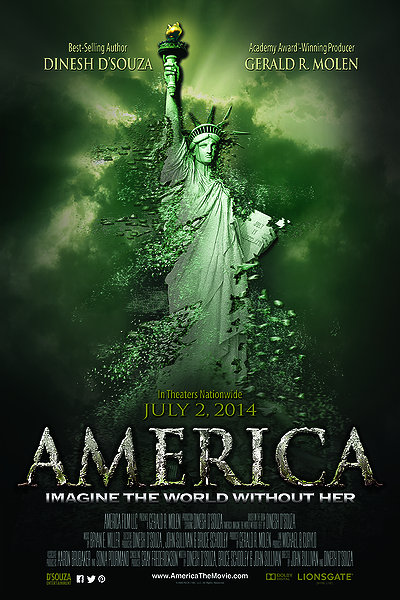 Conservative author and political speaker Dinesh D’Souza struck gold with his last documentary, 2016: Obama’s America. The 2012 film struck a chord with enough moviegoers to earn over $33 million at the box-office, and it earned my own hallowed award for Worst Film of 2012, a puerile character hit-piece that only served as agitprop. My in depth review even got picked up by other outlets and message boards and became something of an e-mail forward itself. So when D’Souza announced his follow-up, America: Imagine a World Without Her, I knew I would have plenty to write about. It’s not as overtly risible as 2016 but its true intent is possibly even more sinister. Let me assure you, dear reader, that I go into every movie to objectively critique what works, what doesn’t and why. I would welcome a conservative counterpart to Michael Moore, but Dinesh D’Souza is not that filmmaker, not by a long shot.
The film begins with an interesting “what if” scenario questioning what might have happened in history if George Washington had fallen on the battlefield and America had lost its revolution for independence. American monuments are turned to dust and ominous music pervades. However, instead of following through on this slice of alternative history, D’Souza switches gears immediately and points toward a new goal. He wants to change what he sees as a “shame America” narrative, fostered by the likes of Howard Zinn and Noam Chomsky and the “blame America first” crowd of liberal and academic nogoodniks. To do so, D’Souza seeks out to reclaim America’s past, which amounts to defending or mitigating the famous sins of America’s past. D’Souza’s demonstrably shaky logic disputing America’s past ills only takes a modicum of critical thinking skills to see it for the intellectually facile, dishonest, disingenuous, morally bankrupt rhetoric of a charlatan. Allow me to examine D’Souza’s rebuttal of the five reported thefts he examines in the film.
 1) “Theft of land from Native Americans.” This one seems pretty obvious. They were here first. American settlers, as well as other nations, came, conquered, and Manifest Destinied the continent. D’Souza tries to argue that the Native Americans themselves would engage in war and take over other tribes’ territories; therefore their original claim to the land is nil. Also, the land is only valuable because of what the new owners built on that land. I guess America’s national parks have no inherent value then. It almost ends up transforming into a rhetorical line that the Native Americans didn’t know how best to use their own land, so they didn’t deserve it. The worst part of this segment, besides breezing over the Trail of Tears and countless broken treaties, is that D’Souza has the temerity to dispute the semantics of “genocide.” See, D’Souza opines that with genocide there has to be intent to do harm, and Europeans simply bringing along deadly infections the natives had no immunity for cannot count. Never mind the whole smallpox blankets episode, America’s earliest form of biological warfare, which was intentional. D’Souza then compares the decimation of the Native Americans via disease to the Black Plague. “We don’t call that genocide,” he smugly asserts. Let me provide a more fitting analogy: if Turkey had invaded the European continent, bringing with it the Bubonic Plague, and then purposely spread it to the natives to eliminate them, while claiming the land as Turkey’s own, establishing settlements, and forcing the weakened Europeans into small unobtrusive clusters, well maybe we would accurately call that by all accounts genocide.
2) “Theft of labor of Africans.” First, re-read that sentence and really let D’Souza’s slimy word choice sink in. “Theft of labor” is what we’re calling slavery now? How about theft of life, theft of rights, theft of future, theft of family, theft of dignity, theft of their basic humanity? This rebuttal is curious because at the outset D’Souza admits, “Yes, slavery was theft.” Everything referenced after this point cannot alter this declaration, meaning the rest of this segment is all about mitigating the terror of slavery. D’Souza says the United States didn’t invent slavery, and that even Africans would enslave one another. He literally uses the “everybody else was doing it too” argument children use to get away with misdeeds. He even tries to turn it around as a positive, enthusiastically informing us that America is the only country to fight a war to end slavery and that makes us a special place. Well, that’s one way of looking at it. Another way would be to celebrate other countries that didn’t require bloody wars to come to a consensus that owning other people as property was morally repugnant. Then D’Souza flouts anomalous examples to try and muddy the disgraceful practice of slavery. There were black slave owners, yes, because these people still exist in a crooked system. What does the existence of black slave owners prove? D’Souza’s unsourced claim that there were as many black slave owners as white slave owners is so obviously dishonest that it takes your breath away. But even if it were true, which it is most assuredly not, what does it prove? Is D’Souza trying to say blacks are just as complicit in slavery? Then he adds that white indentured servants worked alongside many slaves and they had it rough too. Indentured servants were still seen as people with human rights. There is no comparison to slavery. The end.
3) “Theft of land from Mexico.” This one is given even shorter shrift, mostly boiling down to a simplistic analysis of how lousy life is in Mexico. The United States gained much of the western states after annexing them from Mexico. D’Souza reasons that after the war we had all of Mexico and we only took half, so that should be acceptable. “I wonder how many of those in Mexico wish we had kept all of their country,” he intones.
4) “Theft of independence with foreign policy.” I forget the exact wording on this one, but really it just amounts to the American wars and conflicts in the last 50 years. Tackling Vietnam, D’Souza offers a straw man that has never existed in mainstream thought: that we went to war in Vietnam to take over their land as imperialists. The war in Vietnam was a result of the domino theory in thwarting the spread of communism, not to take over Asia. On top of this, let’s ignore the Gulf of Tonkin incident that was manufactured as a rationale to escalate a war in South Vietnam. All D’Souza does is interview one P.O.W. veteran who says he went to war to spread democracy. That’s fine, but one man’s experience is anecdotal and not indicative of the whole, let alone of the military command. D’Souza then says we gave back Iraq to the Iraqis and didn’t ask for anything in return, except, you know, permanent military bases that they objected to. Wars aren’t just fought for territory, they can be fought for profit by powerful interests; just look at the military industrial complex run amok. And yet, weirdly, D’Souza never combats Noam Chomsky’s listing of all the American-assisted coups across the globe, from Iran (1953) to Chile (1973) to Brazil (1964) to Guatemala (1954) and others. In 2011, documents over the Iran coup were declassified and admitted CIA involvement as “an act of U.S. foreign policy conceived and approved by the highest levels of government.”
 5) “Theft of wealth by capitalism.” D’Souza actually comes to the defense of Wall Street, lamenting that America’s wealthy are under unfair attack from the unwashed masses. First, D’Souza conflates a critique of unregulated, Laissez-faire capitalism with capitalism itself. There are socialists and communists and others of similar ideology out there, but the mainstream left is not arguing for the wholesale destruction of the economic system of this country. A lack of oversight and unchecked greed and fraternal collusion lead to the financial meltdown of 2008, bringing the world to the brink of economic ruin because of the bad bets of Wall Street. Instead, D’Souza stages a silly example of himself running a fast food restaurant, complete with himself playing all of the workers and with a comical (?) Indian accent. He flatly contends that it costs the consumer more money to make a hamburger at home than to buy one from his restaurant, ipso facto “the American people are not being ripped off.” This is D’Souza’s insufficient summary of capitalism, ignoring the 2008 financial crises, ignoring the robber barons, ignoring strike-busting, ignoring the reasons the unions had to be formed in the first place because of dangerous, unfit working conditions that would still exist without intervention. Thomas Piketty wrote a 700-page book on the history of capitalism that has become an unexpected runaway bestseller. He studied hundreds of years of documents of all sorts and concluded that return on capital is higher than the growth rate of the economy, meaning the rich get a bigger part of the pie as time goes on. Economic inequality is hitting record rates not seen since the Great Depression, but somehow for D’Souza this is Obama’s failings and not those of the enshrined 1%, a.k.a. the “job creators.”
Each of these segments runs less than 10 minutes and D’Souza seems to brush through them with little effort as if the man can’t be bothered to knock down his own poorly reasoned straw men. Every claim that D’Souza makes is lacking in substantive facts. He has little evidence to support his slanted and mischaracterized claims. I only recall him ever once citing a source as he worked through his rebuttal of America’s past transgressions. That’s because D’Souza’s assertions don’t hold up under any trace amount of intellectual scrutiny, which is why he often defers to emotional appeals and anomalous anecdotes (Hey, a black woman became the first female millionaire selling hair products, therefore all ex-slaves could have prospered in this country if they only worked hard, never mind Jim Crow and all that). We watch re-enactments of the P.O.W. being tortured in Vietnam, and obviously our empathy goes out to this man, but that doesn’t erase a million dead Vietnamese and 55,000 fallen Americans. There is an absurd amount of historical re-enactments in America, to pad out its running time given the paucity of its argument, but mostly to fall back upon unfettered emotional appeals. D’Souza relies on the symbols of patriotism and actors portraying great figures from history, notably Abe Lincoln, to persuade his audience about the unimpeachable history of America rather than the integrity of his unsubstantiated and spurious claims.
D’Souza doesn’t even bother to cover his obvious biases with his interview subjects. He asks Michael Eric Dyson why the re-election of Obama doesn’t mean “the end of racism” (forgetting that half of the country did not vote for the man, and no, this does not mean every non-Obama vote was a racist). He props extremist Ward Churchill as the face of modern liberalism, referencing his comparison of 9/11 victims to Eichmann, and prompting him to justify dropping an atomic bomb on American soil as retribution. D’Souza then spends the duration of an interview with a Mexican-American student by asking him what the American Dream means to him. His interview subjects are also rarely identified onscreen, nor does D’Souza disclose such pertinent facts like the talking heads belonging to prominent conservative think tanks, ones that have lined his own pockets. There’s also a noticeable lack of follow-up questions. D’Souza’s interview style is also haltingly slow and modulated, as if speaking slower is the same as being reflective. But my favorite interview by far begins with these magical words: “Senator Ted Cruz, why did the Mexican-American War take place?” Oh my.
 America lacks a general workable thesis to hold its claims and counter-claims together, which is something at least 2016 had going for it. This may be because the film’s possible real intent is only revealed in the closing twenty minutes, and it amounts to a plea not elect Hilary Clinton to the White House. D’Souza’s last effort to stop Obama’s re-election didn’t work out, even though he claims his ridiculous assertions have come true (the debt hasn’t doubled since 2012 and Israel has yet to become the “United States of Islam” as well). D’Souza enjoys reasserting conservative bogeymen, which is why we get more references to Bill Ayers, Reverend Wright, and especially Saul Alinsky. Until a few years ago, I doubt anyone even knew who this man was but now D’Souza, and others, have pinned him as the ultimate political bogeyman, contorting America from beyond the grave. That’s because his disciples are living out Alinsky’s anti-capitalist dogma, chief among them Obama and Hilary Clinton. There is a goofy re-enactment where a young Clinton is introduced to Alinsky in a high school cafeteria, and the scene is played with such ominous music and lighting that it’s meant to convey a sit-down with none other than the devil (Alinksy is quoted as taking organizational tips from Lucifer, so you make the connection, audience). Hilary wrote her college thesis on the guy even. However, when she graduated she turned down working for the guy and instead became a lawyer, so… I don’t know what. Hilariously, the Alinsky re-enactments are bursting with overwrought menace including one incomprehensible scene of Alinsky sitting in his car and scoping out school children for likely nefarious purposes. “Alinksy would love Obamacare,” D’Souza notes, which makes little sense considering the ACA is all about providing new clients to private industry. As a socialist, I imagine Alsinky would have preferred the public option found in every other Western nation.
It’s these kind of broad generalizations, armchair psychological projection, and guilt-by-association pleas that typify D’Souza’s documentaries. Last time he said Obama’s “anti-colonialist” views were all because he wanted to appeal to an absent father he saw a couple of times in his life. Now D’Souza is warning us that Hilary Clinton is doing the same but trying to appease the ghost of Alinsky, a man she turned down working for way back when.
The real question is WHY would anyone even pose arguments to mitigate the horrors of slavery and genocide? What morally charitable rationale can even be created to try and argue that these horrors were not as bad as history has thoroughly documented? D’Souza says he wants to take control of the “shame America” narrative, but in doing so he’s whitewashing and mitigating this country’s mistakes just to make, what, his core audience of conservatives feel better about themselves? In this, I must quote my critical colleague Ben Bailey, himself paraphrasing a quote from Al Franken: “Franken once observed that, while liberals and conservatives both love America, they love it in different ways. Liberals love America like an adult loves their parents, seeing them not just as mom and dad but as complex individuals with strengths and flaws. Conservatives love America like a baby loves his mommy, who in the child’s eyes can do no wrong, and anyone who says so is a lying bastard.” Patriotism does not mean turning a blind eye toward your country’s mistakes, past and current, nor does it make the ignorant more patriotic than the educated that accept their country’s past, warts and all, and pledge to ensure that those same mistakes are never repeated. Now, slavery isn’t exactly likely to return any time soon to this country, but the core tenets that enshrined slavery were looking at others as subhuman, as undeserving of equality, rigging a system to deny people fair opportunities, a true lack of empathy for the hardships of others. These traits still exist today and can still be found in modern domestic and foreign legislation.
 As a movie, America: Imagine a World Without Her is also a failure. It’s a political polemic that preaches to the faithful, assuaging any feelings of guilt they may have had over the past sins of our country, and yet D’Souza doesn’t even offer a vigorous or even competent attempt to do just that. Unless you are already converted to D’Souza’s worldview, you are unlikely to be persuaded by this crackpot expose. The film lacks corroborating evidence for its outrageous claims and rebuttals, conveniently ignoring a larger context in many cases because it would disprove D’Souza’s disingenuous claims, that is, when D’Souza isn’t inadvertently disproving his own claims. History is written by the winners and Zinn wanted to show history from the point of view of the oppressed, the disadvantaged, and the lower classes that typically get lost amidst the resuscitation of kings, generals, and Great Men of Industry. D’Souza’s view seems to be, yeah history is written by the winners, so stop whining minorities and suck it up. After all, the Native Americans get to open casinos, so how bad off can they be? Here’s the thing: most people, liberals and conservative and everyone else, don’t feel guilt per se about Native American genocide or slavery, mostly because we were not alive and responsible. I feel no more guilt over these issues than I do over the other numerous acts of genocide, slavery, and general horror that populate the far-away past. But civilization is a constant work in progress and the responsibility of every citizen is to try and make this world better than it was before. The past informs our actions and our understanding of the world and us. Nobody except the fringe thinks America is a pit of unrepentant evil that has done the world nothing but harm. It has been a force for good but it’s also made mistakes, but to quote Stannis Baratheon, “The bad does not wash out the good, nor does the good wash out the bad.” We all love our country but just because some recognize certain inconvenient historical facts don’t make them any less patriotic.
With all of this exhaustively analyzed, allow me one more moment of examination, borrowing some of the armchair psychological speculation that D’Souza likes to primarily trade in. It appears that D’Souza has a healthy opinion of himself bordering on obsessive narcissism. He cheerily lets us know his past film ranks as the number two highest-grossing political documentary of all time, omitting who owns the number one spot and by a large margin. His name is listed SIX times in the opening credits, including credits for having written the source book, writing the screenplay, and “creating and narrating” the film. Much of the film involves D’Souza in his turtlenecks strolling along national monuments and looking forlorn. He is the star of the film. But there’s also the problem that D’Souza pleaded guilty to federal campaign finance fraud, posing as third parties to continue making campaign donations in 2012. D’Souza admits, “I made a mistake. No man is above the law,” but he frames his guilt as martyrdom. D’Souza makes himself seem like the “latest victim to be targeted by the White House,” instead of, you know, a man who broke the law and got caught. He argues the White House, using the NSA and the (debunked) IRS scandal, are out to silence dissent, abusing whatever measures they have at their disposal (never mind that Bush began the wiretap surveillance program). I propose that America is nothing more than a cover for D’Souza’s conviction and to save face amidst impending jail time. It’s a 90-minute excuse not for America’s misdeeds but for D’Souza’s.
Nate’s Grade: F
Share this:

Captain America: The Winter Soldier (2014)
 A welcome addition to the Marvel Cinematic Universe, the second Captain America film brings the square superhero to our modern-day and presents a complicated national setting where the enemy is the U.S government. The challenge with a Captain America (played by Chris Evans) movie is just how outdated his whole sensibility seems, an irony-free nationalistic hero. Smartly, the filmmakers have pushed his loyalties to the test, and the movie transforms into something along the lines of a Jason Bourne thriller, where the government is hunting down a rogue fugitive. It’s certainly the most timely superhero film since 2008’s The Dark Knight, and the political commentary on the NSA spying and drones is a welcome big screen subversion. But the action is still what people come for and in that the Winter Soldier is quite an entertaining movie. Directed by the Russo brothers, known mostly for their comedy work in TV like Community, the movie packs quite a punch with a variety of action/thriller sequences, each well staged and well developed. My favorite might be Nick Fury under assault and desperate to escape in his car from overwhelming enemy forces. An opening sequence rescuing hostages on a boat serves as a great reminder why Captain America is indeed so super. The movie does have some issues but nothing so large as to derail the enjoyment. First off the villain is way too obvious, but also the movie lets the U.S. government off the hook, falling back on a select evil group that has been undercover perverting the government. Secondly, the Winter Soldier of the title is one plotline that doesn’t feel needed or well integrated. It’s another super soldier for Cap to combat and this guy has a mysterious link to our hero. It feels like one plotline too many, a story that deserves better attention on its own. Still, Captain America: The Winter Soldier is an engaging, thrilling, intelligent, and altogether entertaining addition into Marvel’s sprawling cinematic canvas.
Nate’s Grade: B+
Share this:

Mandela: Long Walk to Freedom (2013)
 One of the most important figures in the twentieth century, you’d expect Hollywood to give Nelson Mandela his well-deserved close-up, and in 2013 we got a biopic on his wife and the man himself, with Mandela: Long Walk to Freedom. It is a respectful, reverent, and relatively inspirational biopic boasted by a pair of great performances. Idris Elba (Pacific Rim/everything cool ever) nails the voice but also inhabits the courage of the man, the toll of his decisions, and the doubt that crept in at his darkest moments. Harris (Skyfall) gives a fiery performance as Winnie Mandela. You may be surprised, as I was, how active she was in South Africa’s rebellion against the government. The problem is that the film plays like a greatest hits collection without much more insight than we could glean from a cursory new report. Cramming the man’s life into 140 minutes is obviously going to be insufficient, but the speedy narrative does little justice to the man’s hardships and the complexities of South Africa’s civil rights movement. The cradle-to-grave approach in biopics is somewhat passé now. Rather movies like Lincoln and Invictus, also about Mandela, focus on pivotal moments that encapsulate the person. I think I have the perfect rewrite of this movie: adjust the focus squarely on the series of meetings in the late 1980s Mandela had with the South African government about political reform. Let’s dig deep into the political conflicts, the government’s fear to equal rights and possible recriminations, the smoothing of tensions, the building of trust, the fragility of a country in the balance. It may seem like more of a stage bound approach, but I think it has more immediacy, nuance, and works to summarize his lifetime of struggle and the change of his country. Oh well. Mandela is a respectful biopic but the man and his legacy deserved something better than a speedy run-through of his life’s checkpoints.
Nate’s Grade: C+
Share this:

Lee Daniels’ The Butler (2013)
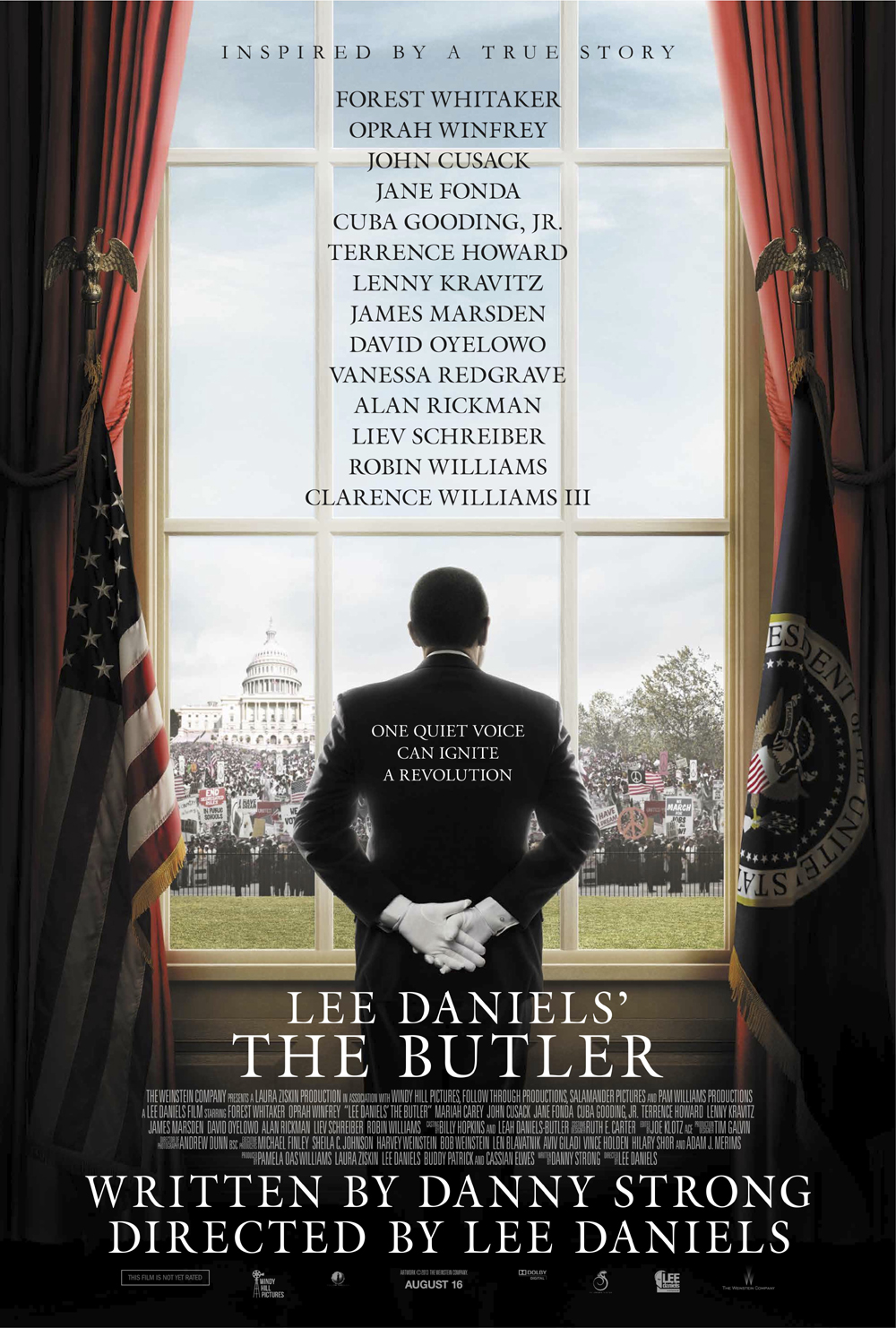 Before I begin my review, I feel the need to come to the defense of Oscar-nominated director Lee Daniels (Precious). Despite what Internet message boards and detractors may have you believe, it was never the man’s intention to insert his name into the title of his latest film, Lee Daniels’ The Butler. Warner Brothers claimed copyright ownership over the title of The Butler. The MPAA mediates title discrepancies in cases where one movie could clearly be confused for another. However, Warner Brothers’ claims a 1915 silent short film in their vault by the same name. Is anyone in the year 2013 really going to pay a ticket for the Butler and reasonably expect a silent short that’s almost 100 years old? Rather than pay a financial settlement, The Weinstein Company decided to alter the original title, adding the director’s name. This isn’t The Butler. Now it’s Lee Daniels’ The Butler. So before I get into the thick of my review, I’d like to absolve Daniels of Tyler Perry-levels of hubris. You’ll excuse me for just referring to it as The Butler throughout the duration of this review, not to be confused with a 1915 short film.
From Harry Truman to Ronald Reagan, one man served them all and his name is Cecil Gaines (Forrest Whitaker). He was a White House butler for over 30 years, even attending a state dinner at the behest of Nancy Reagan. Cecil grew up on a Georgia cotton plantation and moved up the ranks in high-class service. His wife, Gloria (Oprah Winfrey), wishes her husband would worry more about his own home than the White House. Cecil’s two sons, Louis (David Oyelowo) and Charlie (Elijah Kelley), have very different views of their father. Louis feels like dear old dad is too close to the men of power, and Louis is going to do what he can on the frontlines of change.
 I’m sure everyone had good intentions with this movie, but I walked away with the overwhelming impression that The Butler was too heavy-handed, too corny, and too mishandled with its plot construction for it to be the effective drama all desired. I also know that my opinion is of a minority, but that has never bothered me as a critic. Let’s start with the biggest handicap the film has going, and that’s the fact that its central character, the titular butler, is too opaque for a biopic. Early on, Cecil rises through the ranks of black service workers because of his skill, and that skill is none other than “having a room feel empty with [him] inside it.” I’m not downplaying the man’s dedication, or the culture he grew up in that preferred their black workers to be silent, but here is a movie where the man’s claim to fame is that he served eight presidents but he was in the background for all that history. I wasn’t expecting Cecil to lean over and go, “Mr. President, that Voting Rights Act might be a good idea, and I’ll help ya with it.” He is just sort of there. I was expecting him to have some larger significance, especially in his own life, but here’s the kicker: by the end of the movie, you’re left with the impression that all of his years of service were for naught. Cecil comes to the realization that his son, who he has sparred with for decades, was right and he was wrong. Is this the intended point? My colleague Ben Bailey will argue this is Daniels’ subversive intent, to undermine the tenets of typical biopics, to fashion an anti-biopic. I am not as convinced.
The problem is that Cecil is a passive character, which makes him the least interesting character in his own story. He served eight presidents, yes, but what else can you say about him as presented? What greater insights into life, himself, or politics does he have during those years with seven different presidential administrations? I cannot tell. I was thoroughly astounded that Cecil, as a character, was boring. I suspect this is why screenwriter Danny Strong (Recount, Game Change) chose to split Cecil’s story with his son, Louis. Here is a character on the front lines of the Civil Rights movement, getting chased by mobs, beaten, sprayed with firehouses. Here is an active character that wants to make a difference. He also happens to be mostly fictional.
While the film opens with the phrase “inspired by a true story” you should be wary. Upon further inspection, very little is as it happened. I think all true stories, when adapted to the confines of a two-hour film narrative, are going to have to be modified, and pure fidelity to the truth should not get in the way of telling a good story, within reason. I don’t have an issue with Louis being fictional, but it points to the larger problem with the biopic of such an opaque man. The real-life Cecil, Eugene Allen, had one son who went to Vietnam and married a former Black Panther. Strong splits the difference, supplying two sons with different paths. Because of his invention, this means Louis has the benefit of being present at a plethora of famous Civil Rights events, like the Woolworth counter sit-in, the Freedom Rider bus burning, and the assassination of both Malcolm X and Martin Luther King Jr. Seriously, he’s in the same motel room with MLK in Memphis. With the exception of the Woolworth sit-in, the Civil Rights events feel like minor pit stops, barely spending any time to develop. It ends up feeling like a facile Forrest Gump-like trip through the greatest hits of the Civil Rights movement.
This narrative expediency also translates to the supporting characters in The Butler. Beyond Cecil, Louis, and Gloria, there aren’t any characters that last more than one or two scenes. Cecil’s White House co-workers, played by Cuba Gooding Jr. (Red Tails) and Lenny Kravitz (The Hunger Games), provide amiable comic relief but little else to the narrative. Terrence Howard (Dead Man Down) has an affair with Gloria and then is never seen again. That affair, by the way, is also never referenced again nor does it have any further ramifications with the relationship between Cecil and Gloria. So then what was the point? There is a litany of famous faces playing real people, but they’re all in and out before you know it. The actors portraying the presidents are more an entertaining diversion than anything of real substance. Alan Rickman (Harry Potter) as Reagan gets the closest in the physical resemblance game, though I strongly doubt Reagan, as presented in the film, sat down and openly admitted he was wrong to his African-American service workers. John Cusack (The Raven) as Nixon is a hoot. The movie speeds right through the Ford and Carter administrations, so I’ll play my own game of casting (Ford: Dan Akroyd; Carter: Billy Bob Thornton). The presidents, like the clear majority of supporting players, don’t stick around long enough to leave an impression. It’s as if our prior knowledge of these famous faces is meant to serve as characterization. Beyond the immediate Gaines family, you don’t feel like you’re getting to know anyone.
 Then you bring in Daniels as director and the man has not shown much of a penchant for, let’s call, subtlety. This is, after all, the same man who directed Nicole Kidman in the ways of urinating upon Zac Efron. A coherent tone has often been elusive in Daniels’ films, which veer into wild, loud, sometimes clashing melodrama. The most clashing thing in The Butler are the matching 1970s and 80s fashion that will burn your eyes. He tones down his wilder sensibilities but The Butler is an especially earnest movie; but overly earnest without earned drama usually begets a corny movie, and that’s what much of The Butler unfortunately feels like. The significance of the Civil Rights movement and the bravery of the ordinary men and women, and children, fighting for equality cannot be overstated. These were serious heroes combating serious hate. I expect a serious movie, yes, but one that isn’t so transparent about its Staid Seriousness. The Butler is very respectful to history (fictional additions aside) but too often relies on the historical context to do the heavy lifting. It also hurts when the film is so predictable. At one point, I thought to myself, “I bet Cecil’s other son gets shipped to Vietnam and probably dies.” Mere seconds after this thought, young Charlie Gaines says he’s going to Vietnam. I’ll leave it to you to discover his eventual fate.
Daniels’ true power as a director is his skill with actors. The man nurtured Mo’Nique into an Academy Award-winning actress. From top to bottom, no actor in this film delivers a bad performance, which is a real accomplishment considering its stable of speaking roles. Whitaker (Repo Men) is the anchor of the movie and he puts his all into a character that gives him little to work with. He brings a quiet strength and dignity to Cecil, able to draw you in even as he’s presented so passively and ultimately perhaps in the wrong. Winfrey hasn’t been acting onscreen since 1998’s Beloved. Gloria is an underwritten part but she does the most with it and I’d like to see more of Oprah the actress more often. Another highlight is Oyelowo (Jack Reacher) as the defiant son fighting for what he believes is right. I want to also single out former America’s Next Top Model contestant Yaya Alafia as Louis’ girlfriend and eventual Black Power participant, Carol. She’s got real potential as an actress and if she gets the right role she could breakout and surprise people.
Lee Daniels’ The Butler (just one last time for feeling) is an earnest, emotional, but ultimately unsatisfying picture and it’s mostly because of its title figure. The figure of Cecil Gaines is not the kind of man that the entire perspective of the Civil Rights movement can be hung onto as an allegory. He’s treated as background of his own story. If the filmmakers wanted to highlight the life of a man who grew up on a cotton plantation, worked in the White House, and who lived long enough to see an African-American be president, well then tell me that story. But they don’t. I think Daniels and Strong knew the limitations of their central figure, which is why the son’s role was invented to provide a more active perspective outside the hallowed walls of 1600 Pennsylvania Avenue. In the end, I really don’t know what the message is, because the one I’m left with is that Cecil Gaines realizes late in life how wrong he was, not just with his son, but his faith in the office of the presidency. I doubt the majority of filmgoers are going to walk away with this message. While well acted and with a sharp eye for period details, The Butler is earnest without having earned your emotions.
Nate’s Grade: C


 nathanzoebl
You must be logged in to post a comment.