Blog Archives
Until Dawn (2025)

I’m going to do something I don’t know if I’ve ever really done before in my twenty-five-plus years of toil as a film critic. I’m going to devote almost the entirety of this review to try and make sense of the ending and its cascading choices that confound and astound me. I’ll present some spoiler-free analysis beforehand but, dear reader, this is going to be a spoiler-heavy review because, quite simply, it’s all I want to talk about as it concerns Until Dawn. The horror movie is an adaptation of a 2014 PlayStation video game that itself was fashioned like a ten-hour horror movie. It was a love letter to the horror genre and your goal was to keep as many of the characters alive as you could through quick-time events and choices that could have lingering and unexpected consequences later in the game. It was, above all else, fun, and news that Hollywood was going to turn it into a movie made a degree of sense. After all, it was practically an interactive movie to begin with. Then news matriculated that they weren’t really adapting the game and instead were making something new and different, so why call it Until Dawn? Beyond the cash-grab from the use of a familiar name, if you’re going to be Until Dawn in name only, why not just be that original horror idea and let someone else actually adapt Until Dawn as it was? You’re not going to get another crack at this title, so why is the first attempt one that could be done without the game existing? Regardless, the movie is a bad adaptation of the game and a bad use of dwindling brain cells.
Five teenagers make a trip to search of Clover’s (Ella Rubin) missing older sister. They trace her last recording to a gas station just outside the mining town of Gore County. The gas station attendant (Peter Stormare) lets these curious kids know that weird things happen in town, and sure enough the weird stranger is right. The teens take refuge in a visitor center with a guestbook and a peculiar hourglass time piece on the wall. Soon enough they’re beset with masked killers and monsters and each of the five friends is slaughtered. Then they wake up back in the visitor center with the hourglass starting over. They have to learn about this mysterious location to try and stay alive all the way… until dawn!

Before the heavy spoilers begin, I’ll provide a few accolades to what the movie does well. Director David F. Sandberg (Shazam!, Lights Out) has a clear affinity for the horror genre and can summon some pretty effective and skin-crawling imagery. I actually like the premise of a horror time loop, though this was also covered with the tongue-in-cheek genre tweak that was 2017’s Happy Death Day. However, that movie primarily dealt with a slasher scenario whereas Until Dawn can mix and match different genres, which makes each new iteration feel like a blank slate to explore. I loved the shortest loop, where the characters hold up in a bathroom and gruesomely discover what happens if you drink the local water. It’s the best development in the movie and one I’m glad the script revisits from time to time. With most time loop movies, once the characters adjust to the reality that death is not final, they get a little more loose with their physical well-being. I enjoyed some of the turns the characters make with the understanding that they’ll come back again. The visual nods and connections to the game are there without feeling too gimmicky. Plus, having Stormare come back to play a variation on his nattering psychiatric weirdo from the game is exactly what the movie adaptation needs. Stormare is on his own unique wavelength.
Now, the madness. Abandon all hope ye who enter the spoiler section of this review.
I don’t understand this movie. At all. I read over its Wikipedia summary and watched a few of those YouTube explanation videos to see if it was just me and I missed important pieces of information that would connect the various elements together. It’s not me, folks. These story elements don’t connect. They don’t form a coherent whole. I don’t need a reason why time loop scenarios happen; they never explained it with the genre grandaddy Groundhog Day, and if it’s good enough for Groundhog Day, it’s good enough for your movie. The problem is when they try to explain and it actively makes things worse, because now you begin to question everything. I liken it to 2019’s Us, a movie with plenty of outlandish story elements including the existence of a same-age evil twin for every person but living in a subterranean mimicry of surface life. I would have happily accepted that as-is, but then the movie tries to find a real explanation for where these people came from and why, and now the illusion of ignorance is shattered. Now all those pesky questions start flooding the mind that could have before been kept at bay.

Let’s examine the explanations for the two primary mysteries: 1) why there are monsters, and 2) why there is a time loop trap. Again, both of which didn’t even need explanations but here we go.
The mythology of the game gets ported over in starts and stops, but the movie keeps the setting of a mining town that had a tragic collapse that devastated the town. In this version, the majority of the town fell into a sinkhole below the earth. Do we get to explore these exciting and creepy locations? Nope. One of the town’s psychiatrists (Stormare) is still alive and continuing his mad experiments for… reasons. Like the game, there is a curse wherein if you resort to cannibalism you will become a spooky wendigo monster, so the creatures are a result of the former townspeople and other past residents from the previous time loops. Fine. I can accept that. However, late in the movie, our creepy psych doc clarifies for Clover that things aren’t just all in her head, a nod to the original game. Except that ending would have made more sense. The new ending says that Clover’s fears are responsible for manifesting the different antagonistic monsters and killers. Okay, so we’re externalizing the internal, fine, but why her? Why not any of the other friends? Does this mean every previous group was also responsible for manifesting their own tormentors based upon personal psychological fears? Why are we including this roulette wheel of terrors on top of the constant of the wendigo creatures? How is this even happening because the movie gives no scant indication? Do the deadly rules get reset with each new group? In our story, the characters can’t drink the water, but what about other groups? If every group is manifesting the same avatars of fear then why not just adopt them as stable rules? Why is this one man staying behind to catalogue the results? He’s mortal so he just lives in the sinkhole or works at the gas station, waiting for wayward teens to stumble into his next experimental group? Who is keeping the lights on in this visitor center? What does this guy do during the “off season” when there are no looky-loos? Does he have to feed the existing wendigos like some kind of demented zoo? What is to be gained from all these experiments? Is he planning on publishing his research later? What is this guy’s regular life like?

Then there’s the time loop explanation which is -wait for it- nothing. Absolutely nothing. Why are characters getting second and third and thirteenth chances to survive until dawn? Why is it thirteen? The movie doesn’t even have the time to demonstrate thirteen loops, instead jumping from like the fourth straight to the last one through the annoying use of, “Oh, let’s watch these film clips we took that we don’t remember.” If you didn’t have the interest or time for thirteen loops, why even make it thirteen? Why does the number matter if they inevitably turn into wendigos from desperate cannibalism? You would think the loops should be infinite to guarantee this result. Why would the other victims bother writing their name in the guestbook every loop? It establishes a timeline of sorts, but if writing can last in this guestbook, why doesn’t anyone write anything other than their name over and over? Detailing your experiences and lessons learned as a living record might be helpful to future loopers. Also, what obligations do these people feel about signing their names in the guestbook? Who accepts getting murdered over ten times but is still being a stickler for signing their name, and for what? Are they getting some little feeling of superiority that they were able to scribble their name thirteen times? Where did the hourglass come from? It definitely looks like it was installed with purpose, so did these just materialize? Why do the timeloops even consider having a mechanism for letting participants win and escape? What about the other quirks like how the weather is affected by the bad vibes of this place? Even the rain knows better.
So, in summation, the time loops and manifesting monsters are unrelated to one another and there is no added context provided for like some ancient curse or witchy magic or anything to cause this mess. There is one nefarious wacko doctor who just hangs around for kicks, though why he is immune from the loops or the larger effects of the manifested monsters is beyond me. Is he recruiting the monsters like some sort of work foreman, telling this gnarly creature, “Need ya to pull a double today, Fangy.” It just all feels like scary elements working in parallel and occasionally drifting into one another’s orbit, but there’s no fitting or acceptable explanation, so why does the movie even try to present one in the first place? I’m stunned at how Until Dawn just completely unravels into incoherent madness by the conclusion, which sets up that there might be a larger universe of these doctors overseeing experiments. At that point, you might as well be watching The Cabin in the Woods. If you have no allegiance or familiarity with the video game, you might find enough to amuse you, at least for fleeting moments. I was open-minded to what an Until Dawn-in-name-only adaptation could do with a time loop gimmick, but the final results feel like an uneven grab-bag of imagery and ideas and directions that go nowhere.
Nate’s Grade: C-
Share this:

Dancer in the Dark (2000) [Review Re-View]
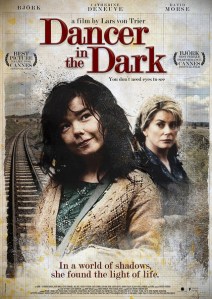 Originally released October 6, 2000:
Lars von Trier’s latest shaky video opus is likely the most unique movie going experience you’ll have all year. Dancer in the Dark is a clever, heartfelt, and achingly beautiful tale of sorrow and redemption. Dancer stars Iceland’s version of Madonna in the elfin Bjork. She plays Selma, quite possibly the nicest but also most stubborn person in the world. She’s an immigrant in 1960s America working long and odd hours to ensure that she can raise enough money for her son. You see Selma is slowly going blind but continuing to work so she can make sure her son will not have to suffer the same inherited illness. So she works late on heavy industrial machinery causing accidents as her condition worsens all to stop her son’s genetic curse she will give to him. Selma’s escape has always been musicals. In life she hears music in unusual places and visualizes life stopping to burst out into a vibrant fully choreographed musical number. Selma’s life continues to degenerate along with her vision as events pile on worse and worse until they all come crashing together.
Dancer in the Dark is no picnic in the park. The movie is haunting but incredibly depressing. Lars von Trier’s previous film (Breaking the Waves) was another wrenching drama with good people going through rough times with no fraction of light at any end of a tunnel. His jerky handheld video work is back capturing the life of Selma and seemingly framing it in a more realistic sense. The video images are edited to look like a documentary and the whole feel is one of raw power. You aren’t merely watching a film, it’s like you are in it witnessing the actions from the sidelines. The escapist musical numbers are shot in glorious still film to contrast the drab realism of video. The colors are bright, the faces are happy, and the cinematography is a wonder to envision.
 Bjork soars and delivers what should be an Oscar-caliber performance. I never knew the queen of alt-rock had such emotive powers. Selma’s innocence is keenly expressed in Bjork and her glassy eyes. Her love for her son is no more evident then all the suffering and tragedy she goes through. All of the suffering and tragedy could be avoided – except her son would not be helped.
The ensemble around Bjork work fantastic magic as well. Peter Stormare is a sad figure trying to just get a glimpse of Selma’s attention. David Morse is a down-and-out policeman who is Selma’s landlord and in need of some cash. He’s afraid to tell his bourgeois wife they’ve run empty with money. Catherine Deneuve turns in the brightest supporting performance as Selma’s co-worker and friend Kathy. She’s torn between trying to stop Selma from continuing on her acts that could cause her harm and helping her along her determination. A great scene as example of her care for Selma is when the two of them are in a theater watching an old Hollywood musical. At this point Selma is completely blind and can’t see what’s going on, so Kathy takes Selma’s palm and dances her fingers in correlation with the actions on screen to Selma’s delight. A simple scene yet so elegant and beautiful.
Dancer in the Dark is a wonderful piece of original film making that gives us the escape of hope and the crush of despair. Selma’s love of musicals and their role in life is perfect symbolism for discussion. Dancer will leave you with a distinct feeling by the end credits. Whether it’s sorrow or bewilderment Dancer in the Dark is a film not to miss.
Nate’s Grade: A
——————————————————
WRITER REFLECTIONS 20 YEARS LATER

I knew going back to my first Lars von Trier film was not going to be a pleasant experience, and oh what an understatement that turned out to be. von Trier has compared himself to a Nazi, his intense methods have driven his actors to the brink, including Dancer in the Dark’s Bjork who swore off the entire profession of acting after her experiences working with him. I am not surprised by this response because his movies have famously followed a formula of a woman being tortured by men, by society, by forces outsider her control, and then she suffers for two hours and dies, a victim of the cruelty of the universe. Repeat. It’s a formula that I’ve since grown weary of and after 2018’s The House That Jack Built I contemplated not watching another von Trier movie again. He just can’t help himself and his nihilistic, heavy-handed impulses handicap his genuine artistic abilities and the merits of his storytelling. Back in 2000, it all felt relatively new. von Trier was the biggest name of the Dogme 95 movement, a Danish collective of filmmakers who swore to adhere to digital video and other aesthetic rules to better replicate reality as it was, ripping away the glossy artifice of Hollywood fantasy. von Trier was subversive, provocative, and exciting, and since then I’ve broken free from the von Trier spell. I was questioning whether I would share Requiem for a Dream or Dancer in the Dark with my girlfriend, who had seen neither, and in hindsight I’m glad I picked Requiem instead (think about that, yikes).
Dancer in the Dark is a powerful experience and one that is unfortunately smothered by von Trier’s heavy hand. It’s easy to root for Selma (Bjork), a Czech transplant in small-town 1960s America (the movie was filmed in Sweden because von Trier is afraid to fly). She already has so much going against her: 1) she’s a woman, 2) she’s an immigrant, 3) she’s poor, 4) she’s suffering from a degenerative disease that will rob her of her sight. Even worse, her son will suffer the same fate unless Selma raises enough money for an operation. She takes on extra work at her factory, even if she’s not exactly qualified, and she’s a hopeful yet stubborn woman who says what she means, earning friends who will champion her. She’s also a lover of old-fashioned Hollywood musicals, as they presented an escape to her as a little girl growing up in poverty. America was the land of opportunity, where everyone dances all the time, sings their hearts out, and gets the girl or the guy by the conclusion of the finale. That dichotomy, between reality and fantasy, and all the cultural and psychological commentary within, is the strongest aspect of the film and a peak of ambition that von Trier never really got close to again with his later punishing dramaturgy. The first musical number doesn’t come until 45 minutes into the movie, and by that time we have had our heroine, her plight, and the first markers of a looming tragedy efficiently established.
 Jeff (Peter Stormare), a lovesick co-worker who shows up every day to maybe drive Selma home, cannot understand musicals, saying people just burst out into song and how unrealistic this is, and Selma agrees, but for her it’s wonderful. She hears music in the world around her and it gives her life, especially as her vision deteriorates. As injustice after injustice falls upon her, Selma uses extravagant musicals as an escape, where everyone is a friend waiting to jump into the number and work together. A common refrain she sings is “there’s always someone to catch me,” referencing the choreography of musicals where the dancers frolic together but it’s also her request to the universe for a little help, for someone to catch her when she stumbles and provide that level support a woman of her means and background lacked in this landscape. The musical numbers staged by von Trier have a chaotic energy to them, assembled from dozens and dozens of sporadically placed cameras. They feel like a burst of imagination while keeping an improvisational feel; less drilled than managed. The first musical number “Cvalda” is a delirious daydream where Selma imagines the various sounds of the work machines creating a percussive symphony and she’s a Mary Poppins conductor. After Bill (David Morse) dies, she retreats to “Scatterheart” to make sense of her actions, with her son telling her she only did what she had to do and Bill rising from the dead to beg her forgiveness. When she’s in solitary confinement and can’t hear any sound, Selma goes into despair. She shouts the lyrics to selections from The Sound of Music to bring music back into her isolated world. Even on her march to execution, Selma copes by turning the “107 Steps” to the noose into a song. Her last words are her singing her final goodbyes to her off-screen son, so until the end musicals were how this woman chose to compensate for the rotten luck of her life. And oh boy was it ever rotten.
There’s one scene in the second half begging for symbolic unpacking where Selma is in the middle of her trial and the prosecution calls a famous Czech film actor and dancer to the stage. It’s none other than Oscar-winning theater legend Joel Grey (Cabaret) and his character doesn’t know who Selma is, even though she told the court she had been sending money to him (she listed her son’s account for his operation under a pseudonym to not risk it being derailed). This famous actor starred in movies in her native Czechoslovakia and crossed over to American cinema. He was an idol for young Selma and another figure to encapsulate the promise of America. Then as he’s testifying on the stand is when Selma drifts back into another rendition of “In the Musicals” and Grey joins her in tapping, and he confesses, “I didn’t mind it at all / That you were having a ball / at my musicals / And I was always there to catch you.” He understands and empathizes. This scene alone is just packed with so many layers of metaphor and projection and symbolic subtext and commentary and you could probably write an entire Master’s thesis on its myriad meanings. At its best, that’s Dancer in the Dark, when von Trier is using the language of musicals to subvert their form, to lay commentary on the un-reality is a rejection of the cruelty of real life, of finding order in disorder, finding community amid a nest of selfish vipers competing for dominance. It’s when von Trier uses our understanding of musicals to really make us think about the associations and contradictions that makes this movie a stirring and sometimes sensational experience.
 Alas, the artistry is seriously wounded by von Trier’s heavy-handed approach to all drama. This has become even more pronounced after where von Trier has obliterated the entire world (2011’s Melancholia) and ruined a four-hour movie with a last-second dumb joke of an ending (2014’s two-part Nymphomaniac). Subtlety is not one of the tools von Trier prefers to dabble with. It’s a shame because he’s a natural storyteller when it comes to establishing vulnerable characters in fraught scenarios and slowly raising the temperature, organically transforming allies into enemies and friends into abusers. This is done very well in 2004’s Dogville as well, a movie I would argue both plays into and succeeds his tortured-woman formula of drama and political allegory. I would say Dogville is his second-best film precisely because I was expecting another unrelentingly unjust ending for another anguished woman. However, where a lighter touch could accomplish his points, von Trier instead brings out a bazooka. Selma’s deadly encounter with Bill happens at the halfway point in the film. From there there’s still another 65 minutes of her suffering to drag out to preposterous proportions. We go through the trial, her cross-examination, her willfully keeping secrets that will only make her look guilty to maintain a promise to a dead man, and then there’s her visitations in jail, her appeal, her rejection of her appeal because the costs will empty the fund’s for her son’s operation, the realization of her impending execution, the march to the execution, her being bound to a board because she cannot stand straight because she’s so scared, her rejection of the hood, her last song while she waits for the governor’s call, and then her abrupt death. There were several points where I was just pleading, “Enough already,” because it was so thoroughly exhausting.
Selma is served to be a martyr of an unjust system that looked suspiciously on immigrants, and Selma elects to accept her fate because anything less would endanger losing what she has set up for her son’s well-being. This woman takes all this punishment and that’s the story, America. That’s the story of America, America. That’s what von Trier is getting at, but the 140-minute movie is so overdone and so drawn out to obsess over the wrongs inflicted on this poor woman that it unintentionally blunts the message. The second half becomes a passion play where we watch our poor Selma elect to accept tragedy and self-sacrifice and endure all the injustices. It’s harrowing and upsetting but would still be so if we didn’t spend half of the movie dwelling on a litany of examples of her fated misery. I’m sure others will argue the crushing nature of the injustice is meant to convey for the viewer the feeling of aggravation and outrage. I would agree that outrage is sought, but when von Trier doesn’t let up, it tilts into overwrought self-parody.
 Dancer in the Dark resonates as strongly as it does because Bjork gives every ounce of herself in this performance. She was originally just going to write songs but von Trier chased her for a year to convince her to also star as the lead. There are moments of awkwardness where it feels like maybe she’s confused in the scene with what her lines are supposed to be, but then her lack of polish is revealed for its true strength. It’s a deeply, deeply felt performance, stunning in how raw and empathetic she gets, subsuming herself into the character and her tribulations. You don’t see the craft so much here as you do sheer, undiluted passion and ferocious naturalism. She doesn’t hold anything back and gives the best performance in any von Trier movie. In my mind, she had been nominated for a Best Actress Oscar that year but this was not the case; she was only nominated for Best Original Song (“I’ve Seen It All”) where she wore her famous swan dress that became a go-to punchline. She was, and continues to be, an eclectic artist and a really weird person, but man could she be a tremendous actress given the right circumstances. It’s a shame that von Trier’s sadistic directing style lead her to quit the entire profession.
Looking back on my original review, I remember seeing Dancer in the Dark with my freshman pal Kat Lewis, who was just the biggest Bjork fan you could find in all of Ohio in 2000. We were both floored by the movie, and Bjork, and cited it as uniformly brilliant. With twenty years of distance, I can say some of the ironic commentary of undercutting musical escapism feels too easy now, seeking credit for daring to ask, “Hey, what if musicals weren’t so happy, huh?” It’s still a worthwhile subversion to explore but simply presenting it as a subversion isn’t enough for a satisfying thematic focus. It’s funny that the moments that stood out to me as an 18-year-old, like Catherine Deneuve dancing her fingers on Selma’s palm to communicate the onscreen dance routine she can no longer see, are the same ones that stood out to me as a 38-year-old. Good writing will still make itself known and felt. There’s plenty to admire and, paradoxically, enjoy about such a depressing movie, but von Trier’s inability to self-edit and hold back his condemnation of humanity is what truly oppresses his movie.
Re-View Grade: B
Share this:

The Brothers Grimm (2005)
 Director Terry Gilliam is one of the true artists working today in movies. His manic, off kilter, visually grand imagination has crafted wonderfully vivid fantasias, but it also has given Gilliam a reputation for being the captain of a sinking ship. The Adventures of Baron Munchausen is regarded as one of Hollywood’s bigger failures, unfairly I might add. A fascinating 2003 documentary called Lost in La Mancha detailed the bizarre circumstances and implosions that forced Gilliam to shut down production of his pride and joy, a film about Don Quixote. We’re talking things as out of control and unlucky as acts of God conspiring to doom this project. But then, Gilliam has always been fighting someone or something his whole film career. The studio refused Gilliam’s cut of Brazil so he sneaked out a print, showed it to the Los Angeles film community, and they dubbed it the best film of that year. Gilliam is a man governed by his idiosyncrasies. He’s blessed with a unique voice but cursed with the prospects of not having anywhere to say something (would he not make simply the most divine Harry Potter film yet?). And so Gilliam strikes his hands at something a bit more commercially minded with the action/comic fable, The Brothers Grimm.
Will (Matt Damon) and Jakob (Heath Ledger) Grimm are nineteenth century ghostbusters, so to speak. They travel from town to town ridding the villagers of evil spirits, witches, and all sorts of demonic creatures. Trouble is it’s all a lie. The Grimm brothers and their pals set up the spooks and rob the town blind. Will enjoys the fame, and especially the women, but Jakob feels apprehensive. It?s the Napoleonic wars, and the French have occupied the Germanic lands. A snooty general (Jonathan Pryce) plans to behead the two Grimm brothers unless they solve a strange case in a rural town. A slapsticky, torture-loving commander (Peter Storemare) is sent to watch over the “Grimmies.” At the village, Will and Jakob discover the town has had 10 of its daughters kidnapped with little explanation. With the help of a free-spirited woman (Lena Headey), the brothers encounter giant wolves, moving trees, lickable frogs, and the giant tower of the Mirror Queen (Monica Bellucci). The Queen was given eternal life but not eternal youth. In order to gain eternal youth, the Queen needs to take the lives of 12 hearty girls, and only the bumbling Grimm brothers stand in her way.
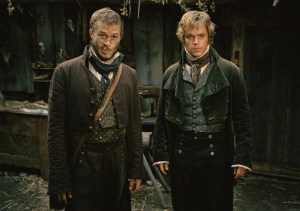 The acting is an example of the film’s messy feel. Ledger talks with marbles in his mouth. He’s putting more detail into the character than it deserves. Damon seems like he’s sleepwalking through the film, and his accent fluctuates wildly. He’s sort of a grinning straight man to Ledger’s tic-heavy daydream believer. Belluci is a ravishing beauty and proof positive for Hollywood that women over 40 don’t need to be put out to pasture. Too bad all she’s expected to do is look pretty and seductive in The Brothers Grimm. Pryce plays his role like a cartoon caricature. Stormare has already given one crazy performance this year (Constantine), and his frenzied, nearly indecipherable performance seems to be the closest to Gilliam’s whacked-out wavelength. Stormare is entertaining in every scene he’s in but can be found guilty of chewing scenery like it was a delicious candy house.
The Brothers Grimm is a gorgeous looking film. The sets are massive and greatly detailed. The location shoots in Prague seem like the perfect environment for Gilliam’s beyond-this-world landscapes. Gilliam experiments with advanced computer graphics for the first time and adds his oddball touches. A child has her eyes taken by a glob of mud, and then the mud reshapes itself into a lumbering gingerbread man. A horse spits out a spiderweb and ensnares a child. And it looks really freaking creepy. The Mirror Queen’s defeat is another standout effect as she breaks apart like shattered glass. The look of The Brothers Grimm is outstanding, but it’s what takes place inside those pretty pictures that dooms the film to mediocrity.
 The Brothers Grimm is an unfocused mess. It has disjointed subplots and several story elements that just don’t fit. The wacky French occupation feels like a leftover from a different movie. It just doesn’t work and grinds the movie to a screeching halt with every resurfacing. The Brothers Grimm will routinely work its way into a narrative corner and then use a “magic” cheat to escape (magic axe, magic mirror, magic kiss). Gilliam has always been a master maestro of chaos and visual oddities, but this time he’s tackled a film with a very weak script by Ehren Kruger (Ring Two). Kruger doesn’t bother laying the groundwork of his magical world or establish the rules. Therefore anything can happen and rarely feels satisfying. The characters are one-note, each given a single character trait to play with (skeptic, believer, idiot, etc.). The pacing is pretty sluggish. The first act takes an eternity to set up the film’s characters, plot, and yet it still feels sloppy. The twists and turns are easily telegraphed and unexpectedly boring. The plot is frustrating, shortsighted in scope, and far too conventional for Gilliam’s tastes. When The Brothers Grimm reaches its happy ending you’ll swear you can hear Gilliam gagging somewhere.
Gilliam adds a worthy macabre tone to the film. There will be touches that you know are pure Gilliam, like a woman skinning a rabbit as she talks, or a cat flying into the blades or a torture device. In fact, The Brothers Grimm has a lot of humor involving the comic demise of animals. This isn’t exactly a film appropriate for young children despite the appeal of a fairy tale background. The film wants to tweak fairy tale legends like the two Shreks, but Gilliam wants to make them disturbing nightmares, not something of irreverence. This puts the film’s tone at odds. One minute you’ll have a scene that?s morbid, darkly funny, and unconventional, and then the next minute you’ll have a scene that’s cliché, dull, and whimsically misplaced.
The Brothers Grimm feels like a Terry Gilliam film under glass. The script is weak and plodding, the characters barely leave a dent, and the tone is uneven. The plot is pulled in too many directions and lacks momentum. There are a handful of fun comic diversions but the movie feels like a loose collection of disjointed story elements. There are flashes of grim humor and visual elegance but more often than not the film is just stupendously boring. The Brothers Grimm feels the same way the Coen brothers’ Intolerable Cruelty felt: a unique vision compromised and downsized by studio conformity. You can see the indie spirit but the heart just isn’t beating. The Brothers Grimm is mediocre at best. How very grim indeed.
Nate’s Grade: C
Share this:

Constantine (2005)
 I’ll admit it; I’m a sucker for Christian mythology played against thriller and action settings. I may be the only person to have watched all of The Prophecy flicks, and probably the only person that eagerly chows down on the cheesy sequels to The Substitute, yet shy away from seeing the first film. I’m captivated by the imagery, the discussion of Heaven and Hell and its mythical logistics, and just the psychology of supernatural biblical beings. With this in mind, I was strongly anticipating the release of Constantine. What I got wasn’t exactly what I expected but I’d be lying if I said I wasn’t entertained.
John Constantine (Keanu Reeves) is a very troubled man. Since his youth he’s had to live with his gift that allows him to see through earthy disguises and witness angels and monstrous demons walking among us. He’s parlayed this ability into a modest side job of exorcising demons and sending them back to Hell. Constantine figures his loyal service should grant him passage into the pearly gates, but Archangel Gabriel (Tilda Swinton) reminds him that that’s not how it works. Constantine is doomed to go to Hell because he tried taking his own life, and if that’s not enough he also has terminal lung cancer from smoking like a chimney. “In other words, you’re f***ed,” Gabriel confides to Constantine.
 Police detective Angela Dodson (Rachel Weisz) is investigating the suicide of her twin sister (also Weisz). She swears her mentally disturbed sis wouldn’t do such a thing, and she seeks out the help of Constantine. He challenges her beliefs, stating that God and the Devil (Peter Stormare) have a wager over the souls of mankind but cannot directly interfere. But now something is breaking this rule and it looks like demons may be getting closer to entering our plane, and it looks like Angela’s dead sister may have known more than people would have thought.
The plot of Constantine is rife with contrivances, aborted subplots, underwritten and nearly forgotten supporting characters, and sketchy logic (staring at a cat can transport you to Hell? No wonder I’m a dog person). Often the film feels overwhelmed by good special effects, as they seem to be the crux of the film?s purpose of being and not, on the other hand, a theological playground of ideas. Constantine gives veiled glimpses of something smart, but routinely shuts that door to focus more on annoying jump scares.
In fact, Constantine seems rather old-fashioned with its theology, still clinging to the Roman Catholic belief that suicide is a one-way ticket to the fiery abyss. I understand its use as motivation for our lead, but will progressive audiences accept something they may find archaic? I suppose it could be worse. Constantine could have briefly gone to Hell for eating meat on a Friday.
It’s interesting that after spending two years making The Matrix sequels, Reeves would choose to attach himself to another big-budget theological action flick. His acting never really rises beyond morose loner but somehow he does make for a satisfying, brooding hero. Reeves? low-key monotone speaking voice allows him to spout cheesy dialogue with a straight face and mercifully keeps the audience grounded.
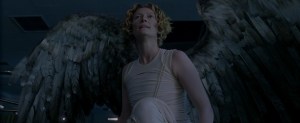 The true stars of Constantine are the memorable supporting players in this celestial smack down. Swinton uses her androgynous looks to forge what David Bowie might be like as an angel: angular, mysterious, waif, and somewhat creepy. Stormare delivers a performance so kooky and tic-heavy, that it could only be compared to the weirder moments of Christopher Walken. Both actors liven up the film and seem to be having the most fun by far with their cheeky roles.
The genius of Constantine is in its one-upsmanship game it holds with the audience. Granted, suspension of disbelief is needed to even go along for the ride, but when we start learning that Hell has its own line of bibles (and they’re longer) we’ve gone beyond suspension of disbelief and into wacky Anne-Heche-speaks-to-aliens land. While sitting through Constantine, we the audience think, “There’s no way this movie could get any sillier.” And then it does! We think, “Alright, that was crazy. Now there’s no way after that this film could get any sillier.” And then it does! Constantine is an amazing ascent into movie madness. After a while, I became drunk from the film’s insanity and wanted it to get even crazier, if possible. It almost seems like there’s a drinking contest between the movie and the audience, and Constantine isn’t afraid to piss its pants to win.
By the time Lucifer shows up, clad in all white like Tom Wolfe, and the Dark Lord appears to have Tourette’s Syndrome and/or a speech impediment, Constantine has hit the bottom of its Kool-Aid cup. Sure the film’s cinematography is slick, and the premise is intriguing, but the real draw of Constantine and the real enjoyment of the flick is how bat-shit crazy it is. I cannot even think of comparable films. I hope David Lynch was taking notes if he saw this.
For a while there, it seems director Francis Lawrence wanted Constantine to be a companion to Wesley Snipe’s Blade character. Maybe the two of them can set up a play date and go destroy otherworldly creatures. There’s a visually striking sequence late in the film involving Constantine in a room full of demons. He’s “contaminated” the water system by placing a giant cross inside, thus holy-fying the water before he can bottle it and sell it to the masses. He holds a lighter to the sprinkler system, demons growling all around him ready for their kill, and then water sprays down across the room. “Holy water?” one female demon says in a stunned voice, watching her flesh sizzle away. Then Constantine marches through the wet room blowing away demons into splashes of ash with his comically unwieldy cross-shotgun. It’s filmed wonderfully with dark hues and is a great idea; however, it’s a bit of a rip-off of the opening sequence in the first Blade.
 This seems to be a repeated sentiment in Lawrence’s direction. He has a sharp visual eye and several camera angles come from odd yet exotic places, but his film is borrowing so heavily from so many other films. What you’re left with is the impression of a stylish if very derivative looking action film. One exception is when Lawrence shows us glimpses of the blistering burnt orange world of Hell. It seems Hell is an exact model resemblance of Earth, only with the fire, brimstone, and crawling demons with their heads sliced open (there is a scary level beneath the surface where we witness a sea of people being tortured). The second or third time we traveled to Hell, I began to wonder what my house would look like and the logistics of upkeep for the homeowner in Hell. Surely the heating bills wouldn’t be the same.
Constantine is funny, frustrating, confusing, gorgeous, and just plain insane in the ole membrane. The film exhibits a rare and engaging form of insanity that may glue audience eyeballs to the screen to see what happens next. I’ve seen Constantine twice (don’t ask why) and even though I knew all the weird plot turns I still found myself getting an enjoyable contact buzz from the film. Who knows how long such a novelty can sustain itself, though. Comic book fans, especially those with a spiritual bent, should get a kick out of Constantine as will anyone else searching for a pristine example of how wonderfully out of control Hollywood moviemaking can be. Sometimes in a good way.
Nate’s Grade: B-
Share this:

Dancer in the Dark (2000)
Lars von Trier’s latest shaky video opus is likely the most unique movie going experience you’ll have all year. Dancer in the Dark is a clever, heartfelt, and achingly beautiful tale of sorrow and redemption. Dancer stars Iceland’s version of Madonna in the elfin Bjork. She plays Selma, quite possibly the nicest but also most stubborn person in the world. She’s an immigrant in 1960s America working long and odd hours to ensure that she can raise enough money for her son. You see Selma is slowly going blind but continuing to work so she can make sure her son will not have to suffer the same inherited illness. So she works late on heavy industrial machinery causing accidents as her condition worsens all to stop her son’s genetic curse she will give to him. Selma’s escape has always been musicals. In life she hears music in unusual places and visualizes life stopping to burst out into a vibrant fully choreographed musical number. Selma’s life continues to degenerate along with her vision as events pile on worse and worse until they all come crashing together.
Dancer in the Dark is no picnic in the park. The movie is haunting but incredibly depressing. Lars von Trier’s previous film (Breaking the Waves) was another wrenching drama with good people going through rough times with no fraction of light at any end of a tunnel. His jerky handheld video work is back capturing the life of Selma and seemingly framing it in a more realistic sense. The video images are edited to look like a documentary and the whole feel is one of raw power. You aren’t merely watching a film, it’s like you are in it witnessing the actions from the sidelines. The escapist musical numbers are shot in glorious still film to contrast the drab realism of video. The colors are bright, the faces are happy, and the cinematography is a wonder to envision.
Bjork soars and delivers what should be an Oscar-caliber performance. I never knew the queen of alt-rock had such emotive powers. Selma’s innocence is keenly expressed in Bjork and her glassy eyes. Her love for her son is no more evident then all the suffering and tragedy she goes through. All of the suffering and tragedy could be avoided – except her son would not be helped.
The ensemble around Bjork work fantastic magic as well. Peter Stormare is a sad figure trying to just get a glimpse of Selma’s attention. David Morse is a down-and-out policeman who is Selma’s landlord and in need of some cash. He’s afraid to tell his bourgeois wife they’ve run empty with money. Catherine Deneuve turns in the brightest supporting performance as Selma’s co-worker and friend Kathy. She’s torn between trying to stop Selma from continuing on her acts that could cause her harm and helping her along her determination. A great scene as example of her care for Selma is when the two of them are in a theater watching an old Hollywood musical. At this point Selma is completely blind and can’t see what’s going on, so Kathy takes Selma’s palm and dances her fingers in correlation with the actions on screen to Selma’s delight. A simple scene yet so elegant and beautiful.
Dancer in the Dark is a wonderful piece of original film making that gives us the escape of hope and the crush of despair. Selma’s love of musicals and their role in life is perfect symbolism for discussion. Dancer will leave you with a distinct feeling by the end credits. Whether it’s sorrow or bewilderment Dancer in the Dark is a film not to miss.
Nate’s Grade: A
Reviewed 20 years later as part of the “Reviews Re-View: 2000” article.


 nathanzoebl
You must be logged in to post a comment.