Blog Archives
Are You There God? It’s Me, Margret (2023)
 When is it not weird for a 41-year-old man to cry about a young woman getting her first period? When you’re watching the film adaptation of Judy Blume’s long-celebrated coming-of-age novel, Are You There God? It’s Me, Margaret. Blume waited almost fifty years before signing over the rights to writer/director Kelly Fremon Craig, whose 2016 movie Edge of Seventeen showed a downright Blume-esque combination of authenticity, good humor, and grace. That trusted vision is evident with how natural and deeply felt the movie comes across. We’ve had numerous coming-of-age tales since Blume’s influence, so I worried that maybe it would feel outdated or surpassed, but the movie taps into a great reservoir of empathy, bringing to relatable light the uncertainty of puberty, of fitting in, and trying to navigate the ever-approaching adult world. Usually these kinds of movies invite the viewer to reflect back upon their own young adult experiences, which I did even though I was never a teenage girl, but I had my own awkward and vulnerable moments too. I really enjoyed that Craig’s movie makes ample time for the adults too, which is where my relatability was prioritized. Watching Rachel McAdams try and explain why her parents disowned her for marrying a Jewish man is a powerfully affecting moment of an adult trying to explain a very hard truth to their child. The movie is affectionate and uplifting and earnest without being too cloying. It’s a pleasant and wholesome movie that showcases Craig as an agile filmmaker who deserves more opportunities and that even fifty years later, being an adolescent girl is still the same old awkward agony.
Nate’s Grade: B+
Share this:

The Holdovers (2023)

Oscar-winning director Alexander Payne and Paul Giamatti re-team for a poignant and crowd-pleasing holiday movie about outcasts sharing their vulnerabilities with one another over the last week of 1970. Giamatti stars as Paul Hunham, a rigid history teacher at an all-boys academy who just happens to be liked by nobody including his colleagues. He gets the unfortunate duty of staying on campus during the Christmas break and watching over any students who cannot return home for the holidays. Angus (Dominic Sessa) is the last student remaining, a 15-year-old with a history of lying, defiance, and on the verge of expulsion. The other holdover member is Mary (Da’Vine Joy Randolph) as the kitchen staff forced to feed them, a woman whose own adult son recently died in Vietnam. The teacher and student butt heads as they try and co-exist without other supervision, eventually connecting once they lower their defenses and attempt to see one another as flawed human beings with real hurts and disappointments. It’s a simple movie about three different characters from very different experiences pushing against one another and finding common ground. It’s a relationship movie that has plenty of wry humor and strong character beats from debut screenwriter David Hemingson. There may not be a larger theme or thesis that emerges, but being a buddy dramedy about hurt people building their friendships is still a winning formula with excellent writing, directing, and acting working in tandem, which is what we have with The Holdovers. It’s a slice of-life movie that makes you want bigger slices, especially for Mary’s character who thought having her son attend the same prep school would set him up for a promising future (he was denied college admission and thus deferral from the draft). It’s a beguiling movie because it’s about sad and lonely people over the holidays, each experiencing their own level of grief, and the overall feel is warm and fuzzy, like a feel-good movie about people feeling bad. That’s the Alexander Payne effect, finding an ironic edge to nostalgia while exploring hard-won truths with down-on-their-luck characters. The Holdovers is an enjoyable holiday comedy with shades of bitterness to go along with the feel-good uplift. It’s Payne’s Christmas movie and that is is own gift to moviegoers.
Nate’s Grade: B+
Share this:

Master and Commander: The Far Side of the World (2003) [Review Re-View]

Originally released November 14, 2003:
Without sounding easily amused, this movie really is glorious filmmaking. With Peter Weir’’s steady and skilled direction we get to really know the life of the early 19th century. We also get to know an armada of characters and genuinely feel for them. Russell Crowe is outstanding as Captain Jack Aubrey. His physicality and emotions are expertly showcased. When he gives a motivational speech you’’d understand why people would follow him to the ends of the Earth. Paul Bettany (again buddying up to Crowe after ‘A Beautiful Mind’) is Oscar-worthy for his performance as the ship’s’ doctor and confidant to the Captain. He’’s not afraid to question the Captain’’s motives, like following a dangerous French ship all around South America. ‘Master and Commander ’hums with life, and the battle sequences are heart-stopping and beautifully filmed. It took three studios to produce and release this and every dollar spent can be seen on the screen. ‘Master and Commander’ is fantastic, compelling entertainment with thrills, humanity, and wonder. It’’s grand old school Hollywood filmmaking.
Nate’s Grade: A
——————————————————
WRITER REFLECTIONS 20 YEARS LATER

They really don’t make movies like Master and Commander anymore and that is a detriment to every facet of our society. It took three different studios to bankroll this expensive movie, made all the more expensive by being almost entirely set at sea, a very costly and volatile location. In a just world, this would have been the beginning of a cinematic universe to rival Marvel, and the dashing Captain Jack Aubrey (Russell Crowe) would be as beloved as Captain Jack Sparrow, and children would beg their parents to read the dozen naval adventure novels by Patrick O’Brian. Just imagine lines of children for Halloween eagerly dressed in little admiral outfits with long blonde ponytails. Unfortunately, we do not live in this utopian universe, and 2003’s Master and Commander was the one and only movie we ever got. It received ten Academy Award nominations including Best Picture and Best Director for Peter Weir, winning two Oscars for Cinematography and Sound Editing, two of the only categories where runaway champion Return of the King wasn’t nominated. This is a masterpiece and a prime example of Hollywood filmmaking at its best. It’s just as easy to be transported in 2023 as it was back in 2003.

This movie is still effortlessly engaging and enthralling, dropping you onto the HMS Surprise during the Napoleonic wars. Even the opening text starts to get your blood pumping: “Oceans have become battlefields.” The opening act is a tremendous introduction to life onboard an early nineteenth-century ship, giving us a sense of the many crewmen and their responsibilities, as well as the different pieces working in tandem while under attack from a French vessel. The movie is structured as an elongated cat-and-mouse chase between the two ships, with the English trying to outsmart the faster French ship with its heavy cannons that easily outnumber the Surprise. Each stage presents a new challenge. One sequence involves them setting up a ruse with a smaller ship attached with a lantern to trick the French vessel into following the decoy at night. The constant threat of this sleeker ship getting the drop on them and attacking is always present, turning the opposition into a mythic monster breaking forth through the fog. The tests of command and camaraderie lead to important questions over duty and sacrifice. There are several children manning the decks as well, cadets eager to be the next generation of English warriors. It’s a shocking reality to process through our modern perspective, and it’s made even harder when tragedy befalls these youngest sailors just like any of the other crew. The movie is steeped in authentic details and realism that makes you feel like you’ve dropped into living history.
In 2023, Gabriella Paiella wrote a GQ article titled “Why Are Guys So Obsessed with Master and Commander?” noting its enduring popularity with a certain selection of Millennial men (yours truly included). She theorized part of its ongoing appeal is how wholesome the movie comes across, with depictions of positive and healthy male friendships. Even the dedication to service is depicted in a way forgoing jingoism. This is a deeply empathetic movie about men who deeply love one another. The most toxic depiction on screen isn’t one born of masculinity run amok during wartime but more a division in class amplified by superstition. Pity poor midshipman Hollum (Lee Inglebee), a man who cannot make friends with the crew because they disdain his privilege and will never see him as a better or an equal. He becomes a scapegoat for the bad luck of the ship, as they feel he is a “Jonah,” a curse. Poor Hollum, who sees no way out of this dilemma and literally plunges overboard with cannonball in hand, ridding the crew of their reputed curse (the wind picks up the sails the next morning). Beyond this valuable and sad storyline, the men of the Surprise seem so grateful for one another’s company. It’s a guy movie that invites men to escape to the frontier as an inclusive summer camp (no girls allowed!).

By the end of this movie, as we’re utilizing every nautical trick we’ve learned and preparing to seize the elusive French boat, my body was shaking in anticipation. We’ve gone on this journey and gotten to know a dozen faces, and we feel part of the team to the point that we’re onboard too. Seeing any of these men close their eyes permanently is awful. It’s not just keen military strategy and theory being discussed; we feel the real human cost. A small moment at the end, where a young man asks for help to sew the death shroud of his mentor, just hits you in the guts. Even watching poor Hollum processing his final fateful decision is heartbreaking. I still gasp even today watching Doctor Maturin (Paul Bettany) accidentally shot and then have to perform his own surgery. You feel the highs and lows throughout this voyage because the movie has made you care. The sheer adventure of it all is terrific, but it’s the immersive details and the strong character writing for everyone that makes this movie so special. It’s not just a rousing high-seas tale of bravery but also a stirring and empathetic character piece and absorbing drama.
It’s astounding to me that Weir isn’t still one of the hottest working directors. The Australian has earned four Best Director nominations across three decades (1985’s Witness, 1989’s Dead Poets Society, 1998’s Truman Show) and proven he can handle any genre with any style. He’s only directed a single movie since Master and Commander, 2010’s Siberian prisoner of war movie, The Way Back. In twenty years, we’ve only been given one other Peter Weir movie, and that is a travesty. In a recent interview, Weir confirmed he’s essentially retired from directing. If only time had been kinder to this great director. For comparison’s sake, other famous artists that also have four Directing nominations include Clint Eastwood, Stanley Kubrick, and Francis Ford Coppola.

I assumed Master and Commander would still be good to re-watch in 2023, but I was amazed at how quickly I fell back under the movie’s sway so completely absorbed. It’s the kind of movie where everything just feels so natural, so authentic, and so compelling, where the hard work can be too easily undervalued because it all just feels like a documentary. This movie is so captivating and enthralling and every adjective you can devise. It earns them all. Why oh why did we never get a second of these? There were over a dozen novels as source material at the time of the first movie. According to that same 2023 GQ article, the studio head at Fox, Tom Rothman, explained that he was a lifelong fan of the O’Brian novels, having fallen in love with them as a boy. It took the studio chief using his position to get this kind of movie made in 2003, that’s the level of corporate power necessary to circumvent all the naysayers trying to kill this. I guess rather than mourn the lack of sequels I should count my blessings that we have even one. You were too good for this world, Master and Commander: The Far Side of the World.
Re-View Grade: A
Share this:

Asteroid City (2023)
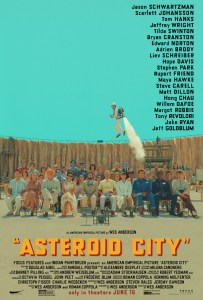 It’s not a good sign that a week after watching a movie I was racking my brain to try and remember what I had watched, and it’s even worse when it’s a movie by Wes Anderson, a filmmaker with such a distinct sense of intricate style it’s now become a go-to A.I. test for untalented people. Asteroid City has the makings of an appealing comic escapade set in a Southwest small town known for its tiny asteroid, and once aliens make their presence known, the entire town and its tourists and wanderers and scientists are quarantined. The problem comes almost immediately, as the movie is presented through several added layers of obfuscating framing devices. The story itself is a play, and we’re watching a movie version, but then also the play of the movie, and the behind the scenes of its now-deceased playwright toiling with his authorial messages and stubborn actors, and it feels like two different movies at odds with one another. The Asteroid City sequence is the more engaging, with some sweet storylines like Jason Schwartzman as a widower processing loss with his family, including his father-in-law (Tom Hanks) who never liked him, while beginning to find a possible romantic kinship with a struggling actress and single mom (Scarlett Johansson). I enjoyed weird little asides about the history of this little town, like a vending machine for land ownership, and s science fair with brainy whiz kids finding their own comradery. There’s even a nice moment in the meta-textual framing where the Schwartzman actor recites an exorcised dialogue scene with the actress who played his deceased wife in the play. It’s elegantly heartfelt. However, the added layers don’t really add extra insight or intrigue but serve as muddy trappings, making meaning less likely rather than more. It feels like Anderson didn’t have enough material with the central story so he added on the meta to make up the difference. There are too many moving pieces and too many characters, and versions of characters, here to settle into something grander. The whimsy and visual style of Anderson is still evident throughout every highly-crafted and pristine arrangement in the movie, so if you’re an Anderson diehard, he still has his charms. This is two Anderson movies in a row that felt disorganized, distracted, and chiefly under-developed, and I’m starting to worry that the form has taken over the function as storyteller.
Nate’s Grade: C+
Share this:

Air (2023)
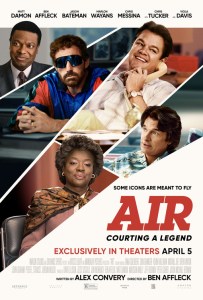 Who exactly could get that excited about a movie about selling a shoe? Apparently, plenty of critics and audiences judging by the success of Air, the dramatization of the eventual formation and presentation for the first Air Jordan sneaker. It’s Amazon’s first original movie that they’ve given a theatrical release since 2019’s Late Night, and it proved a moderate success for a mid-range adult drama before debuting on its streaming service. I was intrigued by the creative pedigree, as I’ve been an ardent fan of Ben Affleck as a director, and the uniformly strong critical reviews, but I kept thinking, “It’s just a shoe.” It was hard for me to imagine getting that drawn into a drama about a bunch of guys trying to get Michael Jordan’s endorsement. I just couldn’t see the movie in this scenario. Now that I’ve actually watched Air, I can credit it as a well-written and well-acted movie about passionate people putting forward a presentation. That’s the movie, and while entertaining, it’s still hard for me to understand all the fuss.
It’s 1984 and Nike isn’t the market-leading trend-setting company that we think of today. They dominated the running world but few if any saw them as hip. They were struggling behind Adidas and Converse in popularity and cultural cache, and CEO Phil Knight (Affleck) had tasked his basketball head of operations Sonny Vaccaro (Matt Damon) with snagging endorsements from the new NBA rookies. Sonny wants to go all-in on just one athlete, a special case that Sonny thinks can revolutionize the game, and one that could propel Nike to the next level. But first he’ll have to convince Jordan’s mother, Deloris (Viola Davis), that this smaller company with its smaller reach is going to be the best fit for her son’s potential future earnings.
 This is still a movie about a shoe, but it’s really a movie about people who are good at their jobs and trying to change a paradigm of thinking and the Way Things Are Done. I’ve seen it said that Air is “Moneyball for sneakerheads,” and that’s an apt comparison. It’s about a bunch of smart guys fighting for clout, a group of underdogs going up against the entrenched winners, but it’s really about passionate people trying to get others to recognize their passion. So it’s scene after scene of Sonny trying to break through and get others to understand why his way of thinking is going to be the best. It’s also structured entirely around the big presentation with the Jordans, with each stop at a competing shoe company as its own act break. It makes the movie feel very streamlined and focused. It allows moments for minor characters to get their own moment, to make it seem like there’s a larger world behind every scene. It makes the team feel more filled out, and as each person and artist comes together, it’s reminiscent of movies in general, about various talents coming together to put on a big show. With our hindsight already locked in before the opening credits, it’s got to be the journey that matters here, because we know the eventual coupling, so Air has to justify why the before time could be captivating. It’s engaging because it’s a story built upon underdogs and smart people getting to flex their smarts.
Of course, it’s also not too difficult to make someone look smart with the power of hindsight. This was one of the more maddening features of Aaron Sorkin’s frustrating HBO series, The Newsroom. The focus was on a TV show on a cable news network but it existed in our universe, covering the big stories from the recent past. Rather than providing insight into the struggles of journalists trying to break big stories and follow their leads, Sorkin’s show was his turn to rewrite the news, showing how the foolish journalists should have covered these major events. It was his condescending attempt to tell professionals how they should have done their jobs. However, he had the extreme benefit of 18 months or so of hindsight and seeing what was important and what was less so, which just made his critiques all the more condescending (“Why don’t you know all the things that I know from the future, stupid present people?”). I could do this myself, writing a story about a guy in the 1930s talking down to these people hoarding their gold and how they should, instead, invest in a burgeoning computer industry. It’s not hard to look smart when you have history already in your pocket. This is also the case with Sonny in Air, who says over and over how special Michael Jordan is, and we know this too with our personal hindsight, so it makes him look transcendent. However, there could be any number of guys in history that had a similar hunch about Sam Bowie, the player picked one spot ahead of Jordan in the 1984 NBA Draft and whose career was cut short by rampant leg injuries. That could have happened to Jordan too. Sometimes the greatest athletes are the recipients of just horrible luck (look at Bo Jackson, a modern-day Greek God who could have been an all-timer in two sports).
 Where Air glides is with its snappy dialogue and attention to its supporting cast, thanks to debut screenwriter Alex Convery. Despite my reservations on the subject matter, this is proof that a good writer can make any story compelling as long as they channel into the right universal elements. A movie about selling a shoe to a future billionaire becomes an underdog story and one about a group of middle-aged guys trying to live out their dreams by picking the right player to become their vicarious capitalistic dream. The side characters played by Chris Messina as a foul-mouthed agent, and Jason Batemen as an exec who mostly just wants to spend more time with his kids following a divorce, and Matthew Maher (Our Flag Means Death) as a lonely shoe designer, are welcomed and I enjoyed spending time with them all before the big decision. It’s pleasurable just to sit and listen to the conversational banter. If you can find a way to make characters debating the particulars of their industry and make it interesting regardless of industry, then that’s the sign of a good writer. There’s plenty of conflict thrumming throughout, like Sonny pushing to spend his entire department’s budget on one player rather than spreading the risk around, and the climax involves whether or not a billion-dollar company is willing to split some of its earnings with the athlete they’re making mega-million from. It was a first-of-its-kind deal that changed the industry, giving athletes more leverage and direct money for the use of their likenesses, and considering how integral Jordan was to the explosion of the NBA’s popularity, it was money well spent.
There’s no distinct directing flair from Affleck, as I think he recognizes the strengths of this script and how best to utilize them, which is to support his actors and give them space. The most noticeable directing feature is the repeated use of period-appropriate songs and archival footage, which might explain the movie’s staggering reported $90 million budget (for a shoe movie?). Affleck keeps things moving at a light-hearted tone but knows when to slow things down too.
 Air is an amusing drama with good performances and good writing and direction that understands how best to hone both of those selling points. It’s very streamlined while still feeling developed, and it manages to make a decades-old shoe deal feel interesting in 2023. I enjoyed it but I would have enjoyed this cast in just about anything, and I feel like the screenwriter and Affleck as a director have better stories on their docket waiting. It’s an enjoyable and intelligent drama with crackling good dialogue. It’s a solid movie but I guess I won’t ever understand the adoration it received, and that’s fine. Air proves you can indeed tell a compelling movie about a shoe deal. There you have it. Now back to that chicken/egg dilemma.
Nate’s Grade: B
Share this:

Tetris (2023)
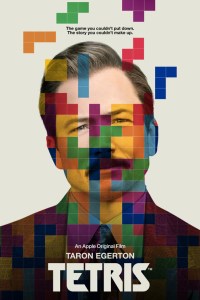 The “real” story behind the addictive puzzle game is an engaging tale of underdogs and corporate intrigue that might prove surprisingly fun and complicated for such a simplistic and straightforward game. We zoom back to the late 1980s and two converging storylines: the rise of handheld gaming and the decline of the Soviet Union. Taron Egerton (Rocketman) plays Herk Rogers, an American businessman living in Tokyo with his wife and family who has put all his hopes on the Japanese license rights of a small little game made in Russia. What follows is one man trying to finagle a system of questionable IP rights between scheming businessmen and Soviet KGB agents. The numerous players fighting for dominance over the course of legal copy, meeting rooms, and offers and counter offers was, for me, the most entertaining part of the movie, and the version that felt the most tethered to reality. There are some Hollywood exaggerations in this retelling, especially in the final act where the movie takes a cue from Argo and has its heroes in a careening car chase to get to the Moscow airport and eave the country (externalizing the internal feelings, much like Argo). Since we all know that the game ultimately ends up as one of the best-selling and most iconic, and packaged with the launch of Nintendo’s GameBoy, the appeal of the behind-the-scenes story is the struggle that our heroes overcome, and Tetris succeeds through its accessible but ever-moving plot mosaic that feels like legal knots trying to come undone. I think the movie gets even better when Herk becomes friends with Alexey, the state worker who created the game in his spare time and is hassled by KGB agents for the game harming national productivity. There are a few too many cutesy touches the movie could do without, like the inclusion of 8-bit sprites as visual transitions, something that is layered over the climactic car chase making it look much duller. I also feel like the honeypot twist feels a little too overinflated Hollywood drama for its own sake. There’s already plenty of drama here that didn’t need the help. Regardless, Tetris is a solid drama that stacks up.
Nate’s Grade: B
Share this:

Cocaine Bear (2023)
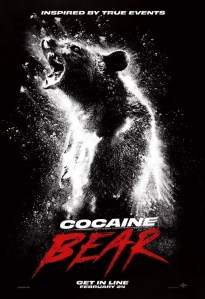 If you’re going to watch one movie with a cocaine-addled ursine killing-machine, it might as well be Cocaine Bear. In a lot of ways, this movie reminds me of Snakes on a Plane, a similarly deadly animal thriller sold on its bizarre concept and the promise of ironic entertainment, and both of the movies creatively peaked before anyone saw the movie. The true story is that in the 1980s, a drug-running plane dropped shipments of cocaine in Tennessee wilderness and a bear came across some cocaine, ate it, and died. The movie asks, “What if it became a coked-out slasher killer?” I wanted this movie to be more fun than it is, and I think the crux of my disappointment stems from the movie working one obvious joke into utter oblivion. The absurdity of a bear being high on drugs is about all you’ll get through 90 minutes. There are characters and subplots that you won’t care about, nor find terribly funny despite having Keri Russell, Alden Ehreneich, Brooklynn Prince, Kristofer Hivju, Isiah Whitlock Jr., Margo Martindale, and the final performance from the late Ray Liotta. It’s a lot of people, staring agog and saying, “A bear can’t do that,” and then we watch the bear do exactly that. There’s some impressive gore at turns and the CGI bear is workable for this kind of budget. The shame of it is too much just isn’t that funny. The movie is too content to rest upon its arch premise without adding enough additional comedy development to actively engage. If you’ve seen the trailer, you’ve seen the movie. This movie needed to be funnier, darker, weirder, or just anything in addition to the simple premise of a bear high on drugs and running a rampage. Is the joke ultimately on me for expecting more from a movie called Cocaine Bear?
Nate’s Grade: C
Share this:

Empire of Light (2022)
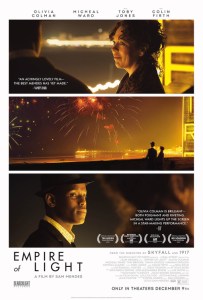 I was recovering from the flu while watching Empire of Light, which probably hindered my entertainment experience somewhat, but I was astounded at how a movie with this pedigree could be this boring and adrift. It’s directed by Sam Mendes, photographed by Roger Deakins, starring Olivia Colman and Colin Firth, and it’s all about running a movie theater in England in the early 1980s, so you would expect it to be nostalgic catnip for any cinephile. Not so. For the first hour, it feels more like a series of moments that feel pressed under glass, all the air and life removed in the presentation. It doesn’t work as a celebration of art and the power of movies, though it tries at points. It doesn’t work as a character examination because so many of the characters are kept surface-level, shallow, or boring. Colman is our main character and having an unfulfilling affair with her boss (Firth) and then she starts a friendship with a new, younger co-worker that transforms into its own romance. Given that setup, you would think you would care about their burgeoning relationship, but I didn’t (I was more amused at all the places beside an actual bed that people are seen having sex). That’s because this movie feels so poorly paced and passionless. Colman gets her showdown with her bad boss and I thought, “Well, we’re wrapping things up,” and then I discovered that, amazingly, there was still 50 minutes left. “How?!” I shouted at my TV screen. Ah, you see that’s when the movie throws out a mental illness subplot that feels entirely too late and awkwardly handled to count for much else than a delay tactic. I wish Empire of Light had just been one of those adorable British small-town comedies with oddballs running a movie theater in the past, either leaning into it as a workplace comedy or a romantic ode to cinema. It’s a lot of missed potential and middling artistic elements without a clear vision to steer them. There are moments that stand out, especially the racist ones, but it’s a too-long movie missing interesting characters and an accessible and engaging story that exists beyond the (assumed) ephemeral memory of Mendes.
Nate’s Grade: C
Share this:

Babylon (2022)
 I completely understand how Babylon is such a divisive movie, and this seems entirely the point of writer/director Damien Chazelle (Whiplash, La La Land). It’s over three hours long, it’s got a budget of around $100 million dollars, and the entire enterprise just shouts artistic hubris, at best, and petulantly self-indulgent miasma at worst. Any movie that literally opens with a sequence that includes shots of an elephant defecating and a prostitute urinating on her giggling john is clearly trying to provoke a very strong response, and Chazelle’s expose on the early romanticized days of Old Hollywood is, chiefly, intended to revile and disgust. Chazelle’s mission is to rip apart the cozy nostalgia and hazy romance of the dawning of the film industry, to proclaim that Hollywood has always been a cesspool of exploitation and misogyny and racism and greed. The movie wallows in giddy exploitation but also hijacks the illusion of achieving stardom and asks whether or not the lasting art is worth all of the horror and ugliness of the systems that produce it. Babylon is a wild party of a movie with multiple sequences brimming with pure brilliant filmmaking bravura, and it also ends in a way that just might collapse Chazelle’s righteous fury and contempt.
Within the first half-hour, we are introduced to the three main characters we’ll be charting over many years. Nellie LaRoy (Margot Robbie) crashes a big house party that would make Gatsby jealous. She’s come to California to follow her acting dreams, which her family and small-town peers would sneer at, and she is faking it until she makes it with her boisterous personality. Manny Torres (Diego Calva) is a Mexican-American just trying to get his big break in Hollywood and willing to do whatever it takes to pal around with those in the movies (he is one of our primary elephant wranglers). Jack Conrad (Brad Pitt) is the highest-paid silent movie star famous for his sweeping epics as well as his drinking and multiple broken marriages. Over the next few years, as the industry transitions into the precarious era of sound, each of these three will experience their own rise and fall as they struggle to hold onto their dreams despite the many personal compromises and risks they have to endure to cling to that glitz and glamor.
 If Baz Luhrrman’s Great Gatsby and The Wolf of Wall Street had an illicit baby, and then it was raised by Boogie Nights-era Paul Thomas Anderson, you might get Babylon. It is a big movie founded on the principle of grandiose excess in all capacities. First off, it’s three hours long though this might be some of the fastest-paced three hours, albeit twenty minutes could have been trimmed here and there. I was never bored once, partly because the structure of the movie is episodic in nature, boasting varied sequences that run the gamut from brilliant to ridiculous to brilliantly ridiculous. From an overall thematic standpoint, there isn’t really any subtlety or nuance. The movie is like having the director screaming in your face. Chazelle’s depiction of Old Hollywood is one of direct shame and wanton hedonism, and beyond the obvious “It was always this bad” moralizing there isn’t much more that Chazelle has to articulate, except for a strangely misguided and arguably antithetical coda (more on this later). For almost three hours, Chazelle holds the industry accountable on their buzzy, boozy wavelength of high energy and thrills.
Babylon is presented as a big raucous party where you’re happy to be a guest but also glad you can go home to your own bed. This isn’t a movie that excuses the misdeeds of its degenerates and hangers-on and the systems of power that enshrined the horrible to be even more horrible. Babylon pushes its many characters into uncomfortable questions of what they’re willing to compromise for fame. It’s a process of assimilation and people cutting free their identity, which can be liberating for some and lacerating for others. A significant supporting character is a black jazz musician who begins to find success in the pictures. Then the producers want the man to blacken his face even further, and the ensuing anguish and rage is so palpable that it’s hard to think Chazelle has anything but seething contempt for the sordid history of his own industry. Babylon yearns to be shocking, to be provocative, and it does so easily, sometimes too easily. It’s exceptionally gratuitous to a fault, cavorting with topless women, drug binges, abrupt and callous violence, and all sorts of lewd bacchanalia. Chazelle is demystifying Hollywood’s self-serious fable, and he’s doing so by boldly leaving no bodily fluid untapped and un-splattered.
 This movie is a lot, and it’s also offering very little on a thematic level, so I can understand why plenty of people would hold their repulsed noses and say, “Not for me.” I get it. Not everyone is going to want to watch Nellie projectile vomit onto a hoity-toity snob during a party where she’s trying to re-frame her coarse, lower class identity to be accepted by the brain-dead social elites. Hollywood is presented as a vehicle for self-actualization, but the system is relentless and unforgiving, and even those who achieve success are never afforded a secure perch. The careless regard for safety in Old Hollywood is highlighted by memorable moments, like when a Medieval war epic is halted as a dead extra has a spear sticking straight up in his gut. The crew argue that the man was known as a drinker and therefore it must have been an accident of his own doing. And then the movie skips back to filming, this man’s passing given no more passing thought. And yet there are thousands arriving every year to work themselves senselessly to be the next awaiting sacrifice for this town. It’s an industry built upon human suffering and I can see how many viewers would view the many examples as wallowing in the muck for titillation. The difference for me is that I don’t feel like Chazelle is glorifying any of these antics…
…With the exception of the ending, of which I will discuss more in depth because I find it to be wholly curious and in conflict with every fiber of the movie up until this very final point. I don’t think much of this would spoil the movie for you, but if you wish to avoid my discussion of the conclusion, then skip to the next paragraph, dear reader. The film has a very definitive perspective on the movie industry’s sadistic history and yet in the last five minutes, Manny is subjected to a montage of cinematic high points, zooming ahead into history to include such movies as Terminator 2, Titanic, The Matrix, and Avatar, and he weeps. For 170 minutes, Chazelle has taken us along the road of perdition of Hollywood exploitation and degradation, complete with a skin-crawling trip through hell with Tobey Maguire. And then in the final ten minutes, Chazelle says, yeah, but maybe all of that exploitation and death and disaster was all worth it because we now have movies like… Avatar. It’s the conclusion where Chazelle, as my pal Ben Bailey would say, reveals himself as an art maximalist, that only the art remains and only the art shall matter, arguing that all the vile behavior we’ve endured has meant nothing. It’s the opposite of what the rest of the movie has been purporting, and it’s strangely sentimental for an unsentimental film. It feels like a misguided misstep that concludes with excuse-making and moral relativism, which is far queasier than any of the gratuitous sequences of nudity, drugs, vomit, piss, and rat-eating.
 The technical qualities of Babylon are outstanding, and when working in such symbiotic symphony, they can be absolutely thrilling to exhibit. The sterling production design, extravagant costuming, and swinging cinematography work with the fevered editing and pumping score, and expertly recreate this era with amazing scope and lived-in period detail. I’m still humming the score’s memorable, jazzy, percussive leitmotifs days later. There are sequences that are simply stunning, such as the first day on a movie set for Nelly and Manny, both of them making names for themselves through problem-solving and scene-stealing, and the revelations and race-against-time brinkmanship are electric. The introduction of sound also creates many complications, brilliantly encapsulated in a comedic sequence where Nellie is trying to adjust to this new reality on a soundstage. It’s a comedy of errors cracked up to a hallucinatory madness by the end. Chazelle also delivers one of the best fart jokes in film history, where Conrad is in a bathroom questioning the appeal of sound and why audiences would want to hear, and as punchline, a giant fart erupts from one of the bathroom stalls. The parties are ribald, with the opening making use of an elephant as a literal distraction stomping through a mansion, and a latter one that ends in a frenzied man-to-snake fight. The entire sequence with Maguire is best left as a stupefying surprise, a sequence that reminded me of the dread-fueled Wonderland scene in Boogie Nights. In my view, even if you found the movie was thematically shallow, the individual sequences are so entertaining and so technically executed that the movie demands to be seen.
I’ve noticed some complaints that Chazelle’s messy opus could have pulled from actual Hollywood scandals, that he didn’t need to make up characters and fictional scenarios. That’s fair, but Chazelle wants to impart an impression rather than a case-by-case history of literal bad men. There are characters meant to resemble clear inspirations, like Fatty Arbuckle (who was innocent, by the way) and the affair of Greta Garbo and Marlene Dietrich or Errol Fylnn’s penchant for underage girls, but I don’t think the movie loses its spirit or bite because it’s not strictly recreating existing historical scandals. It’s still an expose on Old Hollywood without the names.
 Babylon is a rip-roaring experience that condemns the history of cinema through the expansive art of cinema, and it’s a wild party populated by sleazy provocateurs and capitalists. Even some of the criticisms of Babylon I can find artistic explanations for, from its gratuitous nature to even the sidelining of its minority and queer stories, perspectives themselves cruelly sidelined and erased from the studio system of Hollywood. Even its overwhelming explicit nature is partly the point, as characters spin round and round, indulging in every debauchery to avoid the march of mortality. Robbie’s high-energy performance is like if a bag of cocaine became a sentient human being. It’s all about sensation and distraction and the many willing to give everything to be part of that, and for almost three hours, Chazelle makes the manic chaos absorbing and horrifying before going soft in the end and arguing that maybe it’s all worth it. Babylon is dazzling filmmaking that will exhaust and nauseate as many as it potentially thrills. I’m glad Chazelle decided to use much of his carefully built artistic cache to make something this extravagantly divisive and ambitious.
Nate’s Grade: A
Share this:

All Quiet on the Western Front (2022)
 The surprise surge of the Oscar season is a German-language remake of the 1929 Best Picture winner, and after watching all 140 minutes, it’s easy to see how it would have made such an impact with modern Academy voters. All Quiet on the Western Front is still a relevant story even more than 100 years after its events. It’s a shattering anti-war movie that continuously and furiously reminds you what a terrible waste of life that four-year battle over meters of territory turned out to be, claiming over 17 million casualties. I’ve read the 1928 German novel by Erich Remarque and the new movie is faithful in spirit and still breathes new life into an old story. We follow idealistic young men eager to experience the glory of war and quickly learn that the horror of modern combat isn’t so glorious. There are sequences in this movie that are stunning, like following the history of a coat from being lifted off a dead soldier in the muck, to being reworked at a seamstress station, to being commissioned to a new recruit who questions why someone else’s name is in his jacket. It’s a simple yet evocative moment that sells the despairing reality. The movie doesn’t skimp on carnage as well, as long stretches will often play out like a horror movie where you’ll fear the monsters awaiting in the smoke and that nowhere is safe for long. And yet, where the movie hits the hardest isn’t depicting the trenchant terror but with the little pieces of humanity that shine through the darkness. There’s a small moment in a crater shared by two enemies where one of them is dying, and these final moments of recognizing the same beleaguered helpless and frightened humanity of “their enemy” are poignant. Make no mistake, All Quiet is a condemnation on the systems of war where old pompous generals send young men to needlessly die for outdated and absurd reasons like the concept of “maintaining national honor.” A significant new subplot involves Daniel Bruhl (Captain America: Civil War) as a representative of the German government trying to negotiate an armistice when the French representatives are looking for punishment. It allows us to take a larger view of the politics that doomed so many and laying the foundation for so many more doomed lives. The ending of this movie is a nihilist gut punch. The production values are impressive and elevate the artistry of every moment. The sound design is terrific, the cinematography is alternatingly beautiful and horrifying, and the production design is startlingly detailed and authentic; it’s easy to see how this movie could have earned nine Oscar nominations. All Quiet on the Western Front is a warning, a eulogy, and a powerful reminder that even older stories can still be relevant and resonant.
Nate’s Grade: B+


 nathanzoebl
You must be logged in to post a comment.