Blog Archives
Kong: Skull Island (2017)
 Some of Hollywood’s most famous characters are its monsters, and no I’m not referring to studio executives. Kong was one of cinema’s first international stars, a stop-motion marvel in 1933 that had a hankering for blonde women. His legend has endured many different incarnations and once again the gigantic gorilla is given his close-up, in Kong: Skull Island, the second phase in a would-be MonsterVerse after 2014’s Godzilla. This time the monster comes through. Skull Island is a pleasing two hours spent with just enough style, thrills, and comedy to enjoyably pass the time best accompanied by a big bag of popcorn.
In 1973, a geological surveying team has discovered a heretofore-unknown island ominously shaped like a skull. Everyone is heading there for different reasons. Bill Randa (John Goodman) wants to prove the existence of monsters, and that he’s right. Preston Packard (Samuel L. Jackson) wants one last mission before returning home from the Vietnam War and its anticlimactic ending. James Conrad (Tom Hiddleston) is one of the world’s best big game trackers and wants a new challenge. Mason Weaver (Brie Larson) is an award-winning war photographer who wants a new scoop. Their plans are put on hold when a 100-foot tall ape, Kong, violently knocks their helicopters out of the sky. The survivors scramble to regroup and escape the hostile locals on Skull Island along with the aid of Hank Marow (John C. Reilly), a WWII fighter pilot who crashed on the island thirty years ago and might have a few screws loose from the experiences.
 Kong: Skull Island is a monster mash-up that knows how to entertain in grand smash-em-up style. It is not a remake of the original King Kong story, and being free of that “twas beauty killed the beast” narrative opens the movie to be its own thing, a high-concept action vehicle and clear Vietnam War parallel. It’s like someone watched Peter Jackson’s agreeable if bloated 2005 King Kong and said, “Hey, what if we shaved off the first hour and spent the whole time on Skull Island, the undisputed best part of the movie?” It’s the equivalent of an-all marshmallow box of Lucky Charms (Simpsons reference!). The unique environment boasts a retinue of fun surprises and a variety of action set pieces that keeps the movie from falling into a valley of repetition. It’s not just giant apes and dinosaurs, there’s also giant bulls, insects, and in one creepily terrifying moment a giant spider that uses its stalks of long legs to try and impale its prey down below. It’s a long lost world that allows for a constant sense of discovery that doesn’t get old. When the characters stumble upon a graveyard I wanted to soak up every detail of the spectacular collection of bones. I was grateful that Vogt-Roberts made fine use of his locations, real and computer enhanced, to build a sense of space and atmosphere.
One of the best aspects is that the producers have apparently learned from 2014’s Godzilla and elected not to play an elaborate game of hide and seek. My biggest complaint is that I wanted more Godzilla in my Godzilla movie. I was not content to settle for a shadowy impression or a glimpse of a tail here and a foot there. It was an artistic decision that toyed with audience anticipation but it also felt like we were being lead on. Too much teasing and not enough of the good stuff. This is not a problem with Kong: Skull Island; the title beast makes his presence known in spectacular fashion around the half-hour mark, and there’s no tiresome visual obfuscation to blunt the impact. You see Kong smash and it’s glorious carnage. He’s established as ornery protector, a sheriff of Skull Island keeping order with the fragile ecosystem. It makes the world of monsters seem much larger and more balanced. I wish there was more for Kong to do as a character but without his familiar arc he’s less character and more a testy god. There is a moment or two that hint at the soul inside the giant ape, but he’s mostly the physical embodiment of implacable force and the good and bad that goes with such power.
The Vietnam parallels are plentiful and provide a dollop of subtext to the conflicts, but this is a movie that doesn’t forget to have fun. The imagery can often fall into Apocalypse Now flashbacks and other war movie iconography, from the burnt orange sunsets casting dusky silhouette to the slow motion explosions trailing after teams of helicopters. The ever-present 70s rock soundtrack almost reaches Suicide Squad levels of needle-drop proportions in the first half, constantly reminding you of its time period. Skull Island isn’t a very deep movie but it does subvert some genre expectations at turns. A character given significant attention is taken out rather unceremoniously. An appeal to a greater sense of humanity is curtly brushed off. A lone heroic sacrifice that proves to be fruitless. Our more photographic heroes are evidently the worst, most useless characters (more on that below). For a movie that doesn’t strive for more than two hours of entertainment, it finds interesting sub routes.
 I’m shocked at what director Vogt-Roberts has proven capable of considering his only other film was the low-budget, rather unremarkable coming-of-age comedy The Kings of Summer. This is a Russo brothers-esque statement, a Colin Trevorrow-style jump from minor indie to full-blown big screen spectacle. Is Hollywood going to sign up Joe Swanberg or Shane Caruth to direct the next four-quadrant blockbuster based on a toy? He does an adept job of capturing the action with style, and his shot compositions are routinely visually pleasing, confidently guiding an audience’s eyeballs to key info within the frame. I loved Kong’s immediate introduction as the camera circled him in a 360-degree pan, stopping at points to slow down before ramping up once more. There are amusing angles that highlight the comedy or tension of a scene, and Vogt-Roberts’ sense of geography and scale enhances the destruction. The prologue even had me hooked, as we watch a pair of enemy WWII soldiers parachute on the beach and continue their fight on the new territory. It was such a slam-bang opener and Vogt-Roberts’ use of camera placement reminded me of Spielberg. The special effects are reliably terrific even if they don’t seem like leaps and bounds from Jackson’s Kong. The skull-faced lizard monsters are scary enough to be threatening while still cool. The monster mayhem is lovingly reproduced and in environments where an audience can see the spectacle.
Another improvement is that the human cast has just enough characterization to make me care. With the newest Godzilla, I didn’t care if the giant lizard stepped on any of them, short of maybe Bryan Cranston. However, in this film I wasn’t impatient for the monsters to return that much. The best characters are, ostensibly, the antagonists. Jackson (The Hateful Eight) who goes full on heart of darkness, obsessed with killing the mighty Kong, asserting man’s dominance, and winning a war that others tell him cannot be won. He’s still sore and frustrated from the Vietnam War’s conclusion. He’s convinced that brute force and intractable persistence will win out, and he’s trying to prove something to himself, to the brass in D.C., and perhaps to all the lives lost under his watch. It’s not subtle characterization by any means but neither is a movie with a giant ape fighting monsters. Goodman (10 Cloverfield Lane) uses any opportunity to prove his life’s research about the existence of ancient monsters who he claims are the ones who rightfully have dominion. He’s using the looming possibility of a threat, and the paranoia of the U.S. government in the Cold War, to his sneaky advantage. Watching Goodman and Jackson glare at each other, neither side refusing to back down in their stolid beliefs and personal, self-destructive obsessions, is the non-monkey highlight of the film.
The closest thing approaching human drama, and even tragedy, is Reilly’s distaff character, and I don’t know the last time that John C. Reilly was asked to be a movie’s human compass (Magnolia?). His out-of-time character has a definite degree of cabin fever wonkiness. Reilly excels at being the offbeat oddball and has some welcomed comic relief moments, but it’s the drama related to the character that stuck with me. With the appearance of new human faces, he can take stock just how much of his life he’s missed out on and the family he’s been absent for. His genuine melancholy provides a depth to a character that would ordinarily just be made fun of for being kooky. Still, he’s got some great gallows humor that keeps the movie alive comically while also reminding of the dangers at stake.
 The rest of the characters are rather interchangeable or curiously have little impact on the plot, and that unfortunately includes the headlining stars. Hiddleston (Thor) is a big game tracker and he’s the most useless character. Think about that. He’s supposed to be a wildlife expert and a tracker and he provides no real purpose other than he fills out a tight shirt nicely. Hiddleston is eye candy and little else, which is strange considering his skill set should have factored into the plot somehow. He points them in the direction of water and that’s about it. Larson (Room) is a recent Oscar-winner and has tremendous skill burrowing into her characters and finding a raw vulnerability. With Kong, her anti-war photographer gets off a few ideological shots with Jackson, but there’s little to separate her from the other diverse supporting castmates who are just bodies meant to be sacrificed. They’re all waiting to be eliminated in fantastic, gruesome, or unexpected ways. You won’t exactly be shedding a tear for these people when they become monster chow. Fun fact: ⅔ of the core cast of Straight Outta Compton are here (Corey Hawkins, Jason Mitchell), which apparently shows that Ice Cube isn’t a fan of long travel.
Enjoyably dumb at points and smart enough to know it, Kong: Skull Island is an admirably efficient monster movie that delivers its share of fun. Vogt-Roberts makes a major statement as a visual stylist and director of big-time smash-em-ups. The action is varied, intense, and vividly realized from carefully positioned camera angles and a team of high-class special effects wizards. Kong: Skull Island knows what an audience wants and happily delivers. The actors, for the most part, are enjoyable or enjoyably expendable. If this is the next step in the growing MonsterVerse, then I saw bring on the cataclysms and world-destruction. Friendly tip, stay for a post-credits scene that sets up future installments and try not to pump your fist in excitement. Kong: Skull Island is a boisterous B-movie that can make you feel like a kid again watching the amazing film feats of classic monsters.
Nate’s Grade: B+
Share this:

The Great Wall (2017)
 The Great Wall is the most expensive film in Chinese history and the first major co-production between an American film studio and a Chinese-owned studio. While Matt Damon is the name above the title, it’s filled with recognizable Chinese stars, like Andy Lau, Eddie Peng, and pop star Lu Han. China’s most renowned action filmmaker, Zhang Yimou, serves as the director. It has the look and feel of a Hollywood special effects epic but it’s very much a Chinese film in ownership and execution, perhaps marking a new synergy of East meets West blockbusters. With a whopping budget of $150 million, the same as the last Star Trek movie, it looks like a typical Hollywood big-budget epic with visual spectacle and sweeping vistas. It’s up to the viewer whether a majority-Chinese production successfully imitating Hollywood middlebrow action spectacle is a brave step forward or just another source for mediocrity.
In the 11th centruy, traveling European mercenaries William (Damon) and Tovar (Game of Thrones’ Pedro Pascal) are looking for black powder, an explosive substance that’s worth serious money back home. A mysterious feral creature attacks them and William cuts off the beast’s hand, taking it as a trophy. The Nameless Order, Chinese military officials stationed at the titular great wall, capture them and want to know exactly how these foreigners were able to defeat this beast. Legend states that long ago a meteor crashed to Earth, and with it came a horde of green monsters with big teeth lead by a queen that psychically controls her thousands of attack drones. Every 60 years the creatures emerge searching for food for their ravenous appetites. The Imperial City must be protected at all costs and that is why the wall was constructed. Lin Mae (Tian Jing) is thrown into command when her male superiors are killed, and she relies upon her unexpected Western allies to throw back the evolving horde of monsters.
 As the first major big-budget collaboration between studios in China and the United States, The Great Wall feels like something that would have escaped from the 1990s era of tentpole filmmaking, and it’s clearly a paycheck film for all involved. Now that doesn’t condemn in either regard. There’s a certain charm to the relatively dumb sci-fi action movies that started being prepped with steady regularity in the 1990s when advancing special effects made it possible for hordes of CGI monsters to thwart. There’s an obvious point of engagement that crosses all translations: man versus monsters. The film even somewhat admirably knows its own ridiculousness and embraces it. I was reminded of the go-for-broke silliness of Jerry Bruckheimer’s movies like National Treasure’s positing that maybe, just maybe, there’s a treasure map on the back of the Declaration of Independence. This feels like the biggest budget Asylum movie you can imagine, and that in itself is not necessarily a problem. However, because of the mechanical nature of so much of its storytelling and the safe territory it resolutely occupies, The Great Wall is a mediocre monster movie that aims right down the middle for cross-continental mass appeal and nothing more. I’m almost certain that Damon had to have been paid $20 million dollars to justify his participation. The actors and the director go about their business in a professional manner but you feel the lack of passion. It’s a film looking to appeal to the most people and losing any sense of distinction.
Credit director Yimou (Hero, House of Flying Daggers) for keeping the film on life support, providing just enough action variety and pleasing visuals to stir an audience awake. The monsters are introduced very early into the film, around the twenty-minute mark, and their CGI horde definitely presents a worthy challenge. In fact they feel too overwhelming in their numbers. Early on we see that the ferocious creatures, which closely resemble the Ghostbusters demon dog painted green, are hard to kill outside of a straight shot to their shoulder-eyes (they have eyes on their shoulders… because…). The first creature that successfully scales the wall takes out a slew of Chinese warriors. If one of these things is that hard to kill, how in the world can a limited number of people, even with high ground, defend against a sea of a hundred thousand? The mismatched numbers deflate the stakes and lessen the tension, which isn’t helped from subpar characterization. The world building is certainly hazy (Why do they come out once every 60 years? Why do magnets affect them? Why all the effort for small food supplies?) and some of the elements feel inserted just for their “cool” factor. A group of female warriors bungee jump off platforms to spear the monsters, but why is this necessary when we’ve already seen that China has fiery projectiles that are far more effective? It is cool though.
Thankfully a movie with little going for it other than spectacle at least knows to vary up its action sequences. Each encounter with one of the monsters is structured differently. The best sequence may be William and Tovar navigating through a blinding fog and relying upon the sounds of whizzing arrows to alert them to approaching hungry monsters. It provides some fun tension and pop-out moments. There’s a beautiful sequence commemorating a fallen friend with the launching of hundreds of floating lanterns. The concluding sequence involves our remaining characters climbing to the top of a pagoda lined with stained glass. As the characters rush up flights of stairs, the screen is lovingly diluted with colored shafts of light, which also add extra visual flourishes when the monsters begin to leap through the glass level by level. Yimou’s use of color has always been a hallmark of his career and it translates even into the color-coded amour of the different divisions of the Nameless Order. They look like ancient Power Rangers. While lacking a great deal of overall tension due to its predictable nature and dull characters, there are fleeting moments of suspense drawn out in individual action set-pieces. The overall movie is generally unremarkable CGI carnage reminiscent of a too-late Lord of the Rings rip-off, and yet there’s at least a general professionalism to its unremarkable CGI carnage.
 Early on the movie was hit with accusations of whitewashing, and given Hollywood’s recent track record with the likes of Exodus, Aloha, and Gods of Egypt, it would be entirely conceivable that producers felt Damon needed to be a white savior role. That’s not the case at all and in fact the Chinese forces are shown to be flawless specimens. Damon’s character is the out-of-place European (complete with hard to place accent) who represents selfish and arrogant Western attitudes. He’s routinely awed by the ability and precision of the Chinese warriors, who dutifully sacrifice for the greater good and safety of others they will never know. They are symbols of power, teamwork, courage, strength, and dignity. The lessons can be rather blunt (a woman… in charge?!). The portrayal of the Chinese forces is so honorable and so empowered that they come across as boring moral paragons without an ounce of traceably human nuance. They don’t come across like characters so much as interchangeable warriors, and so when they start dying one-by-one their sacrifices ultimately leave little impact. It turns out that the non-Chinese actors, Damon and Pascal, supply the most interesting characters because their roles are allowed personality, basic moral ambiguity, and inner conflict beyond a sense of duty and the requirements of achieving that duty. The Great Wall drafts off Damon’s worldwide star power to teach him a lesson about Eastern values. It certainly presents China and Chinese characters in a very positive perspective, but being so broad sanitizes their humanity and transforms people into boring paragons.
Given the pedigree of those involved, it’s completely expected to be underwhelmed by the end results of such an expensive East meets West collaboration. The Great Wall is ultimately too safe and stately to satisfy beyond generic genre thrills; lowering one’s expectations is highly advised in order to properly appreciate the goofy action spectacle. The Great Wall of China being constructed to protect from a horde of ravenous, possibly extraterrestrial monsters is certainly a silly premise, but the movie doesn’t pretend it’s anything than what it is, a large-scale monster movie with a sense of fun. It’s not soaked in deconstructive irony or meta commentary. Instead, The Great Wall is a straight-laced action spectacle that treats its absurdity with conviction. It’s not much better or worse than other empty-headed big-budget action cinema from the Hollywood assembly line, but is that progress? Is making an indistinguishable mediocre B-movie a success story?
Nate’s Grade: C
Share this:

The Founder (2016)
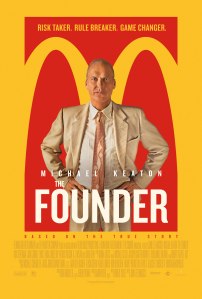 The Founder aims to be The Social Network of hamburgers and milkshakes, a warts-and-all biopic of a huckster who glommed onto other’s success and transformed it into an empire, a pragmatically ruthless entrepreneur run rampant with ambition and leaving behind a trail of lawsuits and disgruntled little people. Michael Keaton, on a roll since Birdman, teams up with screenwriter Robert Siegel (The Wrestler) and director John Lee Hancock (Saving Mr. Banks) to bring to life the story of the man behind the ubiquitous golden arches. The details are routinely fascinating and the movie presents a larger thesis on shifting and conflicting concepts of the American Dream and whether a ruthless yet victorious huckster is to be celebrated, pitied, scorned, or all of the above.
In the mid 1950s, Ray Kroc (Keaton) was a struggling milkshake mixer salesman striking out with just about every drive-in and dinner in the Midwest. His wife Ethel (Laura Dern) is exasperated by Kroc’s flights of fancy, shilling whatever new product might be his ticket to riches. His life changes thanks to one very efficient hamburger stand in San Bernardino, California. The McDonald brothers, Mac (John Caroll Lynch) and Dick (Nick Offerman), have ordered eight of Kroc’s milkshake mixers because they can barely keep up with demand. Kroc travels out West to see for himself and discovers a tasty and speedy hamburger assembly line that nobody else is doing. He pushes the McDonald brothers to franchise their model with him in the lead. They’re wary but agree with a strict contract that still gives full executive decision-making to the brothers. Kroc languishes at first but finds growing success, barely able to keep ahead with the mounting overhead costs. Kroc wants to keep going but the McDonald brothers are unyielding over their terms of business. Kroc schemes to push them out of their own business, establish himself as the founder, and take their very name for himself.
 Firstly, the story of the formation of McDonald’s is probably far less known than the formation of Facebook, and this provides plenty of opportunities for illumination. It is an inherently interesting story. There’s the invention of the modern-day fast food assembly line and the difficulty in perfecting this process and getting customers acquainted with the new reality. Initially, after years of drive-in service, customers are befuddled that they have to physically walk up to a window and order and throw away their own trash. The early history, hiccups, and adjustments are interesting, but it all gets more engrossing once Kroc comes aboard. It’s here where the film becomes very business-like in its examination of Kroc’s ruthless business tactics that lead to his ascent. Without Kroc’s intervention, perhaps the world would never have known the name McDonalds. He’s not an instant success either. He’s already middle-aged when he comes across the McDonald brothers. He’s not a brilliant salesman by nature. He’s cunning and doggedly persistent, the key he tells us since the world is rife with talented, educated, and good people who go nowhere. Kroc is a constant motor that can never be satisfied. Ethel asks him if anything will ever be enough, and after a short pause he replies without pretense, “Probably not.” He cannot enjoy success because he always feels he should be entitled to more. It’s the kind of unmoored ambition that leads him to throw his litigious weight around, knowingly breaking legal contracts and handshake deals to get exactly what he wants. Kroc’s business triumphs will remind certain viewers of Donald Trump, a man who uses similar advantages of wealth to exploit others and force them into advantageous deals. Even when explicitly in the wrong he just rolls along undeterred.
It is Keaton’s (Spotlight) movie and he more than delivers under pressure. Keaton adopts a speaking affect that makes the character weirdly magnetic without being wholly charming, an interesting combination that reflects the conflicted nature of Kroc. He’s a fast-talking salesman who enjoys the sound of his own voice but he doesn’t fool himself. He’s a man who knows what he wants and it just happens to be everything. He knows his limitations but he strides forward. He is bursting at the seams to get out from under the thumb of the McDonald brothers, who he sees as limiting the growth of a company that is more his than theirs. Kroc delights in being treated to the upper echelons of power. He loves having people proverbially kiss his ring and lavish his greatness. It’s the story of a man who scraped by his entire life until stumbling upon someone else’s genius idea. Keaton plays the man with a wily canniness that is always entertaining, channeling the actor’s natural oddball energy and style into a Midwestern McBeth. He says if he saw his competitor drowning he’d “shove a hose down his throat.” He’s generally cold but Keaton and Siegel don’t present him with a standard redemption arc. He’s kind of a hapless jerk at the start and becomes a powerful, egotistical jerk by the end. Keaton’s layered performance gives the film a solid anchor to keep viewers invested in the film.
 If only the other parts of The Founder had as much nuance and care as Keaton’s role. The supporting characters have flashes of interest but are too relegated to be much more than symbols or less developed foils to Kroc. The McDonald brothers have a poignant level of tenderness to them but they’re set up to be symbols of American values that will inevitably be trampled upon by Kroc’s corporatist version of the American Dream. Mac is the hopeful and trusting brother, Dick is the no-nonsense devote to quality and ethics, and together they could use additional ambiguity or depth. They’re meant to represent an older way of doing business, the familiar edict that hard work, dedication to customers, and quality will pay off. The brothers are successful and content at their level of success; they lack the naked ambition of Kroc and his disregard for the rules. They’re set up to be defeated and swindled and victims of Kroc’s tactics, which limits them as characters. There’s a sliver of detail with Dick’s concern for his brother’s diabetes threatening him, but the brothers are more martyrs than anything else. You anticipate their defeat with slight dread but more a sense of impending inevitability. Their good-natured values are no match for the winner-takes-all mentality of a man on a mendacious mission.
Similarly, Kroc’s wife is another figure set up from the start to be trampled upon. She’s supportive but not supportive enough Kroc feels. Like the McDonald brothers, she’s too content within her station and what she deems a good existence, a life of dinners at the club with a retinue of upper middle class friends. Ethel is a plain looking woman of simple pleasures. You already know that there’s a ticking clock before Kroc will trade up. With these expectations, more could have been done to establish her character. Too often Kroc’s selfish, indifferent, or casually hurtful broadsides are treated with silent suffering from Ethel. She’s set up as a walking pained reaction shot. It almost gets to comical levels as the pattern repeats itself and you anticipate a slightly elongated, wounded reaction shot. Kroc’s second wife, Joan Smith (Linda Cardellini), is a sweetly smiling prize but proves herself more than a pretty face. She shares Kroc’s ambitions and proposes swapping real milk for instant milk mix to save refrigeration costs. There’s obviously more to this woman, who we meet already married to a business associate of Kroc’s, but the movie keeps her as a mostly symbolic, almost Fitzgerald-esque trophy. The other side characters that come into Kroc’s orbit, B.J. Novak’s scheming real estate fixer, Kate Neeland’s esteemed secretary, Justin Randell Brooke’s loyal lieutenant, are clipped so that they only appear in the film when they offer some service or advice useful to Kroc. Perhaps there’s a meta level here exploring how Kroc views those seemingly closest to him in strict transactional terms, or perhaps I’m just reaching for more.
 The other liability from an otherwise still entertaining script is the director. Hancock is better known for softer, feel-good films about American values. The Founder is a story that subverts all of those notions and Hancock doesn’t seem to master the skills in order for the satirical and darker implications to land. The onscreen visuals seem to clash with the movie’s overall disquieting tone. The colors are bright and the musical score by Carter Burwell seems curiously jolly at points, confusing the tone of darker scenes. It just doesn’t feel like Hancock had a good feel for the material and how best to execute it. It feels like he’s missing the layers of potential with Siegel’s screenplay. I’ll readily credit Hancock for part of Keaton’s terrific performance but Hancock’s touches are best realized in the art direction details recreating a bygone era. I feel that somebody like a Steven Soderbergh would have tapped more into this story’s satirical potential.
The Founder is an entertaining biopic of a scoundrel who ran roughshod over others dreams and turned their success into his own. It’s anchored by a complex performance from Keaton. It’s a rags-to-riches story that doesn’t tell the audience how to think about its centerpiece character. He’s underhanded, sure, but he’s also got everything he wanted and his tactics proved successful. Is this an ends justify the means story to rationalize the power of avarice, or is this an exploration of the darker undercurrents of the passing American Dream usurping others’ dreams and accomplishments (closing text informs us that McDonald’s feeds one percent of the world’s population every day)? The movie doesn’t seem to take a stand, neither fully condemning nor excusing Kroc’s actions. The tale behind the worldwide fast food giant is full of supersized drama and interesting procedural details about the rise of the most recognizable name in burgers. It’s unfortunate then that the movie struggles to reach the same heights as Keaton. The supporting characters are tragically underdeveloped and kept as figures for comparison to chart Kroc’s ascendance. Director John Lee Hancock also feels like an poor fit for the material, his instincts seemingly at odds with the film’s tone and intentions. The Founder is an interesting movie with a strong central performance but it can’t help but feel like its destiny was far greater, that it’s not meeting the full potential of the material.
Nate’s Grade: B
Share this:

Silence (2016)
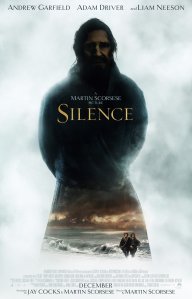 A nearly three-hour movie about Portuguese Jesuit priests facing persecution in 17th century Japan and struggling with the personal demands and costs of their faith sounds like a hard sell for your casual moviegoer. It may seem even stranger coming from the likes of director Martin Scorsese. This is a deeply personal film and perhaps the greatest movie about the nature of spiritual faith, both good and bad, I’ve seen. Two priests (Andrew Garfield, Adam Driver) sail to Japan in 1635 to find their mentor after hearing he has renounced his ties to Christianity and taken up a Japanese wife. Christianity has been outlawed and those caught practicing the religion can be turned in for 100 pieces of silver, and a priest for 300 pieces. The repression forces Christian converts to make difficult choices, especially when their refusal to recant their faith causes suffering for others. The Inquisitor (Issei Ogata) is a fascinating figure who argues that these misplaced missionaries never understood Japanese culture and that this foreign religion simply cannot flourish. The meaning of individual faith is explored beautifully with existential highs and lows. When the priests come across a village of secretly practicing Christians, it’s a powerful example of the goodness of faith, as these people are nourished body and soul, empowered. They can also finally confess their sins and garner a clean slate. However, much of the film is about the internal struggle to retain one’s faith in the seeming absence of confirmation. The priests are eventually caught and ordered to apostate, and their ongoing refusals are met with harder and harder challenges to bear. It’s an ongoing process for many people to square the concepts of a loving God and the horrors and general torment that do not merit said God’s intervention. At one point one of our priests, shaken by his experiences, asks if he is merely praying to silence. In some regard, I think the movie is about coming to terms with the fact that faith is often a relationship with a silent partner. Silence may be the greatest spiritual epic about doubt. It feels like a thriller at times and also the most Christian movie at other times. It puts the simplistic tripe starring the likes of Kirk Cameron to shame. Scorsese’s camera is unmistakably his and the movie is often dazzling to just experience. The pacing is very much a slow burn but the historical context felt increasingly intriguing for my tastes. Ogata is the real star of the movie, embellishing his antagonist with a magnetic power. Every time he was off screen I wished for his return. Silence is not going to be a movie for everyone or for many. It’s too long and airless, but it’s a deeply serious, deeply meditative, and deeply searching film about the power of belief and the price we pay to hold on.
Nate’s Grade: B+
Share this:

Live by Night (2016)
 With only three films, Ben Affleck has successfully reinvented himself as one of Hollywood’s most talented directors when it comes to adult crime thrillers. It’s not just his superb directing chops; the man also serves as producer, lead actor on most films as well as a screenwriter, and Affleck’s ability to write flawed yet deeply human characters within genre parameters has accomplished actors flocking to work for him. Beyond his 2012 film Argo winning Best Picture, Affleck has gotten three different actors supporting Oscar nominations (Amy Ryan, Jeremy Renner, Alan Arkin). He’s an actor’s director and a man who knows how to satisfy an audience hungry for authentic genre thrills and interesting characters. His latest film is an adaptation of Dennis Lehane’s novel and is Affleck’s most ambitious film yet and it’s gorgeously brought to life. There’s still plenty to like and entertainment to be had with his Prohibition era gangster flick Live by Night, but it’s also unquestionably Affleck’s weakest film yet as a major director.
 Joe Coughlin (Affleck) is a hardened WWI veteran who says he came back to Boston as an “outlaw” (he seems to turn up his nose at being called a “gangster”). Joe settles into an easy life of crime with the local Irish gang lead by Albert White (Robert Glenister). Unfortunately, Joe’s lover, Emma Gould (Sienna Miller), happens to be White’s main squeeze. Joe and Emma sneak around and carry on their relationship without proper discretion. Their secret is found out, Emma is dealt with, and Joe escapes with his life, serving a prison sentence and then enlisting in the Italian mob under local boss Maso Pescatore (Remo Girone). Joe is sent to Tampa to manage the rum-running business, starting his life over. The area is ripe for expansion and it isn’t long before Joe is making friends and enemies over his exploits. He falls in love with Graciella (Zoe Saldana), a fellow criminal with a working operation of Hispanic bootleggers. Joe warms to a local police chief (Chris Cooper) and his daughter, Loretta (Elle Fanning) a girl who experiences the darker side of vice and becomes a troublesome born-again leader. All the while Albert White has relocated to Miami, and the specter of vengeance looms just within reach.
It’s a Prohibition gangster flick and Affleck makes sure to check as many boxes as he can when it comes to audience expectations for a pulpy hardboiled action drama. The production design is aces and the cinematography by Robert Richardson (The Hateful Eight) is beautifully composed with its use of light, shadow, and framing. There are shots of violence that are exquisitely rendered so as to be their own art, like a man falling down a stairwell with a Tommy gun blasting above bathed in light. The production details are a sumptuous aspect that Affleck and his team put supreme effort into to better make their movie transporting. The action sequences have a genuine delight as they pop. A shootout throughout the grounds of a mob-owned hotel is an exciting climax that finds fun ways to provide genre thrills. The rise-and-fall structure of the story, mingled with a simple revenge motivation, is a suitable story vehicle for the audience to plug into. There are fun characters, fun moments, and sizzling action, all decorated in handsome period appropriate details. While Live by Night has its share of flaws, a dearth of entertainment is not one of them.
Tone and coherency end up being Affleck’s biggest obstacles he cannot overcome. It’s somewhat of a surprise considering his other directorial efforts brilliantly melded several genres while telling invigorating stories. I think the main fault is a screenplay trying to do too much when more streamlining was optimal. The specific goal that sets Joe in motion is a bit hazy and fails to provide a larger sense of direction for the arc of the tale. Affleck’s previous films were rock-solid in crafting overarching yet specific goals that propel the scenes onto a natural narrative trajectory. With Gone Baby Gone, it’s finding the missing girl. With The Town, it’s getting closer to a bank employee without having that relationship discovered by his cohorts. With Argo, it was rescuing the hostages. With Live by Night, it’s mostly getting vengeance against Albert White, though we don’t know how. In the meantime, we have episodic incidents failing to register connective tissue or at least a cause/effect relationship where it feels like a natural order of organic conflicts. The opening act in Boston that sets up Joe’s tragic love, jail time, and enmity with White could be removed entirely. I’d miss the thrilling 1920s car chase, which is also unique in that it’s the first period car chase I can think of that utilizes the mechanical limitations of the vehicles for extra tension, but it’s at best a moment of flash. Having the story pick up with Joe putting his life back together in sunny Florida would have been a cleaner entrance into this world for an audience. Once Joe ingratiates himself into this new world, the audience has to play another game of character introductions and assessing relationships and the balance of power. It feels a bit redundant after having our previous act pushed aside to reboot Joe’s world.
 It feels like Affleck is trying to corral so many historical elements that he loses sight of the bigger picture. Joe’s criminal path seems comically easy at times as he builds a fledgling empire along the Floridian west coast. First it’s the law and then it’s the KKK and then it’s religious revivals that need to be dealt with. Each incident feels like a small vignette that observes the historical setting with an angle that will be perfunctorily dropped in short order. The conflicts and antagonists don’t feel sufficiently challenging and that lessens the intended suspense. When Joe is dealing with the KKK, it feels like he’s restraining himself out of politeness rather than a series of organic restrictions. The elements and tones don’t really seem to inform one another except in the most general sense, which leads to the film lacking suitable cohesion. It’s easy then for Affleck to overly rely on stock genre elements to provide much of the story arrangements.
The characters have difficulty escaping from the pulp trappings to emerge as three-dimensional figures. Graciela gets the worst of it, proving to be a capable bootlegging criminal in her own right who loses all sense of personality, agency, and import once she becomes romantically entwined with our hero. It’s as if she erased herself to better heal his broken heart. How kind of her. The religious revival element is ripe for further examination but it’s kept at a basic level. We’re never questioning the validity of Loretta’s conversion and sudden celebrity. Chris Cooper’s pragmatic lawman has the most potential as a man trying to keep his morals amidst the immoral. The character isn’t utilized in enough interesting ways that can also flesh out his dimensions, and his conclusion suffers from that absent development. The characters serve their purpose in a larger mechanical sense but they don’t feel like more recognizable human beings.
Affleck’s innate talent with actors reappears in a few choice moments, just enough to tantalize you with the promise of what Live by Night could have been. The standout moment for me is a sit-down between Joe and Loretta where she unburdens her self-doubts. This is a woman who has been preyed upon by others, had her hopes dashed, and is trying to reinvent herself as a religious leader, but even she doesn’t know if she believes that there’s a God. The scene is emotional, honest without being trite, and delivered pitch-perfect by Fanning (The Neon Demon). It’s the kind of scene that reminded me of The Town and Gone Baby Gone, how Affleck was deftly able to provide shading for his characters that opened them up. Miller (American Sniper) has immediate electricity to her performance and reminds you how good Affleck is at drawing out the best from his actors. British TV vet Glenister is so good as a villain that seems to relish being one that you wish he were in the movie more. He has a menace to him that draws you in closer. Maher (The Finest Hours) is a memorable cretin who you’ll be happy to be dealt with extreme prejudice. There isn’t a poor casting choice in the film (hey Clark Gregg, hey Anthony Michael Hall, hey Max Casella) except possibly one, and that’s Affleck himself. I know part of the reason he selects his directing efforts is the possibility of also tackling juicy acting roles, but this time he may not have been the best fit. He’s a little too calm, a little too smooth, a little too out of place for the period, and his director doesn’t push him far enough.
 A strange thing happened midway through, namely how politically relevant and vicariously enjoyable Live by Night feels specifically for the year 2017. It’s a movie largely sent in the 1920s with characters on the fringes of society, and yet I was able to make pertinent connections to our troubled times of today. After a contentious presidential election where many feel that insidious and hateful extremist elements are being normalized and emboldened, there is something remarkably enjoyable about watching a murder montage of Klansmen. The Tampa chapter of the KKK takes aim with Joe’s business that profit from fornicators, Catholics, and especially black and brown people. They’re trying to shake Joe down for majority ownership but they’re too stupid, blinded by their racist and xenophobic ignorance, to accept Joe’s generous offers, and so they can’t help but bring righteous fury upon their lot. There is something innumerably enjoyable about watching abusive bigots brought down to size with bloody justice. I could have seen an entire movie of Joe and crew tearing through the Florida chapters of the KKK and just cleaning out the rabble. This sequence whets the appetite for what comes later. Without going into specific spoilers, the climax of the movie involves the put-upon minorities rising up against their bosses who, like the Klan, felt they were too powerful, too indispensable, and too clever to be seriously threatened. In its own way, it’s like a dark crime actualization of the American Dream. Unpack that if you will.
Live By Night is Affleck losing the depth of his world to its surface-level genre pleasures and they are indeed a pleasure. This isn’t a bad movie by any measure, only one of slight disappointment because it had the markings and abilities to be much more than the finished product. The tonal inconsistency and storylines provide episodic interludes and enticing moments, whether in action or acting, but they don’t blend together to form a more compelling and impressive whole. It’s a gangster movie that provides the gangster genre trappings but loses sight of what makes the characters in these movies so compelling, the moral complications, shifting loyalties, the impossible positions, and enclosing danger. I don’t think you’ll sweat too much over whether the main character will come out on top, which somewhat hinders the intensity of the action. When your movie is more predicated on those genre thrills than character or story, that’s an even bigger hindrance. It’s a fun world worth visiting but it doesn’t have the staying power of Affleck’s better efforts.
Nate’s Grade: B
Share this:

The Handmaiden (2016)
 I’m glad there’s still a filmmaker at the talent level of director Park Chan-wook (Oldboy) dedicated to making genuine Gothic romance with style and reverence. The Handmaiden is a ravishing, enrapturing, and momentously engaging movie with dark delights, startling depths, palpable romance, simmering tension, and high-wire twists and turns that keep redefining the story. The absurdly talented filmmaker takes a novel set in Victorian England and adapts the setting to 1930s Korea during the time of Japanese occupation, a fascinating and little-known time period for a Western audience. A poor orphan Sook-Hee (Tae-ri Kim) is pressured into a scheme to trick the wealthy Lady Hideko (Min-hee Kim) into being admitted to an insane asylum, her family riches sold. From the opening minutes, The Handmaiden produces immersive drama that pushes the central characters into consistent conflict to achieve their varying goals. They’re constantly at odds with one another and themselves. There’s even tension between those who hold onto their Korean culture and those who adopt the culture of their oppressors, namely Lady Hideko’s perverse and treacherous uncle. Sook-Hee grows an unexpected affection for her mistress, and this includes a burgeoning attraction that the movie communicates with serious sensuality. The passionate lesbian sex scenes are, if anything, a tad restrained from what I was expecting from Chan-wook, and they’re definitely far more restrained and absent the male gaze than the still excellent Blue is the Warmest Color. I felt the same carnal desire the characters were discovering, a feat worth celebrating for still staying true tonally without veering into tawdry exploitation. More than the sex or the top-notch technical aspects, it was the characters that hooked me and refuse to relinquish. The deepening relationships and the subtle shifts of loyalty, perception, and desire make what is essentially a twisty and twisted chamber-play into world-class drama. You think it’s one kind of movie, and then it flips the script, and then it does it again, each time opening wider this mysterious, dangerous, and invigorating world. My one quibble is that the final twenty minutes feels unnecessary and self-indulgent, Chan-wook finally scratching a few violent tendencies he had been keeping as veiled up to that point. The Handmaiden is a ridiculously entertaining movie that is handsomely mounted, wonderfully acted by its leading ladies, and a romance worth losing your self over. Plus, there’s also the sex.
Nate’s Grade: A-
Share this:

Fences (2016)
 There’s something about plays turned into movies that bring out the best in actors. Usually they provide meaty characters with flaws and big personalities, which lend themselves to big performances that touch upon every emotion in an actor’s kit. Fences is based upon August Wilson’s Tony-winning play set in 1950s Pittsburgh. It follows the fractious household under the indomitable influence of Troy Maxson (Denzel Washington, also serving as director). He’s a complex man prone to bold protestations and morally righteous fury, but he’s also deeply imperfect, hypocritical, and consumed with self-doubt over whether or not he has done right by his family. He’s a man trying to still assess his place in the world and what is owed. Troy’s older brother (Mykelti Williamson) has been mentally incapacitated from his war service and Troy has been living off of his brother’s wages. Troy’s oldest son doesn’t feel like he ever had a father, Troy’s youngest son wants to devote a future to sports, which Troy adamantly refuses, still nursing a grudge over his failed potential that was never capitalized in his mind. Then there’s Troy’s wife Rose (Viola Davis) who tries to keep her blended family together though Troy’s actions will test the boundaries of her devotion and affection. As expected, the performances are outstanding, lead by Washington and Davis reprising their Tony-winning roles. When these two sink into roles worthy of their caliber, it’s a pleasure just to sit back and watch the high-class mastery. Washington lights up the screen with the overwhelming power of his performance; you feel like your ears are pinned back by the sheer volcanic strength of his acting. Davis has her moments and she tears your heart out when she lets loose on a life of compromises to sustain her husband. The characters are so multi-layered with such plentiful history and generational conflicts. Every actor gets his or her moment to shine and do an excellent job under Washington’s direction. The movie is little more than a filmed version of the stage play, and the pacing is a bit loquacious for being almost two and a half hours, but Fences rises on the sheer power of its performances with expert actors giving all of their considerable skill to bring these fascinating people to vivid life.
Nate’s Grade: B+
Share this:

Hidden Figures (2016)
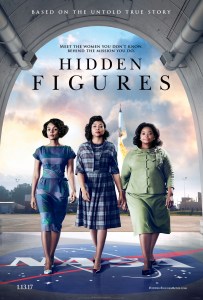 After the end of 2012’s Red Tails, I said to myself that those men of history deserved a better movie. By the end of Hidden Figures I was thinking the same thing for the unheralded African-American women of NASA in the 1960s Space Race. It’s an inherently engrossing story that the public knows precious little about, and the biggest problem with director/co-writer Theodore Melfi’s (St. Vincent) film is that is rarely breaks free from its formula for feel-good mass appeal. Rather than allowing us to absorb the complexities of the three women featured (Taraji P. Henson, Octavia Spencer, Janelle Monae) the movie wants us to just know about their struggles over injustice and inequality. That’s a fine starting point but rarely do these women become fully fleshed out. They’re kept as symbols, put-upon figures, and less as people. That allows them to have their Big Acting Moments where they uncork a snappy retort to institutional prejudice that is the kind of stuff meant for Oscar clip packages. Henson is given the most significant part but even her math genius feels like a crude Hollywood extrapolation of a stereotypical movie nerd. Monae was the one who left me most impressed with her feisty attitude and swagger. It’s all a pleasing and moderately entertaining package but the presentation and artistically stilted character development hinder the movie’s message. I would have preferred a documentary on the same subject, something that would allow further depth as well as the direct testimony of those women involved. I believe Henson’s character is still alive and in her 90s, so there’s no time to waste. Hidden Figures is a safe yet still appealing biopic that hits some of the right notes but lacks greater ambition. Not all films have to try and redefine their genre, but when you’re giving the titular hidden figures of history their much-deserved spotlight, maybe a little more effort is deserving and necessitated.
Nate’s Grade: B
Share this:

Allied (2016)
 Forgive me the indulgence but please hear me out on this peculiar observation. In 2005, Brad Pitt stars in a movie where his onscreen wife may be a spy and he may need to kill her, and his marriage to Jennifer Aniston ended shortly thereafter. Flash forward over ten years and Pitt is starring in another movie where his onscreen wife may be a spy and he may need to kill her, and his marriage to Angelina Jolie is now coming to a reported end. Obviously there are extenuating circumstances in something so personal as relationships, but if I was Pitt’s agent, I think I might advise against all future projects that even come too close to this cursed storyline. Allied wasn’t worth it, pal.
In 1942, Max (Pitt) and Marianne (Marion Cotillard) are husband and wife and also spies for the British government. They’re enjoying life back home with their infant daughter Anna when Max gets some startling news. His superior officers are investigating whether Marianne is secretly a German spy. He is to learn for himself what is real and if she is indeed a spy Max is ordered to kill her or he himself will be executed for treason.
 Allied already starts dangerously when the majority of its opening act is set during WWII Casablanca, setting up an unwinnable comparison. We’re meant to watch these two secret agents go about their clandestine operation and fall in love. One of those things happens. Oh sure, for the purposes of the plot, Max and Marianne fall in love, but no member of the audience is going to believe what they see. Pitt and Cotillard have anemic chemistry together and their characters are too stilted to draw us in (rumors of an onset romance between the stars seem unfounded by the results on screen). They achieve their first act mission, get their kill, but they don’t really encounter complications. It all proceeds just a little too easily and we fail to get a sense of their capabilities as spies. They practice the cover of husband and wife but only in superficial appearances that come across more like Marianne chiding Max (“A real husband would offer his wife a cigarette first”). I recognize that these people are spies and thrown into danger but we need to invest in them as characters if the rest of the movie is supposed to matter, let alone their relationship together. There are no supporting characters of importance. Lizzy Caplan (Masters of Sex) pops up as Max’s lesbian sister and you’d swear she’d have some significance, but nope. When Max is investigating Marianne, it never feels like the pieces are coming together. Rather it feels like we’re just getting new pieces, some lucky and some less so. The plotting feels too disjointed and arbitrary. Screenwriter Steven Knight (Eastern Promises, Peaky Blinders) is one of the best working in the industry, especially when it comes to crime thrillers and naturally drawing out tension. I expected more from him with Allied, but then that will be a trend with several aspects of this mediocre movie.
Here’s the problem with this premise: it’s too limiting. Either Marianne is a spy or she isn’t, and if she isn’t that makes for boring drama. You’re stuck so more and more obstacles have to be put in place to merely delay the inevitable reveal because that’s all the movie had. A solution could have been an Act Two break that revealed Pitt’s character to be the real spy, allowing the audience to reflect back on his action with a new lens of understanding. The crux of Act Three would then be Max’s moral dilemma of whether he turns himself or whether he frames his wife and in doing so erases evidence against himself. It would be a far more challenging and ethically murky scenario than a rather rote finale where the characters follow their predestined paths. I also think summary execution of a spy is a waste considering the value of covert information or even posing as a triple agent. I think the entire story should be told from a different perspective (okay, now spoilers). Little Anna is far too young to know what happened to her mother and I imagine there will need to be a cover story even for the official cover story. My pitch would be tell this story in the mid 1960s when Anna is now in her early twenties and discovering the larger world. She starts to come across testimony or nagging pieces of evidence that contradict her father’s story of what happened to Marianne, and her death now seems very mysterious. As she uncovers the old evidence she learns that her own parents were spies, a truth that had been kept from her, and all the evidence points to dad being the killer. The Act Three confrontation between harried father and daughter would then reveal the actual truth and that Marianne took her own life out of guilt and a desire to spare her husband punishment from his remorseless superiors. The lie was meant to comfort but now it discombobulates a family and a woman’s understanding of her parents and her relationship to them (end spoilers). Doesn’t that sound like a better version of Allied, dear reader? I certainly think so.
Director Robert Zemeckis (Flight, The Walk) is such a skilled craftsmen but this movie just gets away from him. You sense his urge to insert effects sequences into what should be an ordinary period thriller, and so we get distracting sequences that either rip you from the reality of the movie or might make you titter unintentionally. Max and Marianne’s coupling scene involves having sex in the front seat of their stranded car in the middle of a sandstorm. It would have been far more effective and possibly erotic if the camera had merely stayed in that confined space and let the building passion bubble over, all while the light becomes more and more faint from the sand storm, adding all sorts of sensual lighting opportunities with obfuscation and shadows. Instead, Zemeckis has a rotating camera shot that goes on for about a minute steady without cuts and zooms in and out of the car, inside and outside the dusty sand storm. It stops any sensuality from building. Another example if that Anna is born during the Blitz, and yet again instead of being in a small space and leaving more up to the imagination, Zemeckis and his special effects team have to recreate the air assault which increases the melodrama in a bad direction. Zemeckis has never really done a straight thriller and I can feel his flagging interest as he searches for special effects sequences to hold onto as some sort of anchor. I don’t think his skillset was the right balance for this story and the execution it needed to prosper.
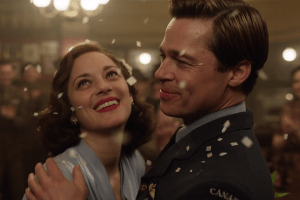 It really doesn’t feel like Pitt (The Big Short) wants to be in this movie at all. Rarely have I seen this lethargic a performance from usually one of the most reliable actors in Hollywood. Part of it is the withdrawn and conspicuous nature of his spy character but it’s more than that. I don’t know if he feels like he understands his character or is that committed to the script, and so it feels like he’s just coasting and waiting for the end. It reminded me of the disastrous Oscar hosting duties from a sleepy James Franco and an overcompensating Anne Hathaway. Cotilard’s character is the gregarious and charming one, and so it feels like she has to do all the heavy lifting to compensate for the dearth of Pitt’s performance. Cotillard can be a brilliant actress with powerful instincts down to her very marrow, as last evidenced in 2014’s devastating and humane drama of personal desperation and dignity, Two Days, One Night. She has to play the more active role, first as the charmer and then as the mystery. She works much better as the charmer. I don’t think either actor knew fully who their characters were and stumbled forward.
Allied is a strange movie where the director, the star, and the screenwriter each didn’t seem to know what movie they wanted to make. Each major participant, short of a game Cotillard, doesn’t even seem like they want to be here, as if this was a school assignment that they’re doing the minimal amount of work to fulfill a requirement. Allied just feels like one of those big studio misfires where nobody was on the same page. The story lacks characters to connect with and complications that feel connected to them and their circumstances. The plot follows the path of least resistance and arrives at its predetermined destination right on time, to the monotony of its audience. Pitt’s somnambulist acting makes the movie and his lead character harder to enjoy. There’s a definite lack of intrigue with this premise and its ultimate execution. I expect better from Zemeckis, Pitt, and Knight, and I’m sure they’ll deliver with their next projects. In the meantime, skip Allied since it certainly feels like the cast and crew weren’t in alliance.
Nate’s Grade: C
Share this:

Fantastic Beasts and Where to Find Them (2016)
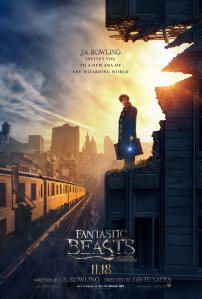 The Harry Potter publishing universe is almost twenty years old and has racked up more money than can be printed, so it was only a matter of time before some enterprising soul thought about expanding from author J.K. Rowling’s seven novels. I wasn’t anticipating that it would be Rowling as the one reopening her world for untapped franchise potential and financial windfalls.
Newt Scamander (Eddie Redmayne) is one of the world’s foremost experts on magical creatures and will one day write a definitive magizoology textbook for students to doodle inside while they sit bored in magic class. He’s traveled to New York City in 1926 and through a series of misunderstandings he exchanges briefcases with Jacob Kowalski (Dan Fogler), a factory drone trying to secure a loan to open a bakery. Inside Newt’s briefcase is a collection of colorful and unique magic creatures with goofy Dr. Suess-styled names, and they break free and need to be rounded up. Porpentina Goldstein (Katherine Waterston) is a disgraced magic authority agent who tries to regain her reputation by helping Newt gather his living contraband before they are discovered by muggles, or as the Americans refer to them, no-majs. Percival Graves (Colin Farrell) is a gravely serious magic official keeping a close watch on the alarming activity. He also has an unclear interest in a fringe political movement that believes witches are real and a real threat. If only they knew the full extent, as a mad wizard-supremacist is also on the loose.
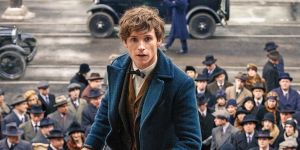 Fantastic Beasts and Where to Find Them is a better franchise catalyst than it is a movie, with several competing storylines that don’t really gel or feel properly developed. This feels like a series of set pieces in search of a movie to unify them. Much of the movie involves dueling storylines that dawdle until they are smashed together at the very end, much like Rowling’s storytelling habit of keeping so many characters and storylines on the fringes and simmering until they are called upon for revelatory disclosure. Storyline number one follows a daffy British magizoologist as he scours New York trying to retrieve his strange and adorable magical creatures. It’s relatively light and mostly fun. Storyline number two is a buddy movie with Newt and Jacob, which is also light and mostly fun. Then storyline number three is an abusive anti-magic movement that may be conspiring to kill wizards that stand in their way, revealing to the wider world the magical realm and the potential threat it poses. This storyline is much darker and adult and it contrasts sharply with scenes like Newt doing a silly dance to present himself for mating with a gigantic rhinoceros creature in heat. It’s hard to reconcile whimsical magic creatures one moment and stern child abuse the next. The varying tones don’t ever gel. The majority of the film is watching Newt scamper around trying to recapture his creatures and stumbling into bigger plot events that are kept on the edges of relevancy.
This movie is more about laying a foundation than telling a relatively complete and gratifying story. The narrative brick laying may be essential for future sequel success but it doesn’t make for the best experience in the theater. Rowling’s first crack at screenwriting has a few hallmarks of novelists-turned-screenwriters (cough, Cormac McCarthy, cough), namely the fuzzy narrative clarity and digressive asides that deter the film’s progressive momentum. It’s hard to critique certain themes and characters that feel useless (Jon Voight for starters) without knowing whether Rowling will decide they are secretly important three movies onward. I don’t know what this movie is about other than setting up lucrative sequels.
 Another area of concern is whom Rowling has decided to be the leader of this voyage back in time; Newt Scamander is quite a lackluster lead character for one movie, let alone the prospect of up to five of them. I found this protagonist rather boring. He’s a kind figure and cares for his exotic animals but the man is pretty much the exact same person by the end of the movie as he is at the start and with only passing hints at a secret tragic past as something to enliven what is assuredly a dull, mumbling character. I’m not against Rowling’s decision to catapult a mild-mannered, shy, polite man as her main character especially in the face of paranoia and fear mongering, but the guy has to at least be interesting. There is not one interesting thing about this character outside of his briefcase full of magical creatures. He is a void of character, a blank slate that isn’t any more filled in by the conclusion. The lack of substance also allows Redmayne to retreat into his actorly tics playing up Newt’s social anxiety, almost to a degree that seems recognizably autistic (at least it was with my friend who saw it with me who is on the spectrum). He feels sensitive to the point that his body is going to collapse inwardly upon itself. I saw the same impulses with his overrated, overly mannered performance in The Danish Girl. When lacking significant depth to his character, or at least something of significant interest, he overcompensates with what he’s given and that’s not usually for the best. Just see Jupiter Ascending if you’re truly brave enough or equipped with enough liquor.
I think the stronger lead character would have been Newt’s buddy, Fogler’s no-maj Jacob Kowalski. He’s already our entry point into this older time period so why not make him the focal point? Jacob is a far more interesting character and he’s actually astonished by the revelations of a magical world right under his nose, adding to the general sense of discovery for himself as well as the audience. He’s the more relatable character as he discovers the world of magic and develops fluttery feelings for a magical lass (Porpetina’s psychic sister, Queenie, played by Alison Sudol). The sweet and flirty stutter-stops of a possible romance with Jacob and Queenie are far more heartfelt and engaging than whatever the film tries to pretend has been set up for Newt and Porpentina. By the very end, the movie expects a few smiles and arbitrary sexual tension to compensate for the rest of the film’s 133 minutes that did not establish one passing moment of attraction. Sorry, Rowling, but cinematic romance doesn’t work in spontaneous vacuums. If you want us to fee for the characters and compel them to get together, we need to see your work if you want the coupling to be remotely satisfying.
The rest of the actors do what they can with the thin scraps of characterization that Rowling provides. Fogler (Fanboys) is a reliable source of comic relief. His sincere pleasure from the magical world and its inhabitants makes him endearing, seeing this world through necessary fresh eyes. Waterston (Inherent Vice) is a screen presence that stands out from the pack, though her character is too muted to leave the same impression. Her character’s goal is to clear her name but she seems to readily forget this motivation. Until writing this review I had no idea that Sudol (Transparent) was the songstress A Fine Frenzy, an artist I’ve enjoyed for a decade. Her acting isn’t quite as accomplished as her singing but Queenie is something of a walking ethereal, sad-eyed psychic kewpie doll. Rowling treats her more as a handy plot device when she needs some item explained or intuited. Queenie’s budding relationship with Jacob makes her more interesting. There are plenty of familiar faces that are stranded in underwritten and confusing roles. The likes of Colin Farrell, Samantha Morton, Ezra Miller, Zoe Kravitz, Carmen Ejogo, Jon Voight, and Ron Perlman, as a mo-cap goblin, must have simply been happy to participate, and I can’t blame them considering the fortunes that await this franchise.
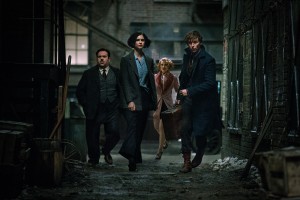 The world building is hazy yet the world of wizards in 1920s New York City is intriguing enough to keep me hopeful that a better movie could emerge later. We’ve never been stateside before in this universe so my first point of interest was the difference between the magical authorities from across the pond. Apparently the magic-inclined aren’t legally allowed to romantically mix with no-maj folks (call it muggle miscegenation laws). That’s interesting but we only get a glimpse. The Second Salem movement in the United States seems to believe that witches and real danger. They seem like a fringe political conservative movement. It’s interesting yet we only get another glimpse at best. Then there’s an evil wizard who wants to wipe the world of the unclean, surely a setup for You-Know-Who and his malevolent Death Eaters. He’s kept further to the background and only bookends the movie. I just looked it up and Voldermort was born in 1926, so expect even more foreshadowing in the future. I wanted to know more about the world inside the Magical Congress of the United States of America. Why do they have a killer magic tar pit and what does it really do to people? There are passing references to the pre-established Harry Potter universe, small morsels for the crowd to hold onto to get them through this muddled expository journey. Still, there is an undeniable entertainment value of seeing magic interact with a 1920s American landscape. A magic speakeasy is a delightful moment to open up this world in amusing historical ways. Newt’s suitcase and its vast interior world is also a great source of wonder and a potent highlight.
Fantastic Beasts doesn’t quite rise to the level of fantastic implied with its title, though if you’re a Potter fan it could be a welcomed and promising start. That’s really what this movie is, a start, and not so much a complete story. It’s a Potter prologue that provides just enough to get an audience interested but not enough to perhaps get them excited. The main character is a total washout and the varying tones and storylines fail to gel. Rowling has some screenwriting novice growing pains and her general world could use more texture amidst all the special effects sequences. Those magic critters are cute I’ll give them that. There just doesn’t seem like there’s enough here of genuine substance in any capacity, other than setting up a playpen for its four sequels. Director David Yates has shepherded the Potter universe for five movies now. The visual continuity from prequel to main story arc reminds me of Peter Jackson’s turn at reviving the Hobbit trilogy. Actually, Fantastic Beasts reminds me of the Hobbit films in more ways than one. They were both somewhat crass moneymaking ventures inarticulately stretched and padded to ensure more movies and more profits. They are also decidedly lesser than the main story arc. To my movie muggle tastes, Fantastic Beasts ranks toward the bottom of the Potter franchise, just a step above Half-Blood Prince. Too often it feels like textbook Potter stuff minus the character investments. It’s a series of set pieces and latent possibilities and less a full movie. Then again, take my so-so critique with a relative grain of salt, Potterheads.
Nate’s Grade: B-


 nathanzoebl
You must be logged in to post a comment.