Blog Archives
Elle (2016)
 It’s been a long time since director Paul Verhoeven (Robocop, Starship Troopers) has directed a movie, a whopping nine years since Black Book (my favorite title is the original Dutch – Zwartboek). In fact Elle is only the second movie of Verhoeven’s since 2000’s Hollow Man. Cinema needs more movies from men like Verhoeven. He’s famous for his penchant for camp and over-the-top violence and sex, but it’s his subversive streak, dark satire, and willingness to push an audience into squirmy situations that are missed most. Elle is a hard movie to describe and a hard movie to sell. It’s an uncomfortable viewing and that’s much of the point that Verhoeven wants to push the viewer into an uncomfortable world of a woman who makes others uncomfortable.
Michele (Isabelle Huppert) is a middle-aged professional woman who, in the opening scene, is raped on the floor of her home by a masked intruder. She tries to brush off the attack, refusing to report it and go to the police. She returns to her normal routine, which involves berating the employees at the video game company she runs, having an affair with her best friend’s husband, and asserting barely passive-aggressive control over her ex-husband and her adult son. Once Michele starts receiving taunting messages from her assumed attacker, she assess who in her life’s orbit may have been her rapist and how best to unmask their identity. There’s also the matter of vengeance.
 Elle starts as a sneaky who-dunnit mystery and then blossoms into an engaging character study. Our first image of Michele is lying on the floor and being sexually violated by her attacker. It’s harrowing and upsetting and your sympathy instantly allies with the victim. However, the rest of the movie does not portray Michele with even the faintest glow of a halo. She’s a venom-spewing bully who sabotages the happiness of others around her and is having an indifferent affair with the husband of her best friend. Michele also runs a video game company that profits from the exaggerated sexual violence of the video game industry. She even lectures a programmer that the distressed cries of a rape victim should be louder and more orgasmic. Everything after the initial rape scene makes us question whether this character is worthy of our sympathies, and then that makes us question whether we should be ashamed to deny a rape victim sympathy at even a basic human level of empathy. There’s a happy moment where everything appears relatively settled, and she just can’t help herself and has to sabotage it with real ramifications with someone she genuinely cares for. It’s just her nature. It’s a complex crucible of self-reflection and it makes the movie an intriguing a unique experience to sit through.
About the half-hour mark, Michele becomes even more absorbing, and that’s when it’s revealed she’s the daughter of a notorious serial killer. As a young girl, she “assisted” her maniac father dispose of bodies into a large fire, and a picture of her looking dead-eyed and covered in ash is famous in French culture. There’s a lingering question of what her culpability was. As soon as this connection was revealed, my interest in Elle increased two-fold. It explains why she felt she couldn’t go to the police because she didn’t want the exposure, and certainly there would be a bitter few saying she got some sort of cosmic justice. Her relationship with her elderly and ailing father becomes its own mystery, and I started looking for parallels between Michele’s relationship with her father and her relationship with her screw-up adult son. Was she manipulating him like her father had done to her? Is her son’s penchant for not fitting in the adult workforce a sign of something more troubling? Is his temper and possibility for violence a hidden bomb thanks to grandpa’s DNA? I was even more observant and looking for connections.
The problem Verhoeven’s movie is that its story engine only takes you about two acts forward. From early on, the two things hanging over Michele are the prospect of finally coming face-to-face with her father one last time and discovering the identity of her rapist. Verheoven plays into the mystery thriller elements by populating Michele’s world with suspects that could secretly be her attacker. There’s the guy at her job that seems to loathe her and find her unworthy of her position. There’s the guy at work that has a little too close of an affection for her. There’s her friend’s husband, angered by being rebuffed when Michele ends their unfulfilling affair. There’s her neighbor’s husband who Michele covets and fantasizes over, who seems aware of Michele’s feelings. As the plot progresses and her attacker sends more messages, we get clues to the identity and who among our band of suspects is eliminated from contention. Then we find out and the movie has like a solid half hour left. That’s because the movie goes in an unexpected direction but one that makes enough sense knowing Michele as a character. Not all of the storylines hold the same level of interest, like Vincent’s one-note baby mama (Alice Isaaz), though you do understand why he might be attracted to abrasive women. The same with Michele’s mother (Judtih Magre) who seems too comically wacky as a sugar momma. Not all of the characters in the story’s sphere are worthy of the attention they receive, however, how Michele responds to them is worth our attention. The other storyline, a sense of closure with her father, is resolved around the same time in another unexpected manner. It’s a bit deflating and after both mysteries are resolved the movie feels like it’s abandoned its sense of direction. You’re waiting for the film to wrap up any moment but it keeps going, a tad too long at 130 minutes. It’s a small grievance but I definitely started feeling a sense of impatience during the final twenty minutes.
There’s a surprising amount of dark humor to be had with Michelle’s caustic view of other people and her genial manipulation of others. There’s an award and dark comedy that comes from the interactions, which seems counterproductive or downright tonally unforgivable given the above admission of how rape-y the film comes across. It’s a squirming comedy, the kind that makes you laugh under your breath to break the tension of people behaving badly. Even the prospect of laughing given the serious subject matter somehow makes the film even more uncomfortable. The older ladies behind me in my theater were already chattering about how Elle was not one of the better movies they’ve come to see. To be fair this was after like the fourth rape scene.
Huppert (Amour, The Piano Teacher) is in every scene of the movie and she unleashes a performance destined to leave you talking. She’s 63 playing 50, which is usually the opposite of how Hollywood movies operate (if the women are even allowed to get to 50). Michele is a beautifully flawed and complicated canvas and Huppert seems to relish in her brusquely dismissive demeanor. She’s constantly testing the people in her world, mostly men, and sizing up the women. There’s a reason that she seems to revel in stomping out the happiness of the men around her whether it be an ex-husband, her oafish son, the husband of her best friend she’s having an affair with. Michele refuses to be defined by her trauma but she is still processing that, and Huppert is agile at showing the cracks in Michele’s armor to provide clues as to what is most important. She doesn’t care what we think of her and that adds a thrilling quality to an already bracing performance.
 Does the movie cross a line into being tawdry exploitation? Because of the nature of its storyline and the past films of its director, it would be easy to slap the title of high-dross exploitation film onto Elle, but I don’t know if it applies fully. I cannot think of a more rape-y movie that I have ever seen. Full trigger warning to those out there, there are like six different rape scenes in the movie, though some of them are fantasy and some of them are violent role-playing, but all of them are disturbing. At its core, Elle is about power and even though our opening impression of Michele is one of victim it’s a title she does not want. She is seeking to punish her rapist, and when the identity is revealed, she transforms the power dynamic and reclaims a sense of her sexual autonomy. Does consenting to abuse and enjoying it undercut the abuser’s power or reconfirm it? I can’t say whether this is any less exploitative than say 1974’s The Night Porter, another movie about trauma where the victim and victimizer indulge in an unhealthy sexual relationship that blurs the lines between sadomasochistic role-playing and fetishizing personal abuse. I feel like there’s enough substance in the characterization and the wide berths that Verhoeven allows free of judgment to classify Elle as more than exploitation, or to classify it as a reclamation of the exploitation film, an exercise akin to what it feels like Michael Haneeke (The White Ribbon, Funny Games) does that I inevitably can’t stand.
I can’t quite grasp what about Elle spurred Verhoeven out of a nine-year absence from filmmaking (he experimented with a 53-minute farce in 2012 whose script was crowdsourced, so I’m discounting that). On the surface, I would make the connections to the film’s extreme sex and violence, staples of Verhoeven’s Hollywood career. But that’s too easy, and there’s no shortage of extreme sex and violence in other stories. What was it about Elle that drew the Dutch filmmaker out of seclusion? I think it was another opportunity to be subversive, this time in the realm of art-house French cinema. Verhoeven has always enjoyed proving people wrong, exploring our baser instincts, and telling damn fine entertaining movies for adults. His subversive streak is renewed with a rape thriller that also happens to be an incisive character study of a very nasty woman who had something very nasty done to her. Audience loyalties and sympathies are consistently in tumult, shifting and being tested by new information and the mounting evidence of Michele’s treatment of others. Huppert gives a calculated, fierce performance right down to the end, pushing the audience into more uncomfortable reflection and uncomfortable laughter in the face of despair. I think this is why Verhoeven hopped back into the director’s chair and even re-learned French so he could communicate with a French film crew. He wanted to push an audience, upending their expectations about power, sex, and subjugation. Elle is downright elegant as it goes about its business, the business of forcing viewers to think critically and question their personal discomfort. It’s not exactly an easy movie to watch at times but it is a hard movie to forget.
Nate’s Grade: B
Share this:

Black Book (2006)
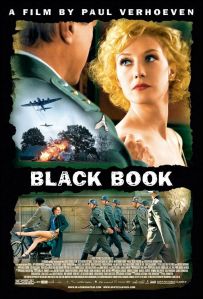 If there’s one thing you can say about Dutch filmmaker Paul Verhoeven, it’s that his films are never boring. He’s shameless when it comes to the amounts of sex and violence he squeezes into his films, and this isn’t typical bouncy violence but cold, serious violence that manage to have whiffs of dark comedy to it. The sex is sleazy and ridiculous, often outpacing the late-night flesh peddlers on Cinemax. I don’t think Verhoeven knows how to do anything subtle, and frankly I wouldn’t want him to. The man is responsible for brawny sci-fi (Total Recall, Robocop), killer lesbians (Basic Instinct), the most subversive mainstream Hollywood movie of the modern era (Starship Troopers is pro-fascism, people), and the most surreal visual effect I have seen in my life – a breast groping itself (Hollow Man). Verhoeven even shows up in person to accept his Razzie award for Worst Director for 1995’s camp classic, Showgirls. This man doesn’t have an off switch. The man makes enjoyable movies, both intentionally and unintentionally.
It’s been a long six years since Verhoeven’s last film and in that time off he’s settled back into his homeland. Black Book (Zwartboek) is a tale loosely based around true stories involving the Dutch resistance in the Nazi-occupied occupied Netherlands. And if there is anyone that can throw in some sex with our good old-fashioned WWII violence, it is Paul Verhoeven.
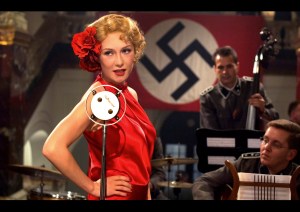
Rachel (Carice van Houten) is a Jew hiding out in the Netherlands. She and her family is trying to pass out of the country by river when they are ambushed by the guns of a Nazi boat. Rachel is the lone survivor and watches all of her family members get mowed down. She joins the underground resistance movement to find out who betrayed her family. She dyes her hair blonde, both above and below the waist to be thorough, and cuddles up to a stamp-collecting S.S. leader, Ludwig Muntz (Sebastian Koch). She works her way into his trust and along the way uncovers a twisty conspiracy to trick rich Jews into ambushed escapes.
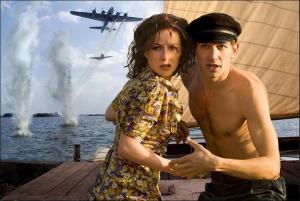 Black Book is skillfully made and pulpy enough to keep the viewer’s enjoyment level in a good place. From start to finish the movie presents enough trials and setbacks to keep an audience satisfied, and enough sex and violence to meet out the standard Verhoeven quota. Nazi occupation hasn’t been deeply explored from the Dutch point of view, and Verhoeven decides not to make everything so black and white. Muntz is a compassionate S.S. officer that wants to work negotiations with resistance fighters to stop further bloodshed. Rachel deeply falls for him, at the disgust of some of her fellow men at arms. On the other side of the coin, once the Nazis have been toppled there are several Dutch civilians and bureaucrats that can behave just as cruel. Those now with power strike out against those deemed to have sympathized and collaborated with German rule. Verhoeven is making a point that there was good and bad on both sides, which is admirable, though this point has been made better elsewhere. Black Book is filled with various twists and double-crosses, so the audience is involved until the very end. Plus, the sex and violence help too.
There’s terribly little below the surface when it comes to Black Book. It’s a thrilling, unabashedly entertaining movie but nothing beyond a sexed-up, suped-up version of a 1940s behind-enemy-lines potboiler. The characters have little to them beyond basic motivations like greed and lust and revenge, so it all can seem like an empty but high-spirited, fun-filled time at the movies. Verhoeven has never imbued his female roles with much characterization, more often showcasing them as ass-kicking vaginas on legs (whoa, now there’s a mental image for you). Another flaw is how Black Book is structured. We open on a tourist trip to Israel in 1954 and see Rachel teaching a class of schoolchildren. This colossal misstep drains the tension from whenever Rachel is in danger; we already know she has to survive to teach our little ones. [I]Black Book[/I] is a largely fictional take, a collection of various historical pieces and figures, so that means that the outcome for our heroine is not preordained. Rachel very well could die amidst her undercover infiltration, but alas the movie opening in flashback erases this threat.
Van Houten is an enticing screen beauty that brings to mind Hollywood stars of old. She has a very simple, prim, elegant look to her, and a presence that is coy and sensual but far from trashy or vulgar. This helps add traces of believability to a figure that does some incredible acts in the name of God and country. Hollywood would have cast Rachel as a tall, buxom bombshell, but it would all be wrong. If this girl turned heads she would be dead. Van Houten gets thrown through the wringer, and at one point literally shit upon, and she handles it with steely grit. The best moments are when we see how Rachel rebounds from setbacks, when she is forced to break from her resolve and think. Her first encounter with Muntz in a train car is a good example, but even better is how she reacts when Muntz accuses her of dying her hair and being a Jew. She grabs his hands and places them on her hips and finally rests them on her exposed breasts. “Are these Jewish?” she asks. She defuses the situation and lives another day, and it’s perfectly played by a nervous but nervy Van Houten. She makes two plus enjoyable hours even more enjoyable.
 Black Book is clearly and fairly rated R, but part of its rating piqued my curiosity. One of the items that help push the film into the restricted rating is “graphic nudity.” Now, what exactly is graphic nudity? I recall last year’s Babel also getting an R-rating for what was deemed “graphic nudity.” One thing the two films have in common is that they both show quick glimpses of exposed female genitalia. I suppose that the MPAA feels that nudity becomes graphic when we see pubic hair. This confounds me. What about pubic hair turns nudity into an extra, more offensive category of nudity? At the end of the day, it’s just hair, people. I did some quick research and [I]Basic Instinct[/I], infamous for Sharon Stone’s career-making leg crossing, is rated R for mere “strong sexuality.” For the record, when Stone flashes her naughty bits they were bare. So let the record show that hair seems to be the qualifier between what is nudity and what is graphic nudity. Maybe I’ll write a dissertation on this some day.
As for another aside, how freaking cool is the name Zwartboek? It sounds like some fun term I’d come across in the pages of Douglas Adams’ The Hitchhiker’s Guide to the Galaxy. The Dutch language is a tad bizarre for my American ears; it’s sounds like a mixture of English and German, and sometimes it seems like a subtitled sentence is actually direct English. I know I can’t stop saying “zwatboek” around my home in place of gasps and curses.
Black Book is Verhoeven’s first Dutch language film in over 25 years, and it also feels like he’s enjoying movies again after his bad experiences across the Atlantic. I welcome more entertaining Dutch films from their favorite filmmaking son. He may not be he most subtle man behind a camera, but we already have plenty Terrence Mallicks and Gus van Sants to bring confounding contemplation to movies. We need more people like Vanhoeven who know how to please the sense, kick you in the balls, and make you grateful for the experience.
Nate’s Grade: B


 nathanzoebl
You must be logged in to post a comment.