Blog Archives
The World’s End (2013)
 The third in the Cornetto trilogy, the series of loving homages to genre films that end up transforming into those films, written by star Simon Pegg and director Edgar Wright (Scott Pilgrim vs. the World), is so self-assured, so witty, and so stylish, but it’s also the best film Wright has done. While my heart will always bleed for 2004’s Shaun of the Dead, it’s something of a revelation how everything comes together so magically in The World’s End. Every joke, every sight gag, every offhand reference, it somehow is all tied up together or has some greater narrative connection, like the names of the 12 pubs on a pub crawl reunion that discovers an alien invasion. The dialogue is packed with layered humor, with choice bon mots like, “That’s why I drink out of a crazy straw. Not so crazy now, huh?” and, “Or selective memory like that one guy… who? Oh yeah. Me.” Given the previous films, Shaun and 2007’s Hot Fuzz, I knew this would be a funny movie, but I was unprepared for how emotionally adept it is. The characters are given surprising depth and pain and anger, mostly stemming from Pegg’s screw-up alcoholic character desperately trying to relive the good times. The writing is so textured that the characters come across like actual people, and the twists and turns, while entertaining, are far more emotionally grounded than in any previous Wright movie. There is real pain and atonement for these fallible characters, which makes us root for them even more against the robot invaders. Pegg and Nick Frost are terrific again. The action is frenetic and inventive, the laughs are frequent, and the characters are so fully realized that The World’s End isn’t just the best film in a stellar, pop-culture savvy trilogy, it’s also one of the best movies you’ll see this year.
Nate’s Grade: A
Share this:

The Bourne Ultimatum (2007)
 I think the best aspect of the The Bourne Ultimatum, the third in the memory-troubled spy series, is how kinetically improvised it feels. Jason Bourne (Matt Damon) is a human weapon and he thinks constantly with his body, feeling the situation and his environment, and he comes up with improbable weapons, be them pens, magazines, or kicking ass with just a book (knowledge is power). Bourne doesn’t rely on fancy gadgets or a caustic wit; he just outsmarts the competition by reading his world and reacting instinctively, and that is thrilling to watch. The Bourne films have separated themselves from other spy series like James Bond and standout because of how viscerally realistic they play out. That said, Bourne still survives scrapes that would kill any mortal. At this point, we know just about all we need to know with most of the characters, so Ultimatum is one long, fantastic, and gripping series of chases between Bourne and the CIA operatives that want to rub him out. Ultimatum is Paul Greengrass’ (United 93) second film in the series and he enhances the excitement through his docu-drama style of shooting. The editing is constantly roving and perfectly channels the nervous wariness of a spy that is constantly looking over his shoulder. The action sequences are stellar and raft with suspense and top notch stunt work amongst exotic locales. Ultimatum tacks on some awkward political commentary (black hoods, secret CIA torture, breaking the law to “win” the battle against terror) and tries squeezing its story into a fight between Bourne and the dangerous and lawless elements of the American government that have flourished under President Bush’s watch. It doesn’t quite work in the context of a summer action movie, but thanks for trying. The Bourne Ultimatum is a spry and refreshing action movie that serves to cleanse the summer palate of huge special effects blockbusters.
Nate’s Grade: A-
Share this:

Cinderella Man (2005)
 Let’s talk a little about screenwriter Akiva Goldsman. This is the man responsible for travesties like Lost in Space and the franchise killing, pun-crazy Batman and Robin. There’s plenty of junk writers in Hollywood and plenty of good writers just saddled by junk to make a living, and either might apply to Goldsman. How in the world did he become a Hollywood go-to guy?It probably has something to do with Ron Howard. Goldsman adapted the screenplay for Howard’s film A Beautiful Mind and both walked away with Oscars. Suddenly the man who wrote Mr. Freeze saying, “You’re not sending MEEE to the COOLER,” had an Oscar on his mantle. Goldsman and Howard, in retrospect, seem like a match made in heaven. They both enjoy big Hollywood event movies that spoon-feed an audience and shave off the gray areas. Cinderella Man serves as the duo’s second collaboration and it’s exactly what you would expect a big Hollywood event movie to be from them.
Jim Braddock (Russell Crowe) is an up-and-coming New Jersey boxer who’s on a warpath to the heavyweight title. His wife Mae (Renee Zellweger) loves him dearly and he dotes on his three kids. Life seems so perfect in 1929 America. And then the Depression hits. Braddock breaks his hand in a fight and his skills slip tremendously. The boxing commission revokes his license and Braddock is forced to take a dock job to provide for his family. Times are tough and there doesn’t appear to be a way out, until Braddock’s old boxing manager (Paul Giamatti) offers him a one time only bout in the ring. Braddock is seen as a has-been but he knocks his opponent flat out. More fights come and so do more victories, and Jim Braddock seems destined for a remarkable storybook comeback. But then there’s the reigning champ Max Baer (Craig Bierko), an arrogant playboy. Baer also is a ferocious fighter and has actually killed two men in the ring. The championship leads through him and Braddock is unafraid. Mae is terrified she’ll become a widow and pleads with her husband not to fight. But now that he’s been through the gutter, Braddock knows what he?s fighting for: the survival of his family. To do that, he?s headed for a title match with Baer.
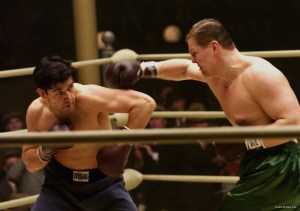 What elevates Cinderella Man from an “okay” film into a “mostly good” film is the singular brilliance of Russell Crowe. This man is simply one of the most amazing actors we’ve ever seen, and he’s been on an incredible hot streak since 1999’s The Insider (forget 2000’s Proof of Life, please). Yet again mastering another accent, Crowe excels at playing a noble man with guarded emotions and honest intentions. He’s an actor that can display such an intense wealth of emotions in the same moment. When he visits his old boxing bosses, hat in hand, begging for enough money to turn the electricity back on, Crowe has laid a sucker punch to your emotions. It’s getting to the point where I will go out and see any movie Russell Crowe stars in just to soak up his brilliant performance. He can throw a phone at my head anytime. Crowe’s stellar and resonant acting will hopefully be noticed come Oscar time; however, I doubt much else of Cinderella Man will be remembered.
Crowe’s sparring partner doesn’t fare as well. I’ve liked Zellweger in a lot of her roles (even the sappy One True Thing), but she’s entirely miscast as Braddock’s underwritten stand-by-your-man wife. She scrunches her face too much and squints for most of the movie.
Two great actors make the most of their meager roles. Giamatti serves as Braddock’s growling pit dog of a corner man and works up a good froth. Bierko almost transcends the film’s one-note villain caste and becomes a figure of showboating sensuality. He struts in the ring with a gallant pride that’s fun to watch, even though you know Howard?s whispering in your ear, “Booooo. Don’t like him. He’s the mean man. Booooo.”
The production design on Cinderella Man is great and really recreates the look and feel of the 1930s in all walks of life. The cinematography, on the other hand, seems washed out and overly dark in spots, though it may have just been my theater?s projection. I miss Roger Deakins, DP on A Beautiful Mind. Deakins knew how to beautifully light a scene and capture the audience with a precise, eye-pleasing angle. In contrast, Cinderella Man seems to think that sepia tones defined the time period of the 1930s.
Howard still has little to no trust in his audience. He can’t rely on the performances of his actors to express their motivation. We know why Braddock is fighting during the Depression, Howard. We don’t need split-second cuts of his family for reminders. It’s almost like Howard wants to point to the screen and tell the audience what to feel. It should be obvious by now but ambiguity doesn’t work here. That’s why Braddock is seen as almost saintly (never mind the connections to organized crime). That’s why Baer is seen as dastardly (never mind that in 1933 Baer heroically wore a Jewish star and knocked out Hitler’s favorite prize fighter, Max Schmeling). It seems that the details just get in the way when Howard wants to turn true-life stories into calculating crowd-pleasers.
At the docks, just in case we don’t get how tragic the Great Depression is (you know, in case you forgot what either the words “great” or “depression” meant), Howard has to bend over backwards to show someone stepping over a newspaper declaring how high unemployment is. When Braddock finds a friend in Hoovertown (Central Park turned into a neighborhood of shanties) we see him run over by a horse and buggy as another man crushed by the system or a runaway metaphor. When Baer fights in the ring Howard makes sure to get that sneering close-up of our villain. And surely anyone who’s a womanizing playboy must go down for the good of the nation. Howard is aggressive in his pandering.
Thanks to Goldsman and Hollingsworth’s mawkish script, Cinderella Man has the myth of complexity to it when it’s really content to go the easy route. It plays this story too close to the rules: embittered hero with humanity intact, stalwart wife, cocky villain, the grumbling manager. Cinderella Man is stripped of complexity and Goldsman and Hollingsworth want to lead the audience by the nose. When Braddock promises his son in a heart-to-heart that he’ll never split up the family, we know it’s only a matter of time before it happens. Their script is also full of workmanlike dialogue that does enough to just push the story forward but give little shading to its people (Zellweger’s, “You are the champion of my heart, Jim Braddock” is particularly not great.
 Cinderella Man really is a film more about the Depression than boxing, except for its pummeling and gritty final act of non-stop boxing. The script paints an almost insulting idea that the Depression was good for people to learn important life lessons, like family comes first, hard work will be rewarded, and one man can heal a nation. Seabiscuit fell into this same trap with its depiction of the Depression but at least Gary Ross’ film dealt with characters that weren’t tired genre archetypes. Cinderella Man could be described as “Seabiscuit in a boxing ring,” as yet again the triumph of an underdog pulls the country back together and gives the common man something to believe in. What I’d like to see is Braddock vs. Seabiscuit in a ring or even on the horse’s turf. Then we can finally decide once and for all who is responsible for getting America out of the Depression (somewhere FDR is spinning in his wheelchair-accessible grave).
The film does come alive when Braddock steps into the ring. The boxing matches are finely choreographed and pack a real wallop. You can practically feel the bruises and taste the sweat during the 15-round bout between Braddock and Baer. These scenes give you a good understanding of the progression of a boxing match and the real strategy that can turn a loser into a winner. Howard also has a smart visual cue during these lively moments. Whenever a bone gets broken, like Braddock’s hand, we cut to an X-ray shot of that scene and see the bone snap. It might seem old in a CSI-drenched landscape of entertainment but it’s effective and neat.
Cinderella Man is a rousing, heartstring-tugging crowd-pleaser that will inspire hope and redemption. Until you look at it more objectively. It?s easy to get sucked into Howard’s underdog tale and that’s because it’s been tailored to satisfy your emotions. Crowe rises above this heavy-handed yesteryear yarn with a riveting performance. I’m positive most people will walk away from Cinderella Man feeling uplifted and touched and would view me as being overly cynical. But with a maudlin story by Goldsman that simplifies the details, Cinderella Man feels like a feel-good-movie that’s been rigged. These people have no trust in their audience, so why should you put your trust in them?
Nate’s Grade: C+


 nathanzoebl
You must be logged in to post a comment.