Blog Archives
Snowden (2016)
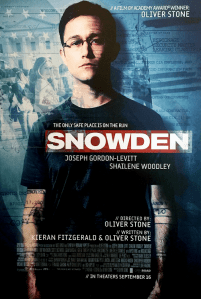 There’s quite a difference when director Oliver Stone actually gives a damn with a movie, and you can tell with Snowden that he is passionate about making a compelling and accessible movie for American audiences to understand why they should be angry. He wants to lead the righteous civil liberties mob against the right perpetrators while providing an appreciative moral context to the actions of Edward Snowden, America’s most famous fugitive. That sense of purpose and drive animates Stone in a way that his recent films have not, and even though it’s far less gonzo and experimental as Stone’s quintessential catalogue, the storytelling skill is still consistently engaging and the resulting 134 minutes inform as well as entertain.
Edward Snowden (Joseph Gordon-Levitt) wanted to serve his country and his expertise in computers landed him in various jobs working for U.S. agencies. He discovered the abuse of surveillance over everyday citizens rubber-stamped by a FISA court meant to provide oversight. Callous private contractors would surf through thousands of collected data points, and if pressed, could justify through terrorism connections, as it seems anyone in the world is perhaps three connections away from a person of interest (consider is the really unfortunate version of the Kevin Bacon game). Snowden risks everything to reach out to a team of journalists (Zachary Quinto, Melissa Leo, Tom Wilkinson) to tell his story and make sure the larger public will know these abuses of power.
 The best compliment I can give Stone as a screenwriter and director of Snowden is that he took a thoroughly challenging scenario with few cut-and-dry answers and made an accessible movie experience that effectively conveys moral outrage and dismay. It feels like Stone the educator is leading you by the hand, taking time out to explain some of the more delicate intricacies of the murky stuff that goes on behind closed doors. I won’t exactly declare it to be an intelligent examination on the moral implications of the material, but it’s certainly a movie that lands its goal of clarity. It produces a sense of clarity for the subject and a sense of clarity for why Snowden made the decisions he did. Gordon-Levitt delivers a steadily engrossing performance, even if it takes several minutes to adjust to his distracting speaking voice. Maybe my ears are just broken but it doesn’t sound like Snowden. Fortunately, my ears did adjust accordingly. Gordon-Levitt and Stone effectively kept my attention throughout the film. I was surprised how much I found myself enjoying long stretches of this movie, even if my own stance on Snowden is less clearly defined. He talks a good talk but the reality is messy.
Given Stone’s conspiratorial history, the plot definitely comes with a distinctive point of view over whether Snowden is a hero or a traitor. I don’t think inherent bias in a movie or the angle taken in storytelling is inherently misguided and that all stories should be as objective as possible. Sometimes the circumstances don’t permit objectivity. Stone’s film is clearly biased but it doesn’t fall into a hagiographical hero worship of its titular figure. This is a complicated subject and deserves a proper analysis to place the real-life people in the meaningful morally ambiguous context. Snowden ultimately makes the decision to become the world’s most famous whistle-blower for what he felt were systematic abuses of government surveillance, but before that climactic decision he comes across less than a spotless martyr. His character arc is a fairly recognizable awakening of alarm and horror at the great abuses of power in the name of security. He does start off as a lifelong Republican with family members who have served in the military and different governmental bodies. He’s devastated to be medically discharged from the Army and hungry to serve his country. He’s a patriot who becomes disillusioned with the system, but he’s also rather self-involved and excuses ego with civic duty. I didn’t know how gifted Snowden was in his field, and the movie has some amusement with the wunderkind training sequences where Snowden delivers shock and awe to his stunned superiors. However, the second act becomes more than a bit protracted because Snowden keeps quitting but eventually going back to government surveillance, whether CIA or private subcontracting. This is because of the pay, sure, but it’s mainly because nobody can do what he can do. He feels important. He feels needed. He convinces himself he’s making a difference in the War on Terror, but eventually the reality of the widening peripheral of the war zone is too much to ignore for him.
This is further epitomized through the romantic subplot with Lindsay Mills (Shailene Woodley), a liberal firebrand, photographer, and exotic exercise instructor. Woodley (The Fault in Our Stars) does her best infusing a warm personality into what is too often the underappreciated yet overly agreeable girlfriend role. It’s a storyline meant to further humanize Snowden as well as personalize the encroaching invasions of privacy and subsequent paranoia. After he discovers that the government can activate laptops and watch oblivious citizens through webcams, Snowden can’t help but stare down his open laptop during an almost laughably forced sex scene. My reaction as Lindsay climbed aboard Snowden was exactly this: “Oh, I guess this is happening now.” She would have a greater impact if the movie did more with her character, as she is the long-suffering girlfriend who keeps accommodating his life choices. They move three times across the country for his jobs and Snowden is always unable to fully explain why he feels the pull to these tech occupations, which further frustrates a woman who just wants trust and stability. There is one interesting conversation that Lindsay offers, typifying the blasé response to spying with a “well I have nothing to hide, so who cares” rationale. Snowden is quick to admonish this line of thinking, an opinion that many still share. The other regrettable reality is that the romance is inevitably going to be the least interesting facet of this story. By going behind the curtain of American secret surveillance, we’re indulging in our collective curiosity at how exactly all these moving parts operate. To then go home and watch a couple squabble is a consistent letdown of drama.
 There are a few other artistic miscues that weigh down Snowden, mostly Stone’s penchant for heavy-handed symbolism. The same instincts that allow Stone to carefully thread a knotty story are the same impulses that tell him that subtlety is for cowards. There doesn’t need to be a frame story here. I understand that select media outlets trying to break this story naturally allows for a question-and-answer framing system of flashbacks. However, very little is added besides a skeletal structure. The media members act as reactionary acolytes. It was all captured much more credibly in the Oscar-winning documentary, Citizenfour. There’s no earthly reason for Nicolas Cage to be in this movie except for drawing financing. He plays an old CIA code-breaker and admirer of outdated technology, but really he’s there to serve as an institutional nod to Snowden. At the conclusion, when Snowden’s identity and message becomes public, there’s a scene where Cage’s character literally toasts his pupil’s actions. I would say it’s a bit much but the character is a bit much for an actor that hasn’t generally been known for restraint. When Snowden is leaving the CIA offices in Hawaii for the last time, he steps out into the light (get it? get it?) and the scene is practically rendered in slow motion as the enveloping white light fills the screen and bathes Snowden (get it? get it?). He smiles bigger than we’ve ever seen. Lastly, Stone can’t just help himself during the very end and has Gordon-Levitt replaced with the actual Edward Snowden to deliver the closure of an interview. I don’t think we needed a reminder that Snowden is an actual living person.
Snowden the man, and Snowden the movie, wanted to shake up an ignorant and apathetic American public about the dangers of unchecked power in a surveillance state, but was the mission a qualified success? Years later and Snowden living in exile in Russia, the charitable answer would be inconclusive, though the pessimist in goes further. It very well seems that the majority of the American public simply doesn’t care (out of sight out of mind). The trial over whether Snowden is a patriot or a traitor seems a little moot perhaps when the larger public shrugs at the revelations of security overreach. Does a movie about a Great Man have as much resonant cultural cache if that defining act of greatness produces a shrug? I’m by no means saying we should apply a polling system to accurately measure a person’s value and accomplishments to the larger cultural and political landscape. Snowden wanted to wake the public up but we hit the snooze button. In the meantime, the movie about his exploits is fairly entertaining, so at least he has that.
Nate’s Grade: B
Share this:

Savages (2012)
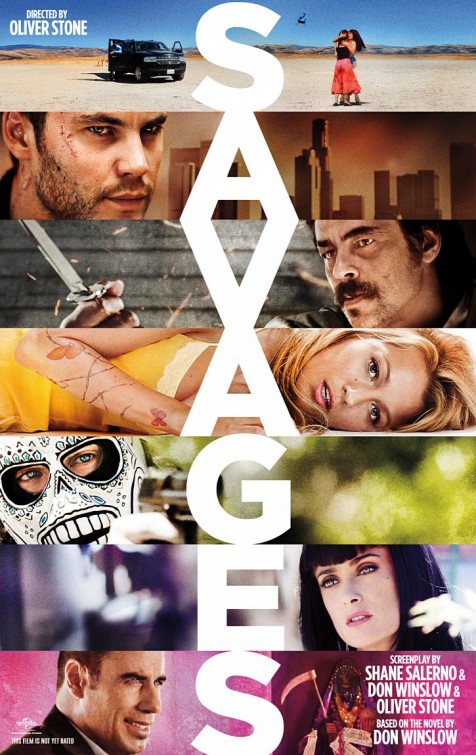 Savages has been described as a “return to form” from prolific director Oliver Stone, who has spent the last decade making straight biopics (W., Alexander) and safe feel-good movies (World Trade Center). The less said about Wall Street: Money Never Sleeps the better. You never thought one of the world’s edgiest filmmakers would follow such a square path. I can’t fault people for getting excited by Savages, hoping this drug-addled crime thriller can revive the gonzo sensibilities of the man. Well, Savages isn’t going to satisfy most people, especially those looking for a cohesive story, characters that grab your interest, and an ending that manages to stay true thematically with the rest of the movie. In short, Savages is a savage mess of a movie but not even an entertaining mess. It’s just a boring mess, and that is the film’s biggest sin.
Best friends Chon (Taylor Kitsch) and Ben (Aaron Johnson) are living the American dream. They began farming their own marijuana plants, using the best seeds form Afghanistan while Chon was on tour with the military. Together, the guys have produced a product high in THC that blows away the competition. They have flourished in California. Now a Mexican cartel, lead by Elena (Salma Hayek), wants in on their business, and they won’t take no for an answer. The cartel kidnaps the boys’ shared girlfriend, O (Blake Lively), and promises to hold her ransom for one year unless the boys agree to their terms. Chon and Ben decide to use their considerable resources to put the squeeze on Elena and her team of scumbags, all the while looking for a way to rescue their shared love of their life.
 It’s a lurid movie all right. Plenty of sex, drugs, and violence, but man oh man is it all just empty diversions because the movie cannot survive its trio of unlikable, uninteresting, and painfully dull characters. O, Chon, and Ben have a dearth of charisma; light cannot escape their black hole of charisma. What sinks Savages is the realization that it’s just a shoddy movie filled with a lot of skuzzy characters but hardly anyone that merits genuine interest. We’ve got skuzzy good guys, skuzzy bad guys, but where are the personalities? Where are the quirks or the hooks to drive our interest? Just having Benicio del Toro (The Wolfman) act weird and mumbly is not enough to cover the shortcomings of his character. I’ve read reviews where critics cite del Toro as “hypnotic.” I have no idea what they’re talking about. He’s just your average skuzzy bad guy you’d find in any mediocre crime picture; he just so happens to be played by Benicio del Toro. The DEA Agent John Travolta (From Paris with Love) plays is your typical skuzzy desk weasel; he just so happens to be played by John Travolta. And that’s where the movie falters. We have all these characters on all sides of the law but we couldn’t give a damn for any of them. O comes across like an annoying, privileged, faux intellectual. Chon is a meathead. Ben is an amorphous do-gooder. I don’t care about their problems and I especially don’t care about them retrieving O so they can return to their vague polyamorous lifestyle. She wasn’t worth all the effort, nor where these men worth dying over. At any point in the film, I wanted these characters to hastily die so that I might, just out of chance, come across a more interesting figure. I received no salvation.
Our trio of bland characters is made flesh by a trio of bad performances. First off, people have got to be realizing that the kind of lived-in, edgy, and compelling performance Lively pulled off in 2010’s The Town is more the exception than the rule. Stop casting her in gritty parts unless they are directed by Ben Affleck. As O, our zombie narrator, she does little to make us sympathize with her dumb plight. Then there’s Kitsch (Battleship) who is just having a record year of high-profile flops. He’s done fine acting work before, but as Chon he’s just another ramped-up hothead with little else on his mind. Johnson (Kick-Ass) has the most “flavor” of the trio, acting granola-y and with philanthropic ambitions, but he’s still just another meathead just in different clothes. All three of these characters are idiots and the young actors don’t find any way to redeem them.
Actually, I found Salma Hayerk’s character the most interesting and would have enjoyed a movie based around her dilemma. Elena’s husband was the head of a drug cartel. He was assassinated, so the duties would have fallen to her son, but in order to protect him she assumed power. She has an estranged relationship with her youngest daughter, Magda (Sandra Echeverria), who is ashamed of her mother. This, Elena tells us, makes her produ; she is proud that her daughter is ashamed. Now just look at all those contradictions and complexities inherent with this character. She’s assumed a duty she did not want, something she knows is morally wrong, but she does so in the interest of protecting her children, even if it means pushing them away and having them despise her. And because she’s a woman, any wrong move and her competitors would be ready to pounce. Plus you add the day-to-day anxieties of a life of crime, the threat of betrayal or some upstart wanting to make a name for himself, and you have the makings of a great character drama. But do we get even a little of this? No. Instead, Elena’s just portrayed as another colorful villain. The supporting cast is peopled with what should be seen as “colorful” characters, but really these people are just as skuzzy and boring and personality-free as our loser ménage a trois.
I suppose there is a certain pleasure seeing Stone return to his blood-soaked, violent, gonzo self. The man has a certain enviable madness when it comes to composing a movie, a mad fever of images and sensations. From that standpoint, Savages is at least watchable even though you would rather see most of the characters get hit by a car. I just wish if Stone was going to go nuts that he committed and went all the way, bathing this movie in his lurid predilections as we tumbled down the rabbit hole of the underground world of organized crime. If you’re going to assault my senses with excess then at least have the gall to be excessive. How can you make a lurid movie but EVERY woman onscreen engaging in sex is clothed? That seems unrealistic even for a movie this stupid. Stone seems to have no problem dragging out uncomfortable rape scenes, so who knows what the further implications of that are. There are several grisly torture scenes and some random brutality, so you’ll at least be kept awake in spurts by people screaming.
 Too much of this supposed crime picture is caught up in the oppressively irritating soap opera between O, Chon, and Ben (a little part of my soul dies every time I have to type “Chon” as a main character name). The script, based upon Dan Winslow’s novel, adapted by Shane Salerno, Stone and Winslow as well, is a mess but not even an enjoyable mess. Some of this dialogue is just laugh-out-loud bad. O opens the movie saying she has orgasms but Chon, you see, has… “wargasms.” Oh ye God, that one hurt. Every time we’re subjected to O’s protracted, monotone narration the movie loses whatever momentum it may have had.
She keeps saying, “Just because I’m telling this story, doesn’t mean I’m alive at the end.” Can you promise me that? Then there’s the very stupid ending, where the movie tries to have it both ways. It gets its bloody, operatic, tragic lovers ending…. and then in the next breath a happy ending as well, a ridiculously inappropriate happy ending. At least bloody and dead would have been satisfying. It’s a cop-out, a cheat, and a mystifying way to end a movie.
I wanted Savages to be a wild thrill ride. I never expected to be bored. Even when things go off the rails, the movie struggles to keep your interest. Blame the inane screenplay that eventually resorts to a cheap, cop-out of an ending, one that barely rises above the “it was all a dream” blunder. Blame the pathetic character and their lack of personality. Blame the strange feeling that Stone is holding back. Blame the bad performances. Blame the lack of fun. Blame the overwrought nature of the title the movie twists into knots trying to give some philosophical meaning. And finally, you might want to blame yourself for thinking that this movie would be any good in the first place. When movies are this mediocre, this lacking in intrigue, you almost wish they had tipped over completely into irredeemable garbage just so you’d at least have something worth watching. Savages is a strange crime thriller that manages to assemble all sorts of exploitation elements and then fumbles them all. If this is Stone in a “return to form,” I weep for what that entails.
Nate’s Grade: C
Share this:

Alexander (2004)
 I was standing in a theater weeks ago and saw a large banner for Oliver Stone’s epic about Alexander the Great. I listed the names; Colin Farrell, Angelina Jolie, Val Kilmer, Rosario Dawson, Jared Leto. This had to be perhaps the greatest assembly of pretty actors ever in a motion picture. There’s a whole lot of sex appeal there, and Anthony Hopkins, as the film’s reflective narrator, isn’t too shabby looking himself for a man his age. After having seen Alexander, it’s safe to say the actors sure are pretty but the movie is far from it.
Alexander (Farrell) is one of the greatest historical figures. He rose to become a Macedonian king, dominated much of the known world before he was 30, and then died mysteriously at a young age. In flashes to his youth, we see Olympias (Jolie) coaching young Alexander on his future glory. Standing in her way is one-eyed King Phillip (Kilmer), Olympias’ husband though not the father to Alexander. She frets that he will sire a direct heir to the throne, and upon Phillip’s assassination, Alexander reaches new heights. He travels to Babylon with the purpose of avenging his father’s death, rumored to be paid for by Persian gold.
Alexander keeps traveling east conquering new lands but returning kings to their rule and assimilating “barbarians” into his armies. His generals begin to question Alexander’s actions, especially his surprise marriage to an Asian peasant woman (Dawson). He is unable to sire a male heir with her. Hephaistion (Leto), Alexander’s childhood friend and lifelong lover, worries that Alexander has become power hungry and distrustful of those around him. Many of his men only want to see home after seven years of battle. After defeat in India, Alexander decides to turn back but he never sees home again.
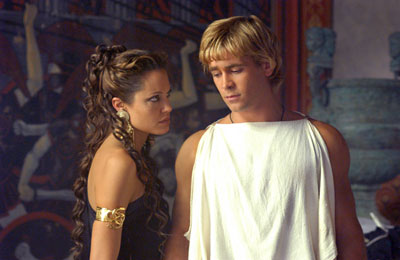 For such a lavish biopic, Alexander seems fairly remote. We don’t really get to know much about the psychology of Alexander. He’s a historical figure with equal parts good and bad ready for debate, but whenever Alexander does hit some of its star’s less-than-stellar moments, it seems to gloss right over them. Hopkins will narrate about some town that resisted, then we’ll see a quick image of it burning, and then we move on. Or we’ll see a slew of dead army officials and Hopkins will say, “He slaughtered all he felt were responsible for mutiny, but I’d expect any general to do the same.” There are several moments where we’ll hear Alexander massacred a town, or sold people into slavery, and then we get the next scene. It’s quite comical, almost as if Hopkins is a tour guide at a museum saying things like, “And then Alexander ate all of the first born babies. Moving on now…”
There are just so many awful laugh-out-loud, loopy moments in Alexander. It’s not enough that Jolie speaks in some bizarre accent; to make sure the audience understands that she’s duplicitous she has a snake wrapped around her in every scene. I’m not kidding; every scene that Jolie is in she has snakes coiled around her.
There’s a moment late in the film that is so hilariously dreadful, it’s hard to believe what you’re seeing. Hephaistion has caught ill and is on his death bed. Alexander is wrought with emotion but then strolls over to a window and begins another huge speech that ends up being all about his glory. What makes the scene go from bad to I-cannot-believe-they’re-doing-this bad is that Hephaistion, in the background, is convulsing and dying. You see his body tense up, twitch, leap into the air, and practically do some kind of triple axle, all while Alexander speechifies blithely unaware. I challenge anyone not to laugh.
Stone needlessly complicates his film with flashbacks, giant leaps forward in chronology skipping Alexander’s rise to respected leader, and skittish hallucinations. Stone is accustomed to breaking up the chronology of his films, but Alexander is too long and too campy to play around with for effect.
The acting of Alexander is set to overkill. Farrell seems miscast and doesn’t have the weight to carry such a historically meaty role. He looks pretty, and he can snarl like a pro, but the only thing worse than his overblown performance is his terrible blonde hair. This just wasn’t the right role for this talented actor. Jolie is so naturally seductive that she could have played her role mute and been effective, maybe more so. Kilmer seems to be working some kind of Irish accent but he comes off the best of the three. Leto gets overshadowed by his bangs.
Alexander also seems to speed over its star’s bisexuality. It wasn’t uncommon for men to bed both sexes, but the movie seems terrified of portraying anything beyond longing glances. Alexander and Hephaistion are reduced to some whispers here and there, but the limit of their physical affection stops at hugs. It actually is kind of funny the amount of times they hug, which I think is over five. You can tell the filmmakers wanted more but then were like, “Eh, let them hug again.” In some weird turn, it seems the film shows more depth with Alexander’s relationship with his horse than with his lifelong lover.
For a three hour movie about a military man who conquered much of the known world, there’s a shocking lack of action. Alexander has two action set-pieces and then that’s it. The first set-piece is a battle between Alexander and the vastly numbered forces of the King of Persia. The battle lasts twenty minutes and is disjointed, bloody, and perfectly indicative of the confusion of war. Stone cuts back and forth between majestic aerial shots showing the progress of battle and hand-to-hand combat amid the sand and dust clouds. Stone also labels certain sections of the armies, which gives a greater understanding of the battle. It shouldn’t be a surprise that this battle is the highlight of Alexander.
The only other action set-piece comes very late in the movie. Alexander’s forces have marched all the way into India. Warriors on the backs of monstrous elephants stampede onward to intercept Alexander’s armies. This battle is also chaotic, and Stone utilizes a lot of quick point-of-view shots like people getting squashed by pachyderms. The action is satisfying if a bit over the top (a warrior gets impaled on a slow-moving elephant’s tusks), that is until Stone goes off the deep end. Alexander gets wounded in battle and suddenly the film switches tints, bathing everything in reddish and bright neon hues. Everything has a tin outline. It’s rather ridiculous and unfortunately reminds me of Ralph Bakshi’s misguided animated Lord of the Rings.
 That’s all you get for action, so I hope you like speeches rich with superfluous historical name-drops, because that’s what Alexander is all about. I’d bet money that nearly an hour of this three-hour opus involves people delivering speeches. Alexander rallies his men, Phillip talks about the Greek tragedies, Olympias strokes Alexander’s greatness and need for kingship, his generals talk about his decisions, and then we get endless moments of Alexander talking about a new world, bringing people together, and respecting other cultures. Alexander seems to go dead as soon as some character pulls out a soapbox. Worst of all, many speeches involve lots of historical references that an audience cannot be expected to keep up with. The overall effect is like listening to an unwanted party guest drone on. Alexander may be trying to talk to death his enemy.
What makes all of this worse is that the dialogue and the drama are so melodramatic. The center of Alexander’s creaky psychology is a domineering mother and a scornful father who scream at each other a lot. Whenever someone has a disagreement in Alexander they resort to over emotive screaming. You may start tuning the actors out after awhile. Much of the dialogue is terrible, but there is the occasional howler line like, “It is said that the only defeat Alexander suffered was Hephaistion’s thighs.” You may concur with Alexander’s men and want to return to your family as soon as possible after watching this.
I was trying to think how something like this, so misguided and off the rails, could chug along without a peep from someone saying, “Hey, maybe this isn’t working.” Then I got it. You see, Alexander is Oliver Stone. Both men are revered for previous victories, both men are generals that take full control of their armies, and both men are fiercely stubborn. If someone questioned Alexander’s decisions, chances are they could be killed. Now I’m fairly certain Stone wouldn’t go that far (there may be many graves dug over the grumblings over U-Turn), but I can see how difficult voicing dissension might have been.
Stone’s long in the waiting Alexander epic is bloody, ponderous, exaggerated, talky, sumptuous and off-the-charts loony. This is a giant mess only a visionary director could amass. Only historical junkies might be entertained by Alexander, and the rest of us will just be glazed over. We never get to really know Alexander, nor do we even get our money’s worth for action, so unless you click your heels to the thought of hours of speeches, skip Alexander. Trust me, it’s far from great.
Nate’s Grade: C-
Share this:

Any Given Sunday (1999)
 Oliver Stone is a seamstress of visuals and visceral noise. Any Given Sunday is perfect as he delves into the professional world of football and how it becomes a dance of testosterone and fury. But after awhile all the audience feels is a pounding and a ringing in its ears.
The biggest stumbling block may actually be its focal point – there’s too much football! The games last as long as actual games and there are multiple games through out. Though Stone captures the essence nicely that these spandex-clad athletes are the gladiators of today playing in a ballet of chaos, he just throws too many jangled cuts, quick shots, and extreme angles flashing around to hyper-decibel soundtrack fodder. After a while the viewer becomes dizzied by the rush of noise and flash of lights buzzing around their precious skull. It’s enough to cause a concussion simply from watching.
]Most of the action in Any Given Sunday actually happens off the field with some meaty drama delivered by multiple players. Stone focuses in on the people behind the catches and blocks and how the game can control or transform their lives. Finally a drawn-out story that covers football with respect. Diaz and Pacino get into screaming matches for roughly most of the movie, but it’s exciting to see two great actors throw the acting medicine ball back and forth trying to out-duel the one before. The supporting characters all have stories suitable to the game and interesting enough to warrant attention. Jaime Foxx has a nonchalant magnetism that keeps the audience pulling for him even after he vomits for the third time on camera.
Stone lets the viewer into the game of football in a manner truthful yet exaggerated. But with all the whiz-bang he throws out in Any Given Sunday one can’t help but have wished for more constraint in the excess and more minutes for the drama in between.
Nate’s Grade: B-


 nathanzoebl
You must be logged in to post a comment.