Blog Archives
The Neon Demon (2016)
 The prospect of a new Nicolas Winding Refn movie is akin to a trip to the dentist for me: long, painful, and full or regret over one’s life choices. The Neon Demon will not change this perception of mine. I hated this movie, and the more I think about it the more I hate it. Unlike Refn’s last film, the punishing, overwrought, and nihilistic Only God Forgives, there isn’t even a kernel of an idea of a movie here. I loathed Only God Forgives but I’ll at least credit Refn for crafting something with potential in its plot dynamics. In better hands, somebody could have done something with the setup for that movie. I don’t think anyone could work with what Refn offers in The Neon Demon because he offers nothing. That’s not entirely true. He offers pretty pictures and alluring shot compositions, bathing the screen in high-contrasting colors. What he fails to offer is a story, or characters, or any reason that this movie shouldn’t exist instead as a ten-minute short. Somebody enlighten me and tell me what exactly this vacuous and tedious art exercise offers.
Perhaps I’m being too cruel so allow me to explain the plot. Jesse (Elle Fanning) is a 16-year-old girl fresh off the bus to L.A. She gets hired at a modeling agency and makes friends with a makeup artist, Ruby (Jena Malone), who also works in a coroner’s office beautifying corpses. Jesse quickly rises through the ranks of the modeling world because of her fresh face and youthful, pure demeanor. She makes enemies with older models (Bella Heathcote, Abbey Lee) who feel threatened by her. And Keanu Reeves plays a sleazy motel owner who sticks a knife down Jesse’s throat for fun. Or that was a dream. I think. Then there’s a confrontation that includes necrophilia, murder, and cannibalism. And even after the cannibalism the movie still goes on for another fifteen minutes!
 There is not nearly enough plot or any substance to carry out Refn’s near two-hour running time, which becomes all the more obvious with one dreary, pretentious, artfully self-indulgent scene after another. There are long segments where I cannot even tell you from a literal level what is happening on screen. Is Jesse descending into madness? Is Jesse losing herself to the vanity of the industry in a heavy-handed visual metaphor? Does anything happening register with the slightest merit? Refn is possibly trying to tackle the same meandering dream logic that populates David Lynch’s more obtuse filmmaking entries, like Lost Highway and Mullholland Drive (recently voted the top film so far of the twenty-first century by the BBC). I’m not a fan of untethered David Lynch but he will at least keep things interesting. The Neon Demon is a powerfully boring enterprise in annihilating audience patience. There’s no there there.
Another problem I have with Refn’s movies is that he hangs much of his meandering on broad and obvious themes and assumes they’re revelatory. Only God Forgives was all about the pointless nature of vengeance and cyclical violence, and you felt the pointlessness with one grisly and uncomfortable moment after the next. With The Neon Demon, Refn falls back on the most general of broadsides against the fashion industry. Did you know that people working in a surface-level industry could be shallow? Did you know that young women are exploited for their beauty and then quickly cast aside? Did you know that succumbing to the appeals of vanity could be self-destructive? These are the most general themes and they are presented without able commentary. It’s like Refn thinks touching upon these shallow themes is enough substance to justify all the excesses.
This is borderline unwatchable cinema. The plot is like Showgirls without the camp but still following some of the basic plot beats. There is nothing interesting about these characters at all and that’s because they’re not people but robotic figurines at best. They’re dolls for Refn to pose and play around with his purple lights. It’s like watching two hours of somebody rearrange fancy-looking furniture. The characters are just as significant as the nearest love seat or coffee table. I’ve complained about all the empty space in Refn movies and The Neon Demon is no different. This movie is padded out exponentially to become Refn’s longest movie in his career. He cares far more about his shot compositions and cinematography than storytelling. At this point I don’t think Refn has any interest whatsoever in telling a story. He wants to construct a visually immersive film experience. The Neon Demon is little more than the misty atmosphere of the impermissible, the phantasmagorical. Refn deploys controversial imagery and plot elements but he deploys them in place of actual substance. Anybody can get a strong response by throwing in a necrophilia sex scene, but has that reaction been earned and has this moment been properly setup by careful development? Absolutely not. Things just happen.
 This was also billed as Refn’s horror movie but there’s nothing genuinely terrifying, at least from an intentional standpoint. You don’t feel any sense of danger or even a sense of uncertainty until the very end, and by then the movie has meandered far too much for the horror elements and gore to have an impact beyond lazy shock value. This is a movie where pretty people stand around and then, on the turn of a dime, do something outrageous. Refn hasn’t laid the groundwork for a descent into mental instability with our lead character, which seems like the most obvious solution. I could see a Black Swan-style psychosexual story about obsession with perfection and how this blinds one woman into making a multitude of sacrifices, driving her over the edge and into murder. Black Swan was a great, often brilliant movie. Go watch Black Swan instead, folks.
I think I have a solution that will benefit us all, dear reader. Nicolas Winding Refn should forgo the director’s chair and devote his career to being a cinematographer. He has an alluring eye for visual compositions and a great feel for atmospheric lighting, but with each passing movie I feel the man’s disdain for narrative filmmaking. His skill set is best utilized at making pretty pictures. Get him away from directing actors. Get him away from writing stories. Have adults in charge of the other aspects that help make a movie what a movie should be. The Neon Demon is a confounding, obnoxious, obtuse, intellectually destitute and monotonous movie experience. It’s frustrating to deal with the Cult of Refn in cinematic circles because I just cannot see what they see (I liked Drive well enough). The Neon Demon is too shallow and tortuous to be an insightful commentary on beauty, too oblique and maddeningly dreamlike to be an engaging story, and too devoid of interesting characters to hold your attention as they drift from one scene to the next. I’d be more forgiving of Refn’s indulgences if he was a short filmmaker. I’d allow more latitude for experimentation. The Neon Demon is not a movie. It’s a collection of half-formed, shallow ideas that Refn has thrown together, a whole lot of dead and empty space connecting them together, and an 80s synth score to underline the high-contrast colors. At this point I’d rather go back to the dentist than sit through another Refn film.
Nate’s Grade: D
Share this:

Only God Forgives (2013)
 Only God Forgives is an apt title for a movie that is replete with such suffering and brutality. Here is a movie that thinks wanton bloodshed and depravity is the same as character depth, and the fact that it’s from Nicolas Winding Refn, the writer/director of Drive might not be as surprising as you’d believe. I enjoyed 2011’s Drive but I wasn’t as taken with it as other critics, my chief complaint being a groping pretentiousness that confused emptiness as contemplation. I see the same issue with Only God Forgives, a grisly morality play that’s simplistic and overwrought at the same time. Once again Ryan Gosling plays a man of few words, so few that I counted he only says eight by the 28-minute mark (at this pace, he’ll dissolve into the background by 2015). Gosling’s brother was killed after the creep raped and murdered a 16-year-old prostitute in Thailand. Gosling’s ferocious mother (Kristin Scott Thomas) demands retribution on the Thai police, but Gosling has his reservations. What ensues is a string of glossy gore, tedious reprisals, and nonsensical plotting, including numerous karaoke sequences with the Thai cops. The movie’s emphasis is almost entirely on a hellish atmosphere, lots of lurid reds and harsh lighting, providing style but minimal substance. The characters are all detestable and unengaging, the story is awash in dreary and ponderous plotting, and the movie just reeks of pretension, every frame oozing with Important Symbolism (catch the emphasis on hands and wombs yet?). Only God Forgives would be forgivable if all of its admirable style and mood had some greater purpose. It’s a grueling movie to endure but the hardest part is getting through all the tedium thanks to the near-mute characters and a script overdosing on torture. At this rate, Refn’s next film will just be 90 minutes of Gosling punching a baby. Silently, of course.
Nate’s Grade: C
Share this:

Drive (2011)
 Driver (Ryan Gosling) is a Hollywood stunt driver who has a lucrative side-project. For the right price, he can be hired as a personal driver. He gives the client a five-minute window. Whatever happens in that window, he’s their driver no matter what. Miss it and he’s gone. As you can imagine, this kind of job offer is mostly filled with getaway driving duties. Driver takes an interest in his apartment neighbor, Irene (Carey Mulligan), a young mother. Her husband (Oscar Isaac) has just been released from prison and already feeling heat to pay his debts. He gets winds of a pawnshop holding a million in cash. Driver offers his services to square the guy’s debt and to keep Irene and her son safe. But of course things go wrong, as they tend to in these sorts of pictures, and Driver is left with a sack of money and two very angry gangsters. Nino (Ron Perlman) and Bernie (Albert Brooks) would like the money back and to eliminate the number of people that know about their involvement in this scheme.
Drive is being sold as one kind of movie, a high-octane action thriller with plenty of car chases, when it’s really a European art-thriller paying fawning homage to those kinds of movies. That means that Drive plays out much more placidly and contemplatively with sudden bursts of gruesome violence. My audience seemed to grow restless with the purposely plaintive pacing so when the violence exploded they would laugh or cheer, happy that something of conventional entertainment value was finally occurring. I was growing restless myself, not with the infrequent appearances of genre action or the artistic flourishes, but just with the prevalent pauses. Danish director Nicolas Winding Refn (Bronson) will have his camera hold onto a scene for several seconds longer than what feels necessary, or he’ll shoot dialogue between actors and Gosling will pause a full 20 seconds before answering. I understand that Refn is establishing a stoic loner akin to Clint Eastwood’s celebrated stable of strong silent types, a modern American cowboy. I’m sure that you could cut 10 minutes of out the film just from snipping these extended pauses and overlong shots, moments that seem to be filling time and giving the audience an opportunity to step outside the movie. I doubt that was ever the intent but it’s certainly the effect. When a scene or camera shot holds on longer than it should, we can feel it, and when it keeps going we start to wonder why, and when an answer is absent then we start to snicker or second-guess the artistic choices. I’m sure audiences that watched Drive will probably be scratching their heads wondering why there isn’t more, well, driving.
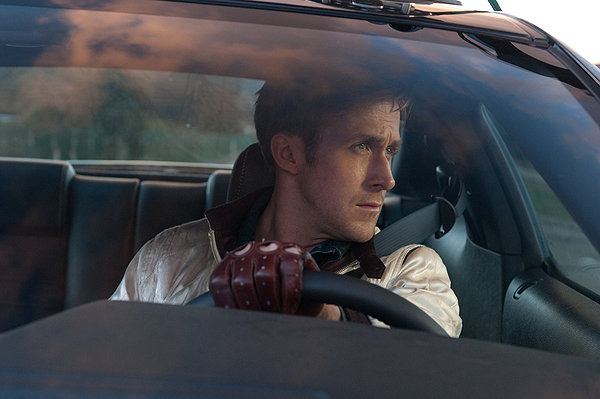 The action that does appear onscreen is extremely well choreographed. The car chases thrill and the edits allow for full audience orientation. You know what’s happening and you know what’s at stake. And we care. A car chase after a botched robbery is particularly exciting when Driver starts driving backwards to block his opponent’s view of the road. The opening chase sequence is notably almost an anti-car chase. Driver is listening to a police radio and choosing when to duck around side streets and wait out the patrolling cop cars. The tension isn’t watching one car chase another, it’s watching one car idly sneak away. What I’ve described, however, is about all the movie offers for car action, though Driver does ram one motorist off a ravine later.
You can tell Refn is a fan of Hollywood genre films, and Drive takes typical thriller tropes and puts them through an art-house prism, bringing a near Kubrickian level of beauty to the violence. Drive is a gorgeous movie to watch; the shot selections, the chiaroscuro lighting, the use of the 80s style Euro-synth score by Cliff Martinez (Traffic, Contagion), it all coalesces into a near hypnotic blend of visual and sound. It’s a beatific landscape even when horrible things are going on. There’s a sequence where Driver, Irene, and one of Nino’s thugs are in an elevator together. Driver notes the imminent danger and slowly motions Irene behind him. He then turns and kisses her, and while he does this the elevator lighting seems to brighten and darken, like it too is being charged through the power of a kiss. And then Driver sharply pivots, blocking the thug’s attack, knocks the guy to the ground and stomps on his head until it bursts. The looming violence is teased through slow motion, and then it hits with the power of a crescendo. The violence is always looming, always seeming to be just on the cusp of an explosion. But under Refn’s direction, the movie fulfills that audience bloodlust in unexpected ways. Instead of a big fight, Driver casually drowns one of the toughs in the surf of a beach. Instead of a brutal elimination, Bernie dispatches someone with what can almost be described as compassion, slitting a major artery and whispering, “It’s done. It’s all over. There’s no pain. Just let it happen.” Even the big showdown between Driver and Bernie plays out with flash-forward edits, giving the meeting an extra level of gravitas knowing what awaits when they leave the table.
Refn has created a beautiful movie, it’s just that it has so much empty space pretending to be nuance. And that’s the rub. I appreciate an art-house sensibilities elevating and celebrating classic American genre pictures. I though Joe Wright did an excellent job of this with Hanna earlier this year. However, Refn shortchanges his actors. The script by Hossein Amini (The Four Feathers) is light when it comes to character detail. Again, this might be because Refn wishes to make a statement on genre films by having his movie populated with genre types and sticking to this limited route of characterization. Whatever the rationale, it makes for some pretty elusive one-note characters. Irene is less a character than a symbol of innocence. It doesn’t help matters that Mulligan has little chemistry with Gosling. Nino and Bernie are interesting characters who have such unspoken histories. They’re mid-level criminals stationed out of a cheap pizza joint in a strip mall. Nino is tired of the criminal higher-ups always disrespecting him. Bernie used to be a movie producer in the 80s, and may have bankrolled something like Drive. He hates getting his hands dirty but he shows an eerie talent for violence. These small glimpses are hints at something more, but that is all Hossein and Refn leave us with.
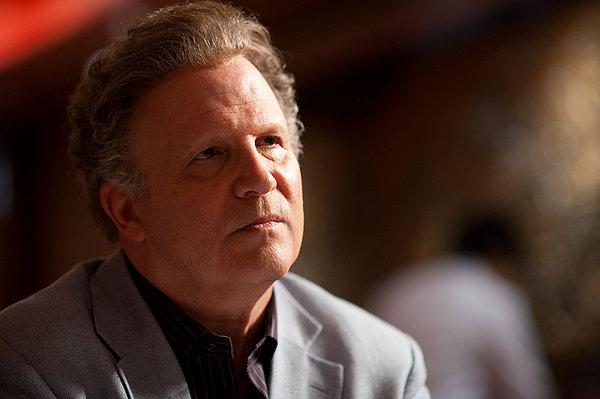 Gosling (Crazy, Stupid, Love) has very little to say in the film. He probably only ever speaks 80 words, but brevity does not mean he’s just sitting around. Gosling goes for understated in a genre known for histrionics. He plays things very close, a taciturn mystery man. The existential drifter. Gosling sure knows how to hone his flinty stares. Mulligan (An Education) gets very little to do in the film, so it’s another round of her crinkling her pretty face and blinking those glassy eyes. Christina Hendricks (TV’s Mad Men) also appears as a third wheel on the pawnshop scam. The real surprise is Brooks (The Muse). The famous comedian is shockingly believable as somebody you don’t want to cross. Even when he’s trying to be cordial there’s a veil of menace. If only there was more to his role. I would have loved to see him regrettably step back into his past, taking care of business with ruthless yet disdainful efficiency.
Drive is an action thriller that’s more a Euro-infused commentary on the genre. Fans of Hollywood action will likely be put off by the elusive characters, the sluggish pacing with numerous pauses, and the overall art-house nature of the finished product. Refn’s movie is beautiful to watch, with intricate precision taken to making the imagery and sound design mesmerize. If only that same level of care was paid to character and plot. We’re dropped into this criminal scenario and left to flesh out the characters given the hints and nods we accumulate in 100 minutes. I don’t need to be spoon-fed but I’d like my movie to have better attention to character than ambiance. Drive is a beautiful looking vehicle that just doesn’t have any particular place to go.
Nate’s Grade: B


 nathanzoebl
You must be logged in to post a comment.