Blog Archives
The Birth of a Nation (2016)
 Sold for a record $17.5 million at the Sundance Film Festival, there were big expectations for the Nat Turner biopic, The Birth of a Nation. Writer/director/actor Nate Parker was the toast of the town and the studio had its sights set clearly for a fall release and a big Oscar push. Then came the revelation from Parker’s past linking him to an accusation of sexual assault (it should be noted he was acquitted of the charge, though it should also be noted the woman declined to continue pressing charges during the second trial). Suddenly the Oscar hopes for Birth of a Nation were put into a tailspin and journalists were wondering if this salient news would provide older Oscar voters just the excuse they needed not to watch the movie. After having finally seen the film for myself, I can attest that this movie wasn’t going to go far into the Oscar race anyway. My friend Ben Bailey said it best as we walked out of The Birth of a Nation, making an apt comparison to the 2013 Best Picture Winner: “12 Years a Slave was a better movie made from a less interesting story; and this is a more interesting story but given a much lesser movie.”
In 1830, Nat Turner (Parker) is earning extra money for his friendly slave owner (Armie Hammer) as a preacher, convincing slaves on other plantations to work harder and obey their cruel masters. He reaches a breaking point and organizes a revolt, violently killing the same plantation owners that kept them in bondage. Nat felt his revolt could be the catalyst for slaves all over, but it was put down by overwhelming forces two days later.
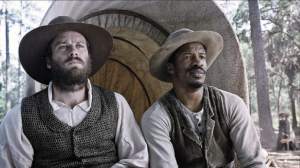 Nat Turner is a historical figure extremely deserving of a big Hollywood spotlight. The problem is that Parker’s movie feels like the arthouse version of the Hollywood Martyr Blockbuster, a field popularized by director Edward Zwick (Glory, Blood Diamond). This thing checks just about all the formula boxes you’d expect by showing the arc of a character called into action, forced to take a stand against an exploited people and series of injustices, and the eventual death for the cause. It’s meant to be inspirational but that sense of inspiration can be capped when you see the machinations. All storytelling at some level is about pulling the strings of an audience, but the storyteller must do their best to make this as nonobservant as possible so as not to disturb the experience. Parker doesn’t have that skill quite yet, either as a director or as a screenwriter.
His movie kept my interest but I felt oddly removed from it, unable to fully absorb the characters, which should never happen in a revolt against slavery. Case in point, we know how the movie is going to end so Parker needs to engineer something of a win for Nat, and that’s where Raymond Cobb (Jackie Earle Haley), nasty slave catcher, comes in handy as a conquerable antagonist. He ends up being the man responsible for chasing Nat’s father away, so it’s even more personal. During their final fight, Cobb implausibly wrestles atop a struggling Nat (this guy has to be at least 60 years old and it’s Haley, not Stallone). Parker even includes the knife that’s just… out… of… reach. I rolled my eyes. Parker shouldn’t have to resort to these tactics to rouse his audience, and as stated above, they’re just too nakedly transparent in their formula machinations. I wanted more suspense sequences like during the opening when Nat’s grandmother has to think on her feet to conceal contraband, smart uses of dramatic irony and ratcheting up the tension. The movie is structured too narrowly as Nat’s call to action, but Parker seems preoccupied with hitting all these other checkmarks to fully open him up as a human being.
Structurally, this movie is amiss because we don’t need 90 minutes to justify why slaves would violently revolt against their masters. The best part of Birth of a Nation is its final act when the revolts come and the slave owners get what they have coming. Some will equivocate that not all slave owners abused and terrorized their slaves to the same degree of abject cruelty, but the very nature of owning another human being is an assault on fundamental morality. 12 Years a Slave had an excellent 15-minute section where it disproved the notion of the “good slave owner” with Benedict Cumberbatch’s character. Even he too was corrupted because the institution of slavery is a corrupting agency. What that movie was able to communicate in 15 minutes is what The Birth of a Nation takes 90 minutes to do the same. The entire movie should have been the slave revolts with some choice flashbacks interspersed to give the movie even better context for the personal animosities against specific slave owners. That way we can better explore the emotional side of Nat Turner and his company without resorting to extended degradation. Parker deserves some credit for being very tasteful in his depiction of the brutality against slaves and the heavy heart of aiding and abetting an unjust system. It doesn’t whitewash, so to speak, the horror of slavery but also refrains from exploiting tragedy for easy gains. With that being said, and I may be alone in this observation, but I found it a bit peculiar that the sexual violence committed against women seems to be primarily framed as how it impacts the male characters, making them sad or angry at the mistreatment of their women. I may be over-analyzing this but it happens twice and stuck out to me. The structure of the movie does a disservice to the emotional power it demands, and Parker should have shown us the bloody campaign rather than the lead-up to the campaign.
Parker also shows some noticeable shortcomings when it comes to directing his fellow actors. His performance is a highlight and his moments where he’s trying to hold back the tide of mixed emotions working for the slave owners and using Scripture to justify the worst of the worst. This is a great showcase for Parker as an actor of suitable range. It’s not a great showcase for any other actor. The performances are a bit big when needing restraint, and a bit broad when nuance would be required. There’s no character that even comes close to the deeply wounding impressions left by the brilliant Lupita Nyong’o and Michael Fassbender from 12 Years a Slave. Hammer (The Man from U.N.C.L.E.) is given one note to play after the first act and that is aspiring drunk. I don’t know if there’s a scene where he isn’t accompanied by some bottle. It’s meant to communicate his increasing sense of shame he has to excuse, but it’s also a fairly facile acting crutch. The women in the film come across as angelic (there’s even a vision of an actual angel in the film) or maternally strong as steel. The lack of variance becomes frustrating, as it seems that Nat Turner is the only character, and by extension actor, allowed depth. You’ll enjoy the actors on screen but be scratching your head to recall anything memorable.
 The Birth of a Nation is very purposely meant to evoke the title of the famous 1915 D.W. Griffith movie, the world’s first film blockbuster and also virulently racist to its core. It’s about the formation of the Klu Klux Klan in a Reconstruction era to save all the honorable white people from the new hordes of wanton free slaves. It’s deeply offensive though an undeniable touchstone in the history of narrative filmmaking. I was looking for some kind of larger thematic connection beyond slavery but it seems that Parker’s movie is meant to be a reclamation of the title. There’s a moment at the very end that made me think that there was another possibility (spoilers). As Nat Turner is executed, one of the last images is a close-up on the face of a young teenage slave who witnesses his death. The camera then pulls out and that boy has aged into a man and is fighting with a battalion of other black soldiers during the Civil War (the movie literally becomes Glory!). I was wondering if we were going to continue skipping forward in time, next to the Civil Rights marches, next to protests against police brutality in the modern era, so that Parker was drawing a direct line from the experiences of old and how they have shaped the America of today, the birth of our current national racial injustices. This doesn’t happen, unfortunately. The Civil War flash forward is the only jump in time.
I’ve been critiquing Nate Parker’s movie for the majority of this review and I don’t want to leave you, dear reader, with the false impression that this is a bad movie; overrated and slightly disappointing, yes, but not bad. If it didn’t sound like faint praise I would say that The Birth of a Nation is a perfectly fine movie. It held my attention though I kept thinking of other ways this movie could have improved, from a restructured plot that begins with the slave revolts, to more attention to the supporting characters, to less fidelity to the patented formula of the Great Martyr Biopic. This was a passion project for Parker and took him over six years to complete. Walking out of my theater, I simply didn’t feel like that same passion was evident on the screen.
Nate’s Grade: B-
Share this:

Non-Stop (2014)
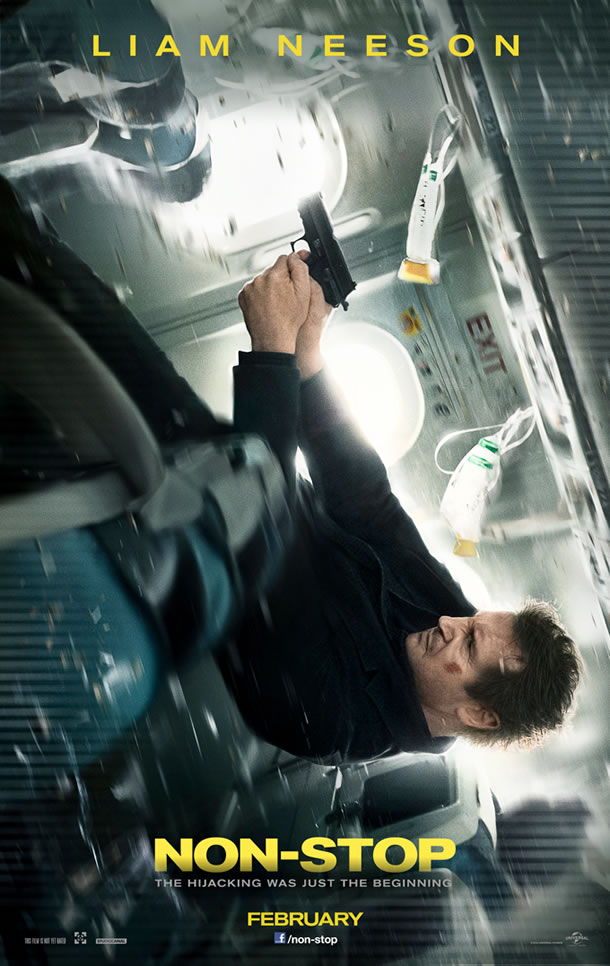 Know that I love contained thrillers, and I love suspense stories where we think alongside the characters step for step, and know that I love Liam Neeson in his career’s second life as our buttkicker in chief, and it looks like Non-Stop was the kind of film made exactly for me and my ilk. And until the final twenty minutes or so, Non-Stop kept me in the throes of entertainment.
Bill Marks (Liam Neeson) is an Air Marshal still getting over a lingering personal tragedy. On a flight from New York to London, he receives a text message on his secure Blackberry. Someone onboard is threatening to kill a passenger every 20 minutes unless $150 million dollars is deposited into an offshore account. When the bodies start piling up, Bill must find the killer but first he has to discover whom we can trust onboard.
Nobody is going to mistake this as a groundbreaking movie of any sort, but it sets about a very specific mission and executes it with vigor. You would be surprised all the different ways the film is able to squeeze out suspense in the meager confines of one airplane cabin. Just when you think you got the film figured out, it throws another twist and complicates matters in a way that is nicely escalating. I loved the fact that the killer essentially uses Bill to commit the first murder. It’s in self-defense, yes, but it also directly ties to his actions, which leaves an air of uncertainty attached to Bill. He now has to keep his own deadly actions a secret, lest he lose more trust with the airplane crew he so desperately needs to assist him. As the passengers start to become suspicious and unruly, it’s a rather plausible scenario that Bill will be subdued and arrested, if not worse. It finds ways to make the outlandish conceivably plausible, at least during the confines of the movie theater before you pick apart the plot holes.
 And let’s talk about that for just a moment. I’ve said before that plot holes only really matter when you’re not enjoying the movie, because then they consume your attention rather than the story and the whole thing falls apart. As long as I’m satisfied, I can excuse the stuff that doesn’t make sense to an extent. With Non-Stop, the movie contorts its mystery in such a way that you know it will never fully deliver on an ending that will perfectly snap together all the pieces and clues as well as satisfy. I went along for the ride already accepting the ending would more or less blow it, but beforehand I just wanted to be ably entertained, and I was thusly. In the end, without delving into too murky with spoilers, the evil plot by our onboard killer relies on such a perfect execution of so many variables that there’s no way this money grab would work. Well, there’s a reason for that, but I won’t elucidate on the details, but suffice to say it is a plan that does not make sense, would not have the intended impact, and you question exactly how somebody got parachutes onto an airplane as their carryon. Does that not strike TSA security as weird?
The screenplay by John M. Richardson, Christopher Roach, and Ryan Engle (two of those gents are an editor and executive producer for the reality show, Big Brother) does just enough right to please without offending when it gives in to the inevitably stupid reveal. In fact, this screenplay could be a prime example of the “Save the Cat” plot formula that has arisen to prominence in Hollywood: the opening scene/image tells us about the character’s metaphorical journey, he does something kindly early, this time helping a child who lost her stuffed animal, and the plot beats are all there in lockstep. The key scenario where a death emerges every 20 minutes provides a potent sense of urgency, with a payoff that comes fast. Each escalates the stakes, adding a personal element with Bill being pinned with the blame and the news leaking to the passengers via rumor and the media. Then Bill’s supervisor adds another level of conflict, and it’s enjoyable to watch all the screws turn against our hero. It’s also fun to watch Bill have to use what limited means he has to suss out the killer, and each makes him more vunerable to a passenger revolt. It’s a well-constructed thrill ride that produces enough jolts, twists, and payoffs to wholly condemn it after the third act crash and burn.
 Neeson (The LEGO Movie) has been carving out a niche for himself ever since the first Taken movie, and as my friend George would say, a movie with Neeson punching things equals his ticket bought. While the man has other great acting skills, it’s just a pleasure to watch someone of his dignity and stature, as well as with his natural sense of gravitas, bark at bad guys and punch them into unconsciousness. Would you rather watch the aging class of 1980s action stars still doing their thing, or Neeson? America has spoken. With Non-Stop, Neeson is again a solid anchor for the film and our interests. I like that his character isn’t portrayed so starkly heroic, like his concealing of personally harmful information. It gives a sense of fear to the character that we don’t ordinarily see. Then there’s the fact that Neeson has to act a third of the movie against nifty floating text subtitles, and the man still outshines others. It’s also nice to have a supporting cast of solid actors like Julianne Moore (Carrie), Corey Stoll (TV’s House of Cards), Scoot McNairy (Argo), Nate Parker (Ain’t Them Bodies Saints), Shea Whigham (American Hustle), Michelle Dockery (TV’s Downton Abbey), and a blink and you’ll miss her role for new Oscar winner, Lupita Nyong’o (12 Years a Slave).
Packed with twists, escalation, and squeezing as much suspense out of its premise as possible, Non-Stop is a contained thriller that invites you to play along for fun. It’s an entertaining ride that weaves its various characters and conflicts together in a satisfying manner that simmers with rising tension. The great supporting cast, and the unbeatable Neeson, sell the silliness, up until the end. By that time, I’ve already been having too much fun to quarrel much, though I’m sure you at home can figure out a dozen more probable and better endings. Non-Stop is an above-average thriller that makes great use of its unique location and the realities of this space to up the stakes. Premise-alone, you already know whether or not this movie is going to be your kind of film. Action fans should find enough to whet their whistle, and there are enough surprises and well-wrought suspense that I would recommend Non-Stop as the perfect antidote to a rainy day. Idea for a new action film… Liam Neeson versus the weather. Just wait.
Nate’s Grade: B


 nathanzoebl
You must be logged in to post a comment.