Blog Archives
Passion Play (2011)
 You would think that a movie where a jazz musician (Mickey Rourke) gets in trouble with a mobster (played by Bill Murray!) and while on the lam he discovers a girl (Megan Fox) with angel wings working in a circus sideshow would be interesting. How could you go wrong with all those interesting elements? Mobsters, circus freaks, angels, Mickey Rourke! Well Passion Play found a way, a triumph of failure. This would-be parable just sleepwalks from scene to scene, rarely making much of its fantastical sci-fi elements. Fox swears she’s no angel, just a girl born with bird wings, and people let this be a conversation ender. Rourke’s character is a pathetic coward who nets little empathy. Not reverent or weird enough, Passion Play was the passion project of writer/director Mitch Glazer but the movie feels devoid of anything approaching passion. The actors seem bored, the romance between Fox and Rourke is a non-starter, and the lame ending borrows a page from An Occurrence at Owl Creek as a last-ditch attempt to interject some meaning into this unholy mess. The only reason I can foresee (sober) people watching this is for the mistaken belief that they might glance upon some heavenly nudity from Fox. Sorry boys, the gal keeps her purity. The entire production is just so wrong-headed and listless; I can’t even work up a good dose of bile to proclaim its utter inanities. This is a terrible, silly, puzzling, dopey movie made even worse by its pseudo-intellectual twist ending.
Nate’s Grade: D
Share this:

The Expendables (2010)
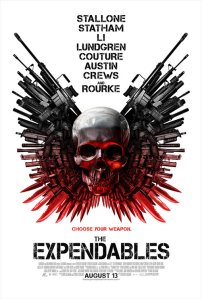 Casting can make or break a movie, and occasionally the cast is the only advertised reason why the public should give a damn about a movie. Ocean’s Eleven wasn’t sold on its craft plot or cool director, it was the George Clooney, Brad Pitt, Matt Damon, Julia Roberts movie. Sylvester Stallone is an actor who?s had some lengthy dry spells but he redeemed his legacy a bit with the modestly affecting Rocky Balboa and his ultra-violent modern Rambo. Now he has set his sights on co-writing and directing The Expendables, a film that gathers as many action movie stars together as possible and dares you not to buy a ticket. There?s Stallone, Jason Statham (Transporter), Jet Li (Unleashed), Dolph Lundgren (Masters of the Universe), Mickey Rourke (The Wrestler), Terry Crews (Gamer), Eric Roberts (The Dark Knight), along with wrestler Steve Austin, mixed martial arts champ Randy Couture, and direct-to-video kickboxing ace Gary Daniels. It?s a smorgasbord of testosterone, a group of guys whose median age qualifies them for an AARP membership. The selling point of The Expendables is the cast and the cast alone. The story about some military general (Dexter”s David Zayas) is completely incidental. These men are here to inflict punishment.
The Expendables is ridiculous with a capital R. Whether it’s punching guys in the face while they’re on fire, breaking necks through kickboxing, or, my favorite, hurling an ammunition shell like a shot-put and shooting it in the air, The Expendables exists in that 1980s world of brute and mostly brainless action. It’s a throwback to those halcyon days for the majority of the cast members, back when men were men, women were damsels or temptresses, and action heroes didn’t have to have more than one dimension, and usually that dimension was muscle. The Expendables is enjoyable but much of that enjoyment is because it’s simply enjoyably bad. I have to assume that Stallone had his tongue firmly in cheek when he was designing and executing this film. How else to explain the bizarre moments of action overkill described above, the premise of saving a single girl from a small Latin American military, the fact that the sleazy CIA villain takes off with the damsel, for no personal gain whatsoever, and even gets to deliver the all-important, “You and I are alike” speech villains are always fond of giving.
I was laughing throughout the movie from its excesses and logistical and narrative shortcomings. This is the kind of movie where characters make veiled comments about a family but then we never see the family. This is the kind of movie where the good guys have perfect aim and it never matters how many bad guys there are because they never know how to wield a firearm. This is the kind of movie where Statham’s ex-girlfriend (Charisma Carpenter) gets beat up by her new dude, so Statham goes to confront the guy at a basketball court with all his friends. But the weird part is that the guy’s posse of friends shows no regret that their dude struck a woman. They all rally behind the domestic abuser, and Statham promptly hands them their asses. Just look at the character names: Ying Yang, Lee Christmas, Gunner Jensen, Tool, Barney Ross, James Munroe (no relation to the fifth president), Toll Road, Hale Caesar. Those aren’t cagey nick-names, those are the characters honest-to-God real names. You can?t help watching The Expendables without the impression that the whole movie is one big joke. However, I cannot rationalize that Stallone spent time and money to make a satire of the burly action genre.
 Throughout The Expendables you quickly realize why these guys are men of action and not men of debate. Their speaking voices are terrible. Some are marble-mouthed mumblers, like Stallone and Rourke. Some are just hard to understand, like Lundgren. Some have pretty bad English, like Li. Some are weirdly whisper-quiet in their intensity, like Statham. And others are just plainly bad actors, like Austin and Couture. The characters they?re given to play are pretty thin, defined by a quirk or two but not much else. Statham’s character is away from his girl too often, that’s why she becomes an ex. The film is basically a contest of machismo. Everyone tries to out-do the competition in glaring and teeth grinding. Also, given the title, (semi-spoiler) is it a little much to think that Stallone’s entire wrecking crew can escape death, even the guy that gets shot inches above his heart? These are men you want to see doing things, preferably painful plural things, and speaking at a minimum. Only Crews seems capable of doing both acting and action. Too bad he gets short supply when it comes to screen time.
And that’s certainly another problem when the selling point of the movie is an all-star collection of action movie badasses — screen time. Everybody has to be juggled around and fight for screen time. As you’d assume, Stallone and Statham rise into the upper character branch while everybody else must be content for a series of moments and one-liners. Part of the fun of seeing this group of actors together is seeing this group of actors together, which is in relatively short supply save for an all-out assault climax. There’s a scene with some great cameos, ruined through TV advertising, where Bruce Willis and Arnold Schwarzenegger appear on screen and playfully jab at one another. For some, it will be a movie moment decades in the making. My response: “Oh my God! The founders of Planet Hollywood are finally together again (minus Demi Moore).”
On the subject of action, the film presents plenty of bloody, macho men-on-a-mission mayhem, but Stallone edits the sequences too quickly. It becomes a rush of images that the brain barely has time to process before moving on to another location and fight. There are a handful of gory money shots to the R-rated spectacle, but I just wish I was able to understand what was happening. I know Stallone was not trying to emulate the hyper-kinetic verite editing style of the Bourne movies, which have influenced much of action cinema for the last five years. Perhaps given the realities of shooting fight sequences around aging superstars, Stallone was forced to rely on quick edits to mask the illusion that these geriatric men are still capable of intense beat downs. The editing is occasionally disorienting but even worse it?s distracting. It’s harder to enjoy the action. Nor are the action sequences really well thought-out or specific to their location. It’s mostly the guys with guns chase other guys with guns variety. There are some impressive knife fights and brawls, but the concluding 30-minutes consists mostly of action chaos. Men with guns run, get shot, people hurl grenades (why does a martial arts guru like Li forced to use guns most of the time?), explosions occur, rather, rinse, repeat. From a fighting standpoint, there are six good guys and three bad guys, though t?s hard to take Roberts seriously. That’s not a good ratio for battles. There needs to be more colorful henchmen.
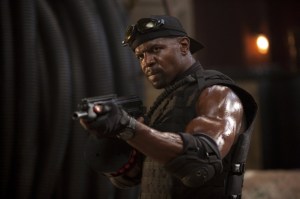 My friend Eric Muller and I came to an intriguing ending that would have made The Expendables legendary. After the film’s mission is complete, the gang collects back at Rourke’s tattoo parlor/clubhouse. Instead of palling around and talking shop, the gang all of a sudden starts having a giant orgy, and then Stallone looks directly into the camera and says, “It was always leading up to this. You just never wanted to admit it, audience!” The movie is awash in testosterone and nostalgia, naturally gathering an older male audience. Would it not be hilarious to instantaneously make all those men uncomfortable? They love their masculine superheroes when it comes to death but love is too out of bounds. It would be the greatest piece of performance art ever and certainly gives people something to think about (now that you mention it, those character names sound like porn names anyway).
The Expendables is pretty clear in its intentions. It wants to be a gritty, bloody, hard-edged action movie throwback to the 1980s when the world was simpler and all you needed was one man with a gun running through the jungle to solve political disputes. The film’s entire selling point is its cast of action stalwarts from past and present, though many are beefcake past their prime (Statham is only 37, though). The movie works as a casting gimmick but it doesn’t work as a movie. I’d be lying if I said The Expendables wasn’t entertaining and with its moments of silly, mindless fun, but clearly this could have been a much sharper action movie. At times it feels like a winking satire of the genre that helped make these men stars, but perhaps that’s just me projecting onto the film. Perhaps I’m trying to make it more self-aware to excuse its various shortcomings. This is a fairly mediocre action product despite the all-star reunion. Given the film’s relatively warm reception by its core audience, I await future installments of the Equally Expendables to feature Kurt Russell, Wesley Snipes, Rutger Hauer, Patrick Swayze (composed of archival footage), Steven Seagal, Hulk Hogan, Mr. T, and, naturally, the biggest badass of them all Chuck Norris. As long as Norris roundhouse kicks a live ammunition shell, consider my ticket bought and my sense of dignity put on review.
Nate’s Grade: C+
Share this:

Iron Man 2 (2010)
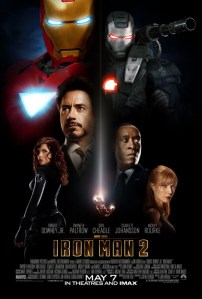 Iron Man was a fresh surprise in the summer of 2008, offering a superhero movie dominated by a middle-aged man’s personality and not the special effects. The story was not overwhelmed by all the demands of what we expect in a glorious summer popcorn experience. Marvel was smart to sign on the same team behind the first film, including director Jon Favreau, but setting a deadline exactly two years after the first film made me worry. There wasn’t much time to get everything together, and it should be no shock that Iron Man 2 feels rushes and absent the finesse of the first film. As much as it pains me to say it, Iron Man 2, while fun in spots, doesn’t come close to the original. You can trace much of it back to the sequel ethos that you take what worked in Part 1, make it much, much bigger and louder, and now you have Part Two. But what worked so exceptionally well in the first Iron Man movie was not the action sequences but the characters, so guess what happens when you pollute the narrative with more characters and disposable action sequences?
Tony Stark (Robert Downey Jr.) is a self-made superhero and now the world knows that he is indeed the metallic warrior, Iron Man. Stark refuses to hand over his technology to the government, saying he has “successfully privatized world peace.” He appoints his girlfriend/loyal assistant Pepper Potts (Gwyneth Paltrow) to CEO so he can devote his time to ridding the world of evil and lapping up the fame that goes with being Iron Man. Lt. Col. James Rhodes (Don Cheadle replacing Terrence Howard) is concerned for his buddy but also eager to help play around with that super suit. But not everybody loves Tony Stark, notably Justin Hammer (Sam Rockwell), a rival weapons dealer aiming for a Pentagon contract, and Ivan Vanko (Mickey Rourke), a Russian scientist who blames his father’s exile from America and Siberian internment on the Stark family. When Hammer sees Vanko’s attack at a Monaco speedway, he knows he has found an ally against Stark. Hammer whisks his newest Russian friend to New York and enlists his expertise in creating an army of super mechanical fighting suits.
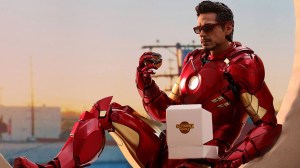 The screenplay by actor-turned-writer Justin Theroux (Tropic Thunder) is overstuffed with people and events all fighting for screen time and narrative dominance that it starts to become unintentionally comical after a while. There are too many storylines jostling for control when any one of them could have comprised a whole movie: military demands to have the suit, Tony deals with blowback from being the most famous man in the universe, and escalation (others trying to top Stark). Don’t even get me started on how Iron Man 2 bends over backwards to advertise that future Marvel Avengers movie lead by Nick Fury (Samuel L. Jackson). I mistakenly believed that the trailers ended before my movie started. There’s a storyline where Tony’s blood is becoming infected with a dangerous chemical every time he uses the Iron Man suit, so being a superhero is literally killing him. You can work with that for some pathos, debating the needs of one man vs. the needs of society and the greater good, personal sacrifice, mortality, legacy, but it all gets way too easily resolved in an absurd way (all I’ll say is, thanks Mad Men‘s Roger Sterling!). It tries to up the ante when less would have been considerably more.
Most of the new characters feel poorly integrated, further causing distraction to any attempts at narrative cohesion. Iron Man 2 also pushes Johansson into the mix so that she can shake up the Tony/Pepper relationship and, plus, she looks good in a skintight cat suit. But her third wheel/love triangle status is barely touched upon and Johansson gets one solid action sequence where she takes out a litany of goons in a hallway with the amazing power of her spinning thighs. Johansson is mostly just another assistant to take notes in the background, although she does it beautifully. The Rourke scenes are few and far between. They establish him as an intimidating force and then he pretty much sits in a room tinkering with stuff, garbling Russian, and feeding his cockatiel for the rest of the movie. He never feels like a real threat or a true match for Tony. Rockwell is the more appealing, slimy villain of the duo, aided by Rockwell’s exasperated bellowing and desperation for the spotlight. Hammer is more interesting to me than a Russian ex-con that rarely speaks, let alone speaks in English. He’s given so little opportunity to develop Vanko as a character. And yet Gary Shandling, as a smug senator trying to make Stark accountable to the U.S. military, might be the film’s best villain of the bunch (curious side note: Shandling and Rourke look oddly similar).
 The personal relationship between Tony Stark and Pepper Potts was the heart of Iron Man. They had that snappy, droll, screwball comedy-esque give-and-take, with hints of something more underneath. This time, the movie doesn’t even speak about their relationship at all, like it never happened in the first film. That scene where she kisses his Iron Man helmet, tosses it out the belly of a plane, and he dives off uttering, “You complete me”? Not in the film. You start to wonder why the movie is being purposely vague and it gets maddening. Their relationship lacks the frustration tinged with flirtation and replaces it with agitation. Both Tony and Pepper are harried and on each other’s last nerve, which doesn’t make for much romantic traction. Their chemistry seems to have dampened. I’m kind of with Pepper on this one because Tony Stark might be even too obnoxious in this movie. Following the sequel-it is code, Tony’s egotistical behavior is expanded and he becomes prone to self-destructive behavior, getting riskier and riskier, pushing others away including, perhaps, decent portions of the audience. He’s stopped being the cocky, likeable arrogant playboy and transformed into a bit of a rich douchebag. Part of this is related to the storyline about the suit literally killing Tony, and his character’s alcoholism featured heavily in the comic books, but it’s just another plot element that feels like it was put in for momentary conflict and then easily resolved or dropped. I understand Tony will be his biggest antagonist but that didn’t stop the first Iron Man film from flying high in entertainment.
The first Iron Man had an unexpected low level of action for a summer movie, but because of the characters you didn’t care. It was that rare comic book movie where you wanted more dialogue and fewer sound effects. To be fair, Favreau and crew saved a pretty nice Iron Mano y Iron Mano fight sequence at the end. Following that narrative lead, Iron Man 2 is structured pretty much like the first when it comes to action. There’s the attack at the Monaco raceway, which features an unrealistic, cartoonish tone that conflicts with the rest of the flick. But the film’s biggest moment of sustained action is the climax involves Tony Stark versus a bunch of silly killer robots. Soulless robot drones don’t get very compelling, plus haven’t we seen a thousand movies where people combat killer robots? What’s more disappointing is that Favreau incoherently stages the action. It’s not due to any sort of hyperactive editing, no, the culprit is that the onscreen action is just moving way too quickly. As a result, much of the action feels like whooshes of color. It’s hard to adjust your eyes to the rapid movement and process what exactly is going on. Because we can’t follow the action the whole thing lacks tension, danger, and drama. I wanted to be blown away by the action, which has several trailer-ready moments of awesome, but mostly I just wanted to be able to understand what I was watching.
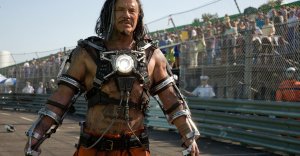 Despite all my complaints, Iron Man 2 still manages to be a fun time out at the movies. Downey is always immensely talented and brings great amounts of energy to the role, centering the movie on his witty charms. While his character is less engaging this go-round, Downey is still on top of his game. Rourke, Rockwell, Paltrow, and Johansson all contribute fine performances when they’re on screen. The low output of Iron Man in suit is compensated by having TWO Iron Men, thanks to Rhodes donning the metal gear and fighting alongside his pal. The opening of this movie captures your interest fairly well, though it loses it again thanks to slack pacing and an influx of new faces. The tone of the movie takes a cue from Downey and the movie as an agreeable, comedic feel without seeming overly glib. And hey, the special effects are pretty nice, too. Iron Man 2 is an adequate popcorn movie but the tragedy of the movie is that the first film was much more than adequate. I think the Iron Man film franchise is in need of a slight upgrade.
Nate’s Grade: C+
Share this:

The Wrestler (2008)
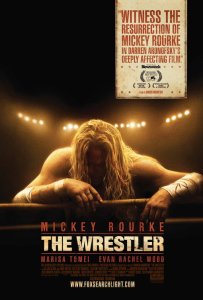 The Wrestler came out of nowhere to be hailed as one of the most stirring dramas of the year. Who would have possibly guessed that a movie that stars Mickey Rourke in spandex would be one of the best films of 2008?
Randy “The Ram” (Rourke) was one of the biggest professional wrestlers in the 1980s. His pay-per-view battle with “The Ayatollah” in 1988 is legendary to wrestling aficionados. But nobody ever stays on top forever. Twenty years later, Randy is a self-described “old broken down piece of meat.” He’s barely staying afloat working at a supermarket during the day. On weekends he adorns his old tights and fights in wrestling bouts at VFW halls, where small numbers still flock to see the scripted carnage. Randy is fighting against the ravages of time and is determined to stick it out with the profession that has both made him a super star and also left him broken and lonely. He can relate to Cassidy (Marisa Tomei), a 40-something stripper that gets disrespected by customers because of her age. Randy seeks out his teenage daughter (Evan Rachel Wood) to attempt to be a father for the first time in the girl’s life. Then a wrestling promoter wants to stage a twentieth anniversary rematch between Randy and “The Ayatollah” (who runs a successful used car business in Arizona now). The opportunity means Randy has one more shot in the limelight before his health sidelines him for good.
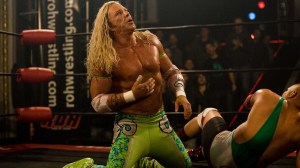 There isn’t a note in The Wrestler that feels misplaced or a moment of drama that feels false or contrived. The scenes of emotional revelation feel genuine and aren’t delivered with deliberate emphasis, like Randy’s moving speech where he tells his neglected daughter how rotten of a father he was, which he accepts bitterly, but he pleads to fashion enough understanding just for his little girl not to hate him. The Wrestler skews against convention and ends on its own terms, following the fated trajectory of its tragic hero. This isn’t a generic or sentimental tale of uplift and redemption. Randy is eager to make amends for a lifetime of bad decisions but he is also keenly aware that he has little to offer and that the outside world has little place for him. The Wrestler is a tender tale about a man trying to find his place in a world no longer familiar to him. Randy tells Cassidy at one point that the only place he ever truly feels pain is outside of the ring.
The film skillfully explores what is fake and what is real in the wrestling world. The matches may be predetermined but the injuries are very real. These muscled warriors are essentially pro stuntmen with some charisma and their bodies are their offering to the screaming masses. They give everything they have for the crowds but what do they get in return once the applause dies down? After witnessing the bloody aftermath of an especially brutal match, which included Randy being lacerated with barb wire and having a staple gun decorate his back, it’s easy to wonder why any sane person would subject themselves to this kind of punishment and for so long. Cassidy is in another profession that tends to grind up and spit out its star attractions. She reaches out to Randy not out of romance (a lesser film would have demanded she fall in love with the big lug) but out of a desire for human companionship, for something real. These two characters are both at a crossroads and must come to grips with the cold realization that the world has passed them by.
 The script by Robert Siegel came alive for me in the details. I love discovering that Randy endures shame that his real name is the more effeminate-sounding Robin. I love that the film shows a scene where a batch of old wrestlers sit next to folding tables and hawk tapes of their greatest matches that no one wants to relive but the old timers. I loved that Randy’s long walk through the bowels of the supermarket to greet his “fans” at the deli counter mirrors his entrances to wrestling bouts.
Astonishingly, Darren Aronofsky directed this movie. The film departs sharply from Aronofsky’s highly artistic yet stylistically mannered previous films, like Requiem for a Dream and The Fountain. He strips away the style pyrotechnics and follows a no-frills docu-drama approach. This dynamic helps accentuate the raw and harsh reality of the film. It’s the most relaxed direction the man has ever done. He’s able to churn the myriad of emotions and broken dreams into a powerful character study that never feels manipulative. The Wrestler feels remarkably intimate and emotionally bruising.
The Wrestler is built to be a one-man show and it’s a terrific show. Rourke’s performance is invigorating and the former Hollywood bad boy channels his own personal history of regret and missed opportunities. The line between character and individual is noticeably blurred. Rourke’s busted and mangled face tells a long history for Randy. The physical shellacking that the 52-year-old Rourke takes is brutal, and you realize that he throws his body into the performance with wild abandon for a man his age. I cannot imagine this film working or having nearly the poignancy with Nicolas Cage in the lead role, which is what was originally planned (Cage might have had a more bizarre haircut). Rourke is the role. It is a perfect marriage of actor and character. The character of Randy is the latest in the long film tradition of the noble loser that must fight to reclaim his victory, which makes for a deeply empathetic experience. Randy is a gentle giant, courteous even to the people that insult him and his glory days. You will feel the man’s every high and low. When he’s working at the deli counter and begins to have fun, joking around with customers, you’ll feel his sense of revelry too. When he’s lonely and invites a neighbor kid over to play an old 8-bit Nintendo video game featuring Randy, you’ll feel the same ache of sadness to connect. When Randy screws up, you’ll feel the same angry disappointment. When Randy is out shopping for wrestling props and playfully involves others in “testing” them, you’ll feel the man’s amusement and sense of peace. Other actors might have given in to the setting and played Randy as a caricature, but Rourke plays with subtlety when he could have gone big. He’s reflective and somber and has a well of repressed anger buried deep within. It’s a performance for the ages and cements Rourke’s cinematic comeback.
 The Wrestler is a rich and engrossing character study that aches and wheezes with the pain of real life. Randy is a man that’s lived a hard life, by design, but at his core he is a kind and decent man. The film takes after its star and proves to be quiet, unassuming, brutally honest, and deeply affecting. Rourke bares his own tortured soul by playing Randy, and his performance is unquestionably one of the best of the year. This is a surprising, heartfelt, and equally heartbreaking movie that finds many truths through the self-dawning of its title hero. It’s not the wrestling matches that I’ll remember most, no sir. I will remember the small interludes, like Randy dancing with his daughter, the beer he shares with Cassidy as they lament the 1990s, the love and brotherhood backstage between with the wrestling opponents, Randy delighting the kids in his trailer park by pretending to fight them. Randy may not find solace or stability outside the ring but the people around him prove that Randy was bigger than “The Ram.”
Nate’s Grade: A
Share this:

Sin City (2005)
 Like film noir on steroids. Director Robert Rodriguez has made the most faithful comics adaptation ever; giving life to Frank Miller’s striking black and white art. The visuals are sumptuous but the storytelling is just as involving, a perfect mix of noir/detective elements and subversive, highly memorable characters. Sin City may be the most violent studio film … ever, but the over-the-top tone keeps the proceedings from becoming too nauseating, even after limbs are lost, heads roll (and talk), and dogs pick away at living bodies. This is a very ball-unfriendly movie; lots of castrations. The blood even looks like fluorescent bird crap. The stories become somewhat repetitious (anti-hero saves distressed woman), but Miller and Rodriguez keep their tales tight, pulpy, comic, and unpredictable. My friend turned to me after it was done and said, “That was a great movie.” I could not argue.
Nate’s Grade: B+
Share this:

Man on Fire (2004)
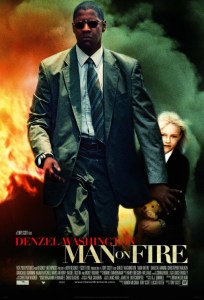 By far, the most entertaining moment of Man on Fire occurs shortly after the movie ends. A message comes on screen more or less saying, Mexico City is a very special place and we thank them. Now, after having watched a lengthy 2 hour and 25 minute film that shows Mexico City as a chaotic equal to the Middle East, a city that experiences four kidnappings a day we are told, these ending sentiments feel like a mea culpa. To say a place is great after showing it to be a corrupt war-zone is hilarious. I doubt Mexico City will be using Man on Fire to lure tourism, just like I doubt Germany uses Hogan’s Heroes for its tourism.
The man on fire is Creasy (Denzel Washington), a former soldier with a drinking problem. Hes hired dirt cheap to be the bodyguard for Pita (Dakota Fanning), the daughter of a wealthy Mexican politician (Marc Anthony). Creasy is pragmatic about his job and shirks Pitas attempts at friendship. Eventually, the precocious tyke gets the better of him and Creasy forgoes his self-loathing for coaching Pita on how to swim better. Creasy has found his recovery in the form of Pita’s love, but his world is ripped apart when Pita is kidnapped and Creasy is left for dead. When he recovers, he vows merciless vengeance on anyone involved in Pita’s kidnapping.
 Denzel Washington is competent in his role, but there aren’t many films that wouldn’t be better by having a Denzel Washington performance in it. Fanning has a robotic nature to her delivery. The wacky Christopher Walken is in this movie somewhere, but you would be hard-pressed to find him in the last hour or so. It’s kind of nutty that Walken of all people plays the voice of reason in a revenge movie.
Director Tony Scott (Crimson Tide, Top Gun) has flat-out forgotten or lost interest in telling stories. His direction of Man on Fire is erratic and heavy on stop-the-action-dead visual flourishes. Scott is a slave to visuals, but so many of them are jarringly miscalculated that the audience can never fully immerse themselves in the film. It’s like a kid fiddling with a new camcorder and wanting to try all the super cool special features (Whoa, I can make things slower … now grittier stock … now sepia … now I can make a mirror of things … etc.).
It takes over an hour to get to the key kidnapping plot point. Until then the audience is relegated to watching scenes of Creasy find redemption through the eyes of a child. Denzel and Fanning have a nice mentor camaraderie, but after an hour the audience is impatiently waiting for the inevitable kidnapping that the movies foreshadowing has been tripping all over.
 When Man on Fire does hit the kidnapping, the ensuing movie gets very messy, and boy does it get ugly. Creasy goes on a grisly killing spree that turns him from a sympathetic loner into a one-man wrecking crew. Vengeance is an easy emotion for an audience to get behind a character, but Man on Fire goes way beyond audience empathy. Are we to cheer when Creasy goes about ruthlessly killing unarmed people and threatening families, pregnant women, and kids? I didn’t cheer. I was somewhat appalled that the filmmakers expected us to revel in this violence as if it was more than justified. It’s just ugly, plain and simple. It is also sickeningly sadistic.
The most bizarre thing about Man on Fire is the subtitles. When I think back on this film in the future, that is the one thing that will stand out for me. These arent your ordinary stay-at-the-bottom-and-do-as-you’re-told subtitles. Oh no. These subtitles dance, jump around, float, fade, expand and shrink in size, and do about everything but make balloon animals (or, I should say, subtitle animals). It’s like a living comic book; however, this is yet another visual trick that draws the audience out of the film. The unusual subtitles call too much attention to themselves, especially when they just pop up for a single word, spoken in English, as if to clue in the audience that this point of information will be vital somehow.
Man on Fire is a sadistic action film that is too full of itself for amusement. By the time that mea culpa comes onscreen its almost a relief to laugh again. The hard-driving ugliness of Man on Fire might make you forget how to. Fans of revenge films may find some redeemable qualities, but Man on Fire is one gruesome 145 minutes to squirm through.
Nate’s Grade: C-
Share this:

Once Upon a Time in Mexico (2003)
 Robert Rodriguez (From Dusk Till Dawn, The Faculty) wrote, directed, produced, photographed, edited, and scored Once Upon a Time in Mexico. I’m sure if you look further this jack-of-all-trades also provided coffee and donuts. Coming off his third Spy Kids feature, Rodriguez seems like the hardest working man in showbiz. Mexico, a sequel to 1995’s Desperado, is one tasty burrito of stylish action, vigorous energy and the immensely appealing Johnny Depp.
Depp stars as Sands, an amoral CIA agent who calls Mexico his beat. Through the help of a one-eyed flunky (Cheech Marin), he recruits a mysterious gunman, El Mariachi (Antonio Banderas), to thwart a coup being lead by Marquez, a military general, and paid for by a drug cartel run by Barillo (Willem Dafoe, a.k.a. the Creepiest Man Alive). Then theres also a retired FBI Agent (Ruben Blades) looking to settle a personal score with Barillo, a Federale (Eva Mendes) looking for some action, a nasty hired gun (Danny Trejo) itching to off a certain Mariachi, Mickey Rourke with a Chihuahua, Enrique Iglesias with a mole, and also the fact that Marquez, who Banderas has been assigned to kill, murdered Banderas wife (Salma Hayek) and daughter. Ill stop so you can catch your breath. Ready? Okay.
 You better think ahead and bring a second pair of pants because Depp will charm them right off as he plays yet another oddball. We are delighted with Sands and his multitude of fake mustaches, tacky T-shirts (one actually says CIA) and method of paying people through cash-filled nostalgic lunch boxes. Despite plotting near a Machiavellian level and shooting innocent chefs, the character settles into a lovable anti-hero that transforms into a blind reaper of vengeance. Depp is one of the best, if not the best, actors on the planet. Once again as he did in Pirates of the Caribbean, Depp gives life to a character and nourishes the film every time hes onscreen. This is Depp’s show. Mexico does have a noticeable lull whenever Depp is absent. I don’t know anyone else that could actually become cooler AFTER what he goes through. Possession is nine-tenths of the law, and Depp totally owns this movie and the 2003 year.
Banderas is smooth and has never looked better than playing the role of the silent-but-deadly musician. Hayeks role amounts to little more than a cameo. Shes witnessed through flashbacks, but she still has a healthy smolder to her. Blades has the most integrity of all the characters. Most of the actors have fun with their roles, especially the ones that are bad (which accounts for most everyone), but you can’t help but get the feeling that theyre being wasted for the most part.
Rodriguez’s overstuffed film is so delightfully over-the top and loopy that it crackles with an infectious kind of energy. Once Upon a Time in Mexico is a wild and lively cartoon of an action movie with a very healthy sense of humor. Its action relies low on CGI and high on inventive, if slightly self-aware, camera angles and furious gun fights. A sequence involving Banderas and Hayek chained to the wrist and swinging one-by-one down the levels of a building is breathtaking.
 What this spaghetti western below the border could have used is a little less of its myriad of twists, double-crosses, triple-crosses, and character subplots. By the time the Day of the Dead rolls on, you might need note cards to keep everything straight. Rodriguez’s earlier Mariachi films were lean on plots which allowed for fun and grandiose action sequences. Perhaps Mexico could have shaved some of these needless characters (cough, Eva Mendes, cough) from its convoluted plot and drawn out its sometimes too quick bursts of stellar action.
Once Upon a Time in Mexico is a bloody good time. Depp amazes yet again in this bombastically silly yet undeniably fun south o the border shoot-em-up. If Rodriguez has any plans for an additional sequel (and he might given his insane work ethic) I’d recommend following Depp’s Sands character wherever the sands take him. To witness this incredibly cool, whip-smart character cut up in any land would certainly be music to my ears.
Nate’s Grade: B


 nathanzoebl
You must be logged in to post a comment.