Blog Archives
Shutter Island (2010)
 This was a pulpy B-movie put together with A-movie artistry. In a year that had some artistically polished genre movies, Shutter Island was Martin Scorsese’s return to genre filmmaking and he brought with him an entire team of experts and professionals. The movie is playful and intriguing, engaging the mind enough for a crime thriller that appears to be a straight-forward mystery but then shows flashes of being about something more, something darker. And when you’re dealing with a movie with Holocaust flashbacks, dead kids, Nazi doctors, mental asylums, well you know you’re not going to be reaching subtlety even with a stick. But the way Scorsese orchestrates all these foreboding elements, tying together various plotlines, and working at different levels to satisfy the informed and uninformed, right before delivering a dynamite twist that calls for further investigation and rewatching, well it’s nothing short of masterful. Shutter Island may not be anything more than a souped-up B-movie, but with this level of artistry, it’s also one of the most entertaining films of the year.
Nate’s Grade: A-
Share this:

Synecdoche, New York (2008)
 Nothing comes easy when dealing with acclaimed screenwriter Charlie Kaufman. The most exciting scribe in Hollywood does not tend to water down his stories. Kaufman’s latest head-trip, Synecdoche, New York, is a polarizing work that follows a nontraditional narrative and works on a secondary existential level. That’s enough for several critics to hurtle words like “incomprehensible” and “confusing” as weapons intended to marginalize Synecdoche, New York as self-indulgent prattle. I guess no one wants to go to the movies and think any more. Thinking causes headaches, after all.
Caden (Phillip Seymour Hoffman) is a struggling 40-year-old theater director trying to find meaning in his beleaguered life. His wife (Catherine Keener) has run off to Germany with his little daughter, Olive. He also manages to botch a potential romance with Hazel (Samantha Morton), a woman who works in the theater box-office who has an unusual crush on Caden. He’s also plagued by numerous mysterious health ailments that only seem to multiply. While his life seems to be in the pits, Caden is offered a theater grant of limitless money. He has big ambitions: he will restage every moment of his whole life to try and discover the hard truths about life and death. Caden must then cast actors to portray the various people in his life. Sammy (Tom Noonan) argues that no other actor could get closer to the truth of Caden; Sammy has been following and studying Caden for over 20 years (don’t bother asking why in a movie like this). Caden also casts his new wife, Claire (Michelle Williams), as herself. The theater production gets more and more complex, eventually requiring the “Caden” character to hire his own Caden actor. Caden hires Hazel to be his assistant and Sammy falls in love with her. Caden admonishes his actor, “That Hazel isn’t for you.” Caden then tries sleeping with “Hazel” (Emily Watson) to get even with the real Hazel. By producing a theatrical mechanism that almost seems self-sustaining, Caden wants to leave his mark on the world and potentially live forever.
 I heard plenty of blather about how mind-numbing Synecdoche, New York was and how Kaufman had really done it this time when he composed a script that involves characters playing characters playing characters. People told me that it was all too much to keep track of and that it made their brains hurt. The movie is complex, yes, and demands a viewer to be actively engaged, but the movie is far from confusing and any person or critic that just throws up their hands and says, “Nope, too much to think about,” is doing their brain a disservice. The movie is relatively easy to follow in a simple linear cause-effect manner; Kaufman only really goes as deep as two iterations from reality, meaning that Caden has his initial doppelganger and then eventually that doppelganger must get his own Caden doppelganger (it’s not nearly as confusing as it sounds if you see it). Now, where the movie might be tricky to understand is how deeply contemplative and metaphorical it can manage to be, especially at its somber close. That doesn’t mean that Synecdoche, New York is impossible to understand only that it requires some extra effort to appreciate. But this movie pays off in huge ways on repeat viewings, adding texture to Kaufman’s intricately plotted big picture, unfolding into a richer statement about the nature of life and death and love.
Theater has often been an easy metaphor for life. William Shakespeare said, “All the world’s a stage, and all the men and women merely players; they have their exits and their entrances; and one man in his time plays many parts.” Kaufman movies always dwell substantially with the nature of identity, and Synecdoche, New York views identity through the artifice of theater. Caden searches for something brutal and true via the stage, but of course eventually his search for truth becomes compromised with personal interests. Characters in Caden’s life are altered and in the end when Caden steps down, as himself, reality starts getting revised. The truth is often blurred through the process of interpretation. Caden ends up swapping identities with a bit player in the story of his life, potentially finding a greater sense of personal comfort as someone else. Don’t we all play characters in our lives? Don’t we all assume different identities for different purposes? Do we act differently at a job than at home, at church than at a bar? Caden remarks that there are no extras in life and that everyone is a lead in his or her own story.
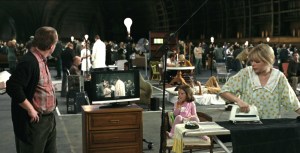 Kaufman’s movie is also funny, like really darkly funny and borderline absurdist to the point of being some strange lost work by Franz Kafka (Hazel even mentions she’s reading Kafka’s The Trial). You may be so caught up trying to render the complexities of the story to catch all of the humor. The movie exists in a surreal landscape, where the characters treat the fantastic practically as mundane. Hazel’s house is constantly on fire and yet none of the characters regard this as dangerous or out of the ordinary. It is just another factor of life. The entire subplot with Hope Davis as a hilariously incompetent therapist is deeply weird. Caden suffers some especially cruel Job-like exploits, particularly what befalls his estranged daughter, Olive. He’s obsessed with her hidden whereabouts and European upbringing, to the point that Caden cannot even remember the name of his other daughter he has with Claire. There is a deathbed scene between the two that is equally sad and twisted given the astounding behavior that Caden is forced to apologize for. There are running gags that eventually transform into metaphors, like Caden’s many different medical ailments and the unhelpful bureaucratic doctors who know nothing and refuse to divulge any info. Kaufman even has Emily Watson, an actress mistaken for Morton, play the character of “Hazel.”
This is Kaufman’s debut as a director and I think the movie ultimately benefits by giving its writer more control over the finished product. The movie is such a singular work of creativity that it helps by not having another director; there is no other artistic vision but Kaufman’s. While the film can feel slightly hermetic at times visually, Kaufman and cinematographer Frederick Elmes (The Ice Storm) pack the film with detail. Stylistically, the film is mannered but this is to make maximum impact for the vast amount of visual metaphors. Synecdoche, New York never feels as mannered as the recent Wes Anderson films, henpecked by a style that serves decoration rather than storytelling. The production design for the world-within-a-world is also alluring and imaginative, like a living, breathing dollhouse.
 The assorted actors do well with their quirky, flawed characters, but clearly Hoffman is the linchpin to the film. He plays a character from middle age to old age, and at every step Hoffman manages to infuse some level of empathy for a man routinely disappointed by his own life. The failed yet lingering and hopeful romance between Caden and Hazel provides an almost sweet undercurrent for a character obsessed with death. Hoffman is convincing at every moment, even as a hobbled 80-year-old man, and gives a performance steeped in sadness but with the occasional glimmer of hope, whether it be the ambition of his theater project or the dream of holding Hazel once more. Morton is also wonderfully kindhearted and endearing as the woman that just seems to keep slipping away from Caden.
There’s no other way to say it but Synecdoche, New York is a movie that you need to see multiple times to appreciate. The plot is so grandiose in scope and ambition that one sitting does not do it justice. Kaufman has forged a strikingly peculiar movie that manages to be surreal and bleakly comic while also being poignant and humane. This is a big movie with big statements that can be easily missed, but for those willing to dig into the wealth of metaphor and reflection, Synecdoche, New York is a rewarding film experience that sticks with you. By the end of this movie, Kaufman has earned the merging of metaphor and narrative. I have already seen the movie twice and still cannot get it out of my thoughts. This isn’t the kind of movie that you feel warm affection for, like Kaufman’s blissfully profound Eternal Sunshine of the Spotless Mind. This movie is less a confounding puzzle than an intellectually stimulating examination on art, the human experience, and, ultimately death. If people would rather kill brain cells watching whatever dreck Hollywood secretes every week (cough, Street Fighter: The Legend of Chun-Li, cough) then that’s their prerogative. Give me a Charlie Kaufman movie and a bottle of aspirin any day.
Nate’s Grade: A
Share this:

Deception (2008)
 Is there a more tired and pathetic genre of filmmaking than that of the erotic thriller? Deception is just about as lazy and bland as its title. The casting director got every role wrong. Ewan McGregor is an accounting nerd that befriends a swanky playboy (Hugh Jackman) and they accidentally switch phones. Of course this leads to people mistaking an accounting nerd for a swanky playboy, and McGregor is introduced to an underground web of anonymous sex (hasn’t anyone heard about Craig’s list?). I suppose the rich would rather take a chance on a stranger than have their handlers recruit some tail. Michelle Williams is completely wrong as the femme fatale who OF COURSE is in on the scheme. Deception plays out exactly as you could predict, and it even bears a somewhat strong resemblance to 2005’s Derailed, another mediocre thriller of little thrills. The chilly cinematography by Dante Spinotti is way too good for this kind of film. It seems that erotic thrillers have graduated from soft focus close-ups of copulating couples set to saxophone music to soft focus close-ups of copulating couples set to electronica beats. I suppose that’s progress for a genre defined by ridiculous plots, unrealistic characters acting like idiots, and, oh yeah, boobs.
Nate’s Grade: C
Share this:

Brokeback Mountain (2005)
 Go ahead and work the snickers out of your system. Brokeback Mountain has been dubbed “that gay cowboy movie,” and been condemned by certain fundamentalist Christian organizations as “a very dangerous and insidious message to America.” But what message is Ang Lee’s film even putting out there? It seems to me that Brokeback Mountain is putting a human face on a slur, making homosexuals look like you or me. For some that prospect may be terrifying. The movie is playing well on the blue-state coasts, expectedly, but it’s also surprisingly playing well in America’s heartland. It seems that people are lining up all over to see a movie about two gay cowboys in love. And perhaps the more people that witness Brokeback Mountain, the harder it will be to listen to those so-called family advocacy groups with their sterling Christian morals. Maybe people will really see what’s behind many of the words of outcry – hate and ignorance (I am in no way insinuating that disliking the flick means you are homophobic). Despite all this political talk, Brokeback Mountain is by no means a political movie. It’s a love story, above all, and it’s a doozy.
In the summer of 1963, Ennis Del Mar (Heath Ledger) is a quiet man looking for work in rustic Wyoming. He finds a job as a sheep herder working atop the canyons and mountains of Brokeback. Working alongside Ennis is Jack Twist (Jake Gyllenhaal), a charismatic rodeo rider. The weeks are long and Ennis and Jack are all the company they have, excluding the hundreds of sheep they tend. Eventually, the more taciturn Ennis finally opens up and bonds with his herding partner. “That’s more words than you’ve spoken in two weeks,” Jack says. “Hell,” Ennis adds, “That’s the most I’ve spoken in a year.” The rules have been laid out: every night one man sleeps in a tent campsite, the other sleeps next to the sheep to guard them. Well one night Ennis has had too much whisky and cannot make it back to the sheep. Jack invites him to sleep in the tent instead of freezing outside. Then something surprising takes place – both men have an alcohol-fueled bout of rough sex. The next morning both men stress they “ain’t queer,” but they have a hard time fighting their feelings inside. Ennis warns that, “If this thing, it grabs hold of us again… at the wrong place… at the wrong time… and we’re dead.” He recounts a childhood memory where his father showed him the corpse of an older homosexual man, brutally beaten and mutilated. For them, their love must stay on Brokeback Mountain.
 The men part ways. Ennis marries Alma (Michelle Williams), a quiet woman after his own heart, and fathers two daughters. In Texas, Jack meets fellow rodeo rider Lureen (Anne Hathaway) and gets involved in a relationship with her, fathering a son of his own. But Jack still thinks of his Brokeback pal and sends him a postcard. Ennis nearly lights up at the returned sight of Jack and the two passionately embrace. He tells Alma that Jack is an old “fishing buddy” and they sneak away every few months for a fishing getaway. Really the men are returning to the countryside to rekindle the love that they haven’t left behind. But can they keep their love a secret, and should they even have to?
I wonder if Lee would ever have directed this if 2003’s Hulk didn’t bomb so badly. Lucky for us, he’s taken the Brokeback helm and infuses lots of emotion into the story. The Wyoming countryside (actually Canada, but it’s all close enough) is gorgeous, and the film has a great earthy feel. Best of all, Lee allows his love story to breathe and go at its own pace, never cutting corners or rushing an emotion. There’s a lovely, lilting feel to the film, and Lee’s guided hand allows the story to play out to its grand promise. Based on Pulitzer Prize winner Anne Proulx’s 11-page short story, screenwriters Diana Ossana and Larry McMurtry (Lonesome Dove, The Last Picture Show) have given incredible depth and subtext to the tale. McMurtry, in particular, has great knowledge of the West and the cowboy lifestyle, and the screenplay gives you an idea of small-town Western life. There are a few moments at bars, social scenes, stores, but they brilliantly give you every detail you’d need to know about this way of life. I even loved how the people of Wyoming wore fashions that were five years removed from their height of popularity, which is exactly how fashion moves around to the smaller parts of America. Ossana and McMurtry are also commended for presenting their characters as people first and never as agenda bulletins. All three lend a level of authenticity that makes the story feel organic and never trite.
In films about forbidden desire and heartbreak, the acting is the cornerstone for how powerful the tale resonates. The acting in Brokeback Mountain is phenomenal. Ledger is the breakout star and the majority of the film’s focus. He gives the performance of his life. Ledger is outstanding as the reserved, taciturn Ennis, brought to believe that queers were something sub-human and now he wrestles with his own identity. He may be a restrained man of few words but you see every emotion bubble under the surface, every conflict played out in his eyes. Ledger’s few violent or emotional outbursts are startling because they show an uncontrollable feeling, one even he can’t withhold 24/7.
Gyllenhaal has the showier role but masterfully displays the frustration of forbidden love. He’s willing to sacrifice everything for Ennis, and the fact that Ennis won’t do likewise tears him apart. Isn’t love enough, he wonders. There’s a moment in the film that so sharply displays Jack and Gyllenhaal as an actor. It involves two different shots in a moving truck. The first is Jack headed to Ennis’ ranch, singing, bouncing, and with a wall-to-wall smile. The second is Jack driving away from the ranch unfulfilled, sullen, broken, and seemingly unable to cry another tear. It’s two small moments and they sum up Jack and Gyllenhaal perfectly. The only thing unsettling about Gyllenhaal’s performance is his late 70s porn star ‘stach. With his tremendous work in Jarhead and now Brokeback Mountian, Gyllenhaal is in class all his own (he’s got the dreamiest doe-eyes in Hollywood).
The ladies of Brokeback Mountain have less screen time to play with but they each deliver fine performances. Williams is a silent, put-upon mother and is shattered when she discovers her husband’s secret love. She just crumbles. She’s never the same and Williams showcases her character’s distress and mounting bitterness. One of the film’s highpoints is her confrontation with Ennis, many years later, finally sharing all that she knows. Me thinks an Oscar nod is headed in her post-Dawson’s Creek future. Hathaway plays quite an opposite character. She begins as a wild, headstrong cowgirl with a healthy sexual appetite, something perhaps Jack sees as a reflection of his self. Then their love dies at some point and she pours herself into work, but Hathaway illuminates every step along the way. Her small smile during a scene where Jack finally browbeats her obnoxious father is terrific.
This is an elegiac, engrossing love story. Brokeback Mountain is not necessarily a “gay thing,” more so it’s a story about forbidden love and about the consequences of moving forward without ever letting go. That sounds universal, right? Nothing “gay” about that. Brokeback Mountain explores the force of love and shows how uncontrollable and unpredictable it is. Jack and Ennis are just as surprised by their feelings and their rough night of passion as the audience, but the happiness they share is hard to argue.
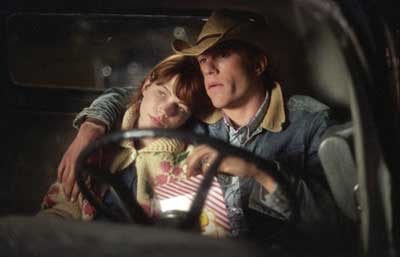 Because of the film’s gentle pace, and Lee’s loose control, we really immerse ourselves in their relationship as they frit away the hours looking after sheep. There was a woman in my theater (I won’t name names, partly because I don’t know hers) who felt that Brokeback Mountain was far too slow and could have been put to better use by cutting 2 hours out. The film’s placid pace is integral to the story’s success; you need to see how expansive that countryside is to feel alone, you need to have the many small conversations to draw out a closer camaraderie, you need the added time to open up to these men, and then once you have –BAM! — they turn their worlds upside down. This buildup is necessary for our connection to the characters but it’s also essential so we can understand what happens. Yes, the film portrays love as it truly is: an all-encompassing emotion that can be as maddening as it is passionate. But Brokeback Mountain doesn’t dare introduce a gay romance, something so dangerous in this land, all lickity-split. It’s supposed to be a surprise to these men, grown up with John Wayne movies and strong, silent role models. The movie enjoyably takes its time to seduce an audience with its tale before choking out every last tear in the end.
The tragedy of Lee’s film is that these men have each found the love of their life but, because of society’s prejudices, are not allowed to act. As a result, each man puts on a different face and pretends they’re a happy heterosexual Western buck for the public, but each is being eaten away inside. Ennis drinks a lot and is full of self-loathing. Jack is less publicly reserved about his feelings and finds momentary comfort with other warm bodies, mostly through silent nods with other closeted gay men. I’m reminded of a line in Paul Thomas Anderson’s Magnolia: “I have a lot of love to give; I just don’t know where to put it.” Ennis and Jack cannot quit each other but they also tragically can never fully commit to one another, at least without any threat of ostracism or death. That’s the power of Brokeback, that it shows you these simple men, shows you their love, and then won’t let that happy ending ever manifest that we yearn for. When we reach our somber, haunting conclusion there weren’t many dry eyes in the theater, mine included. Brokeback Mountain is a love story that won’t let itself be happy, and that’s what provides all the kicks to the gut and lumps in your throat.
I think some of the more hostile criticism of Brokeback Mountain is because of how normal Jack and Ennis are presented. Neither is a swishy stereotype, neither is any less of a man, and that notion probably terrifies the homophobes: “Well, they look normal, and if they get gay then maybe I will too!” That’s a shame really, because those ignorant few will miss out on a powerful, sweeping, complex, aching love story with fantastic acting. Ledger and Gyllenhaal will make you feel every moment of joy, every moment of pain, and every lingering conflict on what makes them whom they are. Lee stressed that he wanted to show the world a love story where you really felt that love was an uncontrollable force. His heartfelt, touching film is a revolution for being a normal love story, albeit with two classic Marlboro men. There is no propaganda, no gay agenda, but perhaps the film will open people’s eyes and strip away any narrow definitions we have toward the ownership of love. Brokeback Mountain set out to merely tell a good story, not change the world. It’s accomplished the first part and maybe, just maybe, it’ll spark discussion, debate, and lasting memories to lay groundwork for the second.
Share this:

The Station Agent (2003)
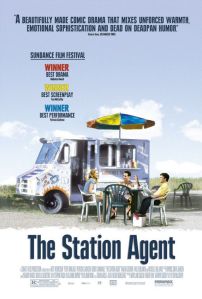 This is the most charming film of 2003, and Im not just saying this because I had an interview with one of its stars, Michelle Williams (Dawson’s Creek). Fin McBride (Peter Dinklage) is a man with dwarfism. With every step he takes every look he gives, you witness the years of torture hes been through with glares and comments. Hes shut himself away from people and travels to an isolated train station to live. There he meets two other oddballs, a live-wire hot dog vendor (Bobby Cannavale) and a divorced mother (Patricia Clarkson). Together the three find a wonderful companionship and deep friendship. The moments showing the evolution of the relationship between the three are the films highlights. Its a film driven by characters but well-rounded and remarkable characters. Dinklage gives perhaps one of the coolest performances ever as the unforgettable Fin. Cannavale is hilarious as the loudmouth best friend that wants a human connection. Clarkson is equally impressive as yet another fragile mother (a similar role in the equally good Pieces of April). The writing and acting of The Station Agent are superb. Its an unforgettable slice of Americana brought together by three oddballs and their real friendship. Youll leave The Station Agent abuzz in good feelings. This is a film you tell your friends about afterwards. Theres likely no shot for a dwarf to be nominated for an Oscar in our prejudiced times but Dinklage is deserving. The Station Agent is everything you could want in an excellent independent movie. It tells a tale that would normally not get told. And this is one beauty of a tale.
Nate’s Grade: A
Share this:

Dick (1999)
 What should have been a biting satire on the whole Watergate mess and Nixon’s resignation comes off as hackneyed and clumsily written. The jokes are stale and moronic, the script is sophomoric, and the satire is not even close to biting. It all appears like it was written by a freshman that got the Cliff Notes on Watergate then decided to watch an episode of Charlie’s Angels.
Kirsten Dunst once again manages to make me question when I will ever enjoy her in a performance. The ditzy girls idea grows thin by the opening sequence let alone stretched to the rest of the movie. There are some bright spots like Dan Hedaya playing Nixon uncannily, and some former SNL and Kids in the Hall alums having fun with the material and parodying their characters. So why didn’t they feature more of them?! Please tell me! The movie is lame and unfunny, and even more so when you account all the double entendres using the name “Dick.” I could very easily use the title of the movie in some sexually inuendous reference to how bad this movie sucks, but I’m above that. For now.
Nate’s Grade: C


 nathanzoebl
You must be logged in to post a comment.