Blog Archives
Tusk (2014)
 You’ve never seen a Kevin Smith film quite like this. Even after the man’s first foray into the horror genre with the flawed but tonally ambitious Red State, I never would have expected the man best known for lewd discussions over pop-culture minutia to take note of The Human Centipede and more or less say, “Hey, let me try.” After a short self-imposed retirement, it seems like Smith is creatively reinvigorated, crafting even more boutique films that no one else would make, and Tusk is a prime example of this. Whether or not the world needs a film where a man is kidnapped and physically transformed into a walrus is a personal question you’ll have to answer in your own space.
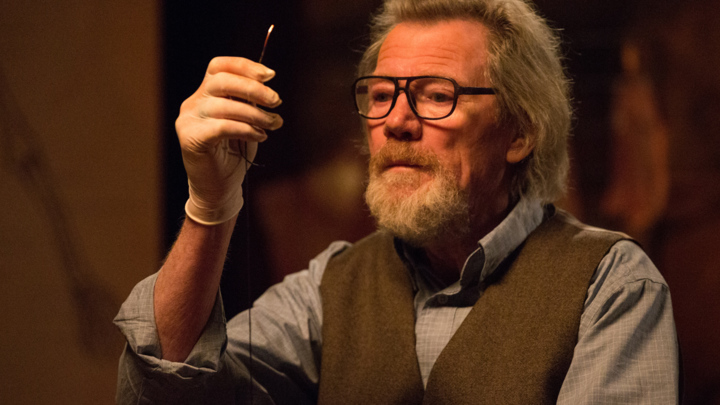
Wallace Bryton (Justin Long) is an egotistical podcaster who is something akin to the mean-spirited version of Ira Glass. He travels around the country interviewing strange people for their strange stories, all to relate to his travel-phobic pal and podcast co-host, Teddy (Haley Joel Osment, all grown up). The two guys then crack jokes and make fun of these pathetic weirdos and losers. While in Canada, Wallace finds a curious posting in a men’s room from a man named Howard Howe (Michael Parks) seeking a companion to share his lifetime of stories with. Wallace jumps at the chance, enters Howard’s secluded home, and listens as the older, wheelchair-bound eccentric spins several yarns, notably a tale where he was lost at sea. His only “friend” was a walrus who he credits with helping to save his life. He misses his seafaring friend, and Howard has secretly drugged Wallace with the intent or transforming him into a human-walrus composite.
 If you’re a fan of bonkers body horror and demented humor, then Tusk just might be a short but potently nasty little treat for you. If you’ve seen enough similar genre entries you’ll likely be guessing several of the plot turns before they happen, like the tea being laced with a chemical or Howard holding back his real and fiendish capabilities. However, there are moments that simply defy prediction, especially the last half of the movie where Smith doubles down on the madness of executing his premise. The tone is rather uneven and can prove to be a hindrance, with the first half more dramatic and the second half more absurd comedy. Smith impresses early on by slowly teasing the reveals: the duplicitous Howard, the revelation of missing parts, the full-on transformation. The knowing camerawork and long, creepy conversations build suspense even when we stop and realize how ridiculous this entire movie can be. And that’s not an insult but a compliment, even a saving grace when the movie takes a few too many unwieldy detours (more on that later). With a premise this bizarre, and from a director in such unknown territory as Smith has waded, I, dear reader, was laughing throughout. Tonally, it felt like Smith was acknowledging the silliness of his movie but still being true to genre. There are some genuinely creepy and unsettling moments sprinkled throughout. The practical makeup gore can at times make skin look like a crumply raincoat. The final image of Long as a human walrus is both ludicrous and a horrifying sight you cannot un-see.
Much of the movie is a series of conversations and monologues featuring Long (Dodegball, He’s Just Not That Into You) and Parks (Kill Bill). Hell, even Genesis Rodriguez (Man on a Ledge) gets a monologue; she’s Wallace’s put upon girlfriend who doesn’t like the man he’s become with fame. It’s a rather rote part undeserving of a performance as good as Rodriguez delivers. She must have thought, “Here’s my acting reel for the next few years; look casting directors, I can do much more than look hot.” Back to the central duo, Long and Parks. The film’s greatest assets are these actors and the movie is at its best when they share the screen. After his skin-crawling turn as a bile-spewing zealot in Red State, I expected Parks to be unhinged and frightening, which he is in spades. The man’s calm demeanor is especially eerie. When he breaks into openly mocking his victims, adopting Wallace’s howling cry, is another moment that bounces from creepy to funny and back to creepy again. It’s a performance pattern that Parks nimbly dances throughout the film. Honestly, this may be the strongest performance of Long’s career. He gets to portray an array of different shades with his character, from egomaniacal jerk to timid victim and finally raging science experiment (Smith’s script reminds you often how much of a jerk Wallace was). It’s more than just a performance of panicked screams. Long manages to find a character here and stays true to him, even as Wallace’s psychological grasp is broken. He almost grounds the absurd third act due to the strength of his performance.
 It’s that more jocular second half where Tusk starts to lose its momentum and focus, and that’s primarily because of the introduction of the character Guy Lapointe (Johnny Depp), a French Canadian private eye. Yes, that Johnny Depp, starring in a Kevin Smith movie, adopting a silly accent and a silly fake mustache and becoming what is essentially his take on Peter Sellers’ Inspector Clouseau. It’s a character that feels like he walked in from the set of a different movie, one that is far more aimlessly wacky. The sequences with Lapointe are also laboriously overstuffed. They just go on and on, and you fee whatever sense of momentum starting to flee, sadly. Depp is amusing and I’m genuinely thrilled to see him in a small movie where he can afford to be even weirder. The problem is that the Lapointe scenes feel more like an improv session that Smith was afraid to cut short or nudge in a different direction, as if he was so gracious about Depp agreeing to be involved that he ceded all control of those scenes. The introduction to the character is a ten-minute sequence, itself with an overextended flashback, and after the initial shock and fun of watching Depp wears off, I started wishing to get back to the man-walrus.
Tusk is a unique experience, a macabre experimental lark from Kevin Smith, but it also seems to be the first in a new direction for a man who made his millions on stoner comedies. Smith is currently underway on three other movies, all of them horror, two of which are the next stages in what has become his Canadian Trilogy of Terror. While Tusk hasn’t made a blip at the box-office (if ever there was a film that cried out for on-demand, here it is), it has reawakened Smith’s creative impulses and now the guy can’t stop. Tusk is gross, funny, and genuinely creepy before it goes overboard with its very special guest star. I understand from a plot standpoint why another main character was necessary, but the movie needs some further discipline and tightening that it lacks. Basically, after reading the premise, you’ll know whether or not this film is for you. My friend accompanied me without any knowledge of the plot or the genre, and she enjoyed it. Perhaps there’s hope for you as well.
Nate’s Grade: B-
Share this:

Red State (2011)
 Kevin Smith, love him or hate him, you can’t deny the man is a natural promoter. Earlier in the year, the indie filmmaker self-distributed his first foray into horror films, Red State, on a nationwide tour of screenings. I first saw Red State way back in March when Smith visited Springfield, Ohio to screen the film and then answer questions afterwards. I’ve been trying to wrestle with my critical opinion in the ensuing months. Fortunately for me, Smith has made it extremely easy to revisit my thoughts. Red State eschewed the traditional theatrical release pattern for a new digital-age model. It was available on demand through cable systems, available for download, and even broadcast in special theaters for a one-night only event. A month later the film hit DVD. In its better moments, Red State is the unholy union of Quentin Tarantino’s love of language, and penchant for jolting violence, and the Coen brothers’ nihilistic, cock-eyed sensibilities. This is strange new territory for the man. I wish I could say Red State is worthy of all the attention, though this sinister, messy, gritty little movie can work its wicked mojo, at least for a while.
The Five Points Church is a notorious family-operated cult. Under the guidance of their shepherd, Abin Cooper (Michael Parks), this fundamentalist Christian group pickets the funerals of dead soldiers, haranguing the grieved that their loved ones are dead because “God hates fags” (excuse me for failing to put two and two together). A group of teenage boys (Michael Angarano, Kyle Gallner, Nicholas Braun) is lured to Sara’s (Melissa Leo) trailer with the promise of sex. The middle-aged woman plies her young bucks with drinks and they are knocked out. The boys awaken to find they are inside the Five Points compound and witness to Abin Cooper’s solution to sinners. Rather than railing with signs, the family has decided to take a more hands-on approach and execute them. While this is going on, a sheriff’s deputy alerts the authorities and the ATF rolls up to the compound. Lead by Agent Keenan (John Goodman), the government agency engages in a firefight with the rightwing cult. Ordered to take down the compound, and all witnesses, the various characters will try and escape with their lives, never knowing when that fateful moment of atonement may drop.
 What Smith does well for a genre novice is to keep his audience constantly upended. Just when we think we’ve settled on a protagonist and a plotline, suddenly Smith switches gears. The surprises are sudden and often merciless, leaving the audience little room to adjust. In a genre usually beholden to formula, the consistency of Smith’s surprises makes for a darkly satisfying viewing. Watching Red State demands due attention. Naturally, not all of these tonal shifts work to the movie’s best interest. The final shift, to all-out action thriller, is the most leaden. The Ruby Ridge/Waco-style standoff allows for a lot of gunfire but very little action. We mostly just cut back and forth between the two sides firing and, inexplicably high numbers, being shot in the face. It can get repetitive and seem like all the mounting tension gets squandered. There is a nice storyline within of one family member, Cheyenne (Kerry Bische), forming a plan to save the compound’s children and escape. Bische (the lead on the last season of TV’s Scrubs) makes fantastic use of her limited screen time to render the anxiety and fear of her character. She’s second only to Parks in the performance department as far as I’m concerned. Then the climax comes along and Smith teases being audacious, going in a fire-and-brimstone angle that would completely obliterate audience expectations. And just when it seems like we’re about to get something radical… Smith falls back to what he knows – dialogue. For the final five minutes, Smith concludes his narrative with two government officials explaining what happened in florid detail. It’s a fairly big letdown.
The setup of luring teens to their doom is an old horror staple, though usually the ones doing the sacrifices are card-carrying Satanists. And when exactly would a Satanist be in a situation needing to prove their validity with a membership card (“I’m sorry Mr. Darkseed, but we can’t give you the ten percent discount on all those goat skulls unless we see some valid photo ID.”)? Smith flips the switch religious allegiance. Instead of Satanists or some other misunderstood fringe religion, the cult is a group of pious Christians. There’s plenty of room to work here and Smith refrains from making easy associations; the Five Points nutjobs aren’t meant to represent Christians as a whole or Christianity. They are extremists, and they will go to extreme measures. Ostensibly based upon the Westboro Baptist Church and Fred Phelps, you keep waiting for Smith to satirically carve up the clan, but this never really occurs beyond the superficial. Smith’s writerly instincts give Abin Cooper a ten-minute sermon/platform where the guy just unloads a hate-filled diatribe against homosexuals and progressives. For many, this will be the make it or break it point of the film. There are some genuinely tense moments to the first half of Red State. There’s one scene where the camera holds on Gallner (The Haunting in Connecticut) inside a wired cage. He rattles and screams and generally comes unglued, and we too piece together what he hears, dreading what is to come. The many escapes and narrow calls are also harrowing and finely edited to ratchet up suspense.
 It seems, though, that Smith’s bleak screenplay does not present any characters we can truly root for. Horror has been shifting this way for the past twenty years. Thanks to the rise of the slasher flick, audience empathy has shifted from being with the running/screaming victims to being with the gruesome yet personable killers. Red State has a high body count but you won’t feel much when those bodies hit the floor. You’ll feel a jolt of shock, but from an empathy standpoint the needle barely registers. Sure, we don’t want people to be tortured and we want the abused to escape torment, but that’s not the same as characterization. The closeted sheriff (Stephen Root) feels like the start of an idea more than anything else. The trio of teen boys is presented with as little care as any other throwaway slasher flick. They are but meat for the grinder, our entryway into this hidden and spooky fundamental world. These aren’t so much characters as bodies waiting to be slain. The people are set up so they can be knocked down. This issue can become troubling when Smith wants us to rethink our loyalties, especially once the siege has begun. He wants us, dares us, to start feeling empathy for members of the Five Points Church. The problem is that the plot’s adherence to shock value and the underbelly of human nature has desensitized our empathy. When the ATF starts firing most in the audience will probably just cheer, not reflectively question the moral relativism. I doubt anyone will be switching allegiances midway through.
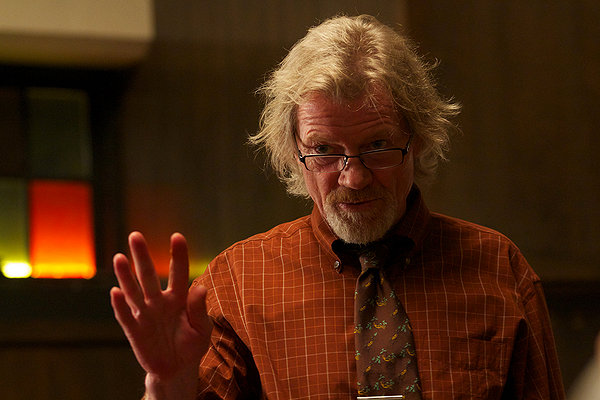
Cults are usually held together with a charismatic leader, and Red State has that in spades with Parks. The man just dissolves into his twisted character, a preacher that uses the Word of God to indoctrinate and arm for his own holy war. Parks has done fine supporting work before in the stable of Tarantino and Robert Rodriguez movies, but Red State is the actor’s biggest modern showcase yet. The man makes your skin crawl the way he can wrap hate into a honeyed, easily digestible product. Abin holds sway over his flock and likewise Parks commands the screen. He provides grandeur and menace to Smith’s words. It’s not a scenery-chewing performance; Parks doesn’t go for the obvious notes when he can hit something deeper and more unsettling. You get a sense that this man fully believes the dogma he teaches, and that makes him all the more terrifying. The other actors peopling Red State are fine, though Leo (Oscar-winner for The Fighter) seems a bit unrestrained especially in contrast with Parks. Goodman (TV’s Treme) gets to talk on the phone a lot to his unseen superiors. The end of the film just descends into frenzied yelling on everyone’s part.
Credited as a horror movie, though I view it more of a survivalist thriller but I suppose genre specifications are subjective, regardless, Red State is miles away from Smith’s usual output. The movie has its share of creeping dread and menace, thanks to Parks’ transfixing performance. The screenplay is unrepentantly dark, cruelly cutting down lives with shocking acuity. The constant surprises and upheavals are a way to keep the audience guessing, though the shock value starts to wear off by the noisy, repetitive gun battle climax. It’s hard to nail down exactly what kind of commentary Smith is presenting. Obviously he doesn’t side with the hateful fundamentalists (this is probably why he pulls back at the end), but he also shows the government’s reaction to religious zealots to be morally queasy at best. It’s hard to get a read what the commentary is, and with horror, if you don’t take a stab at commentary then you’re just watching high-gloss snuff films. Red State resembles a snuff film in several ways and not just in its grimy aesthetics. You feel a little dirty after it’s over, and you can’t help but question your motives for watching it. Plus you can’t help but think it could have been better done (note: I have never watched an actual snuff film, you sickos, but the point remains).
Nate’s Grade: B-
Share this:

Kill Bill Vol. 2 (2004)
 When last we left The Bride (Uma Thurman), she had reawakened from years of coma, traveled to Japan to acquire the finest sword ever created, and crossed off two names from her list of those marked for death in the name of bittersweet vengeance. O-Ren Ishii (Lucy Lui) and Vernita Green (Vivica A. Fox) fell under the hand of The Bride in Kill Bill, Vol. 1. Now, the only members left of the Deadly Viper Assassination Squad (DiVAS), the group our heroine was once a part of, are the one-eyed Elle Driver (Daryl Hannah), Budd (Michael Madsen), and the titular ringleader, Bill (David Carradine).
Kill Bill, Vol. 2 takes a very sharp tonal shift from the previous film. Kill Bill, Vol. 1 was a head-spinning orgy of blood and stylized carnage, and it could be argued that its actual plot was wafer-thin. But it seems with Kill Bill, Vol. 2 that Tarantino had answered every critical concern about the first film before they were even brought to his attention as the two films were shot and cut in one grand effort. This film has a much more genial sense of pacing and numerous moments of drawn-out monologues, a far cry from the breakneck pace and terse dialogue of its forerunner. Fans of the relentless hack-and-slash of Kill Bill, Vol. 1 may be disappointed that this film lacks the chopped limbs, geysers of blood, and senseless, yet immeasurably thrilling, slaughter. In fact, whereas the body count for a lone sequence of Kill Bill, Vol. 1 may be in the fifties, Kill Bill, Vol. 2 has three total murders. It is the quieter, more adult half of this revenge opus. Kill Bill, Vol. 1 was an homage to chop-socky grindhouse Japanese films. Kill Bill, Vol. 2 is Tarantinos homage to spaghetti Westerns and their languid pacing and showdowns.
 The acting is superior to what you would expect from a revenge movie.
Thurman has always been as good as her director, and under the hands of a master like Tarantino she excels. In Kill Bill, Vol. 1 she was a hurricane of rage and an unstoppable warrior. Here we see the human being inside the warrior’s armor, and she performs with amazing assurance and a ragged, raw delivery. When she’s crying on the floor, face and body red and strained, aching, you believe everything this woman does and is capable of doing.
Carradine, with his gaunt features and face like leather, gives the standout performance of the film. Whereas Bill was an unseen menace in Kill Bill, Vol. 1, with the final installment he becomes fully realized as both a figure of terror but also one of great tenderness. He has a lengthy speech about Superman, masks, and the mythology of comic books that is spellbinding. Madsen gives a fine performance steeped with surprising pathos. He’s the only former DiVAS member who feels remorse for his actions at the Two Pines Wedding Chapel that triggered The Bride’s rampage. A large subplot displays Budd’s current life slumming it as a bouncer at a sleazy strip club and getting verbally berated by people he could easily kill. You come away with the idea that its Budds version of penance.Madsen mixes his remorse with sadistic grit, like when he gives The Bride a choice between a flashlight or a can of mace, and this is before he buries her alive.
Hannah seems to relish every moment as the one-eyed right hand to Bill. There’s a scene where a character is suffering from venomous snakebites thanks to her and she sits down and reads a list of Discovery Channel-esque information she looked up on the Internet about the snake and painstakingly copied onto a notepad. She performs with such gleeful insincerity that it is hard not to start to like her for being so good at being so bad.
 Perhaps the person that steals the movie though is Gordon Lui, who plays the cruel master Pai Mei that teaches Thurman all her moves. He has eyebrows like cotton balls and a long, whispery beard he loves to flick around. Its a shame that this hilarious character is not in the film longer. Kill Bill, Vol. 2 also boasts one of the greatest child performances I have ever seen. The actress that plays the daughter of Bill and The Bride has such a natural quality to her acting that it is amazing she isn’t coming up with her lines, reactions, and movements on the spot.
So does a longer, slower, talkier concluding half mean that Kill Bill, Vol. 2 plays it too safe or loses any of its steam? Hell no. Tarantino fills in all the rough spots and unanswered questions from the first film, and the result is drawing the audience further into the story.
We open the film with another perspective of the events that took place at the Two Pines Wedding Chapel that left a wedding party dead, and a bloodied, pregnant Bride shot in the head. We also discover how The Bride became the deadly warrior she is, why she chose to leave the business of hired killing, why Bill reacted in the extreme manner he did, and we even learn to our delight how Elle Driver lost her eye. The result of knowing the full story are characters, which in Kill Bill, Vol. 1 were more archetypal than living and breathing, that have become fully fleshed out, rounded, and incredibly complex figures full of remorse and vulnerability. The Bride and Bill transcend their descriptions as adversaries, and their relationship becomes more intensely complicated when mommy returns home to find her daughter still alive.
Despite all this fancy talk about character building, Kill Bill, Vol. 2 does not disappoint in action and thrills. A fight between The Bride and Elle inside a cramped trailer may be the most brutal, bone-crushing fight sequence I have ever seen between two women. Every strike that connects breaks something, be it furniture or bones. The final showdown between Bill and The Bride is a fitting and satisfying end for both warriors.
Tarantino’s concluding half of this story long in gestation is a highly entertaining, stylish, thrilling, engrossing, eye-plucking good time. There is so much to talk about. This is the first film since, perhaps, Gladiator that I have seen at the full-price theaters three times. In total, I have seen the Kill Bill saga five times in theaters, and I find something new and rewarding every time. Tarantino has given the masses a masterpiece and everyone should take the opportunity to see it.
Nate’s Grade: A


 nathanzoebl
You must be logged in to post a comment.