Blog Archives
Bowling for Columbine (2002) [Review Re-View]

Originally released October 11, 2002:
Documentary filmmaker, political activist and corporate pot-stirrer Michael Moore prefaces his latest film Bowling for Columbine by admitting his lifetime membership in the National Rifle Association (NRA). He even received a marksmanship award as a teenager in his hometown of Flint, Michigan. Bowling for Columbine is Moore’s sprawling and hilarious search for answers among America’s zealous gun culture and alarmingly high number of homicides. It’s the tangents Moore just can’t help but take along the ride that add some of the more fun moments.
He opens a checking account at a Michigan bank that’s offering a gun for new customer accounts. Moore astutely asks an employee, “Do you think it’s a good idea handing out guns in a bank?” Moore travels to Canada to find out what reasons exist that make our cultures so different when it comes to crime. After hearing from citizens about how they don’t lock their doors, Moore decides to go door-to-door and see for himself. Sure enough, he walks into half-a-dozen homes.
Moore is better at pointing the finger than fathoming real answers. He touches media sensationalism, our nation’s bloody history, corporate greed, past military involvement, and an environment of fear being developed by those who profit from such actions. The sobering truth is that there are no easy answers to be debunked. The film’s climax involves an impromptu sit-down with NRA president Charlton Heston. Moore questions the sensitivity of the NRA after it held support rallies days after the school shootings in Littleton and Flint. Heston becomes weary and walks out of the interview after five minutes.
The film demands to be seen. It’s complex, challenging, and thought-provoking. Not only is Bowling for Columbine the most important film of 2002, it’s also one of the best.
Nate’s Grade: A
——————————————————
WRITER REFLECTIONS 20 YEARS LATER
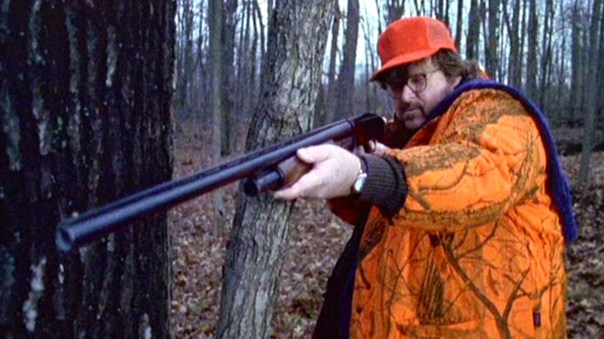
I was a junior in high school when the horrific massacre at Columbine happened in April of 1999. I remember the shock that washed over the country. I remember the daze and sorrow. I remember students not coming back to school for days, some because they feared that our Ohio school could be the next site of the next tragedy because of how upending the Columbine school shooting had been for the general sense of security. “How could this happen?’ we solemnly asked. I remember exasperated politicians wringing their hands, grasping for solutions and scapegoats alike, and I most remember just the overall gravity of the whole situation, the sense of loss, and the sense that this meant something significant. Flash forward twenty years, and the Columbine school shootings, which snuffed out 15 lives that fateful morning, is now ranked fifth on the list of deadliest school shootings in the United States, having been gut-wrenchingly eclipsed by the 18 at Parkland in 2018, the 22 in Uvalde in 2022, the 28 in Sandy Hook in 2012, and the 33 in Virginia Tech in 2007. Since then, mass shootings and spree killers have become so common that the satirical news website The Onion keeps recycling the same condemning headline with the latest mass shooting: “‘No Way To Prevent This,’ Says Only Nation Where This Regularly Happens” (this damning headline has been repeated 22 times in eight years time, and it’s only a matter of months at most before it gets repeated yet again if history is anything).
After each new tragedy, we’ve been inured to the reality of anything of merit being done in the way of reform; we move from “thoughts and prayers” to, “let’s not politicize this now,” to, “you’ll never solve every problem,” and then finally to a litany of social issues that conveniently are the real culprits, and never the guns mind you, of course. It’s easy to be cynical that, in our current day and age, no gun tragedy will ever move politicians to make real changes. After Sandy Hook, the most watered down of reforms, increasing background checks, was met with stonewalling from Republicans and those funded by the formidable National Rifle Association (NRA) lobby. After 60 people were slaughtered during a music festival in Las Vegas in 2017, the next hopeful reform was eliminating bump stocks. That didn’t happen. The patterns emerge and become their own tragic parody of performative action masquerading as meaningful action.

When people argue, “Well criminals will just ignore the new laws we pass anyway,” I’m dumbfounded by this logic, as if that is reason enough to cancel all attempts at law and governance. The oft-quoted axiom of a “good guy with a gun” being the only real solution to a “bad guy with a gun” is equally nonsensical to me. If that’s the case, then the rising presence of guns would better police these matters, mitigating their deadliness, and that is definitely not the case. The good guys with the guns aren’t working. The challenge is determining who is a good guy with a gun or a bad guy with a gun. This reflexive thinking never applies to other tragedies: “The only way to battle a bad drunk driver is with a good drunk driver.” It’s maddening for any citizen genuinely seeking common sense gun reform that’s supported by a far majority of voters.
America’s fixation with our gun culture was already a potent issue in 2002 when political muckraker Michael Moore elevated himself to new commercial and critical heights, and it’s only become even more essential to unpacking twenty years later. Moore had restyled documentary filmmaking with his searing and tragic-comic 1989 Roger and Me, his documentation of the fall of the American auto industry in his hometown of Flint, Michigan, where my mother grew up, and his search for answers with General Motors’ CEO, Roger B. Smith. Moore put himself front and center in his films, the schlubby everyman trying to hold truth to power, though he himself would have a slippery hold on it as well. Moore directed two more features in the 1990s, The Big One and Canadian Bacon, his only non-documentary film. But Moore catapulted into a new stratosphere of media attention and derision in the George W. Bush era, first with 2002’s Bowling for Columbine, which won him his first Oscar and set doc box-office records, and then in 2004 for Fahrenheit 9/11, which obliterated the box-office records Moore had just set and would have likely won him another Oscar but he refused to submit in Documentary and only wanted to submit for Best Picture (Born into Brothels won that year instead, so thanks I guess).
Bowling for Columbine is an aggravating movie by design and through Moore’s tactics. The issue of guns and violence in America has only become more central to American lives. Moore’s thesis is messy because it’s hard to find a single cause for the root of America’s gun violence, ignoring, of course, the sheer number of guns, though he even says Canada has a high guns-per-resident ratio from their culture of hunting but lacks our murder rate. The section on the media sensationalism driving gun sales is potent, as a nation constantly in fear will reach for protection that is abundant supply and access. As the murder rate has gone down over the 1990s and 2000s, the network news’ reporting over violent crime has increased, as well as gun ownership. It’s a brew of paranoia that benefits politicians, media, and especially gun manufacturers. Gun sales soared once Barack Obama swept into office, not because he said he would take people’s guns, but a section sure trumpeted those fears for monetary gain. The extended anecdote on the mother of the youngest school shooter, a six-year-old, is a powerful indictment on welfare-to-work and a system that forces people into unlivable choices. I wish Moore had touched more upon the mental health aspect of the gun violence equation, as the far majority of gun violence are suicides and not homicides. Many were quick to deduce that the Columbine killers, Eric Harris and Dylan Klebold, were victims of bullying, but millions are victims of bullying and do not shoot up their schools. In a 2017 TED Talk, Dylan Klebold’s mother, Sue, discussed her personal process of coming to terms with her son’s actions and realizing how essential his desire to die was to his infamous actions. When people make irrational, impassioned, split-second decisions, and guns are readily available, then bad things can be made even worse. Moore doesn’t explore this angle, unfortunately. Some of his larger connections can seem very reaching, like when he tries to say that kids knowing their parents work for Lockheed Martin, a military weapons manufacturer, would be less likely to value human life.

But it’s the needless sleight-of-hand tactics with the truth that confound me with Moore, and these inevitably blunt the power of his message and ability to convert thinkers. This habit infuriates and flabbergasts me. Moore has so many good points already at his disposal, so many meaningful data points and heart-tugging anecdotes that he doesn’t need to stretch the truth to convey his message. I’ve since used Bowling for Columbine as an example in teaching credibility gaps and the concept of ethos with public speaking. This is epitomized in the handling of NRA president Charlton Heston. Shortly after the events of Columbine are replayed for us, including frantic 911 calls and security camera footage, Moore cuts to Heston defiantly declaring, “With my cold dead hands,” and informs the viewer that within ten days that the NRA held their annual conference in Denver, despite pleas from local leaders for distance and sensitivity. “Don’t come here? We’re already here,” Heston replies to applause. The problem is that Moore has stitched together two separate Heston speeches to seem as one, including the “From my cold dead hands” intro, which was given an entire year after the Columbine shooting. He also excludes pertinent details like the fact that the meeting in Denver was scheduled a year in advance, the NRA was required by law to notify all four million of its members ten days before a location change, and all other NRA events were canceled except for the meeting required by corporate law. When you look at the parts of Heston’s speech Moore picked from, anyone could follow the same approach and edit the speech to say whatever message they desired. The climax of the movie is Moore sitting down with Heston, but when he peppers him with questions about his speech days after Columbine, and Heston has no idea what he’s talking about, it’s because Moore isn’t playing fair. Then also take into account the aged actor likely going through the Althzeimer’s that caused him to step down from acting and the NRA in 2002. Look, I’m no fan of the NRA, and I personally believe their self-serving actions perform a genuine harm to the country, but this is just self-righteously badgering an ailing old man.
Moore is not the only documentary filmmaker to make use of selective editing, anecdotal evidence extrapolated, and narrative cheats for manipulative emotional purposes, but when you’re being provocative, you’re going to get push back, and when you use deceitful storytelling methods with your facts, you are a disservice to your cause and your message. There’s so much on this topic that Moore can effectively criticize, like the handy media scapegoats, the failings of zero tolerance and school resource officers, the obvious hypocrisy of do-nothing elected officials, the fear-mongering news seeking out consistent sensationalism, a deference to the military industrial complex, and the fact that the rest of the world watches the same movies, listens to the same music, plays the same violent video games, and yet, to paraphrase The Onion, we’re the only country where this happens all the time. Sadly, no place is safe in the U.S. from a possible mass shooting, and yet a good portion of this country will shrug and say that’s just the price we have to pay for living our freedoms. There are so many fallible arguments to poke apart, and that’s why I’m so frustrated with Moore’s misuse of his platform, giving his opponents the ammunition to dismiss his points.

Moore’s career has fallen quite a bit from his meteoric height in 2002 and 2004, last releasing Fahrenheit 11/9 in 2018 to warn about the lasting dangers of an inactive voting public and Donald Trump as president (it grossed $6.3 million, approximately five percent of the gargantuan $119 million gross of Fahrenheit 9/11). It feels like Moore’s style, once so revolutionary, prankish, and urgent, has now become stale. As I wrote in 2018: “If our country ever needed Moore, it would be now, but his time might have already passed as an influencer. The last time Moore was breaking through into the cultural conversation was with Sicko in 2007, years before the formation of the ACA. Since then we’ve seen the rise of social media, YouTube, and the instant commentaries of media old and new, all trying to one-up one another in expediency and exclusivity. Is Moore just another member of the old guard he laments has become obsolete?” It’s not uncommon for a filmmaker to lose their edge or passion after 30 years. It’s also not uncommon for the envelope-pushers to become part of an establishment that a younger public starts tuning out for lack of relevance. I don’t know if Moore has a real audience any more.
Re-reading my old 2002 review, I’m sure glad I kept a paper copy of each of my published film reviews for my college newspaper because it was the only surviving copy I could find. I could not find my review for Bowling for Columbine on any of the websites and blogs I’ve used over the years, so in 2022, I literally sat with my twenty-year-old newspaper and retyped my relatively brief review from 2002. Thank you, me, for stubbornly holding onto these yellowing papers. I remember being more taken with the film in 2002, so much so that I would brush aside criticisms from my other friends who made valid points about Moore’s larger thesis (they just “didn’t get it,” I’m sure I incredulously scoffed). My apologies, my put-upon and sensible friends.
In the scheme of Moore’s catalog of films, I still think Roger and Me is his finest work and much of this is because it’s the most personal of his movies, chronicling the decline of his hometown with his special access. It’s the one that feels most essential for him to be the face of the movie. Bowling for Columbine is a messy movie but all Moore’s films are scattershot entertainments in retrospect, each deserving of reflection but also outside verification. As a result, the movies never become more than the sum of their parts and floating ideas and interviews and stunts and his loose thesis statements rarely coalesce into anything definitive, like an Alex Gibney documentary. Moore can be hectoring and disingenuous, especially during his interviews, and most of all aggravatingly short-sighted in his techniques, but he is a documentary industry unto himself and with good reason. Bowling for Columbine is the start of a conversation, with many asides both illuminating and diversionary, and it’s still worth watching twenty years later, as gun violence has only gotten worse. I think it’s likely Moore’s third best film, after 2007’s Sicko, but maybe I’ll change my mind in 2027. Until then, I’m lowering the film grade from an A to a B.
Re-Review Grade: B
Share this:

Fahrenheit 11/9 (2018)
 Does muckraking filmmaker Michael Moore even matter anymore? That’s the question in the wake of the tepid opening of his newest documentary, Fahrenheit 11/9, a spiritual sequel to 2004’s Fahrenheit 9/11, which impressively grossed over $110 dollars (the next highest grossing doc is about $80 million away). Moore has been a loud progressive voice, a champion of the little guy, a provocative and some might argue deceptive filmmaker for three solid decades, but have we simply tuned him out? His last two movies (Where to Invade Next, Capitalism: A Love Story) have done middling business and he seemed to have lost a step. If anything can animate the Moore of old, it should be the stunning ascendancy of President Donald J. Trump.
I was expecting a take-down of our 45th president, but Moore doesn’t really go in for an extended catalogue of the mounting scandals, setbacks, and prevarications of the Trump Administration. It would be hard to keep up with the 27/7 news cycle that seems to fly from one Trump scandal or offensive statement to the next, creating an endless loop of scandals and headlines that can inure the public to negative attention (Trump is certainly counting on this as he games his base to disbelieve any and all negative coverage as “fake news”). By its a nature, a documentary takes a lot of time to fashion, and if Moore had simply made a two-hour catalogue of Trump outrage, it would have been instantly dated (he does sneak in some Helsinki footage of Trump cowing to Putin’s version of events). To be clear, Moore criticizes Trump and his cronies for the lasting damage he feels they are inflicting upon democracy and civility, but this Fahrenheit sequel is really all about the American people, namely those who have grown apathetic or too complacent in the notion that society will be safe and sound without direct and responsive action. There’s a renewed passion here that was solely absent in the last few Moore documentaries.
 Moore states that Trump is not an isolated incident but a symptom of bad actors unchallenged for too long. This includes the media and especially the Democratic Party, including the Clintons and President Obama. There is more time actually spent railing against the shortcomings and decision-making of Democrats than there is on the Republicans. Lest you think Moore is blaming anyone and everyone for the rise of Trump, he even points the finger at himself and his own complacency. He regrets the times he could have stood up and challenged Trump, like on Roseanne’s daytime talk show in the 90s, or to his mouthpieces, like when he’s chummy with Kellyanne Conway on election eve. Back when Trump was still a Democrat, Jared Kushner was a producer on Moore’s 2007 doc, Sicko, which was also amazingly distributed by Steve Bannon’s company. Moore argues he too fell into the trap of complacency, of assuming Hillary was going to win comfortably, that a self-serving, unqualified candidate such as Trump would never be elected president, that the sensible American people would set things right. Moore’s film relives the slow, sickening realization of that fateful night by first crafting a montage of incredulous voices promising Trump had no chance (in a two-person race), and then he veers from the upbeat Clinton election party, complete with vaulted glass ceiling waiting to be ceremonially shattered. As the night wears on and tears give way, the glass ceiling would remain intact. It’s a painful moment to relive for any person hoping for the alternative, and Moore wants his audience to remember that shocked, stomach-churning feeling so it can be prevented in the future.
Moore’s thesis is that the only hope for our society pulling out of its tailspin is for new blood to be injected into politics and government. The resulting two-plus-hours seems to throw a lot of anecdotes and selective statistics at the wall to see what sticks. We jump from a teacher’s strike in West Virginia, to Alexandria Ocasio-Cortez as she canvasses before her upset in New York’s 14th district, to the Parkland High School students staging their own resistance movement for gun control, to the Flint water crisis. It makes for a somewhat haphazard documentary because it feels more like its parts than the sum, losing a sense of momentum. Fahrenheit 9/11 had the Iraq War to act as a narrative focal point, and it was timely and tangible and raw. Fahrenheit 11/9 is missing that central drive, which is why it feels like it’s too episodic. Thankfully his stunts and fitful attempts at humor, usually Moore’s weakest aptitude, are kept to a minimum so as not to further dilute the urgency of his message. His best section on Flint could have been an entire movie unto itself.
 Moore’s personal connections to Flint, Michigan run deep and he has featured the city in every documentary going back to his first daring film, 1989’s Roger and Me. It feels like this beleaguered city can never catch a break. The government switched its local water supplies in 2015 and effectively gave every child in Flint lead poisoning, a condition that literally alters DNA and the DNA of future generations. This will affect the children of the children of Flint. It’s that insidious and tragic. The corrosive water pipes were a result of opportunistic greed, of trying to create a new pipeline for donors to Michigan governor Rick Snyder. It’s here that Moore sends up Snyder as a pre-Trump data point, a businessman with no experience elected to public office who took extra powers, blessed hand-picked emergency managers to circumvent local electoral choices, eschewed checks and balances, and installed cronies and crooked business partners into office. Snyder and his government knew about the lead poisoning for months and did nothing, and then they tried covering it up by telling doctors to doctor the numbers. It’s this segment of the film that feels most impassioned, most excoriating, and most impactful. If these elected leaders could knowingly poison a generation of children for profit, it could happen to you next. It’s here that Moore serves up his biggest criticism of Obama, who visited Flint after the water crisis gained national attention after months of suffering. He performs a stunt, which he swears was not a stunt, where he drinks a glass of Flint tap water to help his parched throat. You can feel the pained anguish of the Flint locals as one of their heroes, a man who was supposed to be a different politician, a man of the people, looks like another disingenuous politician.
But of course there is still time to ridicule Trump and his narcissistic tendencies. Moore argues that Trump has been hiding in plain sight the whole time and we’ve just ignored all his bad behavior and warning signs. There’s a searing montage of Trump’s gross obsession with how attractive his daughter Ivanka is, from talking about her future breasts as a little baby, to saying on a talk show that if she wasn’t his daughter he could see them dating. If you’re going to vomit during this screening, it will be here. Trump’s open admiration of dictators and strong men (he has said more positive things about Kim Jong-Un than John McCain) and his disdain for independent law and order, democratic norms, and American moral standing leads Moore to one apocalyptic conclusion. He warns that when, not if, some kind of terrorist attack happens and Trump demands new powers to combat this new reality, we will have willingly given away our democracy to a dilettante. Moore talks about shying away from direct Trump-as-Hitler comparisons but then throws up his hands in defeat and employs a few talking heads to make the connections more concrete. He even uses Trump rally audio and plays it over a Hitler speech, which was the funniest moment for me because of the bizarre dissonance (Trump is a much worse speaker). There will be people that tune out specifically because of the Hitler comparisons, deeming Moore an alarmist, which the man might agree with. He’s trying to sound an alarm to wake everyone up out of complacency, to get out and vote, to run for office, and to be more involved in their government so that it’s more representative of the 330 million people rather than an elite cadre of special interests with vast outputs of capital.
 Fahrenheit 11/9 is a call to action to Moore’s ever-decreasing audience. It’s emotionally affecting and persuasive at points but it’s also too scattershot and lacking momentum, especially after Moore makes the conscious decision to keep Trump as a background presence, the latest malignant symptom of an apathetic voting public. Moore’s central argument is that too many of us, himself included, became complacent and now our democracy is in peril from a wannabe tyrant who doesn’t care about inflicting lasting collateral damage. If our country ever needed Moore, it would be now, but his time might have already passed as an influencer. The last time Moore was breaking through into the cultural conversation was with Sicko in 2007, years before the formation of the ACA. Since then we’ve seen the rise of social media, YouTube, and the instant commentaries of media old and new, all trying to one-up one another in expediency and exclusivity. Is Moore just another member of the old guard he laments has become obsolete? Fahrenheit 11/9 is better than I thought it would be but it still left me wanting more of Moore. But if his message is anything, don’t count out Moore and the American people just yet, because with the right push, it can all come roaring back.
Nate’s Grade: B
Share this:

Where to Invade Next (2015)
 With agitator-in-chief Michael Moore at the helm and that provocative title, you’d think this was Moore’s critique of the United States’ foreign policy in the Middle East. That’s what I thought too. I was surprised to find that Moore’s doc is really a rather gentle and optimistic examination of policies abroad that America should consider appropriating. Moore travels from country to country under the guise of “invading” them and taking their best ideas back to the mainland. It’s really a travelogue of the world and various ideas that give exception to the belief of American exceptionalism. In Italy workers get eight weeks paid vacation. In France, students get gourmet lunches. In Slovenia, there is free college tuition even to foreign students. In Portugal, they’ve decriminalized drugs and watched their crime rates drop thanks to an emphasis on treatment over punishment. Moore is still cherry-picking his facts (Italy’s high unemployment rate, Slovenia’s small population, etc.) and ignoring the multitude of cultural and government variables that allow these good ideas to flourish in their native lands, but he raises enough good points worth consideration. The humor of the enterprise is often forced and eye roll-inducing, with Moore playing baffled interviewer who just can’t fathom how these people live. The best segment is strangely slotted in the middle of the film where Moore travels to Germany. The sins of the past, namely the Third Reich and the Holocaust, are purposely remembered in monuments and education policy. It’s important not to forget the mistakes of the past. Moore then wonders what the U.S. would be like if we acknowledged the darker moments of the past instead of finding ways to excuse them (see: D’Souza’s doc and the worst film of 2014, America: Imagine a World Without Her). Ignoring uncomfortable realities is counter-productive, and Moore’s doc is all about accepting and implementing the good ideas of others to better our own country. The extra irony is that Moore himself is ignoring realities that conflict with his rosy message. Where to Invade Next feels like an extended segment of one of Moore’s old TV shows. It’s a bit rambling and dull and the whole framing device is too facile, but its simple mission of trying new things is laudable.
Nate’s Grade: C+
Share this:

The Box (2009)/ Capitalism: A Love Story (2009)
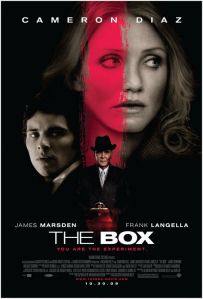 Both films on the surface seem so radically different and yet I found lots of common ground between a sci-fi conspiracy and a muckraking documentary about the biggest financial meltdown of the modern era. Both are centered around the concept of greed and whether humanity can forgo selfishness for empathy of their fellow man. Would you kill a stranger for a million bucks? Would you rig a financial system so that the richest one percent can gamble the life of a nation? Both movies also bite off more than they can chew and both movies exist as interesting yet dispirit elements that could use more cohesion and resolution.
You have been given a box with a button. If you press the button tow things happen: somebody you do not know will die and you will receive a million dollars. Do you press it? That’s the hook of writer/director Richard Kelly’s sci-fi morality tale based upon a short story by Richard Matheson. The Box is a messy and outlandish conspiracy sandwiched between two moral tests, the second a consequence of the first and a means to wipe the slate clean. There’s plenty of weird unsettling moments, including the horrendous wallpaper of the 1970s, but not everything really hangs together. Kelly’s intergalactic conspiracy can get readily outlandish with all the variables and needed participants, but like in Donnie Darko, he lays out enough tantalizing info to keep your attention and then keeps the narrative vague enough for personal interpretation. However, unlike Darko, this movie needed to cleanup its loose storylines. It just sort of ends in perplexing rush, and I sat in silence through the end credits waiting for some kind of scene to help tie together dangling storylines that were left to dangle for an eternity. The Box has a nicely tuned foreboding atmosphere, and it certainly keeps you guessing, but it will also keep you scratching your head to try and make sense of everything from button boxes to teleportation pools to Mars probes to sudden nosebleeds to Satre’s No Exit. Kelly, as he has done with his previous movies, packs a lot in two hours. Whether or not it all formulates is up to the viewer’s wearying patience. I’d rather have more movies like The Box than more thoughtless drivel from the Hollywood assembly line.
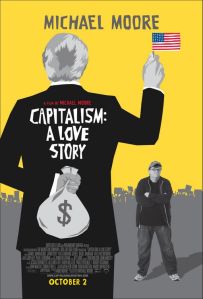 After 20 years, you pretty much know at this point what you’re going to get from a Michael Moore documentary. There’s the anecdotal evidence, emotional interviews of the downtrodden, the one-sided arguments, the nods to the depressive state of Flint, Michigan, and Moore trying to bully his way to see the powers that be that have no interest seeing him. In a way, Capitalism: A Love Story is like a greatest hits collection for Moore that reminds you of his better moments and better films. Despite all the outrage, Moore wants to throw the baby out with the bath water. He cites capitalism as an evil that needs to be eradicated. His thesis isn’t very cohesive and consists of a series of related and unrelated anecdotes, some of them grossly offensive like companies profiting from the death of employees thanks to “Dead Peasant” life insurance policies. But at no point do you walk away thinking, “Let’s start from scratch. What has capitalism gotten us?” Several of his points are easy to agree with. There is a flagrant disregard for the well being of others on Wall Street, who carelessly gambled the nation’s fortunes and then got the taxpayers to cover the loss. The bailout is a crime of pure capitalism and in a true capitalistic society there is no such thing as “too big to fail,” there is only fail. It’s not following an ideology built upon greed that has hurt the U.S., it’s unchecked greed, capitalism run amok without any oversight or regulation that has endangered the nation’s livelihood, and I’m surprised Moore didn’t emphasize the process of deregulation from Reagan to Bush more. The story of our financial meltdown is too large for a confined two-hour narrative window, and it’s too important a lesson for a man like Moore to use it as fire to ignite a people’s revolution.
Both movies: C+
Share this:

An American Carol (2008)
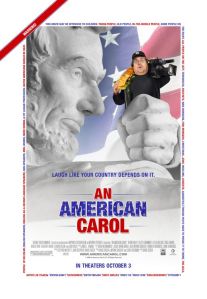 Being a conservative in Hollywood is like being a gay Republican – tough business. Director David Zucker has a notable history with comedy, having helmed Airplane!, the Naked Gun series, and the back half of the Scary Movies. He says that he converted to conservatism in the wake of 9/11, and Zucker actually wrote and directed a short for the 2004 Republican National Convention that was deemed too edgy for the Grand Old Party. Conservatives have also garnered the reputation for not having the best sense of humor, and Zucker’s An American Carol will do little to change this belief.
Michael Malone (Kevin Farley) is an egotistical, fat, liberal documentary filmmaker whose latest work is titled, “Die You American Pigs.” Catchy, ain’t it? Malone wants to abolish the Fourth of July (would we just skip to July 5th?) and plans to protest a Trace Adkins concert for the troops. A batch of inept Islamic terrorists want to bomb the concert and decide into tricking Malone into assisting their goal. He will score them media passes to get onstage at the concert venue. Following the Charles Dickens’ playbook, Malone is first visited by the spirit of his idol, John F. Kennedy (Chriss Anglin), who horrifies Malone by saying war is sometimes necessary (really, conservatives are trying to reclaim Kennedy?). Three spirits will visit him although he spends almost all of his time with the ghost of General Patton (Kelsey Grammer). The ghostly general takes Malone on a trip to see what the alternative versions of U.S. history had the country avoided war at all costs. Malone stays defiant until he meets up with the Angel of Death (also Trace Adkins, because?) and sees the error of his “America-hating” ways. I don’t want to spoil things too much but the movie ends with an expanded Trace Adkins concert saluting the brave men and women in the armed forces.
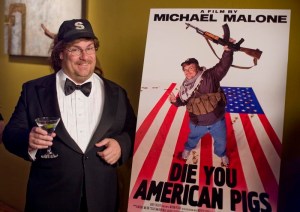 Some from the opposing political viewpoints will find An American Carol to be infuriating. To those angry few I say get over it, because this movie is simply too lazy to get angry over. It barely reaches 77 minutes before the credits roll. Zucker and company tend to stretch their canvas too broadly, to the point that they aren’t exaggerating to lampoon but setting up cheap jokes. Michael Malone is fat. Michael Malone smells. Michael Malone falls down. Liberals hate America and want the terrorists to win. It’s so easy to write this material because there’s nothing topical or nuanced or even socially relevant. The movie beats reliable figures of conservative agita. When the movie tries to slam college professors as being dippy hippies brainwashing teens about the insurmountable ills of America, it just gets dumb (those people spend 10-15 years studying in a specialized academic field). There is no teeth to any of this satire because it’s all just recycled caricatures with the wit ground down. There isn’t anything of true satirical substance here. I don’t even get some of the satire, like the ACLU is depicted as a cluster of zombies with briefcases. What does that mean? Needless to say, the skewering of Arabs is mostly cartoonish and offensive. The flick constantly makes fun of the documentary art form, saying they are inferior to “real movies.” Because Michael Moore has an Oscar does that mean that the history of documentary film has to be slandered as being nothing more than transparent propaganda (at an awards ceremony, the top documentary is honored with the “Leni Riefenstahl Award”)? Marginalizing an entire art form seems rash, especially considering that Moore’s Fahrenheit 9/11 grossed over $220 million worldwide. As of this writing, An American Carol, a “real movie,” has grossed seven million and counting.
The film deals in distasteful absolutes. Every idea is presented crudely in black and white. By the film’s standards, being anti-war and anti-troops are inseparably linked. In my mind, and this might be crazy, but it seems to me that the most pro-troops one could be would be hoping for them all to return home alive and healthy. An American Carol attempts to justify the ongoing War in Iraq, though it conveniently only ever flashes to combat in Afghanistan, the war that a majority of the public agrees with. It makes a case that war is sometimes necessary, though it has to flash back to Hitler and World War II to find a morally justified military engagement that everyone can feel god about. I agree that war is sometimes a reasonable option, but the movie paints all pacifists as wimpy appeasers. George Washington (Jon Voight) even steps in at one point to argue for the necessity of war in reference to the War on Terror. Did the filmmakers forget that Washington spent great expense to keep the nation out of foreign wars in his two terms? Isn’t it also condescending and objectionable to have Washington say freedom of speech is misused when it goes against the government? I think the Founding Fathers would realize the importance of freedom of speech, including offensive speech. Isn’t it also somewhat ironic to use slave-owners as mouthpieces for the merits of freedom? An American Carol says that disagreement is the same as dissent; so refusing to support one’s government blindly during a time of war is traitorous. Criticism is not anti-American. It’s insulting to all rationale human beings. Zucker and crew make their case look just as myopic and dismissive as those they choose to ridicule.
The acting neither hinders nor helps the material. Farley is a game comedian but he cannot do much with such lightweight material. There are several celebrity cameos including James Woods, Dennis Hopper, Bill O’Reilly, Mary Hart, David Alan Grier, Gary Coleman, Leslie Nielsen, Zachary Levi, Kevin Sorbo, and Paris Hilton. When Zucker is calling favors into the likes of Paris Hilton, you know things cannot be solid.
 Here’s the problem. It’s harder to satirize from a conservative point of view. Conservatism believes that the status quo is best or that things were better back in the day. Liberalism believes that society can always improve, so a liberal point of view would tweak the present situation in order to call attention to remaining improvements. A conservative point of view would make fun of that possible change. This is the same reason why documentaries, like it or not, typically have a more progressive bent, and it’s because the filmmakers are presenting a case for change or outrage. Why would anyone devote himself or herself for years to create a film that says the world is peachy? Now I’m not saying that conservatism and humor are conflicting concepts, but it just makes it harder to be smarter. Making fun of Good Night, and Good Luck is not trying hard enough. How dare George Clooney make a film about the media cowering and failing to question our elected leaders and have it be applicable to today’s world.
The Zucker gag-a-minute spoof style doesn’t necessarily translate well to political satire. I wasn’t expecting much with An American Carol. When they exploit 9/11, taking Malone to the wreckage of the World Trade Center to make its case, well the movie stops being a satire and just implodes. It hits its tired targets with a sledgehammer. The satire is extremely lazy, the slapstick is dumb, and the movie specializes in being obnoxious, coloring the world in two extremes. This isn’t satire. This is just cheap and petty. Seriously, making fun of Michael Moore is like four years too late. Moore is a figure worthy of satire but the best that the movie can come up with is he’s fat and hates America? That he’s angry because he couldn’t get girls when he was younger and all those studly military recruits did? That’s not satire, that’s just excessive name-calling. An American Carol presents a new low for Zucker and I think even he knows it. On the DVD commentary track, Zucker, co-writer Lewis Friedman (BASEketball), and actor Kevin Farley basically lambaste the final product, often criticizing their own movie. The derisive commentary track is more enjoyable than the film itself.
Nate’s Grade: C-
Share this:

Sicko (2007)
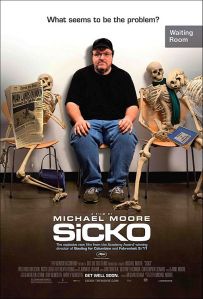 I live in a Western society without universal health coverage, the only Western society without, actually. Living in a consumer-driven society has its plusses and minuses, as any system will, but as political lightning rod Michael Moore’s new film Sicko indicates, perhaps under that system the Hippocratic oath may need to be changed from “do no harm” to “do no harm to the bottom line.” Sicko is different from Moore’s familiar political screeds; no, this is a deeply humanistic Moore who presents a scathing expose on the broken American healthcare system under the control of major corporations. This doesn’t taste like propaganda, not this time.
The film is really structured into three segments: health care horror stories, a comparison of other countries and their systems, and the jaunt with 9/11 rescue workers. The horror stories are the best condemnation of our system and also the film’s best point of argument for change. The additional segments provide more persuasive food for thought but are less explosive. Moore’s best points are his damnation of our home healthcare. I imagine the film is full of selective information and some bias, but the true stories of these people wronged by a system meant to protect are all the information needed to point to change.
 The first part quickly alerts the audience that, unlike the advertisement declaring that this is the funniest of Moore’s films, Sicko really is by far the saddest and most emotionally disheartening film the scruffy man with a camera has ever concocted. Endless full-length movies could be fashioned simply from the personal stories of those with insurance, and especially those without insurance, and how their lives have been ruined or devastated by the decision making of the American health care system. Sure, this segment is a blatant emotional appeal, but that doesn’t excuse what happened to these victims. One man accidentally sliced off two of his fingers and then had to choose which one he could afford to reattach. By far the most infuriating cases are the clear-cut examples where medical intervention would have saved lives. A mother lost her young daughter because she made the mistake of seeking help from a non-HMO approved hospital. She died in the wait to transfer her to another hospital while the mother begged the onsite doctors to treat her child. One woman even worked for a healthcare company and had her husband’s bone marrow transplant because they deemed this long-standing and highly successful surgery as “experimental.” Her husband had a perfect match thanks to his brother. He died a month later. Hearing these people’s sobering sob stories, one after the other, is like repeatedly getting punched in the stomach. It’s hard not to tear up as you witness peoples loved ones being transformed into profit loss statistics.
Moore also gets some plum interviews with former workers within the healthcare industry, and we see that the burdens of their actions still haunt them. One woman breaks down as she confesses a conversation she had over the phone with a couple applying for coverage. The couple was so overjoyed and relieved, but this woman new immediately that they would get denied, and that this moment of happiness would be utterly destroyed weeks later when that fateful letter was delivered in the mail. It’s explained by these people that the real mission of the big insurance companies is to find a way not to pay, thus achieving the exact opposite of what insurance is supposed to be. If by some miracle you do have insurance, they do approve your operation, and you have not incorrectly filled out your application, that’s when they set in the heavy hitters. These people scour through any record they can find to discover any means of denying converge. One woman had her surgery paid for by her insurance agency, then the agency found out that she had misled them by never reporting a serious medical condition in her patient history — she had a yeast infection. They then canceled payment and told the doctors to get their money from her instead. No stone shall go unturned in the pursuit of skipping out on the bill.
 This segment also presents some of the most indicting information as well as some of the weirdest. A healthcare professional testifies to Congress that she received higher placement by denying coverage to people who presumably died without it. Bonuses are awarded to the agent with the most denials. Congress passed a Medicare reform that effectively handed the government system over to private interests, allowing drug companies and insurance agencies to become middlemen and drive up prices and cut out competition. The Senator at the helm of this reform became the CEO of a pharmaceutical company with a starting salary at $2 million. Coincidence? The strangest item is a record the American Medical Association distributed decades ago that stirred up fears of how socialized medicine would weaken our country and grease the wheels for a takeover by those dirty, spooky communists waiting in the wings. None other than eventual American president Ronald Reagan narrated the record.
Sicko then becomes an extended commercial for foreign healthcare programs. Moore visits Canada, England, France, and finally Cuba to see how other countries take care of their own. Throughout the film we’re warned by those in power how disastrous a universal healthcare program would be and how people would not be getting better care. Moore stumbles through every country and interviews doctors and patients in waiting rooms, all of who speak enthusiastically about a program where anyone can walk anywhere and get covered for free or at minimal cost. In France, there are roving doctors that take emergency house calls 24 hours a day, and this system was inspired by a man who reasoned if he could get a plumber 24-7, why not a doctor? A clog is a clog. Every one of these countries has a lower infant mortality rate as well as a higher life expectancy. This segment is informative and dispels misconceptions about foreign care, but it’s also hardly open and shut. The economic realities aren’t fully explored by a handful of glowing interviews where the subjects are sympathetic to Moore’s viewpoints. What is the cost of living in these countries with so much paid sick leave? What is the average salary like? How much are taxes to pay for universal coverage? What is the wait like for serious but not life-threatening operations? I am by no means saying that these other countries do not have favorable systems, but Moore is not covering the costs of those government-controlled healthcare systems.
 The final segment is typical of the stunts in other Moore movies. He interviews a collection of 9/11 rescue workers that volunteered to clear rubble for weeks and months and now have serious health problems from time spent at Ground Zero. Because they were not government employees, the government rejects paying for their medical care. These people were selfless when their nation needed them most, and now the fact that our own government has turned its back on returning the favor is deeply shameful. Moore takes these 9/11 workers and others and travels by boat to Guantanamo Bay in Cuba, where those responsible for 9/11 are getting better healthcare. The rescue workers are brought to tears at the discrepancies between the Cuban health system and the American counterpart they’ve been butting heads with for years. Moore paints an all-too rosy picture for Cuba, a country of notorious political repression, censorship, and the internment of homosexuals. These points are conveniently left out while Moore marvels at the advanced care his charges receive for free.
Sicko is a powerful and searing condemnation of what Americans live with to live. Moore always seems to formulate a conspiracy-laden thesis through his documentaries, but this is one I can definitely get behind. Moore theorizes that Americans are kept demoralized and in fear so that they will be kept complacent. Saddled with mounting debt, you’re not going to rock the boat when you have to keep your job as the only means of affording medical care. The U.S. industry seems to working backwards; instead of protecting people they are protecting shareholders. When people starting dissolving and all that can be seen is profit ledgers, that’s when we’ve gone too far and twisted a system meant to heal people and prolong their lives and not empty their wallets. Moore doesn’t present a strong alternative but presents overwhelming evidence that change is in dire need. Sicko is skillfully presented, has some humor to it, but is by far a more draining and agitating experience than a fun one, ultimately scaring the viewer to ever fill out an insurance application again. Ever have a yeast infection?
Nate’s Grade: B+
Share this:

Michael Moore Hates America (2004)
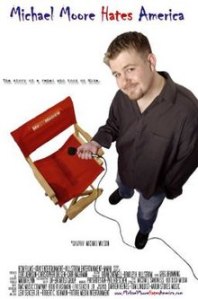 Mike Wilson is an ordinary guy. He saw some of Michael Moore’s documentaries, listened to some of his interview bits, and didn’t appreciate what he saw and heard. But unlike the rest of us, Wilson grabbed a camera and did something. He spent the next couple years scouring the country trying to score an interview with Moore and reevaluate some of his assertions. Wilson’s final product is Michael Moore Hates America, a small but potent documentary that’s far sweeter than the title may have you believe.
With camera in hand, Wilson travels around the country to find out what ordinary Americans have to say about Moore’s viewpoints. He visits Flint Michigan, Moore’s self-proclaimed hometown (his real hometown is a middle class suburb) and finds success stories. Wilson interviews various figures from Moore’s films, like bank workers in the opening of Bowling for Columbine and an amputated soldier shown in Fahrenheit 9/11 without his knowledge. Wilson also speaks with some of Moore’s fans who chillingly declare not to care if Moore misleads or makes up facts, because to them the end justifies the means. All the while Wilson hunts for his interview with Moore but is rebuffed at every pass. Moore even goes on air saying Wilson and his movie do not exist at all.
Wilson weaves three subjects into his film: 1) an analysis of Moore’s filmmaking tactics and statements, 2) a look at what America means to people, and 3) Wilson?s own hunt for an interview with Moore. Wilson’s interview pursuit resembles Moore’s own dogged pursuit of an interview with General Motors CEO Roger Smith in 1989’s Roger and Me.
 Michael Moore Hates America is the best of the rebuttal films because Wilson smartly refrains from preaching. He doesn’t stick to party rhetoric or unleash baseless claims without supporting evidence. The name may seem mean spirited and spiteful, but Wilson’s film may be one of the most fairly balanced looks at politics and film in recent years. This is an attempt to understand why Moore does what he does, and if his actions are honest. Wilson is tackling more than Moore’s questionable tactics; he’s examining the nature of documentary film itself. Is it even possible to be objective when it comes to documentaries? Wilson interviews, among others, legendary filmmaker Albert Maysles (Gimme Shelter) and Penn Jilette (of Penn and Teller fame) and gets insights into the troubles of objective editing, context, and overriding agendas.
Michael Moore Hates America is pleasantly well made and articulated. This isn’t some ribald shout-fest. It isn’t some home movie made in someone’s basement either. Wilson’s pacing is tight and he knows when to use humor to assist his points. An animated game show called “Six Degrees of Conspiracy Theory” is a fun way to deflate Moore’s contention about why Disney dropped Fahrenheit 9/11. It’s a shame Wilson doesn’t go back to this segment again. There’s also a funny montage of Moore backing unsuccessful political candidates, topped off by him predicting George Bush senior would eat Bill Clinton alive. It’s a fun sequence but it also proves Wilson’s point that Moore isn’t necessarily mirroring the views of America despite his claims. There is an actual thematic reason for its inclusion in Wilson’s film.
The most frustrating thing about Moore, as Wilson’s film agrees, is the needless sleight-of-hand when it comes to the facts. It’s not too difficult to make President Bush look foolish; just give him enough rope to hang himself. Nor is it too difficult to make a convincing argument that the war in Iraq was misguided (All you’d have to do is quote the 9/11 Commission’s report). But Moore has the maddening habit of putting two images together, or separate pieces of information, and creating meaning when there was none before.
Take for instance Heston’s post-Columbine speech in Bowling for Columbine. In Moore’s film, we see harrowing security camera footage of the school massacre, and then Heston pops onscreen, rifle in non-cold, non-dead hand, proclaiming defiance. Moore narrates that Heston and the NRA came to Denver shortly after the tragedy as a shameless PR ploy. Not so fast. As Wilson’s film illustrates, Moore has cut and pasted different speeches into one false, defiant statement. The image of Heston clenching the rifle comes from a NRA gathering a whole year after Columbine. The NRA had a Denver gathering scheduled a week after Columbine and was legally obligated to hold the gathering because there wasn’t enough time to contact its millions of members and reschedule. Events in Bowling for Columbine seem a tad different when the harsh light of truth shines upon them. Wilson questions why Moore needs to fudge facts so egregiously to deliver his message.
 While watching Michael Moore Hates America, one gets the distinct impression that Moore cannot take criticism of any kind. One subject calls it Moore’s Achilles’ heel. Wilson attends a Moore speaking engagement at the University of Minnesota. He steps up to the mic, requests a brief interview, tells the name of his film, and Moore shouts him down, talks over him, and then cuts Wilson with 7,000 people cheering. Afterwards, some fans do come up to Wilson to comment on his courage or disapprove of how Moore refused to listen to differing points of view. Moore’s die-hard fans seem to refuse to entertain any notion that Moore’s films could be anything but gospel truth, and it’s a shame they’ll likely never view Michael Moore Hates America.
Wilson even finds himself in some sticky ethical situations. He gets an interview from the mayor of Moore’s hometown by disingenuously telling him that he?s making a film about the appeal of small town America. Wilson prods the mayor for any info on local celebrities. Later, Wilson feels so guilty about misinforming the mayor that he sends him an e-mail apologizing and being upfront about his true intentions. The scene is both surprising and slightly amazing to witness, because it speaks volumes to the brevity of Wilson’s ego. It’s quite something that Wilson actually went through with the apology, but it’s even more impressive that he put the whole incident in his own movie. You think Moore ever sent an e-mail to the people he’s misinformed in his films? I wouldn’t hold my breath.
Michael Moore Hates America does have some non-authoritative talking heads. Quotes about the violence in Canada and the resurgence of Flint are not necessarily all encompassing, but I think Wilson is just trying to show different sides of an argument and not the end of an argument.
Ultimately, Mike Wilson has created a good-natured rebuttal. Michael Moore Hates America may be a visceral title, but the movie is a balanced, intelligent, above average examination on Moore and the nature of the documentary film field. Wilson doesn’t rely on misinformation and emotional appeals; he’s looking at all the evidence and instructing us to judge for ourselves. Moore?s fans and enemies would be equally entertained to see what Wilson has captured on film.
Nate’s Grade: B-
Share this:

Bowling for Columbine (2002)
Documentary filmmaker, political activist and corporate pot-stirrer Michael Moore prefaces his latest film Bowling for Columbine by admitting his lifetime membership in the National Rifle Association (NRA). He even received a marksmanship award as a teenager in his hometown of Flint, Michigan. Bowling for Columbine is Moore’s sprawling and hilarious search for answers among America’s zealous gun culture and alarmingly high number of homicides. It’s the tangents Moore just can’t help but take along the ride that add some of the more fun moments.
He opens a checking account at a Michigan bank that’s offering a gun for new customer accounts. Moore astutely asks an employee, “Do you think it’s a good idea handing out guns in a bank?” Moore travels to Canada to find out what reasons exist that make our cultures so different when it comes to crime. After hearing from citizens about how they don’t lock their doors, Moore decides to go door-to-door and see for himself. Sure enough, he walks into half-a-dozen homes.
Moore is better at pointing the finger than fathoming real answers. He touches media sensationalism, our nation’s bloody history, corporate greed, past military involvement, and an environment of fear being developed by those who profit from such actions. The sobering truth is that there are no easy answers to be debunked. The film’s climax involves an impromptu sit-down with NRA president Charlton Heston. Moore questions the sensitivity of the NRA after it held support rallies days after the school shootings in Littleton and Flint. Heston becomes weary and walks out of the interview after five minutes.
The film demands to be seen. It’s complex, challenging, and thought-provoking. Not only is Bowling for Columbine the most important film of 2002, it’s also one of the best.
Nate’s Grade: A


 nathanzoebl
You must be logged in to post a comment.