Blog Archives
Escape From Tomorrow (2013)
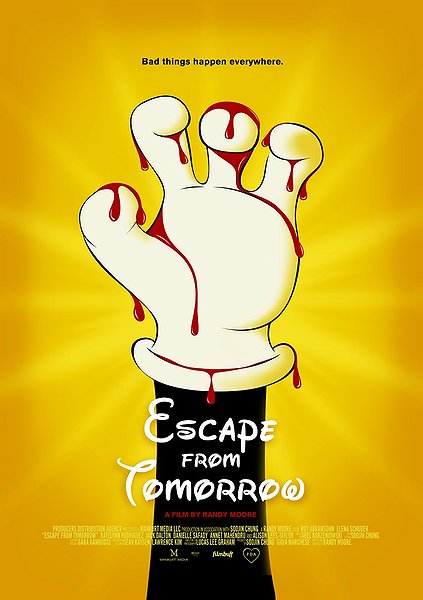 Escape From Tomorrow built a wave of buzz coming out of the Sundance Film Festival, namely because it was a bizarre, psycho-sexual little indie film shot secretly on the premises of Disney World and Disney Land. Writer/director Randy Moore shot his movie in secret, unbeknownst to Disney and the park employees. He was so paranoid about word getting out what they had done that Moore edited the film in another country. There is palpable fear at the reach and power of Disney’s coffers, enough so that a character mentioning the very D-word is silenced, and so I recall early on that people predicted Disney and its armada of lawyers would never allow Escape From Tomorrow to be released. Rather than get litigious, the Mouse House has decided to simply clam up, refusing comment. It’s a smart move, because besides a passing novelty, no one is going to remember the oh so monotonous Escape From Tomorrow in a matter of months.
The wisp of a plot involves a family vacationing at a Disney park. On the final day, the father (Roy Abramsohn) has been told he has lost his job. The rest of the day follows suit as the father loses his grip with reality, interpreting sinister signs throughout the park. He also keeps running into a pair of French teen girls who enjoy holding hands, being flirty, and singing. After the third or fourth time, the father starts to trail the girls, eerily entranced. They warn him that dire things will befall him if he doesn’t go with them.
 Take away the ballsy, surreptitiously recorded angle, the “how did they do that?” factor, and ultimately is there a movie here worth watching? I would definitively say… no. Admittedly it’s interesting to dissect how this guerrilla-style stunt was accomplished, watching scene after scene and figuring out what was shot in the parks unbeknownst to tourists and employees, what was likely shot on a set, where the cuts marry the two, and what techniques the director and his crew utilized to film a movie without blowing their cover. I think many of the scenes had to be improvised, at least the dialogue within the park, because starting and stopping and repeating lines in public, out in the open, would seem suspicious (the cursing would also seem to be courting danger). The Disney theme parks have millions of visitors, so people recording every action would not seem out of the ordinary. Escape From Tomorrow works as a stunt, with the audience picking apart the magic trick simultaneously as it’s performed.
However, a stunt is all that Escape From Tomorrow is because from a thematic, subtext standpoint, this movie is a mess. There just isn’t enough weirdness going on here and whatever small doses of it we get is given precious little connection to any larger theme. It feels like the filmmakers settled on the most facilely subversive idea – Disney Land, the happiest place on Earth, is not. Undercutting all of Disney’s famous family-friendly iconography with the occasional weird thing is not enough. A kid has black eyes. Ten minutes later a stranger makes an offensive comment. Ten minutes later something in a ride that is supposed to be happy looks mean instead. The majority of the movie plays out like you’re watching someone’s boring vacation. You don’t care about the characters. There is no plot to speak of, and that can be acceptable in an atmospheric film that serves as a visual descent into madness. There just isn’t enough madness here. Escape From Tomorrow is far too tedious to be effective. Long stretches are just watching the family traverse the theme park, notably with the father always running into the French teens. There is far too much padding, little connection from scene to scene, and the end is just a confusing muddle groping for a deeper meaning. Midway through, when the father is captured and held underground at Epcot, it looks like the movie is going to take that next step, ramping up the weirdness. Well that conflict is readily solved and then we’re back to the occasional boring out-of-place item. I want to say that Escape From Tomorrow is like David Lynch’s vacation video, but that is giving too much undeserved praise. This is like the deleted scenes of David Lynch’s vacation video.
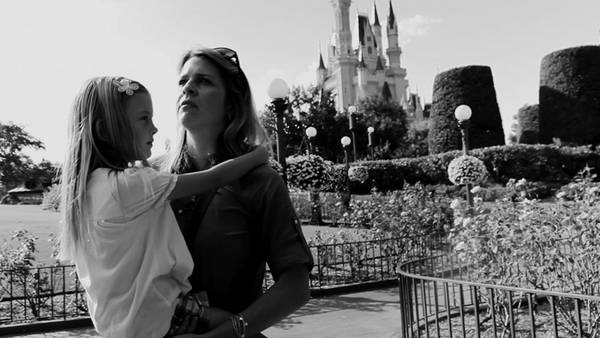 My colleague Ben Bailey countered my negative option with the idea that Escape From Tomorrow is meant to be a dark comedy and to view it through that lens; all right then, because as a “comedy” it still is half-baked, meandering, and poorly executed. The incongruous imagery, often sexual or demonic, is rather cheap in the sense that it’s just flipping the staid Disney script on wholesomeness with no more subversive substance than a moody teenager scribbling on his notebook. The Disney princesses double as high-priced courtesans? Okay, now go further rather than just taking a standard Disney character and making it adult in a shallow manner. There’s a scene where the father escapes by squeezing a tube of Neosporin to lubricate his hands out of confines, and oh boy, the white liquid shoots onto hanging pictures of female body parts. What a riot. Taking a cockeyed, perverted look at Disney is not the same as developing comedy, and even that cockeyed view is lame. I think that the father’s lustful pursuit of the French girls is meant to be comedic, but it was only creepy. When he sneaks up to spy on them in their bathing suits, how else should I interpret that? If this is supposed to be a comedy then Escape From Tomorrow is an even larger misfire.
Escape From Tomorrow is a nonsensical, plodding, superficial film, and it adds up to a whole lot of nothing. There isn’t a grander statement or sense of commentary. There is just scene-to-scene weirdness that grows old rapidly. I commend the ingenuity of the filmmakers for being able to secretly record a movie at one of the most heavily trafficked locations in the world. I don’t think the filmmakers had any clear vision of what they wanted to say with their movie, settling on “weird crap at Disney Land,” and then putting all their time and energy into planning how to pull off this coup, never mind the fact that the finished product was not nearly worth the effort. If you’ve ever wanted to be trapped on a bad vacation, then enjoy, movie masochists.
Nate’s Grade: C-
Share this:

Blue Jasmine (2013)
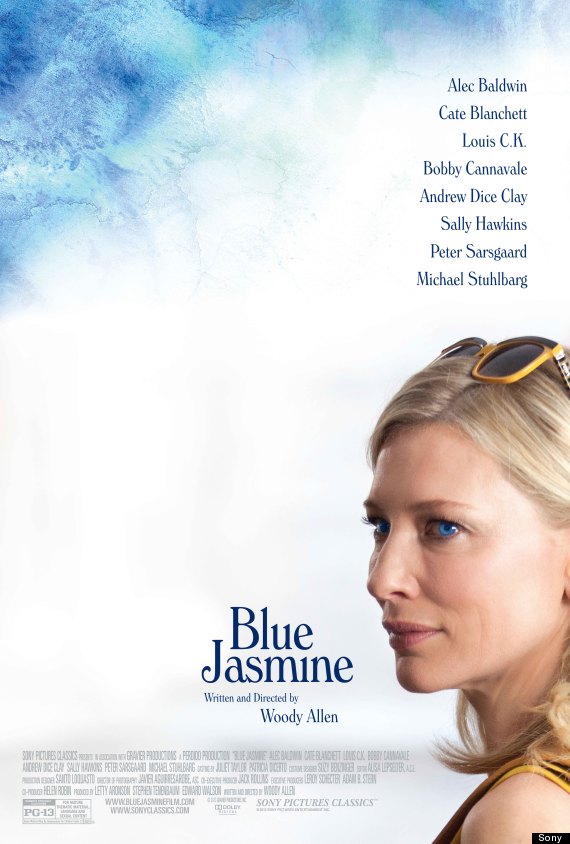 With writer/director Woody Allen’s proliferate output, cranking out a movie every year, it’s all too easy to take the man for granted. Critics will argue his halcyon days are long gone, that the man is coasting on his past laurels. Of course when you’re comparing everything to Manhattan, Annie Hall, or Crimes and Misdemeanors, well sure most movies will be found lacking, even Allen’s. And there’s no real forgiving of 2001’s Curse of the Jade Scorpion. But when Allen hits a rich topic with a capable cast, he can still produce knockout cinema, as is exactly the case with the engrossing Blue Jasmine.
Jasmine (Cate Blanchett) is experiencing a tumultuous change of living. Her wealthy husband Hal (Alec Baldwin) has been indicted for a Ponzi scheme that fleeced millions. Her posh New York lifestyle has vanished, Uncle Sam has frozen the assets that haven’t been repossessed, and she’s forced to move in with her working class sister, Ginger (Sally Hawkins), in San Francisco. Jasmine immediately has her complaints, mostly about the men that Ginger seems to date. She also tries adapting to a life she has been ill prepared for. Much like a domesticated animal, Jasmine’s social skills and pricy tastes do not have real-world transitions into her getting a job and supporting herself. She’s looking for a way to re-enter the shrine of privilege, and that it through a man of means.
 Blue Jasmine is a fascinating character study of a life of self-delusion, denial, greed, and guilt, and it is a marvelous film. Allen hasn’t done something this cutting, this precise in several years and it’s a reminder at just how skilled the man can be at building magnetic, fully realized characters, especially women. This is a rich, complex, and juicy character for an actress of the caliber of Blanchett (Hanna) to go wild with. Jasmine is something of a modern-day Blanch DuBois with a sprinkling of Jay Gatsby; she’s a woman who’s become accustomed to a luxurious fantasy world that she’s still striving to recreate, but she also is a woman who reinvented herself. As we learn in the opening scene, Jasmine left school without finishing her degree when Hal whisked her off her feet, to a world of privilege. She even changed her name from Jeanette to Jasmine at her husband’s whim. She also became particularly adept at looking the other way when it concerned her husband’s shady dealings. Surely she must have known what was happening (in the end, it’s pretty clear) but as long as her illusion of wealth was maintained then it was easy to not ask questions. Why ruin a good thing, even if that good thing is built upon ruining the lives of ordinary people? Two of those people bilked of their money were Ginger and Augie (Andrew Dice Clay), which make Jasmine’s complicity all the more troubling. Every line of dialogue from Jasmine needs to be studied and dissected, analyzing how buried is the real Jasmine.
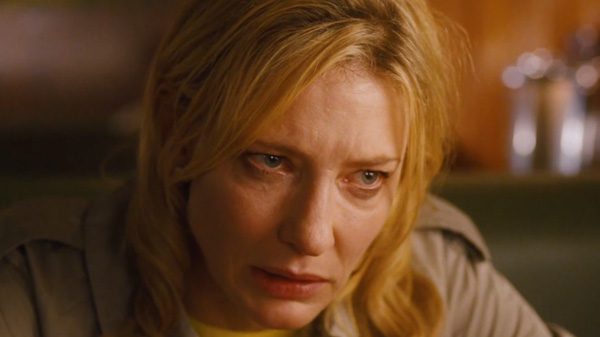
Jasmine’s declining mental state is also given much attention and curiosity. We are watching in full view a woman go through various stages of a nervous breakdown. She’s medicating herself via booze and a cocktail of prescription drugs, but there are hints that point to something other than substances at play. She hints at undergoing electric chock therapy (does this still exist?) and she may have a touch of mental illness as well, though it’s unclear. Jasmine is given to talking to herself, reciting anecdotes and patter from previous parties with the rich and fabulous. It could be a sign of madness or it could be a desperate attempt by Jasmine to zone out, to return to that former life, to relive her former glory. Personally, I’ve done something similar, recited old conversations out loud to myself, though usually a line or so, not to the degree of recitation that Jasmine engages in. In the opening, it’s revealed that the lady she’s sitting next to on the plane, who we assume she’s talking with, is really just a bystander. She tells her husband she was confused because Jasmine was really just talking to herself. As Jasmine tries to get back on her feet, with delusions of grandeur about reinventing herself again, her world seems to be collapsing around her as she struggles to adapt to the real working world. A receptionist job for a dentist is beneath her as well as far too much for her to handle. She has one real sincere heart-to-heart where she lays out her true feelings, and it’s to her nephews in a pizza shop with no other adult present: “There’s only so many traumas a person can withstand until they take to the streets and start screaming.
An enthralling character study, but Blue Jasmine also benefits from Allen’s precise plotting, folding back into flashbacks to create contrast and revelations. There is an economical finesse to Allen’s writing and directing. Every scene is short and sweet and imparts key knowledge, keeping the plot moving and fresh. It also provides back-story in a manner that feels unobtrusive. Jasmine’s more modest living conditions with her sister are contrasted with apartment shopping in New York City’s Upper West side. The class differences between Jasmine and her sister are put on full display when Ginger and Augie visit New York. However, Allen isn’t only lambasting the out-of-touch rich elite here. Few characters escape analysis. In this story, everyone is pretending to be someone else, putting on fronts, personas, to try and puff themselves up. Once living with her sophisticated sister, Ginger starts seeing her world with new eyes, mainly finding dissatisfaction and a yearning that she could do better. She meets Al (Louis C.K.) at a fancy party and gets smitten, though he’s not what he seems. She dumps her current boyfriend, buying into Jasmine’s theory that she “dates losers because that’s what she thinks she deserves.” She tries to remodel herself into a posh, inaccurate version of herself, a knockoff on Jeanette to Jasmine. It’s a bad fit. The person with the most integrity in the entire film appears to be, surprise, Andrew Dice Clay’s character. Augie is a straightforward blue-collar guy but he has a clear sense of right and wrong, one that comes in handy when he’s able to bust people.
 This is much more a dramatic character study than a typical Allen comedy of neurosis, but I want to add that there are a number of laughs to be had, mostly derisive. There is comedy but it’s of a tragicomedy vibe, one where we laugh at the social absurdities of self-deluded characters and the irony of chance encounters. It’s far less bubbly than Midnight in Paris, Allen’s last hit, but that serves the more serious, critical tone. The class conflicts made me chuckle, as well as Jasmine’s hysterical antics and self-aggrandizing, but I was so thoroughly engaged with the characters and stories to complain about a lack of sufficient yuks. Confession: I generally enjoy Allen’s dramas more than his straight-up comedies.
Naturally, the movie hinges on Blanchett’s performance and the Oscar-winning actress is remarkable. I expect her to be a lock for another Oscar nomination if not the front-runner until later. She fully inhabits the character and lays out every tic, every neurosis, every anxiety, and every glimmer of doubt, of delusion, of humanity. She is a fully developed character given center stage, and it’s a sheer pleasure to watch Blanchett give her such life. You’ll feel a mixture of emotions with the character, from intrigue, to derision, to perhaps some fraying sense of sympathy, especially as the movie comes to an end. Blanchett balances the different faces of Jasmine with startling ease; she can slip into glamorous hostess to self-pitying victim to naiveté like turning a dial. I never tired of the character and I certainly never tired of watching Blanchett on screen.
Woody Allen has been a hit-or-miss filmmaker for over a decade, and you’ll have that when the man has the perseverance to write and direct a movie every freaking year. I had a pet theory that, as of late, every three years was when we really got a great Allen movie: 2005’s Match Point, 2008’s Vicky Cristina Barcelona, 2011’s Midnight in Paris. Well now my theory has been put to rest, thank you very much, all because Allen couldn’t wait one more year to deliver Blue Jasmine, a truly great film. It’s a tragicomedy of entertainment, an exacting character study of a flawed, complex, deeply deluded woman as her carefully calculated world breaks down. Anchored by Blanchett’s supreme performance, the movie glides along with swift acumen, doling out revelations at a steady pace and consistently giving something dishy for the actors and audience to think about. It’s funny, it’s sad, but more than anything Blue Jasmine is compelling as hell. This is one of Allen’s best films and one I’d recommend even to non-fans of the Woodman. Give Blue Jasmine a chance and you may be surprised what you feel, for the film and the woman, both complex, engaging, and memorable.
Nate’s Grade: A
Share this:

Side Effects (2013)
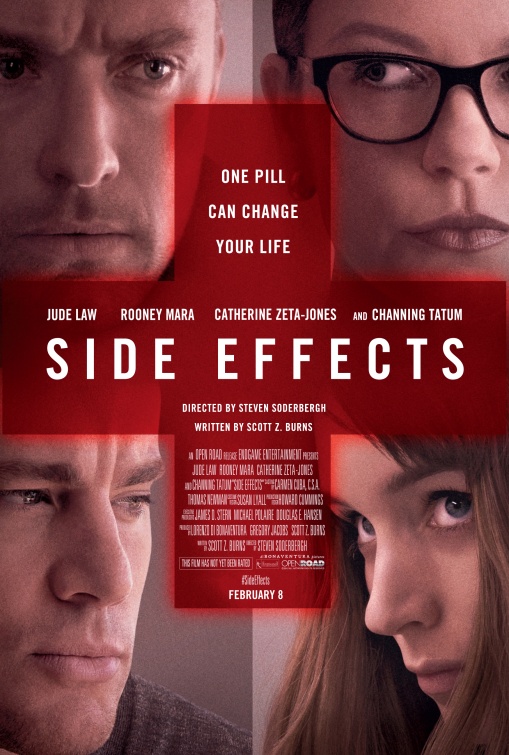 Steven Soderbergh’s supposed last stop before retirement is another of his genre exercises, but Side Effects feels like a firmer success, albeit modest, for the director to go out on. It’s the story of a woman battling depression, played with terrific cageyness by Rooney Mara (The Girl with the Dragon Tattoo). She gets prescribed a new drug and… does some very bad things. Who is culpable? The doctor, being funded by the drug companies? The woman who was sleepwalking at the time? The industry for blanketing patients with ads to demand their drug? After a rather slow start, the movie gets interesting and starts to try out different genres like hats. It appears for a good while we’re now going to be following her doctor (Jude Law) and his downfall as the industry turns on him and the media coverage intensifies. Written by Scott Z. Burns (Contagion), the movie has that same enticing sense of realism about how all the moving parts of a complicated industry would come into sync and conflict. Then the film tries out another identity, that of traditional thriller, with wronged parties orchestrating vengeance. I was invested until the end and felt sufficiently satisfied with the end results. Soderbergh’s smooth camerawork and cool color palate are well suited for a film about the battles of depression, and for a good while, before the thriller aspects take over, the movie is a fairly mature look at the struggles of depression and the industry that profits off it. Side Effects doesn’t seem like a closing statement for an artist as varied and unpredictable as Soderbergh, but as far as a Saturday afternoon goes, it’ll sure pass the time nicely.
Nate’s Grade: B
Share this:

Silver Linings Playbook (2012)
 I am in love. It’s been days since I watched Silver Linings Playbook and I’m still under its spell. It’s a movie that gave me such rapturous emotional peaks, a deeply satisfying crowd-pleaser that doesn’t just nail the big moments, it crushes them. This is a movie that works so well with just about every facet of storytelling, from acting to writing to directing, that you’re liable to be in awe as I was.
Pat (Bradley Cooper), a high school history teacher, came home one day to find his wife in the shower with another man. He admittedly lost it, beating the man bloody, and has been remanded to a state psych ward for the past eight months. It’s determined that Pat is an undiagnosed bipolar case, and the court orders him to stay on his meds and stay 500 feet away from his now ex-wife, Nikki. Having lost his home, Pat is living with his parents (Robert De Niro and Jackie Weaver), both of whom don’t know how to help their troubled son. Pat is convinced he can win back his wife. He starts conditioning by running, wearing a garbage bag to better sweat off the pounds, and meets Tiffany (Jennifer Lawrence). She’s been fighting through depression after coping from the sudden death of her police officer husband. She agrees to help Pat get in contact with his ex, passing a letter, but at a price. He must compete with her in a dancing competition. They spend hours practicing their routine, getting to know one another, and stabilizing one another, providing a foundation for healing and success.
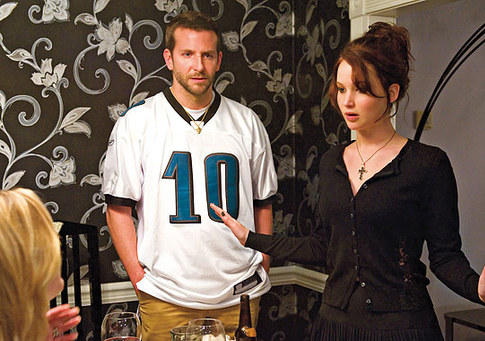 The story itself isn’t anything groundbreaking; you could glibly label it as the “bipolar rom-com” and it does adhere to that structure for the second half. But this is David O. Russell we’re talking about, the man behind 2010’s The Fighter, yes, but also offbeat dysfunctional family comedies like Spanking the Monkey and Flirting with Disaster. The man has a way of working within the framework of conventions and finding the rough edges, to make stories at once familiar and excitingly new. Is there anything groundbreaking with Silver Linings Playbook? It’s your boy-meets-girl formula at heart, but the execution is so extremely sure-footed, so exceptionally handled, that the movie leaves you buzzy and beaming. Once it ended, I wanted to run around, shouting from the rooftops for people to run out and see this movie. You want others to share in something so special and affecting. I felt a similar passion after seeing the unconventional romance Safety Not Guaranteed, and I’d advise any fans of Safety to certainly check out Silver. Being a rousing, crowd-pleasing sort of movie is not necessarily a yoke to weigh down its artistic integrity. As if enjoyment and creative accomplishment are opposing forces. I freely admit that Silver Linings Playbook is a masterful movie that knows what it takes to get an audience cheering, and I was thrilled to be part of that cheering throng. Here is a movie that just makes you feel good, and when was the last movie you saw that made you feel glowing with happiness?
This in an emotionally rich film; I was so happy after my screening that it felt like a high I didn’t want to come down from. To engineer a reaction that enhanced, that enlightened, that potent, well I must sing the praises of Russell and his actors. I bought into the love story and family drama big time. The payoffs are meaty and numerous, and I often found the film to be sincerely moving. There’s a great satisfaction in watching two oddballs find their special someone’s, and when the characters are this interesting, this human, and so well portrayed, it makes every stop along the journey that much more engaging and emotionally triumphant. It’s got an ending that pulls it all together in spectacular fashion, giving us exactly what we want while feeling earned and on its own eccentric terms. This is a deeply felt and compassionate film, one with as much uplift as acerbic rebellion. You feel like these people really do love one another. Silver Linings Playbook has memorized the playbook on how to win over an audience, but it always comes down to the same Xs and Os: strong characters, a compelling story, and people we genuinely care about, and that includes distaff supporting characters too.
 The characters are so interesting and beautifully flawed, and the actors are so in tune with one another, delivering bar-raising performances that take the movie into another realm of enjoyment. When actors are given plum roles about people with mental illnesses or disabilities, it must be very enticing to overindulge in tics and self-conscious mannerisms. That doesn’t happen with Silver Linings Playbook. Beyond an uptick in tempo, the actors portray their parts as characters rather than ailments. If anything, the acting in this movie is practically restrained given the circumstances. What’s more, Silver Linings Playbook is a fine example of what can happen when the cast works in tandem, challenging one another to up their game. It’s like every actor felt revived from all the talent on display. Russell knows how to push his actors like few other directors, and while this has lead to notorious Internet videos of his actors losing their cool, it’s also given way to raw performances that burn in your memory. Russell gets his actors to bring their A-game and then some. The Fighter got three Oscar nods for acting and I wouldn’t be surprised if Silver Linings Playbook gets three as well (I think Lawrence and De Niro are locks).
Cooper (The Hangover) has always had a certain smirking, leering quality about him, a guy used to portraying louts with charisma. I have never seen him tackle anything nearly as challenging as what he does with Pat. He’s unpredictably combustible, ready to explode at any moment, but also empathetic, trying to do better. Pat isn’t meant to be seen as a loveable loser. This guy has serious problems he’s working through. Cooper is simply incredible, showcasing skills and nuance you didn’t know the man had, radiating with an intense outpouring of spontaneous energy that doesn’t ever feel forced. Cooper is not bouncing off the walls here as some wild-eyed loony, playing upon codified ideas of what a bipolar person behaves like. He’s a deeply complicated guy, processing challenging and contradicting feelings in a brain that doesn’t necessarily follow the rules. He has so many impulses leading him in different directions. Pat is obsessed with his goal of impressing his wife, so much that he seems blind to the tangible connection he’s formed with Tiffany, and we yearn that he realizes the catch in front of him. I was won over completely by Cooper’s committed, attentive, anxious, and lively performance.
Readers will know that I harbor a serious crush when it comes to the talented actress, Lawrence (The Hunger Games). I was expecting her to be great in this movie, as this is pretty much my default setting with the actress at this point. I was not expecting what she delivered, a performance that is so enthralling, so astonishing, that you’ll be left stupefied that a woman at only the young age of 22 could be this phenomenally gifted. Lawrence had several scenes that just left me speechless. Lawrence is in elite territory now as far as I’m concerned. Her command of the character is just about impeccable, and you perk up every moment she’s onscreen. She’s a damaged woman recovering from her own powerful grief, but she’s so many things at any one moment. She can be lusty, provocative, angry, sullen, commanding, vulnerable, and hurtful. There are scenes where she will bounce around a plethora of emotional states, but each one gradually shifts to the other, making the transformation genuine and another layer to the character. If she were just some crazy girl we wouldn’t care if she eventually got her happy ending with Pat. With Lawrence’s talents, and Russell’s sharp writing, Tiffany becomes a figure worth fighting for, a bruised romantic that finds her rare kindred spirit who accepts and appreciates her messiness.
The supporting cast from top to bottom may not be at the same level as Cooper and Lawrence, but their output is also impressive. De Niro (Limitless) hasn’t been this good in ages, delivering a few monologues that will hit you square in the gut. Weaver (The Five-Year Engagement) is something of an enabler for the family, but she also gets her moments to shine and reassert her strength and dignity. Chris Tucker (in his first non-Rush Hour movie since 1997) is the least Chris Tucker I’ve ever seen him. He’s downplayed his motor mouth tendencies completely, and he’s a wonderful presence as he ducks in and out. He even teaches Tiffany how to “black up” her dance, a fact that most heterosexual males in the audience will be thankful for this time of year.
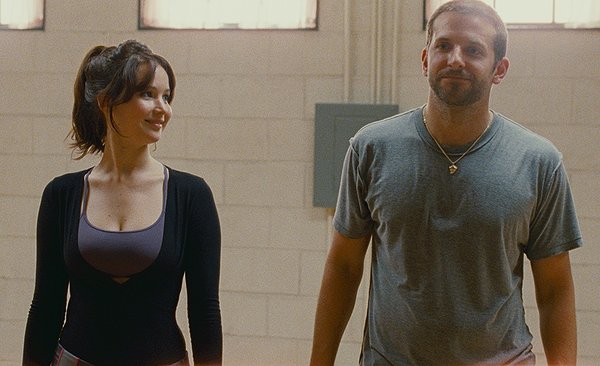 Russell deserves serious credit for portraying mental illness in a manner that doesn’t dance around the seriousness of the condition. Statistically one in three people suffer from a mental illness at some point in their life, and I’ll even admit that post-divorce, I too fell amongst those ranks (I’m a statistic!). In the case of Pat, He’s not just some unfeeling jerk who says inappropriate things or has problems reading social cues. He’s a guy going through serious personal struggles, same with Tiffany. These are not jokes. They are not send-ups of mental illness; they are people. At no point does the humanity of these characters get lost. We will laugh at their inappropriate comments, sure, but we are never laughing at them from some cushy sanctuary of superiority. I also think Russell examines an interesting, more socially-acceptable form of mass mental illness, namely the OCD-nature associated with sports superstitions. Smart and capable people can get caught up in the allure of superstitions, and when it concerns sports in general, groupthink overpowers. I consider myself a sports fan as well (I’m a double statistic!) and fully accept the ridiculous nature of fandom, but I thought it was a clever move for Russell to hold the mirror up to our own cracked community and its irrational behavior. And as any Philadelphia sports fan will acknowledge, they take fandom to a whole other level.
At this point, I don’t know what more I can write about this movie without coming across as a complete, frothing madman. Football, mental illness, ballroom dancing! I’m smitten big time with Silver Linings Playbook. I’m completely in the tank for this film. Future viewings (already planning one soon) will probably highlight certain minute flaws I’ve failed to notice the first go-round. And even if those flaws become more apparent (yes the final dance is something of a contrived climax) I simply do not care. The movie’s many virtues far exceed any shortcomings that could potentially arise. It plays to some familiar rom-com elements but it goes about its business with its own funky charm. The acting, writing, and directing are all on such a heightened level of excellence, it’s amazing just to watch all the parts work together so masterfully. I wasn’t just won over by this movie; I’ve become its disciple. I preach the gospel of Silver Linings Playbook. Here is a rapturous feel-good movie that doesn’t feel like it’s pandering or dulling its edge even after it takes some conventional turns. Cooper is terrific, Lawrence is astounding, and together they form the couple you cheer for. Silver Linings Playbook is everything you’d want in a stellar movie. I can’t wait to watch it again and get caught up in its wondrous spell once more. It took a long ten months but The Grey has finally been knocked off the perch. Silver Linings Playbook is nothing short of the best film I’ve seen this year.
Nate’s Grade: A
Share this:

Robot & Frank (2012)
 It’s the age-old story about an elderly man (Frank Langella) suffering from Alzheimer’s who teaches his robot helper to be his partner in jewelry heists. While that sounds a lot more fantastic than the movie we eventually get, Robot & Frank is a mellow, sincere, and overall nice movie that treats the particulars of its world with a wry sense of whimsy. The movie is really a mismatched buddy film as Frank is hostile to being forced to live with robotic help, but soon the two of them form the basis of a friendship, and when things get dangerous it’s heartwarming the lengths they’ll go to save the other. Give the Alzheimer’s subject, expect some twists in the final act concerning Frank’s world. The movie wants to hit us emotionally but I felt mostly remote, smirking at some of the fun of the old codger back in the burglary business of his youth. But the film just stays at a very even-keel level of emotional resonance, drawing us in but not exactly taking us anywhere. The ending is curiously without any sort of comforting resolution that could have put a solid piece of punctuation on the film’s emotional drama. Langella, it should be said, is excellent. Robot & Frank is a high-concept buddy film, fairly pleasant and entertaining but when it comes to a close you may wish that the film had relied less on chaste understatement.
Nate’s Grade: B
Share this:

Take Shelter (2011)
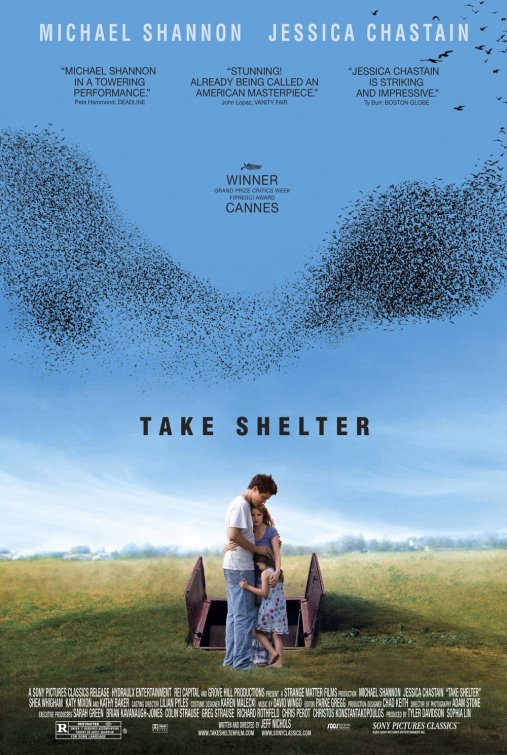 It’s rare that I get to take some local pride and puff my chest about a movie being shot in Ohio. Take Shelter, a small, suspenseful character-piece, was filmed in Loraine County, near Cleveland. Several of the actors in the production are local actors, including Tova Stewart, the adorable seven-year-old who plays the onscreen deaf daughter. The young gal, who is also deaf in real-life, is from Columbus and was in attendance at the theater I saw Take Shelter at. And I can beam with even more local pride at the fact that Take Shelter is unwaveringly magnificent. It’s a remarkably tense movie, deeply realized, expertly crafted, and one of the best films of the year.
Curtis (Michael Shannon) is a working-class family man in rural Ohio. He works as a manager of a two-man drill team, scouring the earth for valuable deposits. His wife, Samantha (Jessica Chastain), cares for their recently deaf daughter, Hannah (Stewart), and sews pillows and embroidery on the side. They are making ends meet to save up for Hannah’s cochlear implant surgery. This family tranquility is interrupted when Curtis begins having strange visions. He sees dark, ominous storms that no one else seems to see. He hears loud cracks of thunder during clear skies. He feels the dark rain fall on his person. He wakes from frightful dreams detailing friends and family turning on him. What does it all mean? Curtis feels compelled to remodel the storm shelter in the backyard. He even purchases a cargo container and buries it in the yard, collecting some end-of-the-world provisions. Could Curtis just be crazy? His mother has been in a psychiatric home since she abandoned Curtis as a child. She began having schizophrenic episodes in her mid 30s, and Curtis is now 35. Is he being warned of what lies ahead or is he succumbing to the pull of a hereditary mental illness?
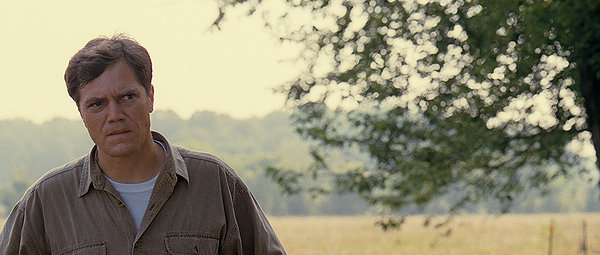 This is very likely the most nerve-racking, tense, dread-filled film I’ve watched since 2009’s Oscar-winner, The Hurt Locker. Writer/director Jeff Nichols (Shotgun Stories) masterfully lays out the particulars of his tale. Even the family drama has some nicely constructed tension. Curtis’ family is living paycheck to paycheck, so his backyard project is a real financial setback. By borrowing equipment from his work, Curtis is even risking losing his job, the only way he can afford his child’s cochlear implant. Not only do we dread stormy weather and strange flocking patterns for birds, we dread the everyday struggles of keeping afloat. Curtis following his visions can very likely put his family into financial ruin, but is that a risk worth taking? Nichols nicely creates an authentic small-town setting. There are small, acute character touches that enrich the story, like when Dewart (Shea Wigham) concludes that the best compliment a man can give is that “he’s lived a good life.” When Curtis and Samantha watch their daughter sleep, they share behavior they are still trying to kick in adjusting to having a deaf child (“I still take my boots off not to wake her,” he confides. “I still whisper,” she returns). These people and their troubles feel believable, and their reactions to Curtis’ strange behavior feel extremely believable. Whispers begin to spread and people start to treat madness like it’s a communicable illness. Religion seems like a natural landing zone when discussing anything apocalyptic and/or prophetic, but Nichols sidesteps this discussion. There could have been some interesting theological room to explore here, considering a Biblical prophet would likely be derided as mentally ill in our modern age. Nichols keeps things secular. Curtis is admonished for missing church again, but that’s about the extent of religion in the man’s life. He does not seek out spiritual advice. He seeks out psychiatry, at least if he could afford it he would.
There are some terrific standard thriller moments, like some well-calculated jump scares and many nightmare fake-outs, but the film’s real skill is drawing out tension to the point where you want to shout at the screen. This is a deliberately paced thriller knotted with unbearable tension. We become conditioned to start doubting the onscreen imagery after Curtis’ series of nightmares. Every time there’s a storm now the audience, too, fears the validity of what we witness. What is the significance of these portent signs? There’s a moment toward the climax, where a storm door needs to be opened, and I simultaneously was dreading every second leading up to that door opening and silently screaming in anticipation. Every part of me wanted to see what was going to happen next and I could not guess where Nichols would take us. I was a nervous wreck. The dread was so heavy, so all consuming, and not just from an apocalyptic standpoint. Curtis understandingly thinks he may be nuts, especially since his own mother is a paranoid schizophrenic. The threat isn’t just the strange apocalyptic signs but also Curtis himself unraveling and lashing out. He worries that he’ll become a danger to his own family, and if he cannot discern the difference between reality and fantasy it’s only a matter of time before he jeopardizes his loved ones. He fears he’ll be ripped away from his family. He wants to be better, he wants to be “normal,” but he can’t trust his own senses.
 Take Shelter is also so effective thanks to Shannon, a talented actor who always seems to be on the brink of freaking out. The bug-eyed, crazed, monotone actor has played plenty of nutcases in the movies. He was nominated for an Oscar in 2009 for Revolutionary Road for playing such a nutter. He’s a live wire of an actor, simmering, waiting for the final cue to explode. Shannon uses this intensity to his great advantage, wonderfully mirroring the movie’s compounding dread. Shannon’s character is troubled, that’s for sure, and worries about slipping into insanity. His performance is simply riveting, searching for answers amidst the desire to keep his family safe at all costs, even if that eventually means his removal. When he has to confront his central dilemma, the legitimacy of his visions, Shannon is racked with fear, eyes glistening with tears, terrified to go on faith, and your eyes are glued to the screen, completely taken in by the depth of the performance. I hope Shannon gets some due recognition come awards season because I doubt I’ll see few performances more compelling.
Chastain has had quite a breakout year for herself with lead roles in Tree of Life, The Help, and The Debt. She has a remarkable vulnerability to her, radiating an ethereal vibe (no doubt why Terrence Mallick chose her), and both aspects are put to fine use in Take Shelter. She’s much more than the oft underwritten put-upon wife, silently enduring her husband’s foibles. She’s desperate for an answer to explain her husband’s actions and motivations. She’s alert, angry, compassionate, and deeply concerned. Chastain holds her own with Shannon, and the two elevate each other’s performance subtlety, making their supportive relationship even more believable.
Take heed movie lovers, and make sure to find Take Shelter, an intelligent, expertly constructed, suspenseful drama with powerful performances and a powerful sense of dread. Shannon’s coiled intensity nicely fits the mounting tension. Nichols has created a taut thriller, a fiercely felt human drama, and an involving character-piece attuned to the talents of its cast. Take Shelter is a commanding, unsettling film that puts the audience in the unreliable position of the main character’s point of view. You may almost hope for some actual apocalypse just to validate the guy’s struggle. When was the last time you secretly hoped for the end of the world just to give one person a sense of relief? Take shelter from inferior movies and find a theater playing this tremendous movie.
Nate’s Grade: A
Share this:

The Beaver (2011)
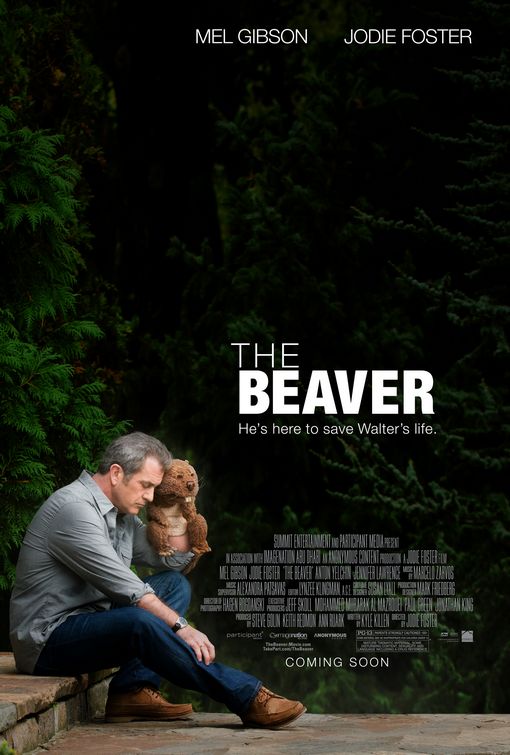 Eerily mirroring his real-life public breakdown, Mel Gibson stars in The Beaver as Walter Black, a man crippled by depression who finds a therapeutic outlet via animal puppet. The beaver is a puppet that Walter chooses to speak through, albeit in a cockney Brit accent that sounds faintly like Ray Winstone (The Departed). Given this twee premise, you’d expect plenty of laughs, but under the prosaic direction of Jodie Foster, also starring as Black’s anguished wife, the movie comes off like a stupefying heart-tugger, a sub-American Beauty style in suburban mawkishness. The comedy and drama elements don’t gel at all, and The Beaver is too tonally disjointed to settle down. Gibson gives a strong performance as a man battling his demons, and the subject matter of mental illness is thankfully treated with respect despite the fantastical premise. It’s the extraneous moments outside the beaver that help to detract and distract. The story of Walter’s son (Anton Yelchin) worrying that he’s already showing signs of mental illness, doomed to end up like the father he hates, is a palpable storyline. But writer Kyle Killen sums up this dilemma with clumsy brevity, having the son jot down post-it notes of behavior he has in common with dad, behavior to be eliminated. The entire subplot involving the son romancing the school Valedictorian (Jennifer Lawrence, sunny and beautiful as always), a pretty gal troubled with grief, never feels authentic. That’s the problem with The Beaver; too much feels inauthentic to be dramatic and it’s too subdued and brusque to be dark comedy. It’s like the strangest public therapy session ever for a fading star.
Nate’s Grade: C+
Share this:

Black Swan (2010)
 The prissy world of prima ballerinas and tutus doesn’t seem like a natural fit for sex, murder, lunacy, and mayhem. Director Darren Aronofsky (Requiem for a Dream, The Wrestler) is used to exploring the punishments of the human body and the strain of the mind, so you know that Black Swan isn’t going to be your traditional dance movie.
Nina (Natalie Portman) has been a company ballerina in New York City for years. She spends her hours at home practicing the grueling routines in hopes to break out for a lead role. Her mother (Barbara Hershey) is a former ballerina herself who gave up her shot at the big time when she had Nina. Then the head of the dance company, Thomas Leroy (Vincent Cassel), has decided that Tchaikovsky’s Swan Lake will be the first show of the season. It’s a bit tired, he admits, but he has a plan to juice it up: the same dancer will portray both the swan queen (tragic protagonist) and the black swan (villainous temptress). All of the dancers are committed to doing what they can to earn that coveted lead role. Nina’s primary worry is Lily (Mila Kunis), a dancer who is imperfect in technique but honest and free in her movements, garnering the attention of Thomas. In the process, Nina is losing her grip on reality. She’s hearing weird things, seeing weird things, and something dark wants to take center stage.
 Black Swan is a grade-A mind freak of the first order, a tonal fusion of sight and sound that echoes earlier masterworks of the eerie psychological horror like Rosemary’s Baby and The Shining. This is a movie that gets under your skin; I literally had a nightmare the night after watching it, though I don’t want to give people the wrong impression. Black Swan is not a horror film by the traditional standard we’re accustomed to today. The entire film has a downright Kubrickian vibe, from its devoted tracking shots, to the overdose on classical music underscoring the dramatic tension, and the unraveling of the human mind toward eventual psychosis. Aronofsky keeps the audience tethered to Nina, at times literally. The camerawork will rarely stray away from Portman, like we’re caught within her orbit and forced to see the world through her fractured perspective. She is our eyes to the world but, as becomes increasingly apparent, we cannot trust what we see. The unreliable POV leads to some fantastic freak-out moments that will consistently leave you scrambling. The diligent pacing marvelously matches the dissolution of Nina’s psyche. As her paranoia and delusion take control, Nina comes undone one thread at a time, with Aronofsky on the other end providing the tugs. The spiraling mental determination culminates with a glorious 20-minute finale that manages to be tense, beautiful, haunting, and powerfully moving. There are moments in this film that gave me goose bumps (a blood red-eyed Portman growling, “It’s my turn” is a chilling highpoint). I became determined to see Black Swan again even before the closing credits arrived.
Aronofsky makes use of every tool at his disposal to heighten the intense atmosphere. The attentive editing and camerawork create a shifty mood, communicating Nina’s desperate groping for direction. But beyond that, Aronofsky employs subtle sound effects to rattle you, keep you off guard. Routinely there will be the fluttery sound of wings flapping or hushed whispers. It’s enough to make you shudder time and again. It’s a small touch that elevates the mood and instantly snaps you to attention whenever you hear the eerie echoes. The disquieting sound effects are coupled with equally subtle visual effects. As Nina absorbs herself in her ballet role we occasionally will witness the pores of her skin raise, as if invisible hair, or fathers, are protruding. Sometimes these raised bumps will wash over her body in waves. As Nina becomes more consumed with her darker impulses, the special effects take a surreal role in conveying her madness.
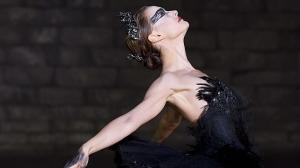 The film is also rather sensual without becoming trashy, late-night Cinemax fodder. Portman’s descent is linked with loosening up her own sexuality. She can portray the innocent and delicate white swan, but she’s having significant problems portraying the ominous and seductive black swan. She’s told to let go, lose herself to her physical impulses, and explore the confines of her nubile body. Black Swan is probably the artiest high profile film to feature prominent female masturbation since 2001’s trippy Mulholland Drive (the two movies have plenty of similarities in ambition). Nina’s suspicions about her rival transform into confusing erotic fantasies that will delight the teenage males in the crowd. Black Swan treads the erotic terrain with a European sense of maturity and candidness. The sex and masturbation and bisexual smooches don’t feel like gross, gratuitous shots at cheap titillation.
Portman ably takes the frazzled lead and gives an enthralling performance that will be hard to beat come Oscar time. The role is a lot more than screaming and crying. Although to be fair, Portman cries a whole lot. You may lose count the amount of times Portman is seen crying on screen. Her character is fragile but not fighting for sympathy. She can be distant and a little cold, obsessed with reaching the unattainable state of perfection. This pushes her to the extreme, goaded by her somewhat loopy mother. Portman has always been an attractive presence on screen, but she is also fairly transparent when she’s bored with her material (watch those Star Wars prequels and argue differently, I dare you). With Black Swan, she throws herself into a role like I’ve never seen before from Portman. I did not think the kewpie-dolled actress was capable of such heights. The immersion is entrancing. She physically trained for over a year before production to be able to do most of those pirouettes and fouettés. I’m not being overly generous with the dancing accolades; Portman comes across as smooth as a professional. The fact that Portman is capable of expressing so much devastating emotion through dance is astounding. My eyes were glued to her every movement. This is the performance that officially lifts Portman to the acting big leagues. She dances circles around the acting competition for 2010.
While it’s certainly Portman’s show, the supporting cast all shine in their small roles. Kunis (Forgetting Sarah Marshall, Book of Eli) is made to exemplify the edgy opposing force in Nina’s life. Kunis’s natural charm and alluring presence might make her the most likeable character in the film, even though her wild ways will keep you guessing about her true motives. Hershey (Hannah and Her Sisters) seems like a doting and supportive mother at first glance, but the actress reveals shades of desperation and mania. Winona Ryder (Star Trek, Girl, Interrupted) makes a welcomed near-cameo as the ballerina pushed out of the spotlight. And then Cassel (Ocean’s Twelve, Eastern Promises) plays lecherous creep like few others.
 The film manages to make ballet feel like a contact sport. These people punish their bodies, their artistic vessels. The rigorous routines require dancers to be in sleek form, which often leads to abuse via bulimia. The excruciating balance and coordination required places unusually high demands on the human body, particularly on the feet that must support the body in extreme positions. Broken toes and split nails are the least of the worries. Black Swan succeeds in showcasing the fierce brutality of dance; however, the movie also showcases the intrinsic beauty. I am a self-described novice when it comes to dance, especially ballet at that, but even I was spellbound by watching the dancing, notably the exhilarating Swan Lake opening night performance. The camera is positioned to be like another dancer, so we’re swooping and spinning around the stage with the featured performers. This gives the audience an intimate glimpse into the fluid movements and, just as importantly, the nuanced and sensual expressions of the performers. I would have scoffed at the idea of a ballet performance being anything more than frou-frou-ness, but Black Swan made me a believer. Witnessing the beauty and gracefulness of the dancing is proof that all that hard, punishing preparation is worth it.
Probing the stress of the body and fraying endurance of the mind, Black Swan richly explores the sacrifices we make for art and ambition. The world of ballet is highlighted as a hotbed for scandal and intrigue and female sensual desire. Not bad for all that hoofing around in frilly tights. Black Swan is anchored by Portman’s captivating descent into madness, a performance that will surely be awarded in the ensuing months to come. Aronofsky has fashioned a riveting psychological thriller with enough artfully crafted chills and spooks to make for one visceral experience at the art house. Beyond bringing the tingles of spine and bumps of goose, Black Swan digs into the psychological underpinnings of competition, devotion to art, and personal glory. There’s much more going on here than ballet. It’s a grade-A mind-freak but under Aronofsky’s skilled direction and Portman’s transfixing acting, Black Swan is also a grade-A piece of art and one of the most stunning works of cinema this year.
Nate’s Grade: A
Share this:

Antichrist (2009)
 Just in time for Easter, I watched notoriously sadistic filmmaker Lars von Trier’s (Dancer in the Dark, Dogville) controversial psycho-horror film, Antichrist, and wow, is this a loathsome, powerfully unpleasant experience. There’s about five minutes of worth in this whole film. In a beautifully shot black and white prologue, we watch a couple (Charlotte Gainsbourg, Willem Dafoe) have sex and, unbeknownst to them, their baby falls out a window and dies. It’s all downhill from there and at rapid speed. The remaining movie explores Gainsbourg’s trauma and grief and her husband’s therapeutic attempts to cure his wife. There’s a somewhat intriguing premise buried underneath the mounds of psychobabble — a husband blurring the lines of professionalism to become his partner’s therapist. There are some complex ethical and emotional areas to explore there, but alas, von Trier takes his characters to a spooky cabin in the woods (named “Eden” for maximum metaphorical pretension) and the move becomes one long, incomprehensible, pompous trek into weirdness and pseudo-intellectualism. von Trier wants his movie to be disturbing, so he packs it will strange images like a dead talking fox (“Chaos reigns”) and a stillborn baby dear handing from the back of its mother, intending to convey the ruthless brutality of the natural world that his characters must navigate. Except I never cared about these characters at all. We never get to know them, so we can’t really feel for them, so when they start becoming unhinged it has no dramatic weight. Their lengthy conversations are a drag, and one psychology exercise after another doesn’t make much sense. The von Trier narrative model (woman is relentlessly tortured) is alive and well and leads to some shocking scenes of over-the-top sexual violence. von Tier’s attitude toward women, and female sexuality, has always been somewhat sketchy; is he an exploitative misogynist or a cloaked feminist arguing that the male-dominated world cannot handle feminine sexuality and independence? I feel like von Trier is an artist that could be diagnosed with Munchausen’s by proxy syndrome.
Nate’s Grade: D+
Share this:

Big Fan (2009)
 The directorial debut from the screenwriter of The Wrestler follows another down-on-his-luck loser. Patton Oswalt gives a surprisingly dark and affecting performance as Paul, a 35-year-old tollbooth worker that still lives with his mother. Paul’s life is devoted to his favorite sports team, the New York Giants. He spends his evenings meticulously planning his call-in statements to the nightly sports radio show. He’s so devoted to his team that when Paul gets brutally beaten by his favorite Giants player he blames himself. The player gets suspended and the Giants start piling up losses, and Paul can’t deal with the crushing guilt he feels. Big Fan is an intriguing exploration of how absorbed people can get with fandom; I always thought it a bit odd when people refer to a team’s accomplishments with “we” like they had something to do with it. Paul’s fragile world is coming apart and he breaks down with it. Obviously, Paul has a few screws loose in order to make him unpredictable, which gives the last twenty minutes some serious unease. Paul goes undercover as a Philadelphia Eagles fan (his disgust at putting on the enemy jersey is palpable) to hunt out his gloating sports radio nemesis Philadelphia Phil. Big Fan is occasionally funny in an under-your-breath kind of way, but really it’s more of a small-scale psychological study on a hapless individual whose religion is sports and who feels he has sinned before his almighty God. At a mere 86 minutes, the movie doesn’t press too hard into the twisted psychology, nor does Paul leave much of a dent as a character as the film doesn’t make judgment on his obsessive behavior. This isn’t as poignant as The Wrestler, pure and simple. Yet, Big Fan is buoyed by a strong performance by Oswalt and some interesting insights into a flawed fan willing to go all the way for his team.
Nate’s Grade: B


 nathanzoebl
You must be logged in to post a comment.