Blog Archives
Suburbicon (2017)
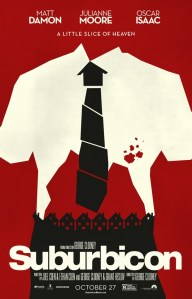 Suburbicon began as a script written by Joel and Ethan Coen back in the 1980s. They shelved it and went on to other stories and justifiable acclaim. George Clooney came across the old screenplay and rewrote it with his longtime partner Grant Heslov (Monuments Men). Clooney’s version of suburban strife is a wash and also easily the worst effort of Clooney’s Oscar-nominated directing career. I wish Suburbicon would make up its mind on which of the three different movies it wants to tell. This is possible proof that Coen brother stories should best be left chiefly to the Coens.
Set amidst the 1950s, an African-American family moves in to an all-white suburban neighborhood and instantly changes the climate. The Mayers have upset the other middle-class white neighbors who want them gone, and they don’t mind subjecting this black family to all forms of harassment to get the job done. Meanwhile, Gardener (Matt Damon) and his wife (Julianne Moore), her twin sister (also Moore), and his son, are threatened by loan shark goons. The family is never the same but there’s more than meets the eye to this domestic tragedy, and the costly cover-up ensnares everyone in danger.
 This is a movie that feels badly stitched together with competing ideas and storylines. Two of these competing movies are so haphazard and lazily explored that it feels like Clooney and company tacked them on for some sort of extra failed social commentary about The Way We Live Now. The shame of it is that either of these vestigial storylines could have existed as their own compelling movie. The integration of the suburbs with a black family brings about an intense reaction. Fellow suburbanites harass the family at all hours of the day, destroy personal property, and do everything to let them know they are unwelcome in this “good-natured” community. The reactions are so virulent and disgusting, and all for a family just existing on the block, shopping at the same grocery store, thinking they too were eligible for the American Dream. There’s a movie there in its own right because, as evidenced in Suburbicon, it’s just background for a larger indictment on suburban values hypocrisy that never generally materializes. At no point does Clooney give the racist response any depth, nuance, or even a deserving spotlight. The only thing we learn is that it’s wrong, which should already be obvious. The entire storyline feels so unfairly attached to another unrelated movie. This family’s story is worth telling right rather than just having something else to cut back to.
Then there’s the larger satire on suburbia itself and its reported family values philosophy. Just because bad people exist and bad things happen in a “nice” community does not mean your satirical work is done. You’re just supplying air quotes to your location. This is the most facile form of irony, lazily slapping together something vulgar against an idyllic setting of morality. That’s why I had no interest in The Little Hours, a comedy that looked to be built around one sole joke, unexpectedly offensive nuns (“Oh ho, that pious person used profanity, and that will never not be funny”). Suburbicon is a story that could have existed in any setting, which further devalues any attempt at legitimate social satire. This isn’t about The Way We Live Now or Even Then.
If you look closely you can see the bones of a Coen brothers’ story here, the only movie of the three that could have worked for Suburbicon. An insurance fraud scam that involves murder and complications is a juicy start for a thriller with some dark comedy edges. This aspect of the movie is the most compelling because it’s obvious that the most attention has been paid to it. Also, there are reversals and unexpected turns that keep the story twisting and turning while accessible. However, the impact of the story is limited by the fact that none of the characters are generally likeable or that interesting. You won’t really feel anxiety over whether or not these people get away with their scheme, which deflates the film’s acceleration of tension despite the best efforts of Alexadre Desplat to replicate an ominous Carter Burwell, a.k.a. “Coen brother,” score. If you don’t care about the characters then they better get into some crazy escalating collateral damage. For a while, it feels like Clooney and Suburbicon understand this principle and begin to ratchet up a body count, though oddly it’s far too fast. Oscar Isaac (The Force Awakens) turns up as a nosy insurance investigation and is taken care of only in his second appearance. The film doesn’t take the time to force the characters to luxuriate in the unease. It just goes straight for the sudden violence, and after awhile it becomes pat and expected.
 This is Clooney’s weakest directorial effort yet. He’s clearly working from the visual framework of the Coen brothers’ classics, using the cookie-cutter production design of colorful suburbia for intended kitschy menace. Even some of the camera angles feel like something lifted from the Coen brothers. Alas, Clooney is not the Coens. He is a director capable of great things depending upon the subject matter, but this movie is a misfire from the start. Clooney cannot decide what the tone is supposed to be, so different actors seem to be operating in their own separate, competing movies. Damon (The Martian) is at either turn hapless or malevolent. I never knew what his read on his character was supposed to be. Moore (Kingsmen: The Golden Circle) is so over-the-top as a distressed housewife that you think she might start bouncing off the walls. It’s only Isaac that feels like he finds the sweet spot of what Clooney must have been going for, and thus it’s even more disappointing about his character’s limited screen time.
Messy, tone deaf, and lacking greater commentary, Suburbicon is a fatally flawed, overbearing dark comedy that has things on its mind and no clear idea about how best to articulate them. It feels like dissonant movies badly stitched together. The overall execution is lazy and relies upon the simplest form of irony to substitute as subversive suburban satire. The tone veers too wildly and the actors are desperate for some better sense of grounding. The characters are pretty flat and poorly developed. It’s an altogether mess that has a few inspired moments and a whole lot more uninspired. The victimized black family deserves to have their own movie and not be the backdrop of somebody else’s broad comedy. The racism is far too real to mesh with the comic goofiness of the rest of the criminal shenanigans. Clooney needed to settle on the movie he wanted to tell. I doubt the final version of Suburbicon that I saw is close to the Coen’s original screenplay. There may have been a good reason that they originally shelved it. Clooney shows that replicating the Coen look and style can be a fool’s errand even by an otherwise talented director. This is the worst Coen brother movie and it’s not even theirs.
Nate’s Grade: C-
Share this:

The Great Wall (2017)
 The Great Wall is the most expensive film in Chinese history and the first major co-production between an American film studio and a Chinese-owned studio. While Matt Damon is the name above the title, it’s filled with recognizable Chinese stars, like Andy Lau, Eddie Peng, and pop star Lu Han. China’s most renowned action filmmaker, Zhang Yimou, serves as the director. It has the look and feel of a Hollywood special effects epic but it’s very much a Chinese film in ownership and execution, perhaps marking a new synergy of East meets West blockbusters. With a whopping budget of $150 million, the same as the last Star Trek movie, it looks like a typical Hollywood big-budget epic with visual spectacle and sweeping vistas. It’s up to the viewer whether a majority-Chinese production successfully imitating Hollywood middlebrow action spectacle is a brave step forward or just another source for mediocrity.
In the 11th centruy, traveling European mercenaries William (Damon) and Tovar (Game of Thrones’ Pedro Pascal) are looking for black powder, an explosive substance that’s worth serious money back home. A mysterious feral creature attacks them and William cuts off the beast’s hand, taking it as a trophy. The Nameless Order, Chinese military officials stationed at the titular great wall, capture them and want to know exactly how these foreigners were able to defeat this beast. Legend states that long ago a meteor crashed to Earth, and with it came a horde of green monsters with big teeth lead by a queen that psychically controls her thousands of attack drones. Every 60 years the creatures emerge searching for food for their ravenous appetites. The Imperial City must be protected at all costs and that is why the wall was constructed. Lin Mae (Tian Jing) is thrown into command when her male superiors are killed, and she relies upon her unexpected Western allies to throw back the evolving horde of monsters.
 As the first major big-budget collaboration between studios in China and the United States, The Great Wall feels like something that would have escaped from the 1990s era of tentpole filmmaking, and it’s clearly a paycheck film for all involved. Now that doesn’t condemn in either regard. There’s a certain charm to the relatively dumb sci-fi action movies that started being prepped with steady regularity in the 1990s when advancing special effects made it possible for hordes of CGI monsters to thwart. There’s an obvious point of engagement that crosses all translations: man versus monsters. The film even somewhat admirably knows its own ridiculousness and embraces it. I was reminded of the go-for-broke silliness of Jerry Bruckheimer’s movies like National Treasure’s positing that maybe, just maybe, there’s a treasure map on the back of the Declaration of Independence. This feels like the biggest budget Asylum movie you can imagine, and that in itself is not necessarily a problem. However, because of the mechanical nature of so much of its storytelling and the safe territory it resolutely occupies, The Great Wall is a mediocre monster movie that aims right down the middle for cross-continental mass appeal and nothing more. I’m almost certain that Damon had to have been paid $20 million dollars to justify his participation. The actors and the director go about their business in a professional manner but you feel the lack of passion. It’s a film looking to appeal to the most people and losing any sense of distinction.
Credit director Yimou (Hero, House of Flying Daggers) for keeping the film on life support, providing just enough action variety and pleasing visuals to stir an audience awake. The monsters are introduced very early into the film, around the twenty-minute mark, and their CGI horde definitely presents a worthy challenge. In fact they feel too overwhelming in their numbers. Early on we see that the ferocious creatures, which closely resemble the Ghostbusters demon dog painted green, are hard to kill outside of a straight shot to their shoulder-eyes (they have eyes on their shoulders… because…). The first creature that successfully scales the wall takes out a slew of Chinese warriors. If one of these things is that hard to kill, how in the world can a limited number of people, even with high ground, defend against a sea of a hundred thousand? The mismatched numbers deflate the stakes and lessen the tension, which isn’t helped from subpar characterization. The world building is certainly hazy (Why do they come out once every 60 years? Why do magnets affect them? Why all the effort for small food supplies?) and some of the elements feel inserted just for their “cool” factor. A group of female warriors bungee jump off platforms to spear the monsters, but why is this necessary when we’ve already seen that China has fiery projectiles that are far more effective? It is cool though.
Thankfully a movie with little going for it other than spectacle at least knows to vary up its action sequences. Each encounter with one of the monsters is structured differently. The best sequence may be William and Tovar navigating through a blinding fog and relying upon the sounds of whizzing arrows to alert them to approaching hungry monsters. It provides some fun tension and pop-out moments. There’s a beautiful sequence commemorating a fallen friend with the launching of hundreds of floating lanterns. The concluding sequence involves our remaining characters climbing to the top of a pagoda lined with stained glass. As the characters rush up flights of stairs, the screen is lovingly diluted with colored shafts of light, which also add extra visual flourishes when the monsters begin to leap through the glass level by level. Yimou’s use of color has always been a hallmark of his career and it translates even into the color-coded amour of the different divisions of the Nameless Order. They look like ancient Power Rangers. While lacking a great deal of overall tension due to its predictable nature and dull characters, there are fleeting moments of suspense drawn out in individual action set-pieces. The overall movie is generally unremarkable CGI carnage reminiscent of a too-late Lord of the Rings rip-off, and yet there’s at least a general professionalism to its unremarkable CGI carnage.
 Early on the movie was hit with accusations of whitewashing, and given Hollywood’s recent track record with the likes of Exodus, Aloha, and Gods of Egypt, it would be entirely conceivable that producers felt Damon needed to be a white savior role. That’s not the case at all and in fact the Chinese forces are shown to be flawless specimens. Damon’s character is the out-of-place European (complete with hard to place accent) who represents selfish and arrogant Western attitudes. He’s routinely awed by the ability and precision of the Chinese warriors, who dutifully sacrifice for the greater good and safety of others they will never know. They are symbols of power, teamwork, courage, strength, and dignity. The lessons can be rather blunt (a woman… in charge?!). The portrayal of the Chinese forces is so honorable and so empowered that they come across as boring moral paragons without an ounce of traceably human nuance. They don’t come across like characters so much as interchangeable warriors, and so when they start dying one-by-one their sacrifices ultimately leave little impact. It turns out that the non-Chinese actors, Damon and Pascal, supply the most interesting characters because their roles are allowed personality, basic moral ambiguity, and inner conflict beyond a sense of duty and the requirements of achieving that duty. The Great Wall drafts off Damon’s worldwide star power to teach him a lesson about Eastern values. It certainly presents China and Chinese characters in a very positive perspective, but being so broad sanitizes their humanity and transforms people into boring paragons.
Given the pedigree of those involved, it’s completely expected to be underwhelmed by the end results of such an expensive East meets West collaboration. The Great Wall is ultimately too safe and stately to satisfy beyond generic genre thrills; lowering one’s expectations is highly advised in order to properly appreciate the goofy action spectacle. The Great Wall of China being constructed to protect from a horde of ravenous, possibly extraterrestrial monsters is certainly a silly premise, but the movie doesn’t pretend it’s anything than what it is, a large-scale monster movie with a sense of fun. It’s not soaked in deconstructive irony or meta commentary. Instead, The Great Wall is a straight-laced action spectacle that treats its absurdity with conviction. It’s not much better or worse than other empty-headed big-budget action cinema from the Hollywood assembly line, but is that progress? Is making an indistinguishable mediocre B-movie a success story?
Nate’s Grade: C
Share this:

Jason Bourne (2016)
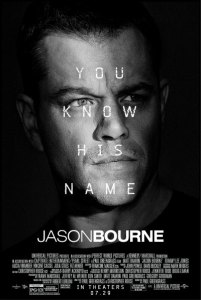 After the indifferent reception of its 2012 spin-off, original super spy Jason Bourne (Matt Damon) and director Paul Greengrass (Captain Phillips) are back and it feels like everyone is falling into familiar paces. The titular fourth film in the franchise (excluding Bourne Legacy) is easily the weakest (excluding Bourne Legacy) and the seams of the formula are starting to show. Once again an ally has intel to expose some sort of secret and illegal government conspiracy that ties into a revelation about Bourne’s past, and once again this ally is killed as the Act One break to spurn Bourne onward, and once again there’s a secondary assassin working for the morally murky government agency head, and once again there’s a signature car chase sequence, and once again there’s a final choice Bourne needs to make about what kind of person he wants to be given his new perspective on his old killin’ ways. The frantic Greengrass staple camerawork and editing can make just about anything bristle with some energy and suspense, but rarely was I fully feeling what was happening onscreen (except for the caveat of admiring how attractive Alicia Vikander’s face looks on the big screen). Short of the final car chase through Vegas with a SWAT truck barreling through traffic, the action sequences are pretty routine and unmemorable. The foot chases and fisticuffs, a hallmark of the franchise, feel slightly blasé in their development. The action isn’t bad but it feels more than a bit staid. The stakes aren’t as high and maybe that’s because it feels like there is little more to reveal about our hero’s hidden past. Is the next movie going to divulge the long lost secret that he never paid a parking ticket? Tommy Lee Jones makes an enjoyably crusty adversary. Vikander has just enough of an angle to provide more substance as a character than the typical agency analyst reciting exposition. The film ends with some promise of looking forward rather than back, and I hope that further adventures with Jason Bourne (excluding Bourne Legacy) stray a little more from the well-worn formula and provide better reasons for this spy to come out of his hiding.
Nate’s Grade: B-
Share this:

The Martian (2015)
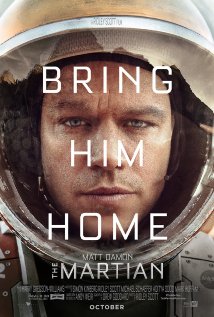 Based upon Andy Weir’s nuts-and-bolts scientific “what if” tale, The Martian is the movie equivalent of Apollo 13 crossed with Cast Away. Just far less personable volleyballs. But there are potatoes. Space potatoes.
After a powerful storm on Mars forces NASA’s crew to flee, astronaut Mark Watney (Matt Damon) is presumed dead and left behind. He wakes up hours later, shrapnel in his gut, and retreats back to the Mars mission base. He has to survive close to two years before he has any hope of being rescued on the hostile world. Before that, he has to establish some kind of communication with NASA, and even before that he has to somehow grow food in the arid Martian soil. Back at home, NASA is debating their limited options to bring back Watney and whether or not they should tell his crewmates that he survived.
In conversations with my friend and critical colleague Ben Bailey, he said that The Martian was the opposite of Gravity, a film he subsequently loathed, because it was smart people making smart decisions. There is an inherent enjoyment watching intelligent people tackle and persevere over daunting challenges, and this sets up The Martian for lots of payoffs and satisfaction. We see both sides of the problem and it provides even more opportunities for challenges and payoffs. Naturally the stuff on Mars is more compelling because of its extreme dangers and isolation, but the Earth scenes are also enjoyable as the NASA determines the soonest they might reach their lost astronaut. Just like the similarly themed Apollo 13, there are challenges to be overcome and the solutions are not without risk themselves. I enjoyed how the screenplay kept throwing out new obstacles; just when you think you can breath for a while the status quo is upset again. The slew of new obstacles doesn’t feel contrived either but rather realistic setbacks. It’s a wonderful storytelling structure that constantly keeps things moving forward and ramps up the urgency. As a result, we don’t ever feel safe right until the climax, and even then you’re still sweating it out because of all the complications and adjustments.
 It’s revitalizing to watch a movie that treats science with a sense of reverence. Mark Watney endures in the most hostile of environments through his ingenious use of the resources he has because of his understanding of science and math. Just as MacGyver proved there was something satisfying about watching a guy make a bomb out of a toilet paper tube, some chewing gum, and a bobby pin, it’s entirely enjoyable watching Watney think his way out of problems, and this starts early on. Watney’s first problem after he regains consciousness is to remove an embedded piece of shrapnel in his gut. The scene plays in a methodical fashion without any obtrusive edits, allowing the full task to settle in with the audience. The man has to perform surgery on himself and dig inside himself, and if he doesn’t get this done soon, sepsis might set in (no doctors without borders here). From there, the situation only gets more serious as Watney’s food supply, even when generously rationed, will only last a fraction of the time it would take NASA to send a rescue team. He has to grow food on an alien planet. That itself could be its own movie, a glossy crossover special from the SyFy Channel and the Home and Garden network. This is a survival story that doesn’t rely upon coincidence or some sort of divine intervention but on the understanding and admiration of science and its possibilities. Though America’s favorite astrophysicist Neil deGrasse Tyson says that in this movie universe, all the science decisions are being made by science professionals rather than, you know, politicians who adamantly open ignorant statements with, “I’m not a scientist.”
Another aspect I wasn’t quite expecting but took hold of me is how uplifting The Martian turns out to be. It’s a celebration of human endeavor and particularly cooperation, as the United States reaches out to other nations for assistance. Watching the determined souls risk their lives to retrieve one fallen man is the kind of thing that represents the best in us. Sure, there’s something to be said about the fact that it’s one prized American life that countries are spending billions of not trillions of dollars to rescue and perhaps that money would be better spent helping more lives on Earth. There’s also the curious fact that the world has spent a ton of money rescuing Matt Damon in movies. From Saving Private Ryan, to Interstellar, and now The Martian, we seem to value Damon above all else.
This isn’t exactly a one-man show with half of the running time flashing back to Earth but Damon’s star quality and acting chops makes it so you don’t mind being marooned with this man. Watney’s recorded messages are a slick way to deal with the internal thinking of its protagonist while giving the character more opportunities to charm thanks to a rich sense of gallows-level humor. At no point is Mark Watney flippant about his unique predicament but his sense of humor goes a long way to further engender the audience’s good will. He’s not moping and having existential crises; he’s getting to work, and it’s through the problem solving that we get to know this character, his ingenuity, his personality, his fears, and his distaste for disco music. Damon steers clear from playing the character too large and bearing his soul as the metaphorical representative for all of humanity and its place in the cosmos. He’s just one guy who happens to be lost millions of miles from his home planet, and he’s making the best of it.
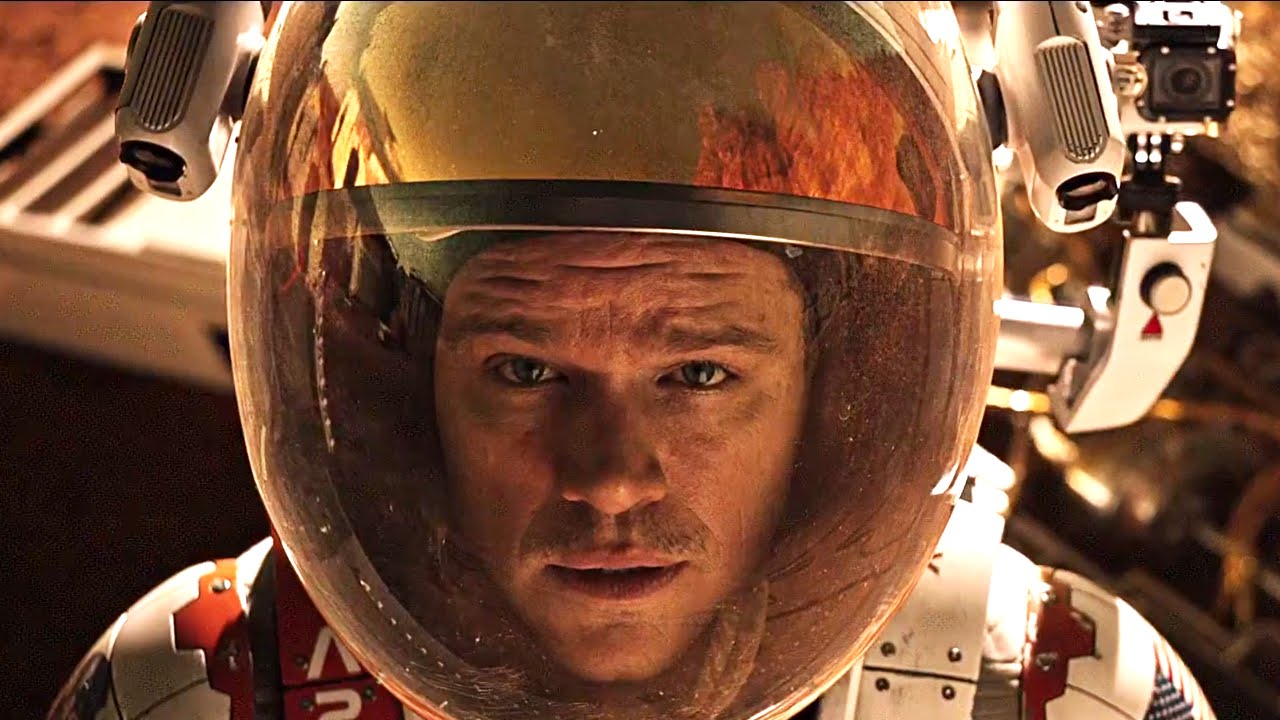 Being a Ridley Scott film, naturally the film is downright impeccable from a technical standpoint. The photography is great, communicating the frightening and awe-inspiring scope of the alien topography, especially when compared to maps for scale. The visuals find ways to further help communicate Watney’s dilemma and diminished resources. Scott’s visual sensibilities are so naturally attuned to developing tension. I was holding my breath at times from the suspense of certain sequences even though I long assumed that Watney would make it back home safe and sound. A scene with a desperate need for duct tape was a real nail-biter. There isn’t a bad performance among the star-studded cast of actors who must have been grateful for even a tiny morsel of screen time. I have no idea what Kirsten Wiig really does in this movie as the NASA PR person besides fold her arms in rooms, but hey, she’s there, along with Donald Glover as a socially awkward physicist. Jessica Chastain (Zero Dark Thirty) gets to pour over the regret of leaving a friend behind, Jeff Daniels gets to once more practice his skill of being an authoritarian blowhard he honed from The Newsroom, and I even was able to tolerate Kate Mara (Fantastic Four), so that’s something.
The Martian is a natural crowd-pleaser. It’s engineered from the start to engage an audience with its survival thrills, present a series of increasing payoffs with new challenges and solutions, and by the end of our journey we’re treated to a rousing finish that carries a poignancy and sense of inspiration about the best in all of us, what can be accomplished through grit and cooperation and sacrifice. It’s a movie that let’s the science of survival be the ultimate star, with Damon serving as a handsome host to guide us through the marvels of the universe and duct tape. When dealing with the vastness of space and the vulnerability of human life, it’s easy to feel insignificant in comparison, but that’s where the human will to endure and to work together comes in and reconfirms the possibilities of the collective inhabitants of this giant blue orb. The Martian is a sci-fi thriller, a potent human drama, and one of the best times you can have at the movies.
Nate’s Grade: A-
Share this:

Interstellar (2014)
 While arguably the industry’s most ambitious blockbuster filmmaker, Christopher Nolan hasn’t released a film to his name that I would call a misstep; even the weaker but still altogether thrilling Dark Knight Rises. Until now.
In the twenty-first century, food shortages and climate change will render Earth inhabitable. The planet is dying and the only hope is to find a new home in the stars. Conveniently, a wormhole near Saturn has opened and a secret NASA mission sent 12 brave astronauts through to send back information on the 12 potential worlds. Cooper (Matthew McConaughey) is the best pilot in the world, a former NASA employee, and trusted by the project’s leader (Michael Caine) to lead a team (Anne Hathaway, Wes Bentley, David Gyasi) to the other side of the universe. Cooper is hesitant to leave his children behind, particularly his ten-year-old daughter Murph (Mackenzie Foy), who says a peculiar ghost is haunting her in her room. The greater good wins out, and Cooper reluctantly blasts off into space to save his children and all Earth’s children.
Interstellar is clearly a personal film for Nolan. It’s about nobility, exploration, sacrifice, but really it’s about a father trying to get home to his daughter (the son doesn’t really seem to matter as much in the story). Nolan’s catalogue of films has been able to straddle the line between blockbuster and art, providing mass appeal with uncommon intelligence and nuance. However, I don’t think Interstellar is going to work for most audiences.
 Maybe I’m just too savvy for my own good having seen plenty of movies, but I could accurately predict every single plot turn and Nolan and his co-screenwriter brother Jonathan made it easy. When we’re told about a ghost within minutes and it’s a movie about space travel, you shouldn’t need any help. And then the ghost ends up speaking in Morse code and communicating, “stay,” that’s Nolan hitting you over the head with what to expect by the end (a conversation how parents are ghosts for their children is too much). You should also be able to figure out who Ellen Burstyn is going to be, and it’s not going to be Talking Head #3 in a television interview. Likewise, the illustrious astronaut Dr. Mann is referred to but purposely never shown, so you can assume it’s going to be a familiar face, which it is. Then once that A-list actor is onscreen you know there has to be more to this character because why would a movie star agree to play a part that amounts to merely, “Yeah, this planet is good. We’re done here”? Because of the slow nature of the film it makes the easily telegraphed plot turns more frustrating. The supporting characters are presented so incidentally, as if they didn’t merit extra time. Amelia (Hathaway) has one mushy monologue about the power of love, tipping the film’s philosophy, but that’s all there is to her character. The rest of the cast amounts to stuff like Black Guy on Ship and Bearded Wes Bentley. Nolan’s past work has been very generous to the characterization of his supporting players, especially with the Dark Knight trilogy. These people mattered. With Interstellar, their impact is purely in the name of plot and serving the father/daughter relationship.
And yet, the movie also precariously dips into the danger zone of boredom. Quantum physics isn’t going to be a popular conversation topic for your average moviegoer. There’s a reason that Back to the Future has a wider audience than Primer. By no means am I advocating for a lobotomized science-fiction experience, but Nolan seems to only have two modes when it comes to his characters and their dialogue here: treacle or science jargon exposition. I paid attention but it’s easy to zone out or just have your eyes glaze over as characters talk about the ins and outs of time travel, black holes, relativity, and gravity. The equally frustrating part is that all of the emphasis on science is thrown out the window for the film’s protracted resolution, offering a climax that intends to close a time loop but really only opens further questions when you know the identity of the “they” in question making all the plot mechanics happen. It all just ends up as a simple message to spend more time with your kids. The plot is dense without being particularly complex. The pre-space sequences take up far too much time and in general the Earth plots just don’t compare with the alien planet space exploration. When Cooper is venturing into a rocky alien world, I don’t want the film cutting back and forth between that struggle and his daughter on a dusty Earth. I wish all of the Earth sequences post-liftoff were jettisoned from the screenplay.
For a solid chunk in the middle, Interstellar becomes the exact film I wanted it to be. The crew has traveled through the wormhole to another galaxy and now has to deliberate. Which planets will be visited? What are the risks? Is data more important than human messages? Is returning home more important than fully exploring the worlds? What happened to the explorers? I could have dealt with the entire movie playing out this intriguing and conflict-driven scenario. You feel the immense magnitude of every one of their decisions. The future of humanity depends on them. Every planet provides a new mystery; what’s it like and what happened to the explorer? When you’re dealing with a finite supply of fuel and time dilation, there are debatable options as to what is best for the numbers. There’s always Operation Repopulate as well. If you have to start somewhere, McConaughey and Hathaway are not bad genetic pools. For this stretch, Interstellar is fabulous. It’s a shame then that the film then engineers a plot conflict that dominates the direction of the third act.
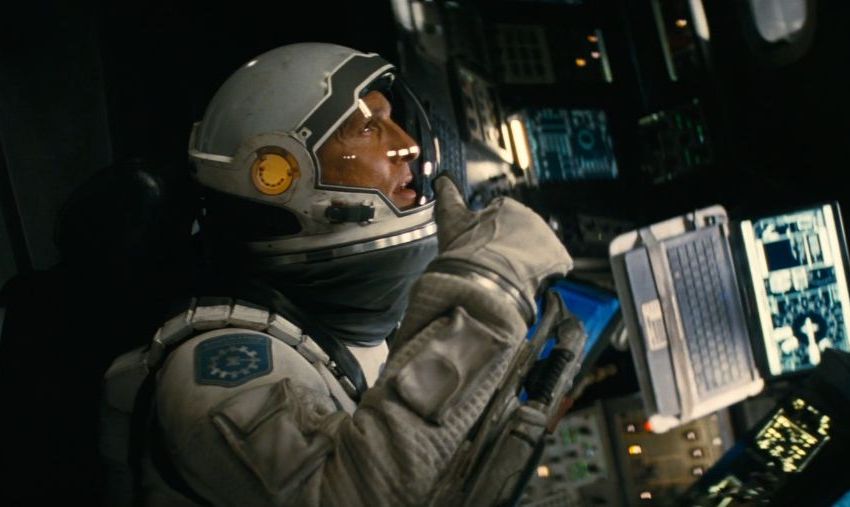 Nolan hasn’t lost his gift for crafting eye-popping visuals and bringing a rousing sense of scale to his movies. Interstellar is blessed with spectacular images of our universe, alien worlds, and mankind’s place in the whole realm of the cosmos. Nolan’s usual DP, Wally Phister, was unavailable, taking time to direct his own debut, Transcendence (probably the last film he directs as well, like Janusz Kaminski’s little-seen, little-remembered Lost Souls). The change of DP does Nolan good, giving the film a different, Earthier feel under Hoyte Van Hoytema (Her, Let the Right One In). Nolan isn’t the greatest stager of action but he is remarkable about putting together memorable set-pieces, and Interstellar has some standouts from the hostile alien environments to a thrilling space-station docking that is not for those susceptible to motion sickness. The special effects are terrific and the retro cubist robots are a fun addition. The only technical element I found lacking is the score by Nolan’s usual accompanist, Hans Zimmer. It’s bleating organ music intended to add a spiritual sense to the cosmic awe but it mostly becomes annoying. It sounds like a church organist died atop their instrument.
There is one great moment of acting in the film. Not to say there is an overabundance of bad acting, more like over emoting with a script and dialogue that do not deserve the waterworks. It involves Cooper after a mission, catching up on video messages sent from his children on Earth. In this very efficient scene, the magnitude of the consequences of Cooper’s decision is emotionally raw and he is overpowered with regret. McConaughey has been on a record-breaking tear of supreme acting performances, especially if you count his mesmerizing turn in HBO’s True Detective. Nolan allows the moment to play out, to sink in, without overdoing it, and it succeeds wildly. The other times Interstellar tries to wring out emotion feel too facile and maudlin to be effective.
This is my first real Nolan disappointment, a bloated film struggling to be important and say Important Things about the Human Condition but coming up short. It has its moments of excitement and awe but more so those moments are surrounded by too much dead space. The story is dense while still being undercooked, with too many listless supporting characters that amount to nothing, and easily telegraphed plot turns that are frustrating. Interstellar snuffs out all the intriguing possibilities it has to come back to its sappy father/daughter relationship that never truly feels earned. By no means is Interstellar, Nolan’s space travel opus/ode to Stanley Kubrick, a bad film. Unless you’re a sucker for easy sentiment, it will likely be a disappointment in some way, whether it’s too long, too boring with its science, too cloying with its emotional tugging, or just underdeveloped and overcooked at the same time. Interstellar is ambitious with its vision but seriously flawed and ultimately an obtusely personal sci-fi snoozer.
Nate’s Grade: C+
Share this:

The Monuments Men (2014)
 An all-star cast, a true-life tale that incorporates a treasure hunt, a race against time, Nazis, and fish-out-of-water tropes as non-soldiers are placed in harm’s way, plus the skills of George Clooney behind the camera; in short, how could this go wrong? With that plot makeup and this cast it would take more effort to tell a boring big screen adventure of the real-life Monuments Men (and women). And yet, the movie found a way. It’s by no means a bad film and its heart is in the right place, but allow me to explain why The Monuments Men sadly fails to live up to its mission.
It’s 1944 and Adolf Hitler doesn’t just have his sights on constructing a permanent empire, he wants all the world’s art treasures as well. The Nazis have been plundering famous works of art, and while the war is coming to a close with the Allied invasion, the fate of these priceless works of art may be in jeopardy. Frank Stokes (Clooney) is tasked with putting together a team to save Europe’s art from the Nazis. He puts together an unconventional group of soldiers (Matt Damon, John Goodman, Bill Murray, Bob Balaban, Jean Dujardin, Hugh Bonneville) and search for the hidden loot.
 The film looks like it’s going to be a high-concept heist film when it reality it’s a series of vignettes that do not add up to a solid whole. Early on, the Monuments Men team is scattered to the wind, divided into pairs, and so we have four or five competing storylines that don’t develop as desired. To be fair, there are some very good scenes, well executed and written by Clooney and Grant Heslov (The Men Who Stare at Goats) where the conflict is turned up, but the film cannot escape the fact that it feels more like a series of scenes than a cohesive story. Not all of the stories are equal in their interest as well. The Cate Blanchett (Blue Jasmine) and Damon storyline in France amounts to little else than her stalling for as long as the plot necessitates, then handing over the Very Important Info, then she’s swept aside. The comical asides, notably with Murray and Balaban, feel like scene fillers when there could be stronger material. Once they’re reunited as a group, you wonder why we even needed the time apart. Perhaps it’s an attempt to showcase a wider sampling of stories and perspectives on a complicated war, which is fine, but the characters don’t get the same complicated examination. Despite physical descriptors, these guys are fairly one-note and stay that way, which is a real shame especially when we start losing Monuments Men. The attention is split amongst a bunch of characters lacking proper development. If I felt like we knew these guys on any substantive level, I would feel more at their untimely passing.
Another issue that exacerbates the directionless feeling pervading the film is that it lacks a clear and concise goal. I understand they’re saving and rescuing art, but that’s kept vague until the very end of the film when it becomes more concrete. Until then, the guys are just traveling from place to place, retrieving this piece or that, having comic misadventures, and the movie just feels like it needs a stronger guiding force to corral all these stories, a concise goal that each scene builds onto and where the urgency increases. Late in the film, I got a glimpse of exactly what kind of movie Monuments Men could have been. Once the war is over, the Germans are replaced as antagonists by the Russians (two-for-two with classic American movie villains) and it becomes a race against time to get to the art before the Russians confiscate it. There was always a ticking clock in the film, as Hitler was assembling his art and his command would destroy them in spite of returning them. However, in the very end of the film, the urgency is cranked up, made real, and for once the film emerges with a sense of suspense. I think it would have been a more engaging film experience if the scope of the film were narrowed simply to the material covered in the climax, namely beating the Russians to the art reserves. It practically has a Raiders of the Lost Ark feel with two parties trying to outrace the other to the next precious treasure. How cool would that movie have been?
 Another problem is the film’s seesaw tone never really gels together in a satisfying manner. The film awkwardly switches gears from drama to comedy to action without smooth transitions. Clooney wants his film to be a comical buddy comedy but also a poignant remembrance of the lives lost so that we can enjoy our great treasures. Clashing tones take away from the effectiveness, making us feel that Clooney didn’t feel confidant with either direction to make a movie. Alexander Desplat’s overbearing musical score instructs the audience what they should be feeling at any given moment. It vacillates without similar transitions informing you with little transparency that you should feel whimsical, now sad, and now heroic, now go back to whimsical. The entire film, from a story standpoint to a technical standpoint, cried out for a greater sense of unity.
Then there’s the question of whether art is worth people giving up their lives, and this is a valid question that deserves consideration. I was never in doubt what Clooney and company would say to this ethical query, but it’s as if Clooney has little faith in his own audience. He gives three separate speeches about the significance of art and culture and why it is worth dying for. I expected one hefty speech, but three? It’s like Clooney is afraid his audience will waver when blood starts to be shed, and so we need to be reminded by the professor why art is significant to mankind’s value. The point has been made; it doesn’t need to be belabored. The film even ends on recycling this debate, with Clooney putting one final stamp of judgment before the credits roll.
One gets the sense while watching The Monuments Men that it would make a better documentary than a fictional feature film, at least this incarnation of a fictional film. Hearing from the men who lived it will be far more interesting than watching the comic squabbles of Clooney’s crew through Europe. I was instantly reminded of an engrossing documentary from a few years ago called The Rape of Europa, which looked at the subject of saving the arts from Hitler, not specifically the Monuments Men. That documentary was filled with so many different fascinating stories, I remember thinking that any one of them could have made a stellar movie. Monuments Men is further proof that a sharper, more contained focus would be best rather than trying to tell as many war stories involved on the topic. Clooney has proven himself an excellent director and despite his film’s faults it’s still an entertaining film in spurts. I just think we all expected better given the pedigree of talent involved and the can’t-miss quality of the history.
Nate’s Grade: B-
Share this:

Elysium (2013)
 With the subtlety of a sledgehammer to the face, Elysium is a sci-fi action movie with more on its mind than pyrotechnics. It’s writer/director Neill Blomkamp’s follow-up to 2009’s out-of-nowhere hit, District 9, a film so good that the Academy even nominated it for Best Picture that year, a rarity for a sci-fi flick. The apartheid allegory of District 9 was pretty straightforward, but Blomkamp and company found inspiring and fresh ways to tell a rousing story that worked in tandem with its social commentary. Elysium takes the haves and have nots to an admitted extreme.
IIn 2153, the rich have left Earth for a floating space station known as Elysium. It’s a luxurious paradise where technology can miraculously zap people to complete health. Secretary Delacourt (Jodie Foster) is in charge of Homeland Security and protecting Elysium from the less desirables that want to break in. Those “less desirables” would be the inhabitants of Earth. The planet has become an overcrowded, dirty, impoverished slum; Earth as third world. Max (Matt Damon) is an excon working a factory line for a sneering corporate bigwig (William Fichtner) struggling to leave behind a life of crime. His childhood friend, Frey (Alice Braga), works as a nurse at a hospital, but she’s got her own worries, namely a terminally ill daughter. After an accident at work blasts Max with radiation, he has five days to live. If he can just make it to Elysium, he can be cured. The problem is that Delacourt is shooting down spaceships trying to land on Elysium, including ones filled with women and children. To get off planet, Max needs to help in a heist, but it’s prized codes that could lower the defenses of Elysium and make anyone (ANYONE!) a citizen, thus available for medical treatment. To make sure this doesn’t happen, Delacourt relies on a rogue mercenary, Kruger (Sharlto Copley), a crazed madman who leaps at the chance to do dirty work. The hunt is on for Max.
 The socio-political commentary isn’t terribly veiled here, and maybe that’s because now Blomkamp has bigger targets than South Africa’s governmental policy. I didn’t have a problem with the fact that the inhabitants of luxury are portrayed as all white and that the denizens of the impoverished Earth are mostly non-white minorities (if minorities dominate a future Earth, when do they become majorities?). It’s clear that Blomkamp intends for Elysium to represent the United States. The poor who break through into the Promised Land, many to give their children a better life, or a life at all, only to be deported back to a slum, are clear stand-ins for contemporary immigration, notably Latin America. This is all fine by my book, though I can already hear the persecuted cries of some conservative commentators. It’s not as refined a commentary and that’s fine, not every message needs to be subtle, but I want more with my message than a simple rich vs. poor allusion. We never get to see what the people of Elysium are like, nor what most of that world is like beyond wide idyllic imagery. Fichtner’s character does a good job of symbolizing the callousness of an elite, but then he’s just one guy. The difficulty of maintaining a working wage is given the most care in the film, but much of the higher thinking takes a backseat for the third act movie heroics. The shift is acceptable but it makes a thin development of socio-economic commentary that much thinner.
When it comes to action, Blomkamp certainly knows how to stage a scene to get your pulse racing. The only problem is that there isn’t terribly much action to Elysium, or at least methodically sustained action to satisfy. You always feel like you’re getting a taste of something cooler down the road but it never fully materializes, much like the exoskeleton suit. It looks cool, it provides some progression, but it doesn’t lead to much. What does it accomplish? It allows him a port into downloading the Elyisum codes, but so could anything else. If anything, the metal exoskeleton seems like more of a hindrance, dragging Max down with extra weight and bulk. It pains me to say that the cool exoskeleton, such a prominent marketing feature, could have easily been eliminated as well. The best action in the movie is a heist in the middle that manages to juggle a team of good guys, a team of bad guys, a mark, and a deep sense of urgency for the score. It’s terrific and makes fun use of Blomkamp’s inventive future weapons. The rest of the film is mostly a series of chases, many of which are well orchestrated but only flirt with long-lasting action satisfaction.
The third act on Elysium is an entertaining and noisy conclusion, except Blomkamp sets himself up for limitation. Some spoilers to follow so tread carefully, reader. Elysium gets taken over by Kruger and his team as a defacto coup… except, well there are only three of them. We don’t even get to see them train the robot sentries on enemies or the populace of Elysium. I really don’t know how far-reaching their hastily staged coup is going. We want Kruger to be the big baddie that Max has to fight right before the cusp of the climax, but when there are only two other dudes who aren’t making great use of their fancy resources, it feels too boxed in and restrained. The action is fun while it lasts.
 Another niggling concern is the glut of side characters and their side stories that don’t feel organically integrated into the hero’s story. The flashbacks to Max as a kid could have been completely wiped out. They don’t add more information to the story and feel a tad too hokey for the movie. Sister Saintly Nun espouses wisdom and promises Max will be destined for one great thing in the future (could I settle for two “kinda good” things?). The bigger distraction is Frey and her sick kid, a.k.a. the Angelic Sick Child, you know, the type that feels so at peace with things and with no worry. This is a staple of the movies. Her only purpose in the narrative is to goad Max into making a bigger sacrifice, to think of others, not that beforehand the guy was displayed as being particularly selfish. Then there’s Max’s friend Julio (Diego Luna) who serves little purpose other than to carry him out of the occasional scene and to, of course, be sacrificed to drive the hero forward to achieve his goal. There’s a middleman who arranges for people to get identities that will be read on Elysium, if they get on there safely first. The villains are also pretty one-dimensional in their stock villainy: Kruger a sociopathic killing machine and Delacourt a tyrant. None of these characters leave much of an impression to make you want to take time away from the main story arc. Worse, many of them feel vaguely characterized and are clear plot beat generators rather than people. Maybe Max would be better off as a loner.
The acting is also all over the place. The worst offender is Foster (Carnage), who weirdly over enunciates every syllable in an affected future accent. She also seems to bob and swivel her head a lot as she talks, as if the Oscar-winning actress really had to go to the bathroom but was holding it at bay to complete her takes. Damon (Promised Land) is a reliable action hero but realistically, it’s a little curious that the main character would be, by all accounts, white. It makes much more sense for the savior of planet Earth to be like those left behind, but then I don’t really want to wade into deeper racial subtext than necessary. The real treat of the movie is Copley (The A-Team) who is having a ball playing a sword-wielding psycho killer. He provides a notable spark whenever onscreen, bringing a menace that makes you tale notice. Again, I just wish there was more to the character than his vague back-story and bunt motivations.
Despite what has seemed like a fairly negative review from the start, Elysium still a good movie but beware higher expectations forged from District 9’s unique alchemy. There are a lot of familiar plot beats here and everything from the characters, to the action, to the world building feels like it could have been pushed further. It feels like they took the freshness of District 9 and applied it to a more tired-and-true blockbuster formula. Blomkamp drops us into an intriguing world but I wanted more of just about everything. More with the characters, more with the plot, more with the socio-political commentary, more with the ins and outs of this future world and its inhabitants. The ending is also a bit jubilantly naïve given the powers of the Powers That Be. Really, a keystroke sets everything back to scratch. Again, I’m being more critical than I intend to be. Elysium is quite an entertaining movie with great visuals and Blompkamp is certainly a visionary auteur to praise, but it’s hard not to feel a smidge of disappointment with the man when you know what he’s capable of, even with a perfectly fine movie.
Nate’s Grade: B-
Share this:

Promised Land (2012)
 Actors Matt Damon and John Krasinski co-wrote Promised Land, which has been labeled as the anti-fracking movie. I wish. While it does take a suspicious view of the practice of extracting natural gas via high-powered underground water jets laced with chemicals, the movie feels too timid to really land home its points, settling on a familiar narrative of the redemption of one man working for The Man. The character development feels like it happens overnight rather than through a gradual process. Damon begins as a corporate raider, a guy selling false hope to the economic downtrodden, and ends up an altruistic environmental fighter. I mostly found him to be a pompous jerk. The scenes with Damon squaring off against Krasinski, an environmental activist, are easily the best, giving the movie a bristling energy it otherwise lacks. Krasinski provides a fine foil and some snappy competition until a late preposterous plot turn muddies everything up. I feel like the writers, as well as director Gus Van Sant, wanted to lure in wary moviegoers with something more broadly appealing (the evolution of one man) versus a more alarmist, message-heavy movie. That’s fine, but at least give me a better story. Promised Land even falls into the trap of having he Damon/Krasinski competition come down to a woman (Rosemarie DeWitt) they both fancy. Because otherwise it wouldn’t feel serious, right? It’s a solidly acted movie, with some nice turns by veterans like Frances McDormand and Titus Welliver (TV’s Lost), but the movie just doesn’t live up to the promise of its potential.
Nate’s Grade: B-
Share this:

Contagion (2011)
 For the germophobes amongst us, you probably want to skip seeing the new thriller, Contagion. Like for life. Never see this film if you’re the type that needs a paper toilet seat cover before sitting down to do their business. Contagion is a movie that makes you reevaluate basic human interaction. You may not leave the house again without covering yourself in plastic and a year’s worth of Purel. Director Stephen Soderbergh (Che, Ocean’s Thirteen) has assembled an all-star cast to drop like flies like only Hollywood’s most talented can do. Contagion is an intelligent, unnerving, technically authentic thriller that will make you cringe just watching people cough.
Contagion’s main character is a virus that begins its origin in a Hong Kong casino and quickly spreads from there. A British model takes it to the UK, a Chinese waiter goes home infected, a Japanese businessman keels over dead on a return trip home, and Beth Emhoff (Gwyneth Paltrow) comes home from her business tripe back to Minneapolis and goes into seizures. The next day, she’s dead and soon after having her brain dug out for an autopsy. The spooked docs alert the Centers for Disease Control immediately; something is definitely wrong with Paltrow’s brain (insert Coldplay joke here). The head of the CDC, Dr. Ellis Cheever (Laurence Fishburne), and his specialists track the expansion of the virus. He dispatches Dr. Erin Mears (Kate Winslet), to Minnesota to coordinate inter-agency action and interview Beth’s husband (Matt Damon), who appears to be immune to the virus. He’s in shock and isolated from his remaining daughter. He’s still trying to make sense of how quickly everything fell apart for his family. Capitalizing on fear, anti-establishment medical blogger Alan Krumweid (Jude Law) steers a panicked public toward a homeopathic medical alternative that he just so happens to have a financial stake with. The World Health Organization sends Dr. Leonora Orantes (Marion Cotillard) to investigate the Hong Kong casino and overview hours of security footage to glean the origins of the virus. But she, like others, soon find themselves in ever-increasing danger as the world races against time to beat this new threat.
For those expecting an action-thriller with plenty of doctors barking moral quandaries and racing against time to escape government agents… you will be sorely disappointed. Contagion is much more cerebral, cool, like a scientific procedural that plays the premise out in a realistic fashion, which means it’s often short the fireworks that mainstream audiences have come to expect from disaster movies. The CDC is really the main setting as they try and determine the origin of the virus, breaking down the virus, and projecting its rate on infection and contamination. Soderbergh has onscreen titles indicating how large the population centers are for the plot settings, reminding us simply with text how vulnerable to danger all those people are. The real pleasure of the film is watching A-level Oscar actors puzzle out how to solve this multi-faceted crisis. The movie does a minimal amount of explanation and expects an audience to be able to keep up with its scientific analysis. Soderbergh’s film is much more in keeping with The Andromeda Strain than Outbreak (find that monkey and all will be happy again!). You witness smart people doing smart things and still making little traction. This isn’t necessarily Irwin Allen territory of disaster. It’s a disaster that seems all too reasonably possible rather than being trapped in the belly of a ship that has turned upside down. Getting sick is a lot harder to avoid especially in our modern world. Globalization has done many wonders for the world, but by making the world a smaller place it also means that we’re all much more susceptible to the spreads of pandemics. No longer can geography be held as a total defense. We’re all one flight away from the spread of the next great illness (as the end credits to Rise of the Planet of the Apes also remind).
Soderbergh and screenwriter Scott Z. Burns (The Informant!) cast a wide net all over the world to see the ramifications of crisis. Things go rather quickly. By the end of the first week, the CDC is coordinating its resources and media strategy to not inflame panic. Easier said than done when ignorance and fear are in large quantities. The reaction to the news, the intra-government squabbles over resources and money, the exploitation of fear by opportune business types, the rising resentment of those left out of the loop, and even the kidnapping schemes for those known to have access to medicine. Contagion works because it gets the details right without losing track of the big picture. The film feels eerily plausible at every beat. Nurses are on strike refusing to be near the sick until uniform safety protocols are established. Funeral homes refuse to handle infected bodies out of health concerns. These are absorbing details that feel completely authentic yet would easily have been overlooked in other disaster pictures. The movie even addresses recent pandemic fears related to H1N1, SARS, and the perceived “overreaction” when these potential worldwide disasters turned out to be milder bugs. A government agent asks the head of the CDC if some terror organization could have weaponized the bird flu. “They don’t have to. The birds are already doing it,” the CDC head replies.
While Burns lies out a host of characters and scenarios with increasing tension as stakes mount and the death toll rises, Contagion just kind of drifts into an ending for the last 20 minutes. I was expecting another big wallop, some kind of sudden plot turn that reestablished an ongoing threat, but it wasn’t to be. The tension just sorts of lets out slowly like a balloon, playing against movie laws. That means that Contagion, wile tense, eschews a dramatic buildup for a climax. Burns and Soderbergh instead to play out their realistic “what if” experiment to its conclusion, which makes for a realistic if somewhat inert final act. There’s no chasing monkeys or butting with government agents willing to sacrifice infected town for “the good of mankind”; it’s just government employees doing good work and trying to minimize damages. It’s exciting to watch smart characters break down a nasty new virus and try to understand it and get ahead of it, but once they succeed, it’s not as exciting to watch the aftereffects of people getting better and returning to a normal existence (minus 30 million people on the planet – the solution to fixing unemployment?).
 Because the emphasis is on the cross-sections of plot and scientific breakdown, the emotional connection to the characters is limited. There are a lot of famous faces that appear in this movie; even bit parts are taken up by the likes of Bryan Cranston (TV’s Breaking Bad), John Hawkes (Winter’s Bone), Demetri Martin (Taking Woodstock), Enrico Colatoni (TV’s Veronica Mars). Damon (The Adjustment Bureau) is probably the closest thing the film has to an emotional center. He’s immune to the virus but he has to watch his family fall apart with the knowledge that his wife was Patient Zero. On top of that, he has to deal with the fact that she was cheating on him. That’s a healthy brew of emotions to confront in such a heightened situation, and Damon does a nice job of putting a human face to the mass tragedy. Winslet (The Reader) is superb as a CDC investigator, so duty-bound that even when she awakes to discover she has become infected she goes through protocol trying to investigate who serviced her room so that others will not share her fate. Law (Sherlock Holmes) is suitably sleazy as a moral relativist trying that uses his army of Internet followers to discredit the government’s response. Fishburne (Predators) has terrific poise as the man in charge of scrambling the response forces, keeping his cool, and being the public face of the government response until an all too human scandal tarnishes him. But perhaps the best performer is Jennifer Ehle (Pride and Glory, The King’s Speech). She plays one of the chief CDC scientists studying the virus and takes some extreme measures to test a potential vaccine. She has a scene with her sick father that is likely the most emotionally affecting moment in the film. Her sturdy determination even when most vulnerable is selfless.
Contagion is a smart by-the-book procedural thriller that may not be dramatic enough for audiences fed by Hollywood disaster films. The film is far more analytical and detail-oriented to its benefit and sometimes detraction. It’s got stars galore and some plenty of rising tension, but the film also follows a realistic blueprint toward a rapid world response to a new pandemic, which means that well-developed characterization is spared amidst all that fraught scientific lingo. As a result, Contagion feels more like a docu-drama than an amped-up Hollywood thriller with its finger firmly pressed upon American anxieties. Contagion is a bit overextended and data-heavy. It’s a stripped down indie in studio clothing. Soderbergh’s movie is a bit too lean and clinical to be fully satisfying and emotionally engaging, especially with its somewhat inert ending. It’ll sure make you look at free bowls of peanuts differently. And Gwyneth Paltrow’s skull.
Nate’s Grade: B
Share this:

The Adjustment Bureau (2011)
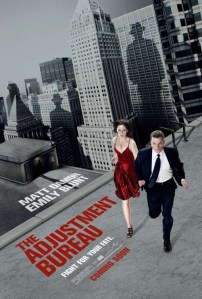 Gentlemen, if you were looking for an original excuse about not calling a girl back, try this one on for size: I couldn’t call because a team of men who control human destiny told me that if I did they would erase my memory and keep you from the fame that you are destined to achieve. She’ll probably at least give you points for originality before throwing a drink in your face (but it was all part of The Plan, or was it?).
David Norris (Matt Damon) has just lost a New York congressional election thanks to his frat boy ways of old resurfacing. As he composes his concession speech inside the men’s restroom, he meets Elise (Emily Blunt), a ballet dancer hiding out. They have one of those crazy only-in-a-movie conversations that manages to feel authentic. Then they kiss. She inspires him to ditch his prepared remarks and speak from the heart to the national TV audience, which eats it up. David spends the rest of his days trying to meet the enchanting Elise again. Then he runs into a big stumbling block. He’s late to a meeting and catches a group of mysterious men in suits and fedoras fiddling around with people frozen like statues. They are the adjusters, the ones who ensure that the participants of mankind follow The Plan. These are the people responsible for the illusion of choice in our lives. If we deviate too far from The Plan, causing ripple effects that too need to be accounted for and adjusted, they step in. Richardson (John Slattery) is the spokesmen for the group and decides to just level with David. He is not supposed to be with Elise. He has a different future ahead of him, so sayeth The Plan. They will throw obstacles between the two of them. David seeks out Elise and fights against the whole universe for the two of them to make a future together.
 Horrible title aside, The Adjustment Bureau is a sometimes corny but often deeply satisfying movie. It may distract with some efficient and just-smart-enough sci-fi leanings and magic tricks, but it’s really a unabashed romance at its core. Not just that, it’s a good romance, once that flutter the heart and causes the ends of your mouth to do that thing, you know – smile. It helps when you have movie tars as gorgeous as Blunt and Damon, and are such good actors that they can fill their roles with dangerous amounts of charm, but let’s credit writer/director George Nolfi (The Bourne Ultimatum, Ocean’s Twelve). He takes a fairly routine concept (powerful forces control our lives and choices) and turns it into a finely tuned character-driven romance. Immediately from their first meeting in a men’s room, Blunt and Damon have that electric dynamic that you can genuinely believe in. Their chemistry will knock you over. You feel the spark between these two, which is essential because the two characters spend years apart at times, forever hoping to reunite. In that brief encounter, you fall in love as well and realize that this character, and this actress, is worth waiting for. I think people are going to be surprised that The Adjustment Bureau is a big gooey, stars-in-the-eyes love story, and it’s actually good. It’s a really enchanting love story, tackling the question of whether whom we love is a result of choice or destiny. This central concept is what every sci-fi element and thriller sequence is spun from. Here’s a funny thought: it’s all in service to the story.
It’s rare to see a studio movie that mixes so many different elements together to such effective, satisfying results. The film doesn’t get overly dark despite the cosmically long-reach and determination of the adjusters. There’s never any real threat of danger, only a broken heart or dashed dreams. The film has many light moments throughout, creating a rather bouncy tone that suits the romance angle nicely. The adjusters aren’t very menacing, more so comically perturbed. John Slattery, all silvery Mad Men appeal, is a perfect foil as the face of the adjusters. He feels like an exasperated parent baffled by the thought-processes of his youthful charge. It helps that these cosmic accounting agents have a finite level of power. If they had unlimited power then the film would fail to have any hope for David and Elise. But we learn that there are only so many adjusters that there are limitations to their powers, and that they can be outsmarted with enough gumption. Mingling with that light touch is enough whimsical science fiction to engage your brain. The concept of the adjusters and their supernatural abilities is nicely teased, setup, and then developed, making sure never to rock the audience with too much weirdness at one time. It’s a gradual process of discovery and it leads to a somewhat goofy, but infectiously amusing, climax that involves multiple doorway portals and magic hats. Yes, I said magic hats, which means there is an honest to God good reason why that stupid fedora hat, seen so prominently in advertising that it feels like the third-billed star, is featured. Admittedly, a concept like a magic hat that allows you to teleport through doorways would seem silly, but Nolfi makes it all work. The hardest aspect to believe (in a film with, I repeat, magic hats) is that Blunt could be a ballet dancer, let alone a future star of the medium. I’m by no means saying that the British beauty has anything to worry about in appearance, but she does not have a ballet dancer’s dangerously minuscule physique. Natalie Portman in Black Swan looked like a real-deal ballerina of fragile frame. Blunt doesn’t have the movement or the physique.
 In his directorial debut, Nolfi does enough good things, and does them with a smooth sense of style, to impress. The visual trick of going in one door and opening to another world walks a dangerous line of over saturation, but it’s playfully utilized enough to forgive. Nolfi is not perfect with his plotting, falling to misstep that can push back momentum. Characters will be chatting, and then they’ll walk away and we’ll get a title card that says something like, “Three years later,” and it sort of makes it feel like we have to start all over again. The fact that this happens more than once means that Nolfi might have wanted to plot his story around a series of events that occurred more often than Senate election terms. If we have to begin with David losing one campaign at the start and then zoom ahead at several points through another campaign, then perhaps the timeline could have been condensed a bit in retrospect. The film manages to be religious and faith affirming without pushing an agenda or overstating its romantic cause. The ones behind the plan are only referenced in oblique business terms, never confirming a certain high power but definitely nodding in that general direction.
Damon and Blunt are a terrific team. This is easily Blunt’s finest role as an actress since breaking out in 2006’s Devil Wears Prada. The actress has taken many a role that makes use of her large crystalline eyes and her sometimes go-to acting response of simpering. But in this film, she finally finds that perfect role that makes use of Blunt’s modest, goofy charm. She’s never been a leading actress in a traditional set; there’s always been a delightful goofy appeal that set her apart. When Blunt offers her playful smiles and asserts those glassy eyes of hers, you too will be smitten. Her character is a charming woman thanks to Nolfi’s writing, but having an actress of Blunt’s ability fill her out is a blessing. Damon is at a point in his career where he just grinds out good-to-great performances that manage to be convincing in unassuming, dignified ways. Damon has never been an actor given to the superfluous. His character feels like a sincere sport, which is amazing considering he’s supposed to be playing a politician. He’s the kind of guy you’d actually stand in the rain to vote for, and you understand why Elise would keep a place tucked away deep in her heart for the dashing Damon.
While the movie hinges on the coupling of Damon and Blunt, the rest of the supporting cast does fine work matching tone and making the most of their roles. Actors like Anthony Mackie (The Hurt Locker), Terrence Stamp (Valkyrie), and Michael Kelly (Changling) can make any movie better.
 The Adjustment Bureau, on paper, should not work. A sci-fi fantasy that’s unapologetically grounded in romance. A tone that nestles firmly in a safe, bubble-wrapped whimsy. And those magic hats, need we forget them? On paper this should be one overly silly, dumb, tonally disjointed, cornball movie worth venomous mocking. And yet it works; it does better than “works,” it succeeds. Blunt and Damon are terrifically charming together and imbue the movie with a sense of cheerful optimism in the face of uncertainty (and perhaps heaven itself). You desperately want these two crazy kids to get back together; they’re good, decent, charming people, winning personalities apart and even better together. What might have fallen apart in other hands becomes this endearing, fizzy piece of studio entertainment that fulfills and exceeds most expectations. I was really taken by this movie, won over by its effusive charm offensive, and left buoyant with happiness by the time the tidy, perhaps too tidy ending, came rolling. The Adjustment Bureau is hooey but it’s my kind of hooey.
Nate’s Grade: A-


 nathanzoebl
You must be logged in to post a comment.