Blog Archives
Looper (2012)
 I became a Rian Johnson disciple the second that 2006’s Brick ended. I was floored by the originality, the artistic vision, the intelligence, and the creative voice. This was a unique filmmaker and I instantly knew this writer/director would be a man worth following. His follow-up, 2009’s The Brothers Bloom, was three fourths of a great movie, but a bit of an overdose on whimsy. Then I read that Johnson was next going to try his hand at time travel, and I could not contain my excitement. One of my favorite film genres and one of my favorite up-and-coming indie filmmakers together. I was expecting Johnson to do for time travel what he did with film noir (Brick) and the con movie (Brothers Bloom). How could Looper disappoint? Well, sadly, the movie found a way. It feels like Johnson smashed two halves of two different movies together, one good and one not so good.
In 2072, time travel is invented but instantly made illegal. The only people who have access to time travel are the mob. They have a surplus of dead bodies that need to disappear, so the mob sends them back 30 years. In 2042, Joe (Joseph Gordon-Levitt) is employed as a looper. He kills the guys the mob sends back in time and then disposes of the bodies. He’s paid well, and he and his fellow loopers live it up as privileged members of the Kansas City social sphere. Abe (Jeff Daniels) runs the show in town; he’s a mob guy from the future. There’s a catch to all the looper riches. The mob also wants to protect them in the future, so they send back the looper’s future self to be executed. It’s called closing the loop. And if you don’t kill your future self, bad things will definitely happen, just ask Seth (Paul Dano), a looper hacked apart to lure his future self back.
 The day comes where Joe is tasked with executing his future self, Old Joe (Bruce Willis). Old Joe escapes and goes on the run. Younger Joe is now under extreme pressure to kill his guy, or else the mob might just find him and start slicing body appendages. Old Joe is looking for the Rainmaker, who in 30 years will become a criminal tyrant responsible for much death. But in 2042, he’s only a child. Old Joe’s mission is to kill the child before he becomes the Rainmaker, and before he murders Old Joe’s eventual wife. While fleeing the mob, Joe takes refuge on a farm outside of the city. Sara (Emily Blunt) and her young son Cid (Pierce Gagnon) warily take in Joe but they’re also hiding a secret, that Cid has powerful telekinetic powers that can be put to great damage.
The film’s premise is compelling and allows for plenty of mind-bending possibilities, and Johnson has a fresh take on the sci-fi genre. Hunting down your future self is a grabber of a concept and I loved the scenes where Joe and Old Joe would sit down and converse. There’s the natural tension of Joe’s mission to eliminate his future self, but there’s also a flurry of ideas, ones that make the film better developed. Old Joe has an edge in foreknowledge but Joe has his own edge. He can change Old Joe’s memories by choosing different actions. He swears if he ever sees a picture of Old Joe’s wife that he’ll do everything in his path to alter fate, to make it so he never finds her. As a result, Old Joe is hobbled by headaches and fuzzy memories because the order of events is no longer concrete. “This time travel stuff fries my brain like an egg,” Old Joe admits. That, my friends, is a fascinating struggle for dominance and a refreshing take on time travel. Then you throw in the mob chasing after both Joes and you got an extra sense of urgency. Looper is playfully heady but easy enough to follow. It’s a thriller that doesn’t get bogged down in time travel logistics but it doesn’t pander to its audience either. If it did, I’m fairly certain Joe (addict, criminal, selfish) and Old Joe (eventual child slayer) would have taken turns to be more likeable. For a solid hour, Looper is alive with narrative jujitsu, a nice balance of action, drama, dark humor, intelligent plotting, stylish direction, the occasional startling visual, and strong acting from Gordon-Levitt and Willis.
And then the Looper becomes a completely different movie. Once the action shifts to Sara’s farm is where this movie completely unravels. I just couldn’t believe what was happening. The first half was so intriguing, intellectually stimulating, and thrilling, and then I got stuck on a farm and the movie turned into a lame version of Children of the Damned. I didn’t come for a telekinetic kid movie; I came for a time travel movie. The second half of this movie is practically wall-to-wall telekinetic kid stuff. The action slows down to a crawl and the flurry of ideas turns to a trickle as we introduce Strong Single Mom and Weird Son. I may have a cold heart but I didn’t care about these characters. I found the romance forced and Sara to be poorly developed. I found the kid annoying, and when he got mad and made his stupid mad face, it irritated me. Mostly I was irritated that the promise of the first half of the film had stalled out, and that this was where the movie was choosing to spend its dwindling time. It’s like the movie has been swallowed inside out by this stupid telekinetic subplot. The climax is fine but why did we have to travel through Dumb Farm Rest Stop to get there? Is it so that Joe can learn to be a better person? I didn’t buy that growth, especially with a kid as annoying and obviously dangerous as Cid. I suppose one night of sex with Emily Blunt (The Adjustment Bureau) could do the trick.
Besides the whole farm deal, there are other nagging questions I have that devalue Looper in my eyes.
 1) So in the future the mob is the only entity with access to time travel, but all they use it for is to dispose of bodies? That’s it? Biff Tanner used a sports almanac from the future to become king of the world. Are you telling me an organization that has historically profited from gambling would make no use of foreknowledge for personal gain?
2) Why would the mob have the loopers kill their older versions of themselves? This seems like a natural conflict of interest that could readily be avoided. Instead of having that particular looper kill his future self, thus closing the loop, why not assign that future version to a different looper? That way you don’t have to run the risk of the past looper letting his future self go. Or you could just never tell them what happened. For that matter, why does the mob have to send the guys back alive? Could they not simply just kill them and send the dead bodies 30 years back in time? This seems like an easier solution that also minimizes risk.
3) If you’ve just uncovered the power of time travel, why are you even bothering to send back your dead bodies 30 years into the past? Why not send your dead bodies back BILLIONS of years where the Earth is still forming, hot, and uninhabitable? I find this to be a better solution (I also wrote this solution in my own time travel screenplay, so there’s that too). Why can’t the mob feed dead bodies to dinosaurs? I’d love to see that.
4) You have a mob guy from the future, and you do nothing with that? Abe has one wisecrack about being from the future, and it’s a good one, but otherwise this guy could have just been from the present. The movie does nothing with the juicy element of a mob boss from the future. Maybe he doesn’t do as he’s told and arranges for his own rule. Or maybe he utilizes a sports almanac and makes some prescient bets, huh?
5) The movie takes place almost entirely around the confines of Kansas City. I find it hard to believe that a criminal organization would be sending all its bodies to Kansas City. Perhaps the mob also sends people across space and time, otherwise this means that we’re only following the future evil masterwork of the Kansas City mob.
6) I suppose you have to ask at what point do you really start to nitpick the whole butterfly effect of cause and effect paradoxes. With all time travel movies, there’s going to be some degree of suspension of disbelief, because changing one action can have wide-ranging consequences. However, with Looper there are several instances that gave me pause. Firstly, there’s the central idea of killing the Rainmaker as a child, which would negate the killing of the loopers, which would negate Old Joe seeking out the Rainmaker to kill. I’ll look beyond that. So Old Seth, in the film’s most horrifying sequence, starts noticing his fingers are disappearing, then his nose, and then his legs, etc. The mob is torturing young Seth to lure back the missing target. It’s an amazing visual sequence, but are you telling me that cutting off young Seth’s body parts would not have altered his future to a greater degree? I’m fairly certain when you start removing fingers and legs that Old Seth’s timeline would have been dramatically altered and he would cease to exist or follow the exact path to wind up in the past again. For that matter, why even bother luring the older Seth back? Could they not just take care of him by killing young Seth? What are they going to do with young Seth? If they’re just going to kill him then they should have just done that to begin with.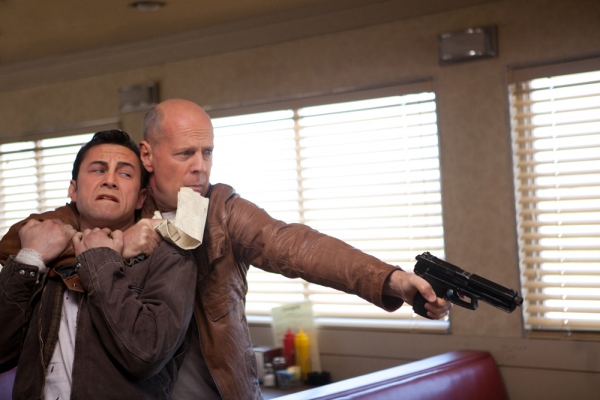
Johnson has plenty of thought-provoking questions he’d like to address within the bounds of a sci-fi action thriller. Would you kill a child if that kid were going to grow up and be a monster? Is redemption possible after doing horrible things? Could you kill your future version of yourself? Would you sacrifice everything to prevent future misery? These are legitimate questions and Looper deserves credit for spending time to ponder them, but I just wish Johnson could have gone back in time and chosen a different path.
Coming off of the stupendous Brick and the perfectly enjoyable Brothers Bloom, my expectations for Johnson’s third film were astronomical, especially given this crafty man’s take on time travel. I love the premise, love the actors involved, and love the ideas toyed around with, but the movie completely falls apart at the halfway mark. The pacing gets slack, the story becomes forced, and Looper transforms into a different, unwelcome movie. I can’t help but feel disappointed, partly from my expectations but also from the knowledge that Johnson could do better. The story just isn’t as well developed as it carries on, and the telekinetic subplot feels like a dull leftover from another movie. After an invigorating first half, Looper crumbles under the weight of a weak subplot that consumes the movie. There’s a good amount of thrills and intellectual stimulation aboard, but it’s all concentrated in the first half of the movie. I can’t recommend one half of a movie. I’ll still eagerly anticipate Johnson’s next project, but Looper is a sci-fi thriller that unravels at an alarming rate, turning a possibly great movie into a mediocre one.
Nate’s Grade: C+
Share this:

Gomorrah (2008)
 In the Bible, God promised not to obliterate the town of Gomorrah if Abraham could find a righteous man. That didn’t work out so well. This stirring Italian crime drama explores the long-reach of the Camorra crime syndicate stationed in Naples. The oldest Italian criminal organization is larger than the mafia, and the film’s four overlapping narrative threads showcase how the Camorra has a grip on every industry. The usual criminal enterprises are there, from drug trafficking to hired murders, but the organization is also deeply involved in the fashion industry as well as toxic dumping; in a perfect metaphor for the entire film, the Camorra is profiting by burying toxic death just below the surface. The objective docu-drama style lends disturbing reality to the ordeal, though the screenwriting too often feels like a pumped-up “true crime” novel – there’s far more emphasis on the minute details than the people. The movie makes empathy nearly impossible, not that this is necessarily a stinging detriment. The movie steers away from the excitement of violence and instead the death is merciless and swift and unexpected. Gomorrah strips away all the romantic notions involved with the gangster lifestyle; the two teenage gangster wannabes who quote Tony Montana are in for a rude awakening by the established toughs. The movie can be punishing and bleak but it’s always fascinating and told with factual backing that makes it spooky. It may not be as powerful or intense as 2002’s City of God but this is certainly one movie that can be punishing and bleak but it’s always fascinating.
Nate’s Grade: A-
Share this:

Eastern Promises (2007)
 Director David Cronenberg is an idiosyncratic director who explores Big Ideas through the context of creepy horror movies where the body is violated. He’s covered everything from evil gnome-like children, ravenous monsters in Marilyn Chambers’ armpit, and Jeff Goldblum’s face unfortunately peeling away. But then Cronenberg struck it big with 2005’s A History of Violence, giving him the highest profile of his long Canadian career. The auteur of ick is now back in a similarly themed tale of the true impacts of bloodshed with Eastern Promises, a gripping and thoughtful work.
Anna (Naomi Watts) is a midwife working in London and come across a young Russian girl who dies in childbirth. She leaves behind a diary that Anna seeks to have translated so that she can find family members to contact about the newborn. This brings her unknowingly to the doorstep of Senyon (Armin Mueller-Stahl) who runs a restaurant in London’s Russian district. She inquires if Senyon or any of the employees knew the dead girl, and as soon as Senyon hears about the reality of a diary he becomes more concerned. And he should be since he is the head of one of London’s most notorious organized crime families. His loose canon of a son, Kirill (Vincent Cassel), has authorized a hit behind his father’s back and repercussions may soon be approaching. Nikolai (Viggo Mortensen) serves as the family’s chauffeur but takes an interest in Anna and is willing to assist her as she stumbles into impending danger the more she translates from the diary.
 Much like writer Steven Knight’s excellent previous film Dirty Pretty Things, this is a film that shines a light on the underbelly of London and focuses on the immigrant experience and how apt they are to be exploited. Eastern Promises is both a straightforward crime thriller with an intriguing, albeit simple central mystery, but then as it moves along it transforms into something far richer. Through the diary, we uncover the hidden inner workings of the Russian mafia, which is a truly global enterprise. Women are promised with great riches and freedoms in their Slavic homeland, and then once transported will spend the rest of their lives behind the bars of a whorehouse, kept dependent thanks to a drug habit forced upon them. We’re immersed in the culture of this crime family. Eastern Promises takes its noirsh sensibilities and then gives us the foreboding and enigmatic Nikolai, a mysterious figure that the audience, like Anna, is drawn to. He spent time in a Siberian prison and is covered in telling tattoos that serve as a resume for the mafia. Nikolai is such a dominating presence and proves to be more intriguing than the central diary mystery, and it’s here where the film performs a balancing act and transfers our attentions fully to this brooding brute.
Cronenberg subverts his usual irony and weirdness to stay true to his tale, and this may well be, even more so than A History of Violence, the most accessible Cronenberg movie yet. We’re a long way from flesh-eating-monster-in-Marilyn-Chambers’-armpit. He still works with such compact efficiency so that no scene feels wasted, and Eastern Promises is a brisk 1 hour 40 minutes. Where Eastern Promises really succeeds is by layering in strong characters within a relatively genre movie. People are not exactly who they seem and the actors do their best to give remarkable depth to their roles.
Cronenberg seems to have found an actor that shares his artistic sensibilities. Scorsese has Leonardo DiCaprio, Wes Anderson has Bill Murray, Kevin Smith has Ben Affleck, and now Cronenberg has Viggo Mortensen. I never thought much of Mortensen as an actor until Cronenberg unlocked something deep and mesmerizing in their first pairing. With Eastern Promises, Mortensen establishes himself as an extremely capable actor. Nikolai is a complex figure and he Mortensen displays a mastery of understatement; his stony silences and piercing stares speak volumes, but you can practically watch the decision-making of the character pass through the face of Mortensen. He skillfully displays the good inside a man bred for evil.
 Watts is an actress with few equals and she dazzles once more in a role that requires her to do a lot of legwork. And yet, there’s a sad, haunting quality to her thanks to the back-story where she lost a child due to miscarriage. Cassel is also impressive in a complicated role that requires a lot of internal languishing. He’s at one an impudent child willing to live high off the power of his family name, and at other times he comes across as a severely wounded man who cannot thrive in his hostile family (both little and big F) environment. There are interesting revelations that make Kirill a much more complex and captivating figure, and Cassel plays the many dimensions very well. Personally, I’m happy to see Armin Mueller-Stahl in another high profile movie. There was a time shortly after his 1996 Oscar nomination for Shine where if you needed an old guy for a movie, you got the Armin. Lately, it seems James Cromwell has taken his place as go-to old guy. In Eastern Promises, he has such a sly menace to him from the moment his ears prick up at the notion of a diary. He insists upon inserting himself into Anna’s life and casually makes remarks like, “You know where I work, now I know where you work,” with just the right amount of finesse to sound intimidating and yet potentially harmless.
One scene I will never forget is when Nikolai is ambushed in a bathhouse by two revenge-hungry thugs. He sits there naked and exposed and these two unhappy gentlemen descend upon him (fully clothed) with knives. Nikolai fights like a wounded animal and manages to successfully take down both men even though he is unarmed and un-clothed. Up to this point the character has been something of a gentle giant, knowing the vicious ways of the Russian mob but seemingly at distance from them for whatever ethical decision. But it’s at this moment that we bare witness, no pun intended, to the cagey survival instincts of a man who must live his life looking over his shoulder. It’s a bravura scene that is played out in agonizing detail. Nikolai is slashed and thrown against tiled walls (much penis-related mayhem is glimpsed), but he keeps coming back and knows precisely when to strike. It really is the actors doing all the hard knocks and brawling, which heightens the tension. Cronenberg stages the violence in his realistic drawn-out style, which horrifies an audience while simultaneously fascinating them. This is by far one of the most indelible film moments of the entire year.
 Eastern Promises is an engaging character-based thriller, and yet I wish it finished as strongly as it began. This is the kind of movie where much is implied or said in silence, which works great at respecting the intelligence of an audience as well as staying consistent with a believable reality where everyone in such dangerous positions is not explaining everything aloud. However, one of the drawbacks of a film where much is implied is that when it’s over you may wish that they implied less and showed more. The climax to Eastern Promises is a little weak, especially when it comes shortly after the incredible bathhouse attack. There’s a very hazy sense of a resolution. From an artistic standpoint, I suppose I can appreciate a thriller that doesn’t feel the need to end with a pile of dead bodies and much blood being spilt, but at the same time, from an audience point of view, I was really left wanting for more when the film finally comes to a halt.
Thanks to a smart, twisty script, Cronenberg’s sharp yet quirk-free direction, and some stirring performances, Eastern Promises is a first-rate thriller with the added benefit of strong characterization to add richer depth to this tale of mobsters, retribution, and sex slavery. Mortensen is the real deal when it comes to acting, folks. Cronenberg may have found a true match with Mortensen, and the added cache may give the director greater financial opportunities to tell more intriguing tales that may or may not feature ravenous armpits.
Nate’s Grade: B+
Share this:

Inside Deep Throat (2005)
 I find that there are generally two requirements that make a really great documentary: 1) have an interesting story, and 2) have an interesting way of telling it. I’ve seen documentaries on ripe topics squandered because of the dull and unimaginative ways they tell their tales. The skilled documentary team behind The Eyes of Tammy Faye and Party Monster has set their sights on a little smut film that changed the world in the early 1970s. Deep Throat was a “dirty movie” made for peanuts (25 grand) that ended up becoming the most profitable film of all time, eventually grossing more than $600 million. The story behind its meteoric rise, cultural acceptance, and damnation hits both requirements, thus making Inside Deep Throat a sensationally entertaining documentary.
It all started in 1971 when Gerard Damiano wanted to make an inexpensive pornographic film. Back in those days, many aspiring filmmakers actually got their start in porn (Wes Craven admits it). Damiano was in the planning process when he was visited by a man who wanted his girlfriend, Linda Lovelace, to appear in the eventual porno. He swore his girlfriend could do the most amazing trick. Lovelace demonstrated her trick, the full swallowing of an erect penis. Damiano was dumbstruck. He was determined not just to involve Lovelace but to base an entire film around her stunning ability. Deep Throat was written in three days, filmed in six days, but the furor it would bring would be irrevocably long lasting.
 Deep Throat, as many of the crew will happily report, is not exactly a good movie. In fact, some call it the worst pornographic film of all time. Lovelace’s character found sex joyless, that is, until a doctor (Harry Reems) discovers that she has her clitoris all the way in the back of her throat. Thus to orgasm she has to swallow head-on (oh the double meaning). When the crew actually witnessed Lovelace’s cavernous abilities firsthand, they too were flabbergasted. But they wouldn’t be alone. Inside Deep Throat makes smart use of archival footage to prove how mainstream a small smut flick became. We see clips of Bob Hope and Johnny Carson cracking jokes about the film, and most amusingly of all are one or two interviews with little old ladies who “wanted to see a dirty picture.” Deep Throat crossed over and people went out in their Sunday finest to watch a hard-core porno.
Inside Deep Throat is rated NC-17 and with good reason. We do get to see Lovelace strut her stuff and the film almost playfully teases an audience with anticipation. We hear interviewees discuss their amazement; we see a close-up of Reems face as he gets pleasured. By the time the scene in question is shown uncut, we’re eager to witness this feat of fantastic fellatio ourselves. Let’s be honest, you can?’t have a documentary about Deep Throat‘s impact without showing the goods.
Filmmaking duo Fenton Bailey and Randy Barbato have a very visually satisfying way of telling their story. Images tear across the screen and animation pops, all set to what must amount to most of the soundtrack to Boogie Nights. The glossy visual flair reminds me of the swirling, near-pop-out book imagery of The Kid Stays in the Picture. The pacing of Inside Deep Throat is near break-neck, with the film clocking in at just over 90 minutes. I wish that the filmmakers had spent more time on their subject and gone more in depth into certain areas like Lovelace’s turnaround from girl next door goddess to anti-porn crusader back to fifty-something nude model (she was killed in a car accident in 2002).
 The cultural splash Deep Throat made is interesting enough, but the meat of the story is in the battles that would ensue. Damiano openly talks about how the mob controlled the early porn industry. He admits that he refused his share in the millions out of fear that he might have had his legs broken, or worse. There’s a long tangled web of mafia influence in the proliferation of Deep Throat. It was banned in over 30 states, but everywhere it went it became a hit. A Mafioso says that they were making so much money that they had to count it by the pound. Mob hits would materialize over the film’s profits and territory.
Even more fascinating, the U.S. government, to no one’s surprise, declared the film indecent. They couldn’t prosecute the director, or the distributors (unless they liked sleeping with the fishes), or anyone really making money off of the success of Deep Throat. So what’s a stubborn government to do? They prosecuted Reems for his involvement in a pornographic film. It was the first time an actor was ever prosecuted for his participation in art after the fact. Celebs like Warren Beatty and Jack Nicholson came to Reems’ aid, fearful of what might happen if a government could retroactively punish artists. Sadly, Reems was found guilty and sentenced to years in prison and was really never the same afterwards.
But instructional films on sexuality were still okay as far as government was concerned, and we see clips of them in all their medical film hilarity (apparently some positions are not meant for the obese we’re told). These were acceptable because they were meant to help and inform, whereas porn is meant to entertain.
The film’s interviews comprise some of its best and worst moments. Most of the Deep Throat crew is in their 60s or 70s now, and hearing them talk about porn and sexual acts does make you titter a bit. The crew provides funny anecdotes and some of the juiciest material. However, the film also curiously interviews people like Dick Cavett and Bill Maher. The expected talking heads are here like Dr. Ruth, Camille Paglia, John Waters, Hugh Hefner and Larry Flynt, but they regularly don’t have anything insightful to say.
 Inside Deep Throat goes back and forth with its objectivity. It’s obviously pro-freedom of speech and doesn’t mind ridiculing the government agents who tried taking Deep Throat down (oh the double meaning). Particularly telling is an FBI agent who wishes that terrorism could be tidied up so that he could finally get to the real importance, which is stopping people from seeing pornography. One of the main points of the prosecution of Deep Throat was that it “wrongly” purported the idea of a clitoral orgasm (I think many will find some error with this judgment). It’s easy in retrospect to chide government officials ruling on inaccurate information or just plain ignorance. It may be too easy for some viewers, but for me it’s fair game to lambaste any idiot trying to strip me of my Constitutional rights.
Inside Deep Throat is an engrossing if light-hearted look at a moment in time. Some of the seedier elements feel skipped over, but this is a documentary on a fascinating subject told with a pleasing visual style. Don’t be put off by the NC-17 rating or the subject matter. Inside Deep Throat is more than a behind-the-scenes featurette on a wildly successful porno. It’s a fast, funny, and greatly entertaining time capsule of an era where boundaries were still being pushed, both by artists and by censors. And in today’s FCC-fearing landscape, maybe not everything has changed since Deep Throat brought porn into the mainstream.
Nate’s Grade: B+


 nathanzoebl
You must be logged in to post a comment.