Blog Archives
The Last Airbender (2010)
 Let The Last Airbender be a shining example of how NOT to adapt a children’s fantasy series into a standalone 90-minute movie. M. Night Shyamalan was hired to write and direct the popular Nickelodeon cartoon into a major movie with a major budget. It’s astounding how poorly made on every front this movie is. Seriously, people should be taking notes because Shyamalan has given a blueprint of blunders to avoid. The first blunder, and perhaps the source of all the others: hiring Shyamalan to begin with.
The film takes place in a fantasy realm where human beings are divided into four different nations based on the natural elements: earth, fire, wind, and water. Each nation has a special select group of people that can control that element. These people are known as benders. The one figure who can control all four elements is referred to as the Avatar, and this figure is reincarnated into a different nation each generation. In the absence of the last Avatar, the fie nation has invaded the other nations. Prince Zuko (Dev Patel) has dishonored his father, leader of the fire nation, and been banished. He seeks redemption by attacking the water nation, where siblings Katara (Nicola Peltz) and Sokka (Jackson Rathbone) live. They discover hidden among the ice a small bald child named Aang (Noah Ringer). This kid is the last of the airbenders and is believed to be the last reincarnation of the Avatar. For obvious reasons, Prince Zuko is after the Avatar to regain his father’s acceptance.
 At one point christened with the moniker of “the next Spielberg,” the writer/director has been slipping and sliding down into the pits of his self-deluded grandeur and stubbornness. After Lady in the Water and The Happening, who in their right minds would give this guy $150 million to direct a special effects-driven summer action movie AND let him adapt the show too? Even if you somehow managed to convince yourself that Shyamalan sitting in the director’s chair was a feasible solution, why on Earth would you let this man near the screenplay? I must repeat: did people see Lady in the Water and The Happening (this is a rhetorical question, because nobody wants to remember seeing them)? The Airbender series is a very well regarded television show that has appealed to audiences of all ages, including those old enough to buy their own beer, thank you very much. What purpose does it serve to ditch the show’s creators and longtime show runners in place of giving the responsibilities for coming up with plot, characterization, and God help us, dialogue, to the man that last gave the world The Happening? The Happening, people! What did you think was going to happen? Even with the lowest of expectations, The Last Airbender will still confound with its dead-on-arrival acting, zero character development, and overly serious spiritual mumbo jumbo. Who at the studio read Shyamaln’s adaptation and thought it was ready to move forward?
The Last Airbender begins with an opening scrawl informing the audience of the four different nations and the significance of the Avatar. Then it sprints forward without ever establishing context. Spending time to explain the rule and makeup of a new world is essential to the fantasy genre; we need to be able to know the rules of this universe and the dramatic stakes. Shyamalan establishes his villains via a lame text crawl. How hard would it have been to open the movie by showcasing the Fire Nation being big and bad? Most films open by establishing the bad guys in true villainous form. This movie would have started out so much better by establishing the villains, their mission, why they’re so bad, and introducing the general audience to the family of bad guys. That way our first introduction to them isn’t so perfunctory. In the film as it is, Shyamalan just sort of slides his characters into the plot in the most bumbling, awkward fashion. We don’t even learn about Prince Zuko’s banishment firsthand. In grand Shyamalan style, characters explain to the audience at every opportunity. Because why would you rather watch Zuko try to impress his father, fail and become scared, and have his father banish him from his nationality, promising to return and win back his father’s approval… when you could just listen to a character recite what took place? Isn’t that way better than watching something in a visual medium? There are a terrible amount of moments that feel clumsily strung together, like several important scenes were taken out at the last minute.
 This is emblematic of the entire movie because unless you’re well versed in the Airbender story, you will be as clueless as I was. I had no idea what was going on for most of the movie. Suddenly characters appear. Suddenly they can do some magical ability. Suddenly they can’t. Suddenly they’re gone. Suddenly we’re somewhere new. Suddenly this character’s dead/ Suddenly the Earthbenders are all kept together in a prison that lies atop plenty of bendable earth. Where’s the correctional planning on that one? I couldn’t explain why anything was all of a sudden happening, or what the exact rules were that helped or hindered characters, and I was left grasping for any sort of workable motivation among all the ridiculous and reflexive New Age spiritualism. Shyamalan and the film’s producers do not set up a damn thing. The film operates on a false assumption that the audience is already familiar with the source material, so it never stoops to setup plot or explain characters and events. That would be a waste of time when they have more substandard water effects to show. Because why would you want to spend $150 million on a movie that appeals to people outside a narrow margin of fans? And when you try and try and cannot understand what’s happening on screen, it’s only natural to lose interest. When the film is as dopey as The Last Airbender it only speeds up the process. I was deeply apathetic all the way through this ungainly mess.
I don’t think there’s anything that irritates me more in a fantasy film than when characters treat everything with such general indifference: “Ho hum, we just found a bald kid and his flying buffalo in a block of ice. Ho hum, he can master all the elements. Whatever. What’s on TV?” If the characters can’t be bothered to care then why should I?
I don’t know what this movie spent on special effects but whatever it was it clearly wasn’t enough. Last Airbender has some of the worst special effects I’ve ever seen in a major Hollywood summer release. Did the ILM gurus pass along their effects work to their interns? The green screen work, featured early with Katara and Sokka in some Icelandic realm, is ridiculously shoddy. People look like they have halos as they stand out against the all-too fake backdrops. The special effects in general are missing a polish and resonance that helps to disguise the illusion. I have to admit that it gets pretty boring watching one character hurl blue water orbs while another hurls red fire orbs. You would hope that a movie where people can control natural elements for combat they could do something more imaginative than fling different colored blobby orbs at each other. You have the power to control fire, the power to command the oceans or the wind, why must you low-ball it? I saw infinitely better choreographed elemental fighting on old episodes of Captain Planet and the Planeteers.
 Once again Shyamalan completely betrays the trust of his actors (don’t think Zooey Deschanel can give an awful performance? See The Happening). He gets lost in the whirlwind of special effects and fantasy worlds, so his actors get short shrift when it comes to direction. Ringer look the part and can perform the tricky martial arts moves with ease, but is that the best reason to hire an actor? Can’t makeup take care of perfecting a look? Can’t a stunt double fill in for the more challenging physical stunts? I’d rather have somebody who can act rather than just look like the human form of an animated character. Ringer is an annoying messianic figure to have at the center of your franchise. His counterparts don’t fare much better. Peltz (Deck the Halls) is impassive and routinely hits the wrong note for a scene, and Rathbone (Eclipse, New Moon) is fairly wooden and plays too many scenes like he was given one note (“bigger eyes”). Patel (Slumdog Millionaire) gets to glower and his voice kicks up in volume at weird intervals. It’s another example of unmoored actors struggling for direction. But the worst offender in the film is Aasif Mandvi, though through no real fault of his own. He is dreadfully miscast as the movie’s chief villain, and wickedness is not in Mandvi’s repertoire. He’s a cutup on TV’s The Daily Show but here Mandvi couldn’t seriously menace anyone. His tone, demeanor, and even very look lack intimidation. He has a glint of mischief that you can’t take seriously. I’m usually not one to point and shout “racism,” but the fact that Shyamlan and the producers have whitewashed the film’s casting is troublesome. Caucasian actors have filled in for the series’ predominantly Asian characters, and all the villains happen to be transformed into dark-skinned figures played by Indian actors.
I can’t explain most of M. Night Shyamalan’s thinking when it comes to the finished product. The Last Airbender seems intended solely for fans given how forgetful it is when it comes to plot setup and explanations and back-stories. Why should an audience be able to follow along? Comprehension is overrated (David Lynch being a lone exception). At the same time, Shyamalan gives nothing back to those fans who have looked forward to a big-budget realization of the popular TV fantasy series. Shyamalan even seems downright disdainful, again falling victim to his own ever-swelling hubris. Why shouldn’t he write the script? Why would the creators have any clue about how to condense their mythological dense show into a satisfying two-hour taste? If you’ve never watched the TV show, you’ll leave the theater wondering why the hell anybody would give a crap about all this junk. The movie presumptuously sets itself up for a series of sequels that I doubt we’ll ever see, certainly not with Shyamalan’s involvement at the least. Shyamlan once again defies his critics and lives on to make yet another artistic disaster. If three straight duds couldn’t detract somebody from throwing $150 million and artistic license his way, then I don’t know if this man and his ego will ever be humbled or tamed.
Nate’s Grade: D
Share this:

The Happening (2008)
 M. Night Shyamalan is still reeling from the beating he took over 2006’s Lady in the Water, a colossal misguided attempt at a modern fairy tale. The man is trying to retain his cozy relationship with audiences that adored his earlier works like The Sixth Sense and Signs. Shyamaln’s latest, The Happening, isn’t going to dissuade the detractors. This man is a talented filmmaker and I think it’s finally time that he starts thinking of focusing on one creative job and one job only, either writing or directing.
There’s a pandemic sweeping across the Northeast United States. It first starts with disoriented speech, then moves to disoriented movement, and ends with people committing suicide. Nobody knows what is officially going on. High school science teacher Eliot Moore (Mark Wahlberg) tries to flee Philadelphia with his estranged wife, Alma (Zooey Deschanel). They travel out into the suburbs when their train stops. The conductor says that they’ve lost contact with everybody. Eliot eventually theorizes that what’s causing this pandemic isn’t terrorists, or the government testing some biological agent, but plants. Yes, plants. In their defense, the plants are releasing an airborne toxin that flips a neurological switch in human brains. Instead of self-preservation the brain is pushed toward immediate self-destruction.
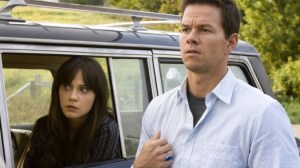 The Happening is no Lady in the Water, thankfully. The premise is pretty interesting in a feature-length Twilight Zone kind of way. Shyamalan does know how to spin an interesting idea and watch social paranoia explode. The best moments of The Happening take place during its beginning where confusion and panic reign. Shyamalan then takes a page from 2005’s War of the Worlds and follows the perspective of a handful of normal folk as the experience an apocalyptic event. We even spend the third act hiding out in the home of a crazy person (the creepy Betty Buckley). Unfortunately, we in the audience feel no involvement with the poorly written main characters. Once again Shyamalan utilizes a horrific and unique encounter as the impetus for reconciling the pains in a marriage. At a scant 99 minutes, there isn’t much time set aside for building characterization. There is not a whiff of personal connection to this tale.
Shyamalan doesn’t seem to explore the psychological ramifications of his premise. Suicide is very traumatizing and it would have swept over the East Coast in waves; millions would be dead. Yet the characters and Shyamalan never seem to focus on this point. Perhaps they’re in shock but no one seems to actually react realistically to the possible end of the world. Normal people would be freaking out. I would be freaking out. The idea that the country goes back to normal after three months is preposterous. Would anyone want to live on the East Coast again after all that death? People would be finding bodies for many months after the “happening;” just look at the slow recovery of New Orleans. Never mind the hit the economy would take from millions of people expiring.
The ecological message can also be incessantly heavy-handed. Characters run past a sign for a housing development that advertises the slogan, “You deserve this.” Oh, gee, I get it. A TV host at the very end interviews a scientist theorizing that what happened was a warning from the environment to shape up and change our ways. The TV host is so incredulous that he actually says, “Well, I’d like to believe you doc, but maybe if it just happened somewhere else again, maybe then I could believe you.” You idiot, millions of people died and there are how many witnesses? I know exactly what message Shyamalan is trying to say (wake up, we can’t ignore the signs) but having a character denying the obvious is too ludicrous given what happens in the story.
 But the story does invite further inquiries. How exactly do the plants communicate with each other? I can understand root structures but how does a bush talk to a tree unless they share root structures? Do plants speak different languages? Can a bush talk with a tree, and do French bushes speak differently than their English brethren? The plants seem to react to large numbers of people, but how do they know when there’s say enough folk running around to kill? Do they smell people? That toxin seems to not affect animals but I don’t see how that could be possible given that, as far as I know, animals inhale the air as well. Of course, if all surrounding animals and insects were to keel over then that would irrevocably harm the ecosystem and endanger the plants. This must be why the “happening” lasts a little over a day, coincidentally ending just when our protagonists are about to give up. And if Mother Nature, as a form of population control, triggers this toxin release then wouldn’t it stand to reason that some place like China or India would be hit first instead of the Northeast United States? Shouldn’t a science teacher know that still air would be filled with more toxins than when the wind blows? I’ll give Shyamalan this — he was able to make me fear a tree. There was one moment where a little girl was on a swing that was bolted into a tree limb and the constant creaking made me nervous that they would anger the tree.
Despite the flaws in storytelling, this narrative still could have worked as is if it just had a better director at the helm. Shyamalan lets everyone down on this one. Much of the marketing angle was how The Happening is Shyamalan’s first foray into R-rated material, but you can tell he doesn’t feel comfortable showing more than implying. One sequence follows a police officer’s gun as different individuals take turns shooting themselves in the head. Shyamalan shoots this sequence like the camera weighed 800 pounds, so the shot never rises above people’s feet. We see the gun fall on the ground, feet walk over to the gun, hands pick it up and lift it off screen, then a very unconvincing gunshot sound effect, then the process repeats. By not actually seeing the deadly aftermath Shyamalan risks the sequence becoming unintentionally funny and it almost happens. This directorial technique does not raise suspense, and in fact, Shyamalan botches most of the potential suspense in The Happening. Given the premise, Shyamalan doesn’t find too many sequences that make the audience squirm. A man wandering around in a lion’s cage is so fake and played in the wrong tone that it just becomes goofy even when his arms get ripped off. There’s only one protracted horror sequence that shows true gore, where a man lies down in the path of a giant lawnmower and we start to see the machine ride over him and whirl its blades. However, even this scene could have gone longer to fully draw out the shock and terror. Shyamalan just doesn’t have the temerity for R-rated material, and as a result the movie could have been a lot more terrifying had the man embraced the gruesome potential of a more mature rating.
Shyamalan’s visual storytelling is pretty rote. I kept thinking to myself how poor everything seemed to be looking. The cinematography is lackluster and the shot compositions are rather bland. Part of what makes a horror movie effective is clever visual setups that slowly leak tension like air from a balloon. Shyamalan’s idea of drawing out tension is to watch tress blow in the wind. After a while, when you realize this is the one trick Shyamalan has, it gets old and extremely boring. The Happening would have benefited from a stronger visual storyteller who could also goose the narrative with better-constructed scares. It’s disappointing because Shyamalan was able to elicit top-notch suspense in 2002’s Signs with simple sounds and the imagination. Now, when he’s given the chance to show terror he falls on his face.
 Another dent to Shyamalan’s direction is the fact that the actors all give bad performances. Wahlberg and Deschanel have given great performances in other movies so I know they are capable of more, and the blame must lie at the feet of Shyamalan. They overact with gusto and always seem to never be fully immersed in the reality of the drama. Even Wahlberg’s first line delivery raises your eyebrow because it seems too amateurish and flat. Deschanel is even worse and whatever emotion she is playing in a scene is the wrong emotion. She’s whiny and overly childlike when she should be reflective and contemplative, she’s wide-eyed and weepy when she should be tender, and she’s bad with just about every line. Alma is a weak character and seems to turn everything back to an injustice against her, even when people are killing themselves en mass. Part of the actors’ woes is complicated by Shyamalan’s wooden dialogue, which includes gems like, “We’ve just got to stay ahead of the wind” (how exactly does one do that?) and, “We’re not going to stand around like uninvolved bystanders” (who says that?). The most shocking aspect of The Happening is that Shyamalan totally betrays the trust of his very competent actors.
M. Night Shyamalan would be best served in the future by focusing on one role. He could direct someone else’s material or he could write and have someone else direct. If he had gone the latter route I’m convinced that The Happening would have worked even with a flawed script. The movie is too timid to push the horror boundaries available to a mature rating, the suspense is minute, and Shyamalan completely leaves his actors hanging out to dry. There is some laugh out loud moments of unintentional hilarity (like when Wahlberg calmly says “Oh no” upon hearing suicidal gunshots), but the movie also has moments of intrigue amidst its heavy-handed environmental message. Statistically, if there were a killer toxin there would be those who would be genetically immune to it, much like the scenario in I Am Legend. I have to say that if I was fortunate enough to survive I would whisper some threatening words to some choice flora and then I would set lots and lots of fires out of revenge. Take that, you stinking vegetation!
Nate’s Grade: C
Share this:

Lady in the Water (2006)
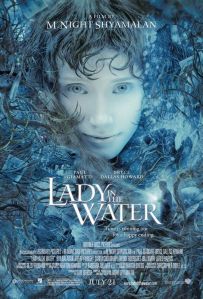
Writer/director/twist-abuser M. Night Shyamalan must have been smarting from the cool reception to his last high-concept thriller, 2004’s The Village. Shyamalan has built a reputation for smart, eerie, complex movies, as well as forced twists and endings that leave the films in shambles. He went back to basics. Lady in Water started as an ongoing story he told his kids at bedtime. His kids participated in the creation of the story. If we didn’t learn from last year’s The Adventures of Sharkboy and Lava Girl, movies where children helped shape the story should be left as bedtime stories. Lady in Water is further proof of this.
Cleveland Heep (Paul Giamatti) is the fix-it man at an apartment complex. Someone’s been swimming in the pool late at night and clogging up the filter. The unexpected culprit is Story (Bryce Dallas Howard), a waif of a girl. She says she is a “narf,” a sea nymph who’s crossed from her world, the Blue World, to ours. Her purpose is to plant the seed of change by finding a special individual. When her mission is complete a giant eagle will carry her back to her world. Cleveland accepts being her guardian and protector and assists her on her quest. He mingles with the apartment complex’s eclectic residents, trying to figure out who fits what role to help Story. There is one hairy problem. A scrunt, a wolf-like beast with twigs and long grass for fur, is after Story. An evil monkey creature is overseeing the whole weird affair.

Early on, Lady in Water was advertised as “a bedtime story by M. Night Shyamalan,” and just like your typical bedtime story, the thing feels entirely made up on the spot. The story sounds like a little kid making up a book report: “There’s this grass wolf, see, and it’s after this sea lady, and there’s these evil monkeys that oversee everything, and an eagle carries her away when she’s done, but she’s like the unknown Queen of the sea ladies, and she has helpers but can’t say who they are, and they all have special abilities, except some of them can only do stuff, and no one can see her leave.” What? Was Dio an unaccredited co-writer for this? Lady in Water feels like Shyamalan is haphazardly throwing spontaneous obstacles and rules into his story, hoping something sticks when it just muddies up the story.
Naturally, there are many unanswered questions brought about by the supernatural subject matter. Why is it an eagle that plucks Story away to safety when she?s fulfilled her mission? Wasn’t part of the schism between man and the Blue World because man moved to land? Wouldn’t something aquatic make more sense to rescue her? What about the entirely unnecessary evil monkey judge? Why is it even there? Why does it just sit there idly if the scrunt breaks the rules (and if the scrunt is a rule-breaker then why not just bust inside Cleveland’s home and eat the chick)? For that matter, if the monkey judge is so evil then why does it even respect the rules? Why don?t the evil monkey judges side with the already evil scrunts? Why do the scrunts hate the narfs so? Who established these systems of rules for narf contact and scrunt hunting? Do the monkey judges allow the narfs to get killed as long as it’s during the right time? Is it like a boxing match (“Touch gloves, to your corners, and no biting after the bell”)? And of course everyone believes this tripe. Shyamalan could fall back on the excuse that his tale is a bedtime story and not meant for extensive examination. Sure, not everything needs to be explained but that doesn’t mean Shyamalan can get away with being lazy.

There’s no finesse in the writing. Shyamalan seems to have taken his frustration with the dwindling critical reception of his works hard. The movie critic character, Mr. Farber (a droll Bob Balaban) is one of two items, either the embodiment of his ire, a figure out of touch with human emotion and the public’s trust, or Shyamalan making a preemptive strike. The critic complains there are no more original stories left in Hollywood; well, Mr. Smarty Pants, what do you think of a tale of narfs and scrunts? The problem is that the film critic is not unlikable, just cynical, and despite how dismissive Shyamalan may wish to be, the critic’s complaints and observations about the film industry are solid. In Lady in Water, characters do speak their feelings so casually. People explain back-stories and motivations like it was written on foreheads. The critic character is so inconsequential as well, so the notion that Shyamalan spends so much energy on him makes it feel like a score being settled.
What’s more irritating is how self-involved the movie comes across. The whole purpose of Story’s venture to our world is to inspire a gifted writer, a writer whose work will be seen as unchecked genius that will cause great change throughout the world. Nations will renounce war, men and women will greet each other as brother and sister, and the world will be a profoundly better place to live, all thanks to one artistic genius that changed the world. And who plays this artistic genius lying in wait? M. Night Shyamalan. In conjunction with the critic character, perhaps Shyamalan is proclaiming that his movies will stand the test of time, despite what those fuddy-duddies at their typewriters say. Lady in Water is either an intense example of artistic insecurity or an unflappable, monstrous ego.
Shyamalan is too gifted a filmmaker to make outright bad movies. However, he is prone to making very misguided choices. The addition of the monkey judge just mucks things up and more unanswerable questions. Are the monkeys like the regional overseer? Is there a tri-state office run by a giraffe with twigs on its head? Shyamalan’s plot is too formless and relies on some garish ethnic stereotypes, like the nattering Jewess and the screechy, rail-thin Korean teen. His sense of direction takes a back seat to his writing. Many moments are filmed out of focus, or the camera bounces around trying to capture whoever’s talking, always seemingly just out of reach. His visual aesthetic feels noticeably simpler. There’s a certain unapologetic yearning in Lady in Water to be a Steven Spielberg film, from the John Williams-like score, to the assembly of characters wanting to believe again, to the heaping helping of schmaltz. Lady in Water is proficiently crafted (special thanks to cinematographer Christopher Doyle) but the movie is an unmistakable artistic misfire.
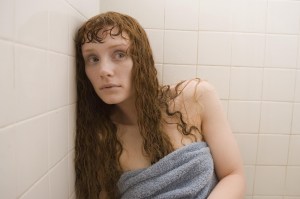
Giamatti is a dependable sad sack, and he deploys an array of stutters and tics to convey how damaged Cleveland Heep is. He’s good but then he always is, no matter how stupendously awful his material may be (he did survive Big Momma’s House). Howard is one of the more beguiling and intriguing young actors in the movies right now. She bewitched me in The Village, but in Lady in Water she befuddled me. It’s hard acting as a made-up creature. Howard relies on lots of vacant, supposedly, ethereal staring. She comes across as less supernatural and more like a club kid on ecstasy.
Lady in Water is not an unmitigated disaster but it’s definitely not good by any stretch of the imagination. M. Night Shyamalan seems to fray with every new movie, and Lady in Water is by far the man’s most ridiculous and self-involved flick. He’s too great of a talent to write off, even during his misfires, but we can’t be expected to iron out his narrative kinks every time. Shyamalan’s films generally center on broken people looking for their place in the universe and finding a grander plan for their pain. Hopefully, after the birth pain of Lady in Water, Shyamalan can find his place in the artistic landscape and spare us more half-baked bedtime stories.
Nate’s Grade: C-
Share this:

The Village (2004)
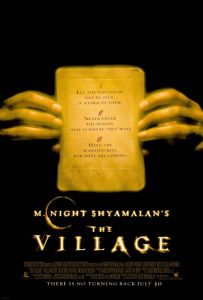 When saying director names you can play a fun little game of word association. Someone says, “George Lucas,” and things like big-budget effects, empty storytelling, and wooden dialogue come to mind. Someone says, “David Lynch,” and weird, abstract, therapy sessions dance in your head. The behemoth of word association is M. Night Shyamalan. He burst onto the scene with 1999’s blockbuster, The Sixth Sense, a crafty, moody, intelligent thriller with a knock-out final twist. Now, though, it seems more and more evident that while The Sixth Sense was the making of M. Night Shyamalan, it also appears to be his undoing. His follow-up films, Unbreakable and Signs, have suffered by comparison, but what seems to be hampering Shyamalan’s growth as a writer is the tightening noose of audience expectation that he kowtows to.
With this in mind, we have Shyamalan’s newest cinematic offering, The Village. Set in 1897, we follow the simple, agrarian lives of the people that inhabit a small secluded hamlet. The town is isolated because of a surrounding dense forest. Mythical creatures referred to as Those We Dont Speak Of populate the woods. An uneasy truce has been agreed upon between the creatures and the villagers, as long as neither camp ventures over into the others territory. When someone does enter the woods, foreboding signs arise. Animals are found skinned, red marks are found on doors, and people worry that the truce may be over. Within this setting, we follow the ordinary lives of the townsfolk. Ivy Walker (Bryce Dallas Howard) is the daughter of the towns self-appointed mayor (William Hurt), and doesnt let a little thing like being blind get in the way of her happiness. She is smitten with Lucius (Joaquin Phoenix), a soft-spoken loner. Noah (Adrien Brody), a mentally challenged man, also has feelings for Ivy, which cause greater conflict.
 Arguably, the best thing about The Village is the discovery of Howard. She proves herself to be an acting revelation that will have future success long after The Village is forgotten. Her winsome presence, wide radiant smile, and uncanny ability to quickly emote endear the character of Ivy to the audience. She is the only one onscreen with genuine personality and charisma, and when shes flirting and being cute about it you cannot help but fall in love with her. And when she is being torn up inside, the audience feels the same emotional turmoil. I am convinced that this is more so from Howard’s acting than from the writing of Shyamalan. She reminds me of a young Cate Blanchett, both in features and talent.
It seems to me that Shyamalan’s directing is getting better with every movie while his writing is getting proportionately worse. He has a masterful sense of pacing and mood, creating long takes that give the viewer a sense of unease. The first arrival of the creatures is an expertly handled scene that delivers plenty of suspense, and a slow-motion capper, with music swelling, that caused me to pump my fist. The cinematography by Roger Deakins is beautifully elegant. Even the violin-heavy score by James Newton Howard is a great asset to the film’s disposition.
So where does the film go wrong and the entertainment get sucked out?
What kills The Village is its incongruous ending. Beforehand, Shyamalan has built a somewhat unsettling tale, but when he finally lays out all his cards, the whole is most certainly not more than the sum of its parts. In fact, the ending is so illogical and stupid, and raises infinitely more questions than feeble answers, that it undermines the rest of the film. Unlike The Sixth Sense, the twist of The Village does not get better with increased thought.
Shyamalan’s sense of timing with his story revelations is maddening. He drops one twist with 30 minutes left in the film, but whats even more frustrating is he situates a character into supposed danger that the audience knows doesn’t exist anymore with this new knowledge. The audience has already been told the truth, and it deflates nearly all the tension. Its as if Shyamalan reveals a twist and then tells the audience to immediately forget about it. Only the naïve will fall for it.
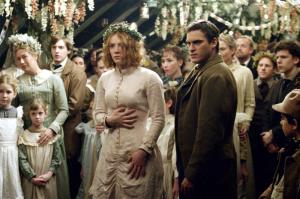 Shyamalan also exhibits a problem fully rendering his characters. They are so understated that they dont ever really jump from the screen. The dialogue is very stilted and flat, as Shyamalan tries to stubbornly fit his message to ye olde English vernacular (which brings about a whole other question when the film’s final shoe is dropped). Shyamalan also seems to strand his characters into soap opera-ish subplots involving forbidden or unrequited love. For a good hour or so, minus one sequence, The Village is really a Jane Austin story with the occasional monster.
The rest of the villagers don’t come away looking as good as Howard. Phoenix’s taciturn delivery seems to suit the brooding Lucius, but at other times he can give the impression of dead space. Hurt is a sturdy actor but can’t find a good balance between his solemn village leader and caring if sneaky father. Sigourney Weaver just seems adrift like shes looking for butter to churn. Brody is given the worst to work with. His mentally-challenged character is a terrible one-note plot device. He seems to inexplicably become clever when its needed.
The Village is a vast disappointment when the weight of the talent involved is accounted for. Shyamalan crafts an interesting premise, a portent sense of dread, and about two thirds of a decent-to-good movie, but as Brian Cox said in Adaptation, ”The last act makes the film. Wow them in the end, and you’ve got a hit. You can have flaws and problems, but wow them in the end, and you’ve got a hit.” It’s not that the final twists and revelations are bad; its that they paint everything that came before them in a worse light. An audience going into The Village wanting to be scared will likely not be pleased, and only Shyamalan’s core followers will walk away fully appreciating the movie. In the end, it may take a village to get Shyamalan to break his writing rut.
Nate’s Grade: C+
Share this:

Unbreakable (2000)
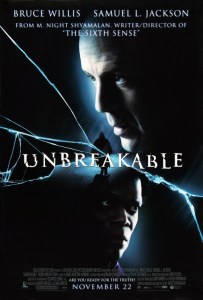 “I should have known it from the children…” Ladies and gentlemen, you have now witnessed the most atrocious ending of this year. Unbreakable has a simple yet moderately sophisticated premise in the examination of what makes a super hero. The psychology going into it would be fascinating, like do you feel a civic duty to help others? This could have made ‘Unbreakable’ a good escapist flick with some imaginative thoughts, but instead it all gets destroyed by a lame lam-shackled ending that will suck the life out of everything good and decent.
There are numerous shots in the film that go on and on and are single coverage. This likely wouldn’t pose as much a problem if it weren’t so persistent and annoying. The opening scene where the camera dances back and forth between two seats to see Bruce Willis fumbly trying to hit on another woman is aggravating to the least in its set-up. Willis himself is a security officer for a college and basically suffering from a faltering marriage and overall loser status. That is, until he is the lone survivor in a horrific train accident. Samuel “Mr. Glass” L. Jackson seeks him out to reveal to Willis that he believes he has been chosen to do good, and comic books are true, and whatever else. How can you trust a man with Gumby hair?
Unbreakable is not a movie without merits, in fact it almost could have been a good film or at least a better one. There are moments of tension, and a scene with Willis stretching out his arms in a bus station a la Christ is particularly well directed. Then there is…. the ending.
M. Night Shyamalan had true break-out success with the monumental Sixth Sense but he is now a victim of his own success because everyone and their invalid grandmothers will be looking and waiting for a twist ending. And the payoff is NOWHERE near as rewarding as Sixth Sense. In fact, it might make you mad. Mad that it ruins the rest of the film that had its few moments. Mad enough … to become a super villain all your own.
Nate’s Grade: C
Share this:

The Sixth Sense (1999)
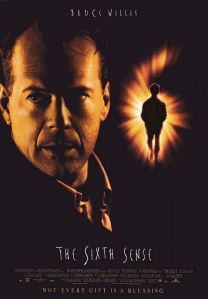 August is mostly thought of as a time of dead water for summer movies. But now I think it should be regarded as the best month for film this whole mediocre summer, and The Sixth Sense is one of the main reasons. Though the title kinda’ sucks.
In a summer low on genuine chills here’s one movie that offers honest-to-God-grip-the-armrest-chills. It’s very moody when it needs to be and creepy when it never has to be but is anyway, and constantly moving. The Sixth Sense also offers audiences something they haven’t seen this summer: real characters with depth. The characters leap from the screen and are slowly established as complicated, rounded, and very thoughtful people. Now that’s something that took me for surprise.
Bruce Willis achieves his quiet mode and teams up yet again with another child (a la Mercury Rising). Willis’ acting is solemn and just enough to drive his character through his quest. You haven’t seen Bruce Willis show this much emotion since he walked over glass in Die Hard! But the story of The Sixth Sense is a little tyke that comes from out of nowhere and redefines child acting. To say Haley Joel Osment carries the film is an understatement – he throws it on his back and runs a 4.3 with it. If Ana Paquan can win an Oscar for babysitting a piano then this kid deserves one too. This is the greatest child actor I’ve seen in years and I begin to wonder why Lucas chose his miscast young Anakin.
The best thing The Sixth Sense has is intelligence. It rewards those who stood up and paid attention with a knock-out terrific ending that wraps everything up you questioned before. And you will rerun things in your mind over and over when you leave the theater. My only complaint, and it is small, is that the direction could be tighter at times. But for everything The Sixth Sense has to offer I will gladly wait in line for seconds. The best summer chiller, and one of the best movies of the year. The title still sucks though.
Nate’s Grade: A


 nathanzoebl
You must be logged in to post a comment.