Blog Archives
Black Panther: Wakanda Forever (2022)
 It’s hard to talk about Black Panther: Wakanda Forever without first discussing its missing whole, namely Chadwick Boseman. It was a shock when Boseman died during the summer of 2020 of terminal cancer, which he had kept hidden except for a small number of close confidants. I remember hearing the news and being in disbelief, figuring this must be another celebrity death hoax, but then the terrible news was confirmed. It’s one of those celebrity deaths that you remember when you found out, mostly I think because here was an actor in his prime and headlining Oscar-nominated movies and precedent-setting blockbusters. It felt too soon to be gone. It felt wrong. It’s that grief that the characters of Wakanda Forever are also wrestling over. Reflecting real life, the sequel to 2018’s hit Marvel Cinematic Universe (MCU) entry elects to have T’Challa (Boseman) pass away in the movie as well, off screen, and from a cause more human than super, dying from a disease. The movie is knowingly channeling our grief for the loss of Boseman into a story about characters also mourning the loss of this good man. This loss hangs over the entire movie and provides it more gravitas and emotional depth it would have had otherwise. Wakanda Forever is a suitably exciting and expansive sequel, especially following the empowering cultural model writer/director Ryan Coogler followed with the first film, but it’s hard not to feel the loss of Boseman, both in presence and in storytelling.
We open with Shuri (Letitia Wright) diligently trying to save her brother’s life only to be out of time. The nation of Wakanda is in full mourning, losing their champion and king. In the wake of this loss, the outside world sees opportunity. Having come out of hiding, Wakanda is being pressured to share its valuable vibranium mineral resources with other nations, and some are eager to take them by force if necessary. This has inadvertently created a gold rush for vibranium, and the C.I.A. has discovered traces of the rare mineral on the ocean floor. This undersea incursion has provoked a heretofore unknown underwater community into action. Namor (Tenoch Huerta) is a super-powered mere mutant, able to fly with tiny wings on his heels, and able to breathe under the sea just like the inhabitants of Talochan. Namor has declared war on the surface world and seeks Wakanda to be an ally, and if not that, then their first conquest.
This is a movie dominated by the women of Wakanda, and they bring the fury. Everyone is processing the loss of T’Challa in different ways. Shuri is rededicating herself to her scientific research, as she blames her brother’s death on her inability to solve his ailment in time. T’Challa’s mother, Ramonda (Angela Bassett), has been appointed leader of Wakanda and must represent her nation’s interests while still grieving for her son. Nakia (Lupita Nyong’o) has retreated from the larger world of spycraft to open a school in Haiti. Okoye (Danai Gurira) is supposed to be the chief security officer for Wakanda, and she busies herself with new threats and armor rather than dwell on being unable to save her king. Each character feels the weight of the loss and opens up reflections of grief, as each knew T’Challa on a different level: mother, sister, lover, protector. The attention that Coogler allows for their and our grief allows the movie to work on a communal cathartic level (I teared up a few times myself). Wright (Death on the Nile) has some heavyweight emotional moments, and the movie is structured around her path of healing as well as the wayward detour of vengeance and hate. It’s a conclusion that hits upon the expected spectacle of superhero action but hinges upon, foremost, an emotional arc.
Coogler is two-for-two when it comes to creating dynamic, engaging villains who have strong perspectives that cause the heroes to better reflect upon their own roles. Killmonger (Michael B. Jordan) is one of the MCU’s best villains, and I think it’s interesting that the first Black Panther ends with the hero realizing the villain’s perspective is right and adjusts from there. With Wakanda Forever, we get Namor protecting his people, and his reasoning sounds a lot like the Wakandan leaders who wished to remain separate from the larger world in the earlier film. The background for Namor is completely rewritten by Coogler and co-writer Joe Robert Cole and for the better. They’ve invigorated the character by attaching a rich Mesoamerican culture to Namor’s people and history. We have another hidden world of minorities that are super-powered and developed beyond the reach of colonialism. The flashback for Namor, dating back to the sixteenth century, is startlingly effective, establishing his strange origins, the great change for his tribe to being sea-dwelling, and what happens when he returns to the surface world to honor his late mother’s funeral wish. When he returns, the Spanish have built plantations and have captured the indigenous into being their chattel. Namor sees this exploitation in the name of a foreign God and swears off the surface world. This cultural angle imbues the character’s focal point but it’s also just plain neat to watch an ancient Mesoamerican culture given the big screen superhero treatment with reverence and awe. By providing a compelling villain, it also makes the emotional stakes more compelling. We’ll likely side with the women of Wakanda, but you might also be rooting for Namor too. I also think it’s fun that the underwater Atlantean prince character for DC and Marvel is portrayed by a Mexican-American actor and a Polynesian actor. 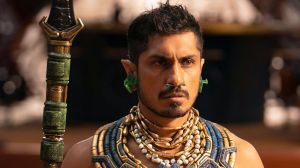
Where the movie doesn’t work as well is with its introduction of Riri Williams (Dominique Thorn, Judas and the Black Messiah) who is the human McGuffin. She’s a brilliant engineer who accidentally discovers a vibranium detection device, but why does nabbing her matter to Namor? With the device already created, the proverbial horse has left the barn. Kidnapping the inventor after her technology has already been utilized seems too late. There’s no real reason she could not be replaced with an inanimate flash drive except that this establishes the character up for her 2023 Disney Plus TV series. It’s this larger corporate portfolio push that I’ve always worried about with each new MCU edition, now 39 in total, that they will be forced to set up future movies and shows at the detriment of telling a focused and satisfying movie. The MCU movies I’ve generally liked the least are the ones that fall under this pressure the most, like Age of Ultron, Iron Man 2, and Multiverse of Madness. I found the character of Riri Williams to be fun, but her inclusion always seemed like a distraction to the larger story. I’m sure you can make thematic connections, a young brilliant black woman finding solace in Wakanda, but if you were looking to trim down an already overlong movie, I think Riri is the easiest to eliminate.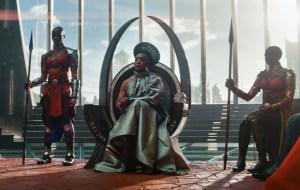
With Black Panther: Wakanda Forever, Phase Four of the MCU has officially closed and Phase Five will begin shortly with Ant-Man 3 in February, 2023. In the wake of the conclusion of the multi-phase Infinity series and 2019’s Endgame, this phase felt dominated by closure and exploration. The Disney Plus series provided little conclusive offshoots for many of the original Avengers characters. It’s also been a period of experimentation, with Marvel broadening its tone and scope from martial arts movies, spy thrillers, romantic epics, and familiarizing audiences to the concept of the multiverse with good movies (Spider-Man: No Way Home) and not-so good movies (Doctor Strange 2). And of course Wakanda Forever is the biggest edition yet on fulfilling a sense of closure, though it had never been intended to be before Boseman’s passing. It’s a sturdy sequel with a palpable emotional undercurrent and an engaging villain to boot. I called 2018’s Black Panther as agreeable, mid-tier Marvel entertainment, and I’d say the same for its sequel. However, with Boseman’s passing, it’s naturally elevated. Wakanda Forever is long and overstuffed but also emotional and engrossing and satisfying.
Nate’s Grade: B+
Share this:

Black Panther (2018)
 Black Panther is unlike any other Marvel Cinematic Universe (MCU) film prior. It’s unlike any other super hero film prior. Yes, there have been African-American leading men in comic-based movies, notably Wesley Snipes’ half-vampire-all-badass Blade. However, this is the first movie I can think of with this kind of budget, this kind of backing, and with this kind of ownership over its cultural heritage and the heavy burdens it carries.
We last saw T’Challa (Chadwick Boseman) in Captain America: Civil War mourning the loss of his father, the king of the African nation of Wakanda. The outside world does not know that Wakanda sits on a vast supply of virbanium, the strongest and more durable metal in the world and the key to Wakanda’s impressive technology. Under a holographic cover, Wakanda is a thriving metropolis with flying cars, skyscrapers, and next gen weapons. T’Challa goes home and must earn the right to the throne. However, Erik Killmonger (Michael B. Jordan), a former top-level black ops solider, is looking for his own path into Wakanda and onto the throne. Killmonger teams up with arms dealer, Ulysses Klaue (Andy Serkis), to force Wakanda to deal with being cut off from the world.
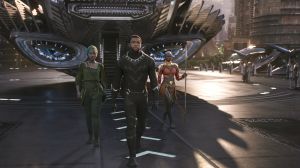 This is a movie populated almost entirely by black faces, notably black women (more on that later), and they are given a mainstream platform that celebrates its multitudinous African roots and traditions thanks to co-writer/director Ryan Coogler (Creed). This movie is proudly black, which will rankle some on the fringes of society, as if celebrating one’s own identity is somehow denigrating those who do not apply to that status. Black Panther is not an exclusionary movie because of its content and execution; this is a very accessible movie to a mass audience, even those who haven’t been paying attention to every nitty-gritty detail in the previous seventeen MCU entries. There are only two characters from other MCU films that appear, one as a post-credits cameo and the other an officious representative (Martin Freeman) of the outside’s clandestine organizations. This is a unique world isolated from the long shadow of colonialism. Wakanda has never known, to our knowledge, the depravity of the European and American slave trade. They have continued to develop uninterrupted by conquerors, slave traders, and the crippling aftereffects of racism. The Wakanda people could very easily be the conquerors themselves. They’re the most technologically advanced nation on the planet and hide as a “third-world nation,” utilizing the ignorance of the Western world to its security. The world of Wakanda is a fascinating, awe-inspiring, and defiantly independent nation.
The larger theme is over the responsibilities inherent to those with privilege. The nation of Wakanda is vastly successful by all conventional metrics. T’Challa must wrestle with whether to continue their exclusionary stance, ignore the plight of the larger world and say it’s none of their business or engage with the world, potentially putting his own kingdom’s peace and prosperity at risk. It’s a simple enough theme and yet it has tremendous weight to it especially when you account for those on the other end of the Wakanda borders. The character of Killmonger is a direct reflection of this. His experiences in Oakland are not the ideal pairing with the luxury of Wakanda. Killmonger sees Wakanda’s great influence as a way to protect beleaguered black citizens of the world and especially in the United States. It’s a way to prevent more senseless deaths from black citizens who were slain as a result of the fear of just being black (a powerful example was Coogler’s debut film, Fruitvale Station). It’s a pointed political statement that doesn’t get too heavy-handed (even though I would have preferred that). It questions the value of isolationism especially when suffering can be prevented. Killmonger works as a villain because you can understand his point of view. He goes beyond the need for vengeance. The wrongs he wants to right are larger and historical. Even Killmonger’s last line really attaches itself to this theme. T’Challa offers him a way out but with imprisonment. “No,” Killmonger declines, “My people were the ones who leaped over the sides of the slave ships. They knew death was better than bondage.” The emphasis is “his people,” not T’Challa’s, not Wakanda. His people were the ones who suffered from slavery. Could Wakanda have possibly prevented it?
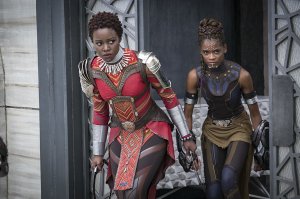 Another wonderful surprise of Black Panther is its incredible all-female ensemble that provides expert support to their king. T’Challa has the good fortune of four strong women, each of them having a different and vital relationship to him. The standout will be Danai Gurira (TV’s Walking Dead) as the fierce chief of security, Okoye. She has a swagger that vacillates between being intimidating and being brashly enjoyable. Okoye has many of the best lines and she throws herself into every fight. There’s also a sense of duty that transcends a single man that challenges her loyalty. Letitia Wright (TV’s Humans) plays Shuri, the Q of this world, the top scientist and creator of many a gadget. She’s T’Challa’s little sister and their interplay is very competitive and teasing. She’s looking to be more involved in the action and a highlight is when she teams up with her big bro. Lupita Nyong’o (The Jungle Book) is Nakia, a former flame of T’Challa’s who comes in and out of his life as an undercover spy. All three of these women have a powerful sense of agency and are integrated in important and essential ways. Even though Nakia may slide into that romantic interest role, she still has a vibrant life outside whatever feelings she may or may not have for the hero. Then there’s T’Challa’s mother, Ramonda (Angela Bassett), who radiates strength and fortitude. These women gave me some of the biggest moments of entertainment in the entire 135 minutes of movie.
Now some careful readers might note that I haven’t done much to emphasize the actual action of the super hero action movie, and that’s for a good reason. Black Panther stands stronger on theme and character than it does its actual action sequences. Coogler had a wonderful sense of scale and verisimilitude with 2015’s Creed, relying on long takes to put the audience in the heightened drama of the boxing ring. With Black Panther, the action sequences can lose a sense of immediacy. Many happen at night or are filmed and edited in ways that diminish some of their impact, like hand-to-hand combat in splashing water where the splashes obscure the activity. Other scenes felt like a video game CGI cut-scene. Speaking of video games, Black Panther’s suit has a crazy ability to absorb the kinetic energy of weapons, which means the stakes take a dip when our hero can merely just stand and allow himself to get shot repeatedly. The payoff for this absorption is a giant energy shockwave but it plays out like a fighting game’s special feature. It’s an aspect that’s not really utilized in a satisfying or unique way. The final showdown between Black Panther and Killmonger feels too weightless in execution. It’s meant to even the playing field by nullifying their extra abilities, but if they both have the same “Panther powers” isn’t the field already even? The third act, the usual punching bag for MCU critics, is the best part of the movie from an action standpoint. It utilizes the characters in significant ways and allows for organic complications while still maintaining its wider sense of spectacle. Plus it’s one of the few action sequences that allow all the pyrotechnics to be enjoyed during the visibility of day.

Boseman (Marshall) was an excellent choice for a stoic and too-cool-for-school character that can glide right on by. The ageless Boseman is at his best when he’s working off the other actors, especially his female posse. He has a couple of very effective emotional confrontations as he learns of his family’s secrets. As steady and soothing a presence as Boseman can be, this is Jordan’s movie. Michael B. Jordan (Creed) has been Coogler’s cinematic good luck charm and we’re still benefiting from that divine kinship. His character is at the heart of the central thematic question. While T’Challa is ultimately the one who has to decide, it is Killmonger who embodies that need for change and the desire to rectify the past. There’s a flashback with Jordan that got me to tear up, and this guy was the villain! It’s one of the film’s biggest mistakes sidelining Jordan for far too long. After his introduction, Killmonger is strangely absent for the next hour or so of the movie, ceding the spotlight to Serkis (War for the Planet of the Apes), a more antic and goofy scenery-chewing baddie who has a few regrettably “faux hip” lines of dialogue that land awkwardly. Serkis is having a blast but can feel like a holdover from a different film.
Much like last summer’s Wonder Woman, this is a movie that is going to mean a lot to a lot of people. It has a personal significance that I will not be able to fully tap into, no matter the expansive powers of empathy. Black Panther, as a long-awaited cultural moment, will have many ripples of inspiration. After my early screening, I sat back and watched an African-American boy, no older than seven or eight, walk out of the theater in a daze. His eyes were wide, his mouth agape, and he said in astonishment, “That was the best movie ever.” That kid has a hero he can call his own. That matters. Black Panther, as a work of art, is rich in topical themes and has a wide supporting net of exciting, robust, and capable women. I enjoyed how personal and relevant and political the movie could become, folding new and challenging ideas onto the MCU formula. Coogler is a marvelous director and storyteller showing rare acumen for being able to handle the rigors of a Hollywood blockbuster and deliver something hearty. The action has some issues and there are some structural hiccups that hold it from the MCU’s upper echelon (I enjoyed all of the 2017 MCU movies better). Black Panther is a winning movie when it features its sterling cast celebrating their virtues and solidarity and a still respectable enough action spectacle when called upon for big screen duty.
Nate’s Grade: B


 nathanzoebl
You must be logged in to post a comment.