Blog Archives
Dear John (2010)
 Best-selling author Nicholas Sparks is probably a perfectly reasonable human being. I’m sure he’s great at parties and that people love him. He may even have a dynamite recipe for sugar cookies. But I don’t know what happened to Sparks to turn him into the romance genre’s angel of death. His novels have followed a familiar practice of big Third Act deaths that usually deny readers their cherished happy endings. Is the motive to push people to make the most of our preciously little time spent on Earth? Is Sparks just sadistic and has found the secret to eternal life — the tears of millions of housewives and teenager girls. Whatever his rationale, another commonality for Sparks is that the film adaptations of his books are pretty corny and dreadful. A Walk to Remember, Nights in Rodanthe, Message in a Bottle; all about romance ultimately denied, none coming close to watchable. Dear John can at least be called watchable; however, watching should be limited to the confines of your living room TV when there’s nothing else on.
It’s the spring of 2001, and John Tyree (Channing Tatum) is enjoying his two-week leave from the military. He’s out surfing the fine North Carolina beaches when he rescues the handbag of Savannah (Amanda Seyfried) from being washed away. They two of them casually chat and soon those chats lead to barbecue invitations, parental visits, and kisses in the rain (a romantic movie tradition). Savannah takes an interest in John’s eccentric father (Richard Jenkins) because she recognizes his condition as autism. She’s been helping to watch her neighbor’s autistic child. Savannah would like to start her own horse camp for the autistic (sounds like an insurance nightmare). Life seems so full of promise and John promises to be back as soon as his military commitment expires in six months. Then 9/11 happens. John re-enlists and extends his tour another two years. This places great strain on his relationship with Savannah, but they write each other countless letters that manage to find John no matter what far-flung village he’s stationed at. Can their love exists on a series of hand-written letters? Well, look no further than the classic implications from the film’s title.
 Dear John goes through all the traditional Nicholas Sparks waterworks trademarks: young love leads to yearning, which leads to heartbreak, which leads to more yearning, which then inevitably leads toward one of the leads dying and everyone learning some sort of shallow profound meaning about life, blah blah blah. There are plenty of heightened melodramatic elements thrown into a fairly traditional, unspectacular love story, but all potent potential moments of drama feel underwhelming pretty much because the audience doesn’t care. John and Savannah are perfectly nice people and their love has that hopeful bloom, but their relationship is no more involving than watching a pretend couple in a commercial for greeting cards or life insurance. These people are vanilla. It makes it astounding, then, that such highly charged elements like cancer autism, and 9/11 fail to leave any impact. Dear John confuses listing dramatic events as drama itself. The dramatic stakes feel entirely too mellow and the film generally has a detached feeling, like it’s purposely distanced from the material for fear of getting too involved. This is a relationship movie that has its own commitment issues.
The military angle is respectfully explored, though not in much depth. John is torn apart by the pull of returning to his beloved but also of serving his country and, more personally, keeping his band of brothers in arms together. It’s a complicated scenario but the military commitment is another item in a list that should grab your interest but fail to do so. 9/11 isn’t given any deeper consideration other than the fact that it serves as a roadblock between our two lovebirds. If you want to see a more nuanced, complicated, and empathetic view of today’s overburdened military, check out the movie Stop-Loss, which also stars Tatum.
 The film drops any facade of being a romantic drama about midway through when Seyfried gets completely sidelined. She’s less a character and more an agreeable plot device; she’s self-aware and kind and knowing and receptive yet also naive. This makes her sudden character shift rather jarring, which seemingly paints Savannah as extremely co-dependant. Dear John then transforms into a serviceable father/son drama. There are some nice and moving moments between John and his father; this should have been the real focal point of the movie. Jenkins acts circles around everybody in this movie. It’s wonderful seeing a grown-up in these kind of movies show the kids ho this acting thing is done. Tatum actually might become a pretty good actor. He convincingly plays the more emotional moments well. He may very well prove to be the Patrick Swayze of his generation. Tatum can dance (Step Up), make the girls cry, and also handle some rock-socking action (G.I. Joe, Fighting, most of Tatum’s other movies). I think there’s an actor buried beneath that daunting physique waiting to blossom. Don’t disappoint me, Channing.
Dear John is a formulaic romance trained to seek pre-programmed audience responses (“Now you will laugh. Now you will cry. Now you will cry again. Now you will once again continue to cry…”). Lasse Halstrom (What’s Eating Gilbert Grape, Cassanova) directed this movie but you’d never be able to notice. I don’t want to be too harsh on the film because the acting is pleasant the story isn’t repulsive and does have some good moments, but mostly the movie comes across as bland and remote. The romance seems absent a beating heart to keep things moving. It’s all too lifeless. The character of Savannah best summarizes Dear John as a whole: mild pretense of wisdom, pretty to look at, genial, but fairly bland and difficult to convince is worth your valuable time.
Nate’s Grade: C
Share this:

An Unfinished Life (2005)
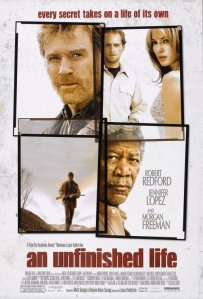 Einar (Robert Redford) is a gruff rancher living with his long-time friend and ranch hand, Mitch (Morgan Freeman), who has been recovering from a bear mauling. Jean (Jennifer Lopez) and her young daughter (Becca Gardner) have run away from her abusive boyfriend and seeking temporary refuge with Einar. There’s still a lot of tension and unspoken anger between the two. Einar blames Jean for the death of his son from a car accident. As their stay continues each member imparts wisdom to the other, hard exteriors get warmed, and lessons about forgiveness are learned.
This is melodrama with a capital M. An Unfinished Life is clunky, the movie hasn’t the foggiest idea when it comes to subtlety, the characters all shout out their feelings all the time, and worse yet, it’s also incredibly transparent. A scene where Lopez breaks a dish and Redford goes nuts is just too much. Of course they’re talking about his dead son but the moment is played to the hilt that I half expected every line to end in a wink (“It’s just a dish” wink “Maybe it’s more than a dish to me!” wink “Maybe that was my favorite dish!” wink). Honestly, it was at this point that the film lost me. The metaphors are another symptom of the film’s overly ramped-up obviousness; Redford might as well be pointing at the bear to pantomime that it?s supposed to represent his pain and anger. And Freeman’s eventual forgiveness of his attacker is meant to encroach upon Redford to do likewise to the source of his pain, and many other moviegoers, Jennifer Lopez. I cannot find a movie emotionally involving when it doesn’t even bother to mask its grand statements.
Seriously, this movie is brimming with sprawling earnestness meant to cover the narrative shortcomings. This is a simple tale that could have suckered the audience in with its framework to showcase complex characters and their personal interactions, like a Million Dollar Baby, but even though An Unfinished Life is simplistic it still manages to beat you over the head. Every line of significance is underlined so you get it. It’s like director Lasse Hallstrom was making a seething parody of these overarching, small-town, large cast, homesy feel-good flicks he’s specialized in for a decade.
The acting is all fine. Redford is fun to watch and get his Jeremiah Johnson back on. Lopez makes you forget how much you hate her in other movies. Freeman is settling into a weird groove as a disfigured narrator. The acting of the ensemble really isn’t the issue with An Unfinished Life.
Despite all its earnest intentions and lush scenery, An Unfinished Life is too much melodrama squeezed into such a small space. It’s an old fashioned tale that feels too convenient, too simplistic, too perfunctory, and too unhappy with being any of those things. This feels like a Hallmark card turned into a movie by someone who has no grasp for human emotion. Everything is shouted when it needs to be a whisper and explained when it needs to just be experienced. And yet there will be an audience for this slow burn small-town tale of forgiveness and accountability. It may please people immensely, but I prefer a little subtlety to my drama. I won’t say the film is bad but I’ll never say An Unfinished Life is particularly good, even as melodrama.
Nate’s Grade: C


 nathanzoebl
You must be logged in to post a comment.