Blog Archives
Kirk Cameron’s Saving Christmas (2014)
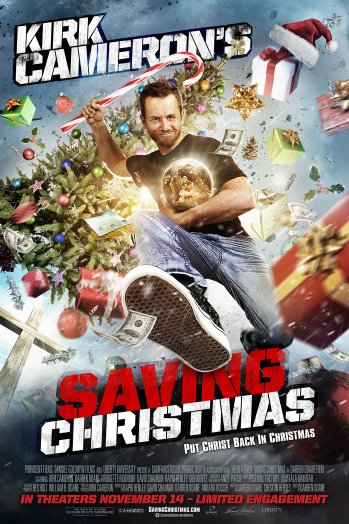
Given the title, Kirk Cameron’s prominent placement, and a poster involving Cameron with a background explosion of holiday paraphernalia, one would assume Saving Christmas would concern itself with the oft-repeated “War on Christmas.” I was expecting Cameron to lament our use of “Happy Holidays” and the like. Perplexingly, Cameron’s war is not with those outside Christianity but those within. Saving Christmas is a shoddy evangelical sermon with shoddier theology, straining to fill out a running time, and ultimately being pro-materialism and anti-empathy. Come again?
At Kirk’s (Cameron) family Christmas party, his brother-in-law Christian (Darren Doane) is a Grinch. He complains that Christmas has been co-opted by secularism. Santa Claus and other symbols with pagan origins dwarf the nativity and baby Jesus. Christian removes himself from the party and sits in his car. Kirk won’t allow this to stand. He gets inside the car and proceeds to explain why Christian is wrong about Christmas.
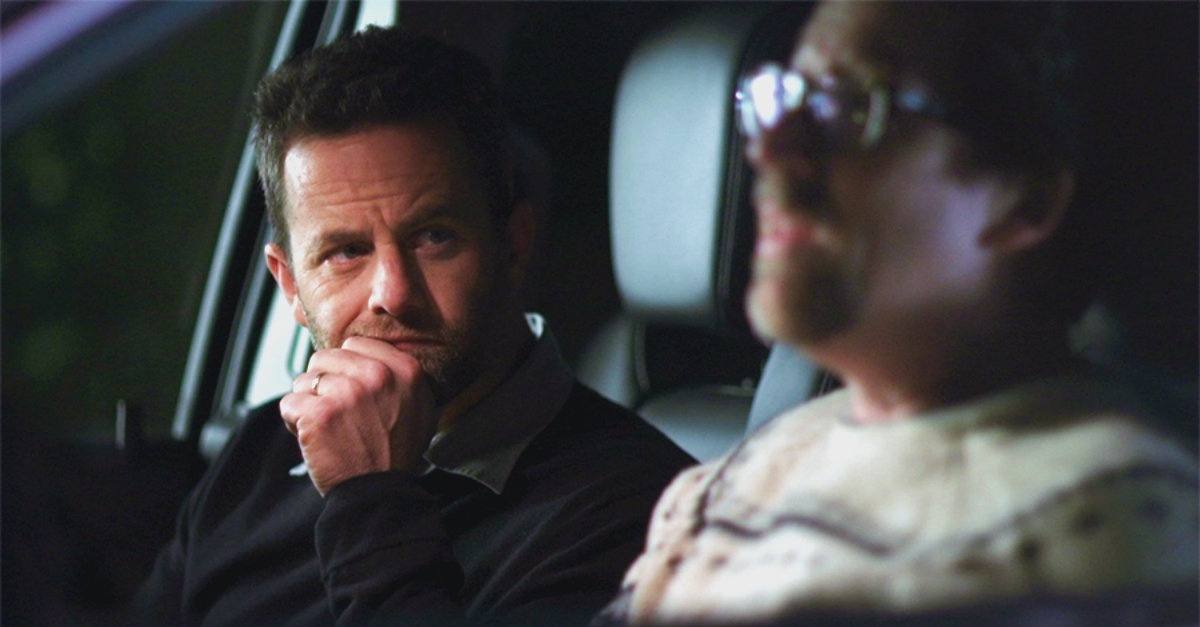
To call this a film is to be more charitable than perhaps even Jesus would be. Saving Christmas (or Kirk Cameron’s Saving Christmas as listed in certain places) is a smug sermon presented by Kirk Cameron lecturing his “bro”-in-law in a car. The majority of the film takes place in a parked car. If that sounds deeply cinematic to you, then stick with me. The film shambles its way to 80-minutes, exasperating to fill out a minimum feature-length running time. There’s about ten minutes of “hilarious” bloopers. There’s a five-minute opening where Cameron speaks directly into the camera and sips from his mug of hot chocolate three separate times. There’s a five-minute, though it feels tortuously endless, “hip hop Christmas dance” performance by a bunch of white people (it is powerfully uncoordinated, like you’re watching someone’s home movie of their kids). You do get to watch Cameron effectively do the Worm, though (his finest acting moment onscreen, in my humble opinion). There’s also the occasional, very tin-eared comedy break with supporting characters that skirt the line into stereotypes. When it all comes together, there’s maybe a total of 40 minutes of an actual movie here, laboriously stretched out. And when I say “movie” I mean Cameron and Christian talking back and forth in a stationary car. This is not a movie. At all.
Director and co-writer Doane is one of the most inept filmmakers I’ve observed. This is a horrible looking movie with many clueless edits and strange visual compositions. His onscreen wife is always seen looking wary and in slow motion, like her face has frozen. There’s also the annoying habit of not properly framing his subjects, who will get caught behind a pot of hot chocolate or some poinsettias. This is just bad filmmaking. The lighting is amateurish or overdone, like when Kirk spends about five minutes standing back-lit, as to communicate his inherently angelic nature. Doane will also keep focusing on repeating scenes like he’s filling time. The film has a very rushed and patched-together feel, as if they had a weekend to film it at Cameron’s place with his friends and family. The “comedy relief” is also terribly executed, with two characters having a conversation holding mugs to their face, the better to disguise the fact that one of them is not actually speaking his lines. The pacing is also dead. The movie keeps faking you out when it’s going to end but then continues on, overstaying its welcome so Cameron can have yet another victory lap to hear himself talk.
Cameron and his producers seem to subscribe to an all-or-nothing approach when it comes to recognizing the malleable symbolism of cultural artifacts. Is there any harm in acknowledging the past connections of certain ceremonial customs and artifacts we use today? While the origins of the Christmas tree can go back to the pagans, Cameron seems to forget to mention that it was Martin Luther who took the Christmas tree as a German holiday tradition and gave it a Christian spin. Of course acknowledging such would indicate that the Christmas tree wasn’t always the same symbol. But who cares? History is a melting pot as far as cultures are concerned, and we pick up many customs that become passed down for various reasons, often expanding and adapting. Is there any implicit harm in simply admitting that a Christmas tree has an origin that predates Christianity? Today it is a different symbol commemorating a different holiday. Just because we know history doesn’t somehow devalue our customs and traditions. Cameron and his cronies seem to disagree, which is why he presents flimsy arguments to reclaim historical authority. What he’s really doing is treating the symbols of the season as metaphors, applying deeper meaning to them. That’s fine and good. If Cameron wants to see the Christmas tree as a representation of the cross, or the trees of the Garden of Eden, that’s fine. But he shouldn’t pretend that this interpretation is gospel. That’s the thing about metaphors; they’re subjective and pliable. They are not absolute.
Amazingly, Saving Christmas ends up becoming a misguided and ludicrous defense of materialism and the commercialism attached to Christmas. In Cameron’s very narrow perspective, anything associated with the holiday has to be positive. Yes, Cameron literally argues that all the material excess and spending actually honors God. Instead of looking at the presents under the tree as just that, look at them as the outline of a skyline of a new Jerusalem, Cameron offers in one of the more head-scratching moments. He conflates the spending of money with celebration, admonishing people to buy “the biggest ham, the richest butter” as long as they just don’t “max out their credit cards.” That’s the limit he sets, so everything below that must be agreeable. Just to hammer the message home further, Cameron says that materialism is good because “Christ was made material.” That sure is a slippery slope of ethics there. It’s not much of a leap to then justify greed or to equate spending the most money with being the godliest. Why would any film, let alone a Christian one, choose to defend unchecked materialism?

I know Christian is more a foil for Cameron to helpfully inform, a straw man who cannot articulate his intellectual rationale, but Christian is the worst skeptic of all time. If he truly believed what he does then he should be able to provide evidence to support his stance. It wouldn’t be hard. The historical record is loaded with stuff ready-made to counter-argue Kirk’s cherry picking of relevant theology. The very concept of late December existing as a pagan holiday celebrating the winter solstice (Saturnalia) is backed up by a treasure-trove of sources, despite Cameron’s snide rejoinder that “last time I checked, God created the winter solstice.” The Romans would even exchange gifts on December 23 in celebration and feast. If Christian were a real skeptic, he’d at least have a cursory knowledge of this stuff before even approaching specifics. Instead he sputters and is proven to be a fraud, duped into believing these anti-Christmas thoughts. Every time Kirk finishes another of his rather unconvincing asides, Christian shakes his head, dumbfounded, and says he never looked at things like that. He is the most easily converted skeptic since the Spanish Inquisition.
I kept going back in my head to a vital point of Christian’s that is never referenced or challenged by Cameron: wouldn’t all this money better be spent helping the disadvantaged? Christian looks at the extravagant money spent on an ostentatious party and thinks of how many people could have been fed, how many wells could have been dug in villages. “You’re wrong,” Kirk says. “About everything. You’ve drunk the Kool-Aid.” Even as Cameron bends over backwards to defend materialism, he never addresses Christian’s fundamental point, which is that the money can be better spent elsewhere. To the movie’s worldview, Christian is a “jerk” and he’s “terrorizing” (I kid you not, they specifically use the word “terrorize”) his family with his negativity. This is a guy who wants to put the “Christ back in Christmas” and he’s setup as the bad guy. He’s not storming the party, aggressively challenging people, calling them names. He sits to himself, eventually leaving the space for his car. It doesn’t sound like he’s terrorizing anyone and is rather considerate of others. No matter, no one is allowed to have a different opinion than Kirk Cameron and so he will not allow one man’s empathy to bring everyone else down as they spend lavishly to celebrate the birth of a poor carpenter.
And that’s what’s most distressing for me when it comes to this poorly made and poorly reasoned movie; I’m concerned that others will use Cameron’s distorted teaching as a justification for excess over empathy. Cameron seems to use the film as a defense of his affluent privilege. He uses the Bible to back up his lifestyle and to defend materialism. Did we forget that part where Jesus said to sell all your possessions and help the poor? The film is packaged as a comedy and a family movie with a spiritually uplifting message, but what’s so uplifting about saying “SPEND SPEND SPEND” is how you show love? Just because Cameron says a nutcracker is representative of King Herod’s foot soldiers prowling Jerusalem for the baby Jesus doesn’t make it strictly so. To call this a movie would be too charitable and I am not in the season of giving. Saving Christmas is a lump of coal disguised as a open-hearted message. Skip this movie and donate your money instead to some charity. At least that will do some actual good.
Nate’s Grade: D
Share this:

Fireproof (2008)
 Earlier this fall, a small flick financed by evangelical Christians broke into the top of the box office. It was written by the Kendrick brothers, Alex and Stephen, both associate pastors, and directed by Alex. They previously wrote and directed 2006’s small hit Facing the Giants, a Christian-based sports movie. Fireproof is a story about Caleb (Kirk Cameron, the Russell Crowe of direct-to-video Christian produced movies) and his strained marriage to his wife Catherine (Erin Bethea). She works as a public relations rep in a hospital and feels that it may be time to divorce her irritable, selfish, and overall jerk of a husband. Caleb’s born again father convinces him to hold off on any divorce proceedings and passes along a book called The Love Dare, which challenges couples to 40 days of guided help.
This movie is bad. You probably already knew that. I am somewhat alarmed that there appears to be a whole lot of eager Christian filmgoers that will plop down plenty of dollars to see anything, no matter how horrible, if it conveys a Christian message. Just because you can agree with a message doesn’t mean the product is worthwhile. Here are some things to think about if someone ever asks you if you’ve seen the movie Fireproof.
1) Fireproof exists in a world not our own. The characters behave in odd ways that do not appear to resemble observable human behavior. Some leeway is given because, yes, they are fictional characters, but they say dialogue that sounds forced and clichés, and they do actions that are contrived because the movie requires them for the plot. Here are some minor examples that play to this theme:
 a) The town of Albany, Georgia is designed like a small town even though it has a metropolitan population of about 160,000. And yet the town only has one crew of firefighters consisting of five guys, and three of those guys are clearly not in a physical condition that would be deemed passing. Seriously, these guys are too overweight to be firefighters. Because of the film’s small town presentation and the fact that the county clearly doesn’t care about physical fitness for its emergency responders, Fireproof thus gives us a fire crew that has a whole lot of time on their hands. This complicates things because it makes it seem like Caleb would have more time to be nice to his wife.
b) The women are presented in completely unflattering ways. There are two main female characters, Catherine and Caleb’s mother, and a gaggle of female nurses that simply cannot help themselves when it comes to gossiping and clucking like hens. Every black woman in this movie at some point must say the utterance, “Mmmhmmmm,” and of course bob their head as they talk. The dialogue feels forcibly “black” for these characters when it just could have been anything. Caleb’s mother is briefly presented as a concerned figure but Caleb just tells her to shut it and asks for alone time with dad, you know, the man of the house. She never stands up for herself and her husband, Caleb’s father, does a lousy job of telling his idiot son to respect his mother. Now Catherine is given plenty more time and she has some serious grievances with her lunkhead mate, but when he tries doing helpful and nice things she still decides to be cold to him. Why? Maybe Catherine is just a cold person, after all. One of the very first moments we see her character is when she’s talking to her mother, who has recently had a stroke. Catherine is venting about her troubled marriage and then begins to break down to her mother and says, unbelievably, “I miss the real you.” Excuse me? Just because your mother had a stroke doesn’t mean she’s any different mentally, and she can still hear and understand you, dear.
 c) Internet pornography is played with more drama than the Holt’s marriage. When it comes to dramas that center around marital discord, it shouldn’t take much effort to create a compelling conflict. But I just didn’t buy the conflict between Caleb and Catherine from the start. The conflicts in their marriage are rather mundane, which is likely very realistic for many couples but it makes for poor drama. He wants the respect he feels he’s entitled to. She wants her husband to spend time with her and be nicer to her. He wants to buy a boat with his money. She wants new shelves. How expensive can shelves be? Catherine does feel temptation at work from a doctor that takes time out to listen and make her feel special. That’s a real dilemma. On Caleb’s side? His big moment comes when he battles his addiction to Internet pornography, which was an issue the filmmakers also addressed in their previous flick, Facing the Giants. Caleb is looking at boats online when a pop-up appears that asks if he “Wanna see?” a sexy lady. Oh, the horror. Caleb lingers. Then he paces, all the while staring at the tempting pop-up ad a mere click away. He paces more. Dramatic music starts to build. “Why is this so hard?” he angrily asks to no one in particular. This goes on for like a minute solid. Then he resists the temptation and is determined to be a better man for his wife, sans pornography. Great. Except that’s not exactly what he decides to do. He decides to take the computer outside and literally smash it to pieces. There is likely plenty of personal information, credit card numbers, family photos, personal documents, and more on that computer, but alas Caleb decides to get smash happy with a baseball bat. I understand that Internet pornography is a realistic addiction for many people but, again, it makes for terrible drama in a PG-rated movie. His wife is nonplussed when she finds out about the computer being smashed. Human beings do not behave like this! At the very least, she should have been angry that he just wasted money. You know, you can get Adult Web site blocking software for much cheaper than a new computer.
d) Caleb totally got hosed when it came to hospital supplies. This is a lesser charge but it still sticks in my memory. Caleb has saved up $24,000 for a boat but ultimately spends all of it to pay for a wheelchair and a hospital bed for Catherine’s mother. Catherine is so thickheaded that it takes her weeks to figure out her husband spent the dough and not the nice doctor she talks with at the hospital. There is no way that a hospital bed and one electric wheelchair cost that much money. Caleb got taken for a sucker. Catherine’s mother had a stroke, and you’re telling me that in her situation she doesn’t qualify for Medicare? The government probably should have covered the whole thing, if not most of the expenses. But then this incident is just a cheap conflict that makes Catherine look stupid and Caleb look naïve.
 2) The metaphors are leaden and inane. Given the title and the nature of Caleb’s profession, you can bet your bottom dollar you’re going to be inundated with “fire” metaphors: “You never leave your partner behind, especially in a fire.” Or how about: “Fireproof doesn’t mean the fire will never come. It means when the fire comes that you will be able to withstand it.” You get the idea. What’s even worse is that the movie offers metaphors that are intended to be profound but are astoundingly shallow. One character says, “You know a woman is like a rose. If you treat her right she’ll bloom, if you don’t she’ll wither.” That is quite possible the worst simile I’ve ever heard in my life. Read it again, please. It is essentially saying, “A woman is like a [thing]. If you are [good] to her then [good will happen to thing]. If you are [bad] to her then [bad will happen to thing].” This is basic attribution, people. I can come up with equally profound comparisons using this model. How about this one: “A woman is like a ’62 Chevy. If you treat her right she’ll keep running, if you don’t she’ll need to be put up on blocks.”
3) This Love Dare book is tripe. This book actually exists now, by popular demand from the many people that watched Fireproof and asked for this guidebook. I’m supportive for anyone out there that actually tries to save their marriage rather than give up, but let’s face it, sometimes some marriages were meant to be dissolved. Just ask Britney Spears. Caleb’s mentoring firefighter buddy reveals, shocker, he was previously married at one point, and he confesses, “I got married for the wrong reasons and then divorced for the wrong reasons.” Well, if you were married for the wrong reasons and not truly compatible then perhaps you got divorced for the right reasons. Ignoring this, the book that Caleb’s father presents has some tepid advice. Day One: Don’t say anything negative to your spouse. Day Two: Do a small act of kindness. Day Three: Check in on your spouse. Yawn. This is common sense marketed as life-changing behavior recipes. You really needed a book to tell you that a successful marriage is aided by holding your tongue? What really makes the book questionable is what happens on Day 23 or so: remove parasites from your marriage, a.k.a. addictions like gambling, drugs, and pornography. Why is such a monumental step placed at the halfway point? Will saying nice things and buying flowers really matter if you still have a heroin habit?
 4) Little to this movie feels authentic or genuine. I’ve already gone into plenty of detail about why the movie feels unrealistic, but the $500,000 budget doesn’t help matters when it comes to authenticity. Visually, the Kendrick brothers know the language of film but are clueless when it comes to making a visually appealing picture. Fireproof does the term “bland” a disservice. I counted exactly five shots that I thought were visually interesting, and I might have been generous. The editing is also poor and frequently shots will not match up well. Yes, shortcuts are going to have to be made but monetary shortcuts don’t interfere with writing good characters and realistic interplay. Not one single character feels like you would ever find them existing outside of this movie. Even the Christian characters come across unflattering and not genuine. My favorite part in the entire film was when an old nurse at the hospital spotted Catherine and the hunky doctor flirting in the hall. The camera fixed on her disapproving stink-eyed glare and it held for so long, and the woman put so much distaste in her expression that I instantly wanted her face as a Halloween mask. When she appears again to eat with Catherine she takes great pains to excuse herself so she can call attention to her praying before her meal. I cannot fathom a random moviegoer warming up to this woman via her portrayal. Even Caleb gets to threaten the hunky doc with a not so subtle call to a brawl.
I’ve already espoused more words on this movie than it deserves. Fireproof isn’t so much a movie as it is an accessory to a Bible study guide, or a marketing tool for selling the Love Dare book. It cannot stand on its own merits as a worthy film. It’s predictable, unabashedly cheesy, poorly written, poorly directed, and poorly acted. I know Kirk Cameron isn’t a terribly good actor, but man he blows every other actor away in this. There is some fairly pedestrian acting, especially from Bethea. I’m happy if people can walk away from any movie and want to be better people, even if it’s because of dumb movies like Fireproof. I think the most annoying aspect of the film is how insistent it is that a faltering marriage must turn to God in order to be saved. Look, if you need God to tell you to clean the house or be nice to your wife, then you have bigger issues.
Nate’s Grade: C-


 nathanzoebl
You must be logged in to post a comment.