Blog Archives
50 Shades Darker (2017)
 I’ll admit not understanding the appeal of the 50 Shades of Grey phenomenon. The introduction into BDSM was a worldwide sensation and the 2015 first film made half a billion dollars, the kind of money usually reserved for movies featuring muscular men in rubber costumes that use whips and chains for different purposes. I happily watched the first film to get a sense of what the big deal was and was unmoved. For a film designed to be titillating and provocative, I came away wishing it had more action (of any sort). With great success, author E.L. James asserted more authority in the film series. Out went original director Sam Taylor-Johnson, who at least provided a sleek sheen to the final product and sexual tension where able, and in came new director, James Foley (Glengarry Glen Ross). Out went the original screenwriter Kelly Marcel and in came a new screenwriter, James own husband Niall Leonard, which could only mean the threat of the film hewing closer to the book was a guarantee. James is giving fans of her popular though critically savaged romance novels more of what they want, and I guess what they think they want are relatively bad movies, limp sex scenes, and an inert romance.
Anastasia Steele (Dakota Johnson) is trying to get back on her feet after leaving her ex, billionaire and bondage enthusiast Christian Grey (Jamie Dornan). He’s got serious issues but won’t stay out of her life. He has to have her back, and rather easily the on-again off-again couple is back on and back getting it on. However, their sex life is threatened with women from Christian’s past and the question of whether he can settle down for good with such a plain Jane submissive like Ana.
 There is a mystifying lack of conflict in the movie that makes 50 Shades Darker feel aimless. There are occasional bumps in the road in the form of old girlfriends still looking for their turn, and Ana’s aggressively inappropriate boss (Eric Johnson), but they’re dealt with almost immediately and without larger consequence. One of these antagonists is foiled by nothing more than a stiff drink to the face like a full-on Dynasty parody. Dealing with Christian’s past seems like natural territory for a sequel. A character as cold and self-serving as Christian could very likely attract a host of dangerous women. Stalkers who cannot let go would present an organic threat to their relationship and Ana’s literal life. A deranged former lover would provide a substantive question for Ana to deliberate. Is she doomed to the same fate? Bella Heathcote’s troubled character is begging for attention but she is so unceremoniously sidelined to the point of hilarity, and then she’s never seen again. Why should the story provide any question that these star-crossed lovers might not magically work out in the end? None of the mini-conflicts last longer than fifteen minutes before being effortlessly overcome, including a helicopter death scare. The shapeless plot structure is tediously airy, leaving too much space for characters and a world that doesn’t warrant the consideration. You would think the extra time would be spent with lengthy, over-the-top sex scenes stripping away all inhibitions and pushing the boundaries of cinematic good taste, but that’s not so much the case (more below). I knew we were in trouble when a sequence of Ana sailing Christian’s yacht was as long as one of the so-called outrageous sex scenes.
Here’s a prime example of just how poorly 50 Shades Darker is plotted. While dressing up for the masquerade, Christian admires Ana in lingerie. “You just going to stand there gawking?” she asks. “Yes,” he replies. Later, she walks in on him exercising shirtless and getting all sweaty while practicing for the Olympics on a pommel horse. It’s a flip of the male gaze, for once in the movie’s two hours. This is obviously a prime spot to repeat the dialogue exchange for a clever payoff, have Christian ask if she is going to just stand there gawking and her answer be in the affirmative. This movie cannot even do that! 50 Shades Darker doesn’t just fumble the big things, like plot and character and tone, it fails to even achieve modest, easily reachable payoffs that can be as ludicrously obvious.
Devoting more time with Ana and Christian outside of the bedroom is also best not advised. These one-dimensional characters are also barely removed archetypes from late night soft-core porn. Ana is an audience cipher but she’s also one incredibly dense human being. Forget the annoyingly mousey acting tics that Johnson (How to Be Single) is instructed to never abandon, this is a lady who just doesn’t get it. She’s had sex with her dude like minimum a dozen times and she’s never noticed the array of scars across his chest? After her boss tries to force himself on her, she fights back and runs into Christian’s arms, and he gets the guy fired (because a woman reporting a sexual assault on her own is not convincing enough?). Hearing the news, Ana acts deeply confused, as if she cannot understand why her boss is now not her boss. Did she just forget the upsetting assault? Every man in this universe seems to find Ana uncontrollably irresistible. She’s the ultimate prize to be owned. Even her own friend, who clearly has a crush on her, creepily makes her the centerpiece of his photography gallery show without her consent. She can huff and puff all she wants about agency but Ana is still a woman looking for her prince to sweep her away to a land of exotic privilege. Her reason for accepting a dinner date with Christian: she’s hungry. That’s fine, not every romance needs to be progressive or healthy, but when that guy is as controlling and worrisome as Christian Grey, then the romance starts to sour and become an exhibit of toxic misogyny. And that’s before Christian reveals that Ana, as well as his previous subs, looks like his dead mother.
 Christian is your dark, brooding, oh so attractive as the bad boy but he’s defanged, turned into proper boyfriend material, the kind of guy who would drop down for an old-fashioned proposal of a girl’s dreams. In other words, the movie makes him boring. He’s still problematic as a romantic partner. While he swears this time will be different and no finely worded legal contracts are necessary, he’s still a controlling jerk and a boor. Even during his “please take me back” dinner he’s attempting to order for Ana. He deposits money in her account despite her protests, he buys the publishing company she works for to become her ultimate boss even outside their relationship, and he’s constantly insisting she is his and his alone in the creepiest of declarations. The movie seems to think it’s found a palatable excuse to explain away his warning signs. His mother, depicted in a hilariously sad picture that looks like a Wal-Mart family photo from a refugee camp, died of a drug overdose at a young age and he was physically abused by his father. It’s a slapdash, simplistic cover for his bad behavior. Another strange discovery: the childhood bedroom of Christian Grey has a framed poster of 2004’s The Chronicles of Riddick. I know Universal is trying to play some studio synergy here, but come on. How old is Christian supposed to be? Also, HE HAS A FRAMED POSTER OF THE CHRONICLES OF RIDDICK.
All of this can be moderately forgivable if the movie more than makes up for where it counts with fans, namely steamy and scorching sex scenes that were the hallmark of the lurid book series. While the first film was far from perfect, or even adequate, let it be said it still could constitute an erotic charge when it desired. With the sequel, the sex is shockingly lackluster. There are only four full sex scenes and they start to become weirdly routine. You anticipate that Christian will spend a little time here doing this, and little time there doing that, and then as soon as would-be penetration comes into being they oddly jump forward and spare the audience the sight of sexual congress. It’s different minor tracks of foreplay and then the movie seems to shy away from the sex itself. For something this supposedly kinky it becomes strangely mechanical, predictable, and boring. Another irritating feature is that every sex scene is accompanied by a blaring rock or pop song. It announces itself with what I call “sex guitar music.” It blares over the scene and makes it difficult for the viewer to better immerse in the scene. Some of the music is downright nails-on-chalkboard awful from a tonal standpoint, creating its own source of comedy. The absolute most hilarious musical pairing is Van Morrison’s “Moondance” while Christian is fooling around surreptitiously with Ana in a crowded elevator. Go ahead and look up the song and come back to this review, I can wait. The jazz flute playing over the scene is certainly… different. It might be the worst sex scene song pairing since Leonard Cohen’s “Hallelujah” in Watchmen. I stayed until the end credits and counted 27 songs used in a 118-minute movie. Reportedly there’s a score by Danny Elfman in the film but I challenge you to find it (easiest paycheck of his career).
 If you’d like to be spared the turgid two-hour experience, I’ll spoil the specifics of the sex scenes in this paragraph so you can see how truly tame the movie is for something so reportedly transgressive and kinky. The first sex scene is their reunion as a couple and he undresses her, goes down on her, then climbs atop, then it’s over. The second involves him spanking her, upon her request, then he goes down on her, climbs atop her, then it’s over. The third sex scene involved Ben Wa balls as foreplay reminiscent of the superior and far more erotic Handmaiden (seriously see that Korean movie like 1,000 times before this), or was that the second sex scene? As I type this, it’s only been mere hours since I left my screening and I can’t recall the general details of the third sex scene, that’s how boring it was. The fourth is more montage but it’s an unleashed exuberance of sexual id. Christian dumps an entire bottle of massage oil onto Ana’s breasts, which seemed impatient and wasteful to me, but I’m not a billionaire. I cannot overstate just how dull and lazily staged the sex scenes are in the film, extinguishing any kind of titillation and strangely demurring once things get passionate. The nubile bodies are on display, Johnson’s in semi-permanent arched back, though Dornan is often coquettishly obscured (sorry again, ladies). The word that seems most appropriate for the sex scenes is “anticlimactic.” Ana jokes that she’s a vanilla girl and trapping Christian into a plain relationship, and their big screen sex life typifies this (anyone remember Ana’s question about what a butt plug was?). It’s a world of kink where nipple clamps are giggle-worthy accessories to the participants and the go-to sexual position is missionary. This movie is not the daring dip into untapped sensuality it’s been made out to be. It’s much more conservative at heart.
Ironically, 50 Shades Darker is a curiously reserved romance that lacks serious heat. The actors have very little chemistry and are fighting losing effort to convince you just how sexy they find one another. Dornan still seems like a dead-eyed shark to me. I know people aren’t going to this movie for the story, but some better effort could have been afforded rather than false conflicts that are arbitrarily resolved one after another. It’s an empty fantasy with boring characters and timid sex scenes that register as sub-soft-core eroticism. I wrote of the original film: “Surprisingly boring and rather tepid, 50 Shades of Grey feels too callow to be the provocative film experience it wants to be. It needs more of just about everything; more characterization, more organic coupling, more story, more romance, more kink. It is lacking in too many areas, though the production values are sleek, like it’s the most technically accomplished episode of Red Shoe Diaries.” Every criticism is still valid and even more so. Whereas the first film was about the flirtation and exploration of the coupling, the sequel inevitably treads the same ground, watching pretty dull people get dressed in pretty clothes and then take them off. For a book series so infamous for its tawdry smut, I was expecting more smut or at least better smut.
Nate’s Grade: C-
Share this:

Noirvember: L.A. Confidential (1997)
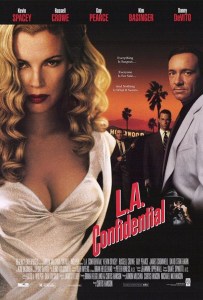 There was no stopping Titanic in 1997, iceberg be damned. James Cameron’s epic disaster movie had all the momentum of the times, and yet it’s a smaller movie that captured more of the critics and was far more deserving of the ultimate Oscar prizes that year. L.A. Confidential was based upon a James Ellroy novel that many argued was unfilmable. Enter journeyman director Curtis Hanson and novice screenwriter Brian Helgeland, and the pair stripped the book down from eight main characters to three, kept the spirit and essence of the book alive while rearranging the storylines for large-scale popcorn thrills. It’s been nearly twenty years since L.A. Confidential first seduced big screen audiences and its powers are still as alluring to this day. It’s a neo noir masterpiece.
In 1950s Los Angeles, not all is what it seems. The captain of the police, Dudley Smith (James Cromwell), is looking to keep the peace in the City of Angels as outside criminal elements are looking to fill the void from Mickey Cohen going to prison. Three police officers of very different stripes find themselves on the edges of a complicated murder case stemming from a massacre at the Nite Owl cafe. Ed Exley (Guy Pearce) is the son of a famous police captain and wants to rise up the ranks as quickly as possible. He’s a political animal and unafraid of ruffling feathers. Bud White (Russell Crowe) is a bruiser of a man who enforces his own level of justice when it comes to men who beat or harass women. Jack Vincennes (Kevin Spacey) is a happily shady officer who serves as a consultant for a hit TV police procedural. The Night Owl case takes them into many sordid corridors of sex, money, and power, including Lynn Bracken (Kim Basinger), part of Pierce Pratchett’s (David Strathairn) stable of prostitutes meant to look like movie stars, the mysterious self-serving sources to tabloid journalist Sid Hudgens (Danny DeVito), and good cops and bad cops on the controversial L.A. police force.
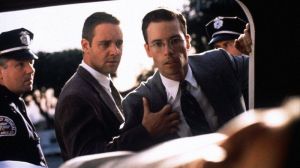 This movie is a master class in plotting and structure, enough that it should be taught in film schools. By nature noir plots are meant to be busy and mysterious, and a guarantee for mystery is a Byzantine plot full of plenty of suspects, dispirit elements, and strange coincidences that eventually coalesce into a larger picture. The beauty of what Hanson and Helgeland have done is that they have made the script complex yet accessible, able to lose one’s self in the tangled web of intrigue but still able to see how all the myriad pieces fit perfectly together by the conclusion. There is an efficiency to the screenwriting that is mesmerizing. It all seems so effortless when you’re with storytellers this gifted or who have a divine connection to the source material. Forgoing the customary slow builds of recent film noir like the oft-cited Chinatown, L.A. Confidential just moves from the opening narration. Within the first 25 minutes, the movie has expertly set up all three of its main characters, what defines them, their separate goals, the obstacles in place, and previews how they will intersect into one another’s orbit, and then the Nite Owl case explodes. Every scene drives this narrative forward. Every scene reveals a little more depth to our characters or fleshes out a superb supporting cast. Every scene cements that contradictory theme of the glitzy allure and unseemly darkness of the post-war City of Angels. My only quibble is that before the truncated third act the movie resorts to a few easy shortcuts but by that point Hanson and Helgeland had more than earned their paces. This is one of the greatest modern screenplays, period (WGA listed it as #60 all-time).
There are so many remarkably assured sequences but I want to emphasize one in particular – Exley’s interrogation of the three Nite Owl suspects. “Oh I’ll break him,” Exley promises his superior before entering into the first interrogation room. At first you’re with the other officers and morbidly curious with his arrogance. By the end, your jaw hangs in amazement at the intuitive pressure this man is expertly applying. It’s a terrific moment that allows Exley to masterfully manipulate three different men, taking pieces and running toward accurate insinuations, building momentum and clarity. Each man is different and each man offers a new piece of the overall puzzle. A slight reference by one unlocks another’s confession. An overheard sound byte pushes another into self-defense. I’m convinced it was this scene that ensured robust and thorough interrogation was a crucial element of the gameplay for the 2011 video game L.A. Noire, a noble misfire that definitely looked to replicate Hanson’s film as a user experience.
 Noir is one film genre with a visual code that can get the best of directors, but Hanson played this to his advantage. Classic noir is filled with criminal activity and the allure of sex and violence, typified perhaps best in the position of the untrustworthy but oh-so-sexy femme fatale. Yet the majority of film noir was produced in an era of censorship thanks to the implementation of the notorious Hayes Code, making sure that audiences didn’t enjoy the sordid elements too far. Free of these restrictions, some modern filmmakers take the opportunity to revisit the noir landscape and fill in the blanks of old, furnishing an outpouring of unrestrained exploitation elements. Brian DePalma’s 2006 film The Black Dahlia (also based on an Ellroy novel) gets drunk on this mission, though “restrained” has never been a word I would associate with DePalma’s filmmaking anyway. My point, dear reader, is that it’s easy to get lost in the superficial trappings of the genre: sexy dames, corrupt lawmen, temptation, shootouts, schemes, and chiaroscuro lighting. It’s easy to dabble in these elements because they’re so nostalgic and celebrated.
Hanson did something different with his 1997 masterpiece. He builds upon the audience expectations with noir but he doesn’t let his complex story and characters come second to the visual spectacle of the famous genre. L.A. Confidential is in many ways a movie that straddles lines; old and new, indie and Hollywood classicism, and film noir and drama. It’s an adult film that doesn’t downplay its darkness, brutality, and moral ambiguity, yet when it comes to those exploitation elements, especially sex, it’s almost chaste. The relationship between Lynn and Bud seems refreshingly square, like it was pulled from Old Hollywood. The entire movie feels that way, an artifact that could exist any decade.
Hanson was something of a journeyman for most of his career, directing competent thrillers like The Hand That Rocks the Cradle and The River Wild. As Variety film critic Owen Gleiberman wrote in his eulogy for Hanson (he died in September 2016, a fact I shamefully didn’t know until writing this review), after 25 years in the industry the man became an earth-rattling auteur after the age of 50. That is a rarity. Who knew the guy had something this singularly brilliant within his grasp his entire career? The care he puts into the screen is evident from the opening montage onward. There’s an elusive magic to the filmmaking on display, a bracingly divine sense of how to move the camera for best effect, how to escalate and deescalate audience nerves. He knows his story structure and characters inside and out, but he also knows how to play an audience. His time making serviceable studio thrillers certainly helps him during the film’s climax, a bloody shootout that’s also a mini-siege thriller.
 Hanson also assembled an incredible crew to enable his vision. The technical elements recreate the early 1950s L.A. time period with beguiling immediacy; the cinematography by Dante Spinotti (Heat) gives a sense of the darker elements just under the surface without having to overly rely upon the film language of staid noir visuals. Peter Honess’ sharp editing provides a downright Thelma Schoonmaker-esque musical orchestration to the proceedings, especially as the multiple storylines and developments spill onto one another. Speaking of music, the score by Jerry Goldsmith (Star Trek) is thick with the jazzy overtones of the genre. It’s a score that simmers with sexual tension and malevolence. The casting director deserves a lifetime free pass. There are a whopping 80 speaking parts in the movie, and each person is a great hire that builds a richer film.
While the plot of L.A. Confidential sucks you in right away, its characters take hold the strongest. Film noir is one genre that has a codified cheat sheet of character archetypes, and this movie fulfills and subverts them, finding surprising and gratifying ways to further round out these figures into complex and nuanced human beings. The three main characters all provide a different approach to law enforcement and when we see them start to work together it’s a wholly wonderful turn of events. Bud is the muscle, Exley is the brain, and Vincennes is the charm, and each one attacks the Nite Owl case and its subsequent leads from different angles that best apply to their set of skills. Each of the three characters discovers new pieces of evidence, new contacts and suspects, and when they start to work together it not only provides a payoff with the combined evidence but with the satisfying nature of their teamwork. That’s because they become better people when they work together and each moves closer to some moral redemption.
Bud is the loyal cop with a hair trigger and a penchant for being a white knight to abused women. His personal history of abuse makes him seek justice, often by his own fists. He has a rigid moral code of right and wrong and isn’t afraid to cross lines to achieve it. He’s also tired of being a bully and wants to be more than just the muscle. Exley is a straight arrow with a strong sense of moral righteousness and a mind for politics. He knows how to play sides for his own gain. He’s not afraid of making enemies within the department, and his opportunistic choices create many. He’s trying to forge his own path outside the shadow of his father, a famous lawman who was gunned down by a random purse-snatcher (“Rollo Tamassi”). He has to learn that he can’t do everything on his own. Finally, Vincennes is in many ways the face of the department as an ambassador to the world of TV and film. He’s succumbed fully to the glamour of Hollywood but he’s also full of profound self-loathing, trying to count how many compromises he’s made in life and where it’s gotten him. The appeal of the old life is crumbling and his detective instincts are reawakened, spurring Vincennes into the fray and surprising even himself. It’s extremely rare for any movie to successfully develop more than one protagonist, let alone three, and yet L.A. Confidential achieves this milestone so that when we alternate perspectives there isn’t a drop in viewer interest. Each man brings something different and interesting, each man reveals new hidden depths, and each character is fascinating to watch in this setting.
 The gifted actors take the already excellent written material and elevate it even further, turning an already sterling movie into one of the all-time greats. Almost twenty years later, it’s fun to see these famous actors when they were young and, arguably, in their prime. Spacey (House of Cards) was on a tear at this point in his career, between his two well-deserved Oscar wins, and having the time of his life in every role. His character seemingly has the least complexity, a man who knows he’s sold out but believes himself to be enjoying the ride, but Spacey offers poignant glimpses of the man behind all that oily charm and sly glances. There’s a scene where he stumbles across a mistake of his making and the subtle, haunted expression playing across his face is amazing. The man was capable of expressing so much, and still is. Crowe was still a couple years from his big breakout in 2000’s Gladiator but he put himself on the Hollywood map as Bud White. He’s a coil of anger and pain looking for an outlet, and Crowe is magnetic as hell. His glowers could burn right through you. Pearce (Memento) was another knockout that solidified leading man status thanks to his performance as the rigidly self-righteous Exley. He’s a character that thinks he’s above moral reproach, and his humbling is a necessary part of solving the case. Exley is constantly surprising his peers and it feels like Pearce does the same, showing exciting new capabilities from scene to scene, from his stirring hire-wire act with the interrogation scene to his understated glimmer of fear through a poker face. These three performances are golden.
Nobody better represents sleaze than Danny DeVito’s character and the man brings a merry lechery to his tabloid journalist/exposition device. His unquenchable thirst for the worst in humanity to sell more papers feels even more sadly relevant given the media climate that contributed to the recent presidential election. Kim Basinger (Batman) won an Oscar for her somber performance, which reinvigorated her career. She’s good but I can’t help but feel that she won the Oscar in a weak field (my choice would be Julianne Moore for Boogie Nights). David Strathairn (Good Night, and Good Luck) is enjoyably nonplussed as a man who specializes in delivering vice. James Cromwell used every bit of audience warmth associated as the loveable farmer from Babe and used that to his advantage. His pragmatic police captain is a father figure for Exley and the audience and perfectly sets up a turn that leaves the audience spinning even twenty years later.
There are little details the could go unnoticed but confirm for me just how much thought was put into L.A. Confidential. Exley is chided by his superiors for wearing glasses as they think it makes him look weak. As the film develops and he gets more immersed in the Nite Owl case, his compulsions against violence and rash judgment start to waver about the same time he stops wearing his glasses, a subtle symbol of his difficulty to see things for what they truly are. I enjoyed that our introduction to Lynn is in a liquor store and she’s wearing a winter cloak that strongly resembles a nun’s habit. It’s a memorable costuming choice and also suggest Lynn’s penchant for straddling the line of devotion. The Patchett “whatever your heart desires” line of high-class prostitutes has allusions to our current media culture of celebrity worship and personalized sexual fantasies. It naturally ties into the exploitation of the dream factory of Hollywood that takes young ingénues with dreams in their head and squashes them pitilessly. It’s not the first film to explore the darker side of the film industry but that doesn’t make its themes lesser.
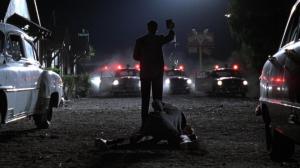 L.A. Confidential feels like the noir thrillers of old but stripped down to its essentials and given a new engine. It’s something that celebrates noir thrillers of old and Old Hollywood but it isn’t so lavish to either the genre or older time period that it loses sight of its own storytelling goals. The elaborate plot is complex and intensely engaging while still being accessible, populated with memorable and incredibly well developed characters, each given their own purpose and own insights that contribute to the larger whole. Hanson’s lasting accomplishment is a near-perfect masterpiece to the power of story structure and characterization. The three lead detectives are compelling on their own terms and the movie keeps them separate long enough that when they do come together it feels like a payoff all its own. Hanson recreates the world of classic film noir and makes it his own, using new Hollywood to lovingly recreate Old Hollywood. It’s the kind of movie I can watch again and again and discover new depths. It gave way to a wave of success for its participants. Hanson never quite delivered another movie on the level of L.A. Confidential, though I’ll posit that In Her Shoes is an underrated character piece. Helgeland has become a go-to screenwriter for many projects low (The Postman) and high (Mystic River) and became a director for A Knight’s Tale and 42. It’s a movie that plays just as strongly today as it did almost twenty years ago, and that’s the mesmerizing power of great storytelling and acting. L.A. Confidential is a lasting achievement that proves once more the power of our darker impulses. It’s stylish, seductive, smart, subversive, and everything you could ask for in a movie.
Nate’s Grade: A
Share this:

Cellular (2004)
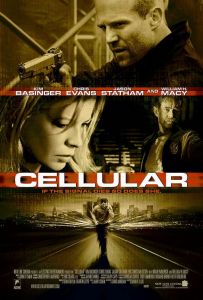 Cellular, a new thriller, relies on the simple device of a cell phone for the crux of its plot. With cell phones becoming ever more present, and ever more an eyesore in our daily lives, it was only a matter of time before they had their own movie. They’ve slimmed down from their heavier 1980s days, and become more useful, allowing one to surf the Web, take candid pictures of people in gyms, and are able to ring in the tone of the new hot rap song of the week. The premise for Cellular may be pitch-perfect for our modern society, but will an audience answer its call?
Jessica Martin (Kim Basinger) is a high school biology teacher caught up in some scary events. She’s been kidnapped by a gruff man (Jason Statham), and locked in an attic. She’s informed that her son and husband will be found and kidnapped, unless she tells him what he wants to know. Unfortunately, she’s clueless as to what her kidnappers want. There is a wall phone in the attic, and one kidnapper smashes it with a sledgehammer and walks away satisfied. Jessica goes to work re-configuring the shattered phone pieces, tapping wires until she can reach out and touch somebody.
Ryan (Chris Evans) is a hunky beach bum who’s chastised by his ex (Jessica Biel, I know, I didn’t believe it too) for being too irresponsible. He’s driving around in his cool ride when he gets a panicky phone call from, you guessed it, Jessica. At first he thinks it’s a practical joke until he overhears her kidnappers threaten her. Reluctant to help, Jessica asks him to stop the kidnappers from reaching her family. Ryan runs around town all day scrambling to help Jessica’s family and solve the case. He also enlists the help of a retiring police officer (William H. Macy), who’d rather open a day spa than do desk work.
 The premise for Cellular is near-genius and provides an abundance of smart, problematic possibilities. Ryan runs around and is always in danger of losing the signal. At one moment his cell phone is about to die from low battery charge. Another time the lines get crossed. Every step seems believable and the characters’ reactions seem credible. With Cellular, the audience thinks along with the characters step-by-step. When Ryan encounters stumbling blocks, the audience is with him in solving them, and this makes for a very engaging and thrilling movie.
The acting in thrillers is usually a minimal speed bump but the actors in Cellular do fine work. Basinger attempts to make up for her role in The Door in the Floor and plays harried and teary like a pro, but her best moments are when she uses her biology teacher know-how in precarious situations. She’s like a female MacGyver. Cellular is really a coming-out for Evans as a leading man. He’s had small roles before in The Perfect Score and Not Another Teen Movie, but this is his first leading-man role, and he handles the running, shouting, and panting with aplomb. Statham does his usually fine work of sneering and acting menacing. It’s also fun to watch William H. Macy, usually playing an every-man or a sadsack loser, play a bloodhound cop that morphs into an action hero.
The pacing in Cellular is breakneck. In the first 10 minutes, we witness Jessica’s kidnapping, and the momentum built up from that point is exhilarating. There is rarely a moment to catch your breath in Cellular. The action sequences are exciting but not redundant, and the tension readily mounts, especially when the audience is given more information than our heroes. There’s also some fun jabs at our country’s cell phone lifestyle.
 Director David R. Ellis worked as a stunt coordinator for 20 years, before advancing into the director?s chair and helming 2003’s schlocky gore-fest Final Destination 2. Ellis knows how to keep his plot moving, and something is always happening in Cellular to draw our attention or to push us on edge. Cellular was written by Larry Cohen, who also penned Phone Booth and probably won’t rest until he’s the Robert Rodat of telecommunications (Rodat wrote Saving Private Ryan and The Patriot, and seems destined to write a movie about every American war). Might I envision an erotic thriller with the “Can you hear me now?” Verizon guy just around the corner? Only time will tell.
As with any thriller, there are going to be lapses in logic that have the possibility of stopping the story dead in its tracks. Cellular‘s biggest logic loophole occurs right at the start, and if you can get behind it then you can enjoy the rest of the ride. Instead of smashing a telephone, why not yank it out of the wall and fully decommission it? Or, even better, why leave your kidnapped victim in a room, out of your sight, with a phone? Would it not have been easier to just tie her to a chair in plain sight? The mind boggles. The real answer we all know, of course, is because then we wouldn’t have a movie. There’s also a sequence late in the film where the bad guys discuss their evil plan on cell phones, which seems a tad careless considering anyone with a police scanner could listen in. As I said, gaps of logic are expected in this movie terrain and it’s your ability to rise above them that will determine if you enjoy the film.
Cellular is a thriller that dials the right numbers. It may have some gaps in logic, but it delivers when it comes to sharp suspense, smart action and a great premise. Fans of action thrillers should lick their lips with what Cellular has to offer. Just remember to keep your cell phones turned off during the movie, unless, of course, you’re surfing the Web, sneaking pictures of some girl, or jammin’ to the rap song of the week.
Nate’s Grade: B
Share this:

Bless the Child (2000)
 How bad is Bless the Child? How bad does bad get? Kim Basinger somehow forgets she actually won an Oscar for something good and takes up the mantle as a nurse or nun or whatever caring for a “special” child. But aren’t they all special in their own way? The child is deemed “the one” and kidnapped by a religious cult led by better-actor-than-this Rufus Sewell. Jimmy Smits comes in somehow as an FBI agent specialized in the field of Satanism. I guess Mulder and Scully couldn’t make the ride. There’s a point in the film where Smits reveals that he entered the bureau so he could have an easier time stopping Satan and his minions. I dare you not to crack a smile from any of this. Is this the movies Jimmy Smits left NYPD Blue over?
The special effects are lame, the story is knee-high in contrivances and loop holes, and the acting is laughable. Christina Ricci has a small part as a reformed cultist that shouldn’t even register if you pay attention – which requires more skill than you would believe. The dialogue in Bless the Child is laughably bad along the lines of Battlefield Earth smack yourself in the head. It’s not as mind-numbingly horrible to sit through, but it’s pure cheese no matter what sheep’s skin it hides under.
Nate’s Grade: D


 nathanzoebl
You must be logged in to post a comment.