Blog Archives

Southland Tales (2007)

Richard Kelly is a talented writer/director who scored big with his first film, modern cult classic Donnie Darko. I was in love with the ominous yet inspired Darko from the moment I saw it, which, not to toot my own horn, was February 2002, way before the cult got started. I have been eagerly anticipating Southland Tales, Kelly’s writing/directing follow-up, even after its notorious 2006 Cannes Film Festival reception where critics readily cited terms like “indulgent,” “bloated,” “messy,” and, “disaster.” My love of Darko shielded me from such negative affronts, and so I watched Southland Tales undaunted and with as open a mind as possible. The regrettable truth is that even after Kelly shaved off a half-hour from the Cannes version, Southland Tales is every bit a mess as had been advertised; however, it is occasionally worthwhile and subversively ambitious.

Kelly begins his massive yarn with a nuclear attack on Abilene, Texas in 2005. America is plunged into World War III and fights, simultaneously, Iran, Syria, Afghanistan, and North Korea, while the conflict with Iraq continues. The Internet is now in control of the government, who passes sweeping security measures, chief among them IdentiCorp. This government arm uses thousands of trained cameras to keep watch over the lives of ordinary citizens, including when they duck into public bathroom stalls. Violent neo-Marxist groups have placed cells around the country, ready and willing to strike to destroy the last vestiges of American capitalism.
Fuel resources have almost run dry and the world looks to scientist Baron Von Westphalen (Wallace Shawn, hamming it up and having a good time) for a solution. The Baron has devised a substance known as Fluid Karma, which works under the properties of the churning oceans and will produce a radius of power. Fluid Karma also works as a powerful hallucinogenic drug and the Baron tested it on wounded Iraqi vets like Pilot Abilene (Justin Timberlake). Coldly narrating the film, Abilene stands guard outside the Baron’s laboratory and also peddles the drug on the side.

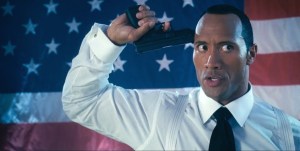
It is the summer of 2008 and the presidential election is months away. The Republican candidate, Senator Bobby Frost (Holmes Osborne), is in crisis mode. His spoiled daughter (Mandy Moore) is frantic because her husband, actor Boxer Santaros (Dwayne “The Rock” Johnson), has vanished. He’s awakened in the California desert with amnesia and shacked up with porn star Krysta Now (Sarah Michelle Gellar); the duo has written a prophetic screenplay called “The Power.” Krysta and a pair of tattoo babes (Nora Dunn) plan to blackmail the Frost campaign with video of Boxer frolicking with the adult movie star. They want the campaign to endorse Proposition 69, which would rescind the encroachments on civil liberties by the U.S. government.

A group of neo-Marxists, led by pint-sized Zora Carmichaels (Cheri Oteri), have kidnapped a police officer, Roland Taverner, and are using his twin brother Ronald (both played by Seann William Scott) to frame the police and Boxer. And I haven’t even begun to talk about Senator Frost’s wife (Miranda Richardson), the president of Japan having his hand lopped off in a loony sequence, the frequent inverting of T.S. Elitot’s quote about the way the world ends, a commercial where two cars literally have sex, and a rip in the space-time continuum that people are putting monkeys inside.

Extraordinarily messy and scattershot, Southland Tales has 1000 ideas rolling around inside without much traction. It’s as if Kelly thought he was never going to get the chance to make another movie again so he crammed every thought and topic he ever had into one 144-minute cross-pollinated jumble. The movie veers wildly and chaotically from political satire, to crude comedy, to sci-fi head-trip, all the way to Busby Berkley musical. There’s a little of everything here but few of the dispirited elements mesh and the film runs a good two hours before any sort of overall context becomes remotely approachable. One second the movie is satirizing a Big Brother control state and the loss of American civil liberties, and in the next second a character is threatening to kill herself unless Boxer allows her to orally pleasure him. You got, among other things, zeppelins, global deceleration, perpetual motion machines, Zelda Rubenstein, drugs, holes in time, twins, a murderous Jon Lovitz, ice cream trucks that house military-grade weapons, blackmail, Kevin Smith in a ZZ Top beard and no legs, reality TV, the American national anthem cut together with an ATM robbery, Biblical Revelation quotes courtesy of Timberlake, and, why not, the end of the world. What does it all mean? I have no idea but I credit Kelly for his ambition.

Plenty of stuff happens for a solid two hours but little to nothing feels like it amounts to anything, and several subplots just get dropped. There are long stretches where I cannot explain even “what’s happening” from a literal description. This sprawling, magnificently self-indulgent meditative opus consists too much of side characters running into each other and having vague, pseudo-intellectual conversations that go nowhere. There are a lot of nonsensical speed bumps in this narrative. Sometimes the screen is just nothing but a series of newscasts overloading the audience with details on the reality of this alternative America; it’s filler. The conclusion is rather frustratingly abrupt; after slogging through two-plus hours of oblique questions it finally seems like we may reach some tentative answers, and then Kelly pulls the pin on his grenade and collapses his tale. Krysta tells Boxer in a moment of clarity, “It had to end this way.” Really? It did? This way?

The movie feels like a giant garage sale with scattered treasures hard to find but buried beneath loads of kitsch. Kelly clearly has bitten off more than he can chew and yet there is a bizarre undeniable power to some moments here. Roland (or is it Ronald) Taverner watches his mirror reflection a step behind; it’s unsettling and eerie and very cool. Timberlake has a drug-induced dance number where his scarred (both physically and mentally) Iraq veteran character is covered in blood, drinks beer, and lip synchs to the Killers’ song “All the Things I’ve Done,” which has the pertinent lyrics, “I’ve got soul but I’m not a solider,” and “You gotta help me out.” All the while, leggy dancing girls in blonde bobs strut and coo around him. It’s weird and tangential to the plot but it has a certain draw to it. The conclusion featuring the Taverner twins seeking forgiveness even generates some redemptive quality. Religious questioning and the philosophy of souls occupying the same realm plays a heavy part and gives the film an approachable reflection that tickles the brain, even if Timecop, sort of, visited the same ground, albeit secular, first (you’ll kind of understand when you see the movie). Southland Tales is grasping at profound and relevant messages, and yet some images achieve this easily, like a toy soldier crawling on the L.A. streets or a tank with Hustler stamped across its side for product placement. These simple images are able to transcend Kelly’s pop manifesto.

None of the actors really equip themselves well with the outrageousness. Scott comes off the best but that’s because his character(s) is/are the only figure(s) the audience is given a chance to emotionally connect with. The Rock, listed for the first time simply as Dwayne Johnson, is an actor that I genuinely like and think has tremendous comic ability, as evidenced by 2003’s The Rundown. With this film, however, he comes across too constantly bewildered and shifty, like he really needs to pee and cannot find a bathroom. Gellar is woefully miscast and I think she knows it given her leaden performance. Southland Tales is the kind of film where every role, even the two-bit nothing parts, is played by a known face, be it Christopher Lambert, John Larroquette, Curtis “Booger” Armstrong, Will Sasso, and a horde of Saturday Night Live alums.

Kelly’s previous film succeeded partially because an audience was able to relate and care about the central characters, which is not the case with the comically broad Southland Tales. Kelly seems to work best when he has some restraint, be it financially or artistically; the director’s cut of Donnie Darko explained far too much and took some of the magic out of interpreting the movie on your own terms. Southland Tales runs wildly in the opposite direction and is a giant mess unseen in Hollywood for some time, though for the doomsayers comparing Southland Tales to studio-killing, self-indulgent, era-defining Heaven’s Gate, may I argue that Oliver Stone’s Alexander was far more self-indulgent, longer, wackier, and duller. Due to its unpredictable nature, you can never say Southland Tales is boring.

Southland Tales the movie begins as Chapter Four of Kelly’s saga, the first three chapters being made into comic books, and really, when I think about it, a comic book is the right medium for this material. The confines of narrative film are too daunting for Kelly’s overloaded imagination. Southland Tales is oblique, incoherent, strange, and unfocused but not without merit. I doubt Kelly will ever be given the same artistic legroom to create another picture like this, so perhaps Southland Tales has helped to reign in Kelly’s filmmaking. A reigned-in Kelly is where he does his best work, and I look forward to Kelly’s remake of Richard Matheson’s story, “The Box,” presumably with no dance numbers and sexually active motor vehicles.

Nate’s Grade: C

Live Free or Die Hard (2007)

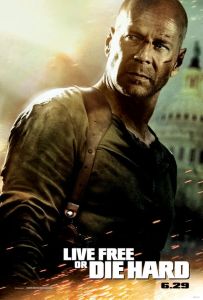
A lot has changed in the world and for Bruce Willis since last we saw John McClane in 1995’s Die Hard with a Vengeance a.k.a. Die Hard 3: Die Harder-er. Is a post 9/11 anxiety-ridden world, does someone like McClane feel quaint, like the remnant of a bygone era? Live Free or Die Hard, a.k.a. Die Hard 4, is Willis getting back to butt-kicking, wise-cracking basics. The film is a surprising and fun summer entry that could have been much much worse, and for that I am grateful.

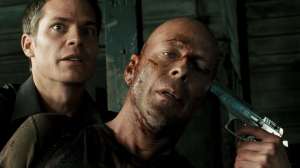
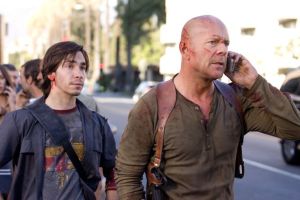
McClane (Willis) is a pretty run down man thanks to the rigors of his job the heavy price being labeled a “hero.” He’s divorced, estranged from his teenage daughter (Mary Elizabeth Winstead), and retired from the force. He gets called to transport a hacker named Matt (Justin Long) from New Jersey to D.C. and into federal custody. Before he can leave Matt’s apartment, assassins start shooting at McClane and the hacker and the two go on the run for their lives. A former national security leader, Thomas Gabriel (Timothy Olyphant) has planned what is known as a Fire Sale, where the United States’ infrastructure is brought to a standstill by eliminating all power services, communications, and causing the nation to be consumed by chaos. Matt was one of the many that were contracted to unknowingly write code that would assist in Gabirels’ techno takedown. Now Gabriel is cleaning up his tracks and that involves removing an increasingly irritatable John McClane.

The film is nothing short of Bruce Willis trying to reclaim the action movie genre the way he sees it should be. Die Hard 4 is all about how computers and our complete reliance on modern technology put us all at risk if someone ever pulls the plug. Willis and the film are an efficient, and enjoyably retrograde Hollywood action flick that scoffs at kung fu, self-indulgent effects, and the gravity-defying acrobatics that have dominated action cinema since the rise of The Matrix. McClane shrugs and cannot understand this “kung fu shit” and mistrusts computers. Die Hard 4 puts most of its attention on good old-fashioned practical stunt work, not that the film’s sequences are practical, like when McClane is driving an 18-wheeler around a crumbling highway while being fired upon by a fighter jet. Live Free or Die Hard is crammed with gunfights, fistfights, and motor vehicles launched into the sky. People bounce around like pin balls. It pushes the boundaries of PG-13 action; the profanity of the previous films isn’t exactly missed, but it’s regrettable that cinema’s best catch phrase to ever use the term “yippee-ki-yay” has to be partially muffled by a sound effect to keep its more family-friendly rating.

Willis helps keep things grounded with an enjoyable acting style best be described as bemused crankiness. Throughout the long trip foes and intense obstacles beset McClane, and yet he remains the same grumpy Gus that can’t believe his own damn luck. Whenever he defeats a well armed opponent, or does something “so crazy it just might work,” and it does, he laughs to himself like he cannot believe his luck. He informs the bad guys that he is coming, and he will kill them, and they ask him how and even he doesn’t know and he doesn’t care. He’s a one-man wrecking crew, as he always has been, but there’s an added level of fun watching someone with an AARP card (who isn’t Clint Eastwood) kicking ass and taking cyber geek names.

Director Len Wiseman cut his teeth on the terrible Underworld movies (I’m sorry, but if you got a movie about vampires vs. werewolves, you don’t give them leather and guns and call it a night), but he now has won me over with his work on Die Hard 4. His careening, deep-focus visuals are like a mix of Michael Bay with an extra dose of the fetish-loving Wachoswki brothers. There are a handful of visual scrapes that really pop onscreen like some very close encounters with high-speed cars.

But let’s not get too wrapped up in the fun of Live Free or Die Hard. It’s still an out-and-out action movie complete with plot holes, logic gaps, stock characters (the movie loses steam every time we have to cut back to the FBI agents), and some one-liner groaners. The villains are pretty standard, though very tech heavy in their approach. The movie never explains why a good portion of the henchmen are French. McClane’s daughter will obviously get crafty and bullish when under pressure, proving herself a chip off the old block. The banter between Willis and Long is overdone in an attempt to add more frantic feeling to a tale about the end of all reliance on technology.

Live Free or Die Hard is an efficient and satisfying retro, macho action movie. The action is frenetic and focused on hard-nosed stunt work that brings so much more excitement to the film. The movie works, and that in and of itself is something of a miracle. McClane rattles off a monologue about what it means to be a hero, and in the end he says it’s just about you being the guy willing to do his job no matter what. Well, as far as I’m concerned, the John McClane job is about providing solid action-packed crowd pleasers. I don’t care how old the man gets, because under the right direction he delivers.

Nate’s Grade: B

Catch and Release (2007)

Catch and Release may in fact have the most bizarre meet-cute in movie history. Gray (Jennifer Garner) is mourning the loss of Grady, the man that would have been her husband. She seeks a refuge from all the well-wishers and lies down in a bathtub with the shower curtain drawn. Fritz (Timothy Olyphant), one of the deceased’s best friends, enters the room with a female caterer. They position themselves against a wall and engage in some opportune sex. Gray is trapped and forced to hear the whole thing. The caterer keeps screaming, “Sock it to me” in increasing orgiastic pleasure. I was waiting for some more 1950s hipster dirty talk, like, “Lay it in me, Daddy-O.” Eventually the sex comes to an end and Fritz lights up a post-coital cigarette. But then Gray flings the shower curtain back. Aha! It’s boy meets girl in the most preposterous fashion, but that’s Catch and Release for you, a romantic comedy with enough to be different but still too limited to become anything other than a lukewarm date movie.

Now absent one less earner, Gray is forced to move into a house occupied by Sam (Kevin Smith) and Dennis (Sam Jaeger). They were friends of Gray’s ex as well. Then life proceeds to give Gray a series of curve balls. She discovers that her dead fiancé had over a million dollars in the bank and an 8-year-old son with another woman (Juliet Lewis), a flighty New Age massage therapist. Grady might not have been the same man Gray thought she was set to have and to hold (her married name would have been Gray Grady?).

Things get off to an interesting start. The proposed wedding party has been transformed into a wake. Then as she is trying to cope with loss and put the pieces of her life together she’s further undone by revelation after revelation of secrets her ex kept from her. That’s pretty dark for a usual airy genre but also a pretty interesting setup for something different. Catch and Release flirts with being unconventional but then is on a fairly predictable trajectory once its promise settles down and completely dissolves.

Thankfully, despite all the doom and gloom there isn’t any grating sense of whininess. The perspective feels knowing and in search of wisdom through life’s unexpected calamities. Writer/director Susannah Grant (Erin Brockovich, Ever After) has a worthy adult sensibility that helps make the film feel a bit more credible and less like an inane melodrama. Catch and Release feels less pre-programmed and unlike most paint-by-numbers romantic comedies, and yet it still wears the weight of its genre around its neck and can never take a step forward without taking two backwards. There’s ample opportunity for a romantic comedy that begins at the literal end of a relationship, with the widow discovering more than she ever knew about her dearly departed (a rom-com version of The Constant Gardener? Call me, Hollywood). However, the movie seems too content to walk the same beaten path many have before it. It may be nothing more than a throwaway genre movie but it got my hopes up that it could have been something more. I feel spurned and betrayed, somewhat like Gray must have felt.

Catch and Release is a hit-and-miss date movie that can never really reel in what it wants to do. The film has some somewhat inspired moments but is also dominated by romantic comedy clichés and sitcom generalizations when it comes to its characters and setting. Of course the nice guy has had a lifelong crush on Gray. Of course the fat guy is also funny and rude. And of course we’re going to house all of these people under one roof so it will produce plenty of Gray-Fritz interactions that will lead to their eventual coupling. Plus, who could forget the classic eleventh hour misunderstanding followed by the pursuit that ends in a glib line like, “What took you so long?” The movie seems to be trying too hard to make Fritz seem like a suitable replacement when we never really know much about him. He’s kind of sleazy and he knows it, but when exactly does he become likeably sleazy? Their union feels forced and unrealistic, even by romantic comedy standards. It also feels like Grant named Garner’s character Gray just so she could include this passage:

Gray: “What’s your favorite color?”
Fritz: “Gray.”

This prompted an entire row of teenage girls to go “ahhhhh” in my theater. I wanted to laugh, but then I was grossly outnumbered in my theater.

Catch and Release is mostly a grab bag of other romantic comedies. It doesn’t even know what to do with the fly fishing metaphor it valiantly tries to lift into some deeper meaning. I don’t get it myself. Gray says that her dead ex was always a “catch and release” man; does this mean he never had the heart to finish off his prey, or that he was too sympathetic with struggling creatures? It doesn’t matter what the metaphor attempts are because it allows for the cast to put on their rubber boots and wade in the cool waters of predictability. At least only one character works in the usual romantic comedy job pool (publishing, advertising, theater). Though Sam does come up with quotes for boxes.

Garner is such a winning actress but still finding her stride. She’s being positioned to fill the void of Meg Ryan and Julia Roberts, which is fine, but when I see her more as a modern Sigourney Weaver, someone who can excel in light comedy but also kick your ass when the time came. Gray’s world goes into upheaval and Garner is up to the task balancing emotion and wry life observations, but too often there’s little else for her to do but pout or crinkle her eyebrows. Her cheekbones certainly get quite a workout in Catch and Release but I wouldn’t exactly call that dramatic acting. I have been a fan of Olyphant since 1999’s Go. He’s always had a scary sexiness to him, and works best playing assholes you just can’t help but love. Grant totally drops the ball on his character. Fritz is behind the eight ball early and never really recovers when it comes to audience loyalty. Olyphant is also given a problematic shaggy haircut that manages to neutralize his natural alluring danger and still make him seem aloof. His role is a stock role and nothing more.

Thank God for Kevin Smith. Grant wisely chose Silent Bob as her comic relief and Smith has such natural laid back charm and great timing that he should get more acting gigs full time. His presence is deeply missed when he steps offstage and the film returns back to its familiar roots. I don?t know why Grant has Sam eating or making food, or talking about eating in almost every scene. After the fourth scene in a row where Sam has a chicken leg in his fist, it gets tiresome, like she defined a character by hunger. Smith has the best scenes and the best chemistry, whether it’s with Garner, Lewis, or a little kid. I think someone should cast Kevin Smith as the lead of a romantic comedy. Now that’s an unconventional date movie I’d pay to see.

Catch and Release has some glimmers of promise before succumbing to the weight of the romantic comedy genre. The movie just cannot get past mounting clichés and shallow characters, plus some fairly contrived situations like the bizarre meet-cute. Garner and her dimples will survive to enchant another day. At the end of the day, Catch and Release is just like any other romantic comedy movie, and there’s plenty more of those in the sea.

Nate’s Grade: C+

Jersey Girl (2004)

Writer/director Kevin Smith (Dogma) takes a stab at family friendly territory with the story of Ollie Trinke (Ben Affleck), a music publicist who must give up the glamour of the big city to realize the realities of single fatherhood. Despite brief J. Lo involvement, Jersey Girl is by no means Gigli 2: Electric Boogaloo. Alternating between edgy humor and sweet family melodrama, Smith shows a growing sense of maturity. Liv Tyler stars as Maya, a liberated video store clerk and Ollie’’s real love interest. Tyler and Affleck have terrific chemistry and their scenes together are a playful highlight. The real star of Jersey Girl is nine-year-old Raquel Castro, who plays Ollie’’s daughter. Castro is delightful and her cherubic smile can light up the screen. Smith deals heavily with familiar clichés (how many films recently end with some parent rushing to their child’’s theatrical production?), but at least they seem to be clichés and elements that Smith feels are worth something. Much cute kiddie stuff can be expected, but the strength of Jersey Girl is the earnest appeal of the characters. Some sequences are laugh-out-loud funny (like Affleck discovering his daughter and a neighbor boy engaging in “the time-honored game of “doctor””), but there are just as many small character beats that could have you feeling some emotion. A late exchange between Ollie and his father (George Carlin) is heartwarming, as is the final image of the movie, a father and daughter embracing and swaying to music. Jersey Girl proves to be a sweetly enjoyable date movie from one of the most unlikely sources.

Nate’s Grade: B

Jay and Silent Bob Strike Back (2001)

Kevin Smith returns back to his comedy roots. No more movies with a message (Chasing Amy and Dogma) it’s back to good ole’ snowballing and stink palming. His latest, Jay and Silent Bob Strike Back, is like a giant thank-you card to all his fans that have made the man who he is today. It ties up the entire View Askew universe so Kevin can drift off into uncharted ventures of film making and not have to keep referencing the same damn characters. Plus there’s plenty of good-natured vulgarity to go around.

The plot of Jay and Silent Bob is nothing too heavy but seems to keep the film on a continuous pace, unlike the sometimes stagnant feel Mallrats had (what, they’re in one location for 90 minutes). It seems that after getting a restraining order at the Quick Stop on them, Jay and Silent Bob learn that Miramax is making a movie from a comic book that is in fact based off of them. Learned of the riches they could make they seek out the comic’s author Holden McNeil (Ben Affleck’s first appearance in the film) and demand a piece of the pie. Holden tells them that he long ago sold his right to his partner Banky Edwards (Jason Lee, in his second appearance in the film) and that there’s nothing they can do to stop the film. Jay suddenly gets the idea that if they stop the movie from ever getting made then they don’t have to worry. So off go our stoner duo on a mission to sabotage and satirize Hollywood.

Along the way are a hitch-hiker (George Carlin) advising the best way to get a ride is to go down in your morals, a confused nun (Carrie Fisher), the cast of Scooby Doo offering a ride (which will be 100x funnier than the feature film coming out this summer), a beautiful band of international diamond thieves (Eliza Dusku, Ali Larter, Jennifer Swalbach-Smith, Shannon Elizabeth), a rescued chimpanzee, a dogged Wildlife agent (Will Ferrell), and a full barrage of hilarity once Hollywood is finally hit.

The best barbs are laid out by Ben Affleck and Matt Damon bickering about the other’s film choices on the set of Good Will Hunting 2: Hunting Season. This moment is truly inspired and full of great humor from Gus van Sant too busy counting his money to yell action to Damon turning into a vigilante hero. I almost fell on the floor laughing during this sequence.

When Jay and Silent Bob hit Hollywood is when the comedy starts hitting its stride as this Jersey Greek chorus interacts with the Hollywood life and encounters many a celebrity. The jokes are usually right on target except for Chris Rock’s performance of a racism obsessed film director. Rock’s portrayal becomes grating to the moviegoer far before it’s over, though he does get a few choice lines.

Smith as a director has finally elevated his visual art into something that can sustain itself instead of his earlier just-hold-the-camera-and-shoot movies. There are pans, zooms, quick cuts, cranes, action sequences, and even CGI. Smith is evolving as an artist but still staying his “dick and fart joke” self, and Jay and Silent Bob Strike Back is evidence. And that’s fine by me.

Nate’s Grade: B

Reviewed 20 years later as part of the “Reviews Re-View: 2001” article.

Scream 3 (2000)

Master of the macabre Wes Craven returns to the most anticipated and secretive horror series in recent memory. The Scream saga opened the doors for the teen proliferation of all that is commercial, and now the same people come back to close the book on what they started. At least that’s what the idea was.

Craven proves his directing credentials even more so with this vapidly dull sequel to the sequel about horror sequels. Even when the story is dragging, and it will, he wrings some amount of tension and excitement that I’m sure would likely be absent from any other director’s hands.

The void of teen powerhouse scribe Kevin Williamson is distinguishing, but newbie Miramax goldenboy Ehren Kruger walks the walk effectively. What is sadly absent are the touches of irony and intrigue that Williamson dabbled through like a French chef. Ghostface loses the edge it had in the earlier flicks where the deaths would all be unusually related to the topic at hand in some clever way. But in Scream 3 the irony is left behind at the Williamson offices and killer-man-guy just hacks people away. No interesting approaches or set-ups, just unrelenting running and slashing.

Scream 3‘s biggest drawback may be the lack of the central mystery the first two exhibited so well. Scream 3 introduces about 15 different characters, but then quickly enough kills off about 14 of them. Face it kids, if Scream 3 is your first Scream flick you ain’t making it to the end credits. Kruger lays no clues or red herrings for the audience to gape and trip over in wondering who is behind the killer’s mask. More time is spent needlessly killing needless characters than creatively playing the audience along an intricate guessing game that would have made the movie more enjoyable.

It may sound like I’m coming down hard on Scream 3 but, on the contrary, I had a huge amount of fun with it. Parker Posey is wonderful. I was laughing often and was usually entertained even though I could sense the franchise losing steam. Besides a lame ending (two in a row), Scream 3 is good popcorn fun but nothing more promising than that.

Ladies and gentlemen the Scream horror series has finally degenerated into the very thing it’s making fun of. Except with this installment it seems not to know that the joke is on them.

Nate’s Grade: C+


Dogma (1999)

In a time where simply having faith in anything, let alone religion, is scoffed at, Kevin Smith daringly and passionately expresses his personal search for answers and understanding. But while the zealots decree Dogma as blasphemy, what they truly miss is the biggest commercial for faith and God that American audiences have seen in decades of cinema.

The story of the religious epic causing all the hubbub begins with a pair of fallen angels (Ben Affleck and Matt Damon) spurned from the pearly gates of Heaven and banished to Wisconsin. One discovers a re-dedication of a church imploring a little used Catholic practice of plenary indulgence allowing whoever to enter through the church’s arches to have their slate cleaned of all sin. The two seize this opportunity of a dogmatic loophole to sneak back into heaven. The only slight problem is that by doing so they reverse a decree of God and disprove the Almighty’s unfallability, and thus will wipe out all of existence. The voice of God (Alan Rickman) recruits a lapsed Catholic named Bethany (Linda Fiorentino) for a Holy Crusade to halt the scheming angel’s plans for the good of the universe. Along the way she is aided by two unlikely prophets (the dynamic duo of Jay and Silent Bob), an racially discredited 13th Apostle (Chris Rock), and a shapely strip-teasing muse (Salma Hayek) as they engage with demons, seraphims, angles, and all sorts of celestial “who’s who” to stop the end of existence.

Smith’s direction has taken strides since the point-and-click days of his earlier works; however, there’s still an awkward flatness to his framing and action. Fiorentino plays the role of a grounded character well. Rickman as the bitter Brit shows why he can still take anyone toe-to-toe for acting chops. Affleck and Damon have terrific chemistry together and play off one another for great comedy. Jason Mewes has never been funnier as the terminally stoned and foul mouthed Jay. Rock shows he can restrain his abrasive personality. Salma shows… well she shows she can dance. Jason Lee as an air conditioning-adoring demon and George Carlin as a used car salesman type Catholic Cardinal are so commanding in their presence and excellent in their performances that it’s a sin most of their scenes were cut during editing. Even Alanis Morrisette works as a humanly childish God. She’s given no lines but expresses great feeling and humor anyway.

Dogma is rambunctiously hilarious and a never ending joyride of fun as it jumps from jokes about demons made of excrement to “Buddy Christs” to insightful and sensitive thoughts on religion. Rarely does it bore even with the large plot it must always keep in successive movement. The only drawback Dogma suffers from is the amount of religious points it desires to make. The characters will reach a subject, chat, then directly move on to the next. The sporadic nature can easily keep an audience’s head spinning, but is brought back down to gentle rest from Smith’s Divine wit and sharp writing. Some of the opus’ many characters appear for only brief stretches as Hollywood’s A-list battle for valid screen time among each other.

Smith is not one to shy away from controversy, or his quota of sexual innuendos and profanity. But the protestors for this film attacking its vulgarity are beyond missing the point; Dogma is reaching people the church hasn’t and can’t. It may be an audacious tweaker of a flick, but ultimately it’s bringing up religion into open debate and discussion amongst the masses where there was none before. And isn’t that in itself glorifying some type of achievement?

It would do well the opponents of Dogma to venture into a darkened theater sometime to see the movie and realize it is a humorous affirmation of faith and beliefs. The story of a crisis of faith is relatable to a society too jaded and cynical. Smith’s wrestle with theology is the public’s gain, and his halo only glows a little brighter for having the courage to do so.

Nate’s Grade: A-

This movie also revisited and analyzed in the article, “1999: The Greatest Year in Film? A Review Re-View.”