Blog Archives
Heaven is For Real (2014)
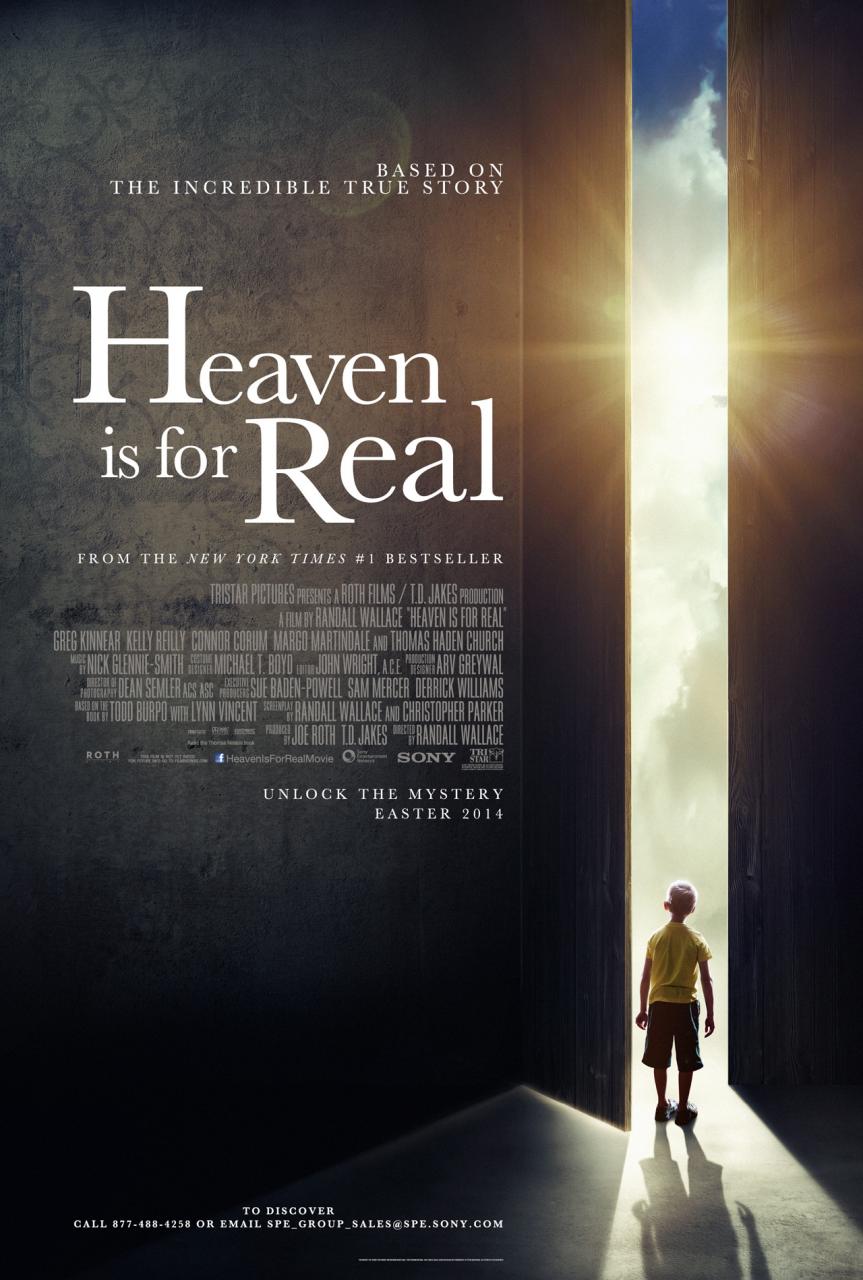 Christian movies have been lighting up the U.S. box-office this year. First there was Son of God, which opened at over $30 million dollars for what is essentially a retread of what people could see for free on TV. Then there was Noah, the Biblical epic given a new life with modern special effects magic. Then the little indie that could, God’s Not Dead, which continues to hang around the box-office, collecting astonishing sums. Now in time for Easter is Heaven is For Real based upon the best-selling book of the same name. Adapted and directed by Randall Wallace (Secretariat, Braveheart), the film manages to be emotional, earnest, and efficient, even despite not really having the elements needed to be called a film.
Todd Burpo (Greg Kinnear) is the pastor for a small town in rural Nebraska. He and his wife Sonja (Kelly Reilly) are struggling to pay the bills and care for their two children, Cassie (Lane Styles) and Colton (Connor Corum). One fateful day, Colton is rushed to the hospital with a burst appendix. He makes it through the operation. Afterwards, he tells his family the amazing news that while unconscious he visited heaven. The Burpos are ready to dismiss their son’s experience as a response common to those who went through near-death experiences, except little Colton never died on the operating table. Todd is unsure what to do with his son’s information, including key knowledge that he has no Earthly way of knowing. The members of Todd’s church worry about trusting the child’s account, and are wary of the media circus, and may just hire a new pastor for all the trouble caused by Colton’s confession.
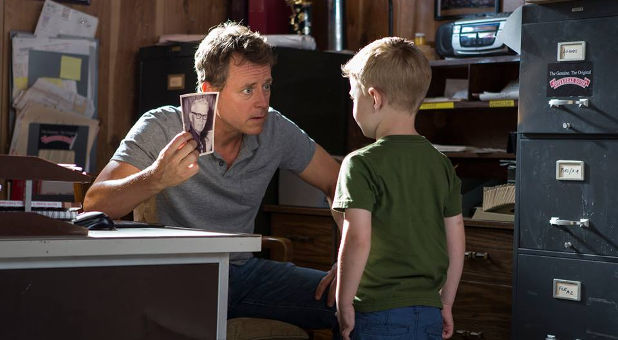 Kinder and gentler, here is a movie that has an inclusive, positive message executed with earnest conviction. The drama isn’t subtle but it can be effective. The music rises, the actors crinkle their faces and get tears in their eyes, and you’re left feeling like there’s something in your own eye. It may be manipulative in some sense but it’s so well executed, and without any hint of pretension or agenda, that I really didn’t mind. It’s a heartfelt movie that could fervently inspire the masses that pack the theater. I’d much rather have any Christian consumers, or the curious, check out this well-meaning movie than the mean-spirited and spurious God’s Not Dead. This movie actually allows its characters to feel like regular people who exist in our world. Todd and Sonja have a sex life, and the Burpo family doesn’t just sing famous Christian tunes in the car, they’ll shout Queen at the top of their lungs. In other words, they’re a fairly normal Midwestern family, and I appreciated that the movie didn’t feel the need to sanctify them. The supporting characters also have dollops of depth to them, at least in the hands of actors like Thomas Haden Church (so wonderfully deadpan) and Margo Martindale (her sorrow fermenting into bitterness). Heaven is for Real is anchored by two strong performances by Kinnear (The Last Song) and Reilly (Flight) as the parents. Both of these actors get a wealth of emotions to play, a few crying scenes, one angry outburst, and they sell it all, never overplaying the emotions of the scene, gently grounding the film with compassion.
I suppose in some capacity this film could be the more religious version of The Sixth Sense. It’s about a gifted child who sees things others cannot and who battles with being taken seriously by the scolding adults. We know that he’s going to say something he should not know, the adults would gasp and say, “How did you know that? There’s no possible way,” and then we’ll repeat this process. It reminded me of when young Haley Joel Osment finally gets through to his mother when he tells her that grandma saw her dance and is proud of her. Just add a dash of non-denominational Christianity.
The problem is that there really isn’t a movie here. Heaven is For Real is comforting and earnest, but there just isn’t a story here that translates into the structure and form of a film, and it shows. First off, there really isn’t much in the way of authentic conflict here. After Colton is saved, the only real conflict is whether to believe what he experienced. This setup could work in the scheme of a movie if his parents were not believers; thus their arc is one that goes from disbelief to belief. However, the movie already begins with the Burpos as good Christian folk. Todd is the town’s pastor for crying out loud, so you’d think he wouldn’t be troubled with his own set of doubts. These are also rather good people. In the opening scenes, despite being behind on bills, Todd refuses to charge someone for his garage-repair services and accepts free carpet instead. In the end, when Todd is preaching and talking about his own journey and how prideful he was back at the start, I’m left wondering what he’s talking about. I suppose he didn’t have to try and run to third base in that church softball game, but is that really all we have to go on? Would staying on second symbolize his lack of faith? What I’m saying is that the Burpos don’t really travel on a character arc, so their squabbles over their son feel forced. More so, the struggles with Todd’s church feel the most inauthentic. I just don’t get it. The pastor’s kid says he went to heaven, and the congregation has members that are mad, but mad at what? Should the pastor, who preaches about heaven for a living, dispute his son, especially when the boy possesses extraordinary knowledge? I don’t understand what the conflict is here and neither does the movie, which doesn’t really adhere to a three-act structure, and just sort of ends without much preparation. People just believe. End. Why did it take this long? It’s not like these people are stone-cold atheists.
 It’s that lacking sense of urgency, let alone goals or a central through line, which makes me question how Heaven is For Real spends its time. Why does the movie choose to spend as much time on scenes that don’t seem to matter? The first act is spent with such dramatic moments as… Todd playing softball and breaking his leg (the one thing that pushes the film into PG material). And from that… a completely unrelated kidney stone infection. Then from there… the family takes a trip to the Denver zoo. I was getting restless myself that this kid was never going to get to heaven. I kept waiting for these moments to have consequence, like how the Burpo kids fall ill after visiting the zoo. Aha, it must be connected to the zoo (monkey pox!). Nope, it’s his appendix rupturing. Very little of the pre-heavenly visit looks to have any bearing on the overall plot, instead providing texture to the family life. I suppose Todd passing the kidney stones was meant to be a comedic excursion (Church says the average is passing 15 stones – that is too insane for me to believe at face value). Why kind of hours does Todd have for his family when he’s a minister, a full-time job, repairs garage doors as a second job, then volunteers as a firefighter AND coaches a high school wrestling team? He’s got way too much on his plate but objects to the idea of his wife getting a job. What purpose does Todd seeing a psychiatrist on short notice serve other than allowing an externalization of his internal doubts? I’ll let that one slide, but they never come back to the psychiatrist. Too much of the movie feels like padding and stalling until the non-conflict reaches its end.
Wallace also shows a lack of faith in his own audience. By choosing to visualize the heavenly sequences, though brief they are, the movie risks being goofy, as whatever man can derive will never be comparable. If the whole movie is about whether or not to accept Colton’s story on faith, why do we have to have dramatizations of his story? Isn’t that cheating? The heavenly sequences don’t really add much oomph to the story any way. Colton goes to church, watches vaguely humanoid angels bathed in light hover and sing. He asks them to play “We Will Rock You.” The angels laugh but they don’t play the classic Queen rock song/universal sports anthem. Is it a matter of taste, angels? Who doesn’t like Queen? Then Jesus shows up and walks Colton outside. Other than a visual glimpse of Colton hugging his dead sister, that’s it. The other issue with depicting heaven onscreen, or something close to it, is that we can start picking it apart. Just ask Peter Jackson and his miscalculated Lovely Bones. If everyone is young in heaven, as Colton observes, then do we get a say in what our prime age is? I personally think George Clooney is a more handsome man as he ages than back in his E.R. days. And why does Jesus have to dress in the standard robes and sandals of 2000 years ago? Couldn’t he wear something more casual? Just imagine: Jesus relaxing in the pajama jeans. Then there’s Colton coming across his departed sister, who died at eight months, but is represented by a 6-8-year-old girl. Does this mean she’s going to be like that for eternity? Does she not get to choose to be an adult? See what I mean about picking it apart?
Its heart is in the right place, its message is inclusive and positive, and ultimately Heaven is For Real preaches about making life on Earth just as significant as the one after, and so I can say that the film is a relatively inoffensive and effective drama. It isn’t enough to say heaven is for real; the movie challenges the audience to do more. It doesn’t go overboard into maudlin territory, though it comes close enough with some of the wistful child acting. There really isn’t much of a movie here, and some of the choices seem to backfire, but it’s saved by its sense of earnestness, compassion, and some above average acting. Amidst the glut of evangelical movies this spring, I’d recommend Heaven is For Real above the rest (I’m excluding Noah from this list). It’s a thoroughly nice movie, and a film that should inspire its core audience, but in a good way, unlike God’s Not Dead. I can’t exactly say that this is a movie that needed to be made, especially from the cut-and-dry source material, but there’s a level of skepticism and reality imposed on what could easily be transformed into a blunt outreach piece. Even though the outcome is never in doubt, there’s an intelligence to the craft here that is much appreciated. Heaven is For Real may not be a great movie, but it works well enough as a movie when it shouldn’t, and that’s enough of a success in my book.
Nate’s Grade: B-
Share this:

Flight (2012)
 The advertising for Flight has highlighted the sexier elements, the star wattage of Denzel Washington and director Robert Zemeckis, and the thrills of the air disaster. What you get is a different matter. The first thirty minutes prepares you for one movie, and then Flight takes off in a different direction, a path that fails to capitalize on the potential of the subject matter.
Whip Whitaker (Washington) is one hell of a pilot. He miraculously lands a downed airplane, limiting the loss of life to six. He is also a hell of a drunk. Whip also happened to be drunk and high on cocaine at the time of the crash. As the airline investigation searches for the causes that lead to the crash, Whip and his team, longtime friend and union ally (Bruce Greenwood) and high-priced ethically sketchy defense lawyer (Don Cheadle) try and protect their own. The media is agog in hero worship with Whip, but they don’t know about what awaits in his blood test drawn at the scene of the crash. As Whip prepares for possible criminal charges, he meets a recovering addict Nicole (Kelly Reilly) and the two form a connection. He hides out at his father’s old estate, invites her along, and they struggle to stay clean and fly right. But temptation is too powerful a beast for Whip, and he will continue to make poor decisions.
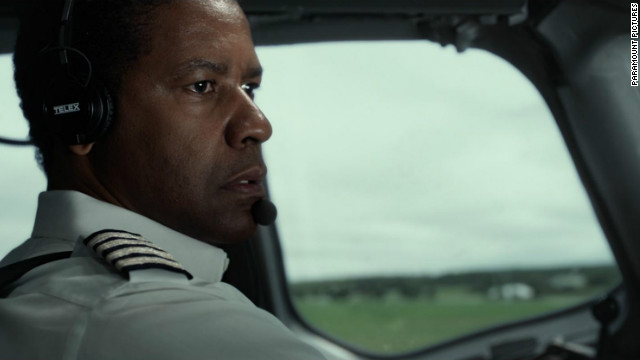 It’s really a modern-age version of The Lost Weekend or The Days of Wine and Roses. It is an alcoholism story. We’re all familiar with them at this point in the movies. A part of me thinks addiction stories are some of the easiest ones to write; you take a flawed character, introduce the addiction, have them determined to get sober, and then provide temptation after temptation. And that’s kind of what Flight feels like. The compelling elements of the movie, notably the legal ramifications of the crash and the political maneuvering, get too often sidelined by a repetitious mélange of Whip getting drunk or thinking about getting drunk or trying not to get drunk. There are many ups and downs, but the cycle of addiction and abuse starts to grow weary, especially when the movie offers more interesting and unique story avenues worth exploring. The airplane sequence is a taut, horrifying, intense sequence. The legal wrangling resulting from it seems like the stuff of good drama. The airline is trying to limit its monetary damage, the lawyers are trying to cover for their clients including having the dead crew stripped from the fatality numbers, and all the while the investigation is getting closer to uncovering Whip’s secret. That’s the movie I wanted to see with Flight. The majority of what I got was a by-the-books addiction parable with some good actors. The movie seems to be going in too many different directions.
Zemeckis’ return to live-action is welcomed and long overdue, and it’s great seeing him direct real people in real environments again, even if the finished film is flawed. His interests seem more with the special effects-laden crash, a harrowing sequence for the ages. When it gets to the addict stuff, it seems like Zemeckis goes on autopilot himself, bowing to the strength of his charismatic star sucking everything into his orbit. The movie becomes an acting showcase for Washington’s abilities at the expense of a completely coherent plot or tone. At times the film seems cavalierly comic, particularly with John Goodman’s character that gets treated like an endearing figure. He’s Whip’s chief source of drugs and his chief enabler and his casual nature with hardcore drugs, and the film’s noncommittal stance, gives the movie a strange, unsettling quality. Then there’s the religious aspect that feels like it flew in from a whole other screenplay (I can’t tell whether the film is dismissive of religion or just flippant). Plus Zemeckis just can’t help himself when it comes to on-the-nose literal music selections (after Whip gets high due to his compatriots, the elevator plays the Muzak version of the Beatles’ “Some Help from My Friends.”). It’s at this point I’m so happy for Zemeckis to be back making live-action movies, I’m probably giving Flight an even bigger pass than it may deserve.
I’m not sure the Nicole character provides anything substantial to this movie, let alone the movie treating her as a co-lead for the first thirty minutes. In between our moments of watching Whip on the plane, we have scenes of Nicole going about her sad day. I’m wondering how in the world these storylines are going to connect and why we have to leave the drama of the plane for the mundane life of an addict eeking out a desperate life. These should not be parallel storylines; the audience interest is not divided here. Nobody is complaining about spending too much time with Whip and the plane crash. No one is saying, “I wish I could see that woman’s sad life some more.” Why did we even need to see Nicole before she meets Whip in the hospital? Were all of those early scenes just too essential to lose in a movie over two hours? Thematically, I can understand that Nicole presents a romantic possibility but also a reward for Whip if he stays clean and sober. Seeing him screw up this pseudo-relationship is another example to convey the self-destructive nature of Whip. I get that. But if this woman were really integral to the plot, she wouldn’t vanish for the entire final act.
It’s easy to see why actors are always attracted to addict roles. They’re usually showy parts that allow for many opportunities to bottom out. Rest assured, Washington (Safe House) is uniformly excellent, portraying a deeply flawed individual prone to grandiose self-delusion and justification for his behavior. We’re so used to seeing Washington play the calm, cool, collected men of dignity, men who seem preternaturally gifted at leading others. With Flight, he becomes far more vulnerable, a self-destructive character that pushes others away and betrays the trust and faith of others. He’s not fighting some larger external force; he’s battling his internal demons that continually lead him astray. He can be petty, mean, weak, delusional, and downright unlikable at turns. It’s a strong performance that anchors the film. The other actors all provide admirable backup duties, from Cheadle to Greenwood to a brief appearance from Melissa Leo (The Fighter) as an airline investigator. I want to single out James Badge Dale (HBO’s The Pacific) for the impression he makes with a part that amounts to one single scene in the movie. He plays a gaunt cancer patient sneaking away for a stairwell smoke (“Wouldn’t want to give my cancer cancer”), joined by Whip and Nicole. He’s so good with the gallows humor and surprisingly poignancy that I wanted the camera to just start following him.
 I want to point out one quirk during my movie going experience with Flight. I was easily the youngest person in my theater by 20 years minimum. I don’t enjoy seeing movies with a predominantly elderly crowd because they do not follow the agreed-upon rules of movie decorum. They often engage in conversations or provide a running commentary. A man two rows behind me had his watch beep for a solid minute to inform him, and the theater, it was now seven o’clock. Either he didn’t hear it beeping (which defeats the purpose) or couldn’t figure out this new-fangled 1980s watch technology to turn it off (which also defeats the purpose). Anyway, what I really enjoyed then was the audible reactions when Flight’s beginning, its very opening images, was a pair of naked breasts. The first scene features Whip and flight attendant Katerina (My Name is Earl’s Nadine Velaquez) getting dressed after a wild night of booze, cocaine, and sex. Whip talks to his ex-wife on the phone, and in one ongoing camera shot, we watch Velaquez walk around completely naked. Then she leaves off screen… and comes back still completely naked. Now I mention this because it delighted me to no end to listen to the grumbling of the older audience members. And yeah, the nudity is fairly gratuitous but I’m happy Zemeckis was able to rankle my elder audience before the second second of film.
Flight is also unique in the sense that it may be the only film I know of to posit that drugs and alcohol could save lives. Will is drunk and high while flying, but he saves the day because of his impairment. Ordinarily in the event of a crash or a dive he would revert to his training; every pilot in a flight simulator recreating the events crashed and killed all passengers. Instead, Will goes by instinct, thinking outside the box, and saving the day. And what enables him to do this? Booze, sweet life-saving booze! He’s so calm and relaxed in the moment that he’s able to think straight and discover unorthodox solutions in limited time. Flight never makes this fact explicit but I think it would have made a more interesting film if this debate had been given more airtime. Yeah Whip was drunk, but not every drunk is impaired the same. I’m not excusing driving while intoxicated, but the movie presents a strange situation, fictional yes, where drugs and alcohol saved lives. Then in the end, and our lead is in trouble, what does it look like will save the day? Cocaine! Seriously, the white knight in the final act is the white powder.
I think audience might be in for a rude awakening while they sit through Flight, advertised as an airline thriller. It’s still a competent, occasionally compelling movie with strong acting from Washington and others, but are audiences really interested in another alcoholism drama even if it has Big Stars? The most frustrating part of Flight is that it has so much potential, so many intriguing storylines or angles to choose from, and it settles on the most mainstream one, the familiar arc of an alcoholic coming to terms with their addiction. How is that more dramatic than an airline crash or the later investigation and legal witch-hunt to find a culprit to blame? The movie prefers to focus on the minor rather than the major, following the familiar formula to the very end when our lead has to make a grave moral decision. It’s a character study but the character and his path are the familiar. All the stuff that makes Flight different (the airline disaster, the investigation, the politics of blame) is the stuff that gets relegated so we can watch Whip screw up time and again. There’s an interesting study on hero worship buried somewhere in all this. I enjoyed Flight more in the moment but it has been crumbling under further reflection and analysis. I’m dearly glad Zemeckis has stepped back to the land of the living but Flight has too much baggage to go anywhere new and exciting.
Nate’s Grade: B-


 nathanzoebl
You must be logged in to post a comment.