Blog Archives
Snowpiercer (2014)
 I have seen Snowpiercer twice and it’s still a hard movie to describe. It’s the English-language debut of Korean filmmaker Joon-hoo Bong, notable for The Host (the good one) and Mother. It’s based upon a French graphic novel only printed in France and South Korea. It’s an international production, filmed in the Czech Republic, and populated with recognizable actors like Octavia Spencer, Tilda Swinton, John Hurt, Ed Harris, and Captain America himself, Chris Evans. It’s a dark dystopian allegory about class warfare, it’s a stunning sci-fi action movie, it’s a parable about humanity, it’s a stylish thriller that puts most of Hollywood to shame; it’s many things, chief among them, an incredible movie that demands to be seen on the big screen when able.
To combat global warming, world leaders disperse a chemical to lower temperatures, and oh boy does it work, inadvertently causing a new Ice Age that kills almost all life on the planet. Almost, because a few hundred got aboard the train owned and operated by Wilford (Harris), a rich and secretive industrialist. He built a train that can circle the globe, running on a perpetual motion motor. The last of humanity is housed on Wilfrod’s train. After seventeen years aboard, the class system has become rather rigid. The important and wealthy are at the front of the train, and the poor are crammed in the back, given gelatinous protein blocks to eat, and kept in line by armed guards. Curtis (Evans) is plotting a revolt, biding his time, consulting with the wise Gilliam (Hurt), an aging leader missing several limbs. Together, they storm ahead, capturing effete Wilford spokesman Mason (Swinton) as a hostage, rescuing an engineer (Kang-ho Song) with a drug addiction who will help them open the train cars, fighting car by car to take control of the train. Naturally, those in power fight back in force to maintain the uneven status quo.
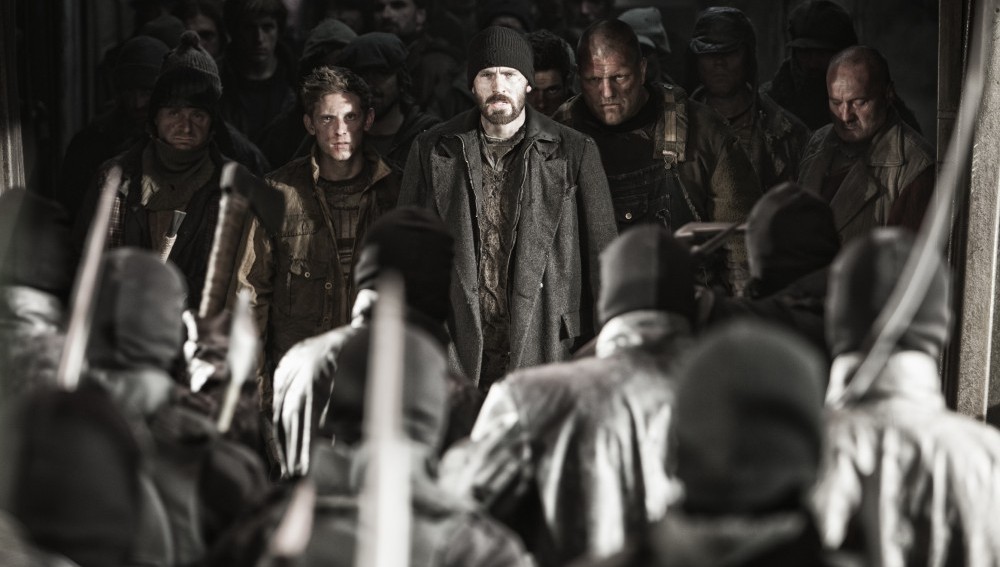 Short of the adrenaline-soaked Raid 2, there hasn’t been a better action movie this year than Snowpiercer. It starts slow, drawing the audience in, setting up its initial burst as a prison break of sorts where the tail section passengers have to figure out a way past the guards and several security doors open for only a few seconds. When the break does happen, in a clever fashion, you feel the full rush of the new opportunity thanks to the movie properly setting up the stakes and obstacles. Each new car presents a new world and a new obstacle. There’s one car where Curtis and his revolutionaries are met with fifty ski-mask wearing grunts with axes. This is the standout action sequence because of how it keeps changing. At first its brawn versus brawn, complete with swinging axes. Then the fighting stops briefly and all the grunts put on night vision goggles. The train enters a long tunnel, condemning Curtis and company to the dark. The grunts then go to town, spearing and slashing the hapless passengers blindly swinging in the dark. I won’t spoil the solution to this scenario but it too is properly set up and leads to some extremely satisfying action imagery, the kind of stuff that pops in a trailer. There’s an entirely different sequence later that also stands out. As the train goes into a long curve in the track, certain train cars are visible from others. Our chief heavy, listed as Franco the Elder (Vlad Ivanov), sees Curtis in the car ahead and starts firing. Eventually Curtis and Franco blast small holes in the protective glass and wait, wait for their moment, for their shot. It’s a tense neo-Western standoff moment, and another delightful addition. The accumulative action has a surprising degree of variety and development.
Snowpiercer is a stirring action movie that keeps your eyes glued to the screen, but it does an equally impressive job of building its world and adding dimension to its storytelling. Reportedly, Harvey Weinstein wanted to cut twenty minutes out of the 126-minute film, but I’m puzzled as to where those edits would come. Every scene in this movie drives the film forward or imparts crucial pieces of information or metaphor that will play out later. Even something as comical as stopping for sushi in the aquarium car (balancing the ecosystem) has greater meaning and subtext when you look back at the film as a whole. Joon-hoo Bong and his co-screenwriter Kelly Masterson (Before the Devil Knows You’re Dead) have given serious consideration to how this world operates and what life would be like when all of humanity is confined to one long train. The past is revealed incrementally, gingerly allowing the audience to become consumed with this odd dystopian landscape, our fascination brewing with each new puzzle piece being added. I was enthralled with the rich details, the cruel methods of keeping those in the tail section in line, the regular head counts, the protein block bars and what they truly are made of, the annual celebration of passing a certain bridge marking their own New Year, and especially the deification of Wilford. The characters worship the engine, and why not since it is the source of life for them, or as the chirpy schoolteacher (Alison Pill) sings: “What happens if the engine fails? We all freeze and die!” The later reveals are the best, giving full explanation why tail section children are important and, particularly, why Curtis is so ashamed at having two good arms. That monologue by Evans, looking back on the earliest and most cruelly chaotic days on the train, is a whopper. I truly hope that aspiring actors will use it during future auditions. It will make an impression.
 Its dark sense of humor and political and philosophical subtext provide an even richer texture to this strange, bleak world. The political commentary isn’t exactly subtle, I’ll admit, but it’s exceedingly better executed and integrated into its plot than, say, last year’s Elysium. The class-consciousness provides a greater depth to the proceedings, providing a new spin on the have/have nots that’s just as relevant today. It’s not just tacked on, either. The political commentary is intertwined with the mechanics of the plot, as we’re witnessing class warfare against inequality, how barbarous acts can be co-opted for personal gain. When Curtis and his small company finally reach Wilford and the engine, it’s a moment akin to visiting the Wizard in Oz, the man behind the curtain they’ve heard so much about. There’s a great degree of incredulous humor from Wilford’s vaulted perspective, but the longer you listen, the more you start to follow his twisted logic and why exactly the status quo must be upheld despite the bloody consequences. Then there’s the macabre humor, which can be bracing at points, none more so than the school car sequence with Alison Pill (TV’s The Newsroom). Also doing plenty of comedic heavy lifting is Swinton (Only Lovers Left Alive, We Need to Talk About Kevin) with such an odd authority figure character. With a mouthful of fake teeth, some owlish glasses, and a peculiar speech pattern, it feels like she stepped out of a Terry Gilliam movie, and we’re all the better for it. Often she’s the only source of humor in what is otherwise a dreary story about the strong preying upon the weak.
Stylish, intelligent, rewarding in surprising ways while still being thoroughly entertaining, with tremendous technical attributes such as production design, Snowpiercer is a sci-fi flick that borrows from many but creates its own unique and enthralling landscape. Rare is the movie going experience where you sit at the edge of your seat, completely taken in by the creativity of the artists at work, transported to somewhere new and exciting, and you dread the approaching end credits. Snowpiercer is an experience that’s hard to describe beyond an unrelenting checklist of positive, glowing adjectives. Simply put, it’s movies like this that make going to the movies special.
Nate’s Grade: A
Share this:

Before the Devil Knows You’re Dead (2007)
 Sidney Lumet is 83 years old and still directing movies, God love him. The man is behind cinematic milestones and classics like The Pawnbroker, Serpico, Dog Day Afternoon, Network, and 12 Angry Men, which goes back all the way to 1957 – 50 freaking years ago! The longevity of this man is admirable. He hasn’t pulled together a compelling film in some time, but Before the Devil Knows You’re Dead is a stirring, character-driven crime drama that reveals itself to be a first-rate melodrama.
The film is anchored by two huge performances by Philip Seymour Hoffman and Ethan Hawke, playing a pair of brothers both on hard times. Hoffman’s character, Andy, has been living well outside his means to keep up appearances and to sate his taste for a local heroin den. He’s in charge of company payroll and an internal review just discovered a pair of terminated employees still drawing checks, the source of Andy’s cash to pay for his lavish lifestyle. Hawke’s character, Hank, is behind on child support and belittled by his ex-wife. He’s having a hard time even finding the dough to pay the 100 bucks for his daughter to go see The Lion King in New York City. Andy hatches a scheme to solve both their money woes: they’re going to knock over a mom-and-pop jewelry store. It just so happens that the store belongs to Andy and Hank’s mom (Rosemary Harris) and pop (Albert Finney). The plan goes hopelessly awry and both brothers feel intense pressure in the aftermath.
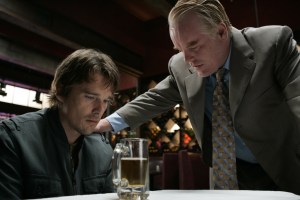 Lumet and debut screenwriter Kelly Masterson really know how to ratchet up the suspense. The nonlinear timeframe keeps the audience on its toes and continuously rewriting what we think we know. Unlike movies like Babel and 21 Grams, the plot is actually assisted by skipping around time and telling the story out of order. We get the basics and then the details begin to take shape, but because of the prior knowledge the film packs an increasing sense of dread that builds in intensity. As the brothers sink lower trying to cover their misdeeds, Lumet and Masterson crank up the tension to a peak. The knotted and twisty narrative exposes the fragile dynamic of this family and keeps the audience alert and hungry for more.
Hoffman is at his sleazy, duplicitous best with this performance. His character is a man accustomed to getting what he wants and he knows all the manipulative tricks to get there, be it bullying or cajoling. He’s a pusher with so much anger and desperation just below the surface. Andy never feels respected or loved by his father, and he has a great scene where he breaks down in a fit of rage and tears in response to his father apologizing for the bad upbringing. Hoffman imbues great emotional complexity to a man whose world is crashing down. It is enthralling to watch.
Not to be outdone, Hawke puts forth his finest effort of his career. He’s the baby of one very corrosive family; he misplaces trust and admiration in his big brother. Hank isn’t the sharpest tool in the shed but he has a distinct weariness to his worries, living day-to-day with the knowledge that the world sees him as a loser or a screw-up, losing the respect of his own daughter. When things go bad he unravels rapidly while still holding to his secrets. It’s a performance brimming with nervous anxiety, mounting regret, and self-effacement.
 The secondary characters don’t get nearly the attention and consideration. Marisa Tomei is more a plot device than a character; she’s Andy’s wife but has been having an ongoing affair with the more nurturing Hank. She spends most of her scenes in some form of undress and feels more like another notch in the complicated relationship between the brothers.
Finney is fine with a rather small role that merely requires him to be aghast or incredulous with the slow police work. I don’t know if a suitable Finney performance can compensate for a staggering leap of character late in the movie, but I suppose I’d rather have any Albert Finney performance in a movie than none at all. Before the Devil places Finney’s character on a perch and just doesn’t give him much outside of his own dawning realization of who was responsible for the botched robbery.
Before the Devil Knows You’re Dead is a gripping family tragedy that takes on a Shakespearean quality as it comes to a somber, chilling close. The wordy titles comes from an Irish drinking toast that states, “May you have food and raiment, a soft pillow for your head; may you be 40 years in heaven, before the devil knows you’re dead.” The message declares the inescapable consequences of our actions. This is a film about the disfiguration of one family; it’s bleak, tragic, but whole-heartedly entertaining and extremely focused in its aims. Lumet has returned to smashing form and reminds an audience that there’s still plenty of vigor left in this 83-year-old director.
Nate’s Grade: B+


 nathanzoebl
You must be logged in to post a comment.