Blog Archives
Goodbye Christopher Robin (2017)
 The young author sub-genre has become an awards season cottage industry. We’ve seen recent stories about J.M. Barrie, Jane Austin, P.L. Travers, Beatrix Potter, Ernest Hemingway, and a whole assortment of the Beats. Even in 2017 there have been stories about a young J.D. Salinger (Rebel in the Rye), the creator of Wonder Woman (Professor Marston and the Wonder Women), and soon Charles Dickens (The Man Who Invented Christmas). We seem to relish watching the formation of brilliance, or at least watching a recognizable creative voice find their flights of inspiration. Goodbye Christopher Robin is meant to be another in the tradition of young author movies served up on a platter for season-ending awards and recognition. Goodbye Christopher Robin is so serious, clumsy, and tacky in final execution that it enters awards bait self-parody.
Alan Milne (Domhnall Gleeson) is coming to terms with his PTSD after his experience sin WWI and trying to re-enter the literary and theatrical world of London. He finds inspiration through the imaginative play dates with his young son, Christopher Robin a.k.a. “Billy Moon,” and in time the formation of Winnie the Pooh’s world. The book is met with immediate success and Alan and his wife, Daphne (Margot Robbie), are all too ready to ride the wave of fame. Christopher is raised by his kindly nanny, Olive (Kelly Macdonald). Eventually, Christopher grows to resent his parents, the public’s assumption about himself, and the very name of Pooh itself, so much so that he volunteers to go to war as a means of just escaping the overbearing attention of the spotlight.
 The opening act of this movie is the best part, and it’s all pre-Pooh. It also helps that it focuses more on Alan Milne rather than his son, who will take a far larger role later. Milne is already a slightly prickly character who doesn’t exactly fit in with the British upper class. He’s also trying to process his PTSD and return to some semblance of a normal life. He’s also struggling artistically, and this is where the film is at its most interesting because it has the most focus. We get to really delve into the triggers and emotional state of a character in a way that feels engaging. We spend time establishing a person, a trauma, and how it impacts his relationships. It’s not the most singularly compelling drama but it’s still more effective than what regrettably follows.
Where things start to go irreversibly downhill is the exact emergence of Pooh. While Milne is spending more time with the son he doesn’t fully know how to relate to, he’s also pumping his boy for ideas during their play for a children’s story. We get the expected but still lazy moments of all the little signifiers in their lives that connect with future characters. Then one Pooh gets published it becomes an international best seller and the movie just zooms through plot. It goes from releasing the book to everyone in the world loving it literally in a minute of screen time. The Milne family, and especially Christopher Robin, can’t go anywhere without being recognized and hounded by fans. This is also where the film makes a sharp turn and reveals Alan and Daphne Milne to be really terrible parents. As soon as success appears, they’re actively exploiting their child at every opportunity, including such stunts as a radio station also listening in to father wishing his son a happy birthday over the telephone. If there’s a chance they can sell more books, get extra publicity, or simply parlay their fame into something, they take it, and often Christopher Robin is left home alone with his nanny while mom and dad lap it up. Rarely have you seen childhood neglect made to appear so strangely whimsical.
 Even this abrupt plot turn could have worked as an interesting and unexpected portrayal of a literary family that lost the “family” sensibility once fame and fortune arrived. Unfortunately, this is not really a movie about consequences being felt because we’ve got to speedily move onto the next plot point in order to fulfill the formula. After Olive has her big speech about how the Milnes have been mistreating Christopher Robin, it’s literally two scenes later where Alan comes to agree. Lot of internal turmoil there, huh. Christopher Robin’s life gets so bad he’s practically begging to go to war. Even his fate during the war is something the film doesn’t leave unanswered for long. Why dwell on the consequences of decades of bad parenting when we can still careen into a feel-good ending that will attempt to poorly wipe clean the slate? Everything is resolved so rapidly and without larger incident that rarely does the story have time to register. We’re never going to feel great insights into these characters if the film doesn’t give us time. Who cares about hardships and betrayals if they’re just going to be erased in the next scene or if some life lesson will be ham-fistedly learned, but not earned, in short succession?
This is not a subtle movie by any means. The second half of Goodbye Christopher Robin is all about how the boy’s life is awful and how much he dislikes the spotlight. The father comes up with the solution of sending Christopher Robin to a boys’ home way out in the country. As soon as dad leaves, the boys instantly start bullying and harassing Christopher Robin, literally throwing him down flights of stairs while chanting insults. Dear reader, the next part astounded me. It is during the shot of him being pushed down the stairs that the movie uses this sequence as a transition device. By the time Christopher Robin stumbles to the bottom of the stairs he is now a teenager. It’s as if he has been falling down the stairs for a hellish decade. Then there’s the moment where dad sees his son off to war at the train station. As he looks back, for a brief moment it’s not teenage Christopher Robin boarding that train but young child Christopher Robin. I laughed out loud at this moment. It’s too earnest and too clumsy not to.
 The acting cannot save this movie. Gleeson (The Revenant) gets to be that kind of aloof where the actor pronounces words with great care. His acting style is a bit too removed and opaque to really feel much for his character, especially when he cedes the spotlight to his neglected and exploited son. Robbie (Suicide Squad) is just completely wasted. She might be the film’s biggest villain and her disapproving stares look like they should be accompanied by cartoon steam coming out of her ears. Macdonald (HBO’s Boardwalk Empire) fares the best mostly due to her genuinely appealing nature. It also doesn’t help matters when it appears that our young Christopher Robin, newcomer Will Tilston, was hired for his toothy grin and dimples. This is not an especially good child performance. It’s powerfully winsome but in an overly cloying manner. It was hard for me to work up much empathy for Christopher Robin because the performance kept left me cold.
Goodbye Christopher Robin is a feel-good movie that made me feel like checking my watch. It’s tonally off with its mixture of sentiment and indifference, zooms through important plot points rather than dwell on the impact of decisions, and looks for any opportunity to bludgeon an audience rather than deliver something genuine and subtle. If you’re a major fan of Winnie the Pooh perhaps you’ll get something out of it knowing its author was a terrible parent. This wasn’t a movie that made me feel authentic emotions. It felt too clumsy, too mechanical, and ultimately too miscalculated. The only awards this might be contending for at the end of the year are not the kind it’s going to want.
Nate’s Grade: C-
Share this:

Anna Karenina (2012)
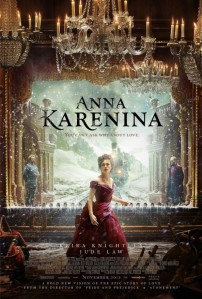 I’ve never read a Russian novel before, mostly because I don’t need to read 900 pages of bleakness and repressed happiness. With that said, I knew very little going into Anna Karenina (the very title sounds too heavy in syllables, like you’re stuttering). What didn’t help matters was director Joe Wright’s edict to set the story as if it was being performed on a living stage. This bizarre visual concept is interesting for a little while until you realize that it never goes further than the obvious note that the lives of the elites were played out in public for cruel judgment. The staging also gave me many periods of confusion where it felt like a character fantasy was taking place. The peculiar staging seems superfluous and the real draw for the film, not the relatively fine performances or Tom Stoppard’s (Shakespeare in Love) adaptation. I don’t think it works as a movie because, much like Wright’s Atonement, it feels too self-satisfied in its own mannered artifice. It’s an overload on style and the film neglects to give me a reason to care about the story and the characters. Keira Knightley as the titular heroine is hard to embrace, Aaron Taylor-Johnson (Savages) seems miscast as her dashing lover, and Jude Law (Hugo) comes across as unreasonably tolerable of his wife’s flights of fancy, so much so it makes it hard to sympathize with her downward spiral. It’s a pretty movie and I applaud its attempt to do something different, but Wright’s Anna Karenina feels too fanciful to come across as tragic.
Nate’s Grade: B-
Share this:

Brave (2012)
 Perhaps after a series of ambitious, mature, celebrated animated works, we just hold Pixar to unrealistic expectations. Their latest film Brave isn’t bad by any means, but it’s certainly second-tier Pixar among their cherished catalog of hits (somewhere along with Monsters Inc. and A Bug’s Life, I’d say). The movie is an eye-popping beauty to watch; the Scottish highlands look gorgeous and teaming with life, and our heroine, Princess Merida (voiced by Kelly Macdonald), has a signature mess of red tresses that look incredibly real. The hair practically blazes onscreen. Even though the independent-minded young heroine has been a staple of stories, and particularly animation, since the 1990s, Merida is still a feisty, engaging, and relatable lead. Her friction with her mother (Emma Thompson), who wants Merida to accept royal responsibilities and marry a suitor, creates some nice sparks, and the mother-daughter dynamic is an exciting new avenue for Pixar to explore. Without spoiling too much, Merida, in a moment of anger, has a spell cast with disastrous results. It’s here, at about the 30-40 minute mark, where the movie goes in a completely different, and unwelcome, direction. The rest of the film becomes a series of chases and comical close calls and lots and lots of slapstick humor. The timeframe of the movie, about 36 hours as near as I can tell, is too short for substantial character growth. And so, by the film’s end, the character development feels facile and forced and just unbelievable. Rather than keep its focus on Merida making her own way against a patriarchy, the film devolves into a supernatural buddy comedy and then concludes in a clumsy, dues ex machina fashion. The tone is uneven, and some points are a bit scary for young children, and I kept thinking that this was more a Dreamworks release. I may sound overly critical but that’s because we’ve come to expect the best from Pixar. Brave is an entertaining, funny, and often visually astounding movie, and while it’s second-tier Pixar, that’s certainly better than most.
Nate’s Grade: B
Share this:

No Country for Old Men (2007)
 Joel and Ethan Coen are two of cinema’s most talented oddballs. Together, they’ve created some of the most intricate, eclectic, and best movies of the last 25 years. Their last two efforts, 2003’s Intolerable Cruelty and 2004’s remake of The Ladykillers, didn’t feel like Coen movies; they felt like they were compromised and missed the artistically deft touch. As a result, both movies were mild failures for filmmakers that have a series of genre-spanning masterpieces to their name. No Country for Old Men is the first time the brothers have adapted someone else’s work, in this instance Pulitzer Prize-winning author Cormac McCarthy’s 2005 novel. Not too shabby if I say so. Fortunately for all lovers of film, the Coens have embraced McCarthy’s blood-soaked tale and crafted an exciting, honest, and intensely provocative modern Western that stands out as one of the greatest films of the year.
In dusty West Texas, Llewellyn Moss (Josh Brolin) is out hunting the lonely plains when he discovers a blood trail. It leads him to four empty cars riddled with bullet holes, dead bodies collecting flies, and a sack containing two million dollars in cash. The signs are all there that this was a drug deal gone badly, and two million will never go unnoticed, but Moss sees this as an opportunity of a lifetime and takes the money. The men in power have hired Anton Chigurh (Javier Bardem) to find their drugs and money and exact retribution. Chigurh’s preferred method of killing involves a high-pressured air canister that can blow out doorknobs and human brains. Chigurh chases after Moss all the while Sheriff Ed Tom Bell (Tommy Lee Jones) is following the trail of death to try and save Moss or any future innocent victims.
 What a fine-tuned, nerve-wracking, and engrossing cat-and-mouse thriller this film is. The action is brief but the buildup can be nearly unbearable to endure. The tension is magnificent. Chigurh chases Moss from hideout to hideout and some of the tensest moments are just waiting. There’s a moment where Moss is calling the front desk of his newest motel and we hear the phone ringing unanswered again and again from the hall, all the while Chigurh’s footsteps inch closer. But it’s the moments of silence that cause the most dread. When Moss is trying to recover his loot, all the while Chigurh is in the opposite motel room, it becomes a balancing act of sound and silence. No Country for Old Men is expertly orchestrated to involve the use of sound as a tool for high suspense. None of our main three characters inhabit a scene together. Sure Moss and Chigurh shoot at one another but even then it’s short and focused on waiting for response and counter response. Moss is no dummy and he sets up some traps for his would-be dispatcher. No Country for Old Men is unnerving, intelligent, near flawless entertainment.
Chigurh, as masterfully played by Bardem, is the stuff of nightmares. I was literally afraid to go home after seeing this movie and it is because No Country for Old Men fashions a villain so methodical, so cold-blooded, and so downright deadly and cunning that I felt as if he could very well be residing under my bed at night waiting. Bardem is hypnotically horrifying and the Coen brothers establish early on how ruthless their cinematic boogeyman is. The very first moment we’re introduced to Chigurh he escapes from police custody and strangles the inattentive officer on duty. He drags him to the floor and chokes the life out of him, but the Coens position the camera not on the last desperate kicks of the officer but on the face of Anton Chigurh, and it is nasty. His eyes are bugged out and his intensity comes across as sadistically jubilant. He seems like a caged animal finally let loose. It’s a scary yet fascinating introduction to a deadly character.
Chigurh is a humorless and determined man, and every scene he steps into instantly changes. A gas attendant casually asks Chigurh about the weather and gets on his bad side and the stone-faced killer in the Dutch boy haircut proceeds to press the poor man with increasing agitation, yet Chigurh always speaks in such a placid tone that makes him far creepier. He’s a maniac that never raises his voice. Chigurh then corrals the man into one of his signatures, having a victim decide their fate by the flip of a coin. Before the man can say anything the coin is flipped, Chigurh intones to “call it,” and the man nervously repeats that he needs to know what he’s at stake to win. “Everything,” Chigurh responds. This scene starts off so innocuous but becomes monumentally unsettling thanks to the rising dread and Bardem’s deeply committed portrayal. Bardem is alarming, ferocious, grimly efficient, mesmerizing, and deserves an Oscar win, not just a mere nomination, for what is his finest performance to date.
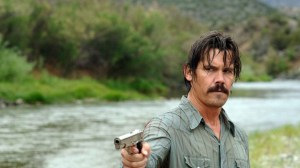 There are many ways to describe Chigurh, but it seems most appropriate to speak of him as nothing short but the full-tilt vengeance of God. He’s a hired killer, yes, but that doesn’t stop him from killing indiscriminately. He murders several innocent victims, he murders his competition sent out to nab Moss just because it insults him, and even after the money no longer becomes a concern, Chigurh still plans to continue his wrath out of sheer moral principle. He made a promise of swooping vengeance and he will stick to it. This means that anyone could die at any moment while onscreen with Chigurh, and No Country for Old Men has plenty of surprises as it toys around with our baited anticipation. When Chigurh gets the drop on his competition he doesn’t shoot the man immediately; instead the scene plays out for an agonizing length even after we listen to the room phone ring several times, and then blam! Chigurh answers the phone and casually raises his boots so the pooling blood doesn’t touch his feet. This is the most memorable incarnation of soulless evil I have seen in the movies since Hannibal Lector came to iconic form in 1991’s Silence of the Lambs.
Brolin is having quite a career year for himself after compelling turns in American Gangster (where he also shoots a dog), In the Valley of Elah, and Robert Rodriguez’s Planet Terror half of Grindhouse. Brolin gives the audience a figure to root for even though he never actually displays true heroism, just survival instincts. Jones serves as a wise and guiding father figure that feels out of place in a world that is becoming increasingly, shockingly violent. It’s a role that Jones has performed before but it’s a role that fits the actor exceptionally well. Woody Harrelson pops up as a charming and laid back handler trying to convince Moss to give up before things get worse. Kelly Macdonald, as Moss’ wife, cuts through the darkness in a refreshing performance.
The technical craftsmanship is on par with previous Coen excellence. Roger Deakins’ cinematography is exquisite, Carter Burwell’s score barely makes its presence felt, and the editing is tight and focused. The sound design, which I’ve already discussed in detail, deserves an Oscar. This being a Coen brothers’ film, it wouldn’t be complete without some dark humor to punctuate the bleakness. They have a perfect ear for local vernacular and Texas shorthand, so the dialogue feels sharp but realistically twangy without being condescending as some had accused Fargo (I do not agree with this accusation).
 What works in the favor of No Country for Old Men may perhaps be its undoing for a mainstream audience. The film works against conventions and this provides for some stellar surprises and upheavals, none of which is bigger than killing a certain character off-screen. No Country for Old Men definitely seems like it’s laying stage for a climactic showdown and then one key figure has been bumped off by a group of ancillary characters that have little overall bearing over the plot (I have read that the same gap happens in McCarthy’s novel). If this doesn’t perturb audiences then the final 10 minutes ought to do it. There’s no sense of closure for the movie and this will frustrate many, but it all fits rather nicely with the movie’s highly nihilistic tone. Like Chigurh’s coin, the film focuses much on the randomness and cruelty of fate. By sticking to this ethic, the Coen bothers are eschewing the traditional Hollywood rulebook and playing around with our expectations for characters and plot. The outlook isn’t too sunny for many involved. It works and demands an audience remain on edge for fear that anything could happen at any moment. However, don’t say I didn’t warn you if you walk out of No Country for Old Men and say, “What was that all about?”
No Country for Old Men is exactly the kind of material the Coen brothers needed to return to form. This is a lean and stirring thriller that plays to their strengths and echoes some of their most riveting and twisty work, like Blood Simple and Fargo. In many ways the film feels like a Western, a high-stakes drama, and a tragedy that takes its time to unravel. It may have taken some time but the Coen brothers are back, baby, and No Country for Old Men is fit to stand beside their hallowed pedigree of cinematic classics.
Nate’s Grade: A


 nathanzoebl
You must be logged in to post a comment.