Blog Archives

Street Kings (2008)

This is a wildly overwrought and sleazy drama is hoping to come across as edgy but everything is so overdone. It fulfills all the requisite elements of the modern crime picture; double crosses, forlorn anti-heroes, bloody violence, but Street Kings misses the mark big time when it comes to any nuance. Every beat of this murky, convoluted dirty cops mystery is plain and obvious. If you cannot guess within minutes who the eventual culprits will be then you haven’t seen enough movies. Every character is a cliché of a cliché, every unrestrained actor is constantly speaking in nothing but exclamation marks, and the dialogue is some of the worst I’ve heard all year. Keanu Reeves is a listless leading man who is blank and lifeless, unable to wrestle the dark and complicated emotions needed for a “cop on the edge” role. I can practically feel Forest Whitaker’s spittle every time he speaks. Street Kings feels like a route retread of rogue cop pictures, which are director David Ayer’s specialty. It wants to shine a light on the seedy underbelly of the law but it can’t stop from feeling like a lobotomized version of L.A. Confidential (Note to Ayer: Jay Mohr + mustache = an arrangement that benefits neither party).

Nate’s Grade: D

The Lake House (2006)

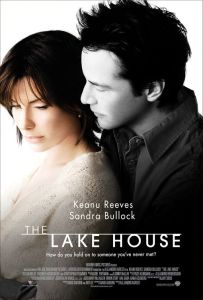
The first time I saw the trailer for The Lake House, a time-travel romance that reunites the stars of Speed, I said to myself at its conclusions, “If this lake house drops below 55 miles per hour…” I know, I’m a comedic genius, that much is obvious but what I was really reminded of was a 2002 film called Happy Accidents, a delightful gem of a movie with a similar time-travel romance. In that film you felt like anything could happen with its intricate plotting and off kilter, potentially seriously disturbed characters. Now it seems like Hollywood’s on board. The Lake House is based on an Asian film I’ve never heard of (though, in all honesty, I’ve never heard of 99.99% of them; sorry Asian cinema). This new East-West The Lake House doesn’t come across as that romantic but it’s hard to deny its points of interest.

Kate (Sandra Bullock) has taken a new job in Chicago and is moving out of a giant glass house on stilts that overlooks a lake. She leaves a note for the new resident, Alex (Keanu Reeves), an architect that struggles to fulfill his talent and his father’s (Christopher Plummer) legacy. Alex is confused; to his recollection, no one has lived in this house for years. Kate writes back and slips her notes into the nearby nostalgic mail box. But there’s something magical with this mail box. Kate is living in the year 2006 and Alex is living in the year 2004. Neither understands how it’s possible they’re even communicating by transporting letters through the mailbox. What’s even worse is that they’re falling in love with each other through their correspondence. Talk about your long-distance relationships.

To go along with this kind of movie you really need to take it at face value. Once you start that slippery slope of questioning paradoxes of time travel or the narrative plot holes, you’ll be left in the cold for the remainder of the film. Yes, there are all sorts of logic paradoxes to clog the brain with, like the fact that every time Alex does something thoughtful, like plant a tree by Kate’s building, she won’t notice because she’s never had memories of anything being different. The characters themselves just shrug at the movie’s concept and accept this bizarre predicament. No explanation is given for this short circuit in the time space continuum, and frankly, no explanation is needed. The Lake House is not emphasizing the “why” but more the “what now?”

The Lake House is still a Hollywood romance in most senses. There’s little doubt that a happy ending is just around the corner, but at least the wrinkles and the road map to that point are not altogether predictable. The typical big moments are foreseeable, including that ever popular 11th hour misunderstanding, but The Lake House manages to tickle with surprise in the details of its journey. You don’t so much pull for the leads to get together but just see them tackle this mighty daunting obstacle before them.

The biggest flaw of The Lake House is that you never really believe these sad pretty people are falling in love. There is something indelibly romantic about falling in love with someone just from their words, constructing a potential soul mate with the few puzzle pieces given to you through long correspondence. Unfortunately, there’s nothing in those many pieces of parchment that Alex and Kate pass along that pinpoints why either pen pal would fall for the other. Both seem to have spotty luck with the opposite sex or are at least seeking more from a mate. But if The Lake House is any indication, these people have been chiefly seeking celibacy and verbosity in a mate. They talk about their lives, they talk about their pasts (in Kate’s case is a bit more extended), but it’s not too long before they start swooning and clutching those letters ever so tightly. The audience is left to fathom what invisible combination must have been unlocked that these sad pretty people have fallen for each other. While a lack of sustainable, let alone believable, romance in a romantic drama might be disastrous, at least The Lake House has a conceit strong enough to engage the brain even if it fails to engage the heart.

The time jumps manage to keep the audience on its toes, plus there’s some fun in witnessing Alex and Kate try to locate each other and become bewildered. Director Alejandro Agresti (Valentin) and playwright David Auburn (Proof) play around with different techniques like split-screens and dissolves to present their lovers together. The conversational back-and-forth voice over does present problems; how exactly can they interrupt each other? The Lake House leans a little too hard on faith that we want to see these people end up together. Problem is that Kate and Alex are essentially void of depth; two characters defined more by the clunky subplots around them than their own personalities. Bullock and Reeves don’t help matters much, each perpetuating a vacant pretty android quality, like they’re waiting for a button to be pushed to explain human emotion.

I don’t know about you but if I was writing to someone in the past I’d use my knowledge and tell them to play certain lottery numbers or sports bets (“The Red Sox win what?”). Maybe it’s simply unromantic to start the basis of a relationship on gambling earnings. Then again, maybe it’s just unromantic to start a relationship with Keanu Reeves anyhow.

The Lake House is an old fashioned Hollywood romance but with some intriguing wrinkles and a playful structure. There’s a degree of predictability, the high-wattage stars fail to generate even low-wattage heat, but with the time-slip premise the film cannot be judge as familiar. The unusual situation and obstacles presented are more interesting than the main characters. Their love feels artificial and neither Kate nor Alex is rather deep, involving, or particularly smart (e-mail anyone?). Despite the limited help by the leads, The Lake House is a pleasant, different, if not terribly romantic Hollywood drama. For Hollywood, sometimes “pleasant and different” is enough for an enjoyable evening with the stars and someone special by your side. For everyone else, rent Happy Accidents.

Nate’s Grade: B

Constantine (2005)

I’ll admit it; I’m a sucker for Christian mythology played against thriller and action settings. I may be the only person to have watched all of The Prophecy flicks, and probably the only person that eagerly chows down on the cheesy sequels to The Substitute, yet shy away from seeing the first film. I’m captivated by the imagery, the discussion of Heaven and Hell and its mythical logistics, and just the psychology of supernatural biblical beings. With this in mind, I was strongly anticipating the release of Constantine. What I got wasn’t exactly what I expected but I’d be lying if I said I wasn’t entertained.

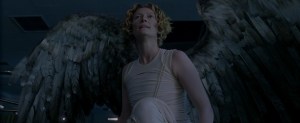
John Constantine (Keanu Reeves) is a very troubled man. Since his youth he’s had to live with his gift that allows him to see through earthy disguises and witness angels and monstrous demons walking among us. He’s parlayed this ability into a modest side job of exorcising demons and sending them back to Hell. Constantine figures his loyal service should grant him passage into the pearly gates, but Archangel Gabriel (Tilda Swinton) reminds him that that’s not how it works. Constantine is doomed to go to Hell because he tried taking his own life, and if that’s not enough he also has terminal lung cancer from smoking like a chimney. “In other words, you’re f***ed,” Gabriel confides to Constantine.

Police detective Angela Dodson (Rachel Weisz) is investigating the suicide of her twin sister (also Weisz). She swears her mentally disturbed sis wouldn’t do such a thing, and she seeks out the help of Constantine. He challenges her beliefs, stating that God and the Devil (Peter Stormare) have a wager over the souls of mankind but cannot directly interfere. But now something is breaking this rule and it looks like demons may be getting closer to entering our plane, and it looks like Angela’s dead sister may have known more than people would have thought.

The plot of Constantine is rife with contrivances, aborted subplots, underwritten and nearly forgotten supporting characters, and sketchy logic (staring at a cat can transport you to Hell? No wonder I’m a dog person). Often the film feels overwhelmed by good special effects, as they seem to be the crux of the film?s purpose of being and not, on the other hand, a theological playground of ideas. Constantine gives veiled glimpses of something smart, but routinely shuts that door to focus more on annoying jump scares.

In fact, Constantine seems rather old-fashioned with its theology, still clinging to the Roman Catholic belief that suicide is a one-way ticket to the fiery abyss. I understand its use as motivation for our lead, but will progressive audiences accept something they may find archaic? I suppose it could be worse. Constantine could have briefly gone to Hell for eating meat on a Friday.

It’s interesting that after spending two years making The Matrix sequels, Reeves would choose to attach himself to another big-budget theological action flick. His acting never really rises beyond morose loner but somehow he does make for a satisfying, brooding hero. Reeves? low-key monotone speaking voice allows him to spout cheesy dialogue with a straight face and mercifully keeps the audience grounded.

The true stars of Constantine are the memorable supporting players in this celestial smack down. Swinton uses her androgynous looks to forge what David Bowie might be like as an angel: angular, mysterious, waif, and somewhat creepy. Stormare delivers a performance so kooky and tic-heavy, that it could only be compared to the weirder moments of Christopher Walken. Both actors liven up the film and seem to be having the most fun by far with their cheeky roles.

The genius of Constantine is in its one-upsmanship game it holds with the audience. Granted, suspension of disbelief is needed to even go along for the ride, but when we start learning that Hell has its own line of bibles (and they’re longer) we’ve gone beyond suspension of disbelief and into wacky Anne-Heche-speaks-to-aliens land. While sitting through Constantine, we the audience think, “There’s no way this movie could get any sillier.” And then it does! We think, “Alright, that was crazy. Now there’s no way after that this film could get any sillier.” And then it does! Constantine is an amazing ascent into movie madness. After a while, I became drunk from the film’s insanity and wanted it to get even crazier, if possible. It almost seems like there’s a drinking contest between the movie and the audience, and Constantine isn’t afraid to piss its pants to win.

By the time Lucifer shows up, clad in all white like Tom Wolfe, and the Dark Lord appears to have Tourette’s Syndrome and/or a speech impediment, Constantine has hit the bottom of its Kool-Aid cup. Sure the film’s cinematography is slick, and the premise is intriguing, but the real draw of Constantine and the real enjoyment of the flick is how bat-shit crazy it is. I cannot even think of comparable films. I hope David Lynch was taking notes if he saw this.

For a while there, it seems director Francis Lawrence wanted Constantine to be a companion to Wesley Snipe’s Blade character. Maybe the two of them can set up a play date and go destroy otherworldly creatures. There’s a visually striking sequence late in the film involving Constantine in a room full of demons. He’s “contaminated” the water system by placing a giant cross inside, thus holy-fying the water before he can bottle it and sell it to the masses. He holds a lighter to the sprinkler system, demons growling all around him ready for their kill, and then water sprays down across the room. “Holy water?” one female demon says in a stunned voice, watching her flesh sizzle away. Then Constantine marches through the wet room blowing away demons into splashes of ash with his comically unwieldy cross-shotgun. It’s filmed wonderfully with dark hues and is a great idea; however, it’s a bit of a rip-off of the opening sequence in the first Blade.

This seems to be a repeated sentiment in Lawrence’s direction. He has a sharp visual eye and several camera angles come from odd yet exotic places, but his film is borrowing so heavily from so many other films. What you’re left with is the impression of a stylish if very derivative looking action film. One exception is when Lawrence shows us glimpses of the blistering burnt orange world of Hell. It seems Hell is an exact model resemblance of Earth, only with the fire, brimstone, and crawling demons with their heads sliced open (there is a scary level beneath the surface where we witness a sea of people being tortured). The second or third time we traveled to Hell, I began to wonder what my house would look like and the logistics of upkeep for the homeowner in Hell. Surely the heating bills wouldn’t be the same.

Constantine is funny, frustrating, confusing, gorgeous, and just plain insane in the ole membrane. The film exhibits a rare and engaging form of insanity that may glue audience eyeballs to the screen to see what happens next. I’ve seen Constantine twice (don’t ask why) and even though I knew all the weird plot turns I still found myself getting an enjoyable contact buzz from the film. Who knows how long such a novelty can sustain itself, though. Comic book fans, especially those with a spiritual bent, should get a kick out of Constantine as will anyone else searching for a pristine example of how wonderfully out of control Hollywood moviemaking can be. Sometimes in a good way.

Nate’s Grade: B-

The Matrix Revolutions (2003)

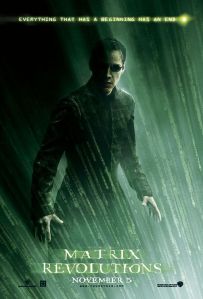
Four years ago the Wachowskis revolutionized the world of cinema, with their surprise sci-fi opus, The Matrix. Their mixture of philosophy, kinetic visuals, and inventive action with style to spare laid waste to all inferior action movies and gave birth to a cult of fan boys. Now six months after the second installment, The Matrix: Reloaded, we’re left to supposedly close the chapter on Matrix land.

Neo (Keanu Reeves) is caught in a strange limbo between the machine world and the real world. The only passage back to either is through the Merovingian’s chief hobo, the Trainman (seriously, he’s a hobo with teeth like a jack-o-lantern). Trinity (Carrie-Anne Moss) and Morpheus (Laurence Fishburne) travel to the most spastic fetish club imaginable for negotiations with the Merovingian. He agrees to give them back Neo if they will bring him the eyes of the Oracle, the prophet of the Matrix.

The rest of Revolutions takes place within two storylines. The first involves Morpheus and his former flame Niobe (Jada Pinkett Smith, finally getting a sizeable role she deserves) flying the last remaining ship of the human fleet back to Zion, the last remaining free human city, before the tunneling army of the machines breach the city walls. The other storyline involves Neo and Trinity flying a ship to the heart of Machine Town to have a face-to-face with The Wizard. They want to negotiate a peace between the two factions and put a stop to the increasingly uncontrollable rogue program, Agent Smith (Hugo Weaving), who, left unchecked, could destroy both the human and machine world.

Reeves has never been confused with a serious actor, or even much of an actor for that matter. And sure, he has a penchant for being out-acted by inanimate objects, but his stint in Revolutions is stiff and wooden, like he’’s just punching the clock to get through another day. It doesn’’t help his case that half of his scenes involve the woefully inept romance between him and Moss.

The only person that seems to be having any fun in this overly serious melodrama with guns is Weaving. His Agent Smith character has morphed into the true star of the Matrix trilogy. He’s charming and even more likable than the dull-witted Neo. Weaving seems to love the drawn out line delivery, so much so he might be accused of abusing anti-depressants. His insidious cackles are a delight.

The plot of The Matrix: Revolutions has several head-scratching moments. Like the kid who yearns to be in the fight but is too young and clumsy. Anyone who’’s ever seen any movie ever will know how that plot point turns out. Then there are questions like, why do people far in the future still use wheelbarrows to lug ammo around? Why, during a shoot-out at the fetish club’s gun check room, do people jump on the ceiling? Why would being on the ceiling make you any more difficult to shoot? The whole sequence comes off like a poorly done rip-off of the Wachowski’s’ own bank lobby shoot-out from the original Matrix.

Revolutions is the least densely plotted of the three films. Now, one would think this would be a godsend, especially after the pretensions and bloated mess that was The Matrix: Reloaded. But there’s nothing at all memorable in this third installment, and perhaps this is because everything but ten minutes of it takes place in the dingy “real world.” Who cares about a post-apocalyptic universe where the surviving subterranean humans wear rags and pull all-night raves? I’’ve seen that stuff in a thousand other movies (maybe not the raves part, though). Everything is better within the virtual reality Matrix world; from the clothes to the gravity-defying cool acrobatics to the cinematography to, God help me for saying it, the acting and dialogue. At least Reloaded gave us the stylish goods when it came to that heart-thumping freeway chase.

Although Revolutions is a slight improvement over the tedious Reloaded, this is only because after seeing the third and final leg of this trilogy, it makes the second film look worse. The intriguing new elements of Reloaded, like the French Merovingian and his wife (the lovely Monica Bellucci), are now seen to be nothing more than dropped subplots. Even the coolest additions to the Matrix universe –the ghostly twins- don’’t even show up. Sigh. Now that I know where the story ends, the loose ends of Reloaded don’’t justify themselves nearly as much as I would have liked.

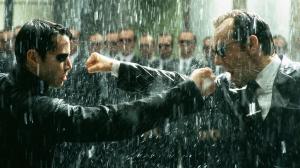
The showpieces of Revolutions are two long battles in its final act. The first is a near-20 minute assault by the Sentinels, resembling flying mechanical octopi, against the defenses of Zion. It’’s exciting for a while but battle fatigue settles in quickly. You can only watch so many CGI robo-exoskeletons shooting CGI machine guns at CGI flying machines as they explode in CGI explosions and CGI shrapnel. The effects are nice, and seem more polished than Reloaded, but the sense of imagination seems to be entirely absent. The second battle is the final fist-fight between Neo and Agent Smith in the pouring rain. Smith has duplicated himself enough to cover miles upon miles of high rises. The fight sequence is impressive and beautifully filmed, but it amounts to a big shoulder shrug after watching Neo battle 100 Smiths in Reloaded. The final confrontation in Revolutions is adequately satisfying if a bit under whelming and unmemorable.

The need for corporate coffers to ring has turned what was a great stand alone film into a mediocre franchise, one whose diminished hopes and lowered expectations can only be judged on par with the Star Wars prequels. My friend Colin equated watching The Matrix: Revolutions to a wet dream: momentarily satisfying but leaving one with nothing but pangs of emptiness. The Matrix trilogy doesn’’t end with any sense of urgency; instead it draws to a close with a half-baked artificial fulfillment. The journey of Neo and Trinity and all the rest has come to a whimpering end.

Nate’s Grade: C

The Matrix Reloaded (2003)

Imagine my disappointment as I viewed the highly anticipated sequel to 1999’s sci-fi smash The Matrix and learned that the writing and directing team of the Wachowski brothers had taken a page from good ole’ George Lucas on how to make sequels: the “bigger is better and more is more” approach. Like the first two Star Wars prequels, the second Matrix movie is overstuffed and unfocused. Unlike the Star Wars prequels, it’’s also extremely talky when it comes to psycho-babble that would only impress the bong-carrying peanut gallery.

Reloaded picks up sometime after the first. Morpheus (Lawrence Fishburne), Neo (Keanu Reeves), and Trinity (Carrie-Anne Moss) are late for a pow-wow with other leaders including Morpheus’ former flame, Niobe (Jada Pinkett Smith). In this meeting, which is within the Matrix, we learn that the humans have discovered that the machines are drilling at an incredible speed and will reach Zion, the last human city far beneath the Earth, in a matter of days. Add this to the bad dreams Neo keeps having where Trinity falls out of a building and gets shot by an Agent, and things are not looking good for our heroes from the first film.

At Zion, Morpheus stokes up the crowd who already believe that Neo is The One in the prophecy of the Oracle (Gloria Foster). They believe he is the one who will lead them to topple the machines. Morpheus informs the many citizens of Zion (okay, the last battalion of the human race lives in caves under the surface and people are STILL wearing sunglasses all the time? Watch your heads.) that the machines are digging to a town near you, and they have 250,000 Sentinels to wipe out what remains of humanity.

So what do people do next; what would your standard response be? Apparently, in Zion, it involves a massive spontaneous, sex-charged rave. The multitudes of Zion start grinding and sweatily dancing to electronic beats. And curiously, as you’ll notice with the slow camera movement in the scene, NO ONE in the future wears a bra. Perhaps the machines got those too. So after a tremendously long span of raving with nipples, intercut with Neo and Trinity knockin’ boots (though could you imagine zero-gravity sex in the Matrix?), the heroes set off to find the Oracle once more. Zion is preparing to mount a counterstrike against the burrowing machines and is hopeful that it will buy them some time. They plan on sending the entire fleet out, save Morpheus’ ship and one or two to aid him in his quest.

Neo finally regroups with the Oracle along a park bench inside the Matrix. She puts forth more psychological babble about choice and how choices are already made before you make them. You may start zoning out and wondering when people are gonna’ start punching people again, because it takes a good 45-50 minutes to get into this movie. The Oracle does have an interesting tidbit of information however. She reveals that the Matrix if just chock full of rogue programs living out their days in the confines of this virtual reality. Included in this group are werewolves, vampires, ghosts, angels which are all programming errors that walk among the Matrix. So, wouldn’’t it be kind of neat to see Neo fight the monsters from Universal Studios (“Hey Frankenstein monster … I know kung-fu” “Fire baaaaaaaaaad!”)?

The supreme drawback of Reloaded is that it introduces us to a plethora of new characters, all with minimal screen time and even more minimal plot impact, and then fails to advance the story. Niobe is pointless except for the old action picture adage of being at the right place at the right time to rescue our seemingly doomed heroes. A rogue program that calls himself The Merovingian (Lambert Wilson), who decides on being a European playboy with an accent that renders all speech useless, snoots and huffs his way around. Monica Bellucci plays his wife. This Italian actress can be enthralling, and not just on the eyes, but she also serves minimal purpose other than some heaving chest shots. Then there’s the Keymaker, who will somehow lead Neo to his destiny or whatever. There’s about fifteen or so new characters and hardly any of them matter. The coolest additions are the twins, a pair of pasty dreadlocked fighters who can go through walls and parry any enemy assault. More time is needed for these two before they turn into another wasted villain, like Star Wars‘ Darth Maul.
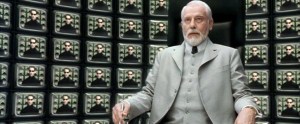
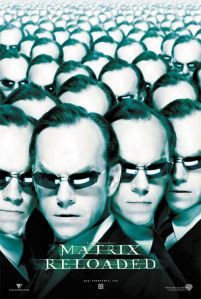
All of this criticism is moot, of course, because the center of The Matrix is on inventive and pulse-pounding action, right? Well I’’d say that is so with the 1999 film but its sequel suffers when its action sequences drone on and become repetitious and dull. Neo fighting twenty or so replicates of Agent Smith (Hugo Weaving) is interesting and fun, but when ninety more show up and it’s painfully and slightly embarrassing when the people fighting are CGI, then the fun level drops with the film. Neo ends the big brawl by flying away. My friend next to me whispered in my ear once this scene concluded, “If he could fly, why didn’’t he fly away at the beginning?” My response: “That would be using your brain.” Seriously, this action sequence is nifty and all but it serves no purpose, just like much of the first half of the film.

The freeway chase scene seems to already be famous and with due cause. Trinity and Morpheus zooming through traffic, fighting Agents and the twins, is a fantastic set piece that is reminiscent of the inventive action the first Matrix gave us. When Trinity zooms through oncoming traffic on her motorcycle the film comes alive and my attention was certainly front and center. The scene does fizzle a bit as it segues into Morpheus fighting an Agent atop a speeding semi. Again, the CGI rotoscoping of the landscape and the people is painfully obvious and detracts from the enjoyment.

What ultimately kills The Matrix sequel is that no one had the heart to question if maybe more wasn’’t better. Sure the Wachowski brothers had all the riches unto Caesar to make this movie, but what perplexes me is that once we do get much more it only feels like more of the same, and disappointment sets in. Agent Smith is shoved to the side of the film and pops up here and there to glare. He’s more or less just repackaged with nothing new and no personality, like much of the film. The purposely perplexing psycho-babble does not help. I’m sure hundreds of websites will dissect the exact philosophical links the movie presents, but man, all this talking about stuff that’s shutting down my brain is getting in the way of ass-kicking. I felt bloodlust the more I heard people, usually some old fruitcake, endlessly blab about causality and choice. When it comes to action-packed sequels from 2003, I’ll take X2 any day over Reloaded.

This is not to say that Reloaded is a bad film because it does have some nice special effects, cinematography, and some cool action sequences. These points of interest do not, however, justify its bloated running time. Some things were better left to the imagination, like the city of Zion, which looks about as dreary and dull as you might expect the last bastion of human civilization to look like in a ruined world, but this is science-fiction. Where’s the fun in dreary and dull? Again, whereas the first Matrix took place mainly in the false virtual reality where we could watch fantastic feats defying the laws of physics, Reloaded spends half its time running around the dank real world.

Some moments did have me giggling, like the Merovingian’’s joyous creation — an orgasm cake. A woman has a piece of cake and her temperature rises. Finally the camera zooms into her vagina (it’s in computer-code so it’s all columns of sexy green numbers) and we see an explosion of light. Very interesting indeed. Essentially, this is a key metaphor for the film itself: an attempt to have its cake and eat it too.

The Matrix: Reloaded is an occasionally entertaining and often mind-numbingly talky summer entry. You’ll get some thrills, maybe the philosophy will connect more for some (even though to me, at the heart, they say very little very eloquently), but because The Matrix is a colossal franchise that will make a gazillion dollars and then some, the power of editing has been kicked to the curb. If that power had been present perhaps someone could have trimmed a few of the many peripheral characters, kicked the pace up a few notches, reworked the fight scenes to advance the plot and stopped events from being so repetitive, and while they were at it maybe they could have done away with all the philosophy and stilted love dialogue. As it stands, The Matrix sequel has lost a lot of edge and this is because of the initial success of the first film. Sure, you might have an intermittently good time, but you should have had a great time. The Wachowski brothers had every tool at their fingertips but they became so enamored with fame and fortune that their work of creativity and genius has morphed into a self-indulgent, adolescent (with its hormone driven sexual events and its stoner philosophy), cash cow.

Nate’s Grade: C+

The Gift (2000)

Sam Raimi is a slick director and is maturing smoothly. The Gift is a nice ensemble pot-boiler in the South. Cate Blanchett gives a remarkable performance that was, as most were that were nominated, better than Julia. Keanu Reeves finds a role he can actually excel with in that of a wife beating redneck; he’s actually quite scary in it. Giovanni Ribisi gives the best performance of his career as a mentally challenged mechanic. The film coasts on some good atmosphere and direction by Raimi, but it is too easy to figure out the final turns in the end.

Nate’s Grade: B

The Watcher (2000)

The Watcher doesn’t do much, if realistically anything important, but it does prove that Keanu Reeves is more cardboard than cut-out. Reeves plays a serial killer with no distinct edge or angle, in fact he’d be more of a stalking man child if he just didn’t kill his victims in the end. Anyway, the plot is a rehash of other serial killer vehicles; James Spader has a limited time to rescue a victim, he’s haunted by the ones he’s failed, Keanu is a killer with too much free time to overly plan elaborate set-ups etc.

Keanu may be the goofiest serial killer in all of western civilization. Every twitch, dumbfounded stare of aloofness, or one-toned droning moronic voice only add to the feelings of Keanu as a lost student and not as someone dangerous. Maybe this was the desired effect but I doubt it.

A more interesting prospect arouses when you consider what the movie could’ve been had the male leads switched characters. As it stands, The Watcher is a lifeless and tired strain of an experience. One, I might add, that allows Keanu to light entire rooms with dainty candles with his added spare time.

Nate’s Grade: C-