Blog Archives
Opus (2025)
 Ever want to watch a second-rate version of The Menu and be left wondering why you didn’t just watch The Menu? That was my main takeaway watching the indie horror/comedy (?) Opus, a darkly satirical look at the music industry and specifically cults of personality. John Malkovich plays Alfred Moretti, an exalted and reclusive musical genius who has earned numerous awards and built a devoted fandom. He’s invited six special guests to a listening party for his new album, the first since his mysterious retirement. It just so happens that party is at his compound and the guests are tended to by a cult of devotees. From there, people start to go missing and weirdness ensues. I was waiting throughout the entirety of Opus for something, anything to really grab me. These are good actors. It’s a premise that has potential. Alas, the movie is uneven and under developed and I found my interest draining the longer it went. The music satire isn’t specific or sharp enough to draw blood or genuine laughs. The weirdness of life on the compound is pretty bland, with the exception of a museum devoted to Moretti’s childhood home that is explored during the climax. The characters are too stock and boring, not really even succeeding as industry send-ups. The music itself is also pretty lackluster, but the movie doesn’t have the courage to argue that the cult has formed around a hack. In the world of Opus, Moretti is an inarguable musical genius. We needed the main character, played by Ayo Edebiri (The Bear), to be an agnostic, someone who doesn’t get the appeal of this musical maven and can destruct his pomposity. Alas, the obvious horror dread of the followers being a murder cult is never given more thought. It’s fine that Opus has familiar horror/cult elements (The Menu, Midsommar, Blink Twice, etc.) but it doesn’t do anything different or interesting with them. It’s obvious and dull without any specific personality to distinguish itself, and if maybe that was the argument against the cult leader, I might see a larger creative design. Instead, it all feels so listless. When the weird cult movie can’t even work up many weird details about its weird cult, then you’re watching a movie that is confused about themes and genre.
Nate’s Grade: C-
Share this:

Music (2021)
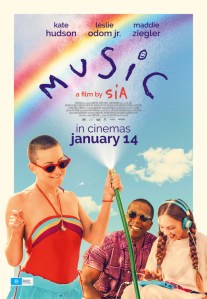 I didn’t even know Music existed until a couple weeks ago. The musical was nominated for two Golden Globes, including Best Comedy or Musical, and a passion project for the pop singer Sia. She wrote, directed, and cast her music video muse, Maddie Ziegler, as the titular figure Music and filmed back in 2017. Then I read about the backlash from the autism community for the film’s portrayal of autism and I became more intrigued. Currently, Music rates even lower on Rotten Tomatoes than Cats, and the reviews have been equally as baffling and unkind. Sia has responded defensively on social media to her film’s critics, and the brewing controversy has given the movie a fascinating rubberneck quality of, “You have to see this.” It is with that morbid curiosity that I sat and watched Sia’s Music, a movie awash in misguided decisions.
Music (Ziegler) is a teenager living in Los Angeles who is severely autistic and in need of care. She needs eggs in the morning, insists on a walk around the neighborhood, loves dogs, and has her headphones on to shield her from being overwhelmed by exterior noise. Music escapes into elaborate fantasies where she dances along to soaring pop songs. Her grandmother dies early and the only living relative is Zu (Kate Hudson), a recovering drug addict who doesn’t want to play mom to her demanding younger sister. Eventually, Zu begins to see her sister differently and bonds with her neighbor, Ebo (Leslie Odom Jr.), who teaches boxing classes to the neighborhood youth. Zu is getting her life straightened out and learning responsibility, though she might ultimately still decide Music is too much for even her.
 Let’s tackle the biggest issue of contention, the film’s portrayal of autism. Ziegler is not autistic or, to my knowledge, neurodivergent. This fact alone doesn’t necessarily mean the movie was doomed to insincere failure. It may well become the norm that neurodivergent actors play neurodivergent characters, much as it seems has happened with trans characters and firmly established for ethnicity. However, I think much of the response to a person outside of a community portraying that community comes from the intent and the depiction. Are they coming from a good place? Are they trying to portray this life in an honest fashion? And is the portrayal harmful, derogatory, or trading in negative stereotypes? With Music, I have no doubt that Sia was coming from a good place. She has spoken about the autobiographical elements of the movie and basing the character of Music on someone that she knew personally. I know there are people like Music on the autism spectrum. It’s a spectrum for a reason. The problem comes with the depiction of a person this severely autistic from an outsider. I’ll explain in a comparison.
In 2001’s I Am Sam, Sean Penn played a mentally challenged man fighting for custody rights. He was nominated for a Best Actor Oscar. In the film, Sam had a group of friends, all of whom were similarly mentally challenged, and some of them were played by actors who were genuinely living with that same condition and others were played by actors only pretending. It was very apparent who was who, and it made the entire movie feel uncomfortable because it felt like the real people were being caricatured in literal proximity. It didn’t feel right, and I can’t imagine twenty years later that filmmakers would make that same choice. On the other hand, with the Netflix series Atypical, the lead character is played by a neurotypical actor but the portrayal of a character on the spectrum is done with great empathy and consideration, with an outreach toward those within the autism community. Intent and depiction are the keys.
The onscreen depiction of autism in Music is pretty galling and potentially harmful for those within the community. It’s all negative stereotypes. Ziegler is constantly contorting her body, making silly putty faces, side-eye glances, hitting herself in the head, and playing to the most abrasive and controversial cliches of those living with autism. She can barely mutter more than a few words, usually in imitation. Because this is the depiction of the character, having a neurotypical actor in this role can feel plenty insulting to many viewers. Music is less a character and presented more as a burden because of her needs and challenges. She gets Zu into trouble and lashes out in public. At no point does Music come across as more than an assembly of tics and ugly stereotypes.
 It’s not just that the depiction in unflattering, as all characters do not need to be unerring shining examples for their individual communities, it’s that the movie doesn’t bother to give her any inner life. There are a few of passing comments about how Music sees the world, like a savant too pure to take in all the majesty at once, but these are merely gestures. The biggest opportunity into the mind of the character would have been through the numerous musical numbers but these are, by far, the most confusing artistic choice by Sia. I was expecting the musical numbers to provide insight with Music, to give voice to a character who has trouble communicating. Someone would ask how she was feeling and we’d zoom into her mind and the singing would be her way of expressing that answer or her complicated emotions about any topic. The use of singing and music would be her voice. Alas, this doesn’t happen at all. Like at all. This is shocking to me and the movie never really recovers from this misstep. The musicals are confusing because they often seem to be from the perspective of Zu instead and communicating her own struggles. Is Music just imagining her own sister’s inner turmoil through dance? There are also musical numbers devoted to exploring Ebo’s inner turmoil. That means two other characters are given primacy over Music in her own personal imaginary musical interludes.
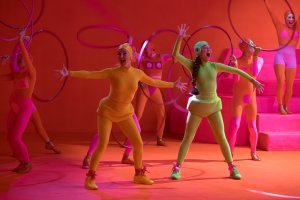
What is the point of the musical numbers then, besides squeezing in ten or so Sia music videos into a dramatic narrative that doesn’t appear to be connected to them? The music videos themselves are very reminiscent of Sia’s recent output, largely single takes and bursting with bright pastel colors and goofy costumes that look like a children’s TV show. The dancing is interpretative, which means a lot of emphasis through the body movement and facial expressions, and you may find it slightly lacking or perhaps too goofy that it takes away from the emotional content or attempted investment. I enjoy musicals and I even like the approach, in theory, that Sia would have been articulating, shedding light on a personal experience that re-sees the world as a more whimsical, wholesome, and friendly environment. This approach succeeded in Lars von Trier’s 2000 film Dancer in the Dark, where Bjork’s love of old musicals shaped the way she chose to escape from the world and highlighted the discrepancies between fantasy and reality. That’s not what Music does or even attempts to do. You could remove the musical numbers completely or just serve them on their own. The only direct story connection comes with a side character, a Chinese teenager who is pushed into being a boxer by his belligerent father. He secretly wants to be a dancer. In his lone appearance in the musical numbers, he gets to indulge in his dream and dance and sing (or lip synch) and it has emotional resonance because it’s an expression of his inner desires and the longing is felt. Why is this one supporting character, who could have easily been removed entirely from the narrative, the only one that fits with the approach to the musical interludes providing actual insight? As far as the quality of music, it sounds very much like Sia’s pop ditties and there are a couple winners. “Together” has a buoyant bounce and swooping, cheerful melodic hook that is hard to resist.
 Hudson (Bride Wars) is the real main character of the movie and her struggle with responsibility is a familiar arc, from screw-up on the margins to matured adult with goals and a found family. She’s an trying to stay clean though she’s really just looking to skip out on life and enjoy a permanent vacation in Costa Rica. This is even her stated goal after inheriting the guardianship over Music. There are plans late to transfer her sister into a group home but this deliberation isn’t really given the attention it’s due, in fact I don’t think I can recall even the mention of it prior to the potential move-in day. The character of Zu is completely stock, a neo-hippie wild child that needs to learn to slow down and accept responsibility. I don’t know what that looks like because for most of the movie she’s just having her sister tag along while Ebo explains things about autism in a delicate fashion (including physical restraints, which have met with plenty of disagreements from the autism community who cite the danger they pose). You would think Zu might have a better handle on this stuff, or that her grandmother would have been more helpful with that instruction book she left behind for the care of Music. This is more a movie about a recovering addict getting her life together and bearing with her burdensome younger sister. Seriously, the character of Music could have been a coat rack for all the impact and agency displayed. Hudson does an admirable job with what she’s given even if grungy and strung out are hard for such a naturally sunny and charming actress more prone to breezy rom-coms. Odom Jr. (One Night in Miami) is wasted as the kindly neighbor harboring a secret and mending a broken heart. At least he gets to sing too.
While watching Music, I kept thinking of an obvious creative choice that would have sidestepped a majority of the mushrooming controversy and spared Sia. Why not just make the character of Music someone with a different condition? Why not make her suffer from post-traumatic stress, or an anxiety disorder, something keeping her form living the life she desires and communicating all that goes on inside her person? Automatically, it eliminates the controversy over the negative depiction of autistic stereotypes from a neurotypical actress and it makes the character more a central figure in her own story that can be developed and examined. Frankly, in 2021, we don’t need portrayals like Music to better understand life with autism. This kind of movie might have been met more charitably in the 1990s but now it’s instantly problematic, and I feel like much could have been avoided by removing the autistic aspect to Music’s character, especially since it does so little to the story other than create havoc and challenge. Beyond that, Music falters because the many musical sequences fail to tie back to the characters in meaningful ways. I’m confused over the shifting perspective as well. From a technical standpoint, the movie looks and sounds like a professional movie with a polished Sia soundtrack. However, it’s the poor thinking behind these decisions that dooms the project. While it’s no Cats-level disaster, at least nobody was living with human-feline creatures at home. Music is not a good movie but it’s the kind of rare artistic flop that might be worth viewing just for its audacious missteps, like 2018’s Welcome to Marwen. I don’t think we’ll be getting a second feature film from Sia any time soon.
Nate’s Grade: C
Share this:

Ma (2019)
 I’ve just sat and watched the entire 99 minutes of Ma, a low-budget horror thriller starring a three-time Oscar nominee, and I’m genuinely confused who exactly this movie is for. Does it qualify as campy? Is it meant to be campy? Is it meant to have a message? The optics are just all over the place and begging for more context, and you have Octavia Spencer holding court with a movie that teeters into Mommie Dearest territory of bizarre choices. If someone asked me to recommend this movie I wouldn’t know whether it was possible. Not because it’s so overtly bad that no human being could find some degree of enjoyment, though make no mistake it’s certainly not good, but because I have no idea who to recommend this to. It almost feels like if you’re that very small niche that absolutely loves Showgirls, Sleepaway Camp, Falling Down, and Everything Everything, then maybe this will be for you. Is that person out there? Does that person exist?
Ma (Spencer) is a lonely veterinarian technician in small-town Ohio who is enlisted by a group of teenagers into purchasing them alcohol. She offers up her basement for the kids to get their drink on, free from the law and other prying adults, and it becomes a hangout space for the entire school. Ma starts dressing younger, stalking the kids online and in person, and getting a little too attached to her new friends and the feeling of being young and part of the in-crowd.
 This is a Crazy Person Movie, which means it falls under the formula of the Crazy Person infiltrating the likes of, presumably, non-crazy individuals, warming to their company, and then eventually going too far and revealing themselves to be dangerous and crazy. As such, there’s a natural plot trajectory where the Crazy Person cannot be too off-putting early on. They need to be a little odd, maybe misunderstood, and very vulnerable, enough so that other characters may take pity upon our Crazy Person and invite him or her into their lives. That doesn’t work when your Crazy Person is acting crazy and dangerous so early and at every turn. The entire premise hinges on a group of teenagers befriending a 40-something woman who opens up her house for their parties and underage drinking. I have to imagine, even in a small town as the setting, that teenagers have to find other places to go drinking. It can’t be that hard. Given the opioid crises, there has to be more than one or two abandoned houses in this neighborhood. Regardless, the first time this older woman invites them over to drink, under the auspices of making sure they’re going to be safe with their shenanigans, she literally points a gun at one of them and pretends like she will murder him. Then it’s revealed it’s not loaded and everyone has a laugh. Now, I don’t know about you, dear reader, but if a stranger pulled out a real gun and threatened a friend of mine, that would be our last interaction with that strange stranger. This tenuous grasp on reality makes the movie feel much dumber as it goes, as we keep waiting for what the final tipping point will become for our teenagers to finally conclude that Ma might not be all right.
The problem with this is that it makes all of the characters into complete morons, and they’re not very well developed beyond stereotypes to begin with. I was struggling to remember the difference between the white guys. The adults aren’t much better. Nobody seems to be acting like actual human beings and they’re all so boring. This means we’re drifting along and either waiting for them to get a clue or get killed, and when it feels like neither is happening any time soon, Ma can become a dreadfully tedious experience that invites further criticism.
Tonally, I don’t really know what director Tate Taylor (The Help) was going for here as he stepped into unfamiliar genre territory. This was also evident in his film adaptation of The Girl on the Train, which got really confusing and sloppy and potentially campy itself, at least with how self-serious it got to be even when it was twisting corkscrews into necks. When Ma wants to be scary, it’s mostly creepy. When Ma wants to be funny (?), it’s mostly creepy. When Ma wants to be dramatic, it gets very serious but never follows through, falling back on camp or creeps. Ma has a tragic back-story involving a sexual humiliation, and it just happens that her all-white high school are the cackling faces pointing and laughing at her pain. The flashback scenes of young Ma feel like they were made in the 1960s and not, presumably, the 1980s. She is victimized by the collective white supremacy of her school and the film never deals with the racial aspect. There’s a truly weird moment where Ma paints the black male friend’s face white, saying there is only room for one of them in the friend group, implying they are token minority positions, I guess. But she literally puts him in white face, and this moment isn’t given any more thought and the movie simply hasn’t earned any of this. None of the moments relating to race are given any more than passing mention. There’s a motherly revelation that, much like the other heavier elements, feels tacked on and never explored in depth, calling into question its very inclusion. There are so many story elements that get thrown out that it feels like Taylor and his screenwriter are just blindly stumbling through their narrative and hoping that something sticks together.
 If there is in fact any reason to watch Ma, besides morbid curiosity, it’s Spencer (The Shape of Water) who works to find the humanity of an increasingly cartoonish character. Finding out Ma’s back-story provides a suitable tragic motivation for her to seek vengeance on the children of her high school tormentors, but there’s also the strange element of her intense attention on Andy, the son of the man she was crushing on in high school. Is she setting him up for some devious end result to get back at his father, or is she trying to get with this kid as a means of tapping into the intimacy with his father that Ma was denied but still obsesses over? She seems to zone out at work often, but is this a general malaise, the idea of a physical or mental sickness that she alludes to, or just her being a poor employee who daydreams about her murder vengeance fantasies? Spencer is bouncing around many different emotional poles and maintains a sense of dignity even when the movie is asking her to behave in cringe-inducing, youth-imitating behavior. I don’t know what movie Spencer thought she was acting in from scene-to-scene, but then I don’t know if Taylor knew what movie he was directing from scene-to-scene either.
Ma is a strange movie for Taylor, Spencer, and every viewer left scratching their head. It’s not really a comedy. It’s not really a horror movie despite some blood and gore. It’s not really a drama because whenever it introduces potent dramatic elements the film abandons them. And it’s not really a good movie. It feels like a game experiment that everyone attached just lost clear sight of, ultimately losing whatever thread or meaning had appealed to them with the project. Just say no to Ma and yes to Mamma.
Nate’s Grade: C-
Share this:

Catch and Release (2007)
 Catch and Release may in fact have the most bizarre meet-cute in movie history. Gray (Jennifer Garner) is mourning the loss of Grady, the man that would have been her husband. She seeks a refuge from all the well-wishers and lies down in a bathtub with the shower curtain drawn. Fritz (Timothy Olyphant), one of the deceased’s best friends, enters the room with a female caterer. They position themselves against a wall and engage in some opportune sex. Gray is trapped and forced to hear the whole thing. The caterer keeps screaming, “Sock it to me” in increasing orgiastic pleasure. I was waiting for some more 1950s hipster dirty talk, like, “Lay it in me, Daddy-O.” Eventually the sex comes to an end and Fritz lights up a post-coital cigarette. But then Gray flings the shower curtain back. Aha! It’s boy meets girl in the most preposterous fashion, but that’s Catch and Release for you, a romantic comedy with enough to be different but still too limited to become anything other than a lukewarm date movie.
Now absent one less earner, Gray is forced to move into a house occupied by Sam (Kevin Smith) and Dennis (Sam Jaeger). They were friends of Gray’s ex as well. Then life proceeds to give Gray a series of curve balls. She discovers that her dead fiancé had over a million dollars in the bank and an 8-year-old son with another woman (Juliet Lewis), a flighty New Age massage therapist. Grady might not have been the same man Gray thought she was set to have and to hold (her married name would have been Gray Grady?).
 Things get off to an interesting start. The proposed wedding party has been transformed into a wake. Then as she is trying to cope with loss and put the pieces of her life together she’s further undone by revelation after revelation of secrets her ex kept from her. That’s pretty dark for a usual airy genre but also a pretty interesting setup for something different. Catch and Release flirts with being unconventional but then is on a fairly predictable trajectory once its promise settles down and completely dissolves.
Thankfully, despite all the doom and gloom there isn’t any grating sense of whininess. The perspective feels knowing and in search of wisdom through life’s unexpected calamities. Writer/director Susannah Grant (Erin Brockovich, Ever After) has a worthy adult sensibility that helps make the film feel a bit more credible and less like an inane melodrama. Catch and Release feels less pre-programmed and unlike most paint-by-numbers romantic comedies, and yet it still wears the weight of its genre around its neck and can never take a step forward without taking two backwards. There’s ample opportunity for a romantic comedy that begins at the literal end of a relationship, with the widow discovering more than she ever knew about her dearly departed (a rom-com version of The Constant Gardener? Call me, Hollywood). However, the movie seems too content to walk the same beaten path many have before it. It may be nothing more than a throwaway genre movie but it got my hopes up that it could have been something more. I feel spurned and betrayed, somewhat like Gray must have felt.
Catch and Release is a hit-and-miss date movie that can never really reel in what it wants to do. The film has some somewhat inspired moments but is also dominated by romantic comedy clichés and sitcom generalizations when it comes to its characters and setting. Of course the nice guy has had a lifelong crush on Gray. Of course the fat guy is also funny and rude. And of course we’re going to house all of these people under one roof so it will produce plenty of Gray-Fritz interactions that will lead to their eventual coupling. Plus, who could forget the classic eleventh hour misunderstanding followed by the pursuit that ends in a glib line like, “What took you so long?” The movie seems to be trying too hard to make Fritz seem like a suitable replacement when we never really know much about him. He’s kind of sleazy and he knows it, but when exactly does he become likeably sleazy? Their union feels forced and unrealistic, even by romantic comedy standards. It also feels like Grant named Garner’s character Gray just so she could include this passage:
Gray: “What’s your favorite color?”
Fritz: “Gray.”
 This prompted an entire row of teenage girls to go “ahhhhh” in my theater. I wanted to laugh, but then I was grossly outnumbered in my theater.
Catch and Release is mostly a grab bag of other romantic comedies. It doesn’t even know what to do with the fly fishing metaphor it valiantly tries to lift into some deeper meaning. I don’t get it myself. Gray says that her dead ex was always a “catch and release” man; does this mean he never had the heart to finish off his prey, or that he was too sympathetic with struggling creatures? It doesn’t matter what the metaphor attempts are because it allows for the cast to put on their rubber boots and wade in the cool waters of predictability. At least only one character works in the usual romantic comedy job pool (publishing, advertising, theater). Though Sam does come up with quotes for boxes.
Garner is such a winning actress but still finding her stride. She’s being positioned to fill the void of Meg Ryan and Julia Roberts, which is fine, but when I see her more as a modern Sigourney Weaver, someone who can excel in light comedy but also kick your ass when the time came. Gray’s world goes into upheaval and Garner is up to the task balancing emotion and wry life observations, but too often there’s little else for her to do but pout or crinkle her eyebrows. Her cheekbones certainly get quite a workout in Catch and Release but I wouldn’t exactly call that dramatic acting. I have been a fan of Olyphant since 1999’s Go. He’s always had a scary sexiness to him, and works best playing assholes you just can’t help but love. Grant totally drops the ball on his character. Fritz is behind the eight ball early and never really recovers when it comes to audience loyalty. Olyphant is also given a problematic shaggy haircut that manages to neutralize his natural alluring danger and still make him seem aloof. His role is a stock role and nothing more.
 Thank God for Kevin Smith. Grant wisely chose Silent Bob as her comic relief and Smith has such natural laid back charm and great timing that he should get more acting gigs full time. His presence is deeply missed when he steps offstage and the film returns back to its familiar roots. I don?t know why Grant has Sam eating or making food, or talking about eating in almost every scene. After the fourth scene in a row where Sam has a chicken leg in his fist, it gets tiresome, like she defined a character by hunger. Smith has the best scenes and the best chemistry, whether it’s with Garner, Lewis, or a little kid. I think someone should cast Kevin Smith as the lead of a romantic comedy. Now that’s an unconventional date movie I’d pay to see.
Catch and Release has some glimmers of promise before succumbing to the weight of the romantic comedy genre. The movie just cannot get past mounting clichés and shallow characters, plus some fairly contrived situations like the bizarre meet-cute. Garner and her dimples will survive to enchant another day. At the end of the day, Catch and Release is just like any other romantic comedy movie, and there’s plenty more of those in the sea.
Nate’s Grade: C+
Share this:

Old School (2003)
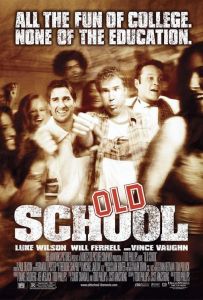 There’s something to be said for stupid comedies. Not necessarily the ones that are centered on large men getting hit in the head or crotch. Or films that climax with pie fights. Or any film where a wild animal plays some kind of pro sport. Or any film where Rob Schneider transforms into something and learns that life is indeed tough from a different perspective. As you can see, the stupid comedy has a very dubious history but when it succeeds at creating those hearty belly laughs, the kind where your face is sore afterwards from laughing so hard, few movies are as entertaining. Billy Madison is every bit as perfect in its humor as the more critically lauded comedies Rushmore and Raising Arizona. So then, is the crass college comedy Old School funny, stupid or both? It’s safe to say its makers did their homework and admirable achieve an unrepentant uproarious stupid comedy.
Mitch (Luke Wilson) is a real estate numbers cruncher who catches an early flight home from a business retreat only to discover his girlfriend (Juliet Lewis) blindfolded and ready to engage in an orgy. Mitch moves into a house on a local campus with the help of his two friends, smooth talker Beanie (Vince Vaughn) and man-child Frank (Will Ferrell). The trio of thirty somethings comes up with the idea to start their own fraternity and relive their youth. Their rebellion from adulthood leads to wild parties, underage girls, KY Jelly wrestling, drunken streaking, birthday party tranquilizers, eulogies featuring White Snake songs and, of course, taking it to the man that just wont let these kids have their fun.
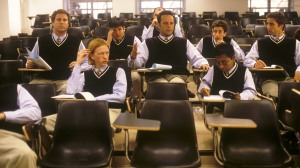 Wilson is relegated to the role of the straight man, which means he pretty much gets to make faces at the antics of Ferrell and Vaughn. Wilson is the nice guy of the film, which in comedy terms means hes the individual tortured by others. And in other terms, means hes normally quite bland. Consider both checked with Wilson in Old School. Wilson is a very capable actor but he’s more or less backdrop.
Ferrell is like instant comedy, just add water and he can make anything funnier. Much has been made of Kathy Bates strutting around in her 54-year-old birthday suit (which may have led to a Best Unsupported Actress nomination) but Ferrell equally jogs around jiggling his goods with glee. Ferrell is hysterical as the films biggest party animal. He takes everything to another level of comedy. Stick around during the end credits just to see him kick some woman’s shopping cart. I’m telling you this simple action is one of the funniest things in the movie.
Vaughn has made a career of playing fast-talking louts that would normally incite people with his caustic remarks if he weren’t so damn charming. What happened to ole Vince and his oodles of sex appeal? Circa 1998 or so he was going to be Hollywoods next leading man, especially after massive exposure from Spielberg’s Lost World. Yes, starring in the very ill conceived remake of Psycho (now with masturbation at no extra charge!) was a bad career move but it shouldn’t have been a killer. I mean, Anne Heche went on to other films after it and this was before she was communicating with aliens with her made up language. Hell, I’m just kind of glad to see Vaughn in films again. His running gag with a bread maker is great.
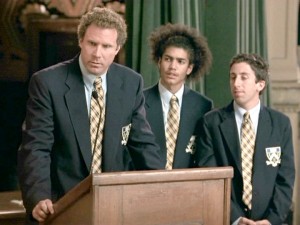 The plot of Old School is really nothing more than a paper-thin device for the jokes to spring forth from. There are only stock characters in these kinds of films. Theres the nice girl (Ellen Pompeo) that will eventually get together with our protagonist in the end. There’s her smug boyfriend played by the smug Craig Kilborn. Jeremy Piven is a stuffy dean trying to shut the boys down to settle old grudges with them.
The women of Old School are really left with nothing to do. Either they are there to have sex with the men or, when older, marry and control them. Lewis is the opposite of the good girl as the oversexed former flame of Wilson. Leah Remini has a very brief role as Vaughns wife who knows when to lead him by a chain. 24‘s Elisha Cuthbert is a naughty schoolgirl that could get Wilson in trouble after one unexpected night. The ladies of this world are really tools for the guys, but what kind of feminist analysis is needed for a film that features Snoop Dog and not one, but two correspondents from The Daily Show?
Old School is from the director and co-writer of Road Trip, a crude yet very entertaining and lively comedy. Old School is kind of a big brother companion to Road Trip, and while not rising to the level of Animal House (as every college comedy wishes to be now) the film is indeed a pristine example of a gloriously stupid comedy aided by a very game cast. See it and be prepared to laugh a few pounds off.
Nate’s Grade: B
Share this:

Way of the Gun (2000)
 Way of the Gun is screenwriter Christopher McQuarrie’s follow-up to the twisty smash who-dunnit The Usual Suspects. This time he takes the reigns of directing himself and establishes that he is a born man behind the camera and in the chair.
Gun unfolds its tale through the center of two antisocial hoodlums “Parker” (Ryan Phillippe) and “Longbaugh” (Benicio Del Toro), two men brought to the point of selling plasma and sperm to pay the bills. One afternoon they overhear a conversation in the doctor’s office about a wealthy couple paying a woman (Juliet Lewis) to act as the surrogate mother for their child. It seems the real mother just doesn’t want to be burdened with a child hanging on her for nine months. The two men use this information to plot what should be their big break and their big score. After a scheduled doctor’s visit they get into a heated shoot out with the bodyguards (Nicky Katt and Taye Diggs) protecting her for their wealthy employer. Parker and Longbaugh kidnap their impregnated prize and hold her to squeeze a fat ransom.
 The story-telling Way of the Gun plays is a mix of older mature films where they would have room to breathe as well as Quentin Tarantino flicks. This is a story of characters and their devious multiple back stabbings, crosses, secret affiliations, and ultimate intentions. ‘Gun’ moves methodically with an armada of gaunt twists and turns keeping the audience alive and awake.
James Caan comes in mid-way to play a conniving intermediary in the exchange. His character is the wisest of the bunch and knows more then he’s always telling. It’s also quite a perplexing site to see Caan’s nipples through his shirt in an interrogation scene. Up to this point I never thought about James Caan having nipples.
The action in the flick is pulse-pounding. The shootouts are probably the best on film in a long while. You see and hear every effect a bullet has. The final climax which involves a drawn out gun battle in an empty Mexican brothel is a scene of sheer excitement and relentless entertainment that it may well be my favorite 10-15 minutes of film all year.
There can be a word to describe Way of the Gun and that word could be “ugly.” This is not a film for everyone. The violence and its after-effects can be gruesome at times, as I heard just as much groans and shrieks in my theater than anything else. There’s scenes of picking shards of glass from one’s own arm, performing stitches on one’s eyebrow, and even an impromptu hand done C-section. This will not be something to take grandma to.
Way of the Gun pacing is also a problem. There are moments of drag as we wait and wait. The languid pacing works for the story and the characters but the double-edge sword creates dry spells of interest. The score uses tympani to full extent, sometimes beyond that which it reasonably should.
McQuarrie has sold me with his re-spinning of tired cliches and familiar elements into gold. Way of the Gun is a flick I’ll see with my friends time and again.
Nate’s Grade: A-


 nathanzoebl
You must be logged in to post a comment.