Blog Archives
Running with Scissors (2006)
 Ever since author James Frey imploded into a million little pieces, the memoir has come under intense scrutiny. At issue is the validity of the written word, whether these people are being honest as they recount their tortured yet inevitably redemptive lives. What is the difference between nonfiction and memoir, and does it implicitly imply personal bias? Running with Scissors is the 2002 best-selling book detailing the bizarre childhood of Augusten Burroughs. It’s a book with lots of out-there claims but they’re all held in check by Burroughs’ tart observation and witty writing. When translated to the silver screen, Running with Scissors loses credibility without the author’s voice. I doubt many people going in cold will even believe what they’re seeing.
In the 1970s, Augusten (Joseph Cross) is a gay teen growing up in the care of his alcoholic father (Alec Baldwin) and his deeply delusional, bipolar, wannabe poet mother (Annette Benning). When their marriage hits one of its many slags they seek out a therapist, Dr. Finch (Bryan Cox). He has a room he dubs his “masturbatorium,” a resemblance to Santa Claus, and a family just as whacked as he is. His oldest daughter, Hope (Gwyneth Paltrow), helps him in his practice and thinks that pets talk to her, even from beyond the grave. Natalie (Evan Rachel Wood) is the rebellious daughter who likes to play doctor via electric shock therapy. Agnes Finch (Jill Clayburgh) is the matriarch of this cracked family that also enjoys eating some dog kibble here and there. When Augusten’s mother signs over adoption papers he becomes the reluctant newest member of this dysfunctional family.
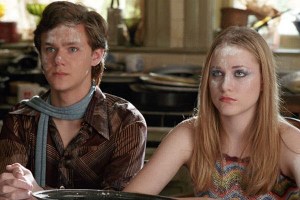 The trouble with translating a book is that you lose the author’s voice and commentary. Running with Scissors maintains the horrifying living conditions for Augusten and the stable of oddballs, but lost is the author’s snappy humor that carried him through this tumultuous time. It’s definitely weird but it’s far from engaging. Without the wit and dark humor from Augusten’s voice we’re left with a series of loosely bandaged scenes about crazy characters and crazy anecdotes, little of which contains further importance. This is a fan of the book talking here, and I’m afraid that the film adaptation has heightened some of the weaknesses of the book, namely the loose storyline. When pieced together as a film, Running with Scissors can become slightly tiresome and overly reliant on background details. The film treats its wild, kitschy production design and 70s nostalgia as a character on par with anyone. It makes for great production design, true to the spirit of the book, but also serves as a narrative distraction. Too much attention seems to be put on getting things to look right than getting the screenplay to feel right.
Without the author’s voice the results lose credibility. It’s funny to see a Christmas tree up year round, and it’s funny when Dr. Finch is convinced God is communicating to him through his bowel movements, but it all just comes off as another joke like the art direction and nothing more. When fully added together without any sense of pathos, it all seems like a joke. The subplot involving Augusten’s sexual relationship with a much older schizophrenic patient (Joseph Fiennes) seems mishandled without much insight. Running with Scissors presents all examples of dangerous, sometimes illegal, behavior and doesn’t bat an eye, nor does it pass judgment. While this may irk some and seem irresponsible it’s just another case of little mattering. Running with Scissors, as an adaptation, presents little of consequence.
Director Ryan Murphy also adapted the screenplay and knows a thing or two about dysfunction and trashiness, having created the risky TV show Nip/Tuck. His adaptation has a blunted feel, but it also seems too broad. Then again, maybe only fans of the book would notice. He has a good feel for his actors and can stage some nice shot selections, but man, someone needs to slap his hand away from the AM radio. Running with Scissors is crammed with so many popular 70s tunes that it becomes a crutch, with Murphy hitting the soundtrack button whenever he needs some kind of character catharsis. It doesn’t work and comes across as indulgent and simplistic. There are so many zippy classic pop songs you may think Elton John is owed a writing credit.
 The acting is one of the elements that help give life to this adaptation. Benning has been generating Oscar buzz for her deeply self-involved portrayal of a mom held hostage by her illness. Benning digs deep and displays a comic range of absurd behavior and wild paranoia. She’s all over the place and you can’t help but loathe her, that is, if you ever take her seriously. But then, once overly medicated, she gives an entirely secondary performance as an emotionless zombie, and we feel a sliver of sympathy, a true surprise. It’s a good, meaty role, however, I actually think Clayburgh gives the more Oscar-worthy performance. In a lot of ways she’s resigned to her fate and yet manages to be the gauzy heart of the picture. She tells me more with her wrinkles than Benning does in her gesticulating outbursts.
The rest of the cast work admirably. Cross is our focal point of the story and does a fine job of, essentially, gawking and looking perplexed. He’s like a blank, gangly canvas, and I wonder what else Cross is capable of than a performance built around indignant reactions. Wood is developing into a lovely adult actress and has some of the best foul-mouthed lines. It’s just nice to see Paltrow in a movie again. Baldwin has transformed from leading man into incredibly versatile supporting actor that excels as comedic lunkheads. Cox remains one of my favorite character actors of all time. There’s nothing this man cannot do. The actors all do a good job of filling out their zany characters while leaving their own imprint.
The issue with Running with Scissors is that when you strip away the author’s caustic voice, then the movie strains credibility, even with the knowledge that it?s based on a personal memoir. The movie gets all the wackiness but misses out on some of the finer points and humor that helped save Augusten from his unorthodox housing. The story feels dulled and stretched too broad, and yet it still manages to be intermittently entertaining despite these flaws. The actors range from good to great and the art direction is fantastic, even if Murphy expects it to do more work than his screenplay. Running with Scissors isn’t as nervy, engaging, or provocative as its source material. Then again little else is. Consider the film Running with Safety Scissors.
Nate’s Grade: B-
Share this:

Luther (2003)
 Certain things can pass under my radar. Previously it’s been items like female flirtation and the due dates of papers. So imagine my befuddled surprise when last weekend my father, himself a Lutheran minister, said the family was going to hop on over to the movie theater and catch a historic bio-flick about Martin Luther, plainly titled Luther. I had no idea this movie existed. And after seeing it, it left no strong memory that it did.
Luther (Joseph Fiennes, Shakespeare in Love) is a 16th century German monk with some quibbles with the Catholic Church. Seems Luther doesn’t like how the Church is preying upon people’s faith for money, most notably its chief indulgence seller Johann Tetzel (Alfred Molina, with a criminally scant appearance). He makes up a list of 95 grievances, nails them to the doors of a church, and thus Protestantism is born. Luther’s ideas catch on wit the lower classes through rampant publication, thanks to the newfound printing press. The princes of the German states also like what this monk is cooking, and they decide to hold him in safety. The Catholic Church, however, is none too pleased. They threaten excommunication and eventually death, and keep pushing for Luther to recant. But Luther feels he must stand strong in his convictions.
The acting is fine, and the direction is passable, but the pacing of Luther is like tracking the movement of a glacier. Some representative decisions are also fairly stupid. To try and communicate Luthers internal struggle he hits his head and yells like at voices. The first time it’s funny. The next five times, it’s dumb. There’s also a dirty peasant child who’s crippled but still a big fan of the Luther Man. Her gaping tooth smile has more screen time than some characters. Later in the film the peasant revolts ravage through the country with thousands massacred. Luther visits the ruins and comes across the little girl’s broken crutch and breaks down and cries. If you were in my theater you probably heard me hitting my forehead repeatedly (no voices though).
The film is an admirable effort, but Luther ultimately fails because of the measures of film. To try and tell the story of Luther would be more appropriate for the confines of a miniseries, not a two-hour movie. The Reformation and its players lose its impact in such a shrift retelling. What the audience gets is a pared Cliff notes version that misses the richness, and gives lip service to the historical importance. What were left with are endless scenes where people dress up and talk and talk and talk. Without a sense of weight for character or story, the countless talky moments blur into tedium. If I had a sleeping bag with me I would have curled up into it.
Another problem is the lack of makeup. The film spans thirty-some years and yet Fiennes doesn’t age a day. My mother proposed that maybe he didn’t want to look old and decrepit in the film. I responded by saying, He let them shave his head but he didn’t want anybody to splash some gray in his hair?
I guess if you judge movies on costumes or production values, Luther would be competent. But does anyone go to a film saying, ”Man, I sure hope those costumes and sets are incredible! Fingers crossed!?” Luther is a well-meaning bore that only historical enthusiasts and Lutherans might enjoy.
Nate’s Grade: C
Share this:

Enemy at the Gates (2001)
 Enemy at the Gates tells its tale over the pivotal Battle of Stalingrad where over a million Russians lost their lives to repel the German advancement. The Russians at this point were throwing boys as young as school kids into the battle and arming some of them with nothing. It was an attempt to create wave upon human wave to overrun the Germans. The Battle of Stalingrad was a decisive moment in WWII, but how Enemy of the Gates portrays it – the battle was nothing. The entire war was turned by two men.
The beginning to the film (and also the best part) shows the immediacy of the war and is very parallel to the Omaha invasion. People are shepherded into box cars onto a train, then arrive on the river and travel by barge to the ports of Stalingrad, then are sent up a hill one with a rifle and one with the rifle’s ammunition, and then thrown into the battle on the other side. Literally, an hour could pass from leaving home and death. Enemy at the Gates doesn’t paint a pretty picture of the Russians themselves (this is a Hollywood film after all) and displays the Russian war tactic of firing on your own men if they have the gall to retreat.
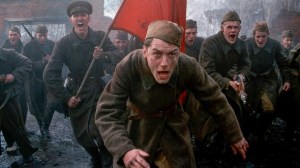 A survivor of the slaughter is Vassily Zaitsev (Jude Law), a rural farm boy with a great shot. He takes out a slew of Germans that have him and fellow Russian Danilov (Joseph Fiennes) trapped in the ruins of a city. Once back to friendly quarters Danilov decides to turn Vassily into a hero and prints numerous propaganda fliers and articles about his many triumphs to increase the morale of the faltering Russian army. Vesilly becomes a hero and a celebrity, though he continues to have his doubts if he can live up to his inflated image.
Rachel Weisz (The Mummy) plays the peppy patriotic girl who comes between our two mates creating an awkward Hollywood favorite: the love triangle. The very fact that she, and other women, are out there on the front lines defending their Motherland should not be taken as something in the advancement of feminist ideals in WWII Russia – at this point in the war them Ruskies would arm dogs and squirrels if they could.
Enemy at the Gates introduces its villain as an expert Nazi sniper played by recently Oscar nominated actor Ed Harris. Harris plays the character cold, yet sincere, like he is following the ways of war but not because he wishes to. He has a duty and he will accomplish it, down to the meticulous wire if he must. Harris’ sniper is sent in to assassinate Vassily Zaitsev and more importantly kill the morale of the Russians. This sets up the film’s showdown between the Law and Harris. Two men who are patient and silent killers dueling to see which one of them blinks first. A cat and mouse game amongst the fallen remains of a once proud city.
At least that’s how it happened in real life. The two men played a waiting game that went on for over two days to see whom would move first. The Nazi slipped and wound up dead. But this standoff where you couldn’t move for fear of being shot at any moment of weakness would’ve been fascinating alone to tell, especially if done straight. Instead we get Hollywood’s Saving Private Ryan.
 A rather peculiar aspect associated with Enemy of the Gates is the amount of people that die from being shot in the head. I mean, I actually looked and counted, there was maybe two people in this film that did not die from bullets that were not exploding through their heads. It gets a little silly as it goes and almost becomes an unintentional joke as we go on with 15… 20… 40 some CGI shots of bullets zipping through people’s foreheads. And the way the snipers are portrayed has it seem like a slasher film – you duck your head around that corner you are instantly dead!
Director Jean-Jacques Annaud’s previous film was the pretty but oh-so-mind-numbing-long Seven Years in Tibet. Here he takes the torch from Spielberg and plays with all the Ryan elements; dabbling with some blues, and muddy browns, and wreckage and what not. Annaud’s film is less a war film and more of a war propaganda film showing the strong effects it can attribute. Annaud also has the distinction of having the most awkward sex scene I’ve ever seen in a film. Weisz comes into where Law is sleeping and sneaks under his blanket. Except Law is sleeping in a row of other soldiers all lying on the cold cement ground with rubble all around them. The scene is very awkward to sit through and I feel will become notorious for it.
The movie isn’t all bad. Some scenes do have good tension and excitement. Law and Harris give credible performances, and Bob Hoskins appears for a very memorable role as Nikita Khrushchev. Enemy at the Gates is a war movie played with Hollywood elements that are as clear as day and weigh down whatever chance the film had. And would it have killed the cast if they could have tried a Russian accent!?
Nate’s Grade: C+


 nathanzoebl
You must be logged in to post a comment.