Blog Archives
Mickey 17 (2025)
 Bong Joon Ho is one of those filmmakers that has earned the right to make any movie he wants. Hollywood might not feel the same, but the filmmaker behind Snowpiercer, The Host, and the triumphant Oscar-winning Parasite, the first time an international movie won Best Picture, is an amazingly versatile storyteller who seamlessly blends different genres and tones into unique and mesmerizing film experiences. If he’s interested in telling a story, then that guarantees I’m interested in watching it. This is especially true if he steps into the realm of science fiction. After the worldwide success of Parasite, Bong Joon Ho was given $100 million dollars and final cut from a big studio to make whatever he wanted, and he chose an adaptation of Edward Ashton’s novel, Mickey 7, telling the story of the world’s most/least fortunate expendable in a fledgling space colony. I read the book last year and it was quite good, so my anticipation was even higher for the feature film Mickey 17, especially after Warner Brothers delayed the movie an entire year. Now, after the long wait, we can all finally enjoy Bong Joon Ho with peak artistic freedom, a position that will likely not be repeated. It’s a grand movie with big ideas, vision, satire, and also enough underutilized ideas and distracting characters and performances to quibble over “what if’s.”
In the distant future, Earth is overrun in population and low on natural resources, so the next space race is to find habitable colony worlds. Mickey (Robert Pattinson) gets in over his head to shady loan sharks and looks for any possible way off of the planet. The only position he can sign up for is that of an expendable, a person who can be cloned from a biological printing machine. These expendables are put in dangerous jobs and different science tests because, well, if they die, you can start over. It’s a terrible job, one that involves dying repeatedly, and Mickey agrees to be the human crash test dummy. He’s on a multiyear colony ship traveling across space to find a habitable world. The planet they land on is bitterly cold, impossible to farm, and crawling with its own crawly wildlife. Mickey 17 is left for dead after falling down a chasm but he survives, trudges back home, only to discover another Mickey in his bed. They’ve assumed Mickey 17 died and already printed out his replacement. There’s a rule about there not being multiples and, if discovered, both expendables would be killed. They have to hide their secret and work together while still vying for dominance over one another and staying out of the crosshairs of buffoonish yet powerful political leaders Kenneth Marshall (Mark Ruffalo) and his wife, Yifa (Toni Collette).
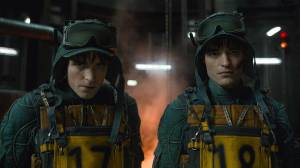 Mickey 17 is a smart, weird, and consistently fun and thoughtful movie. It doesn’t waste any time getting started, literally with Mickey 17 on the cusp of dying with his looming interaction with the aliens. Bong Joon Ho adapted the screenplay and has a nimble way of dealing with the conflicts and setting. I appreciated that he doesn’t prolong different storylines beyond their point of interest. He’s always got another development or joke or set piece to provide. There’s a fun sense of discovery with the movie as well as satisfaction to watch how he slides all the pieces into place. I appreciated how he imbues character notes so easily with supporting characters, giving this universe a larger personality that resonates. I love the setting and the reality it presents of a long-voyage space colony fighting for resources and struggling to keep the lights on. The sets and photography are gorgeous to behold but also filled with details to help make the world feel lived-in. I loved that even in the far-flung future, technology can still work in fits and starts, like watching Mickey slide out of the printer conveyor belt only to lurch backwards before going forward again, like the printers of the 1980s. I love the alien creature design that resembles an armadillo crossed with the subterranean worms from Tremors. I loved how they were able to defend their queen/mamma in Act Three. I love the goofy comic flourishes too, like the fact that there’s a guy just walking around in like a pigeon mascot costume that is never really explained. This is also the same movie where characters constantly ask Mickey what it’s like to die and you realize that every version of Mickey doesn’t know because he’s never experienced it personally, only born from the aftermath. The way this movie is capable of marrying big ideas with silly visual jokes and slapstick and explosions is impressive and a reminder that certain artists will prosper on big stages when given ultimate freedom. Come for the star power and slapstick, stay for the existential dread.
Pattinson presents another wildly weird performance that reminds me how exciting he is as an actor. He’s got these movie star good looks but he really wants to play all the weirdos he can with the most eclectic filmmakers, and I love it. His Mickey 17 and Mickey 18 may be constructed from the same DNA but they come across as vastly different iterations of our hero. This provides a more assertive version of Mickey to try and shape up our more passive Mickey into standing up for himself, taking chances, and taking charge when the situation calls for it. He’s like a mentor. Mickey 18 isn’t featured that often in the story, and truthfully he wasn’t featured that often in the book as well. It’s mostly the story of the hapless and whiny-voiced Mickey 17 and his journey of self. It’s a familiar yet enticing formula to watch a character gain agency and go from pushover to defender of the vulnerable. Pattinson finds little sparks to grab onto with the character, little pieces of weirdness that really help crystalize our understanding of Mickey. Of course the human lab rat would have the fight bred out of him through resignation, and it’s still gratifying to see him stay who he is while also rising to the challenge of the moment. In interviews, Pattinson has said that he modeled his two Mickey performances after the cartoon characters Ren and Stimpy. This actor is perfect for the wacky, tone-blending worlds of Bong Joon Ho. He’s game for everything.
 It’s not hard to see the entire enterprise as a crafty critique of capitalism, not exactly a new point in the Bong Joon Ho movie universe. Mickey’s value to his mission is the literal exploitation of his body. He’s callously tested upon for vaccines and weapons and whatever the scientists may cook up. Because they know they can download another Mickey, it changes how they view the current iteration: he’s not a person, he’s only whatever they want him to be at whatever moment. His value is what he can offer to them as a test subject, as a pile of flesh to be experimented upon. Therefore, the casual cruelty in the name of science and “progress” is yet another example of how we can easily dehumanize our fellow man in a system that profits from their labor and exploitation. Bong Joon Ho also provides a more compassionate view of the downtrodden Other, in particular the indigenous alien species on the colony world (to be fair, as is pointed out by another character, the humans are the actual aliens in this scenario). The creatures are viewed as unworthy of co-existence, in the way of man’s intergalactic manifest destiny, and so they must be wiped out for greater conquest. It’s not a huge surprise that the aliens might not be the stupid and scary creatures that they’ve been projected to be, and this is revealed very early when a collective herd saves the wounded Mickey 17. He views this as an insult, that he’s not even seen as worth eating, but the reading should be obvious to everyone in the audience. Thus we spend the rest of the movie for the other characters to realize the reality of these strange creatures. I did appreciate that the end of the movie coincides with a battle for primacy versus cooperation and compassion, which centers some of the major themes and ties the movie’s character arcs and significant messages together. Plus there’s also explosions.
And yet, there are ideas that could have been explored for even more depth and contemplation. There’s a very intriguing question concerning the different personalities of Mickey 17 and Mickey 18, which begs the follow-up question whether or not they are indeed one hundred percent replicas. Their personalities are such wild swings away from one another, with one being much more the laconic pushover and the other being the aggressive and assertive ideal Mickey. The next Mickey is built upon the recorded memories of the previous memories, so in theory there wouldn’t be many significant differences. However, the big personality differences are not explored or even questioned. This is a missed opportunity that could have gotten to something deeper philosophically and with the revelations of its world-building tech. Perhaps the cloning device doesn’t actually work as advertised and each new Mickey is a close proximity but there are minute yet distinct differences, meaning each new Mickey is his own person deserving of identity. This could then also further connect with the religious objection to cloning that one body should only have one soul. This could lead to Mickey 17, and even 18, debating whether or not they have souls of their own and their conception of life and sacrifice, being more than just the living equivalent of a punching bag. It could also bring into a spiritual element about possibly having a celestial reward after their extra-solar toils, at least the hopeful belief. There were real thematic qualities to explore and provide meaningful texture to the whole movie, and yet they’re disappointingly ignored.
 The Trump buffoonery avatar stuff is a little harder to take in early 2025 with the fallout of a second Trump presidency still having its far-reaching, chaotic, despotic consequences. The character and his wife are invented entirely for the movie by Bong Joon Ho, and clearly he had some things he wanted to say about the former and now-current president (there are even followers wearing those signature red caps). I just don’t know if there’s anything of real substance to this portrayal. He’s a cartoonish idiot villain overcome with vanity, ego, overconfidence, and craven manipulation, but there’s not much that is gained from his multiple appearances. Ruffalo is doing fine work jutting out his jaw and making sure to show those upper teeth as often as possible. It’s just that the character is an exaggerated all-purpose blowhard villain, and it makes for a character you desperately want to see brought lower, to be exposed as a fraud, to get their cosmic comeuppance. The problem is that the appearances are all hammering away at the exact same point that I began to tune Marshall out. In our current political landscape, with the intended target taking up every iota of oxygen in the public sphere, it just becomes another reflection point of the exhaustion felt from the Trump administration. One character verbally lambastes the political bully as a world-class idiot and says, “That’s why you lost the elections.” Plural. It’s then I recalled Mickey 17 was delayed a year, and this would have played differently for me in early 2024 than 2025.
There’s also a very late sequence I would like to analyze why it doesn’t quite work as conceived, but this will enter into some spoilers, so skip to the next question if you’d like to remain pure, dear reader. During the epilogue or coda, Mickey is seemingly remembering something from his past until it’s revealed to be a nightmare and thus having little consequence beyond insight into Mickey’s subconscious anxiety. In this nightmare, Mickey stumbles upon Yifa in the midst of her printing out a new version of her husband through the cloning machine. We’d been previously told that after her husband’s death that Yifa had been locked away and supposedly slit her own wrists. This raises the question whether the Yifa that we see at the machine is her or a clone, and that tantalizing possibility unlocks a new world of story for the movie that seems completely natural and essential. It’s the kind of twist hiding in plain sight that could have worked, that there were two Yifas at the same time there had been two Mickeys or long predating. This is because once you start thinking of this possibility it’s too obvious that it would happen. Of course the rich and famous blowhards who regard themselves as more important than others would see the expendable process as a means of living forever, or at least having a back-up plan. Of course the Marshalls would be hypocrites about their moral righteousness against cloning being an affront to God and creation. Of course these people would use whatever means they could to extend their power and their lives. Just like that, the very end of the movie has an extra layer to it that also provides more purpose for Yifa as a character. Then, just like that, it’s revealed as a nightmare, and all that intriguing possibility is wiped out, and I was left wondering why even produce this moment after the duplicating machine has been destroyed?
 Mickey 17 is an engaging, funny, enraging, and silly example of what science fiction can do. It can explore existential and essential questions about what it means to be human while also employing cartoonish slapstick, as well as cartoonish political satire. Not everything comes together smoothly; it’s a true jumble of tones and ideas, a Bong Joon Ho staple, but he’s typically so skilled at hiding the transitions and seams so you don’t even notice the genre movement until it’s already happened. There are intriguing directions and ideas I wish the movie had explored more, and the climax is a little conveniently tidy but suitably fitting as an invention for a showdown. As a reader of the novel, I can say that it’s an entertaining and fitting adaptation but also one that works on its own while I can still encourage people to read the novel. Mickey 17 is ambitious and messy and also very human, finding grace inside the darkness and absurdity. It’s not perfect but it is worth celebrating, just like each of the put-upon Mickeys.
Nate’s Grade: B+
Share this:

Parasite (2019)
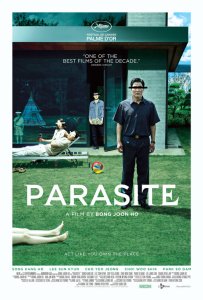 Parasite is the latest from award-winning South Korean filmmaker Bong Joon-ho (Snowpiercer, The Host, Okja) and it won the prestigious Palm D’or at the Cannes Film Festival. The filmmaker has never settled down in any genre and often goes for broke when it comes to embracing whatever genre he is dabbling in and then subverting, accelerating, and broadening that territory to show an audience what a master can do with these storytelling parameters. No movie under Bong Joon-ho’s guidance is ever limited by its genre. Needless to say, I’ve been highly anticipating Parasite, even more so since the critics started bandying about terms like “masterpiece.” Simply put, Parasite is a miraculous movie.
We follow the Kim family who live in a scummy basement apartment on a filthy street known for public urination. They scam free wi-fi off their neighbor and badly fold pizza boxes for little money. They’re barely hanging by on the outer edges of society when opportunity comes knocking. A rich family, the Parks, is in need of a new English tutor for their teenage daughter, and Ki-woo Kim (Choi Woo-sik) has the connection. He will pose as a college-educated English teacher, recommended from his friend, the departing tutor. He gets the job and sees further opportunity, eventually scheming to get each member of his family hired; sister Ki-jung Kim (Park So-dam) as an art therapist for the Park’s troubled son, father Ki-taek Kim (Song Kang-ho) as the personal driver to the family, and mother Shung-sook Kim (Jang Hye-jin) as the housekeeper and personal assistant for the family. The Kim family gains further leverage as they worm their way inside this house, but there are secrets that will force them to readjust how far they are willing to go to service this bourgeois family and keep their good lies rolling.
 Parasite just unfurls with such natural ease, building and developing outward, building its characters, their problems and deceptions, and then, like that, it effortlessly turns gears toward another tone, and you weren’t even aware it was happening until after the fact. Bong Joon-ho’s film is so exact and impeccable and calculated that the pieces are move in tandem like a well-oiled machine. The synchronicity is so amazing that I often had to acknowledge how effectively the movie had surprised or satisfied me. There isn’t a wasted moment in the 130 minutes here, which begins as a fun con game between one family of shady grifters working their way inside a rich family’s trust. From there, the movie gets even darker, more mysterious, outlandish, and even more mournful and delightful. There are moments of slapstick comedy that had me howling, divine sequences of tension that felt ready to explode, and regular emotional punches to the system that reminded you that despite everything these are still people capable of great suffering and great feeling. Parasite is a rare movie that works on near every level, each facet of filmmaking operating at such precision that it blends together to create a masterwork of tone and tenor that is universally accessible, brimming with menace and glee.
There’s a simple pleasure to be had watching a con artist at play, so there’s even more amusement when we’re watching a family of con artists all spinning lies in tandem. The process of escalation is so clean and believable in the world’s universe, with the first family member using their position of influence to manipulative the family into hiring the next family member, even if that means scheming to get rid of the Park family servant already occupying that desired position. The Park family matriarch is all about personal recommendations and using a tight circle of trust; however, the Kim family exploits the obvious loophole of what if the initial link in that chain is untrustworthy him or herself? Initially I thought the movie was going to be watching this one family worm their way into the lives of the rich and powerful and take over, and while that is true to a certain extent, the movie is thankfully even more than that. Still, the con aspect alone is highly entertaining and so naturally plotted, with each new addition feeling organic from the last. There are natural complications that provide new challenges for the family of con artists to maintain their shifting covers and having to think on their feet, and there isn’t a moment relating to these antics where Parasite is not completely compelling and darkly funny even as it veers into extremes.
 If you’re thinking that the Kim family is the obvious target of the movie’s parasitic titular allusion, slow down, my friend. While the Kim family is more obvious about their deceptions, the Park family too is filled with the deception of civility, kindness, and graciousness. At first, we laugh at them because of a general naivete that allows the Kims to flourish. As the Kims successfully roust different servants, they are routinely dismissed without much thought. Some of these people have been with the family for years and otherwise have spotless records, but all it takes is one whiff of impropriety and the Parks are already scrambling to cut them loose, usually very unceremoniously and immediately, with the misplaced idea that this will somehow be the “nice” and “respectful” way of handling a dismissal. They’re so quick to turn on people they feel are disloyal or incompetent, but really, it’s the disloyal aspect, that they can be manipulated so easily by the Kim family’s suggestions and assertions. Never once do Mr. and Mrs. Park ask for their servants’ side of the story; they accept the accusations with minimal evidence are gung-ho about removing their formally trusted help as if they have been waiting for these moments.
The movie becomes a parable of exploitation and the consequences of avarice, and I’m going to do my best to dance around some significant spoilers that reshape the film in its second half. At one point the Kims have all made themselves at home in the luxury of the Park estate while the family is away on a camping trip. It’s carefree wish fulfillment, lapping in the excess, and then over a drunken family dinner, Mrs. Kim says that if she had this kind of money that she would be as nice as Mrs. Park (appears). For her, money is like an iron and irons out all the problems of life, and as a family that has constantly been hustling for their next dollar, to be free of cares and worries would be the ultimate luxury. However, there is naturally more to this estate and the Park family, and the movie takes some dark turns into a battle over status and how far people will go to protect what they feel belongs to them. This is acted out in very personal ways and also in larger metaphorical waves, which adds to the overall class warfare satire. What starts off as a spiky little con comedy becomes something deeper and more challenging, expanding its targets to indict everyone jockeying for position in a system that seems corrupted to a fault.
 Even as the Kim family is scheming and conniving, there are still moments that remind you that they aren’t these smooth, amoral con men of the movies and are real human beings with real feelings and real insecurities. There’s one moment Mr. Kim overhears his boss casually talking about him, and it’s very complimentary except for one admission. Apparently, Mr. Kim has an odor to him that the rich man finds to be rather unpleasant (he describes it like an old radish). No matter the suits he puts on, no matter the politeness and charm he manifests, no matter his skills when it comes to being a dutiful driver, no matter the gaps that Mr. Kim feels he is surpassing, there will always be something innate to him that stops him from being accepted and integrated in this cherished, cordoned-off land of the rich. His very smell is offensive to the noses of the rich, and this is something so personal, so nasty, that it genuinely wounds the man and we feel for him. Bong Joon-ho asks his audience to embrace all sorts of uncomfortable positions, taking characters you found despicable and asking to see them as real human beings capable of great loss and shame. It stops the movie from feeling like it’s treading into cartoon territory even as its violence and physical comedy ramps up in the second half. It never loses a sense of its soul.
Ki-woo Kim asks his father, after several setbacks, what their plan is next, how they will persevere against the latest setback. Mr. Kim answers that his trick is to never have a plan, because plans will inevitably fail. This is a nice character moment but also an insight into a perspective that leads to what I would argue is the emotional climax of the movie, where Ki-woo pledges to save someone through an elaborate and years-in-the-making plan. In that moment, is he rejecting his father’s philosophy and driving forward on what will be at minimum years of hard work to reach his goal, which is motivated through reclamation and salvation rather than personal gain? Or is the very fact that he is committing such an elaborate plan an act of folly he knows will never materialize because that is the nature of plans? I love that the film leaves you, the viewer, to determine whether this assertion is optimistic or pessimistic and how that paints the film’s message.
 From a technical standpoint, the movie is another showcase of how Bong Joon-ho is brilliant at visually communicating his wonderful stories. The editing is so tightly precise to maximize tension and comedy, and sometimes both simultaneously. The photography is gorgeously composed with the use of space in the frame excellently communicating character relationships. The geography of the home is nicely utilized to ratchet up the tension of escaping around corners and hiding around furniture. There are moments that just made me want to applaud the filmmakers for their top-level craft.
Parasite is an effortlessly impressive movie that blends tones, insights, and entertainment to create one of the more unique and pleasing film experiences of the year. Bong Joon-ho once again shown himself to be a masterclass filmmaker who can tackle just about any subject and any genre and make it sing. I’d advise to avoid specific spoilers to maintain the surprise factor; however, this movie is so well executed, so astonishingly developed with precision and attention given to each of the characters and their individual whims and problems, that even knowing every single plot beat in this movie will not diminish the enjoyment factor. That’s because Parasite is a rare movie that is so sumptuously put together, so seamlessly calibrated, that to watch the movie is to simply sit in awe of how talented the filmmakers are at weaving their tale. Parasite is definitely one of the best films of 2019 and worth tracking down where able.
Nate’s Grade: A
Share this:

Snowpiercer (2014)
 I have seen Snowpiercer twice and it’s still a hard movie to describe. It’s the English-language debut of Korean filmmaker Joon-hoo Bong, notable for The Host (the good one) and Mother. It’s based upon a French graphic novel only printed in France and South Korea. It’s an international production, filmed in the Czech Republic, and populated with recognizable actors like Octavia Spencer, Tilda Swinton, John Hurt, Ed Harris, and Captain America himself, Chris Evans. It’s a dark dystopian allegory about class warfare, it’s a stunning sci-fi action movie, it’s a parable about humanity, it’s a stylish thriller that puts most of Hollywood to shame; it’s many things, chief among them, an incredible movie that demands to be seen on the big screen when able.
To combat global warming, world leaders disperse a chemical to lower temperatures, and oh boy does it work, inadvertently causing a new Ice Age that kills almost all life on the planet. Almost, because a few hundred got aboard the train owned and operated by Wilford (Harris), a rich and secretive industrialist. He built a train that can circle the globe, running on a perpetual motion motor. The last of humanity is housed on Wilfrod’s train. After seventeen years aboard, the class system has become rather rigid. The important and wealthy are at the front of the train, and the poor are crammed in the back, given gelatinous protein blocks to eat, and kept in line by armed guards. Curtis (Evans) is plotting a revolt, biding his time, consulting with the wise Gilliam (Hurt), an aging leader missing several limbs. Together, they storm ahead, capturing effete Wilford spokesman Mason (Swinton) as a hostage, rescuing an engineer (Kang-ho Song) with a drug addiction who will help them open the train cars, fighting car by car to take control of the train. Naturally, those in power fight back in force to maintain the uneven status quo.
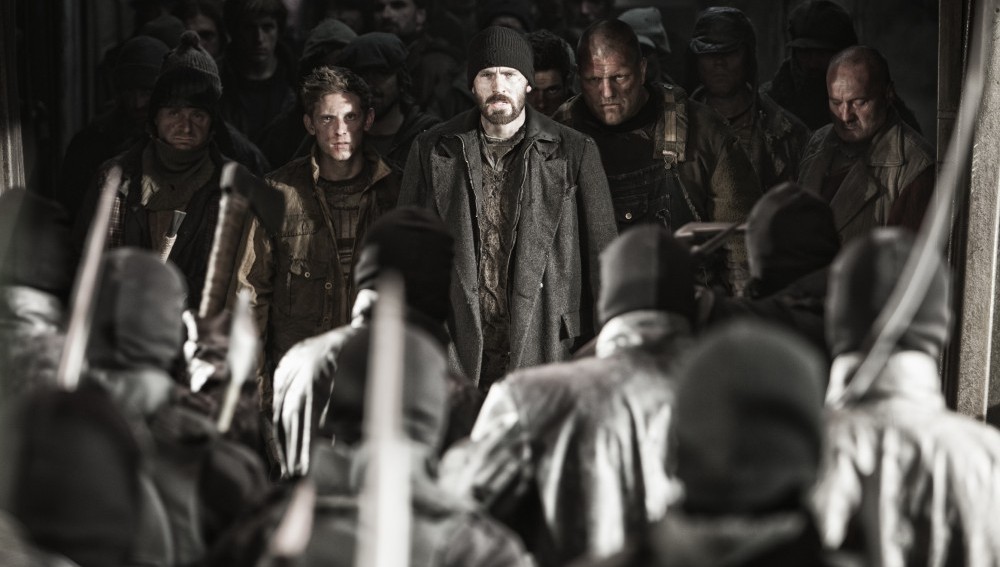 Short of the adrenaline-soaked Raid 2, there hasn’t been a better action movie this year than Snowpiercer. It starts slow, drawing the audience in, setting up its initial burst as a prison break of sorts where the tail section passengers have to figure out a way past the guards and several security doors open for only a few seconds. When the break does happen, in a clever fashion, you feel the full rush of the new opportunity thanks to the movie properly setting up the stakes and obstacles. Each new car presents a new world and a new obstacle. There’s one car where Curtis and his revolutionaries are met with fifty ski-mask wearing grunts with axes. This is the standout action sequence because of how it keeps changing. At first its brawn versus brawn, complete with swinging axes. Then the fighting stops briefly and all the grunts put on night vision goggles. The train enters a long tunnel, condemning Curtis and company to the dark. The grunts then go to town, spearing and slashing the hapless passengers blindly swinging in the dark. I won’t spoil the solution to this scenario but it too is properly set up and leads to some extremely satisfying action imagery, the kind of stuff that pops in a trailer. There’s an entirely different sequence later that also stands out. As the train goes into a long curve in the track, certain train cars are visible from others. Our chief heavy, listed as Franco the Elder (Vlad Ivanov), sees Curtis in the car ahead and starts firing. Eventually Curtis and Franco blast small holes in the protective glass and wait, wait for their moment, for their shot. It’s a tense neo-Western standoff moment, and another delightful addition. The accumulative action has a surprising degree of variety and development.
Snowpiercer is a stirring action movie that keeps your eyes glued to the screen, but it does an equally impressive job of building its world and adding dimension to its storytelling. Reportedly, Harvey Weinstein wanted to cut twenty minutes out of the 126-minute film, but I’m puzzled as to where those edits would come. Every scene in this movie drives the film forward or imparts crucial pieces of information or metaphor that will play out later. Even something as comical as stopping for sushi in the aquarium car (balancing the ecosystem) has greater meaning and subtext when you look back at the film as a whole. Joon-hoo Bong and his co-screenwriter Kelly Masterson (Before the Devil Knows You’re Dead) have given serious consideration to how this world operates and what life would be like when all of humanity is confined to one long train. The past is revealed incrementally, gingerly allowing the audience to become consumed with this odd dystopian landscape, our fascination brewing with each new puzzle piece being added. I was enthralled with the rich details, the cruel methods of keeping those in the tail section in line, the regular head counts, the protein block bars and what they truly are made of, the annual celebration of passing a certain bridge marking their own New Year, and especially the deification of Wilford. The characters worship the engine, and why not since it is the source of life for them, or as the chirpy schoolteacher (Alison Pill) sings: “What happens if the engine fails? We all freeze and die!” The later reveals are the best, giving full explanation why tail section children are important and, particularly, why Curtis is so ashamed at having two good arms. That monologue by Evans, looking back on the earliest and most cruelly chaotic days on the train, is a whopper. I truly hope that aspiring actors will use it during future auditions. It will make an impression.
 Its dark sense of humor and political and philosophical subtext provide an even richer texture to this strange, bleak world. The political commentary isn’t exactly subtle, I’ll admit, but it’s exceedingly better executed and integrated into its plot than, say, last year’s Elysium. The class-consciousness provides a greater depth to the proceedings, providing a new spin on the have/have nots that’s just as relevant today. It’s not just tacked on, either. The political commentary is intertwined with the mechanics of the plot, as we’re witnessing class warfare against inequality, how barbarous acts can be co-opted for personal gain. When Curtis and his small company finally reach Wilford and the engine, it’s a moment akin to visiting the Wizard in Oz, the man behind the curtain they’ve heard so much about. There’s a great degree of incredulous humor from Wilford’s vaulted perspective, but the longer you listen, the more you start to follow his twisted logic and why exactly the status quo must be upheld despite the bloody consequences. Then there’s the macabre humor, which can be bracing at points, none more so than the school car sequence with Alison Pill (TV’s The Newsroom). Also doing plenty of comedic heavy lifting is Swinton (Only Lovers Left Alive, We Need to Talk About Kevin) with such an odd authority figure character. With a mouthful of fake teeth, some owlish glasses, and a peculiar speech pattern, it feels like she stepped out of a Terry Gilliam movie, and we’re all the better for it. Often she’s the only source of humor in what is otherwise a dreary story about the strong preying upon the weak.
Stylish, intelligent, rewarding in surprising ways while still being thoroughly entertaining, with tremendous technical attributes such as production design, Snowpiercer is a sci-fi flick that borrows from many but creates its own unique and enthralling landscape. Rare is the movie going experience where you sit at the edge of your seat, completely taken in by the creativity of the artists at work, transported to somewhere new and exciting, and you dread the approaching end credits. Snowpiercer is an experience that’s hard to describe beyond an unrelenting checklist of positive, glowing adjectives. Simply put, it’s movies like this that make going to the movies special.
Nate’s Grade: A


 nathanzoebl
You must be logged in to post a comment.