Blog Archives
The Ruins (2008)
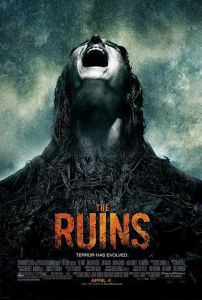 Author Scott Smith is from Ohio, my home state, which makes me like him. What made me respect him was his adaptation of his own novel, A Simple Plan. The movie version was splendid and taut, well acted and riveting and disturbing. Smith even received an Oscar nomination for his screen adaptation. When Smith released The Ruins, his second book, in 2006 I was mildly intrigued but never got around to reading it. Something about tourists, and Mayan temples, and bad things, and it got plenty of good reviews. Then I saw that Hollywood was producing a film version and that Smith had written the screenplay himself. Well, I figured, I’m going to be in for a chilling treat. Let’s just say my opinion of Smith has been slightly diminished.
Four over privileged American tourists are enjoying their final hours of a vacation to Mexico. Jeff (Jonathan Tucker) is studying to be a doctor. His girlfriend Amy (Jenna Malone) is best friends with Stacy (Laura Ramsey), and the two pal around together. Stacy’s boyfriend Eric (X-Men’s Shawn Ashmore) is along for the ride and enjoying every sun-soaked, boozy second. Lounging around the hotel pool, the group comes across a German (Joe Anderson, Across the Universe) who has a map to a hidden Mayan ruin. It’s a bit off the beaten path but the group decides to witness some genuine history. They take a taxi 12 miles into the jungle, hoof the rest, and discover a not very well hidden path to a not very well hidden Mayan temple (seriously, you’re going to have to do better than a couple of palm leaves if you want to obscure the path and keep people out. Try a fence next time). As soon as they arrive so do a band of armed Mayans that really insist the tourists do not leave the site. The Mayans chase the tourists onto the ruins and then they set camp around the perimeter. The Americans are being kept quarantined. Why? Inside and atop the ruins are a deadly plant that has a powerful hunger.
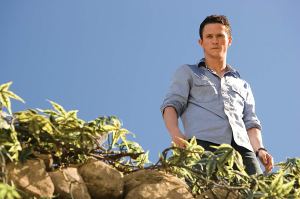 For a horror movie filled with unremarkable and generally unlikable characters, I must say that they at least don’t do anything incredibly stupid as is accustomed to the genre. Once they are chased to the top of the ruins you, the audience, are now put in their shoes. Every choice they make seems decently reasoned and cautious, exploring their surroundings and testing their boundaries. The Ruins features cheesy killer plants, yes, but the more interesting element to me was the survival game. These characters are quarantined in a remote area with little water, armed guards, and a handful of useful tools. What will they do next? This scenario grabbed my interest, as I played out my own personal survival scenario step-by-step and it wasn’t too different from what befalls the characters onscreen. However, I’m surprised no one tried setting the freakin’ plants on fire. The eventual psychological meltdowns and increasingly grim outlook help The Ruins maintain some level of credible drama.
But I think in the end I just couldn’t get over the fact that the main culprit was killer fauna. I can accept carnivorous plants, but seeing them is a whole different matter. Somewhere from pages to screen a step was forgotten to make them believable. The ancient plant system inhabiting the ruins looks like an overgrown swatch of ivy and marijuana leaves, and the vines would slowly inch forward to retrieve fallen pieces of meat. It’s downright comical to see a stringy piece of a vine trying to discreetly drag a dead body away, and frankly that’s where the movie fails. I shouldn’t be giggling at the killer plants. The execution comes across as way too goofy and made me shudder that I could be watching Little Mayan Shop of Horrors. I’m also wary that this highly localized plant has evolved to the point that it can duplicate exact sound. It mimics a specific cell phone ring tone to lure our vacationers deeper inside the ruins. Now, how in the world would it know well enough to do that? I can’t imagine in its potentially thousands of years of existence that it was come across a significant amount of cell phones. How would it know that exact sound would effectively lure others? I did enjoy the notion that the indigenous birds and insects have wised up and learned generations ago not to go anywhere near the ruins. Let this be a lesson to you, backpackers of America, that when insects refuse to go somewhere then perhaps you should take note.
 The Ruins should play out with a slow-burn sense of dread where the characters sadly realize with setback after setback that they are doomed; to be played right the plot needs to be methodical. Instead, Smith’s adaptation is more like a haunted house tale with crummy, obvious jump scares and lackluster spook setups. It seems like most of the film is intended to be a setup but the payoff is badly muffed, like seeing the stupid thin, twisty vines creeping out to sneak inside people’s open wounds. The Ruins has some fittingly disturbing scenes where something is moving and growing under the surfaces of people’s skin, but then you remember it’s just a plant vine and your mind starts racing with questions that illuminate how inane this whole situation comes across (How does a plant stem continue to grow inside a human body? What purpose does having an offshoot inside the prey serve? How does it penetrate open wounds without anyone noticing at all? Why should I be watching this?). I would have preferred if the under-the-skin creatures were some kind of insect or worm that had a symbiotic relationship with the plants. That would be cool and far creepier than stupid ivy vines.
From a gore standpoint, The Ruins has a few squirm-inducing moments. One character is badly injured and needs to have their legs amputated to survive. Oddly enough, this amputation sequence comes across as the most memorable part of a movie dealing with killer vegetation that can mimic cell phone ringtones and, later, lovemaking noises (now who goes out to have sex atop Mayan ruins?). The imprecise nature of the amputation is what makes it so gruesome. In one feel swoop, this character has to have leg bones crushed, then legs sliced off, and then have the stumps cauterized with a frying pan. And the only anesthetic is a bottle of Jack Daniels. Yikes. The amputation is played out with a deliberate pace and allows a satisfying buildup of nervous, queasy anticipation. Aside from that, there isn’t anything notable from the makeup department.
 None of the characters approach anything closely resembling characterization, but the acting is a notch above what you might expect from a horror movie populated with expendable, good-looking twenty-somethings. Tucker makes for a capable lead and projects a cool and controlled persona, never rising to hysterics. When he does realize the inevitable he begins to crack and it’s more effective because of how stoic he was before. The actor who gets tested the most is Ramsey, and this isn’t because she started her career in the derided “reality TV documentary” The Real Cancun. Her character is put through an emotional wringer and she sells the distress and Stacy’s fraying mental state. I never once was tempted to laugh even as she sliced herself open and fished around her insides. Malone and Ashmore are stuck being in the stock roles of whiny girlfriend and horny carefree dude.
The Ruins is a horror movie that’s far from horrible but not scary or perverse or funny enough to be recommended. The setup of isolation in unfamiliar territory could definitely produce some chills and thrills, however, when you throw in a ridiculous carnivorous plant that looks as menacing as your mother’s flower bed, well then, things just fall apart. I’m sure The Ruins worked well on the page, since it demands the reader create their own version of what goes bump in the night. Too bad that when you see it fully realized on the big screen it comes across as stupid. I really expected a lot more from Smith than this. The Ruins doesn’t justify why it should be treated any different than cheap, straight-to-DVD cheesy horror flicks (If there are multiple horror movies about killer snowmen, then there has to be an entire sub-genre of killer plants). I know M. Night Shyamalan’s upcoming summer release The Happening also features plants turning on humans. Let’s hope the creative force that brought us Lady in the Water can do more with the subject.
Nate’s Grade: C
Share this:

Hostage (2005)
 A tense thriller that turns the hostage genre on its ear with a brilliant personal twist. Not only must the sheriff (Bruce Willis) try and talk a group of disturbed kids (led by the freaky Ben Foster) out of holding a mob accountant and his family hostage, but he must also try and recover soemthing inside the barricaded house because HIS family is being held hostage by the mob. It makes for some gripping decisions, as every move has two to three intentions, and Willis looks like he’s being put through the wringer. The movie is a great modern turn on the genre, until, that is, it all goes to crap in a preposterously violent showdown. Still, Hostage is a nice turn for Willis and a smart turn for the thriller genre.
Nate’s Grade: B
Share this:

The Deep End (2001)
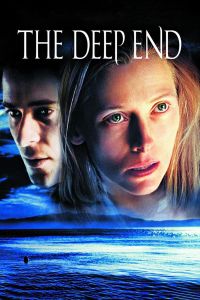 In the vast wasteland the summer has become of mediocrity and sub-mediocrity, go to your local art house. There you may very well see The Deep End, a dramatic thriller that burrows itself into the audience’s mind. The film is an absolute breath of fresh air in the stagnant summer finally winding down.
Tilda Swinton plays a normal mother living on the banks of Lake Tahoe. Her days usually consist of trying to ship her kids to school on time and handle the duties of the home in the long stretches her Naval officer husband is gone. She’s juggling responsibilities and chores when her first strike of maternal protection occurs. Her 17 year-old son is, to her great surprise, in a relationship with a sleazy man in his 30s. She discovered this when her son got into a serious car accident while this paramour was traveling with. The scene of the crash is replayed in flashbacks for Swinton as a motivational jump-start for her protection and love.
She tells the man she doesn’t want him seeing her son any longer, but of course he refuses to desist… unless the price is right. This revelation sends her son to a late night confrontation at home that ends in the accidental death of the sleaze. Mom sees her son rush back into the house in the middle of the night and decides to go out and investigate. On her stroll to her horror she finds the dead body of her son’s lover. From that moment on something in her clicks and she clumsily tries to hide the body and any evidence that could incriminate her own brood.
Just when she believes her headaches are over a dark and handsome stranger (Goran Visnjic) visits her one day. He has within his possession a videotape of her son having explicit sex with the dead lover. He threatens to turn the tape into the police and thus destroy the peace Swinton has created. The video can be hers, but she must pay him and his unseen partner the sum of $50,000.
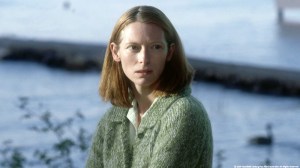 Tilda Swinton is best known as the gender-swapping title figure in Orlando based upon Virginia’s Woolfe’s story. The Scottish actress has a wonderfully pallid face and soulful eyes that express every moment the determination and fear she wrestles with. Swinton gives a remarkable performance of pure emotion. She is a mother determined to protect her son and family at every cost, no matter the means. She is constantly in over her head but refuses to relent. Swinton’s portrayal is a woman running on maternal instinct and she herself is the very gravity that makes The Deep End as great as it is.
Goran Visnjic currently plays a Croatian doc on E.R. but has a provocative presence in this flick. He’s got the smoldering good looks and his character opens up more and more as the tale progresses to strip away pretensions layer by layer.
The Deep End is directed, written, and produced by David Siegel and Scott McGehee, with only one other film to their credit all the way back in 1993. They inject their story with great moments of character and suspense but also have a terrific visual eye to create mood. The cinematography is lush and hypnotic with certain moments of exquisite beauty. Even the music adds to the feeling of the film unlike so many other accompanying scores. Every component of ‘The Deep End’ is just clicking.
The Deep End is a luminously tight thriller with remarkable performances. They story has a few implausible moments but outweighs them with heapings of great dramatic depth. Swinton better be one of the first choice on everyone’s lips when the name of Oscar rolls about, because I doubt I’ll see a performance more elegant and wonderful as hers this year.
Nate’s Grade: A


 nathanzoebl
You must be logged in to post a comment.