Blog Archives
The Campaign (2012)
 Broad and oafish for political satire, The Campaign has some decent belly-laughs to it with the main point that our national political environment has become a parody of itself. It’s Will Ferrell doing his usual boorish boob stuff and then there’s Zach Galifianakis as an effete, weird, family values doofus. When it gets looney, The Campaign is at its best. I loved a town hall that descended into a mob chanting their willful opposition to Rainbow Land. I enjoyed that Ferrell’s punching of innocent creatures was turned into a running gag. Having a racist old man pay his Asian maid to talk like an old black mammy because he misses the good old times? That is downright inspired and I giggle just thinking about it. The campaign commercials were perfect, and who knew Dylan McDermott could be this funny as a political ninja? The problem is that the movie works best as a series of scenes but doesn’t add up to much more. Some of those scenes are hilarious, and others are just passable lowbrow entertainment. Then the movie tries to foster a happy ending, with the evil business tycoons (an obvious avatar of the Koch brothers) foiled. I do not believe that satire can have a happy ending. It undercuts the angry, sardonic message of the movie. It’s just not the right fit for the genre. Alas, The Campaign tries to insert some pathos into the mix and it feels false and far too tidy. As for summer comedies, the movie has a few killer jokes and an amiable presence, plus a very short running time so as not to wear out its welcome. Like most politicians argue… you could do worse.
Nate’s Grade: B-
Share this:

Rise of the Planet of the Apes (2011)
 I owe the makers behind Rise of the Planet of the Apes a huge apology. I have been vocally dismissive of a new Apes film from the first moments I heard about the project. I just thought rehashing this material was a stupid move. Then I heard James Franco (127 Hours) was going to be the lead, and I sighed. Then I saw the trailers and verbally impugned them in my theaters. Upon the conclusion of the trailer I yelled, “You can still shoot them!” and my criticism drew applause from those around me. The concept that we suddenly made apes smarter and they could now enter the Bronze Age, brandishing spears, didn’t overwhelm me. Just because the apes suddenly had tools didn’t seem like enough to topple mankind from the top of the evolutionary ladder. So in the months and weeks ahead I sneer, jeered, and overall dismissed Rise of the Planet of the Apes. And then the reviews came out and they weren’t just good, they were ecstatic. I went begrudgingly into the theater, waiting to hurl my own feces at the screen (figuratively, of course). Then I was completely taken aback by how much I unabashedly loved it.
Will Rodman (Franco) is a young scientists working hard at create a miracle cure for Alzheimer’s. His corporate company has been testing their drugs on chimps to mixed results. One day a promising ape, made smarter by a dose of ALZ 112, goes bananas and is put down by security. The lady ape left behind a baby ape that has taken on traits from the ALZ 112. Will takes the little chimp home to care for the “company property.” But then he ends up adopting the chimp, which his ailing father (John Lithgow) names Caesar. Due to the super drug, Caesar shows remarkable intelligence and looks to be getting even stronger. It looks like Will might have found his cure, and his boss (David Oyelowo) will make billions. But then complications ensue, as they always do, and Caesar is taken to an animal preserve facility run by a crooked father/son team (Brian Cox and Harry Potter’s Tom Felton). Caesar is mistreated and distraught to adjust to a life in pens. He makes plans to escape but then decides to rally his fellow imprisoned apes to a greater cause with the help of some of the ALZ 112.
Even through Franco is the headliner he’s really nothing more than a supporting character, a catalyst. The real star of the movie is undoubtedly Caesar the chimp. After about he 45-minute mark, Franco is reduced to making frowny faces while he scowls, trying to ascertain where his favorite monkey is. His dialogue is mostly reduced to different iterations of yelling Caesar’s name in different locations (the guy even manages to smirk in his sleep in one scene). But the major surprise is that Caesar is not only a compelling leading character but also a well-developed one at that. This is a living, breathing character brought to life thanks to top-notch computer wizardry and the talents of Andy Serkis, the leading authority for soulful motion-capture performances. Caesar may be the greatest single special effect of all time, not because of its life-like quality (it’s close, but again the creature’s features seem too waxy). But the reason Caesar is so impressive is because of the depth of emotion that can be read onscreen. This is a textured performance where you can read varying emotions through the looks of eyes, the twitching of facial muscles, the biting of lips. The emotions are genuinely recognizable; he flashes guilt, anger, frustration, heartache, disbelief, betrayal, fear, shame, just about everything in the book. From a DNA standpoint, chimps and humans share 96 percent of the same genes, so it’s understandable that we can relate to the plight of our distant relatives. Serkis is responsible for providing the groundwork for CGI creations like Gollum and King Kong, so he’s the world’s go-to guy when it comes to providing a framework for animators (Robert Zemeckis, why have you never called this guy?). It’s an amazing special effect accomplishment and works side-by-side with the storytelling to make Caesar a complicated, interesting, and deeply empathetic hero. He’s a terrific center for the movie and a figure that you root for, even with the tacit understanding that cheering on the apes’ escape is also tantamount to cheering the decline of the human race. But by God, during the apes-run-amok climactic sequences you are cheering for mankind’s downfall hardcore.
The Planet of the Apes saga (six films) is, let’s be honest here, rather abysmal. Everybody loves the first movie but the quality sharply drops from there, with four sequels in four years each managing to answer the depressing question, “Can this thing really get any worse?” The 2001 Tim Burton “re-imagining” was just embarrassing and filled with loopy logic (how can the apes take over Earth’s past when Marky Mark crashes on a DIFFERENT planet in the FUTURE?). Given that, the filmmakers behind Rise of the Planet of the Apes did not have to achieve much to separate themselves from the monkey-stank of the sci-fi franchise. The film serves as a prequel to the series but it’s easily the best film since the original. Easily. For one, the storytelling is not overwhelmed by the allegory of sci-fi packaging. The world is decidedly our own and the problems the characters grapple with are fairly relatable. Will may be responsible for the annihilation of the human race but his motivation is pure – he wants to save his ailing father. That’s a believable motivating force that would push the character to action over caution, testing his special serum without fully examining all the side effects. You know what they say about the road to Hell (my friend Eric Muller always suspected Franco would be linked to the end of civilization)? But in a Planet of the Apes movie there is a wealth of thoughtful human drama. Animal rights are one of the more obvious messages the movie deals with, but the film takes a character-driven approach following the animal himself. You care about these characters and when one CGI ape was cradling a dying CGI ape, I swear I was getting choked up over those computer pixels. That’s how emotionally involving this new Apes film can be. It’s refreshing to have a Hollywood action film that has more on its mind than blowing stuff up all good like.
 But when the action shapes up, mostly during a stirring man vs. apes climax, the film easily delivers. The nimble screenplay by Rick Jaffa and Amanda Silver (their first film since 1997’s Relic!) is a terrific example of economical big-budget pacing. Every scene moves the story forward and doesn’t waste a frame. The final running time is only 105 brisk minutes but it squeezes in so much entertainment and emotion. Director Rupert Wyatt keeps the thrills coming on a human-scale, never letting the enormity of the events getting too out of hand. Sure suddenly there are like 500 apes all of a sudden and all of them are super smart, but I can roll with that. The stakes are always clear and the action is easy to follow and easier to get swept up in. There are a few shout-outs to the original film’s iconic lines, which will either come across as fun or ham-handed. And thankfully a plausible scenario is put forth to explain why the humans would be overtaken by the apes. That’s not to say that everything is smartly woven into the narrative. Several of the side characters are but crude renderings. Frieda Pinto’s (Slumdog Millionaire) underdeveloped love interest could be completely taken out with minimal effect on the plot. Likewise the Evil Business Head seems to have nothing but speeches that remind you his sole interest is making lots of moolah.
Rise of the Planet of the Apes is a Hollywood movie with a soul. Finally late in the summer a major studio movie emerges that has the right balance of brains, brawn, and thrills. It’s an exciting action movie, a poignant drama from an animal’s point of view, a tour de force of special effects that manage to make the film more emotionally involving, and a sci-fi prequel that’s actually worthy of its name. Serkis’ gifts for physical performance are invaluable to the emotional core of the movie. By going back to its DNA, Rise of the Planet of the Apes has given new life to a franchise whose best days were 40 years ago. I don’t see where the series can go from here. A prequel to the prequel seems superfluous. A sequel would only really showcase the waning days of humanity and also seem superfluous. Then again, until the moment I was watching Rise of the Planet of the Apes I would have said this very movie was superfluous too. Instead this is the finest summer spectacle of the year and destined to make my top ten list for the year. If you can’t beat them, join them, damn dirty apes and all.
Nate’s Grade: A
Share this:

Kinsey (2004)
 Bill Condon’s probing, fascinating biopic of Indiana University sex pioneer Kinsey (Liam Neeson) could not come out at a more important time. Kinsey lived in the Dark Ages of sexuality and fought against what he saw as “morality disguised as fact.” Kinsey broke barriers studying the science of sexuality and gathered nationwide statements to amass the first thorough book on what’s under the sun and what’s going on under the sheets. Today, we live in a splintered world where people listen to information that affirms their beliefs, and tune out contradictory evidence even if it’s fact (look at the latest report on abstinence-only programs dishing out highly erroneous information). Kinsey railed against this dangerous line of thinking. The man was no saint and had issue comprehending some of the more complicated human emotions. Kinsey is exceptionally well acted and Neeson gives a career best performance. Kinsey is fearlessly graphic in its frank discussion but also enormously intelligent. The fact that conservative groups are actually protesting it shows that Kinsey’s work is far from over.
Nate’s Grade: A-
Share this:

Shrek (2001)
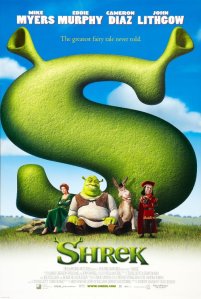 Shrek is Dreamworks’ kick in the pants to fairy tales and some of the staple creations of the Mouse house. There’s nothing a bug eating green ogre named Shrek likes more than his peaceful privacy. But this is brought to an immediate halt when all sorts of fairy tale creatures invade his swampy domain. To regain his privacy Shrek takes it up with Lord Farquad (say the name fast) who agrees to relocate the fairy tale creatures he outlawed to Shrek’s swamp in the first place if he travels to a castle and rescue a princess. Shrek agrees and along the way gets a buddy for the trip with a talking donkey, named appropriately enough, Donkey.
Shrek is amazing world of computer artistry. The characters move so life like and the detail is so magnified that it is a living and breathing world all its own. Mike Myers and Eddie Murphy are the comic duo of Shrek and Donkey and provide a good portion of laughs on their journey. With Mulan and now Shrek, Murphy seems like a natural when it comes to animation voicing. He gives it his all. Cameron Diaz is also a nice contributor as the voice of Princess Fiona, which kinda’ looks like her too creepily enough. Rounding out the cast is the always over-the-top John Lithgow as the stilted Farquad.
The humor of Shrek is enough to please kids with the fart and burp jokes, but lends its aim for more adult humor as well. There are a few jabs at the Disney Empire that are more than hilarious and the story keeps them coming. Shrek turns out to be a delightful tale of an ogre who’s a green softy at heart.
Nate’s Grade: A


 nathanzoebl
You must be logged in to post a comment.