Blog Archives
Eternal Sunshine of the Spotless Mind (2004)
 No other movie this year captured the possibility of film like Michel Gondry and Charlie Kaufman’s enigmatic collaboration. Eternal Sunshine was a mind-bending philosophical excursion that also ended up being one of the most nakedly realistic romances of all time. Joel (Jim Carrey restrained) embarks on having his memories erased involving the painful breakup of Clemintine (Kate Winslet, wonderful), an impulsive woman whose vibrant hair changes as much as her moods. As Joel revisits his memories, they fade and die. He starts to fall in love with her all over again and tries to have the process stop. This labyrinth of a movie gets so many details right, from the weird physics of dreams to the small, tender moments of love and relationships. I see something new and marvelous every time I watch Eternal Sunshine, and the fact that it’s caught on with audiences (it was nominated for Favorite Movie by the People’s friggin’ Choice Awards) reaffirms its insights into memory and love. I never would have thought we’d get the perfect romance for the new millennium from Kaufman. This is a beautiful, dizzingly complex, elegant romance caked in visual grandeur, and it will be just as special in 5 years as it will be in 50, that is if monkeys don’t evolve and take over by then (it will happen).
Nate’s Grade: A
Share this:

The Grinch (2000)
 Ron Howard brings to the screen a lively but languid and ultimately empty revision of Dr. Seuss’ magical tale of a green haired grouch with an ill temper for yule tidings. There’s plenty of noise and effects but none of the magic can be sustained.
The most difficult problem with making a feature film out of Seuss’ How The Grinch Stole Christmas is that it’s 20 minutes of source material. This then requires a lot of padding, and boy does Howard pad like none other. With the aid of the screenwriters of Who Framed Roger Rabbit? (who I’ve now lost all respect for) they go into a psychoanalysis of why the Grinch acts how he does. As it seems with every serial killer movie the Grinch was tormented as a child for being a little green, hairy brussel sprout. What child wouldn’t make fun of a kid that was green? This distaste for the holidays turns the Grinch into a hermit who enjoys his days making prank phone calls down to the city of Who-ville and wallowing in despair. Cindy Lou-Who sees a nice but misunderstood person underneath all that fur and thus embarks on a quest to show the citizens of Who-ville that the Grinch isn’t so bad. Mixed results ensue.
Howard’s direction is very child-like but empty after an initial glow. One wonders what Tim Burton could have concocted with the same material. The art direction looks like a candy-coated Oz instead of the whimsical imagination of Dr. Seuss. The central message of The Grinch is that Christmas doesn’t come from a box or a store but the message is entirely hypocritical when you have a bazillion product deals for the film. The whole “lost view of Christmas” is a very lame moral anyway.
Jim Carrey, on the other hand, puts this movie on his green back and nearly saves it himself. But the immense weight overtakes him in the end. Carrey gives a flat-out slapstick comedic performance like none other. If you had any doubt in Carrey’s ability to contort himself for laughter all doubts will be quelled. While Carrey is marvelous as the central villain/hero (?) the majority of time is spent with the dog-nosed Whos. These people are lifeless and uninteresting. It’s a breath of relief every time we return back to Carrey. The Who’s are populated with a Martha Stewart like former crush of the Grinch’s (Christine Baranski), the mother who strives to be like Martha May-Who and has no other characterization (Molly Shannon), and the dowdy mayor of Who-ville (Jeffrey Tambor). No one can survive unclean.
Without Carrey this family film would be without merit. The writing throws a few bones toward the adult audience but relies too much on Carrey being goofy – which he is good at. Anthony Hopkins as a grandfatherly narrator works only in making you miss Boris Karloff even more. In short, watch the Chuck Jones special instead. This Christmas gift is a lump of coal disguised as candy.
Nate’s Grade: C
Share this:

Man on the Moon (1999)
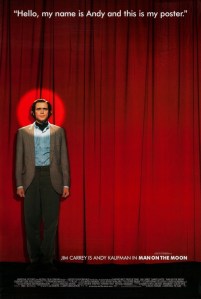 After many years the big screen biopic of one of comedy’s greatest figures of recent finally emerges to the awaiting public. Many never knew what to make of Kaufman or what he was attempting to do, and the movie displays this attitude to its core.
First things first, there is no Jim Carrey in this picture, only Andy. Carrey’s performance is pitch-perfect and swarming and enthralling that he becomes the glue of an otherwise sticky movie. Carrey IS Andy Kaufman, it’s like seeing dear Andy alive and well back on screen still terrorizing the easily duped. It almost brought a tear to my eye. Carrey takes the sheep skin and pulls off an incredible career best performance that demands attention come award time.
But without Carrey’s masterful performance Man on the Moon is not worth venturing out of the home for. The movie never delves beneath the surface to discover who the true Andy Kaufman was or why he did the things he did. And if the point is that there was no true Kaufman but merely a stage character then fine, but did we need a movie? Without any inner depth the flick becomes a shapeless reassembling of TV stints and clips Andy pulled. If I wanted to see this I’d watch Comedy Central at odd hours of the night.
Courtney Love pops her head in late into the running time to establish herself as the love interest, but her character like everyone else, is never fleshed out. Love just becomes a hollow foil to Kaufman’s antics in some vain attempt to add heart to the madness. The most lingering problem is that of the relationship between Kaufman friend and co-conspirator Bob Zmuda never being shown beyond communal frat brothers. Man on the Moon gives the reigns of the picture to Carrey, and rightfully so, but then seems to believe Carrey as Kaufman is the only substantial character in the story.
Man on the Moon is for the most part an entertaining retelling of the rise and fall of Kaufman, and his indifference all the way. Director Milos Foreman and his two Larry Flint scribes try their hand at uncovering the man behind the curtain, but stumble along the way. Maybe this is the film Kaufman would have wished, one that doesn’t answer any questions or is forced to entertain its patrons. But me thinks that the Hollywood version of Andy stays true to his stubborn nature, but trips its feet towing the mystery that was one of comedy’s most peculiar influences.
Nate’s Grade: C+


 nathanzoebl
You must be logged in to post a comment.