Blog Archives
Cats (2019)
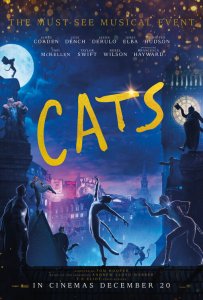 Cats, beyond all reason, is a musical sensation. Andrew Lloyd Webber based the show on the poems of T.S. Eliot. The original production played on Broadway for eighteen years from 1982 to 2000 and I don’t know a single person that likes it. It was only a matter of time before these jellicle cats were headed for the big screen in a big-budget folly. The first look the public got of a Cats movie musical trailer was met with revulsion and horror. I was anticipating the worst and yet I still wasn’t fully prepared for the jellicle disaster strutting around with undue confidence.
Director Tom Hooper (Les Miserables, The Danish Girl) made the colossal misfire to film his action in motion capture bodysuits and provide CGI hair and cat features to them later. This choice dooms whatever meager chance a big screen Cats might have had. There’s a reason the Internet erupted in collective horror when the first trailer was released, and Hooper and his producers tried assuring the public that those were early renditions of the technology and it would be improved upon its holiday release. Dear reader, I am here to tell you that the horror of that first trailer is alive and well in every unnatural moment of this nightmare. The uncanny valley has been a busy transit stop this year with the unsettling live-action (?) Lion King and now Cats serves as a dire warning about the perils of modern technology. Just because you can try and give human beings CGI fur and ears and tails doesn’t mean you should. The look is never fully transporting and often it appears like human features have been slapped onto a furry background composite, like a snowman’s facial features while it might be melting. Then there’s the additional levels of scary anthropomorphism, with mice and marching cockroaches. Why not just use prosthetics and makeup like every stage production? I think the Cats producers wanted to do something to distinguish it and in doing so they unleashed one of apocalyptic seals.
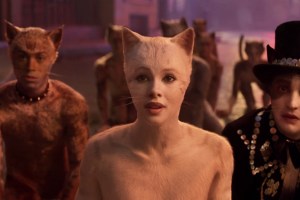 Whatever film version of Cats was destined to be disappointing because the source material is so lackluster. The Broadway musical was so popular for so long, I assume, primarily from its creative use of costumes, makeup, and staging to bring to life a fanciful world of felines. The CGI decision takes away whatever admirable craftsmanship and charm the stage show might have conveyed and replaced with nightmare fuel for the eyes. Absent the initial appeal, we’re left with a truly underwhelming story populated with underwritten characters that only really exist when they’re singing and otherwise just operate in background space. It’s a show that feels powerfully redundant with a plot structure that amounts to cats being tapped to deliver an explanatory song about themselves and then to move onto the next. It’s very much, “I’m a cat. Here’s my cat song,” followed by, “I’m a different cat. Here’s my different cat song.” Without further plot advancement, it feels like the silliest job interview with the worst candidates seeking the position of Cat Who Gets the Honor of Being Reborn in the Sky. By the end of the movie, I was convinced that I was watching an even scarier version of Midsommar and that this cat gang was really a religious cult that was selecting a ritual sacrifice to their blood-thirsty Egyptian Gods.
It’s a storytelling experience that never connects because this is designed entirely for children. Much of the show feels like a children’s television series that was hijacked by a sexual deviant. The film is replete with simplistic moral messages that you would find in children’s television, things like “Believe in yourself,” and, “Invite others into your play,” and, “Wait your turn,” and, “Treat others with respect,” and other easily digestible platitudes. This isn’t a complicated show and children would not be tasked with remembering the many characters and their stupid names because most of them are meaningless to the larger story. There is nothing complex about this story, which was compensated by the production values of the original stage show. The large stages the actors frolic around are fun to watch because they’re built to scale, meaning the tables are gigantic to present the world from a cat’s perspective. However, the proportions vary wildly and at whim. The cats will seem much larger than their world and much smaller; dining cutlery will appear far larger than a cat’s whole body, or they’ll strut on a railway and look like they’re three inches tall. Couple that with inconsistent world building and ill-defined magic powers (teleportation works except when it doesn’t) and it becomes very hard to hold onto anything as a baseline. The attempts at whimsy through the exaggerated scale become another point of confusion and unease as this world continually feels like a simulation that doesn’t quite add up.
 I really want to examine just how ridiculous so many of these character names are. Apparently, a cat chooses their name (sorry, pet owners, but you’ve been giving them slave names?) and they’re selecting some pretty insane identities. Without further ado, we have Bombalurina, Bustopher Jones, Grizabela, Macavity, Jennyanydots, Rum Tum Tugger, Rumpleteazer, Mungojerrie, Mr. Mistoffelees, Munustrap, Griddlebone, Tantomile, Jellylorum, Growltiger, and without a doubt, my favorite, Skimbleshanks. You could play a game guessing whether the names were cat names, pirate names, or something an elderly human said during a stroke.
The songs are also another source of disappointment. There’s the lone exception of “Memory” and Jennifer Hudson kills it with the kind of emotion the rest of the movie was missing, but everything else feels like it’s droning on and absent a strong sense of melody. The synth score also feels very dated and hard on the ears. The only saving grace for a movie that puts this concerted emphasis on the performances would be the song and dance numbers, and the dance choreography is bland and undercut by the editing, and the songs are forgettable. The Skimbleshanks number is a slight variation because of the force of personality from the character, being introduced like a fancy feline member of the Village People, suspenders and literal handlebar mustache and all. He also has an impressive tap number that leads into the exciting world of… sleeping cars on a train. It’s hard for me to impart any emotional impact from the songs because they’re so plainly expository, explaining a different cat’s life from being mischievous to being fat and lazy. These are not interesting characters in the slightest (sorry, Skimbleshanks) and their songs are like boring third grade essays about their home lives.
 Nobody walks away completely clean from this movie but the actors with singing experience come closest. James Corden (Into the Woods) is a real highlight from his comic asides that feel like he’s puncturing the bizarre self-serious nature of this silly movie. Jason Derulo has a slick amount of charm to be a commitment-challenged alley cat. Hudson (All Rise) is a strong singer and made me think of her character from Dreamgirls being a cat and singing her big number. The lead heroine, Francesca Hayward, has a genuine grace to her presence and a nice face to stand out amid a world of scary human-looking cat deformities. I wish she had more moments to showcase her balletic talents. The older actors fare the worst, unfortunately. Judi Dench (Murder on the Orient Express) looks pained and sounds it too. Her fourth-wall breaking song that concludes the film, instructing the audience on how to address and treat their kitties, is inherently awkward. Elba (Hobbes & Shaw) provides a palpable sense of menace to his devil figure, until he appears without clothes and I audible gasped and groaned. In one instant, any sense of menace vanished as I watched a naked black cat version of Idris Elba dance a jolly jig. I know these actors signed up for this but that didn’t stop me from feeling a resigned sense of embarrassment for them.
And now is the time to talk about the unspoken audience for a live-action Cats, and that’s the contingent of furries or soon-to-be discovered furries. I was wondering before if the filmmakers would be cognizant of the unorthodox appeal of their film production to a certain select group of audience members, and I am here to say they are completely aware and play into this. There’s a musical number where Taylor Swift sprays catnip (a.k.a. magic horny dust) that drives the cats crazy and they writhe and purr with wild abandon, striking evocative poses with legs raised. There may not be any visible genitals but that doesn’t stop Rebel Wilson’s character from a joke about neutering. In news reports, Derula has been upset by his phantom phallus in the movie, which is slightly hilarious considering he signed up for this, but it’s also indicative of the weirdly sexual vibes the movie is playing around with but at an infantile level of wonder. There is going to be a generation of moviegoers who watch Cats and discover that they are turned on by sexy human versions of animals slinking around, lifting their legs, and rubbing their fuzzy little butts.
 I was waiting for Cats to end long before it did because so much felt so pointless. The false whimsy was covering ineffective and repetitive storytelling, malnourished and unimportant characters, confusing world building and powers, middling songs (with one sterling exception), and direction that seems to make the whole enterprise feel like a children’s cartoon. It’s too simple to be intellectually stimulating, too weird and confounding to be whimsical, too sporadic and repetitive to be emotionally involving, and vacillating between complete seriousness and wanton silliness. I’m not even a hater of Hooper when it comes to his idiosyncratic direction of big Broadway musicals. I enjoyed his rendition of Les Miserables and thought several of the artistic choices made the movie better, especially the live singing. With Cats, I don’t think there was a possibility of this ever being a good movie as long as it was a faithful adaptation of a not great stage show. However, there were decisions that made this movie much much worse, namely the scary marriage of technology and flesh. If somehow you were a fan of Cats, or somehow consider yourself one as an adult, or a furry, you might find some degree of enchantment. For everyone else, Cats is a cat-astrophe. Sorry.
Nate’s Grade: D
Here are some pun-laden blurbs offered by a colleague, Steven Gammeter, in preparation for writing this review:
1) “You’ll need to change the litter box after this movie.”
2) “Follow Bob Barker’s lead and spay and neuter these Cats.”
3) “It feels like you’re living all nine of your lives while sitting through this movie.”
4) “There’s more than one way to skin a cat.”
Share this:

Sex and the City (2008)
 A lady told me that the Sex and the City movie is like “the Super Bowl for women,” and I couldn’t agree more, especially with the way box office receipts are already shaping up. The smash TV show seemed to become its own brand, launching designer duds and trinkets into the mainstream for single women. I willingly saw the Sex and the City movie on opening night, and I must say it’s an interesting experience to watch the film with a packed house of estrogen. The woman next to me was on a roller coaster ride of gasps and tears, at once passing out tissue to others that she had planned ahead to bring. I was never much of a fan of the show. I found the humor to be pretty lazy and the characters to be somewhat annoying after so many episodes; truth be told, I think I can only watch three before having to walk away. I open this review detailing my biases but with that said, four years after the TV show’s finale, the Sex and the City movie feels like a deflated after party.
Carrie Bradshaw (Sarah Jessica Parker) is planning her life with her beau, Mr. Big (Chris Noth). They find a swanky Fifth Avenue apartment and he buys it for her, then she feels jitters about what might happen if they break up and she’s homeless. Naturally, this causes them to get engaged. Of course something goes wrong before the “I do’s” and Carrie must pick up the pieces of her life.
She has her three friends to reach out to. Career girl Miranda (Cynthia Nixon) is living with her husband Steve (David Eigenberg) and their son. She and Steve have had quite a dry spell when it comes to sex, and one day he strays and cheats on her. She feels violated and she immediately moves out. She won’t listen to Steve’s apologies. Charlotte (Kristin Davis) is happy with her husband and adopted Asian daughter. That’s really about it for her. Samantha (Kim Cattrall) is living out in L.A. managing her boyfriend, the hot actor Smith (Jason Lewis). She feels isolated and misses New York City. She also feels somewhat like a cat without her claws, as her sexy neighbor presents quite the temptation.
 Writer/director Michael Patrick King seems to have condensed an entire season into a movie. It feels like eight episodes packed together but with little central momentum to provide some form of cohesion. There’s no larger scope, not meat to this story, but King feels like he has a checklist of female “events”. So we get weddings, canceled weddings, fashion shoots, pregnancies, and lots and lots of shopping. Sex and the City ends up transforming into hard-core consumerist, female wish fulfillment pornography. The film is heavy with subplots and many of them feel like retreads that the TV show would have already covered and recovered after six seasons. The movie feels overly melodramatic and it isn’t much fun. Carrie spends most of the film moping and heartbroken; she spends a Mexican vacation intended to be her honeymoon in bed. Samantha has to spoon-feed her in order to get her to finally eat something. For some this will come across as moving and heartwarming, but for me it came across as pathetic. King’s idea of comedy doesn’t help. The jokes are pun-heavy and corny, and most sound like they should be followed by someone saying, “Badum dum dum, yeah.” When a film has to resort to a dog humping things over and over you know it has issues.
The movie medium is not the ideal place for these ladies. In half hour doses they come across better, but when blown up to a gargantuan 145-minute length, they become self-absorbed and vapid stereotypes. I didn’t like any of the characters. Perhaps you will. The characters come across as whiny, insecure, and pretty myopic. Miranda holds onto her self-righteous vigor about refusing to forgive her insanely ingratiating husband’s one-time affair yet she holds onto the guilt that her spur-of-the-moment comment doomed Carrie’s wedding. She doesn’t tell her friend about what she said, encouraged by Charlotte to button up out of kindness. In turn, Carrie doesn’t tell Miranda what a mistake it was to make a clean break from Steve after he cheated once. Carrie does this out of kindness to their friendship. They are prolonging each other’s misery. And later Samantha returns with an extra 15 pounds in tow thanks to her constant eating to douse her impulses to cheat. The gals react with such shocked expressions it becomes uncomfortably mean.
 Jennifer Hudson shows up after the hour mark to become Carrie’s new assistant, and she serves as a saintly reminder of how optimistic and buoyant love can be. The character is a total waste and seems tacked on to a story desperately searching for fertile narrative ground. Apparently with oodles of free time Carrie needs someone to check her e-mail for her. I don’t understand why any one of the girls couldn’t have filled this role; it would draw the characters closer together and make the movie shorter. In fact, Charlotte is given shamefully little to do in the film. Her biggest concern is how perfect her life is. Her 4-year-old child (she’s overly meek and barely speaks a word, they might want to have that looked into) is nothing but a prop. She appears in scenes of the girls talking, or shopping, or talking about shopping, but rarely if ever do we see Charlotte dealing with motherhood. Her character’s biggest moment onscreen is crapping her pants. Yes, you read that right.
The rampant consumerism is depressing, especially at such a bloated running time. I’m not going to charge the film with setting back feminism or anything but why do the main characters have to be so shallow, brand-conscious, and live to splurge? The emphasis on buy, buy, buy to make yourself feel good is a rather sad and empty message. I get that the TV show and the movie are supposed to tap into a woman’s fantasy, and the film really panders to Carrie’s princess indulgences and demands. So of course we’re going to get several montages of fashion and shopping and gads of product placement overkill. Seriously, the Sex and the City folk must be pocketing some major dough from all the fawning recommendations they make over brand names (History fact: Louis Vuitton died in 1892). But here’s the thing — the clothes don’t even look good! The difference between designer fashion and complete clownish garbs is practically nonexistent. The outfits these women wear are horrendously garish and bizarrely impractical even for high-end New York career women (high heels on NYC streets?). I’m stunned by the idea that the fashion that these characters wear is deemed glamorous.
 The movie didn’t have to be this clunky. The men are all relegated to the sidelines for giant portions of the film, only to show up and act penitent or selfish. The film’s conclusion, where Carrie and Mr. Big reconcile, looks like it might take its own advice and “write its own rules” but then it ends blandly predictable. Sex and the City could have explored the interesting dynamic of four women well into their 40s and how they navigate the waters of relationships and carnal cravings. Samantha herself turns 50 during the course of the movie and, let’s face it, she has probably gone through or is about to experience menopause. Samantha was always the most promiscuous character, so wouldn’t that be an interesting conflict and feel a bit more realistic? Then again, realism isn’t exactly what Sex and the City is about. If it were there would be no way that Carrie’s terrible, platitude-riddled writing would spawn three best-selling books.
Fans of the Sex and the City TV show will likely enjoy the big screen version of their favorite gal pals. After six seasons, I suppose a 2 hour 25-minute movie won’t feel long enough for the diehards with their cosmos at hand. I am admittedly not a fan of the show, and the movie comes across as long, draggy, aggressively shallow and a tad disingenuous. The actors mug hard, which looks bad when it’s blown up to fit a movie screen. The jokes are pretty stale and the plot spirals into too many subplots. I don’t really want to spend another 145 minutes with these women, especially if this is how they’re aging and maturing. Don’t say I didn’t warn you.
Nate’s Grade: C
Share this:

Dreamgirls (2006)
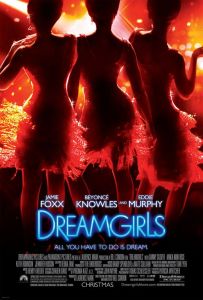 When the smoke cleared after the 2006 Academy Award nominations, there were some media members in disbelief. How could Dreamgirls, an expensive, glitzy musical that many perceived as the front-runner for Best Picture, fail to even get nominated in the Best Picture category? Theories abounded; the mostly white Academy couldn’t acknowledge a movie steeped in black culture, the film fell prey to backlash against a momentous hype machine that rubbed people the wrong way, or even that it was unfairly judged against recent musicals, like 2002’s Best Picture winner Chicago, instead of being judged on its own merits. After having now seen the film, I have an altogether simple explanation: the Academy thought there were better movies and I couldn’t agree more. Here are five reasons why Dreamgirls just didn’t cut it.
1) The film just falls apart after the halfway mark. The focus is on the rise of the all girl group the Dreamettes in the 1960s Detroit music scene. Effie (Oscar-winner Jennifer Hudson) is the strong-willed lead singer with big curves and a big voice. She’s pushed out of the way by her band mates so pretty face Deena (Beyonce Knowles) can front and sell records. Effie is our star and she doesn’t take the news well, and explodes in an emotional fury that results in the film’s true showstopper song, “And I Am Telling You I Am Not Going.” Trouble is, there’s still an hour of movie left. The second hour of Dreamgirls feels like a plot layover, as our characters don’t do much more than stuff their hands in their pockets and grumble. It’s astonishing how deflating the second hour to this movie is, and the film cannot sustain a viable interest or energy, leaving the audience to tap their toes to songs that already ended an hour prior. It’s a troubling sign when a film peaks at the halfway point and seems to only stall and sputter after.
 2) The songs are not that special. Dreamgirls would have been far more entertaining if what we got was some honest, soulful, groove-inducing Motown music. Instead, what we get is the same pop filler that the characters bemoan what commercialism has transformed their music into. None of these ditzy ditties are very memorable and many of them start to just blend together, thanks in part to montage-obsessed editing. The other focus of Dreamgirls is on the rise of Motown, how a very Berry Gordy-like figure, played by Jamie Foxx, patterned black music and made it hit for white listeners. I think this was the most depressing part of the film for me, the fact that I could have done without the music in a musical.
3) The tone lacks clarity and can be grating. For about 80% of the movie when the characters sing it’s on stage as performance. Then two characters sing their displeasure with each other and the audience is like, “What the hell?” I accept the laws that govern musicals, and people spontaneously bursting into song and choreographed hoofing does not bother me, but whatever the choice it needs to be consistent. When the audience is used to seeing the singing contained to the stage, it becomes jarring when it transpires in reality. Director Bill Condon (Kinsey, Gods and Monsters) cleverly worked around this problem in his screenplay for Chicago by placing all the song-and-dance moments as glimpses into one woman?s musical-obsessed psyche. It seems so careless and easily remedied, so what were they thinking?
4) Dreamgirls is desperate for Oscar attention. At the end of the movie, after an awfully messy run to the finish line, come the end credits, however they aren’t so much as end credits as they are “for your consideration” ads. When the director of photography credit appears you see a man in a camera crane. When the costume designer is credited we see her sketches and the real outfits side-by-side. Some of it is silly, like when the casting director is listed and we see, no kidding, a checkerboard of faces, like the movie is saying, “This is what a casting director does, look.” The sequence is moderately annoying and a little patronizing, but it is a splendid example of the filmmaking ethos. It feels like the over zealous studios thought that by throwing together a bunch of musical staples and covering it with fancy decoration that they could fool audiences into thinking they saw a full-blooded story.
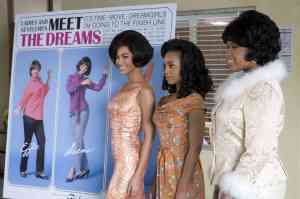 5) You fail to feel for any of the characters. In the rush of production numbers and period detail, the characters all suffer horrendously. The Dreamettes are obviously a take on the Supremes, and Deena is obviously supposed to be Diana Ross; they even recreate iconic Diana Ross pictures with her. By this token, it seems like the filmmakers felt they could slack off on characterization and just banish their actors to the ghettos of genre archetypes. I didn’t feel for anyone, even Effie once she got her walking papers for being essentially fussy, overweight, and sticking with her integrity. She tries to pick up the pieces of her life but even she seems disinterested once the stage lights no longer shine upon her. The characters have about a dewdrop of depth to them and can be summarized each by one sentence. Shallow characters and a less-than-compelling second half doom the movie.
There are enjoyable aspects to Dreamgirls, notably the performances from the supporting players. Eddie Murphy experiences nothing short of a career resurgence playing Jimmy Earl Haley, a groundbreaking soul singer with a fiery stage presence. Murphy puts his all into the performance and is such a live wire that Dreamgirls seems downright downtrodden without him. Former American Idol contestant Hudson has been collecting accolades for her diva-like performance, and while her singing is full of bluster and verve, I cannot say the same for her acting. She gives a solid overall performance but doesn’t try hard to hide her inexperience with acting. I wouldn’t have given Hudson an Oscar, but then I wouldn’t have given Oscars to a lot of the eventual winners (Julia Roberts, your hardware rightly belongs to Ellen Burstyn).
Film critic David Poland was nearly beside himself with Dreamgirls‘ omission from the Best Picture contenders. He argued that had it been nominated it would have won (I’m not sure how that logic works, but I do have a bridge I’d like to sell Poland). Dreamgirls is not bereft of technical charms and entertainment, but to posit this as anything above a mediocre musical is just plain madness. The characters barely leave an impact, the music is the same pop pap it laments, and the movie just simply peaks too soon. There’s nothing daring or innovative with this song and dance revue, and for long periods it feels like a pandering exercise in dress-up and nostalgia. I suppose in the end the Academy just thought there were five better movies than Dreamgirls, and, for once, I agree with them.
Nate’s Grade: C+


 nathanzoebl
You must be logged in to post a comment.