Blog Archives
Couples Retreat (2009)
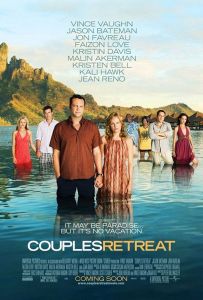 Vince Vaughn is a likable scamp. He’s generally played the same quick-witted, charming, motor-mouth lout in every movie since 2005’s smash, Wedding Crashers. He’s been working fairly nonstop since then and has, by all accounts, become something of a box office draw, which seems bizarre if you think about it long enough. So the best thing I can say about Vaughn’s new comedy Couples Retreat is, hey, at least he’s making sure his pals can pay the bills.
I think it was that famed poet Pat Benatar who said love is a battlefield. She never went through marriage counseling (note: maybe she did, I don’t care to actually research this). The movie centers around four dysfunctional couples that take a vocational to a tropical island resort. Dave (Vaughn) has trouble prioritizing his wife, Ronnie (Malin Akerman). Joey (Jon Favreau) and Lucy (Kristin Davis) have been together ever since she got pregnant in high school. They’re at each other’s throats and secretly looking to cheat on each other. Jason (Jason Bateman) and his way younger wife, Cynthia (Kristen Bell), are unable to conceive a baby. They’re very organized about their life and cannot handle life’s deviations. Finally, Shane (Faizon Love) has been dumped by his wife and is taking the loss hard. He’s found comfort in a flighty twenty-year-old girl (Kali Hawk) that he can barely keep up with. The vacation is interrupted when the couples learn that they must participate in the resort’s relationship therapy sessions or leave. The couples must stick it out to in order to save failing relationships and ride those nifty Jet skis.
 Couples Retreat sure doesn’t feel like any vacation for the audience. Directed by Peter “Ralphie” Billingsley (longtime friend and producing partner for Vaughn and Favreau), the pacing is leaden and the movie feels like its coasting without any momentum. Structurally, the plot is not your series of escalating events but more a relentless parade of tiny plot speed bumps, seemingly indistinguishable from the last. Many scenes just bump right into each other with little transition. Billingsley does not show that he comprehends the rhythms of comedy. Even at a mere 107 minutes, this movie felt twice as long to me. Like Peter Jackson’s King Kong, it just takes way too damn long for these people to get to the freaking island. I don’t need a half hour of setup for stock characters. Many scenes will go on too long and then just sort of come to an abrupt end, like Vaughn and his friends were saying, “Well, we’ve taken this as far as we can go. The scenes don’t end in climaxes or revelations or punch lines, they just end. So after a while I felt like Couples Retreat was one long draggy middle of a mediocre movie stretched out interminably. It’s the equivalent of an eternity of waiting in a doctor’s office.
The character work is haphazard at best. You would think with the premise involving introspection and communication that the screenplay might offer up some deeper characters. You would be mistaken. Each character is given one note/generalized conflict to work, and they stay exactly within that narrow field of play. The male-female dynamics are Joey and Lucy have been together since high school and now they each have wandering eyes. Of course this kind of waffling infidelity is played for such sophomoric yuk-yuks like Joey getting caught masturbating and Joey getting an erection during a massage. You see a trend there? Cynthia and Jason are too anal retentive about their lives and the fun has died out. Sounds like room for some comedy. Oh, and they are also having trouble conceiving, which is way too serious a topic for this kind of movie. It’s somewhat amusing to think of Vaughn as the most stable character in a family comedy; it’s sort of like when Christopher Walken was the voice of reason in 2004’s equally bad, Man on Fire. What is Vaughn’s problem exactly anyway? He’s a “video game seller” who spends too much time… selling video games? The particulars of his job are too nebulous; does he work at a large chain, does he work at a software production company, what does he do that he can’t bother helping out his wife for one afternoon? You could almost certainly eliminate Faizon Love’s character completely. He’s just in the movie to crank out obligatory “older guy with too young girl” jokes, and his resolution is so hackneyed and reliant upon ridiculous coincidence (surprise, his ex-wife has tracked him down to the resort!) that it hurts the brain.
The movie has the benefit of being made in one of the most gorgeous places on earth. I’m sure the cast and crew had a great time making this movie. Too bad it doesn’t translate well to the paying customers. I was surprised at how stodgy the overall film is. I expected it to look down on hedonism, and I appreciated the movie treating marriage as a serious commitment that constantly needs to be engaged, but what is up with how stuffy this message comes across? The people who aren’t in relationships are seen as little party animals looking for their next carefree fix. Sure marriage is going to look better to the masses when you make the alternative so irresponsible. However, prolonging unhappy, extremely dysfunctional couples who can no longer stand each other isn’t helping either. Can’t some dysfunctional couples just grow apart? Why must there be reprehensibly forced happy endings all around? Couples Retreat, after awhile, kind of feels like your grandmother lecturing you about your relationships.
 There’s much potential for laughs with Couples Retreat, but you’ll do no better than scattered chuckles. This is definitely a case where all the good jokes were highlighted in the trailer. Couples Retreat squanders so much talent, mostly consisting of a boy’s club and giving the actresses little to do or play off of. Akerman (The Heartbreak Kid), Bell (Forgetting Sarah Marshall), and Davis (Sex and the City) are all very capable comedic actresses; Kali Hawk quickly becomes irritating with what she’s been given. The island therapists include the hilarious John Michael Higgins (The Ugly Truth) and Ken Jeong (The Hangover), who must be contractually obligated to appear in every movie this year. I would have thought that eccentric therapists plus the natural conflicts of couples counseling would have provided a wealth of funny material. It’s a shame then that the counseling scenes are kept short. It would be a better asset for this movie if it spent more time in therapy and less time doing goofy, trust building exercises by island guru Jean Reno. Seriously, swimming with sharks is supposed to help a deteriorating marriage how? There are comic setups that look like they’re going to lead to something juicy, and then they just fizzle, like a Guitar Hero battle that goes from silly to lame all too quick. A buff and tan yoga instructor (Carlos Ponce) gets a little too in touchy-feely with his female pupils. But then it stays at a distance, hammering home the same PG-13 safe sight gags. It’s like watching people dry hump for laughs. As I expected, the funniest parts are the naturally combative interplay between Vaughn and Favreau. Part of that may be because they’ve been friends for over a decade and part of that might be that both are credited as screenwriters, along with producer Dana Fox (What Happens in Vegas).
Let’s look at how I’ve described Couples Retreat in this review. Waiting in a doctor?s office. Listening to your grandmother condemn your relationship. Doesn’t sound like much of a good time, does it? The comedy consists of mostly one-liners with a whole lot of dead space in between. The characters are so limited, the actors are shamefully wasted, and the comic set pieces are too meandering to be amusing. Somewhere there’s an edgier, R-rated version of this movie that got scrubbed clean to fit a PG-13 mandate. You see glimpses of the naughtier movie Couples Retreat might have been. This is a movie in need of some serious counseling of its own.
Nate’s Grade: C
Share this:

The Da Vinci Code (2006)
 Dan Brown’s The Da Vinci Code has been a best selling novel for three years running. Continents of trees have been felled to produce the 50 million published copies worldwide. Brown’s novel details a centuries long cover-up of some crucial background on Jesus Christ, as well as certain omissions about the role of women in Jesus’ discipleship. The book has been condemned by Christian watchdog groups as heresy, never mind that it is clearly labeled “Fiction.” Debunking fiction is simply redundant. Now Hollywood has adapted The Da Vinci Code into a massive movie, directed by Ron Howard. I must be one of eight who have not read the book, so I entered the theater with little expectation and no idea where the story would take me. Is this a great threat to the Christian church, as some argue, or is it just another dime-store thriller that lucked into becoming a national phenomenon?
Robert Langdon (Tom Hanks) is a Harvard professor of symbolism lecturing in Paris. He’s called in by a police captain (Jean Reno) about a local murder. The curator for the famous Louvre museum has been killed and his death leads to a series of coded clues about a deeper conspiracy involving Leonardo Da Vinci. Sophie (Audrey Tautou) is an investigator, and the granddaughter of the museum curator. She helps Robert escape and the two of them set off on an adventure through France and England, finding clues that lead them closer to the location of the Holy Grail. They get help from Leigh Teabing (Ian McKellen), an old friend of Roberts that has his own theories about what the Catholic Church may be so desperate to keep hush-hush. All the while Silas (Paul Bettany), an albino monk, is on the warpath to dispatch all who know too much, including Robert and Sophie.
There are just so many harebrained, hokey moments in The Da Vinci Code that can rip you right from the movie. Why does Sophie have to pay someone to leave a park bench when she and Robert can just walk out of earshot? Why does a bank teller, with his own devious intentions, drive Sophie and Robert to safety and then threaten them at gunpoint? Surely letting them be captured by the police would have served his needs better. Oh, the bank also has a payable escape clause, like it was a Scooby-Doo mansion. But the hokiest moment comes in the opening minutes. The museum curator, an old man who couldn’t hobble away from his attacker, gets shot in the gut, a quite painful place for a bullet to lodge itself. So he’s fatally shot in the stomach, but the man still has time to scribble coded messages on three separate paintings at different points in the museum, strip down, pose, write a message on the floor and a symbol on his chest. And remember, he’s an old man on top of all this. It’s like he had a checklist he pulled out in case he was ever mortally wounded at the Louvre.
 The characters aren’t any better. There’s little to any depth to these people and most of them are irrational stock roles. The Jean Reno cop character is laughable in how doggedly he’s convinced Robert is his man. Apparently, a priest told the cop Robert confessed. Case closed? Perhaps the cop, in his furtive rush to judgment, should do some outside research. The museum curator?s time of death, something any crime scene tech could denote, would prove that Robert would be ruled out, given that the man was giving a lecture in front of hundreds of alibis. That’s verifiable science, but no matter. Would not a place as heavily trafficked as the Louvre, with so many priceless pieces of art, have security cameras? I think that alone would tell you who murdered the museum curator. These details make the Reno character stupid and unbelievable. The police work hasn’t been this sloppy since the Police Academy saga.
There’s a late scene where a character addresses another and more or less says, “No one will suspect us, my partner. Let us split our winnings together. I will take your identity to my grave. What? Yes I will take a drink from your flask you’re offering me but not drinking from yourself.” The film could not hit you over the head harder with what is to come. I’d expect these kinds of half-hearted character turns from a rote made-for-TV thriller, but The Da Vinci Code has too much intended intellectual prestige to wallow in this manner.
This is not a good film adaptation. This isn’t structured like a thriller, let alone a movie. There?s no sense of momentum and the story is really an ongoing series of mini-climaxes, sputtering out to no payoff. Puzzle-solving and word games can work on the page, with the reader feeling like they’re right along, but onscreen it cannot work in a story of images. Howard highlights certain letters a la A Beautiful Mind, but then it simply becomes less a puzzle and more just witnessing how a character’s mind breaks down the code, nothing more. As a thriller, Brown seems to do just enough to push his narrative further, but he frequently writes himself into a corner and relies on plot contrivances to save his ass. There’s a scene at Leigh Teabing’s mansion involving a gun standoff, and how does Brown get his characters out of it? By conveniently having a bird fly and distract the evil gun-bearing monk. Talk about a cheat. The Da Vinci Code‘s lame behavioral explanations and short cuts are expected in a rote thriller, but Da Vinci doesn’t want to be seen as one.
But that’s the fundamental error of The Da Vinci Code: it wants to have it both ways. The film, and I’d judge that the novel as well, wants you to shut your brain off and swallow these trite lapses in judgment and reality, forgiving the movie for zero character development and polluting the narrative with stupid genre stock roles, but then it also wants you to pay close attention and activate your brain to untangle the origins of symbols, conspiracies, and church doctrine. This flick was destined to fail at birth. You can’t be a brainy thriller and fill the story with hokey moments and lapses in thought, and likewise you can’t be an enjoyably straight forward thriller if you bookend all your action sequences with talky sit-downs to explain the minutia of your story. The Da Vinci Code is thusly pulled in two directions and grinds its gears to the very end.
 This is not a very entertaining flick, in fact is nearly put me to sleep a half dozen times. The Da Vinci Code has tiny bursts of action, and most are easily swept away before the viewer can get a grip. These moments are then succeeded by lengthy, ponderous sessions of heavy exposition. It’s like characters will breathe a sigh of relief at another ludicrous escape and then say, “Well, now let’s discuss in detail some more convoluted theories.” The dialogue reeks, and characters spout plot points whenever they’re needed. The conspiracy doesn’t even make sense. Why would the Church protect a secret that could supposedly destroy its hierarchy? If Jesus was not divine then what difference does it make to go after relatives 2000 years removed? And if Jesus did have heirs would there not be thousands in 2000 years time, not one convenient individual? Even The Da Vinci Code‘s ending seems to soft peddle its “dangerous” message, where Robert, after learning all he has, says it’s all about what you believe.
If it wasn’t for Bettany and McKellen I really would have nodded off. Silas is by far the most interesting character in the whole film, and the only one with a penetrable personality. A deeply religious albino killer monk is a great character, and Bettany makes him scary but also frightfully sympathetic. I was rooting for Silas to knock off the film’s heroes and go on a better adventure of his own. McKellen is handed most of the monologues and he gives his character all the gravitas needed. Thank God for these two actors, because Hanks is miscast and Tautou isn’t nearly as endearing as her work with Jean-Pierre Jeunet. There’s a really good international cast assembled for The Da Vinci Code and the movie manages to mishandle most of them.
The Da Vinci Code played out on the big screen is ponderous, talky, boring, poorly adapted and poorly written. Some things work better on a page than onscreen, and I guess if this is the final product than the whole damn things works better on the page. The story is brimming with lame, hokey moments you’d see in a lazy TV thriller, but then the story also wants to talk you to death with its convoluted storyline. The action sequences are brief, the dialogue is smothered by lengthy exposition, and the plot just isn’t that entertaining. The cast is mostly wasted in thankless stock roles. So let me get this straight. After seeing The Da Vinci Code, the biggest threat the Christian church is facing is … bad movies? I think they’ll be alright.
Nate’s Grade: C-
Share this:

Rollerball (2002)
 The year is 2005 and the number one sport, at least in the former Soviet Union for some reason, is a mixture of roller derby, football and some kind of ESPN X-game. The man behind Rollerball is Alexi Petrovich (Jean Reno), who still thirsts for that lucrative cable contract with the U.S. and just might do anything to get it. Play suspicious music here.
Jonathan Cross (Chris Klein) is an NHL draft pick in trouble with the law after a stupid high speed street race. His pal Marcus Ridley (LL Cool J) tells him of a new extreme sport catching on in Central Asia, and Jonathan accepts his offer. The two are enjoying their success in Spandex but start to have reservations when they notice Petrovich including more violence as a ratings booster. Jonathan can’t just look the other way. Because he’s the good guy. So after a botched escape (shot infuriatingly all in what seems like night vision green) he collects his fellow ballers to rebel against Petrovich and whatever. As you can easily see, the story of Rollerball is not exactly its strong point. Not that there is a strong point in Rollerball.
 The original Rollerball came out in 1975 and was full of political themes like corporate dictatorships and Orwellian observations on a dominated, passive society where war and nationalism have been replaced with a roller sport. Though the themes of this James Caan vehicle were a bit heavy-handed at times, the action was rather impressive especially as the corporations try their best to squash Caan in a bloody onslaught of an ending. The 1975 Rollerball had a political message and some nice action. What does the 2002 version have? Try banality and plenty of it.
Klein came to the limelight through movies like American Pie and Election, and if his dimwitted deer-in-headlights look wasn’t doing it for you before then God help you with his performance in Rollerball. Rebecca Romijn-Stamos plays Klein’s teammate and lover on the Rollerball circuit. Reno deserves a trophy for even delivering the majority of his lines with a straight face.
Oh how the mighty have fallen John McTiernan. You once directed such great 80s action movies like Die Hard, The Hunt for the Red October, and Predator but now you spend your days remaking old Norman Jewison films. It began with the lukewarm remake of The Thomas Crown Affair and now a boring re-cooking of Rollerball follows it up. Can a remake of F.I.S.T. or Fiddler on the Roof be the only thing we have to look forward to now?
 The most jarring problem with Rollerball, and there are so many to choose from, is the hack editing choices made. The way the movie plays one wonders if they threw all their footage in a wood chipper and grabbed whatever pieces they could and glued them into a movie. Scenes exist but appear in no discernible pattern or order. All one sees in their chair is a whirl of colors and you might be wondering if you stepped into Kaleidoscope: The Motion Picture.
The story behind this Rollerball was that it was originally slated to come out August of 2001 but after test screenings that left people howling the studio bumped it to the winter and cut it from an R to a more commercial PG-13. Lost in this cost-cutting maneuver are gore (which you would think would be important for a violent future gladiator sport) and a nude scene involving Romijn-Stamos. Which version would you have rather seen?
Rollerball is a laughably noisy and empty film that will leave your head spinning for all the wrong reasons. It’s likely the worst flick you’ll see for 2002 right now, that is, until the following week when Britney’s near-certain train wreck of a film debut opens. But until that time Rollerball is the true champion – of boredom and stupidity.
Nate’s Grade: D


 nathanzoebl
You must be logged in to post a comment.