Blog Archives
My Sister’s Keeper (2009)
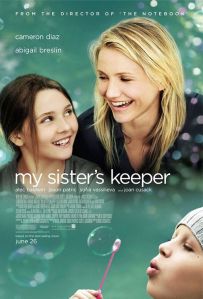 How could a movie about dying children be so schlocky? The best-selling Jodi Picoult novel, My Sister’s Keeper, is awash in drama but it never tipped the scales into absurd and tone-deaf melodrama. How does one botch a tear-jerker? You need only watch the big screen version of My Sister’s Keeper for a primer on how to turn a complicated, challenging book into maudlin mush (hint: make sure to have a sizeable budget for obtaining music rights for endless montages).
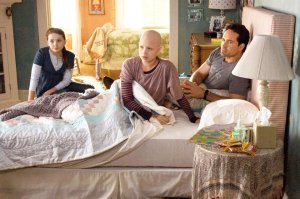
Kate (Sofia Vassilieva) is dying from cancer. Her little sister, Anna (Abigail Breslin), was conceived by her parents, Sara and Brian (Cameron Diaz, Jason Patric), to be a genetic match. Anna was born so that she might be “spare parts” for her ailing big sister. Jesse (Brennan Bailey), is the oldest child, and his needs have been overlooked because of Kate’s illness. Anna’s life has been one of prodding and pricking and testing and operations. Then one day, Anna consults with high-powered lawyer Campbell Alexander (Alec Baldwin). She wants to sue her parents for the rights to her own body. She’s tired of undergoing numerous medical treatments. She wants a life of her own, something more than being “spare parts.” Needless to say, Sara and Brian are horrified. Anna clearly loves her sister but by refusing to donate a kidney she is signing her sister’s death notice.
 The movie strikes one false, heavy-handed note after another. There is rarely a moment that feels authentic or genuine; everything comes across as powerfully manipulative and cloying and contrived and like a tuneless melodrama. Things are cranked to such a high degree of overkill. I swear to you that, no joke, at least seventy percent of the scenes in this movie involve somebody crying. People don’t argue, they flail and shout until they go hoarse. There is nothing subtle to be found here. I didn’t feel emotionally invested in these characters and one of them is a freaking teenage girl suffering with cancer! The first half of the movie feels far too rushed, and the majority of scenes last under two minutes, meaning that the plot lurches forward but the film fails to round out and establish its central characters. The movie’s idea of covering up its screenwriting shortcomings and lackluster character development is to produce an extended music montage. There are over five music montages (I lost count) and it possibly takes up a fifth of the movie’s total running time. I don’t know about you, but watching characters smile and laugh set to music that is so painfully on-the-nose literal does not make due. After so many matching lyrics, I was waiting for a song to literally describe everything I was watching on screen, like, “Heaven/We’re all gonna go/You’re gonna go sooner/Because you’re a little girl with cancer/Don’t you think your mother’s crazy?/So what’s on TV?” Is it better drama to hear a somber cover of Cyndi Lauper’s “Girls Just Want to Have Fun”? It’s just one of several flimsy filming decisions that rip you out of the story and make it perfectly obvious that you are watching a movie, and a poor one at that.
There is just way too much material here for it to succeed as a streamlined, two-hour weepie. There are complicated moral issues here about exploiting one child in efforts to save another. Grief can transform the nucleus of a family in small ways. This requires a delicate adaptation and this movie is certainly not it. This is an adaptation that alternates between syrupy music montages and falling anvils. My Sister’s Keeper is beset with convoluted flashbacks, and I often was confused as to where in the timeline several of the scenes were taking place. Is this before or after Sara shaved her head in solidarity? Is this before or after she Katie starts chemo? There are multiple characters that share voice over duties, often just offering up a line or two. What’s the point of having Jesse announce in voice over, “I wondered how much trouble I was gonna be in,” when he sneaks into his house late at night? Could we not communicate this effectively without the added voice over? And only for a single line? This is just shockingly lazy writing and proof that the filmmakers have no trust in their audience. In fact, Jesse as a character is entirely pointless. He adds nothing to the story except to make things more confusing. Why does he sneak out at night to drink milkshakes in downtown L.A.? Why are judges unclear why a lawyer of such fame and stature as Campbell Alexander has a helper dog? There are intriguing dramatic setups that just get overlooked. What kind of life goes on in a family home when one child is suing their parents? Show me this stuff.
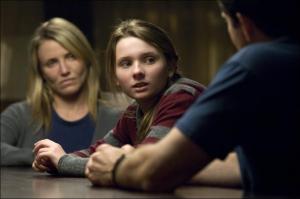 By far, the only believable part of this mawkish mess is a lengthy flashback to Kate’s boyfriend, Taylor (Thomas Dekker, sporting a good-looking dome if you ask me). This is the only segment that’s allowed to breathe and feel naturally developed. It is during this tender sequence where Kate feels like a character instead of a broadly drawn sketch of Cancer Girl. The interaction between Kate and Taylor is sweet and relaxed, until an obvious conclusion that has to spoil Kate’s small hold on happiness. The supposed twist ending is predictable and nullifies the court battle, which makes the ethical struggle of bio-engineered babies just a plot gimmick. In the end, I got the overwhelming impression that the screenwriters, Jeremy Leven (The Notebook) and director Nick Cassavetes, are projecting. We conclude on one character’s voice over, remarking, “I don’t know why she died. I don’t know why what happened happened. I don’t know why we did the things we did.” It’s like a thinly layered confession by the screenwriters that they were clueless. Any tears that manage to squeeze out are unearned and are only the byproduct of such gloomy material.
The acting is typical of such hyperactive melodrama. Diaz fares the worst as the overprotective mom who fights tooth and nail to save her daughter at the expense of everybody else. She’s abrasive and grating even when the movie tries to make her sympathetic. Diaz can do drama and can even manage understatement, as she showcased in the criminally underappreciated 2005 film, In Her Shoes. Cassavetes only knows how to direct actors when they’re being histrionic and unrestrained, as Alpha Dog and John Q. prove. The rest of the cast slogs through the overwrought material with plenty of tears to bailout the Kleenex industry. The lone bright spot amongst the cast is Vassilieva (TV’s Medium) who makes you feel her pain and manages to, at times, cloud your mind that you’re being shamelessly manipulated.
 My Sister’s Keeper is supposed to be one of those moving, heart-tugging episodes that allows us all to re-evaluate life. The movie, in actuality, is a maudlin and overstuffed melodrama (cancer kids, dysfunctional families, court disputes, secret schemes, last wishes, etc.) that is so poorly executed that it manages to make Lifetime movies look like grand art. Cassavetes grounds down all the tricky ethical questions and tortured feelings down into simplistic soap opera gunk. Nothing feels genuine or honest, everything comes across as incredibly forced and contrived, and enough with the music montages. Hitting the soundtrack button does not erase screenwriting deficiencies. My Sister’s Keeper is a malformed, overwrought, clunkily insensitive excuse to empty audience tear ducts. I suppose indiscriminate fans of the weepie genre will find the material forgivable, though fans of Picoult’s novel will find the changes to be unforgivable. I like my emotions to be earned and not strangled to death.
Nate’s Grade: C-
Share this:

The Alamo (2004)
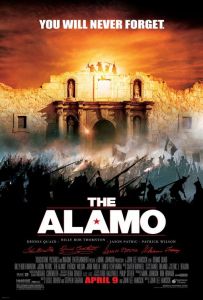 The Alamo was originally going to be the jewel in Disney’s 2003 Oscar crown. It began with a star-studded pedigree: Ron Howard directing, a screenplay by John Sayles and Stephen Gaghan, and Russell Crowe starring. Things got dicey when budget figures were debated, and Howard insisted on an R-rated cut for authenticity. After some creative wrangling, Howard left to get his gore fix on with another flick (The Missing), Crowe went off to sea (Master and Commander), and Disney tapped Johnny Lee Hancock to direct in the wake. Trouble is, Hancock had only directed one previous film, 2002’s The Rookie. The 90 million dollar movie was supposed to be released during December 2003, just in time for Oscar season. However, the editing needed more time, so Disney’s supposed award-grabber was delayed until April 2004. Now, given the final PG-13 product, were the wait and creative compromises worth all the trouble?
In The Alamo we follow the men of Texas, including surly drunk Jim Bowie (Jason Patric), idealistic Sam Houston (Dennis Quaid), girly aristocrat William Travis (Patrick Wilson), and legendary Davey Crockett (Billy Bob Thornton). They want to make Texas their home, but Mexican General, Santa Anna, has different plans and wants to reclaim the land for the glory of Mexico and, more importantly, for the glory of himself. As Santa Anna storms into Texas, a meager number of men take refuge in the Alamo, an old Spanish mission, and arm themselves for an eventual battle between the merciless General and his thousands of soldiers.
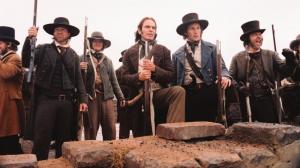 The pacing of this movie is about as fast as a tumbleweed. An entire act of this movie involves Texans and Santa Annas men exchanging a shot here, a volley there, back and forth and back and forth for no reason. It certainly doesn’t build tension. It just squanders time, and this thing is 2 hours and 20 minutes long! If it weren’t for my free bag of popcorn I would have fallen asleep countless times during viewing.
The acting of The Alamo may make you want to throw up a white flag yourself. Jason Patric spends the majority of his time on his back with teeth clenched, and when that’s not the case hes lookin’ to get his famous blade a cameo. Quaid seems to have a frog permanently lodged in his throat. The only performer who walks away unscathed is Thornton. He gives a humanistic touch to the familiar character of Davey Crockett and shows the wear of living up to legend.
Perhaps the most shocking thing about The Alamo is how poorly directed it is. I know Johnny Lee Hancock has only one previous movie under his saddle, but my jaw hit the floor when I saw how flat his direction was. Scenes and angles are very awkwardly framed, everything is too flat or too rigid, his cinematography is an underwhelming mixture of silhouette shots and dusty hues, his sets look like a high school production, and his action scenes are staged without any sense of excitement or tension. Excluding one shot that shows the battle on all four sides of the Alamo, seen prominently in the trailers and TV spots, there isn’t a single shot in this entire film that looks great. This is one of the worst looking $90 million film I have ever seen.
The script is another factor in driving down the entertainment. The makers strive for historical accuracy and to show both sides of the conflict without bias. So we get what all modern historical films feature now, namely the Famous People with Flaws. Bowie drinks a lot. Travis is unsure of himself and leaves his family. Boone doesn’t live up to hyperbolic legend. This information is fine, but The Alamo tries so hard to get the characters accurate that it fails in getting the characters right. I’m not calling for the return of myths, but The Alamo is so focused on the details that that’s all these characters become: historical details instead of living, breathing people.
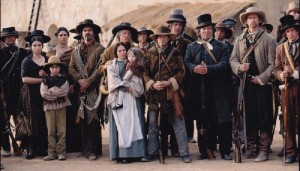 The script also shirks any kind of detailed look at the role of minorities involved during the siege. Black people hardly mention slavery (and Texas would go on to become the largest slave state), women are designated as caregivers, either tending to the wounded or becoming floaty fantasies. The Alamo feels more like a eulogy than a film. And how many eulogies do people pay 5-10 bucks to go see?
I think what ultimately sinks this movie for me is my roots. I’m not from Texas, I dont know anyone from Texas, I dont know if everything is bigger in Texas, and I dont know if I’ve ever messed with Texas, but the lone star state clings to the martyrdom of the Alamo like the crucifixion of Jesus. When I was watching The Alamo I kept having one reoccurring thought: is this accomplishing anything? In my assessment, no it did not. A bunch of Texans banded up in an old mission and fought Santa Anna but there was no reason for it and nothing was really gained. Someone will argue that they held up Santa Anna and allowed Sam Houston to collect his army and eventually take down Santa Anna. I would counter that with, ”You know what else could delay Santa Anna? Anything.”
The Alamo is an overlong, overly serious, flat, uninteresting bore. It feels more like a textbook and less like a story. Sure its not the jingoistic flag-waver that John Wayne’s 1960 version was, and I can appreciate trying to get history right, but The Alamo is so insanely by-the-book serious that its as fun as a funeral march. It seems like the director and the producers were so afraid of telling the story of the Alamo wrong that they lost the ability to tell a good story. Only ardent history buffs, and maybe ardent Texans, will find anything appealing about this boring history lesson.
Nate’s Grade: C
Share this:

Narc (2002)
 Stop me if you’ve heard this before. A hard-nosed and diligent cop (Jason Patrick) gets taken off the force after in accident while serving in the field. The bureau brings him back in the help of solving a case collecting cobwebs, the death of an officer undercover. This cop gets teamed up with a hothead (Ray Liotta) who doesn’t play by all the rules who becomes increasingly more suspicious that said hothead breaks more rules than enforces. Oh, and diligent cops neglected wife and child incessantly worry over his well being as he becomes consumed by the work. Whats that, you want me to stop? Well okay then.
So what do we get with Narc? Well, Ray Liotta yells. A lot. He’ll huff and puff until smoke blows out his ears and veins jump from his neck. Liotta eats scenery uncontrollably like Marlon Brando left alone at the Cheesecake Factory.
Narc attempts to tell a gritty police drama in the same manner of The French Connection but, instead, turns into every other gritty cop movie. The twists (I use this word lightly because every turn is easily telegraphed) do nothing to liven up this rote rogue copper flick. Let’s face it, every cop drama is plot driven, even the classics like L.A. Confidential and The French Connection. So if you don’t have a good story then theres no gas in this car. And Narc barely runs on fumes.
Writer/director Joe Carnahan tries to play window dressing with some superfluous camera tricks in an attempt to jazz up the proceedings. The opening handheld chase scene could give the makers of The Blair Witch Project motion sickness. The editing can at times simulate an annoying fly buzzing around your ear. The result of these tricks is like covering a turd with chocolate and selling it to the masses.
Narc won’t quicken any pulses or knock any socks out of their vicinity. So what will you get? Well Ray Liotta yelling at you, which, surprisingly, could lead to audience narc-olepsy. Even that horrible pun is better than watching the film. I think that says it all.
Nate’s Grade: C


 nathanzoebl
You must be logged in to post a comment.