Blog Archives
X-Men: First Class (2011)
 Marvel’s X-Men franchise had some serious damage it needed to undo. The once mighty superhero series had been harmed by that age-old foe – bad sequels. The collective stink from 2006’s X-Men: The Last Stand and the 2009 Wolverine debacle, the franchise had lost some serious luster. While the recovery was not nearly as deep and cataclysmic as what the Batman franchise had to deal with in the wake of 1997’s Batman and Robin, a film that flirted with salting the earth, the X-Men needed some kind of facelift. Enter director Matthew Vaughn (Kick-Ass, Stardust), the man who was going to save the series back in 2006 when original director Bryan Singer flew away to direct a different man in tights. Vaughn was originally tapped to direct Last Stand but he dropped out and was replaced by the hack Brett Ratner (Rush Hour). Thus began the slide toward mediocrity. Now Vaughn is back to tidy up unfinished business, taking the series back to its historical roots in the 1960s. It seems that a trip back in time was just what was needed to make the X-Men fresh.
Back in 1944, Erik Lehnsherr is a prisoner in a Polish concentration camp when Dr. Schmidt (Kevin Bacon) discovers the young boy’s great potential. When enraged, Erik can control anything metallic. In upstate New York at the same time, young Charles Xavier discovers a young shape shifter named Raven. She’s blue from head to toe and afraid. They’re delighted to find one another, fearing they were the only ones “different” in the world, children of the “atomic age.” All three of these people are headed for a collision course. In 1963, Charles (James McAvoy) has become an Oxford professor, Raven (Jennifer Lawrence) has followed him to England, and Erik (Michael Fassbender) has been systematically hunting down the Nazis responsible for his pain and suffering. Dr. Schmidt has now become Sebastian Shaw, a younger-looking playboy with the intent to push the Soviets and Americans to nuclear war. Shaw has his own team of mutant henchmen, including telepath Emma Frost (January Jones, proving once again that she can really only ever be good as Betty Drapier) who walks around in white lingerie the whole movie. Together with CIA agent Moira MacTaggert (Rose Byrne), Charles and Erik assemble their own team of young mutants to thwart Shaw.
Similar to 2009’s Star Trek, this film provides the opportunity to reboot a franchise by going back in time. It transports the series back to the beginning of the friendship between Charles and Erik, and spends the next 130 minutes filling in the rationale for the “why” of their varying personal philosophies. By dialing back, we’re able to play around with 40 years of back-story and histories. While we know the end results, that these two giants will become enemies, that Charles will lose the ability to walk, and that Raven/Mystique will eventually side with Erik, that doesn’t mean there isn’t pleasure to be had in watching the journey. There are all sorts of self-aware in-jokes for fans and a few nifty cameos that left me howling with glee. The script, credited to Vaughn, his writing partner Jane Goldman (Kick-Ass), and four others, smartly moves the film forward; no scene seems at a waste. Even better, the film strikes a tone that manages to take its real-world implications seriously (nuclear brinksmanship, Holocaust, and fighting for equality and acceptance) without diminishing its popcorn thrills.
As a summer movie, X-Men: First Class has enough razzle-dazzle to compliment its intelligent social pontification. Vaughn and his screenwriters have composed action sequences that neatly incorporate the mutant abilities of its subjects while building the tension and smartly utilizing the contours of geography. I hate action sequences that don’t play to the potential of location and subject. An evil teleporter (Jason Flemyng) finds a fiendishly clever way to dispatch 20 CIA agents. Magneto efficiently takes out former Nazis residing in Argentina in one chilling sequence (“I’m Frankenstein’s monster,” he tells one man). Shaw makes for an actual formidable opponent for our fledgling heroes. The personal connection he has with Erik, on top of Bacon’s devilish glimmer of villainy, makes Shaw a strong antagonist that the audience can rally against. Vaughn has a splendid reveal with Shaw. Back when he was a Nazi doctor, he asks young Erik to move a coin with his abilities. The shots consist entirely from one side of his office, showcasing it to be a bookish study. Then when Shaw calls the Nazi guards to bring in Erik’s mother for a little more direct incentive, the camera flips position. We see the opposite side of the room, a medical station on the other side of large glass panels. Inside is a torturous display of medical cutlery. It’s a fantastic reveal that kicks up the tension while adding to the terrifying character of Shaw. The action highpoint, a mutant vs. mutant battle amidst the Soviet and American naval fleets, provides plenty of parallel action to follow that keeps the movie alive and kicking.
The film mixes a frothy, James Bond-esque spy thriller feel in production design and whatever-goes plot savvy, but then recomposes real life events as mutant enhanced. Alert the history textbooks, because the Nazi scientists experimented on mutant children and that mutants averted World War III. Some will chafe at the alternative history approach, but I find it to be more interesting, suspenseful, and a natural fit with the overall Cold War paranoia feel of the setting. Melding the X-Men into history makes for a more intellectually stimulating adventure, tipping its hat at various historical revisions that payoff as small rewards for a well-informed audience. I’m not saying that the movie is like Noam Chomsky’s take on X-Men by any means, but it’s certainly the most heady film in the series since the departure of Bryan Singer (he serves as producer on this flick). Indeed, this is a rather talky X-Men adventure with plenty of philosophical debates and speeches. But then it’s got naked women in blue too. But you see, it’s not just naked women in blue, it’s that a naked woman in blue can become a political statement – man!
And it’s on that note I’d like to say a few words. Mutants have always been a central metaphor for the oppressed, be they Jews, African-Americans, homosexuals, whatever minority group you’d like to slot in. That’s been one of the secrets to the continued success of Marvel’s flagship series – anybody can identify with the fear of being judged, feared, and despised because of who you are. That’s why the character of Raven/Mystique, short of Magneto, is the most fascinating character in the movie. Her true form, scaly and blue, is what keeps her feeling like an outcast. She doesn’t have an invisible power like her surrogate big brother, Charles. She constantly disguises herself in order to fit in, albeit her disguise is the alluring natural figure of Jennifer Lawrence (Winter’s Bone). “Mutant and proud,” she says in disdain when she stares at her bluish reflection in the mirror. It is through Erik hat she begins to believe in this mantra, gaining pride that “blue is beautiful” and she need not even wear clothes to cover who she is up. Raven/Mystique is the figure torn between the two philosophies argued by Charles and Erik. She is the central figure that has to struggle with reality vs. idealism. It’s also a little funny that a movie piggybacking the civil rights movement of the 60s (mutant rights!) also trades in the casual misogyny of the 1960s (women in lingerie as outfits, regularly practiced sexism). I suppose some of this is intentional. I guess the women’s movement will be saved for a sequel.
While the retro setting ties in nicely with the series’ core metaphor about being different/disenfranchised, the dichotomy of ideas presented by Charles and Erik are not given equal measure. That’s because, quite frankly, Erik is a much more powerfully interesting character and more sympathetic than a rich kid who can read people’s minds. Charles Xavier and Magneto have always represented a comic book version of Martin Luther King Jr. and Malcolm X when it came to the ideas of integration, equality, and representation. Charles believes that mutants should assimilate and that humanity will accept in time; peaceful and hidden. Magneto, on the other hand, takes a more militant stance and feels that mutants need not hide who they are out of fear or shame, that they are the dominant species and should not be threatened by the weaker Homo sapiens. But where X-Men: First Class runs into some trouble is that the ideological deck is completely stacked in Magneto’s favor. He’s the one who suffered through concentration camps, Nazi experimentation; he’s seen the worst of what mankind of capable of. He’s a tormented man seeking vengeance, which is character motivation that is easy for an audience to fall behind. Then, even after the mutants save mankind’s bacon during the Cuban Missile Crisis (the first person who tells me this is a spoiler gets a history book thrown at them), they still get treated as the enemy. Almost everything that plays out onscreen aligns with Magneto’s ideology, which makes it hard not to be on Team Magneto as the movie draws to a close. I suppose the film utilizes our knowledge of future events to counterbalance Magneto’s pessimistic world philosophy.
The other issue that lends more credibility to Magneto than perhaps the filmmakers were hoping for is the fact that he’s the most interesting character in the movie, easily. The X-kids are a pretty bland bunch of boys and gals. This is the first class the filmmakers chose? Did they have recruiting violations at the school? Havok (Lucas Till), a goy who can shoot energy beams, Banshee (Caleb Landry Jones), a guy who can scream loudly and fly, somehow, Angel (Zoe Kravitz), a gal with fairy wings and an acid tongue, and then Darwin (Edi Gathegi), a guy who… adapts? Darwin’s power is so obtuse to explain, it’s no wonder he doesn’t last long in service to his country (it’s a bit tacky that when one character says “slavery” the edits have to cut back to the one black mutant for a reaction shot). Each one of these teenagers has a different reaction to their powers. Some are ashamed, some are afraid, others proud or apathetic. But they are all singularly uninteresting. Once they establish their power, they become less a character and just another piece on a game board to be positioned. And Lenny Kravitz’s kid in fairy wings? Plus she spits little fireballs? I’m sorry but that should have been the first thing removed from rewrites. This crew makes it sure that we empathize even more with Magneto as he refines his powers to reach his personal vengeance, which is the film’s pre-designed payoff. We’re not really looking for the team to band together, which they inevitably do, but we’re awaiting that splash of vengeance. And when it does come, it’s satisfying, stylish, and dramatically fitting (“At the count of three, I’m going to move the coin.”). The fact that the movie still has like 15 minutes of material afterward is almost inconsequential.
Vaughn certainly delivers the spectacle, it’s the actors that produce the real fireworks. This is a vehicle for McAvoy (Atonement, Wanted) and Fassbender (Ingloruious Basterds, Jane Eyre), and both men provide admirable gravitas. McAvoy’s role offers a more jocular performance, showing Charles to be a bit of a lady’s man in his younger years, harnessing his telepathic powers to bed him some beauties. Then again, as I’ve been told from my female friends, looking like McAvoy will certainly also help matters. But this is Fassbender’s show. He has a chilly intensity to him, rather than just being cold and indifferent like January Jones. His performance captivates you from the start, and his slow-burning hatred consumes the man. It’s a dramatically rich performance given the material. After being discriminated against for being a Jew, than a mutant, he has to sell that his character, haunted and rage-filled, would ironically follow the same social Darwinism that his Nazi tormentors evoked. And Fassbender sells every bit of an iconic Marvel villain coming into his destiny. However, his Irish accent slips out in the film’s final reel, and I’m really curious why the studio couldn’t have shelled a few bucks to fix that with ADR. Rushed for time, or revealing that Magneto has unheard of Irish lineage?
Going back in time manages to open up all sorts of possibilities for the X-Men franchise. There could be a whole slew of sequels that play around with the rich, complex back stories of the X-Men without having to serve the aging stars of the original trilogy. Vaughn keeps the proceedings amazingly fluid, stylish without being overtaken by visual artifice, and the swinging 60s provides a groovy backdrop. The action delivers when needed, the smart script doesn’t downplay the clash of ideas to go along with the clash of fists, and the special effects are relatively up to snuff as summer escapism goes. The movie is not without its misses, including a cadre of lackluster junior mutants. But Vaughn has re-energized a flagging franchise and given hope for a future (past?). In the pantheon of X movies, I’d place X-Men: First Class as an equal to X2, the best in the series. It may not be at the head of the class, but this superhero flick earns is stripes with a solid effort and strong potential.
Nate’s Grade: A
Share this:

Unknown (2011)
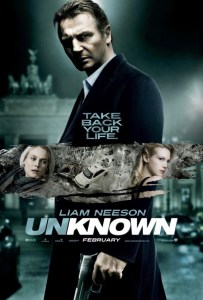 With Liam Neeson kicking ass in a European country, fighting a nefarious conspiracy, and trying to reclaim what has been taken from him, you’d be excused for thinking that Unknown is a sequel to the highly popular Taken. And the films do share plenty in common. Both involve Neeson trying to regain his life against a ludicrous conspiracy, and both are equally ludicrous in their action sequences, and yet both are fun, passably diversionary entertainment. Neeson gets into a car accident to find that his wife (January Jones, blankly Betty Drapier wherever she goes) doesn’t recognize him and enjoys the company of another man asserting the identity of Neeson. Is he really crazy? That idea lasts about ten minutes before the bad guys and their bad guy accents come to kill Neeson and tie up a loose end. The action is swift, well edited, and fairly exciting, a highpoint being a thrilling car chase through the streets of Berlin. The movie has enough clues and questions to string along an audience, though by film’s end you wish you got more scenes with Neeson in full-on attack mode, as seen in Taken from start to finish. What is it about losing one’s memory that always turns men and women into better people? Perhaps prison rehabilitation should consist of a Flinstones-esque treatment of knocks to the head to adjust moral consciousness for the better.
Nate’s Grade: B
Share this:

American Wedding (2003)
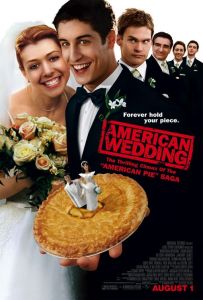 So it looks like Jim (Jason Biggs) and his bang-camp lovin’ girlfriend Michelle (Alyson Hannigan) are going to tie the knot. As the wedding approaches hilarious hijinks ensue. Thats really about it plot-wise. Steve Stifler (Seann William Scott) makes a return to goose every one up for a wedding, which also promises bridesmaids and a bachelor party. More hijinks ensue until the wedding.
The best thing the American Pie makers did was shaving down their overloaded cast. Gone are Chris Klein, Mena Suvari, Natascha Lyonne, Shannon Elizabeth, and Tara Reid. And good riddance I say. What made American Pie 2 an improvement, for me, was that they focused on the interesting characters (Jim, Michelle, Stifler, Finch) and then gave the others some scant storyline. The comedy worked better when it wasnt so divided among characters that weren’t equal in being compelling.
Scott is a whirling comic Tasmanian devil; with his twitchy weaselly grin, his drunken leer, and near spitfire delivery of such profanity-laden lines. The Stifler character has come a long way since having only 11 lines in 1999’s American Pie. He emerged as a strong supporting character in the 2001 sequel, igniting the screen whenever he entered. Now Scott has become the de facto star of the American Pie trilogy: it’s really all about the rise and evolution of Stifler. Hes gone from being the sneering jerk to becoming a lovable loudmouth. American Wedding is really the Steve Stifler show. He shouts, dances, and eats dog crap all for your enjoyment people. Scotts efforts and energy are so transcendent that he rightfully owns the film, much in the same way Johnny Depp entirely owned Pirates of the Caribbean.
 Biggs and Hannigan have a lovely charm to them and both are blessed with radiant smiles. Eugene Levy is still hilarious as the dad who has a problem with over sharing. The other actors serve out their roles from straight-guy (Thomas Ian Nicholas) to horrible-reaction-guy (Eddie Kaye Thomas).
Not everything works as smoothly the third slice around. Some jokes are inspired like the one-upsmanship of a bachelor party gone awry when Michelle’s parents interrupt (which, like the second film, provides the gratuitous nudity). Some jokes feel dull, especially some misbegotten pubic hair belonging to Jim. And then some jokes just lose their momentum as they seem to stretch. Stifler dancing in a gay bar just to prove he can make even gay men want him? Funny. Have it go on and on with substandard dancing for a dance-off? Loses the funny. But with any comedy, and especially ones following the gross-out expectations, everything is hit-or-miss.
I also noticed something quite odd about American Wedding: it’s badly directed. Many scenes are shot at oblique angles often with characters not even facing the camera. The cutting seems awkward as well as the framing. The film was directed by Jesse Dylan (How High), who is, no joke, a son of the legendary Bob.
American Wedding seems like a fitting end to these characters journeys. Its a comedy ripe with laugh-out-loud moments and groaners, mostly supplied by Scott. There’s also a degree of sweetness. In a summer drenched in sequels, at least one of them fulfilled some of its promise.
Nate’s Grade: B-


 nathanzoebl
You must be logged in to post a comment.