Blog Archives
The Hangover: Part II (2011)
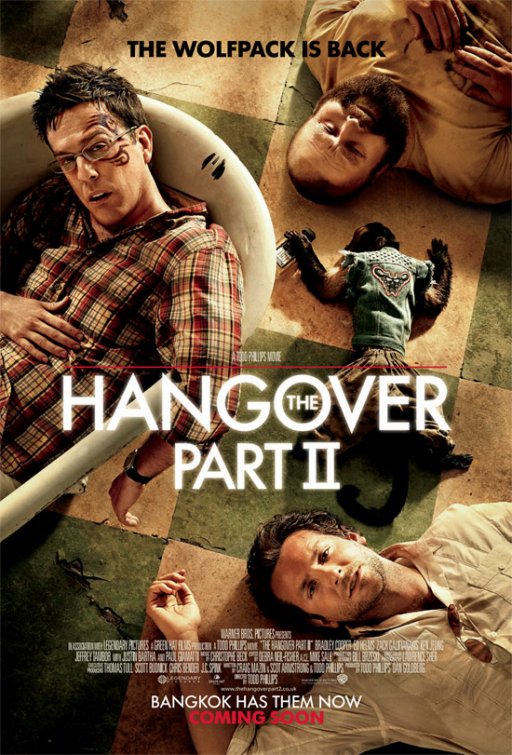 When you’re responsible for the highest-grossing R-rated comedy of all time, a film that grossed over half a billion dollars worldwide, then you don’t want to tinker with a winning formula of a surprise hit. Naturally, with that kind of money, a sequel was inevitable. Director/co-writer Todd Phillips (Old School, Due Date) is back and so is everybody and everything else. You’ll get a strong sense of déjà vu watched The Hangover: Part II. That’s on purpose. This calculated, rather soulless cash-grab sequel wants to recreate the organic experience of the first film. If you played The Hangover and The Hangover: Part II on simultaneous TVs, I would not be surprised if the same plot points happened at the exact same minute-marks. It might even be like a Pink Floyd/Wizard of Oz experience. I paid twice to see the same movie two years apart.
Stu (Ed Helms) is about to get married in Thailand to Lauren (Jamie Chung). Our favorite wound-up dentist is apprehensive about any sort of bachelor party shenanigans after the events of two years ago in Las Vegas. His pals Phil (Bradley Cooper), Doug (Justin Bartha), and the socially inept Alan (Zack Galifianakis) make the trek to attend the festivities. For Alan, it’s a reunion of the Wolfpack and an excuse finally to venture out of his parent’s home. Stu has some ground to make up with his bride-to-be’s father. Her father seethes about the prospect that his beautiful daughter is going to marry Stu, a man he compares to watered down rice. Lauren’s younger brother, Teddy (Mason Lee), a pre-med student and concert cellist, is left to the Wolfpack’s care the night before the wedding. They’ll just have one drink on the beach. What’s the worst that could happen? Flash to the next morning. The guys awaken in a strange apartment. Teddy is missing and missing a finger as well. Stu, Phil, and Alan must once again retrace their steps and solve the mystery of their hard-partying antics before the wedding ceremony.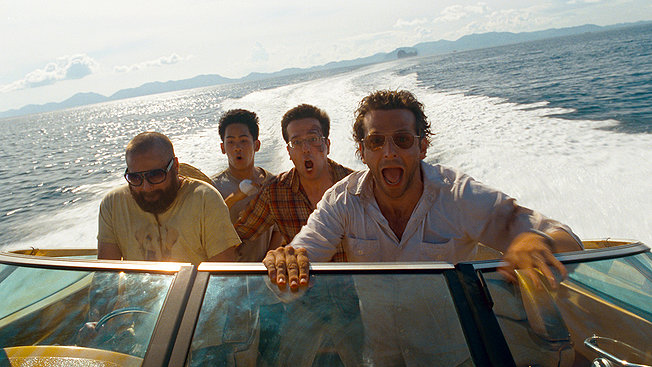
The Hangover: Part II is a carbon copy of the original. Because the same joke is just as funny the second time around, right? This empty enterprise gives its audience exactly what they want, which is precisely the same experience they had with the first film. But so much of comedy is predicated on surprise, so how can you recreate the experience of discovery that people so heartily enjoyed with the first film? The Hangover: Part II is like a cheap comedy Mad Libs game: it reuses the same gags and just fills in the blanks. Hey, if Joke A worked before, why couldn’t we just have Joke A in this different location (instead of two guys walking into a bar, they walk into a different bar)? It’s like somebody copied and pasted the screenplay from the original movie, changed the locations and minor details, and cashed a check. Let me get into how stunningly indolent the screenwriting is (small spoilers to follow). Once again a person in their group goes missing before a wedding. Once again Stu has some self-inflicted wound to his face. Once again the guys have stolen someone else’s unorthodox pet. Once again they find themselves with a ward (baby in first film, Mr. Chow in second). Once again Stu has gotten involved with a prostitute. Once again Alan was secretly responsible for their drugging. Once again Justin Bartha gets left out of the escapades. Once again Mr. Chow shows his junk for shock value. Once again Mr. Chow jumps out of a locked container attacking the guys. Once again the guys have to return money to a gangster. Once again Stu plays a song of his own creation bemoaning their situation. Once again they have to race to the wedding minutes away. Once again we have a Mike Tyson cameo. Once again the guys find pictorial evidence of their debauchery and they play over the credits. Even directing touches like a time-lapse high-rise shot passing the time before they wake up is reused.
That’s what kills the movie is the lack of surprise. It throws the guys into a different setting, gets darker and meaner, but it’s rarely funny. I was surprised how many jokes left me in stony silence. Phillips and his screenwriters have gotten into the trouble of having to top themselves, so they rely on the “bigger is better” approach to match the outrageousness of the original. If Las Vegas is Sin City, then what would be even seedier? Bangkok, of course. Where would they go for a third film? What gets seedier than Bangkok (The Hangover 3 to be set in Rep. Anthony Weiner’s office). Yet the film curiously ignores much of what makes Bangkok the world’s preeminent hotspot in the sexual trades. The payoffs are darker and lack the bemusement of the original. Knowing some guy is missing a finger is not as whimsical as somebody missing a tooth. The movie has an unpleasant homophobia to it thanks to male genitalia being used to shock and horrify and humiliate. The horror of being involved with transsexual women made my theater audience groan with extra relish, like the presence of a penis or homosexual content makes everything automatically more disgusting to the common people, as if anything gay is the worst thing that could possible befall a man. Mr. Chang is an odious and fairly unfunny stereotype, and Jeong (Role Models, TV’s Community), so funny in just about every other role he’s ever had, is a braying, high-pitched annoyance. This go-round the jokes feel stale, the characters feel tired, and the payoffs seem too mean-spirited to be satisfying.
When you have a movie where the comedy is situation-based, then those situations better be funny because the characters are only serving as a means to an end. The premise allows the filmmakers to have it both ways. They can fulfill the hedonistic spectacle that will make people blush, and at the same time they can have button-uped, likable, relatively relatable nice characters that an audience will root for. If we watched these characters acting like irredeemable morons, then audience sympathy would wan. But having the guys investigate their previous dirty deeds, and react in horror, does not lessen audience sympathy. I enjoyed how the main trio played off each other in the first Hangover, and the central mystery was a solid glue to hold together a loose collection of mostly worthwhile gags. Just as the first film fell short of its potential, so too does the second movie. A monkey serves little purpose other than to get it to do things that seem outrageous just because it’s a monkey (it smokes, it mimes oral sex – hilarious!). But the second time around, the amusement of seeing Stu fly off the handle, or listen to Alan’s moony non-sequitors, doesn’t have the same draw. Galifianakis (Due Date) made the film watchable for me despite the fact that the screenplay makes his character a petulant and highly irritating character rather than a man-child doofus. And the women are once again relegated to the sidelines when it comes to being in on the comedy.
For The Hangover‘s legions of fans, more of the same will likely be exactly what was desired. But without the cheeky element of surprise, the comedy just seems like it’s hitting pre-ordained stops according to its formulaic cheat sheet. For the original Hangover I wrote: “Let’s face it; once you know the solution to the mystery and all the surprises, will this movie still play out as funny? …But once you knew who was behind what, and how the whole game was staged and operated, could you even watch the movie a second time? Would it still work now that a repeat viewer knew all the secrets? Does this comedy have a built-in expiration date?” Well, The Hangover: Part II is the answer. If the first film was a comedy with an expiration date, then The Hangover: Part II is one comedy that’s gone rancid.
Nate’s Grade: C-
Share this:

Sucker Punch (2011)

Director Zack Snyder (300, Watchmen) has been drubbed in many circles for being an empty visual stylist, someone in the Michael Bay camp that worships at the altar of style. Snyder is a nearly unparalleled visual stylist. If only he would use his considerable talents for the purposes of good. I’m not a Snyder basher by trade, and have enjoyed all three of his previous films to some extent, but it’s obvious that Snyder spends much of his time scribbling down imagery he thinks will be cool, and then figuring out how to connect it all at the last minute. So Sucker Punch gives us a bevy of highly stylized, anime-influenced imagery complete with a posse of full-lipped ladies with heavy fake eyelashes operating heavy weaponry in fetish-style clothing. If you were expecting much else, then you’re the one who’s been suckered.
Baby Doll (Emily Browning) is a 20-year-old sent to live the rest of her days locked away inside a dilapidated mental ward thanks to her wicked stepfather. He even makes arrangements with a dastardly orderly (Oscar Isaac) to lobotomize Baby Doll to shut her up for good. Then step dad can swindle the family estate for all its worth. While in this asylum, Baby Doll imagines she’s inside a different world to survive. Her fantasies offer her a world to escape to. Inside, she plots with a group of other patients, including Rocket (Jena Malone), her feisty take-charge sister, Sweet Pea (Abbie Cornish), Blondie (Vanessa Hudgens), and Amber (Jamie Chung). Together, along with the sage advice from a mysterious mentor (Scott Glenn) in her visions, they will collect four items to secure their escape. But time is of the essence. The lobotomy doctor, known as the “High Roller” in the fantasy (played in a major surprise by Mad Men‘s Jon Hamm), is scheduled to come do his needle through the brain trick in a matter of days. It’s up to Baby Doll to utilize the therapeutic techniques of Dr. Gorski (Carla Gugino) and retreat into her mind to find the key to save herself.

You can tell Snyder was trying to crowbar in a meek message about female empowerment, but I ask you: is it female empowerment when the women have to be reduced to pretty play things that still operate in the realm of male fantasy? Just because women fight back does not mean that you are presenting a feminist message. Baby Doll’s mode of power is erotic dancing? And her main outfit looks like a grown replica of Sailor Moon’s, which should be a dream come true for just about every male fan of the animated series. You think having characters in short skirts and names like “Baby Doll,” “Sweet Pea,” and Sucker Punch is no more about female empowerment than some ridiculous women’s prison movie where they all fall into long lesbian-tinged shower sequences. That’s female empowerment, right? It’s got women loving women, so what could be more empowering to women?
After Sndyer’s kitchen sink approach to storytelling, the one thing that Sucker Punch lacks, in abundance, is sense. There is no real connective tissue to anything happening onscreen. Snyder employs two different framing devices before slipping into the metaphorical delusions of a third. I felt like I was tumbling through the Inception dream levels without a roadmap or a competent guide. Considering that the first framing device, Baby Doll being locked away in a mental ward, is only featured onscreen for ten minutes, Snyder could have exercised the bit completely. The second framing device, that Baby Doll has imagined her institutionalized imprisonment into a vaguely 1920s-esque burlesque theater/brothel seems just as unnecessary, but whatever. But it’s the third metaphorical level that gave me a headache (more on that later). The premise alone, girls use fantastic imagination to escape from a cruel prison, is good enough to tell a compelling tale. But there desperately needs to be a connection to those images, a relationship between the fantasy and the movie’s reality. In Sucker Punch, there is no substantial relationship to anything. It is a barrage of images meant to arouse and entertain but little more. The different metaphorical levels are only metaphors for, well, hot girls kicking ass, which isn’t so much a metaphor as it is a literal translation. And when the girls are at play in those fantasy sequences, the movie drops all pretenses of any purpose. It’s not just reality defying, which is what movies were meant for, but it defies its own narrative. If I can just cram whatever cool junk I want then what purpose do I even need to set up characters or develop a plot. When the ladies are off on their fantasy tours, they’re invincible and no law of physics, or man, applies to them. It zaps all danger from the screen, and with that, all tension. They all become superheroes who just run around doing super heroic things. And I might have cared if I felt there was any real purpose for what I was watching other than Snyder wanting to scratch a few cinematic itches.

The girls’ quest to attain their needed items for escape is laid out in the most shockingly lazy manner. Snyder uses the power of dance, yes dance; you see, when Baby Doll starts movin’ them hips of hers, she plunges into a fantasy world of her own doing. And then we witness all sorts of crazy things, and she returns back from the fantasy and the mission is complete. The girls have stolen whatever item they were after. I was expecting the fantasy binges to have some direct correlation with the makeup of their world, so that, say, if they have to cross a massive bridge to gain their item, in the brothel they have to cross some massive barrier. It’s the height of indolence for Snyder to simply type “character dances” and then we get an indulgent fantasy sequence and the job is done. We don’t see the steps the girls had to do to win their freedom, the relationships between fantasy and reality, or any clever plotting along the way. There’s no cleverness at all to be had. The fantasy is not just an escape for the characters; it’s an escape from having to do any thinking when it came to storytelling. Imagine what would happen to other works of cinema if they followed this same approach. Why watch the back-and-forth arguments of a courtroom thriller when we could just have “prosecutor dances” and cut to the case being over? Or why bother watching the complicated struggles of a relationship drama when we can have “guy dances” and just cut right to the shot of the camera spinning around the couple kissing? It’s like a fast forward button that eliminates all plot development. Isn’t that much more satisfying? What, you mean it isn’t because it’s a self-indulgent diversion that has no connection to the main storyline and fails to add anything?
I think ultimately Snyder just really wanted to make the most expensive music video of all time. The dialogue is clipped and kept to a minimum, mostly of the expository “you need to do this now” variety. There are long stretches of full-length musical interludes by Tyler Bates (300) and Marius De Vries (Moulin Rouge). The duo orchestrates some uninspiring fuzzy alt covers of alt songs, so familiar tunes like Bjork’s “Army of Me” and the Pixies’ “Where is My Mind?” get a polish they didn’t need (how many times is that Pixies song going to be covered?). Worst of all is a bizarre mash up of Queen’s “I Want It All” and “We Will Rock You” with a rap track. And of course no film that aimed to ape the tropes of Alice in Wonderland would be complete without some version of Jefferson Airplane’s “White Rabbit,” this time covered by talented Icelandic singer Emiliana Torrini. The entire musical oeuvre is a bunch of distorted, loud, blaring guitars meant to amplify the visual noise.

Sucker Punch is not so hot in the acting department. Browning doesn’t particularly act well in the movie, but then again nobody does, especially Gugino’s awful accent. But this isn’t a film about acting so much as it’s looking the part. And Browning is a geek fantasy come to life, samurai swords, pigtails and all. She makes for a great moving poster.
Expect nothing more from Sucker Punch than top-of-the-line eye candy. Expect nothing to make sense. Expect nothing to really matter. In fact, go in expecting nothing but a two-hour ogling session, because that’s the aim of the film. Look at all those shiny things and pretty ladies, gentlemen. This is the perfect film for a 13-year-old kid fed on anime, comic books, and horror films and who don’t give a lick about things like plot, character, or substance. It’s like somebody combined One Flew Over the Cuckoo’s Nest with every single damn videogame cut scene in the history of time. I was waiting for the next dance/trance sequence where Baby Doll was going to start jumping on turtles and collecting coins. It’s a series of vignettes that have no connection whatsoever. Sucker Punch is really a live-action Heavy Metal, except with even less plot. This isn’t a fairy tale. This is a meth-fueled explosion of a Hot Topic store, captured in Snyder’s signature slow motion. Everyone is entitled to their own fantasies but not everyone gets a $100 million dollar check to throw them all together on screen.
Nate’s Grade: C+


 nathanzoebl
You must be logged in to post a comment.