Blog Archives
The Hand of God (2021)
 For writer/director Paolo Sorrentino’s Oscar-winning 2013 film The Great Beauty, of which I was a great fan, I wrote: “It’s a bawdy, beautiful, and entertaining film but one that also takes its time, luxuriates in atmosphere… The film is far more free-floating and meditative … I felt like I could celebrate the absurdities and joys of life along with the people onscreen. It’s existential without being laboriously pretentious, and the comedy and stylish flourishes help anchor the entertainment.” Most of those words still apply to 2021’s autobiographical coming-of-age drama, The Hand of God, so why does it feel less appealing this time? We follow a young man in 1980s Naples and his large, boisterous, very Italian family. It’s a movie of moments, several extended vignettes, and it sadly doesn’t add up to much for me. I think that’s because the young protagonist is too blank to care about. He’s a surrogate for the filmmaker, but you never get a sense of his passions or interests or even personality. It’s a movie of people talking to and at him, so it’s hard to work up much emotion for his triumphs and perseverence. There are some memorable parts, like his awkward deflowering to an older woman, and a tragic turn halfway through that sneaks up on you. The life lessons are familiar for the well-trod territory, and the personal details of the era, the community, the 1982 World Cup (where we get the title from) feel richly realized as Sorrentino’s gauzy nostalgia. It’s just that Sorrentino’s ratio of interesting to ponderous moments has tilted into the negative this time. The Hand of God is overlong, free-floating, occasionally beautiful and frustratingly inaccessible.
Nate’s Grade: B-
Share this:

When in Rome (2010)
 When in Rome, do not do as this banal movie does. Know what kind of movie you’re in for? There’s an audio record scratch/slowdown effect twice in the first ten minutes. Kirsten Bell (Forgetting Sarah Marshall) is an unlucky in love workaholic who, when in Rome, pilfers coins from the Fountain of Love. This makes the subjects who tossed the coins (Jon Heder, Dax Shepard, Danny DeVito, Will Arnett) magically fall in love with Bell. They chase her back to New York and act like obsessive stalkers. Essentially, this is a rip-off of Love Potion Number Nine, except this rom-com is neither romantic nor comedic. The comedy is mostly brain-dead slapstick and the payoffs never materialize. In one scene, Bell and a date go out for a “night dinner” where they eat completely in the dark. There’s plenty of potential there but it’s like a minute until her posse of stalkers interrupt and the date’s over. There’s stuff like people running into trees, people squeezing into a tiny Italian car, a vase that’s supposed to break as a wedding celebration and refuses to break, and Bell and her lead, Josh Duhamel, have zero chemistry and like a three feet height differential. The movie is so joyless and bereft of energy. The scripts seems to be missing many scenes that fill in details about the various characters, or at least help give setup and context. The movie exists squarely in the absurd realm of romantic comedies and it’s thoroughly mediocre. I would expect nothing less from the writers of Old Dogs. I enjoy Bell but it’s not hard to resist the spell of this junk.
Nate’s Grade: C-
Share this:

Angels & Demons (2009)
 Angels & Demons works better as a movie. It is a better movie than The Da Vinci Code, but since I found that film to be one of the worst of 2006 you should know this is not high praise.
Professor Robert Langdon (Tom Hanks, with a better haircut) is the world?s foremost expert on ancient symbols and texts, which is why the Vatican recruits him for a very important mission. The Pope has recently died and Vatican City is in the middle of the cardinals deliberating who will be the newest leader of the Roman Catholic Church. Four of the cardinals, top candidates for the Pope position, have been kidnapped. The Illuminati, a centuries-old secret society, says that a cardinal will die every hour, from 8 PM to 11 PM, and then at midnight Vatican City will be destroyed. The Illuminati was made up of followers who felt the church was rejecting science, and so we?re told that in the 16th century the Catholic Church responded reasonably by branding the Illuminati followers and executing them. 400 years is a long time to wait for revenge. To make matters worse, antimatter was stolen from the CERN facility in Switzerland and placed somewhere within Vatican City. The battery holding the antimatter is scheduled to die about, conveniently, midnight, and the antimatter will result in a huge explosion (science note: antimatter is real but it is entirely harmless and not combustible). With the help of Carmenlengo Patrick McKenna (Ewan McGreggor), acting church leader until there’s a new Pope, and particle physicist Vittoria Vetra (Ayelet Zurer), Langdon must race against time to save the Catholic Church.
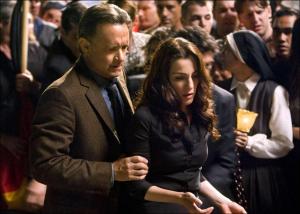 The time element gives the movie a sense of urgency that was missing before, and a kidnapping plot provides a firm structure and supplies more chances for action than unraveling a 2000-year old church conspiracy on the divinity of Jesus. The plot of Angels & Demons works out like a high-stakes scavenger hunt, shuttling Langdon across the many sights of Rome to find the next clue. However, the narrow timeline of killing a cardinal on the hour every hour makes for some tight squeezes, both for Langdon and the cardinal-killing man. I never understand why the villains give themselves such a small window to work with. I know the whole “dead cardinal every hour” thing has a nice ring to it, but is it wholly practical? There’s all that driving around Rome and the Vatican, which has got to be crowded since millions are awaiting news about a new Pope. Beyond this, why must Langdon and crew always show up to a site with like five minutes before the cardinals will be murdered? Are they stopping to get subway sandwiches in between? The timeline and plot setup provide more action sequences that make the movie fleetingly entertaining in spurts.
What doomed the Da Vinci Code movie was not the endless blather, though that certainly bored me to tears, but the fact that the film wanted to have its cake and eat it too — it wants to be a brainy thriller but get away with hokey thriller shortcomings. Angels & Demons suffers more or less the same killing blow. The flick wants you to shut your brain off and swallow these trite lapses in judgment and reality, forgiving the movie for zero character development and polluting the narrative with stupid genre stock roles, but then it also wants you to pay close attention and activate your brain to untangle the origins of symbols, conspiracies, and church doctrine. Angels & Demons introduces the idea of a ticking clock so it’s a far better paced affair than the previous film, but the movie still finds ways to get bogged down. Once again, Dan Brown’s novel has been adapted to a series of chases and sit-down chats, although this time Langdon does a lot of speed walking while he dishes out the minute history of church doctrine and architecture. To borrow from my own review of The Da Vinci Code: “You can?t be a brainy thriller and fill the story with hokey moments and lapses in thought, and likewise you can?t be an enjoyably straight forward thriller if you bookend all your action sequences with talky sit-downs to explain the minutia of your story.”
These stories are just meant to work better on the page than on screen. Puzzles and word games work when the audience can take a moment to pause but film is a medium of images and cannot simply go dead waiting for the audience to posit a guess. Movies don’t have time for you to chew things over. So then the puzzles just devolve into waiting for Langdon to explain everything, which he will do at great length. This can get tedious at a rapid rate. Langdon is less a character in this movie and more a walking, talking encyclopedia of exposition. He is robbed of anything that could be charitably described as characterization. Symbol decoding just does not work on the big screen, and Langdon is an expert whose profession is limited in application. I can’t foresee too many instances where a top-notch symbologist will be needed at a moment’s notice. Sure, it’s nice to get a history lesson and see plenty of those swell ancient churches, even if the filmmakers had to recreate them as sets because the Vatican refused them entry to film, but what point do these Dan Brown thrillers serve as movies? There is an intriguing discussion between science and the role of the church somewhere in this movie, but good luck finding much to stir your intellect. I confess never having read one of Brown’s tomes, including the super colossal mega-selling do-it-all Da Vinci Code, but surely the man deserves a better fate than to have his works die on the big screen as lamentably lame thrillers.
 There are no characters in Angels & Demons, only stock roles and suspects. Langdon’s female sidekick (Zurer,Vantage Point) serves no other purpose but to translate Latin and Italian. Really, if Langdon is a scholar on the conspiracies revolving around the Catholic Church then perhaps he should put in the time and money to learn the language. The Vatican police are there as escorts and little else. Stellen Skarsgård (Mamma Mia!) serves as the chief of the Swiss Guard, the Pope’s security team, and Armin-Mueller Stahl (Shine, Eastern Promises) is a German cardinal running the ongoing recounts for a new pontiff. Both men are presented as sly, untrustworthy suspects. Stahl’s character routinely dresses down McKenna as well, saying the young pup in the collar is not fit for church hierarchy. It?s not much to go on but the “characters” are just figures that occasionally get in the way of the film’s long-winded art history tour.
I think a lifetime of watching movies has just made my mind too analytical to be surprised by the twists in these kinds of dead weight thrillers. I?m already thinking ahead from the first minute and I don’t think I’m alone. When we are introduced to two characters, one gruff and unhelpful and one kindly and overly helpful, it is rather obvious which character will be revealed as being treacherous to provide the biggest jolt. Does anyone still suspect that Hollywood would produce a pointedly obvious evil suspect and then have it actually be that person? Not in today’s class of Hollywood thriller. You see kids, today’s Hollywood thriller is more concerned with piling on the twists than constructing a story that sticks together upon reflection, which is why many a Hollywood thriller simply falls apart as a jumbled mess by the time the end credits roll. Sometimes the endings sabotage everything logically that happened before. For an example of a textbook modern thriller, go rent the French film Tell No One and marvel at how the movie manages to be mysterious without being ludicrous. Angels & Demons doesn’t quite suffer from this screenwriting malady, but the essential evil plot by the eventually revealed evildoer is the most convoluted, ridiculously complicated scheme I have seen since that terminal 2005 thriller, Flightplan.
Director Ron Howard is able keep the film moving, almost distracting the audience away from the plot holes, but Angels & Demons is an adaptation that was doomed to fail from the start. The film plays like a lecture on tape with the fast forward button stuck. I might find more of the blitzkrieg of acts and anecdotes more intriguing if I could verify that they were all accurate. This is a thriller that wants to be seen as smart, so it empties exposition without haste, but it also wants to get away with narrative cheats common in your direct-to-DVD idiotic thrillers. You cannot simultaneously tell me to engage my brain and then a second later tell me to shut it off, sorry. Angels & Demons would have been better served without the Illuminati conspiracy and just plunged fully into the debate about bringing religion into the modern age, the friction between science and religion. Any substance the movie does present ends up being window dressing to an average potboiler mystery. This isn’t an awful movie but it never rises above “acceptable waste of time.” Hanks and Howard will probably be back in due time with the movie version of Brown’s upcoming new novel, The Lost Symbol, which will be released in September 2009. I just hope the duo, and screenwriter Akiva Goldsmith, have learned enough from their mistakes. I myself have little faith.
Nate’s Grade: C
Share this:

Gomorrah (2008)
 In the Bible, God promised not to obliterate the town of Gomorrah if Abraham could find a righteous man. That didn’t work out so well. This stirring Italian crime drama explores the long-reach of the Camorra crime syndicate stationed in Naples. The oldest Italian criminal organization is larger than the mafia, and the film’s four overlapping narrative threads showcase how the Camorra has a grip on every industry. The usual criminal enterprises are there, from drug trafficking to hired murders, but the organization is also deeply involved in the fashion industry as well as toxic dumping; in a perfect metaphor for the entire film, the Camorra is profiting by burying toxic death just below the surface. The objective docu-drama style lends disturbing reality to the ordeal, though the screenwriting too often feels like a pumped-up “true crime” novel – there’s far more emphasis on the minute details than the people. The movie makes empathy nearly impossible, not that this is necessarily a stinging detriment. The movie steers away from the excitement of violence and instead the death is merciless and swift and unexpected. Gomorrah strips away all the romantic notions involved with the gangster lifestyle; the two teenage gangster wannabes who quote Tony Montana are in for a rude awakening by the established toughs. The movie can be punishing and bleak but it’s always fascinating and told with factual backing that makes it spooky. It may not be as powerful or intense as 2002’s City of God but this is certainly one movie that can be punishing and bleak but it’s always fascinating.
Nate’s Grade: A-


 nathanzoebl
You must be logged in to post a comment.