Blog Archives
A Separation (2011)
 When A Separation won the Best Foreign Film Award at the 2012 Oscars, its writer and director, Asghar Farhadi, gave a heartfelt speech where he accepted the award on behalf of a proud people who “respect all cultures,” a country that is much more than portrayed on the news as a Middle Eastern state of agitation and repression. Then the Iranian state-run TV used the opportunity to insult Israel, saying that the Academy “bowed before Iranian culture,” their movie “left behind” the Israeli nominee (Footnote) and “the beginning of the end” of Israel’s influence as it “beats the drums of war.” Sigh. Just when it looks like progress can be made to build cultural bridges. A Separation is a nuanced tale of struggle between tradition, morality, and personal choice. It’s a movie worth taking pride in.
Nader (Peyman Moadi) and Simin (Leila Hatami) are a married couple heading for a divorce. She wants to move to the West. He does not want to leave, especially since he must care for his elderly father who suffers from Alzheimer’s. Simin wants a better life for herself as well as their 11-year-old daughter, Termeh (Sarina Farhadi, the director’s own daughter). Simin does not want to leave without her daughter but cannot get the judge to give her custody without Nader’s approval. Simin has moved back in with her parents. Nader hires a working-class maid, Razieh (Sareh Bayet), to care for his father while he’s away at work. Razieh is working unbeknownst to her husband, who would disapprove but has been unemployed for nine months. Caring for the elderly man is a lot more than she bargained for. At one point, Razieh calls an imam to ask if it is a sin to change the elderly man’s soiled pants. Then one day Nader comes home to find hid father sprawled out on the floor, tied to his bed, and locked in the apartment. When Razieh comes back, she says she had an emergency and keeps it vague. Nader fires her, she demands payment for the day, and he pushes her outside his door. The repercussions of this action will be larger than either could have imagined. Razieh and her husband accuse Nader of intentionally pushing the woman, and when she fell she miscarried her baby. Nader is being tried for murder, but nothing is as clear-cut as what it seems.
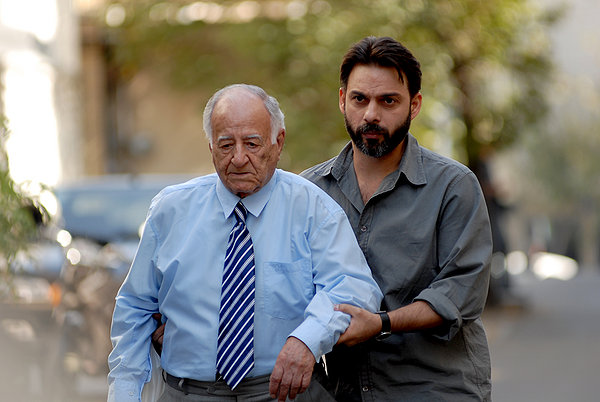 There’s so much to dissect in the intimate, thrilling, and observant little movie about imperfect people living under an imperfect system. It’s far more than the dissolution of a marriage and its impact that has on their family. It’s about the separation of moral relativism, compromises, cultural estrangement, and the concepts of justice in a world brokered by unjust forces. A Separation is really an ongoing court case that ensnares all the characters and brings them down in some degree. The more information we learn, the more we start questioning exactly what we knew about these characters and their circumstances. We’ll get speeches about doing the right thing in the face of opposition, and yet characters will routinely lie to save their own self-interest in the sacrifice of truth. You’re thrown into the middle of this drama and by the end you’ll likely feel exhausted by how emotionally charged the whole thing is. Lots of breathless arguing, lots of teary-eyed emotions, lots of unvarnished pain exposed, and very little in the way of resolution. This is an agonizing film that doesn’t feel the need to kowtow to the hopes of an audience for a happy ending. The lives of these characters are too complicated for tidy resolutions. The open ending, where Nader and Simin await their daughter’s decision over which parent she will live with, feels perfect considering that these people, due to circumstance both personal and political, are resigned to limitations on their happiness.
This is one of those movies where there are no real villains. You can see everybody’s plight and find some reasonable empathy for these people. Initially, the audience sympathy seems to be completely with Nader. He doesn’t want a divorce but feels indebted to taking care of his ailing father. He feels like he cannot abandon his father to live in the West. Simin is more vague about her rationale for wanting to leave the country, though one can only assume that her concern for her daughter is directly tied to the subjugated roles of women in Iran. Otherwise, her daughter is apart of a middle-class family where education is prized. Simin callously says that the old man is so far gone into dementia, why does it matter? The tension becomes whether Nader would rather care for his aged father or secure a brighter future for his daughter. After this opening marital clash in front of a judge, the film mostly follows Nader and his care of his father. When he confronts Razieh and is fuming about how he discovered his father, we’re there with him. Then when he’s accused of murder, a charge we know seems preposterous given what we’ve witnessed, our empathy further aligns with Nader, who we fill is wrongfully accused of something so serious it will wreck his life and family. Then when Simin reappears, and seemingly believes the worst of the story, it feels like she’s using the fraught circumstances to her advantage to force her daughter’s hand into deciding to leave Iran. But then the movie continues and you see that Simin has more at stake, Razieh is a sad woman penned in by circumstances, and Termeh is not the innocent child she appears to be. Your loyalties will be pulled in multiple directions until you ultimately conclude that these aren’t good people or bad people but merely people, fairly relatable and sympathetic.
 A Separation shows a different side to Iran, a side that most Americans don’t see given the news coverage. The Iran on display in the film is a world in conflict. There’s the emerging voice of women conflicting with the male sense of privilege, there’s the conflict between classes illustrated by the stark difference sin living conditions between Nader and Razieh, who must make lengthy commutes just to earn a pittance, the conflict between parents who say they want what is bets for their child but provide her with false choices and use her as a battering ram against the other side, the conflict between a justice system that must stick to the letter of the law and the cases that cannot be so simply defined, the conflict between allegiance and self-interest, the conflict between personal gain and the truth, the conflict of caring for the old versus establishing a life of opportunity for the young, and the conflict between religious faith and daily living. There’s so much going on in this movie that every detail feels telling, ever actor feels rooted is reality, and every new moment further complicates an already messy situation.
A Separation is the kind of meaty drama that Hollywood seems to have forgotten how to make anymore. It’s patient and uncompromising, trusting its audience to wade through nuance and ambiguity rather than be told explicitly how to feel. The complex character work, alarming intimacy, and observational details of a society in relatable turmoil build the foundation of one very enthralling, thrilling, deeply resonant piece of work. A Separation is an example of superior filmmaking and the idea that movies from around the globe, even places that our politicians demagogue as an “axis of evil,” can tell universally human stories. This is a movie that will spark discussion long after it’s over.
Nate’s Grade: A
Share this:

Circumstance (2011)
 Despite a slate of quality movies by homegrown filmmakers, Iran is not exactly the most film friendly country conceivable. Governed by a strict set of Islamic moral laws, filmmaking has often been conflated with Western cultural corruption. In 2010, Jafar Panahi, an internationally renowned Iranian filmmaker, was sentenced to six years in prison for nebulous charges of conspiring against ruling forces. He was also banned from making any movies, or even scriptwriting, for 20 years. Just imagine what the country’s moral authority would say about Circumstance, an independent drama about teen lesbians. The controversial movie was filmed in Lebanon and populated with Iranian-born actors living in North America. The movie is, no surprise, banned in Iran.
Atafeh (Nikohl Boosheri) and Shireen (Sarah Kazemy) are two teenage girls living in modern-day Tehran. They are both free-spirited and yearning for the freedoms not afforded under strict Islamic law. They sneak away from their families to go to parties where they drink, smoke, listen to forbidden music, and dance with boys. The two girls’ lives become even more complicated when they start having new feelings for one another. Shireen’s parents are dead and she lives with her traditional uncle, who is looking to marry the girl off. A suitable suitor is Mehran (Reza Sixo Safai), Atafeh’s older brother. Mehran is back after an, unsuccessful, stint in drug rehab and looks to stern religion to guide him. Shireen and Atafeh must keep their love a secret or risk losing everything they hold dear.

Circumstance seems, under the circumstances of geopolitical intolerance, to be casually tagged as “that Iranian lesbian movie,” much like Brokeback Mountain was initially dismissed as that “gay cowboy movie.” In a sense the movie doesn’t rise beyond the sum of its parts, but it does portray an intriguing slice of life hidden from mainstream society. You pretty much expect that things are not going to work out for these star-crossed Iranian girls, but that doesn’t stop you from hoping that they’ll beat the long impossible odds (the girls talk about running off to Dubai where “anything is possible”). The character work can be lacking, sadly. The girls will drift from scene to scene, perhaps metaphorically indicating the limited role of women in this strict environment. Then again it could just be a screenwriting deficiency. There’s enough interest in a secret lesbian romance behind the veil, but the story would have resonated greater had the characters been given greater attention. They seem real; there’s little in the film that seems inauthentic. The girls and their lives of limited options feels pressingly real, I just wanted to buy into their romance more. The friendship is there but the establishment of desire is taken for granted. A couple of sequences with roaming hands do not substitute for laying down character work. By the end of the movie, one of them blithely accepts her destiny as an unhappy subjugated bride, while the other escapes for a life abroad with possibility. The emotional impact of the ending is diminished. We feel sorry for them, but do we feel the ache of tragedy? I could not, and the unreasonably abrupt ending left zero in the way of resolution.
If you’re looking to quicken a few heartbeats, Circumstance should do the trick. Naturally a story about two young women falling for each other has a spark of eroticism. Writer/director Maryam Keshavarz offers a welcomed feminine perspective on budding sensuality. Her camera lingers on close-ups of hands, fingers dancing across goose bumped flesh. The film manages to be erotic without dipping into exploitation; there is only the briefest of partial nudity and the girl-on-girl activity is tastefully portrayed. Keshavarz could have pushed further so that the audience would feel the sense of longing that drives Shireen and Atafeh.
The unrequited lesbian romance is practically a genre unto itself in independent cinema. It’s a natural magnet for drama: suppressed feelings, oppressive regimes forbidding the forbidden love, and the spark of sensuality at the bloom of youth. I would argue that 1999’s Aimee and Jaguar is the best unrequited romance of modern cinema, gay or straight. Like Circumstance, that film dealt with a surprising lesbian romance during a time when homosexuals were persecuted (Germany in World War II). It seems given the terrain that you’d expect Circumstance to walk the line between unrequited lesbian romance and coming of age tale. While not as fully convincing about the sickness that first love can develop, like 2004’s teen lesbian romance My Summer of Love which gave the world Emily Blunt, Circumstance does present an interesting story due to the particular hostilities the girls must evade. Iran is a rather hostile place for women of all stripe, let alone ones with homosexual tendencies. This is, after all, the same country whose leader publically proclaimed that Iran did not have one gay citizen. The pressures to conform are omnipresent. Atafeh and Shireen are detained simply for going out late and wearing makeup in public. I wish the film had gone into greater specifics about the dangers the girls faced, rather then operate on the assumption that their actions would easily fall in the “no-no” category. I don’t consider myself a sadist, but more scenes like the police detention would dial up the peril as well as better articulate the impossibility of their romance.

While not living to its potential as an unrequited romance, Circumstance succeeds in other ways, namely as a showcase of the cultural struggles of modern-day Iran. We get an interesting glimpse into the underground youth culture, showcasing a world that fights for existence where young people will risk their lives for a taste of Western or modern culture. The particulars of this underground scene are not dealt with in any meaningful way; the characters just seem to duck into hidden parties and peel off their street clothes. One of the characters in the film states that everything is political, and just by showing the flourishing underground youth culture Keshavarz has made a political statement. I would have enjoyed more examination on this cultural schism. We see friends of Atafeh discussing the finer qualities of Milk in a hidden video store, discussing the relatability of the human rights message. They even plan on dubbing it over into Farsi and attaching it to a bootleg of the Sex and the City movie for maximum exposure. When this youthful rebellion gets uncovered late in the film, Iranian officials blame a widespread conspiracy involving Israel and the United States to weaken Iran. Circumstance oddly steers clear from showing many consequences of being caught. As a result, the hidden youth culture feels too protected from the country’s powerful Morality Police.
The Mehran character is the movie’s biggest stumbling block. He’s supposed to be an antagonist in some respects, though his long creepy lustful stares don’t seem to amount to much. His transition from failed musical student to religion convert is poorly handled. He’s seen smoking hardcore drugs but then it appears that Mehran is never tempted again with drugs. I assume that, as presented, Mehran has replaced drugs with religion (Karl Marx would nod to himself). The film’s conflict between modernism and theocratic rule is minimally addressed. The fact that the father, an affluent, college-educated middleclass secular man who was a rebel in his youth, is drawn back to religion by the film’s end is hard to swallow without more convincing evidence or commentary. The entire storyline where Mehran secretly spies on his family with hidden videos seems completely superfluous. It’s just another way to make the guy look creepy, which is just piling on. The hidden surveillance, the idea that women are always being scrutinized, could make for an interesting addition, but not as presented.
The two female leads, Boosheri and Kazemy, are both lovely ladies, giving tender, emotional, affecting performances. I just wish that Circumstance were less shallow when it came to its characters and specific plotlines. This unrequited romance is missing some necessary ingredients to work as a movie. The character work and plot can be frustratingly shallow at times, and the obvious peril of being young, female, and gay in Iran is too often left assumed. Circumstance is an interesting cultural document of Iran, but as the “Iranian lesbian movie” it fails to stretch beyond this simplistic branding.
Nate’s Grade: B-
Share this:

Persepolis (2007)
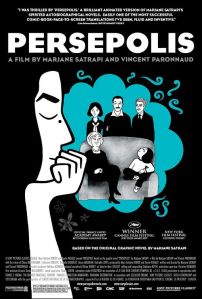 Marjane Satrapi has, by all accounts, a very unique life. Growing up under the repression of the Islamic Revolution, she settled in France and created a series of acclaimed best-selling graphic novels called Persepolis, based upon her life growing up in and out of Iran. The movie was France’s official entry for the 2007 Foreign Language Oscar, bypassing the equally lauded and inventive Diving Bell and the Butterfly. And yet Persepolis did not even make the short list of nine nominees, which eventually gets parred down to five (neither did 4 Months, 3 Weeks, and 2 Days, which WON the Best Film from the European Film Awards, over other movies that managed to make the Academy’s five nominees). I consider this a glaring omission. How could anyone not be entranced by Satrapi and co-director Vincent Paronnaud’s masterwork?
In Tehran, the capital of Iran, young Marjane and her family watch as rebellious forces overthrow the Shah in 1979. The Shah was the ruler of Iran and could readily be described as a dictator. He was friendly to Western countries and wanted Iran to follow their lead. Large forces unified and deposed the Shah, setting the stage for Iran to have its own system of rule that the people would decide upon. Marjane’s father swings her around in his arms and excitedly proclaims that democracy has come to his country at last. Landslide numbers “vote” for radical Islamic leaders to take control of the government, and Iran becomes a militant theocracy. Privileges and reforms are revoked, and women will have to wear long burquas and veils to be righteous. Marjane is too outspoken and her parents, fearing for her safety, send her to Europe to be educated. While she is absent Iraq attacks Iran and the countries are engulfed in a decade-long border war.
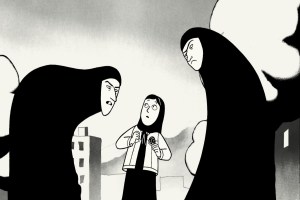 Persepolis is a gem of a movie, at once a personal coming-of-age account that manages to be fascinating and honest and also a universal tale of struggle for cultural identity. The evocative black and white animation is a joy to watch. The crisp drawing style manages to express so much with the seemingly simple, clean images. At times the visuals take on a lovely German expressionistic feel, and the world feels like it is made out of folded layers of paper. I would fall in love with a movement, a facial expression, that fact that smiles look like boomerangs, something small yet immeasurably enjoyable that struck a deep chord inside me. The arresting black and white visuals do not distract from the story in any way, in fact they help to mirror the repressive nature of what befalls Iran. A silhouetted group of protesters is shot at and one of them falls to the ground. Great inky blackness seeps out of the fallen body and merges with the rest of the screen, adding emotional heft that color could never capture.
Told for long stretches from the perspective of a child, Persepolis manages to find unique perceptions. The child point of view allows the film to unfold naturally with innocence and inquisitiveness, qualities that would soon be hard to recapture once the promise of revolution turned sour. Young Marjane feels jealous and competitive that her cousin can brag that her father spent more time as a political prisoner. It’s an odd stance for an adult and yet it feels entirely within reason for children. Marjane deals with issues she cannot fully understand as a child but she tries her best. The eyes of children also let the filmmakers mingle with the fantastic. Marjane speaks to God at points, and after a horrible tragedy God is trying to apologize and explain but little Marjane will not hear any of it. She orders God to leave her and so He departs. A little girl turning her back on God will hit you is the kind of devastating stuff that can put a permanent lump in your throat.
I was dumbfounded at the emotional depths the film plumbs in a scant 95 minutes. This is an incredibly powerful tale, richly told with poignant insights and grace. There were several times I was overcome with emotion and had to dab my eyes. Satrapi achieves great emotional resonance with minute details, making the film exciting in how engaging it continues to be from beginning to end. Marjane’s relationship with her family anchors the movie and you can feel the power of their love and bonds. Imprisoned uncles who spouted communist dogma are released only to be seen as a danger once again. Marjane’s mother is worried when Marjane keeps showing a fiery outspoken spirit. One day she shakes a teenage Marjane, screaming at her the horrid possibilities that can happen to women under this regime. She cites one teenage girl who was executed, but they don’t believe in killing virgins, so the guards took care of that bothersome roadblock. Marjane’s mother is wild-eyed with fear and what might await her little girl, and her gnawing concern is resoundingly powerful. Marjane’s grandmother serves as her emotional compass throughout her life. Grandma stresses that Marjane should be proud of her cultural identity and stay true to herself. When Marjane gets older she hears her grandmother’s voice to set her straight in times of doubt.
 But while the movie can be heartwarming, it does not fall victim to sticky sentimentality. Satrapi deals with some harsh truths about life in Iran and also her time in Europe as a blossoming woman without a country. She doesn’t sugarcoat reality and Marjane’s parents make it a point to be up front with their daughter about what is happening; an uncle tells little Marjane, before he is executed, that knowledge must live on and she, the youth, must be the one to keep it alive. The Iran-Iraq war ends in a stalemate with millions in casualties. Persepolis details life behind the veil and the shift the country took to radical Islamic rule but the film isn’t all doom and gloom. There’s a natural curiosity about a story of a girl who becomes a woman in a repressive society. Marjane’s spiky rebellious spirit makes for genuinely human comedy. She shops for Iron Maiden tapes on the Iranian black market, wears a jacket that states, “Punk is not ded,” and screams with joy at ripping her veil off during a car ride and letting the wind gust through her hair. There is a bounty of humor to be found in unexpected places. Marjane is running to catch a bus and is stopped by two policemen who complain that when she runs her butt moves “in an obscene way.” She simmers and finally yells, “Then stop staring at my ass!”
If Persepolis has any shortcomings it’s that the narrative peaks a bit too early. Seeing a child come of age during the Islamic Revolution is generally more interesting than watching a teenager navigate unfaithful boyfriends in Europe. Persepolis never stops being entertaining or relevant, it just so happens that the greater emotional rewards are tied to life and family in Iran.
Persepolis is a marvelously moving and unique coming-of-age tale set against a unique time. Marjane Satrapi’s graphic novels have fluidly been translated into a film that resonates with great emotional turmoil and inspiration. The alluring black and white visuals and clean animation style dazzle the eyes, while the enthralling personal story reaches deep inside and touches the heart. The film is brilliant, beautiful, harrowing, deeply human, fascinating, and ultimately inspiring. It’s rare to find a movie that can hit so many emotions with finesse, animated or live action. Persepolis is a bold vision and a revealing and lovely film that I cannot wait to revisit often. This is more than just a cartoon, folks. This is art.
Nate’s Grade: A


 nathanzoebl
You must be logged in to post a comment.