Blog Archives
Double Walker (2021)
 After watching so many nominal Ohio-made indies, it’s a welcomed surprise to come across one that falls into the category of an “almost” movie, and by that I mean one with clear ambition and talent that almost fully works as a legit movie without any lingering qualifiers. Double Walker, filmed partially in Columbus and now given a national digital release, comes so tantalizingly close to being a full recommendation without hesitation. I can see what it’s going for, and with a little more careful development and clarity I think it would have achieved all of its genre-busting goals.
Sylvie Mix plays Ghost, a young woman who appears in a white nightgown in the woods. Who is she? What does she want? She is escorted by a young man into his home, disrobes, and then murders him. We come to learn that this adult woman is the ghost of a deceased child, and she’s chosen to walk the Earth as a spirit to seek vengeance. She’s only able to be seen by believers and sinners, though technically every person is a sinner unless there is an unspecified threshold to pass. The Ghost makes a friend, visits with her grieving parents, and reevaluates what it means to be human.
 The first thing to know about this movie is that it is only 65 minutes long, short of the 80 minutes typically seen as the minimum expectation for a theatrical release. It’s not that far from meeting that goal, though the airy nature of the movie also makes it feel already stretched out. The other thing you should know about the movie is that you could describe it as Promising Young Woman meets The Crow, an avenging angel targeting the bad men responsible for her death, except tonally it’s not really a hard-hitting revenge thriller. It has those elements where our Ghost is stalking her very bad men, luring them into positions of vulnerability, and striking back for justice, but the movie seems more aligned in tone with something more ponderous and poetic like 2017’s A Ghost Story (though absent ten minutes of Rooney Mara eating a pie – thus fulfilling my obligation to mention this dumbfounding cinematic moment whenever I have the opportunity, you’re welcome).
For those people looking for sundry exploitation thrills, seized by the striking central image of its poster, you may be left checking your watch, but I found this middle ground between thriller and art film to be an interesting space for Double Walker to inhabit. The screenplay drops you into its bizarre scenario and unfolds slowly, which I think worked to the film’s potent atmosphere. You don’t really know what’s going on or what the character relationships are like. At first you see a grieving family, and next we cut to a man discovering a pale woman who seems lost in the woods. She comes across ethereal and mysterious. Then there is a murder, and from there we’re trying to identify the character connections and back-story, which comes across at a gentle yet assured pace that trusts the audience to put the different pieces together to form a whole. This works well except for an ending that comes across as too confusing, muddling an already convoluted system of supernatural rules that the movie seems to be undercutting, unless the whole thing is presented as a hopeful but passing dream, and if that’s the ending then I’m going to be quite disappointed. Still, this is a movie at its core more interested with the question over being human, being remembered, and personal identity than as a blood-soaked revenge thriller.
 Again, it has its moments of blood, but there’s a somber tone poem quality to the movie that elevates its ambitions and also ties down its ultimate execution. Director and co-screenwriter Colin West is using the structure of an exploitation film to do more than deliver sleazy thrills. He devotes much more time to watching our Ghost character adjust to life as a spirit. The Ghost is the same spirit as the little girl we saw being eulogized in the opening. This presents some awkwardness for the character and the viewer. For the character, she’s gone from the mind of a child to being in the body of an adult, and it’s not determined whether this adult body is what she would have eventually grown into being or whether it’s just a default model. This allows for an even more curious performance as a character that feels alien in their own skin but also fascinated by that change in perspective, like Scarlet Johansson in Under the Skin. I understand the Ghost studying her adult body with curiosity. However, for the viewer, the numerous nude scenes can make you uncomfortable with the understanding that this is a little girl transported into the body of an adult and she is using her sexuality to lure men to their perverted doom. Maybe I’m just more sensitive to this connotation, and “using her sexuality” seems like an overstatement as she’s simply a woman being present with predatory men. I will say the nude scenes are tastefully portrayed where the camera doesn’t feel like it’s going to painful lengths to feature flesh. I was about to accuse the movie of possibly being skeevy with its plurality of nude scenes (does the Ghost need to run out into the woods in the buff?) when I noticed that Mix is also the producer and co-screenwriter. I assume she approved of her depiction.
Because of her newfound identity, and separation from most living beings, Double Walker presents a main character who is trying to form connections but cannot. The Ghost tries to console her grieving mother but is unable to be seen or felt by her. She does meet a kind man (Jacob Rice) at a movie theater who helps her out and who is not looking to take advantage of her. He shares his family’s home movies, which is a slightly strange thing to do so soon with a nearly mute stranger, and compares the images captured on film like ghosts, crystalized memories of people no longer with us. I have thought of this comparison myself and will morbidly watch background extras in old movies and think, “Here they are, alive once more, but likely gone for some time.” The direct connection of ghosts and memory allows the movie another layer to provide additional meaning. However, Double Walker feels more like a stretched out short film than a fleshed-out feature. With a few extra wrinkles and plot development, this could have readily afforded a larger story. Later on, the Ghost makes a rash decision and an innocent is harmed in her path to vengeance. I think that’s an interesting direction and questions the righteousness of her cause, while at the same time the script finds a personal way to make that mistake even more grueling. Again, the script really could have gone into this consequence and pushed the character into more inner turmoil, to question the cost of her mission, and to question her perception of human life. There are areas where the movie could have gone into further deliberation, but they feel short-changed. Double Walker is settled being the extra long version of the movie it presents in its first act.
 This is a very professional looking and sounding movie and probably has the best photography of any Ohio-made indie I’ve watched yet. West also served as his director of photography, and his eye for visuals is crisp and pleasing. The use of light, shadow, foreground and background, composition, movement, it was very deliberate as well as being artistic in a way that didn’t feel like it was overly self-indulgent. West achieves an artistry without making it flashy, and that’s even harder to accomplish. The score and sound design are also polished as well. When the Ghost is luring a victim, the eerie sound is reminiscent of metallic scraping to elicit unease. The costuming keeps our Ghost in white outfits, noting her innocence but also visually connecting you to the associated color of traditional spirits (an also, maybe, A Ghost Story). It makes her standout on the screen. Speaking of that, Mix (Poser) is a natural actor. She has a presence to her and ably communicates the curiosity and otherworldly nature of her character’s dilemma. She doesn’t talk much, nobody really does in this movie, but there’s a melancholy to her that feels more pained than forced. The other actors do well with their minor roles, including other Ohio actors I’ve covered before like Justin Rose (False Flag) and Ralph Scott (Constraint) playing bad men who become ghostly prey.
By the end of Double Walker, I was left feeling almost satisfied, one of those film experiences where you can see the better movie just on the peripheral, the one that was so close. As it stands, it’s an arty and contemplative movie that uses the exploitation formula as a vehicle to explore more existential questions. I wish the movie had developed the story more from the potential on display, and what potential is on display. The filmmakers here feel like they are headed for great things. West has already filmed another movie he wrote, Linoleum, starring Jim Gaffigan and Tony Shalhoub about a science teacher who always wanted to be an astronaut and builds his own rocket ship in his garage. That sounds amazing and it has big names to fill out the cast. I’m rooting for West. This guy has the talent and ability to be a rising indie director and can do Ohio proud. Double Walker could end up being the flawed but promising start to a burgeoning film career. It’s worth watching but be warned that it might not be the movie you anticipate at first glance.
Nate’s Grade: B
Share this:

Escape from Death Block 13 (2021)

Gary Jones is no stranger to schlock. The writer and director’s feature debut was 1994’s Mosquito about killer mosquitos that have fed on the blood of dying aliens. His filmography also includes such amusing titles as Crocodile 2: Death Swamp, Jolly Roger: Massacre at Cutter’s Cove, Planet Raptor, and 2013’s Axe Giant: The Wrath of Paul Bunyan, which was filmed in Ohio and featured several actors that have appeared in other Ohio indies I’ve reviewed, like Dan Kiely (Bong of the Living Dead), Kristina Kopf (The Street Where We Live), and Thomas Downey (Evil Takes Root). Jones knows his schlock. Escape from Death Block 13 is the man’s ode to the prison escape thrillers of the 1970s, and it even stars a lead actor who looks remarkably like Charles Bronson. I hoped that Death Block 13 was going to be the good kind of low-budget indie, the one that swerves into its schlocky genre trappings and limitations. However, too many of its creative limitations felt more notable, from limited actors, the limited location shoot, and especially the limited plot development for payoffs and action goodness.
Mick (Robert Bronzi) is a recent immigrant trying to set right his brother’s fate. He visits his dead brother’s boss, Renda (Nicholas Turturro), and demands the money cheated from his brother. Renda’s goons rough up Mick, and in the scuffle, Mick shoots a gun in defense and he’s the one arrested and charged with attempted murder. Inside the deadly prison, life is rough that the guards will let the prisoners fight to grievous harm because they have bets on who will win. Mick becomes a favorite of Warden Jack (Debbie Scaletta) who pressures him to go along and assist with her lucrative smuggling business of guns and drugs. Mick refuses and makes himself a target. He’ll need to adjust to life behind bars, stand up to the bullies, and plot his escape with the secret tunnels located under the grounds of the prison.

The question arises how far a Charles Bronson lookalike can get you as far as entertainment value, and that’s going to be a question for the soul of every viewer. The movie feels like it was a Cannon production, where the poster and title were the selling point and the rest, well we’ll get to that when we need to. The central image of a man that looks like Charles Bronson, holding a gun, looking grimaced, with a title about a prison break, it all feels meant to target a certain audience’s favorable memories of Bronson and his own popular action filmography. Low-budget exploitation genre movies have been made for less, so it’s not a damnable sin, but it sure means that the movie’s transparent intention to rest on its familiar elements needs to be overcome with story, characters, and most importantly, memorable action and ridiculous moments to satiate an audience’s genre appetites. Escape from Death Block 13 mostly gets there when the escape part happens, but beforehand, it’s a sloppy action movie that can test your patience because there are too many reminders of its own scaled-down shortcomings.
Chief among them is casting Bronzi as the lead. It feels like the mere casting of this Hungarian acrobat, stuntman, and Judo player, as per his bio, was the starting and ending point for his character. He’s an immigrant looking to avenge his brother and immediately gets thrown into the middle of a conflict as everyone seems to be incorrectly judging him (subtle commentary on the audience expectations?) based on his appearance. The gang thinks he’s up to no good, the other prisoners and the warden think he’s a troublemaker, and the law thinks he could be their missing piece and assist to bring down the corrupt warden. It could almost be self-parody the way every new batch of characters project an identity onto this blank hulk of a man. I think even Bronzi is leaning into this helpful projection and association with Charles Bronson. His real name is Charles Kovacs, but Bronzi sure sounds closer to Bronson. He also starred in Once Upon a Time in Deadwood, working to associate Bronson’s Once Upon a Time in the West, as well as the HBO Western series, and Death Kiss, working to associate Bronson’s Death Wish. Again, congrats to Bronzi for finding himself a career as a Charles Bronson stand-in. I look forward to the man’s continued career of kind of reminding people of the departed Bronson.

However, Bronzi is not a terribly good actor. His line readings are resolutely stiff, and his accent is thick, so it can be hard to understand what he’s saying with his flat affect. There’s one joke where he makes fun of another prisoner for not understanding his accent, but I didn’t quite understand the joke because I was having trouble with his vocal articulation. To the man’s credit he definitely has a presence and can convincingly strike an intimidating pose. He’s comfortable with the fight choreography though it’s nothing too complex to be strenuous. His emotional acting range and vocal delivery is another matter. I think the limited nature of Bronzi’s ability forced the filmmakers to minimize the number of lines and dramatic scenes for his character, thus making him even less distinct and relying more on his passing impression.
I legitimately think the movie could have been improved had everyone been dubbed. Bronzi is not the only actor of limited range in the movie, he’s just the one with the most screen time. There are many supporting actors who were clearly hired for their physical prowess rather than thespian abilities. These actors would say lines and it would make me giggle at points. There are other actors who take one note, like the police officer in an interrogation scene trying to go full intense exasperation mode, and then deliver every line in this narrow acting space. It’s moments like this where the movie feels destined to willfully drift into unintentional self-parody. I think having a purposely dubbed audio track would provide two benefits: 1) it would allow better vocal actors to lift some of the lackluster performances, and 2) it would further cement the movie’s silly schlock factor and give the audience permission to laugh along with. The best actor in the entire movie is the prison doctor and just for the one scene where he dies. After being injected with a deadly dosage, he goes into cardiac arrest and the actor is so dedicated, so over-the-top, and so prolonged in his death throes that I had to celebrate the man’s gumption. Here was a guy who took what was handed to him and found a way to make it delightful. I wish every actor was on this same tonal wavelength of good-bad rather than just dull-bad.
Once the titular escape happens, the movie jolts to a new life, enough so that I wish we could have gotten things moving faster. The last twenty minutes of the movie is replete with chaotic violence and over-the-top blood shots. The action is adequately choreographed and fast-paced enough to offer several different set pieces and cross-action to keep your attention. It’s all over the place, it’s more whole-heartedly schlocky, and the frantic pacing is a definite bonus. The problem is that as a prison break movie there wasn’t really any definite reasons why the characters had to wait until this late moment to stage their escape. Usually, these kinds of movies introduce the system of the prison so we understand the routines so that they can then be exploited, like a con or a heist job. We need to know the particular steps for the payoff to feel rewarding. Otherwise, like in Death Block 13, it just feels arbitrary. The evil warden doesn’t come across as too formidable. The guards are not too formidable. These people are not the smartest criminals in the world of smuggling. And the inmates could have banded together at any point and easily overthrown this weak power dynamic. Even the heavy-duty Gatling gun attached to the lookout tower isn’t too hard to overcome. The obstacles are vague or weak, thus making it feel like the big escape could have happened as soon as Mick was thrown into this pokey.
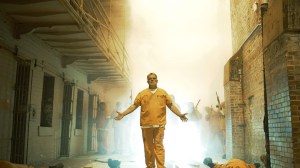
The movie was filmed in the Mansfield Reformatory, the same famously depicted in 1994’s Shawshank Redemption, but at points it sure doesn’t feel that way. I don’t know the exact budget-conscious decisions of the production or the shortcuts they had to work through, but there are several sequences inside and outside the prison that are obviously green screen. It made me start to meticulously examine the visuals and see if it was indeed the famous penitentiary or some other set meant to be stitched together through the power of editing. It’s possible the movie had a very limited availability to shoot inside the prison, so they took extensive pictures to recreate as a more convenient green screen background. I’m uncertain. The green screen work isn’t bad by any means but pretty obvious to the eye and limits the potential visual arrangements for staging the action, which can often resort to shot-reverse shot redundancy.
If the rest of the movie was like its concluding act, I would be recommending Escape from Death Block 13 to fans of low-budget schlocky action and fans of Charles Bronson. It’s strange to think part of the major appeal of this movie is that it stars a guy who strongly resembles another guy that was in movies decades ago that people mostly remember liking. The general association of other, better movies seems to be much of the creative backbone of this movie. The story isn’t packed with careful setups and payoffs, built upon a foundation of obstacles and mini-goals that need to be accomplished before the big escape finish. It relies too heavily on cliched genre moments, like multiple prison yard fights, and the riot ends in a hostage negotiation that could have been its own movie itself rather than a pat conclusion. The movie is weighed down by the acting limitations of its lead who looks the part but fails to do much more on screen. It’s an action movie that, even with caveats and understanding of its limits, manages to disappoint. I wish this had been crazier, or better plotted, or filled with more colorful and arresting characters, or bigger villains, or anything really. It’s an action movie that feels like the ghosts of other, better action movies starring a man who might as well be the living ghost of Charles Bronson.
Nate’s Grade: C
Share this:

Mulholland Drive (2001) [Review Re-View]

Originally released October 19, 2001:
Mulholland Dr. has had a long and winding path to get to the state it is presented today. In the beginning it was 120 minutes of a pilot for ABC, though it was skimmed to 90 for the insertion of commercials. But ABC just didn’t seem to get it and declined to pick up David Lynch’s bizarre pilot. Contacted by the French producers of Lynch’s last film, The Straight Story, it was then financed to be a feature film. Lynch went about regathering his cast and filming an additional twenty minutes of material to be added to the 120-minute pilot. And now Mulholland Dr. has gone on to win the Best Director award at Cannes and Best Picture by the New York Film Critics Association.
Laura Harring plays a woman who survives a car crash one night. It appears just before a speeding car full of reckless teens collided into her limo she was intended to be bumped off. She stumbles across the dark streets of Hollywood and finds shelter in an empty apartment where she rests. Betty Elms (Naomi Watts) is a young girl that just got off the bus to sunny California with aspirations of being a big time movie star. She enters her aunt’s apartment to find a nude woman (Harring) in the shower. She tells Betty her name is Rita after glancing at a hanging poster of Rita Hayworth. Rita is suffering from amnesia and has no idea who she is, or for that fact, why her purse is full of thousands of dollars. Betty eagerly wants to help Rita discover who she is and they set off trying to unravel this mystery.

Across town, young hotshot director Adam Kesher (Justin Theroux) is getting ready to go into production for his new film. He angers his mob producers by refusing to cast their chosen girl for his movie. After some harassment, threats, and a visit by an eyebrow-less cowboy assassin (God bless you David Lynch), he relents.
In the meanwhile, people are tracking the streets looking for Rita. Betty and Rita do some detective work and begin amassing clues to her true identify. As they plunge further into their investigation the two also plunge into the roles of lovers. Rita discovers a mysterious blue box and key in her possession. After a night out with Betty she decides to open it, and just when she does and the audience thinks it has a hold on the film, the camera zooms into the abyss of the box and our whole world is turned upside down.
David Lynch has made a meditation on dreams, for that is at the heart of Mulholland Dr. His direction is swift and careful and his writing is just as precise. The noir archetypes are doing battle with noir expectations. The lesbian love scenes could have been handled to look like late night Cinemax fluff, but instead Lynch’s finesse pays off in creating some truly erotic moments. Despite the population of espresso despising mobsters, wheelchair bound dwarfs, and role-reversal lesbians, the audience knows that it is in hands that they can trust. It’s Lynch back to his glorious incomprehensible roots.
Watts is the true breakthrough of Lynch’s casting and she will surely be seen in more films. Watts has to play many facets of possibly the same character, from starry-eyed perky Nancy Drew to a forceful and embittered lesbian lover.
One scene stands out as a perfect example of the talent Watts possesses. Betty has just been shuffled off to an audition for a film and rehearsing with Rita all morning. She’s introduced to her leathery co-star and the directors await her to play out the audition scene of two kids and their forbidden love. As soon as the scene begins Betty vanishes and is totally inhabited by the spirit of her character. She speaks her lines in a breathy, yet whisper-like, voice running over with sensuality but also elements of power. In this moment the characters know, as the audience does, that Betty and Naomi Watts are born movie stars.
It’s not too difficult for a viewer to figure out what portions of the film are from the pilot and what were shot afterwards. I truly doubt if ABC’s standards and practices allows for lesbian sex. The pilot parts seem to have more sheen to them and simpler camera moves, nothing too fancy. The additional footage seems completely opposite and to great effect. Mulholland Dr. has many plot threads that go nowhere or are never touched upon again, most likely parts that were going to be reincorporated with the series.
The truly weirdest part of Mulholland Drive is that the film seems to be working best when it actually is still the pilot. The story is intriguing and one that earns its suspense, mystery, and humor that oozes from this noir heavy dreamscape. The additional twenty minutes of story could be successfully argued one of two ways. It could be said it’s there just to confound an audience and self-indulgent to the good story it abandons. It could also be argued that the ending is meticulously thought out and accentuates the 120 minutes before it with more thought and understanding.
Mulholland Dr. is a tale that would have made an intriguing ongoing television series complete with ripe characters and drama. However, as a movie it still exceeds in entertainment but seems more promising in a different venue.
Nate’s Grade: B
——————————————————
WRITER REFLECTIONS 20 YEARS LATER

How much is a dream worth to you? That’s my main takeaway re-watching David Lynch’s surreal indie Mulholland Drive twenty years later from its release. Lynch has had plenty of his own run-ins with the dream makers of Tinseltown, from the difficulty to see his admittedly weird projects off the ground to the swift cancellation of his once zeitgeist, and deeply weird, TV series, Twin Peaks. It’s common knowledge now that Mulholland Drive began as a 1999 TV pilot that Lynch re-conceived as a movie, shot 30 minutes of additional footage, and earned a 2001 Best Directing Oscar nomination for his perseverance and creative adaptability. The movie has since taken on quite a reputation. The BBC and Los Angeles Society of Film Critics have both hailed it as the best film of the twenty-first century (so far). Lynch has retreated back to his insular world of weirdness with hypnotic, over-indulgent retreads, Inland Empire, and bringing back his signature TV series for a Showtime run in 2017. In 2001, Mulholland’s Drive’s success seemed to be the last point with Lynch working with the studio system he so despised. In a way, this is his farewell letter to chasing his own dreams of stardom, at least as far as a director can have creative control and a steady supply of protection and money to see his vision through. Watching Mulholland Drive is like stepping through a dream, which has been the hallmark of Lynch’s more celebrated, obtuse filmography from 1977’s Eraserhead onward. The movie is meant to operate on a certain dream logic, sustained with choices that seem artistically self-destructive, but the journey might feel as emotionally or intellectually fleeting as a dream as well, so I ask you, dear reader, to think as you continue, how much is a dream worth?

The failed pilot serves as a majority of the film’s running time and it’s filled with peculiar beginnings that will never pay off. There are actors like Robert Forster (Jackie Brown) and Brent Briscoe (Sling Blade) who show up for one whole scene and then are never seen again. Presumably, the roles would have been more significant as detectives snooping around from the peripheral. There are mysterious forces chasing after “Rita” (Laura Harring), an important-looking woman who has conveniently lost her memory and adopted her name after seeing a poster of Rita Hayworth. She’s got a bag filled with money, a gun, and blue key. One would assume over the course of a network season that we would get closer to discovering the real identity of our amnesiac leading lady. There are also scenes that seem to exist as their own short films, like the darkly comedic hapless hitman and the scared man detailing his spooky dream to a concerned friend in a diner. These characters, presumably, would come back for more significance or at least larger interplay. The same with the mysterious locked box and key. You can practically identify the J.J. Abrams “mystery box”-style of storytelling for future intrigue. The role of a TV pilot is to serve up a storytelling engine that can keep churning, as well as ensuring that there’s enough curiosity to hook an audience through commercial breaks. Lynch is used to inserting strange symbols and starts in his movies that potentially go nowhere, so the difference between a Lynch pilot and a Lynch movie aren’t terribly noticeable. These characters, clues, and moments were perhaps intended to be developed further, or perhaps they never were. It’s as if the movie itself is a nightmare of different television programs colliding incoherently.
There does seem to be a consensus interpretation for Mulholland Drive, one that synchs up the various doubles and symbols. For two hours, we’re riding along with Betty (Naomi Watts) as she moves to L.A. with big dreams and perky naivete. She finds the amnesiac Rita in her aunt’s apartment and takes it upon herself to give her a home and investigate her identity. They grow close together, Betty nails her big acting audition, and then Betty and Rita become lovers. They go to a club (Silencio) where performance artists insist “everything is recorded,” and thus already happened, phony, and a replication of memory, and then Rita inserts that mystery blue key into the mystery box and mysteriously vanishes. We next return to the scene of Diane, who at first was a dead body that Rita and Betty found during their investigation. Now it’s Betty, or at least Watts playing her, and she’s a struggling actress who is jealous of the success and favor her girlfriend, Camilla (also played by Harring), is indulging in from their seedy director, Adam (Justin Theroux). Overcome with torment, she hires a hitman to kill Camilla. From there, she’s attacked by a homeless monster, tiny versions of the people portraying Betty’s parents in the first part, and she takes her own life in grief and guilt. The most common interpretation is that the final twenty or so minutes with Watts as Diane is the real story and that the proceedings 110 minutes was Diane’s dream trying to process her guilty conscience and mixed emotions. The blue key, the symbol from Diane’s hired hitman of a job completed, is the point of transportation between the dream and returning to a living nightmare of regret. Adam’s prominence in the first two hours is explained as punishment from Diane’s mind, so this is why he is emasculated repeatedly, from being robbed of control over his movie, his marriage, and ultimately his future.
Just because this is the most prominent interpretation, and even perhaps the author’s intended one, doesn’t mean other viewers cannot find equally valid and differing interpretations. That’s the appeal or point of frustration with Lynch’s most Lynchian work. However, the problem with asserting that the first two hours of your two-hour-plus movie were all a dream can make it feel overindulgent and unsatisfying. The TV pilot segments are shot in a way that evokes the cliché storytelling stye that prevailed at the time, with overly lit scenes and flat acting. I cannot say for certain but it feels like Lynch purposely told Watts (King Kong) to try and be hammy. Lynch has been known to purposely ape the style of prime-time soaps to provide subtle satirical contexts. Is Watts doing a bad job with the purpose of making us think of other bad actors from soaps? The one scene Betty comes alive is during her audition scene. We’ve already seen her act it out once so we’re expecting more of the same, but in that moment, she comes alive with sensuality, taking control from the aged acting partner who was just there to exploit some young new starlets. The intensity she unleashes, a mixture of carnal desire and self-loathing, is nothing like bright-eyed Betty. Is the irony that when Betty is pretending to be someone else that’s when the performance excels? You can see the points for interpretation, especially considering the ending thesis, but if so, it’s such a bold gamble by Lynch that could prove so alienating. You’re deliberately having your lead actress act in a cliched and stilted manner to perhaps make a point fewer will grasp? Obviously, the ending wasn’t intended to pair with the pilot parts, so it feels like projecting an unintended meaning onto the intentions of acting decisions, but dreams are murky that way.
I wouldn’t be surprised if just as many people are tested by Mulholland Drive as they are mesmerized. It’s a combination of different genres and film iconography, from Manning as a living-breathing femme fatale, to dark whimsical comedy, to surreal mystery, to tawdry erotic drama, to industry-obsessed soap. As much as it feels like a pilot retooled into a new beast, it also feels like a collection of genres being retooled for whatever intended association Lynch wants to impart. It’s ready-made for dissection and ready to take apart the Hollywood studio system. I enjoyed some of the strange moments that felt most ancillary, like the mobster with the extremely refined taste for espressos, and the eyebrow-less cowboy assassin threatening Adam. That scene in particular still has an unsettling menace to it, as Lynch takes what could have been absurd and finds a way to make this man overtly threatening without ever explicitly doing anything threatening. His browbeating to Adam over the difference between listening and hearing is well written and ends perfectly: “You will see me one more time, if you do good. You will see me… two more times, if you do bad. Good night.” I wish more sequences like this could stand on their own. So much of Mulholland Drive seems intended to provide a skeleton for meaning to be provided later as the added meat that Lynch didn’t value as highly.
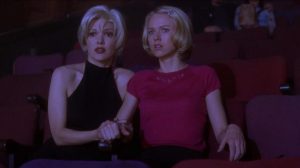
Watts became a star from this movie and was taken to another level with the success of 2002’s The Ring. From there, she was in the Hollywood system of stars and after toiling for ten years from rejected interviews to rejected interviews. She was thinking of quitting acting and going back to her native Australia at the time she got asked to play Betty/Diane. The audition scene, the later distraught and frail Diane, as well as the mannered Betty served as an acting reel for every casting agent that had rejected her. Here was Watts, capable of doing it all and then some (she was nominated for two Oscars – 2003’s 21 Grams and 2012’s The Impossible).
My original review in 2001 is also wrestling with the question over interpretation versus intention, with the genre mash-ups as symbolic satire or as laborious TV pandering. Mulholland Drive is like watching a dream and trying to dissect its many meanings. Some people will relish the puzzle pieces that Lynch has provided and finding further hidden mirrored meanings, and other people will throw up their hands and ask for a road map, or lose interest by then. I don’t think this is the best film of the first twenty years of this new century. I don’t even think it’s close. I think at its best it can be hypnotic and intriguing; it’s a shame that these are only moments for me, and twenty years later these moments felt even further spaced apart. I just didn’t find Lynch’s movie quite worth the long, surreal drive into the dark of his imagination.
Re-View Grade: B-
Share this:

Donnie Darko (2001) [Review Re-View]
 Originally released October 26, 2001:
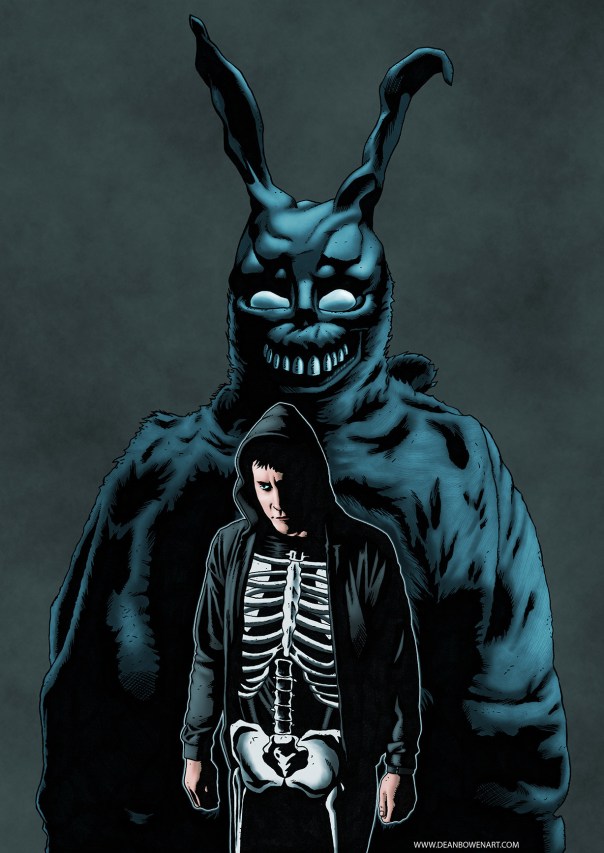
Donnie Darko (Jake Gyllenhaal) is your normal malcontent teenager in late 1980s Reagan America. He bickers with his older sister, worries over the right moment he’ll kiss his new girlfriend, and tries to ignore the advice of many imprudent adults. Donnie’s your typical teenager, except for his imaginary friend Frank. Frank is a sinister looking six-foot tall rabbit that encourages Donnie into mischief and gives a countdown to the impending apocalypse. And I haven’t even gotten to the time travel yet.
One night as Donnie wanders from his home at the behest of Frank, an airline engine mysteriously crashes through the Darko home and lands directly in Donnie’s room. The airlines are all at a loss for explanation, as it seems no one will take responsibility for the engine or knows where it came from. Donnie becomes a mild celebrity at school and initiates a relationship with a new girl, Gretchen Ross (Jena Malone). One of his classes consists of watching videos of self-help guru and new age enlightenment pitchman Jim Cunningham (Patrick Swayze). His school has even, under the persistence of self-righteous pain Kitty Farmer, persuaded Cunningham to speak and try to help students conquer their “fears.”
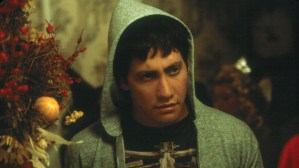 Donnie is also seeing a therapist for his emotional problems and taking medication for borderline schizophrenia. Around this time is when Donnie starts to inquire about a strange old woman, obsess over the possibilities of time travel, as well as see weird phosphorescent pools extend from people’s chests. He also floods his school at the urging of Frank. This is no Harvey-type rabbit.
The longer Donnie Darko goes on the more tightly complex and imaginative the story gets. First time writer-director Richard Kelly has forged an excitingly original film that is incredibly engaging with charm and wit. He masterfully mixes themes of alienation, dark comedy, romance, science fiction, and a sublime satire of high school. Donnie Darko is the most unique, head-trip of a movie unleashed on the public since Being John Malkovich. Kelly has a created an astonishing breakthrough for himself and has ensured he is a talent to look out for in the future.
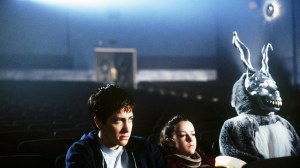 Gyllenhaal (October Sky) is superb as disenchanted Donnie, a Holden Caulfield for middle suburbia. His ghastly stare conveys the darkness of Donnie but his laid-back nature allows the audience to care about what could have merely been another angst-ridden teenager. Swayze is hysterical as the scenery-chewing Cunningham. The rest of the cast is mainly underwritten in their roles, including stars Drew Barrymore (who was executive producer) and ER‘s Noah Wyle, but all perform admirably with the amount they are given. Not every plot thread is exactly tidied up but this can easily be forgiven.
Donnie Darko is a film that demands your intelligence and requires you to stay on your toes, so you can forget any bathroom breaks. The film is one of the best of 2001 but also one of the funniest. You’ll be honestly surprised the amount of times you laugh out loud with this flick. The theater I saw this in erupted every half a minute or so with boisterous laughter.
Donnie Darko is a film of daring skill and great imagination. You don’t see too many of these around anymore.
Nate’s Grade: A
——————————————————
WRITER REFLECTIONS 20 YEARS LATER
Not to sound too annoying, but I’ll cash in my hipster points here and declare that I was on the Donnie Darko bandwagon from the start. The eventual cult phenom was originally released in October 2001, mere weeks removed from 9/11, dooming its commercial appeal considering a major plot point happens to involve deadly airline debris. I was a sophomore in college across from a little indie movie theater, the Drexel, that was like a wonderful escape for a budding cinephile looking for his next fix of weird and daring movie experiences. I recall seeing the trailer for Donnie Darko and being immediately intrigued, but its release date kept bouncing back month after month until it finally opened at the Drexel in February 2002, and I was there opening day. I saw it twice, brought friends with me, and I wrote about it as one of my earliest reviews as my college newspaper’s film critic. I wanted to get the word out that this was something special. The first day it was available on DVD, I went to Best Buy looking for a copy and the store employee was deeply confused about its existence. He probably knows now, as the movie achieved cult status on DVD and became an iconic indie fixture for many a Millennial.
Revisiting the films of 2001 has been reliving many films that made such formative impacts on my life: Memento and its airtight structural sleight-of-hand, Moulin Rouge and its ambitious and messy celebration of old, new, reverent and irreverent, and now Donnie Darko (this isn’t even counting films I never wrote reviews for and thus were ineligible for this re-watch, like Hedwig and the Angry Inch and Amelie – 2001 was an excellent year at the movies). I have probably watched this movie more than any other in the 2000s, with the late exception perhaps of The Room that came on strong for me at the end. My friends and I would debate it, quote it, and work toward bringing others into the cult of Darko. Looking back now twenty years, I’m happy to report the movie’s power is still just as alluring and transcendental. What earned this movie its fawning fandom? Why did writer/director Richard Kelly, only in his early 20s, find success with his weird little indie while others went painfully ignored? I think it comes down to Kelly’s ambiguous approach, threading a delicate needle so that there are enough pieces present to put together an interpretation that can prove satisfying while personal and potentially different from your friend or neighbor with an equally valid interpretation.
 What helps is that Donnie Darko doesn’t feel like it’s weird for weird’s sake, like a formless collection of strange ideas and confounding imagery operating on an unknowable surreal dream logic. What Kelly has done is mix and match parts of an intriguing apocalyptic puzzle. There’s relatable high school drama about pushing back against the hypocrites and phonies of the adult world, there’s a mystery about who or what is behind Frank the bunny, the creepy otherworldly figure serving as Donnie’s Virgil-like guide, and the character study of a lonely, troubled kid trying to find a better sense of understanding of himself, his place in the world, and his sense of what lies beyond. I could just as readily view Donnie Darko as a spiritual refresher, and I’ve always sided more with a divine interpretation than sci-fi. Donnie and his therapist talk about the question over God’s existence and Donnie says he doesn’t feel like he can get anywhere debating it, so he has simply agreed to give up. Donnie talks about dying alone and how if everyone is resigned to do so then this must be a condemnation of God. Kelly establishes these early conditions as the beginning of an arc that leads to Donnie not just accepting a messianic status but volunteering for one, dying alone but in a manner that serves as victory. This to me is why he laughs at the end after being transported back to a fateful spot. He rolls over in his bed and closes his eyes knowing an end for him is not an end but a vindication (the honking from Frank the second time serving as a “we did it” victory celebration). Through his sacrifice, the world will continue (“I hope when the world comes to an end, I can breathe a sigh of relief, because there will be so much to look forward to.”). Through bizarre circumstances, a young man has found spiritual renewal, bringing him to a personal fulfillment as well as the larger picture of averting a looming apocalypse for a tangent world.
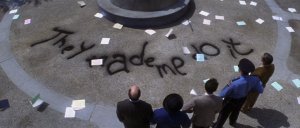
This has been my preferred reading of Donnie Darko, with divine forces selecting Donnie as the universe’s lone hero and mysteriously guiding him along his journey, each intervention and urging from Frank leading to the culmination of events that would convince Donnie of his duty. When Donnie is talking to Frank the bunny in an empty movie theater (playing a double feature of Evil Dead and The Last Temptation of Christ, one of my favorite jokes), he asks Frank, “Why do you wear that stupid bunny suit?” Frank turns and asks, “Why do you wear that stupid man suit?” Under my interpretation, Frank is a supernatural force, call it an angel or whatever you want, but he is not human and only using the form of a doomed man as a necessary vessel. When Donnie breaks into his school and breaks the water main, under the hypnotic control of Frank’s urging, we see that the vandal has also spray-painted “They made me do it” on the school mascot. The school and police go class-by-class and have students rewrite the phrase on a chalkboard, analyzing their handwriting. Donnie’s handwriting is clearly different. Could it be that Donnie, under the influence of Frank, also wrote as him, adopting his handwriting? With that, perhaps instead of Donnie writing a would-be confession it was actually Frank. “They made me do it,” Frank writes in apology to Donnie, not just for prodding him along but ultimately for the pain and suffering the real Frank of this world will cause for Donnie. “I’m sorry that all of this has to happen to you, Donnie. It wasn’t my choice. They made me do it for their plan.” I think that’s a more intriguing examination than Donnie just saying he was told to flood the school by his imaginary friend.
 This is one reason why I was not a big fan of Kelly’s eventual director’s cut DVD release in 2004, which added twenty minutes to the film and changed many edits, song choices, and special effects sequences. The director’s cut went too far for me, specifically spelling out Kelly’s vision of time travelers from the future trying to coach Donnie as their variable. Whole sections from Roberta Sparrow’s book, The Philosophy of Time Travel, were printed on screen, explicitly connecting the various pieces in a way that had previously been left as ambiguous. My disappointment with the director’s cut reminded me of the disappointment Star Wars fans felt when George Lucas went back and tinkered with the original trilogy. Lucas has said the re-releases were the films he had always intended them to be, that the earlier theatrical editions were the imperfect versions of his creative intentions. The problem is that millions fell in love with those versions of the movie, even if they were an imperfect vision of their creator. Richard Kelly always intended for the opening song to be INXS’ “Never Tear Us Apart,” but hearing that felt wrong to me after watching the same scene played to Echo and the Bunnyman’s “The Killing Moon” with the theatrical cut. Kelly’s imperfect version was the one I fell in love with, the one that spoke to me as a 19-year-old and as a 39-year-old, and that’s the one I vastly prefer.
Another reason for Donnie Darko’s success is more than likely the appeal and performance of young Jake Gyllenhaal. Over twenty years, Gyllenhaal has become one of the best actors of his generation and criminally overlooked by the Academy. He’s only been nominated for one Oscar for 2005’s Brokeback Mountain, not for 2017’s Stronger, or 2007’s Zodiac, or, most egregiously, for his hypnotically disturbing portrayal in 2014’s Nightcrawler. Gyllenhaal has mesmerized for so long and handles the many confusing aspects of Donnie with aplomb. It would be easy to play Donnie as a cliched rebellious teenager, but Gyllenhaal really digs into his questioning nature; he’s hungry for answers, desperate even, and tired of being disappointed in the adults of his life. That’s why it becomes emotionally satisfying for me when Donnie appears to achieve some semblance of answers by the end, his laughter is victorious and cathartic.
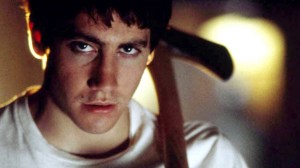 Jake Gyllenhaal is terrific but the rest of the cast is outstanding. This was the first time I saw Maggie Gyllenhaal, as Donnie’s older sister, one year before her star-making turn in 2002’s Secretary (stay tuned, 2022). Jena Malone (The Hunger Games sequels) was a remarkably downhearted presence, able to imbue teenage heartache and unease so preternaturally. Ever since her role as the snitty, judgmental gym teacher Kitty Farmer, I perk up whenever I see Beth Grant in a movie or show. To this day I still consider her wondrous line reading of, “Sometimes I doubt your commitment to Sparkle Motion” to be one of the greatest achievements in mankind’s history. Mary McDonnell (Battlestar Galactica) has two scenes that still get me as Donnie’s mother, where she fights back tears at the suggestion of Donnie’s therapist to up his medication as doing what she thinks is right for her son, and a final scene with that same son where she responds to his query that having a “weirdo for a son” is, in fact, wonderful. The parental care and empathy that she exudes is poignant. I still laugh when Holmes Osborne, as Donnie’s father, cannot contain his inappropriate titter to hearing about his son’s vulgar outburst directed at Ms. Farmer. The adult actors (Drew Barrymore, Patrick Swayze, Noah Wyle) all got the bigger headlines at the time, but it’s these actors that have stayed with me the most.
With so many people being launched into success and acclaim from this movie, it’s a sad surprise that Richard Kelly himself was never able to recreate his winning alchemy. He wrote the shooting draft for 2005’s Domino, a needlessly excessive and irritating movie. His big follow-up, 2008’s Southland Tales, was a disaster at the Cannes Film Festival and Kelly cut a half-hour before it was ultimately released stateside to head-scratching. I was eagerly anticipating Southland Tales and then I watched it and minute-by-minute the sinking realization set in that this was not going anywhere and anytime soon. It was like Kelly was trying to throw every dispirit idea he ever had into one movie for fear he’d never make another. I haven’t re-watched it since and feel no need to do so. The last movie Kelly directed was 2009’s The Box, an adaption of the William Matheson short story featured on newer incarnations of The Twilight Zone. It too failed at the box-office, suffered from a confusing and muddled narrative, and from there Kelly was radioactive to Hollywood. He hasn’t a credit to his name since. With each directorial effort, you can feel Kelly trying to recreate that formula from Darko, bringing the different weird pieces and tones together by the end to form a satisfying mosaic open to interpretation. Southland and The Box both feel over-extended, strained, and cluttered with too much salient junk. I truly wish Kelly has another shot to tell a big screen story after everything he’s been through. I’m sure he has more stories to tickle our brains. Maybe he just needs an editorial guidance.
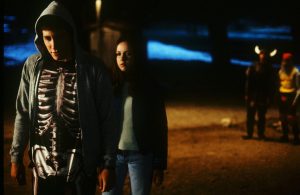 The other thing of curious note is that a sequel, S. Darko, was released in 2009 starring Donnie’s little sister Samantha, played by Daveigh Chase (The Ring). It’s not very good at all and strains to be an imitation of its predecessor, right down to Samantha having to be the sacrifice to go back in time and save her friend’s life. Kelly had nothing to do with the sequel, which was written by Nate Adkins, who would go onto create the Netflix franchise, The Christmas Prince. There is nothing of note in this cash-grab of a sequel to even reward your curiosity in watching it.
Donnie Darko was a movie I loved when I originally saw it and I’m happy so many others were able to become fans and share the good news of Darko. I’m happy this movie exists and has stuck with me all these years. It’s still transporting and invigorating and funny and soulful and tantalizing. I still love the lilt of Michael Andrews’ minimalist score. I love the scene of Donnie reaching out to Cherita Chen, the target of rampant bullying, to promise her one day everything will be better for her. I still get fascinated by the instant-iconic design of that Frank the bunny mask, an image that has lead to thousands of Halloween costume imitations. My original review was more driven by distilling its plot so that I could hook a reader into making the trip for themselves. Otherwise, my thoughts remain relative the same in twenty years of reflection. This is a gem of a movie that was never really recreated by its creator, which makes it all the more remarkable and special. If you haven’t joined the cult of Donnie Darko, there’s no time like the present, folks.
Re-View Grade: A
Share this:

The Green Knight (2021)

The Green Knight is an indie drama heavy on atmosphere and mood and a little lax on pacing, falling into yet another A24 discrepancy between critics and audiences. Much like the contentious differences of opinion over It Comes at Night and Hereditary, it seems like general audiences are a little more indifferent to hostile for this arty release than the critics. Maybe they were expecting something more conventional, which is a mistake considering it’s written and directed by David Lowery, who has dabbled in a studio sphere (Pete’s Dragon, the upcoming Disney Peter Pan remake) but seems more at home with introspective, quiet, occasionally overly obtuse art-house pictures, the kind like 2016’s A Ghost Story where Rooney Mara eats a pie for ten minutes (I will never forget this puzzling movie moment). It’s not surprising then that The Green Knight would be a polarizing film of differing expectations. It’s got good graces, an artistic vision, and a preponderance on atmosphere that can feel a little strained at points.
Gawain (Dev Patel) is the nephew to the King of England (Sean Harris). He longs to be accepted as a respected knight but he has no adventures to his name. Then one Christmas, a Green Knight (Ralph Ineson) enters the kingdom and challenges any daring knight to a game. That knight can inflict whatever blow or mark upon him, but then the Green Knight will return the exact favor in one year’s time. Full of bravado, Gawain takes mighty Excalibur and decapitates the Green Knight. Turns out the knight is not dead. He only picks up his fallen head and promises that in one year, he’ll deliver the same to Gawain. The months pass and Gawain is drinking and sleeping away his last remaining time before finally accepting to meet his fate. He rides out of Camelot in search of the Green Knight and perhaps a solution out of his predicament.
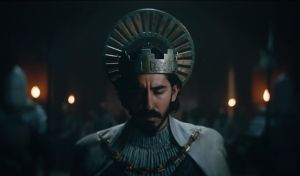
Where The Green Knight excels is with the distillation of mood and myth-making while not losing sight on its own sense of humanity. This is an Arthurian legend that is potentially a thousand years old, and when it comes to big screen adventures steeped in the mythology of cultures, it’s easy to get swept up in the fantasy spectacle of monsters and heroism. The vulnerability of the heroes is often cast aside to provide further attention to the grandiosity of the experience and entertainment. Lowery positions his movie from the perspective of an eager naïf yearning for a proper adventure to bring him respect and legacy, but he’s also a scared young man who is dreading the worst possible outcome that could be his only outcome. As Gawain sets off on his quest, he sets off proud, striding along his horse, not looking back at his home as he rides off to face his destiny, and then he’s immediately beset by treachery that removes the pristine shine off the tales of old. He’s taken advantage of by highway robbers and placed at an even greater risk of failure. As the movie progresses, Gawain becomes more and more anxious about the potential of getting himself out of his predicament. It truly seems like he’s marching off to meet his executioner, and that realization forces him to quickly adapt into the heroic mold he’s been aspiring for, the legendary knight, bold and brave and meeting death square in the eye. That sounds good in theory but it’s a lot harder to realize in real life. If any one of us, dear reader, knew that our lives were coming to an end with certainty, summoning the courage to meet that would be a herculean effort, and many of us would crumble under the pressure. It all doesn’t seem like enough time. This is what I appreciated throughout The Green Knight. It has its weird, atmospheric mythology and fantasy elements, but it also grounds the drama in relatable and nervous human emotions.
Where the movie goes astray, at least for me, is the time it devotes to achieving its poetic atmosphere. This is a two hour-plus movie that feels every bit of it, even if you’re enraptured by all the pretty style and ponderous pontificating. That’s because the movie is very episodic by nature, which at least breaks it up into manageable chunks each with something new to draw our attention, but it also makes it feel like less is being earned or amassed. In one segment, Gawain rescues the head of a ghostly woman (Erin Kellyman). In another segment, this one quite awkward to experience, he is tempted by both the lord (Joel Edgerton) and lady (Alicia Vikander) of a household, keeping his vow while something most distracting is taking place simultaneously. Another segment has Gawain interacting with giants, including one breastfeeding a little giant. There’s also a fox who occasionally talks and tries to plead with Gawain to turn away from meeting the Green Knight. I suppose if you’re being charitable you could surmise each of these stops is like a test of his skills of knighthood, from compassion to chastity to dedication, but it feels less like an accumulation and more like Lowery is simply finding time to explore other weird offshoots of this crazy fantasy medieval world.

A term I first used describing the films of Nicolas Winding Refn (Neon Demon), a filmmaker I’m not particularly fond of, is the use of empty space, where the narrative feels stretched out and the audience is intended to provide that extra level of meaning for the dead air. To me, it’s narrative forfeiture. The Green Knight could have been trimmed down, it could have been reordered, it could have been given more specific meaning, but that would potentially detract from its tone poem qualities. If that cinematic sensation works for you, and you fall under the film’s sway, then congrats. If you’re looking for more or at least more meaning in the plot and chain of events, then you’re going to be left grasping for more significance. Sometimes things just feel put into the movie because, beyond all else, it’s simply cool. That’s fine, though I found too many of the asides to be lacking once the initial obstacle was established. Lowery has a larger thesis under the surface about environmental awareness considering the Green Knight is literally made of wood and plants, he goes out to the forest to live on his throne amongst the wilderness, and there’s even an extended fiery monologue by Vikander about the enduring power of “green” and how it will outlive us all and grow over our corpses (if you were being pedantic, you could argue that all color will outlive us as I doubt there will be a nightmare future without, say, the color orange). The larger thesis, however, doesn’t feel supported by the asides and episodes of Gawain. I guess it’s about thinking of the consequences of our actions and, in a way, proportionality or response. Maybe more people would reconsider their carbon footprint if nature was going to cut off their heads as a consequence of using too many plastic straws. Maybe.
Where Lowery’s plot and ambition do come together, thankfully, is with his conclusion, which I will spoil in the following two paragraphs. In the original Medieval legend, Gawain meets the Green Knight who proves to be the lord of the manor in disguise. The man playfully chides Gawain for flinching and wearing a sash he felt would spare him of harm. He then says Gawain is “the most blameless knight in all the land,” which makes little sense, and then Gawain joins the other knights, and they all have a big laugh about the jape played on Gawain. That’s not exactly a satisfying ending and takes away any personal growth Gawain might have earned. In the movie, the Green Knight is for real. Gawain initially lowers his head, trying to summon the courage to meet his death, but he flees and apologizes, escaping the Knight’s retribution.

In a nearly wordless epilogue, we watch Gawain’s life over the course of decades, inheriting the throne, siring an heir, abandoning the mother, leading his people to war, losing his son, and eventually being such a disliked leader that his own people revolt including his own family members. All the while he wears that magical sash to thwart his own demise. This epilogue is revealed to be a flash forward for Gawain, who returns to the moment of consequence with the Green Knight. Rather than flee his fate, he now chooses to accept it, to avoid this future where Gawain goes down a path of corruption and neglect. Better to die now than become a cruel despot that will harm others. He even removes the sash. It is here where the Green Knight finally acknowledges Gawain with respect. It’s this ending that really hits home the themes and the character arc for Gawain. He’s become a knight worthy of legend but has no audience, and is choosing to have no audience, to die alone rather than live in infamy. He’s found his sense of bravery at long last because of his fear of what avoiding his fate will cost. It’s an ending that feels earned and when the Green Knight is giving him an “atta boy” you want to join in.
The Green Knight is going to be a different experience for each viewer depending upon your patience for ambiguity and pacing. I found myself at points marveling over the mood and visual style of Lowery’s vision, and at other points I found myself getting restless with the episodic side quests and the stalled character development. It all comes together by the end with a finale that really cements Lowery’s big ideas and drives homes the personal journey of Gawain. It’s all a mixture of bold and beautiful and a little bit boring.
Nate’s Grade: B
Share this:

Nine Days (2021)
 Oddly enough, over the course of less than a year, we now have two movies about young souls competing to find their sense of self before being born. Will (Winston Duke) lives in a small cottage in the middle of the desert. Or so it would appear. He’s a former human who now serves as a spirit who watches over the lives of a select group of others on Earth through P.O.V. monitors. After a car accident, one of his people is killed, leaving a new opening. It’s Will’s job to interview a group of candidates and determine who is best equipped to handle being born. Will takes the process very seriously but he is also more emotionally affected by the loss of life under his guidance than he admits. Where did he go wrong, or is right and wrong even the right markers for assessment? Will must choose wisely over nine days of deliberation and insight into what it means to be human and what it means to live.
 Nine Days is a tender and thoughtful movie that has much under the surface given its metaphysical context and probing questions about spirituality, identity, and existence, but it doesn’t simply rely upon the artistic weight of ambiguity. There’s a genuinely involving emotional drama here that’s accessible while offering greater depth to be unpacked by the viewer who enjoys metaphor and implication and debate. At its essence, the movie is about a series of job interviews but for a position that we don’t fully understand what the requirements are and if even meeting the requirements is enough for the hire. It’s a primarily dialogue-driven procedure but it’s also character-focused as the entire process examines what animates Will, what haunts him, and why he does what he does. Early on, the surreal nature of what should be an ordinary event, job candidates interviewing with a boss, gives the movie an air of mystery and offbeat humor. The candidates are showing up, going through a series of questions and role play scenarios, and with each session, the candidates evolve into the personas that will define them. There’s something mildly profound about watching the development of an identity before it’s even been born. As the movie progresses, Will turns down candidates and the news is truly devastating. Not only will these spirits/souls miss out on being born on Earth, they will cease to ever exist and fade away. That is some heavy stuff. Watching each one come to terms with that sort of death can be heartrending. Just imagining having to accept the end before life ever even began.
Rather than simply fade away into the blank of nothingness, Will chooses to help these souls get one last moment of peace before their ultimate end. He becomes a celestial one-man Make-A-Wish spiritual service. It’s unknown whether these “positive memories” are from the souls’ own development or their observation of the souls that have been placed on Earth. Regardless, each rejected candidate gets a moment that Will studiously recreates as an act of kindness. This section can be rather moving as each soul gets a personal sendoff and, in those final moments to savor, we watch them become affected with the generosity and the fleeting moment of life that will be tragically denied to them. One candidate climbs aboard a stationary bicycle, and Will positions one screen after another, each with projection from that angle of the street. When taken together, it creates the illusion of a nice bicycle ride through a town square. The homemade production, even sprinkling cherry blossoms and a swinging light to illustrate a traveling through a tunnel, provide small moments of affectionate conviction. I found each of these moments to be emotionally rich and beautifully rendered on screen. The care and craft Will puts into these acts is wonderful and a tremendous insight into who he is as a character and what he values in others.
 Will is haunted by the idea that he may have been oblivious to the pain of one of his pupils, and this indecision is coloring his interview process for a replacement soul. It’s unclear what exactly Will is, or his boss, or his duties, but he vaguely amounts to a guardian angel. He has a bank of old TVs that he monitors and obsessively documents the lives of a few. He takes particular pride in one soul on Earth and listens to her virtuoso violin playing as a means of personal relaxation. Her sudden death rocks him, and when it’s revealed that she was depressed, he tries to make sense of being able to see and hear everything these souls do but not fully knowing them. Did he get something wrong in his clerical assessment? Did his understanding of her have its limits? Could she have been hiding something so all-consuming without his suspicion? It all upends Will and fosters self-doubt. He’s trying to make sense of something that may not ever make sense. That is how inscrutable human beings can be and how tragically fleeting life can become in an instant.
The other change agent for Will is the presence of Emma (Zazie Beetz), a candidate who shows up late, questions the nature of the questions she is given, and is empathetic to a fault. The other candidates are playing within the rules of Will’s questions but she’s pushing back, and it only makes Will think more and more about her and her aims. I don’t consider it too much of a spoiler that Emma will be one of two final candidates for the open spot for life. Her character causes Will to reassess his own biases, his own way of doing things as they have, and his own conception of himself and what life can be about including his own time spent on Earth, which he likes to remind the others like it’s bragging rights. I suppose one could argue that, yet again, we have a quirky female character in service of teaching the male hero about the importance of embracing life to the fullest, but I think the general makeup of the characters is superfluous to the impact of the story. We’re dealing with spirits taking a physical form here. Their appearance is immaterial to their identity at this point, at least in an otherworldly realm that (hopefully) knows no sexism and racism.
 Nine Days is the film debut from commercial director Edson Oda and the movie is utterly gorgeous from a technical standpoint. The photography favors gleaming sunsets and pristine vistas to communicate the exquisiteness and otherworldly plane of existence. The desert landscape is beautifully filmed, and the interiors are also pleasing with their visual arrangements and the mingling of natural and artificial light. Oda won a screenwriting award at the 2020 Sundance Film Festival and for good measure. This isn’t just a good-looking indie, which it assuredly is, but there is deep melancholy and beauty and transcendence to be had with the very humane and compassionate storytelling trying to get at larger truths about our limited time. The storytelling has plenty of ambiguity and nuance and metaphor, but there’s an accessible core that I believe most viewers can align with and then, if they choose, can discover further meaning. There is a slightly basic “stop and smell the roses” moral, but I found there to be more lyrical beauty at different points that affected me deeper than any condensed message. The conclusion hinges on a recitation of Walt Whitman’s “Song of Myself” and it conveys not just Whitman’s celebratory humanism but also taps into Will’s own character arc. The poetic performance itself is an expression with multiple levels, celebrating life in multiple ways, and serving as a heartfelt and personal goodbye. It’s a lovely ending for a lovely little movie.
Nine Days is packed with recognizable acting faces (Tony Hale, Bill Skarsgaard), several of whom have graced Marvel superhero movies (Duke, Beetz, Benedict Wong), and there must have been something compelling for them to all accept this low-budget, contemplative indie about the human condition. It’s a little movie with a lot on its mind but it doesn’t feel the need to explain everything. There’s a sturdy foundation to begin with but enough ambiguous room for discussion and debate. It reminds me of 2003’s beguiling, divisive, and highly metaphorical indie Northfork. Both movies are poetic, understated, and deeply involved in human connection and spiritual meaning while providing room for interpretation. There’s plenty here to unpack but even on a literal level the movie works as an emotional experience. I found myself under the gentle sway of Nine Days and its mighty beating heart of humanism that extends even beyond the realm of flesh and blood.
Nate’s Grade: A-
Share this:

Pig (2021)
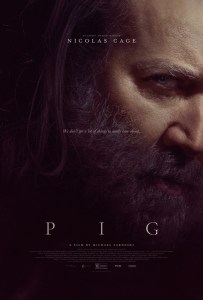
Whatever you may think Pig will be, chances are that you will be wrong. On the surface, it appears like it’s going to be another John Wick clone, with criminals stealing the beloved animal of a loner who happens to be a dangerous man who unleashes a path of vengeance. There is no real action in the movie at all. The missing pig is the catalyst to bring Rob (Nicolas Cage) back from the outskirts of Oregon and to retrace the old haunts of his old life, but the pig is more a symbol of companionship and traces back to his time with his deceased wife (another John Wick nod?). Pig is really more a meditative and reflective character study to unpack slowly. There are deeper themes and messages here, and the fact that they’re attached to a movie starring Nicolas Cage where he must find his stolen pig is all the more bizarre and exciting. This is unlike any Cage movie and, in its own way, feeds on the culmination of his own career of movies great and far from great.

This movie feels deeply personal for Cage. There is an elegiac tenderness that permeates the whole experience. It’s about loss but ultimately it’s a movie about chasing your dreams. There’s a reason the tagline for the film is, “We don’t get a lot of things to really care about.” If you’re expecting a gonzo Cage irony fest, this sincere summation will seem completely mismatched. But this movie isn’t a gonzo Cage irony fest. It’s very much about different people dealing with pain and sorting through heartbreak, disappointment, disconnection, and taking stock of one’s delayed pursuit of happiness. There is no irony to be found here, folks. This movie, called Pig, is bracingly sincere. There’s a standout scene where Rob and Amir are dining at a fancy restaurant and Rob asks to meet the chef. It takes a moment but the chef recognizes Rob and is starstruck and asks if Rob remembers him working in Rob’s own restaurant. He does, and Rob asks this man about his old dream, which was to open a pub-style restaurant, and why he capitulated. The man is initially defensive, citing the local market, but then he has to sit and think it over. It was his dream. It still is, and the fact that this man not only remembers him but also remembers his exact dream and calls him out, it’s like having an intervention from someone who you never knew cared as much as they did. Maybe this man will proceed with his dream of opening a pub. Maybe he won’t, but Rob reminds him and us how little time we have and to really spend it on the passions that positively consume us.
To that end, you can see the parallels with the main character and Cage’s own career. Nicolas Cage has long been an actor defined by excess to the point that he has a catalogue of outsized performances with ironic air quotes attached to them. The man owned his own island and named his son after Superman’s birth name. He has been starring in more and more direct-to-DVD low-budget thrillers, as have John Travolta and Bruce Willis, who both rarely seem to attach themselves to theatrical releases at this stage of their careers. Some might term this the decline of his career, that he is slumming it, but to Cage it’s just another gig. Unlike Willis, famous for shooting his part in a weekend while his stand-in works the rest, Cage is still putting forth quality effort. This might be a little psychological projection on my part, but Cage strikes me as a professional who enjoys his craft even if he makes some unorthodox choices. He has a passion for movies and he’s going to seek that out because it’s what defines him. We might not appreciate the projects he selects, we might not understand them, and they might even be bad, but Cage is taking the roles offered because making movies and acting is the thing he really cares about. His performance here is somber, touching, and suffused with ache. It’s one of, if not the, most restrained performances of Cage’s career and a reminder that the man can be a world-class actor.

Structurally, Pig seems to reinvent itself with every scene, providing new answers and insights as we unravel Rob’s past. It allows you to consistently re-evaluate the movie and characters and makes for a genuinely engrossing viewing because you know there will be something worth paying attention to with every scene change. There are people in the city who revere Rob, who despise him, who seem to be jealous of him, and we’re discovering more and more what that life was like and what drove Rob to being a recluse. The movie rides a line of nuance and ambiguity where not every character detail and connection is spelled out; it’s up to the individual to process meaning. Is this character grateful to Rob because his wife, who battled depression for years, had one significant happy moment she would reminisce over, Rob’s delicious dinner? Is he jealous that a meal could make her happy when he seemingly couldn’t? What emotional response does this man have? It’s up to the viewer to determine the human response to passion and the evaluation of what passions are prioritized. The character writing finds that artistic middle ground of being nuanced but also being accessible. For a movie about a man searching for his missing pig, it’s much more concerned with the man and his demons and dreams.
It’s a beguiling realization that a movie where Nicolas Cage searches for his prized pig might be one of the better films of 2021 and one of the actor’s finest performances. The movie appears like it will be dark, scuzzy, and depressing but it’s actually quite compassionate, humane, and encouraging. It’s not a story about a man cracking skulls and crossing names off a list to retrieve his stolen pet. It’s a movie about a man who left his suffering and who comes back and re-examines his life’s choices and the choices of others. He may look like a bleeding hobo for the majority of the movie, but Rob is a force for good, reminding others of their passions, the urgency of time to chase them, and the importance of spending time with the people, and pets, that matter to them, our own selective families. Pig is an absorbing, poetic, and eminently kind movie and one that doesn’t feel like it could have worked the same without Cage’s professional legacy to build from. It’s a small movie that will surprise many and reaffirms that Cage is always an actor worth watching.
Nate’s Grade: B+
Share this:

Werewolves Within (2021)
 Surprisingly based upon a PlayStation VR video game by Ubisoft, Werewolves Within is a fun horror comedy that plays out like a demented Agatha Christie drawing room mystery. Sam Richardson (The Tomorrow War) is a new park ranger assigned to a small snowy town that may or may not be threatened by a werewolf hiding among the townspeople. A series of bloody murders and mangled gas generators points toward some monstrous beast, and over the course of one long night, characters will accuse one another of being the hidden werewolf, and tensions and paranoia mount as the body count rises. Part of the fun comes from the wild whodunit speculation that the filmmakers are aware of. Early on, I started accumulating my band of suspects, and then my red herring suspects, and the movie seems to be fully knowledgeable of this as well, so there’s plenty of little details spilled that, in an ordinary movie would prove conclusive to the detail-oriented viewer; however, Werewolves Within is full of motivations and clever fleeting details to throw you off. Richardson is wonderfully nonplussed as the supremely nice and easy-going ranger who finds himself frantically trying to be the voice of calm and security as the town breaks down. The supporting characters are rather one-note nutjobs but each has a different personality to sprinkle into the chaotic mix. The eventual reveal of the culprit involves a lot of explaining to cover hidden character deception that could have used more setup to feel less forced. I also wished the humor and the horror was a bit crazier. I knew the horror wasn’t going to be pronounced, as most horror-comedies typically favor one more than the other, but I wished the comedy had escalated as the characters further gave in to the insanity of the ridiculous situation. It’s a movie that’s easy going in charm and finely punctuated with some sharp one-liners and silly visual gags. It’s agreeable to its core and a lighthearted yet gory way to spend 90 minutes. By default, it’s also one of the best video game adaptations made into a movie. That’s primarily because it’s a recognizable murder mystery structure just with a genre kick. I wish everything had been given an extra dose of elevation and hijinks, comedy and horror, but that might detract from the overall droll charm, lead by Richardson. Werewolves Within makes me wish for an anthology franchise just transplanting its premise across new settings. Imagine The Hangover but having to also figure out which of your recovering blackout drunk friends was a werewolf. It just works.
Nate’s Grade: B
Share this:

Black Mamba (2019)
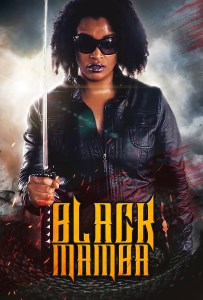
William X. Lee is an Ohio filmmaker who has found credible success on his own terms and over decades, a fact that deserves celebration. The writer/director knows the business of filmmaking as a genre specialist and has even become an adjunct professor of film at two different universities. With his many years on the fringes of the indie business, I expect Lee has a lot of wisdom about the particulars of the industry and finding a market that is welcoming to content that can be messier in execution. His latest movie in pre-production is called Bulletproof Jesus and, sight unseen, I legitimately love that title with my every fiber. His 2020 film, Black Wolf, literally involves a 58-year-old man having to track down and kill his high school bullies, all of whom miraculously grew up to become terrorists. That sounds hilarious. I believe Lee’s personal story is compelling and acknowledge that genre filmmaking could use more voices and visions from under served perspectives. However, the results on film show indifference or even disdain for accessible storytelling and entertainment value. Black Mamba is a 2019 supernatural action revenge available on Tubi, as many of Lee’s films currently are for free, and it’s indicative of the man’s sense of style and storytelling, both of which I have plenty to talk about in excrutiating detail.
Kyiera Stone (Angela D. Williams) was killed by local criminals. She’s brought back to life by angels who give her a second chance to exact revenge. Kyiera is pitted against an endless assembly line of villains that all want to return Kyiera to her state of decay.

I may sound like a scold, but it is near inexcusable that this movie is two hours long. Far be it from me to instruct a creative how much time they need to tell their story, but you have to think about an audience when you intend a platform for your efforts. What is going to keep someone glued to that screen and justify their investment in every one of your minutes? This is the kind of movie that can barely creak over the 80-minute feature-length finish line, and to push forward to two hours is excessive without an engaging story that needs that extra room to grow.
There is no real plot to speak of beyond our main character coming back to life to wreck vengeance. The movie is patterned after Quentin Tarantino’s Kill Bill, itself patterned over hundreds of genre movies, but it’s like Lee said, “Well, why stop with five bad guys to overcome when you can have 100!” Black Mamba (also the code name for the lead in Kill Bill) is stuffed to the breaking point with villainous characters and some of them are even being introduced with ten minutes left. The critical hit involves like a half dozen bad guys, and then there are more bad guys, and then hell is introducing its own bad guys, and then there’s like a fighting champion from hell, and witches, and I stopped caring because every scene played out exactly the same. The settings may vary, the person might be different, though with a cast list of rogues as long as this one good luck keeping them straight, but the scene plays out exactly the same. Some evil character gets the jump on Kyiera and within a minute she will kill them. That’s it. That’s all there ever is in these confrontations, many of which are hilariously short-lived. At no point will you fear or doubt Kyiera because she never seems to be in danger of losing. It makes the entire two hours extremely boring and repetitive. It also makes the majority of its two hours expendable. Rare is a two-hour movie where I could legitimately say that you could cut it down by 90 minutes, and yet that is the case with Black Mamba. It’s a movie of treading water.

Some of this could be mitigated by providing characters with big personalities, memorable flaws or quirks, or even interesting killing utensils, but Black Mamba feels more like a ramshackle improv fest where actors are entering scenes as “characters” with props or costumes they just assembled off-screen. I love genre movies and I love the way characters can be written for genre. Watch the TV series Justified because it is a masterclass in writing for character. Every character, even the bit-part villain of the week, is written with a distinct voice, an identifiable trait, an angle, something to make them stand out and feel more like a flesh-and-blood person in the stylized, hard-boiled universe of the show. The movie’s extended running time could have devoted scenes to showing why we should fear certain characters, their killing techniques that we would then anticipate seeing how they are applied to our heroine. Think of every movie you can with crazy killers and you see them apply their killer skills early because that’s how you get to fear them. Just being told, “so and so is deadly,” without seeing them in action is dull. In Black Mamba, often characters are over explaining things for the sake of the audience or seeming to narrate what is happening on screen. The dialogue is filled with profanity because it feels like nobody knew what else to say from scene to scene. There aren’t any tense exchanges and showdowns or clashes of viewpoints. It’s all just yelling, boasts, and non-clever insults.
The story doesn’t make much sense. There are angels that bring back Kyiera because it’s “not her time,” but then they want to use her in a celestial war? Was she lied to by the higher authorities in order to manipulate into an ongoing and endless war between heaven and hell? Is this a high-concept version of Munich and Kyiera is being used to perpetuate endless conflict regardless over culpability? No, well at least I doubt it. The larger workings beyond our heroine are left vague and seemingly shifting. The first thirty minutes could have been consolidated to ten to introduce the premise of Kyiera dying and being resurrected, but then there’s nary a section that couldn’t be consolidated, like the litany of interchangeable supporting characters.

Can you tell there are three people in this scene?
Halfway through the movie, we suddenly jump to hell and it doesn’t really alter the direction of the story but only provides more witnesses to commentate on the action. This is where Esmerelda comes in. She’s the queen of hell and played by Dawna Lee Heising, a 65-year-old actress who got her (un-credited) start as a stripper in Blade Runner and has a long list of campy T&A roles in low-budget genre fare. She feels like the production’s big “get” and so she gets a lot of unnecessary screen time. The character is annoying and the entire addition of hell as an environment feels tacked-on. I thought I knew who the big bad final boss was, and then hell is introduced with its own cadre of damned killers, and I didn’t know who the final boss should be. There’s no feeling of a direct line for Kyiera’s goals. Think again to Kill Bill as a prominent example. She had a small list, each name crossed off brought her closer to her biggest target, but each became harder to accomplish and more personally reverent as she climbed the ladder of revenge. There was a feeling of progression and payoff as The Bride worked through her bloody vengeance. With Black Mamba, she’s inundated with one face after another, but you never feel progression because the movie only feels like it’s stuck in a Sisyphean loop of disposable foes. The structure of this movie doesn’t have the groundwork to provide forward momentum.
The first thing you’ll notice about Black Mamba right away is the choice to up the contrast so high that it may hurt your eyes at time. There are times where the color contrast is so extreme that it obfuscates what is happening on screen. You’ll see faces disappear into shadow in a room, and not in a way that feels intentionally ominous, and every time a character is driving outside it looks like an atomic bomb is going off in the background. It’s chiefly a distraction and an ugly one and one that feels like it was done to make the footage look more like a grungy grindhouse movie of old. Going for a specific visual aesthetic is a fine marker, but when it harms the clarity of what is happening then maybe it’s worth revisiting. There are simple things that could have been done to better orient the viewer. The color contrasts and color palette could have better been paired with specific locations so that the audience knows exactly where they were or whose story they were following, much like in Steven Soderbergh’s Traffic. We even literally have the denizens of hell as one frequent setting, so why not crank the contrast high and more fiery in colors, favoring oranges and reds, and then go for a cooler color palette for action on Earth? Or even have a section that isn’t contrasted to death? It’s a stylistic choice that grates severely.

I would be forgiving of some of the obvious technical limitations for a low-budget indie aiming for the feel of other classic low-budget indies, except that, reportedly, Black Mamba had a budget of $250,000. When I read that I burst out in incredulous laughter. Maybe it was a decimal error, or maybe Lee was very generous and paid his sizeable cast and minimal crew handsomely, or maybe there are other reasons why a quarter of a million dollars does not, in the slightest, look to have been translated onto the finished product. Where did all that money actually go?
I’ve been watching enough micro-budget indies in my pursuit of reviewing homegrown cinema that I feel more adept at better gauging a potential budget. There are locations to consider, though Black Mamba seems to reuse a lot of empty warehouses, alleyways, and church parking lots, and there is action to consider, though Black Mamba uses a lot of plug-in special effects and limited fight choreography, and there are actors to consider, which Black Mamba has in excess, and there is the general professionalism of the look and sound of the movie, which Black Mamba is definitely lacking. There are persistent sound issues (the louder yelling is so screechy and high-pitched that I had to cover my ears) and there is a dearth of editing coverage. Apart from the fight scenes, it feels like every scene was designed with one shot in mind to connect directly to the next. This can make things awkward in conversations that would flow better with alternate angles rather than one person with their back to the camera or in extreme close-up. I geuss it just didn’t matter or they didn’t have the time, and yet with the budget being reportedly a quarter of a million dollars? This movie feels far more like a $10,000 budget indie than $250,000. To be blunt, I have watched movies with budgets under $15,000 look and sound much better than this quarter-million-dollar movie.
I thought about watching other Lee original movies available on Tubi but I only watched about 15 minutes each of 2017’s Six Feet Below Hell, 2016’s King Killer, and 2008’s Kill Every Last One. I don’t think I could take watching all of these movies even for objective review purposes, each of which appears to have the same faults and high contrast value as Black Mamba (one of those films is an astounding 133 minutes long!). While designed to be sold, these movies do not feel designed to actually be watched and enjoyed. There are no real characters to fall in love with, conflicts to draw intrigue, or well-developed plots to thrill and surprise. These movies feel like empty product to line an endless array of schlock DVD shelves.

This brings me to my final complaint registered at Black Mamba. More than halfway through the movie, yet another character is introduced, this time a formidable fighting champ from hell. Upon hearing the man’s name, the queen of hell falls onto the floor and begins gyrating in pleasure, moaning the man’s name and declaring him to be an amazing god among men. This character is played by none other than… the writer/director himself. I almost walked away from the movie at that point. It’s difficult to critique something like Black Mamba. The people involved don’t seem to have any aspirations that what they were making was serious, and yet maybe they should have taken it more seriously. Because of the punishing two-hour length, because of the repetitive and stretched thin plot, because of the over population of unmemorable and disposable characters, because of the technical flaws that still persist after a decade of filmmaking, because of the lack of accessibility for providing an engaging story and characters for an outside audience, and because of its reportedly sizeable budget, I regret to deliver my first failing grade for an Ohio-made indie. I wish Mr. Lee and his team well but this is assuredly a case where if you’ve seen one of the man’s movies, you’ve seen every one of the man’s movies, and unless you were in these movies, you shouldn’t watch them even for irony.
Nate’s Grade: F
Share this:

Holler (2021)
 In the time I have spent making a concerted effort at reviewing Ohio-made indie movies, I have yet to watch one that amazed me and earned an A-grade. There are several that are enjoyable, others admirable for their technical professionalism, and many that have glaring factors beyond limited budgets that hold back whatever the intended artistic intent was. I was excited with genuine hope for Holler, a small movie shot entirely in Jackson, Ohio and following the lives of a struggling band of small-town metal scrappers looking to survive. It’s the debut feature from writer/director Nicole Riegel (based upon her 2016 short film of the same name) and has recognizable TV actors involved like Jessica Barden (End of the F***ing World), Pamela Adlon (Better Things), Austen Amelio (Dwight from The Walking Dead) and Becky Ann Baker (Girls, Freaks and Geeks). It’s even getting a wide release nationwide through IFC Films, who graciously provided me a screener link. If any movie felt like it was going to breakthrough and become the first truly outstanding Ohio indie, this seemed like a major possibility. Unfortunately, Holler doesn’t merit hollering.
Ruth (Barden) is a high school senior in a small southern Ohio town wracked by poverty, factory closures, and the aftereffects of the opioid epidemic. Her mother (Adlon) is serving time in prison for her drug offenses when she should be in a treatment center. Her older brother Blaze (Gus Halper) is resigned that he’ll work himself to nothing, but he wants a better life for his bright sister and submitted her college application. Ruth and her brother join Hank (Amelio), a local scrapper who offers extra work for side projects stripping the parts from closed buildings.
 While watching Holler, I noticed my heart was sinking because, even with all this professionalism and authenticity on board, I kept waiting for the actual movie to kick in, and then I noticed an hour had passed and I realized, “Oh, this is the movie.” I have seen this artistic calculation with indie movies before and articulated it succinctly with 2012’s Beasts of the Southern Wild: “sacrificing story to the altar of realism.” This feels like a very authentic movie as far as its hardscrabble details about how impoverished people in small towns eke out a life on the peripheral of society. I know people have been pushed to the brink because of desperation, whether economic or psychotropic or beyond, and that scrapping can be a dangerous and competitive landscape to make a few bucks. When you’re struggling to get by, it’s all about what can lighten that struggle. If stripping the copper wire out of an abandoned building is more profitable, and less time-consuming, than bagging aluminum cans all over town, then it seems like a natural attraction to those with limited options. However, Holler feels less like a movie with a story needing to be told than a stark setting with an impression to leave.
The characters are too interchangeable and one-dimensional here to really invest in beyond general well-wishing. These small-town Ohioans have been hit hard by circumstances and as I was watching I wanted them to find some degree of happiness or improvement by the end, but that was because they were simply people in need and I am an empathetic creature and not because of their personal stories or characterization. It would be the same as if I had watched 90 minutes of a lost puppy trying to find shelter and then, at long last, that puppy got to sleep inside a coffee shop. I’m happy, and relieved on a general level, but am I personally invested in this specific animal and this specific story? Could it have been any living being at all?
 The characters of Holler are far too generalized where they keep repeating that same nub of characterization they’ve been given. The entire dynamic seems to be a universe of characters who exist to try and convince Ruth that she is better than everyone and deserves to leave. In an early scene, we watch Ruth sit down and write an essay for a friend to use as her own homework. It’s an early indication that Ruth is smart and not fulfilling her potential. It’s not her homework she’s completing but a friend’s and for money, money she initially refuses from pride. Unfortunately, the movie forgets to continue moments like this to provide further insights. Ruth is too often a walking cipher, taking in her dilapidated surroundings with alternating pensive and glum stares. She is more a symbol than a character, meant to serve as a face of those held back by economic anxieties and limited opportunities. Her mother is a symbol of the wreckage of the opioid crisis and how it has decimated rural communities. Her brother is a symbol of generational sacrifice. These characters don’t have complicated internal drama or intriguing contradictions or anything beyond the surface description because they’re designed to be specific voices meant to convey a Greek chorus of opinion. They’re sides of conversations made flesh rather than interesting or complex people. I wanted to become attached to Ruth’s plight especially as she embarks on performing more dangerous tasks for money with her scrap crew, but you never feel any real added danger or for that matter any real change. When Ruth is out scrapping in the middle of the night, the movie treats it no differently. When Ruth finally makes her decision about her life, it doesn’t feel like the culmination of her emotional journey and more so the character finally accepting the pleas of others over the course of 85 minutes.
The obvious artistic comparison point for Holler is 2010’s Winter’s Bone, another movie that explored in unflinching detail the degenerative disease of systemic poverty. Once again, we follow a young woman trying to provide for her broken family in the wake of a parental drug addiction and trying to stay one step ahead of debt collectors and eviction. Another artistic influence seems to be 1970’s Wanda, an indie featuring a housewife walking away from the malaise of her life in small-town coal country Pennsylvania. The difference with both chief artistic influences is that they had, quite simply, movies to tell with their big screen canvas. With Winter’s Bone, there’s an urgency where the protagonist has to find her absent father in short order to save her family home but also because he has made some very scary meth dealers very angry, so the way to save her family is literally to turn over the man who abandoned them to ruin. There’s a strong sense of personal stakes, there’s a ticking clock, and the themes tie into the emotional journey of our main character. With Wanda, the main character is the one abandoning her husband and children and she takes refuge with a bank robber on the run. With each of those descriptions, you can see the movie there, the reason why this story deserves your time.
 With Holler, I kept waiting for some turn or escalation or something to draw out the movie. The movie feels stuck in an expository gear I would associate with Act One territory and then it ends. I really thought more would be made of the illegal scrapping-for-money angle and whether this would present our lead character with increasingly fraught choices over her well-being. I thought maybe her descent into the criminal side of desperation would force more confrontations or consequences. Maybe there would be another crew that didn’t take too kindly to an entrepreneur muscling in on their hard-won turf. Maybe she would have to hide her injuries as she got more reckless. Maybe she’d even risk getting caught by the law and serving time in prison. Anything to offer insight into this less known world of scrapping. I regret to say that the angle that gives this low-budget indie its very hook could have been replaced with any other arbitrary plot element. Ruth could have been finding lost dogs or stealing cars or selling her bath water to perverts on the Internet. The circumstances of her personal choices are so generalized and don’t produce enough direct cause-effect relationships. The events fail to feel meaningful. The solution to Ruth’s dilemma also seems as generalized – go to college. What is she going to study? Does she have a career in mind? Does she even have personal interests? She rejects one teacher’s recommendation to avoid a crushing load of student debt and to learn a skill and work up, so then what is she going to do with tens of thousands of dollars in debt attached to her name? I understand that education is aspirational and one of the few things in life that, once gained, cannot be taken away, and I champion education as a person working within that sphere. However, “get out of economic desperation by just going to college” seems naively simplistic.
Holler is admirable for its grit and empathetic with the struggles of its people. It’s professionally made with a strong score by Gene Beck (Cowboys), all mournful strings applied to lived-in details that feel authentic to the region and these inhabitants. Even the angle of scrapping-for-money seems ripe for exploration to separate this little movie from the pack of poverty pictures. It’s the storytelling that cannot live up to the good intentions of those involved. The characters are too one-note, symbolic, and disposable, and the story elements are likewise too interchangeable and lacking in meaningful connections. It’s a small-town girl who must decide to leave home to take on massive student debt (happy ending?). Anything that happens in the prior 85 minutes feels like variations on the same point being made repeatedly and without nuance or complication or contrast. It feels less like a movie and more like an expanded short absent the substance to justify its expansion. I think Riegel has promise as a filmmaker and I hope more attention goes to her characters and plot for future projects. I must continue to wait once again for that elusive Ohio-made amazing indie.
Nate’s Grade: C+


 nathanzoebl
You must be logged in to post a comment.