Blog Archives
Robot & Frank (2012)
 It’s the age-old story about an elderly man (Frank Langella) suffering from Alzheimer’s who teaches his robot helper to be his partner in jewelry heists. While that sounds a lot more fantastic than the movie we eventually get, Robot & Frank is a mellow, sincere, and overall nice movie that treats the particulars of its world with a wry sense of whimsy. The movie is really a mismatched buddy film as Frank is hostile to being forced to live with robotic help, but soon the two of them form the basis of a friendship, and when things get dangerous it’s heartwarming the lengths they’ll go to save the other. Give the Alzheimer’s subject, expect some twists in the final act concerning Frank’s world. The movie wants to hit us emotionally but I felt mostly remote, smirking at some of the fun of the old codger back in the burglary business of his youth. But the film just stays at a very even-keel level of emotional resonance, drawing us in but not exactly taking us anywhere. The ending is curiously without any sort of comforting resolution that could have put a solid piece of punctuation on the film’s emotional drama. Langella, it should be said, is excellent. Robot & Frank is a high-concept buddy film, fairly pleasant and entertaining but when it comes to a close you may wish that the film had relied less on chaste understatement.
Nate’s Grade: B
Share this:

Contraband (2012)
 January at the movies has long been a time for two kinds of releases: 1) award-worthy films expanding into wider release, and, 2) crap. That’s about it. I’ll let you figure out which category the action thriller Contraband belongs in.
Paul (Mark Wahlberg) was once the best smuggler in the business. He’s since gone legit, starting a family and his own private security business. His brother-in-law (Caleb Landry Jones) gets into trouble with some bad men. He tosses a load of smuggled drugs to elude Customs ships, but now Briggs (Giovanni Ribisi) wants the value of the drugs or else. Paul knows he has no choice but to put together one last job to save Kate’s (Kate Beckinsale) brother. Paul leaves his family in the hands of Sebastian (Ben Foster), a trusted accomplish on many missions. John puts together a team and plans to board a ship headed for Panama City. While there, the team will load large sums of confederate money. The sale of the fake currency should square things between John and Briggs. However, little goes according to plan.
 Contraband is a lousy heist picture that feels like it’s making it up as it goes. First off, the premise of John having to go back into his art of smuggling to settle a debt has been overdone, and the fact that John’s idiotic brother-in-law is as fault makes it hard to care that something might happen to the idiot. But why God do they bring this screw-up, the brother-in-law, along with them? He’s already proven to be a poor decision maker and a moron, and, surprise surprise, when in Panama the guy gets them into more danger. So irritating is this character, always foolishly making things worse for John, that you wish they had thrown this dolt overboard. This is a movie structured with a small beginning, a small end, and a great big fat middle, and it’s that middle that involves our destination to Panama. With heist movies, as well as most thrillers, we don’t want things to go according to plan. We want to see organic complications and watch our team of characters adjust. With Contraband, the complications don’t feel natural so much as like careening plot elements from other movies. John’s quick visit goes out of control, with the team losing their payment money for the confederate loot (guess who’s responsible for that? Guess?), and they have to go find a budding crime lord, Gonzalo (Milk’s Diego Luna), and then this crime lord just happens to be plotting a heist at THAT EXACT MOMENT and John and his team should come along and then the heist goes bad, as always, and the team ahs to get away, but Gonzalo demands to be taken to a hospital by gunpoint, and then the cargo ship is going to leave port, and, and, and, and, etc. There are so many breakneck plot turns thrown in that it feels like a broken blender spewing half-formed plot residue everywhere. It’s the film equivalent of the If You Give a Mouse a Cookie story (“If you give a smuggler a deadline, he’ll need a contact. If you give him a contact, he’ll need to do the contact a favor. If he does the contact a favor, he’ll have to do this one job for him. If he does this one job for him, he’ll need a crew. If he needs a crew, he’ll need… etc.).
Let’s take a moment to analyze the peculiar masks Gonzalo and his team choose to utilize. They literally wrap duct tape around their faces. That’s got to be the dumbest mask in the history of cinema, and there have been some stinkers. They couldn’t afford pantyhose? Anything? They had to use tape? First off, you can’t conceal key features, like your eyes and mouth, and lastly, isn’t it going to be something of a bitch to rip those things off? The only person who could properly wear a duct tape mask would be someone suffering from alopecia (condition that leaves a person hairless). Otherwise you’re sacrificing your eyebrows. Maybe this is just how things are done in Panama.
So much of this movie feels like it’s on autopilot, just drifting like that cargo ship. At this point, I don’t even think Wahlberg is trying to hide his indifference to the material. He’s a man with a shady past who went legit and has a family now, but in order to protect that family he is drawn back to his shady past. How many times has this plot device just been used in the last few years? The rest of the characters fill out the crime thriller cheat sheet: young screw-up who serves as plot catalyst, parent in prison to provide cautionary tale, best trusted pal that ultimately proves to be untrustworthy, and the harried, often victimized wife. Poor Beckinsale (Underworld) who gets beaten, threatened with a gun in her face, and victimized to a degree that it feels like exploitation. This woman can never catch a break. She gets few moments in the film where she is free from being terrorized with violence. I have no idea what would attract an actress like Beckinsale to this part other than the allure of a paycheck. Contraband stalls when it comes to thrills, and part of this is because the villains seem so lame. Briggs just comes across as an inept criminal, like somebody’s own screw-up brother-in-law that tagged along to play with the big boys. He’s routinely beaten and bossed around. It’s hard to take his threats seriously, so the movie cuts its losses and just has him threaten Kate some more. It becomes old quick. The only thing that keeps Contraband going is the great distance between Paula and his family, a divide that keeps Paul vulnerable. Too bad that the movie can’t think of anything thrilling to do with this scenario and settles, all too frequently, on scaring the wife. Wouldn’t the film have been more engrossing if Paul’s wife had been kidnapped this whole time? Would that not cause a better sense of urgency than the vague threat that a character we don’t care about might get offed for being stupid?
 From an action standpoint, the thrills rarely materialize, relying on a contingent of blunders and coincidences to provide the thrills. There wasn’t a moment where I worried for a character on screen. This may be because I didn’t care for a person on screen, thanks to workmanlike characterization, but it’s also got to fall on the feet of Icelandic director Baltasar Kormakur (who starred in Wahlberg’s role in the original Icleandic version of this flick) and his nascent camerawork. There will be moments where his camera does stutter-step zooms, mimicking the docu-drama camerawork that’s been en vogue with action cinema. And then he’ll never repeat it. There’s a shot of Gonzalo blowing the armored car up and it’s filmed in a high-speed, stylized shot to distill the strange beauty of the force, and then this never happens again. It’s like Kormakur is sampling all 31 flavors of action movie styles and can’t decide on a visual tone. The action is too dependent on arbitrary coincidences for it to be satisfying of thrilling; we’re just waiting for the next out-of-nowhere plot turn to move things along. The ending attempts to tie up things nicely but feels asinine and laughable in how John can take out three villains in one well-orchestrated, tidy swoop. Don’t even get me started on the impracticalities of John hearing a lone cell phone ringing to be able to trace his wife in an entire construction site. The resolution feels ludicrous and a stroke of dumb luck.
Contraband is a convoluted, knuckleheaded thriller that drags because of arbitrary maneuverings, poor characterization, a fat middle section plot-wise, and pedestrian action. The movie feels like it’s being made up on the spot. As a result of all this tiresome lateral plotting, Contraband feels like it’s going nowhere and spinning into oblivion. I found myself nodding off at various points, my brain bored by all the generic goings-on. The constant victimization of Paul’s wife is a rather ugly development for a movie that confuses salty language and furrowed brows for toughness. The movie is devoid of any sense of fun. It just becomes an empty enterprise of actors going through the motions to work of genre pap. Even by the dirt-low standards of January cinematic offerings, Contraband isn’t worth a cent of your hard-earned money.
Nate’s Grade: C-
Share this:

The Town (2010)
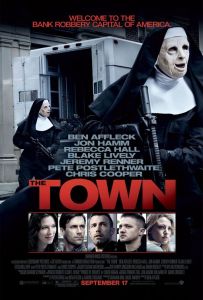 There are many people who think they can direct. It just looks easy to people. You get to tell everybody what to do all day. Who wouldn’t want that, right? And actors always think they know everything already, so there’s a litany of actors who feel like they can make the jump from in front of the camera to behind it with ease. Not everybody is going to be a Clint Eastwood, or a Robert Redford, or even the best of the current crop, a George Clooney. Every now and then you’ll find a true surprise, like Todd Field (In the Bedroom, Little Children) or Sarah Polley (Away From Her), but most actor/director projects come across like indulgent one-time pet projects (see: Drew Barrymore’s Whip It). Ben Affleck has easily endured his slings and arrows as an actor, though I’ve always found the man to be likeable, charming, and intelligent. Even so, nobody can excuse Gigli. When Affleck tried on the director hat for 2007’s Gone Baby Gone, it was easy to be skeptical. But then critics and audiences saw the film, which Affleck also co-wrote, and realized that this guy might have some serious chops after all. The Town, Affleck’s second directorial effort, proves that Affleck has found his rightful place in movies.
Doug (Ben Affleck) is a lifelong criminal living in the working class Boston neighborhood of Charlestown. We learn that this one-square mile produces more bank robbers than anywhere else in the world. It is a neighborhood seeped in the lifestyle of crime, the silent omissions of sin. Doug and his crew’s latest heist went according to plan except for one detail. Jem (Jeremy Renner), fresh from doing a nine-year prison stint, has taken the bank manager hostage in a moment of panic. The men blindfold Claire (Rebecca Hall) and deposit her along the Boston shoreline. Doug and his guys then become alarmed when they spot Claire in their neighborhood. She lives in Charlestown. Will she recognize them? FBI Agent Frawley (Jon Hamm) check up on her and requests interviews. Is it only a matter of time before she discovers the truth? Jem wants to handle it quick and dirty, but Doug insists that he take the lead. He watches her from afar and can’t help but feel sorry for the trauma he has caused her. He asks her out for a drink after meeting her and Doug can’t stop himself from falling for her. Jem is incensed and convinced she’ll give them all away. Doug must reconcile his life?s choices and Claire now gives him a reason to finally walk away from the only life he’s known.
 It didn’t take long for me to know I was in for something good. The pre-title opening sequence sets the tone and informs you that Affleck will be firmly settled in the director’s chair for some time. The opening bank heist crashes your attention. It’s filmed in quick cuts, swift camera movements, mimicking the ambush of the criminals as they throw people to the ground, upturn desks, and smash general office supplies. Then the scene cuts to a security camera footage of the same scene, and it’s static, and eerily silent and the contrast is fantastic. Then we smash right back into the fray and the chaos. Affleck refrains from the film turning into senseless genre junk. The violence in this film hurts. You feel its impact and wince at its approach, and you already get this sense before the credits even show up. Affleck wants his visceral violence to mean something, and these men of violence become more intimidating. Then there’s a scene about an hour in that had me gnawing my hand in anxiety. It all revolved around the possible reveal of an identifiable neck tattoo, where the only character who knows all the particulars of danger is Doug. He’s trying to nervously watch the eye line of the conversation, and I was physically trying to instruct the characters onscreen. The fact that I could get so caught up in a sequence of stellar tension that doesn’t involve cars, guns, or even overt threats of violence is a testament to the abilities of Affleck the director.
Doug’s crew is not a fly-by-night operation. They are honed professionals, knowing the timing codes for bank locks, how to dismantle security camera systems, and splash bottles of bleach all over the premises to eliminate usable fingerprints. And yet, when is enough enough? It feels like only days before Jem is pushing everybody for another job. They’ve barely had time to launder the money through drugs and gambling, given a cut to the local crime boss (Pete Postlethwaite), and they?re anxious for another score. Doesn’t anybody want to lie low for a while before the heat dissipates? Either this is just a conceit of only being able to work in a two-hour narrative or indicative or what a consistently dangerous life these men lead. These men know exactly where they?re headed; in fact, they seem resigned to their fate. Perhaps the expedited schedule is just another form of self-destruction or an impatient death wish, or perhaps it’s just an inflated sense of invincibility by guys who are good at what they do.
 The area where The Town could have been better is with its higher ambitions. The Town dutifully delivers the goods when it comes to a crime picture. The three holdups are all satisfying, taut, well paced, and the action is choreographed in a manner that’s easy to comprehend. The middle holdup creates some dynamic images as the men speed through Boston dressed in plastic nun masks and armed with machine guns. There are several standout moments and images that prove Affleck knows how to frame an exciting action thriller. The climax is great, though the denouement leaves something to be desired. You pretty much anticipate what beats the movie has to hit as a genre piece. These brothers in arms will likely follow the path of doomed protagonists. But Affleck clearly wanted his second feature to be more than a slick genre flick. He had his sights set on examining systemic and cyclical nature of crime and abandonment. The opening informs us that bank robbing is a trade passed down in Charleston from fathers to sons. Doug’s crew are all second-generation criminals, their long absent fathers serving sentences in federal prisons. Affleck wants to explore the nature of what separates good people who make bad decisions, digging into the limited lifestyles afforded to these blue-collar lugs who have lived in brutality. The Town doesn’t quite succeed in this regard. The somewhat saggy middle touches upon these ideas but fails to spend enough time for anything substantial to stick. Gone Baby Gone was a better study of class and moral ambiguity. With The Town, you readily identify who the good bad guys are and who the bad bad guys are.
Just like Gone Baby Gone, Affleck’s second feature excels with a glorified group of actors all given room to find their characters and show off their skills. Each actor kind of gets their own space to work and they all, from top to bottom, give stirring performances. The standouts among the cast include Renner and Lively, both barely recognizable in their parts. Renner (The Hurt Locker) is channeling James Cagney from his 1930s gangster pictures. Renner is a live-wire and creates bundles of nervous tension whenever he enters a scene. He doesn’t even have to say a word. His intensity radiates and keeps all the other actors on their toes, rightfully wary of the short-fused Jem. He’s magnetic, steals the film, and even gets a slightly touching sendoff that has managed to stay with me. Lively, best known as the fabulous face of the fabulous high-end TV show Gossip Girl, is going to open plenty of eyes about her potential. She plays Krista, Jem’s sister and damaged love interest to Doug before Claire comes onto the scene. Lively has levels of makeup and hard living coating her magazine-friendly good looks. Lively just doesn’t rely on makeup tricks to stand in the way for her character. She feels like the most tragic soul in the film. She has a kid, likely destined to be removed from her at some point, she operates as a drug mule, and she’s hitched her wagon to Doug as the man that will save her. When that comes apart, Lively herself disintegrates as well, but it’s never in a showy style. She barely conceals the pain consuming her very being. Her eyes are dead of life. Plus, her accent is spot-on.
 The other performers give strong work just at a level slightly below Renner and Lively. Directing himself, Affleck gives a fine if overly whispery lead performance. Hall (Frost/Nixon, The Prestige) is effectively broken as she works through the post-traumatic stress and uncertainty her character suffers from. She’s highly empathetic, though you’re left wondering what she sees in Doug. Hamm (TV’s Mad Men) is so damn handsome but I wish he had more to do than running around and barking orders. His character always seems to be a mouth for exposition and chews over his righteous indignation. Chris Cooper (Breach) has one total scene in this movie as Doug’s imprisoned father but he nails it. His antipathy for his son and his late mother spills over but the moment never screams what can be expressed with subtlety. To Affleck notable credit, nobody in a movie about cops and robbers gives a performance that could be labeled as over-the-top or campy. These are genre roles but they are treated like real, muscular characters.
The Town cements Affleck’s status as a director. This is a more accessible, streamlined yet sturdy genre picture that has real reverence for working class Boston neighborhoods. I love the faces Affleck peoples his films with, real people. It’s small touches that add to the authenticity and visceral nature of the movie, touches that help make The Town more than just another run-of-the-mill crime movie. While there may not be anything groundbreaking on display (though I think Renner may get remembered when it comes time for awards season), Affleck’s directing credentials are only strengthened. This isn’t as good a movie as Gone Baby Gone, but what this film showcases is Affleck’s ongoing journey as a director, the shaping of his Michael Mann-esque style, and his intent to marry great drama with great characters played by great actors. I can genuinely say that I look forward to whatever Affleck picks to be his next feature. He?s here to stay, baby.
Nate’s Grade: B
Share this:

Micmacs (2010)
 So what exactly does Micmacs even mean? A cursory search online brings me a few definitions: 1) a Native American Algonquian group living in Canada and upper New England, 2) the Algonquian language of the Micmac. That doesn’t exactly clear things up, especially considering that Mimacs is a French movie by the famed filmmaker Jean-Pierre Jeunet. An interview with the director has him explaining that the title is French slang for a mixture. That seems appropriate since the film is a mélange of the director’s other works, high on inventiveness and visual whimsy. Except the one thing Jeunet strangely left out this time was a reason to care amidst the high-powered shenanigans.
Bazil (Danny Boon) is a bit down on his luck. A landmine killed his father when Bazil was a child. He drifted through life, got a job at a video store, and then got a bullet in his brain thanks to a drive-by shootout. The doctors decided to leave the stray bullet inside or else Bazil will become catatonic. Bazil eventually is adopted by a batch of homeless misfits living in a junkyard. They accept Bazil and encourage him to seek vengeance against the warring arms dealers responsible for the land mind and stray bullet. Bazil and his colorful new family plot to antagonize the arms company CEOs. They come up with crazy schemes to then frame on the rival CEOs to escalate tensions. Bazil and crew intend to expose these men and their corporate crimes to the world.
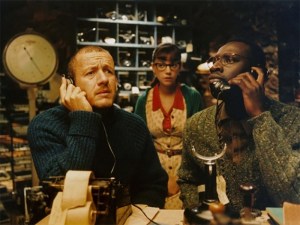 Micmacs succeeds where Rian Johnson’s Brother’s Bloom dangerously came close, and by that I mean that Micmacs overdoses on whimsy and I pronounced it clinically dead about an hour in. It’s too much; it’s just too much. Jeunet has always created movies that existed in rich, idiosyncratic worlds but those worlds always felt lush and lively and bursting with wonder. What saves a movie from whimsy is an emotional connection to the proceedings. 2001’s Amelie is a perfect example of cinematic “magic realism” but it’s also a moving and emotionally rewarding love story that transcends the plucky heroine. 2004’s A Very Long Engagement was a rapturous, old-fashioned love story with flights of fancy. Now, after a long six-year absence, Jeunet seems to have lost touch with the heart. There is no real emotional entry point for Micmacs. The protagonist is pretty much a blank. Yeah, you want him to get justice and you pull for the underdogs, but at no point did I care whatsoever for any character. Most of the junkyard characters are just ideas, walking-talking heist components (the human cannonball, the girl whose brain is good at math, the toy maker). Several characters barely exist except for their specific roles in Bazil’s schemes. There’s a romantic angle with the female contortionist (Julie Ferrier) and Bazil, but that comes off as less a function of the narrative and more of a desperate “Well, who else is gonna get together?” necessity. Jeunet has put together a movie that is all surface and no polish. Sure, the movie is intermittently entertaining and has plenty of imagination, but Micmacs is without a doubt the least involving and least accomplished film from a man responsible for a fantastic output.
The tone of the film seems to hew to something like a silent movie, which might explain why all the older members in my audience were constantly giggling while I just occasionally snickered under my breath. The comedy never rises above the chuckle level. There’s plenty of controlled wackiness, nothing gets too out of hand or edgy despite the fact that the plot revolves around getting vengeance on arms dealers. I was expecting something a little darker than the cutesy oddballs that I got. The best and darkest moment in the film is when we see that one of the arms dealers collects body parts of dead celebrities (Marilyn Monroe’s molar, Mussolini’s eyeball). It’s an interesting quirk that actually reveals something about the dark heart of the antagonist. There should be more moments like this. The bullet in Bazil’s brain is barely referenced. I have no issues with whimsy when it doesn’t overwhelm the narrative, and that’s the problem with Micmacs. The story is merely the vehicle for the inventive hijinks. The story is suffocated by whimsy and visual energy, therefore there’s no room for character development. All that inventiveness takes center stage. If playfulness is all you seek in a movie, then Micmacs will likely satisfy. Jeunet still makes movies that nobody else does, but he’s fallen fall short of his own lofty standards.
 The movie moves along so quickly that it seems like every character just naturally intuits what must be done next, like they all have the screenplay in hand just off camera. Bazil is so quickly adopted by the junkyard gang. He so quickly discovers who is responsible for his life’s troubles. The schemes are so quickly thrown together. They aren’t even that complicated, mostly distracting and framing. The movie just feels like a spinning plate that has to keep moving or else everything will just break. I suppose Jeunet and his longtime co-writing collaborator Guillaume Laurant are trying to keep things busy so people won’t notice that they don’t genuinely care what happens.
This being a Jeunet film, of course it’s spectacular from a technical standpoint. Every frame of a Jeunet film can be used as a mural. His compositions delight the eye and the colorful cinematography by Tetsuo Negata (Splice) makes Paris seem like a dream city. The production design looks like it was taken directly from the Steampunk Architectural Digest magazine. You’ll never have to worry about the visual aesthetics or ingenuity of a Jeunet film. But there are plenty of artists that can master technical craft (you can find them in the world of commercials) but it takes something much more to marry technical precision in the service story and character. Micmacs is a strange film not because of plot, character, tone, or energy, but because Jeunet spent six years in absence and returned with a film that’s got plenty of style but no heart inside all that artifice.
Nate’s Grade: B-
Share this:

The Bank Job (2008)
 An intelligent and rather crackling heist movie that also happens to be based on a true story. The 1971 British bank heist has so many characters involved that you may need a helpful cheat sheet, especially when it comes to varied loyalties. There are three separate groups all playing their own game, and when the heist doesn’t go exactly according to plan, and then the movie gets even more complicated. It’s a flavorful and funny heist movie that also doesn’t ignore the severe repercussions and life-and-death stakes. The Bank Job is an engrossing crime caper that still manages to thrill and surprise an audience.
Nate’s Grade: B+
Share this:

21 (2008)
 Glitzy, breezy, and 100 percent predictable, 21 is a simple con movie that goes through the motions with hyper realism. The most interesting part of the film, by far, is learning the systems that help these coeds fleece Vegas for thousands of dollars. In fact, the true story is far more interesting than this typical tale about a good kid who gets a big ego, pushes his true friends away, is humbled, and then learns a lesson while getting the girl too. What’s a MIT engineer want to go to Harvard med school for? And for that matter, you’re telling me there are no scholarships out there to brainy MIT students? Whatever the case, 21 will pass the time nicely without damaging your brain. The card games are ramped up with zooming camerawork and flashy special effects by director Robert Luketic (Legally Blonde), but it’s all window dressing to an interesting story that was white washed into a bland but undeniably commercial movie. It’s a fine time but, like Vegas, will leave you empty in the end. Still, you could do worse than overly stylized con movies about math whiz card sharks.
Nate’s Grade: C+
Share this:

Inside Man (2006)
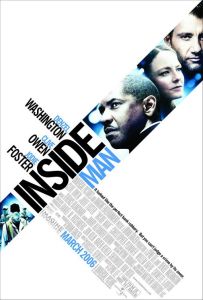 Spike Lee is one of the most recognizable names in film. Usually, the edgy, pointedly opinionated director sets his sights on racial strife, human relations, and satire. So what is Lee’s name doing attached to the Hollywood heist flick, Inside Man? For starters, it’s his most commercial film of his career, a sharp, engrossing thriller that doesn’t blunt his distinct voice.
Dalton Russell (Clive Owen) has set forth the perfect bank robbery. He and a handful of associates, dressed as painters with their faces obscured, have locked down a bank in downtown Manhattan. They’ve rounded up everyone inside, robbed them of their trusted cell phones, and ordered them to wear identical painter suits and masks. Detective Keith Frazier (Denzel Washington) is tasked with resolving this standoff, which the media is all too eager to cover in its escalation. What could the crooks be after? Well, bank owner Arthur Case (Christopher Plummer) is certainly nervous about a key document he has inside a safety deposit box, a document linking him to scratching the backs of Nazis. He pits Madeline White (Jodie Foster) to retrieve the document at any cost, and she has the tenacity to wedge herself between her political contacts and the police. All the characters keep their cards held close and try and outfox the other, while figuring out what exactly is going on inside that bank.
This movie is a born crowd pleaser. The heist and ensuing complications really grab an audience early on. There’s a certain thrill watching Dalton, so cool and clam, plot out his bank robbery like the script is still in hand. The crooks are always one step ahead of the police as well as the audience, and I mean that in the best terms. It’s great fun just wondering how Dalton’s team is going to get out of their many jams, and the results are rarely unsatisfying. Inside Man knows exactly when to tantalize with intrigue, inject humor (“Penalty of code 36DD?”), or tighten the tension. The filmmakers know exactly what button to press and at what time. For a two-hour plus film, Lee keeps the film at a swift pace and smoothly weaves his characters in and out. The draw of Inside Man is watching the tit-for-tat game between Frazier and Dalton, too stone-faced pros trying to outsmart each other. Lee smartly allows his characters and story to take center stage and refrains from goosing a strong genre flick with some annoying, superficial artistic artifice.
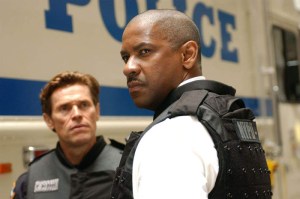 Inside Man is a heist that’s refreshingly grounded in reality. Nothing is altogether too out there or complicated to the point where you’d need a score sheet to follow along. Dalton is the movie’s star and Inside Man gives him the center stage to draw us in and keep us guessing. In fact, the flick is so grounded in the plausible that mainstream audiences might be put off by the fact that there isn’t any super twist saved for the end. I think the same audiences Inside Man is so fine-tuned to entertain will discover the lack of a last-second twist as underwhelming. I hope we’re not to the point, as an audience, where we’d rather have an illogical, forced twist ending than something that closes our story with satisfying maturity and finesse. The biggest plot hole you’ll have to swallow with Inside Man is that a businessman would keep a document that linked him to the Nazis. What’s that about? Sentimental value? I’m also still a bit hazy on the motivation of our crooks.
Even though this is a crowd-pleaser, the film is not without its missteps. Inside Man has one of the worst scores I have heard for a movie, ever. Allow me to explain why I feel so brutally, and I do. The score flashes inappropriate mood all throughout the film, robbing many sequences of drama and calling attention to itself. Take for instance a phone conversation between Frazier and Dalton; we cut back and forth between the two and each actor has a different music score. Frazier’s is a jaunty jazz riff, while Dalton’s is the more traditional brooding orchestral number. Because of the schizophrenic musical score this moment becomes funny. The best example of how this score is dreadful is during a scene late where SWAT storms inside the bank. The camera takes their point of view and creeps through the bank lobby, and then you hear a horn (trumpet?) reverberate. It gets louder and then quieter in beats, like a high school brass orchestra just whizzed by in a race car. Then it keeps going but in another direction. At first I was confused, and then I thought, “Did Dalton actually set up a horn section to distract the police?” No, it’s just the awful Inside Man score that totally takes you out of the movie. Scores should enhance the movie, not turn drama into comedy.
Lee also doesn’t help his story by including so many flash-forwards in time. They mostly rob Inside Man of key suspense points. Now we know the bank robbers get away, we know their identities are still unknown, and we know no one died. Luckily, the charisma of the leads and the clever storyline can survive Lee shooting the movie in the foot. The movie also has what feels like the longest denouement since 2003’s Return of the King 20-minute hug fest.
 The quality cast definitely gives Inside Man a boost. Washington is on autopilot but is still charming as ever while being intense and intuitive. Foster is like a female version of Mr. Wolf (Pulp Fiction) but full of steely determination. It says something when really talented actors like Willem Defoe and Chiwetel Ejiofor take tiny roles. As it should be, Owen is the standout. He’s so menacing and composed that you not only want Dalton to get away with the bank holdup, you want him to humiliate and embarrass his opponents even more. I?m convinced that in the world of film there’s no cooler actor than Clive Owen at this point. He adds a touch of badass to every role, with the notable exception of Derailed. At this point, I would pay to hear him recite the phone book and walk away going, “Wow, I didn’t know Aaron A. Anderson of 1200 West Avenue sounded so kickass!” Clive Owen is that cool.
Inside Man is a sharp, intelligent, mostly satisfying heist flick with a terrific ensemble. Lee’s most mainstream picture ever is a born crowd-pleaser, despite some missteps here and there (flash forwards, a poor score). The acting all around is top-notch, and the flick works as a tight and mature genre piece, simultaneously covering all its genre bases and playing up the smarts. I hope audiences appreciate the sense of believability with the film and don’t walk away irked that there is no super last-second twist. Inside Man isn’t anything groundbreaking but it knows how to tease an audience and tell a good guessing game of a tale.
Nate’s Grade: B
Share this:

Ocean’s 12 (2004)
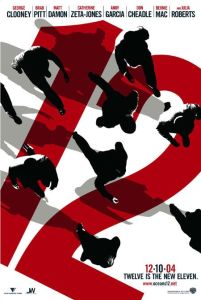 In 2001, Steven Soderbergh’s remake of Ocean’s Eleven was a giant surprise. It was a blast of fun with an impressive collection of Hollywood royalty. It had clever dialogue, fun characters, and a gala of amusing plot twists. It was one of the breeziest, most entertaining movies in years. Now, come late 2004, Ocean’s Twelve is released with the entire cast returning, including the lovely Catherine Zeta-Jones in tow. Expectations are high for another glitzy romp, but what you’re left with in Ocean’s Twelve is all glitz and no romp.
It’s been three years after the gang robbed ruthless casino owner Terry Benedict (Andy Garcia) of 160 million dollars. Benedict tracks down each member of Ocean’s Eleven and gives them the same ultimatum: either pay back what they stole, with interest, in two weeks or they’ll be killed. Danny Ocean (George Clooney) leaves his attempts at normal home life with Tess (Julia Roberts) and reassembles the team, many of whom have burned through their shares of the millions. Danny and his right-hand man Rusty (Brad Pitt) figure they’re too hot stateside so they’ll need to travel overseas if they’re to steal their fortunes. Linus (Matt Damon) also wants to have a greater role in the heist this time around.
In Europe, Ocean is challenged by a French playboy (Vincent Cassel) who moonlights as the notorious thief, the Night Fox. The challenge is to see who can steal a priceless Faberge egg, and if bested the Night Fox promises to pay all of Ocean’s debts to Benedict. Hot on the heels of both thieves is Isabel (Zeta-Jones), an expert police officer that also happens to be the former girlfriend to Rusty.
 Ocean’s Twelve does not work as a heist picture. For starters, the audience has no idea what’s going on for most of it. A general heist movie bylaw is to explain what the heist will entail, and then we watch the team hit it step by step. Forget that. In Ocean’s Twelve we’re never told how they are going to do their heist, and as they commence with their plan it’s not surprising to an audience, only confusing. I had to wait until the very end for some character to go into a monologue to explain how they accomplished their heist, and let me say, it was not worth two hours of waiting and scratching my head. The result seems to push away an audience instead of involving them in the fun of the scheme.
The story doesn’t utilize the talents of the assembled members. There’s a reason you hire a demolitions expert or a pick pocket, and that’s to let them work their skill. Well in Ocean’s Twelve we get none of that. Most of the cast’s skills are not ever put to use, which further gunks up a heist movie. The movie really errs by putting many of its eleven on ice for long stretches of the film. Around the second act almost everyone gets arrested. Pity poor Bernie Mac, who is in jail for near the whole movie. It seems that Soderbergh doesn’t know what to do with all his characters, and the new additions, so he stashes them away for long stages of time hoping an audience won’t notice.
Soderbergh is in danger of becoming a parody of himself. His usual narrative flourishes are present, including jumps in time and perspective; however, they don’t add up to much except unnecessary showmanship. The nonlinear leaps and shell game of information do not add to the film. Soderbergh keeps his audience in the dark for too long and then cheats us with the ending. Ocean’s Twelve is a good looking film (the vistas look beautiful), but it’s a good looking movie with nowhere to go. What’s even more frustrating is the ending to Ocean’s Twelve. You see, in the end we find out that the last hour plus of the movie was unnecessary. Yes, the movie actually makes a reveal that nullifies over half of the film. It’s cheap and unappreciated. Ocean’s Twelve, there’s a difference between tricking an audience and conning them. Maybe some day you’ll realize this.
 The new storylines never really develop. Zeta-Jones doesn’t add much besides another authority figure to chase after Ocean and the boys. Her subplot involving finding her master thief father is abrupt and easy. The best new addition to Ocean’s Twelve was the prospect of a rival, but again nothing really happens with our French thief. He’s more of a catalyst for the plot than anything else, and it’s a shame, because he could have opened the door for a great film pitting two competitive teams of thieves against each other.
Ocean’s Twelve is too satisfied with itself to be that entertaining. It’s now actually reminiscent of the 1960 original film (my grandmother swears it’s wonderful, take that for what you will), starring the Rat Pack. Plot and logic are secondary to a bunch of cool characters having fun. I really enjoyed Ocean’s Eleven (the 2001 film, not my grandmother’s preferred version), but this new sequel lacks any charm and verve. I can’t even say there were many good scenes, just some good ideas that they didn’t fully actualize, like stowing Yen in baggage and then losing their luggage (nothing comes of this). There’s a fun scene involving Topher Grace spoofing his own micro-celebrity, but beyond that many of the scenes and ideas don’t seem developed. The best moment of Ocean’s Twelve, for me, was when I saw Eddie Izzard, the funniest man on the face of the Earth and then some, chat with Hollywood’s A-list on screen. God bless you Eddie Izzard.
Ocean’s Twelve wilts in comparison to its witty, effervescent predecessor. Ocean’s Eleven was fun and hip but didn’t need to coast on star appeal. It had a believable heist, engaging personalities, and it was fun because we knew what was going on and it mattered! I’m sure the cast of Ocean’s Twelve had a blast making the movie together, and their friendly camaraderie shows, but when I left the theater I felt like I had been stuck with the bill for someone else?s good time.
Nate’s Grade: C
Share this:

The Italian Job (2003)
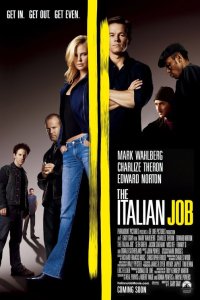 The Italian Job is equal parts dumb and equal parts entertaining, which makes for fine breezy summertainment. The cast is agreeable, the heist is interesting, the action is full of sexy cars and explosions; I call into question how in the world Jerry Bruckheimer’s name is absent from this. Maybe he’s too busy with his TV work.
The film opens up on a nifty heist in, of all places, Venice. Grizzled old-timer John Bridger (Donald Sutherland) leads his crew for, say it with me now everyone, one last heist. Charlie (Mark Wahlberg) is his second in command and the heir to the thievery throne. The crew steals a safe full of gold bars by applying explosive paint to specific levels of ceilings, causing the safe to drop two floors into the awaiting arms of our scoundrels. The Venice police believe the safe to be riding off in a boat, driven by the crew’s getaway man Handsome Rob (the always good to have Jason Statham). But no the real safe has fallen into the canal and Charlie and John are scuba-safe-crackin’. The crew gets away with their misdeed and toast about their thievery atop a mountainside.
 Everything is good. But wait, Steve (Edward Norton) double-crosses his peers and hijacks the gold and kills John. Heres what I dont get. Everyone in the crew is shocked, especially an overactive and whiny Wahlberg (and there’s no worse kind than a whiny Wahlberg). “How could you do this?” whines Whiney Wahlberg. Let me think here. Maybe its because … YOU’RE ALL THIEVES, JACKASS! What was that old saying, no honor among thieves or something. To paraphrase Go, you guys aren’t exactly in a highly ethical industry. There aren’t good thieves and bad thieves; this ain’t no Errol Flynn pic. I would also like to note that everyone in the crew should have known of Steves predestined treachery just by the fact that Norton has a mustache. C’mon, do you need any bigger a sign? Anyway, the van the crew is in drives off a bridge into subzero water. Steve fires some round into the water and believes hes killed his former crew. They of course are not dead and instead are using the scuba gear to breathe. Of course, it’s still subzero temperatures but what does that matter?
We then flash to one year later. Dead John’s not-so-dead daughter, Stella (Theron), conveniently works as a professional safe-cracker to tests security systems. Hmm, I wonder if that will come in handy later. Charlie approaches her with a plan to re-re-re-steal the gold from Steve, the man who, dramatic pause, killed her father. She agrees to help because she wants to see the look on Steve’s face when he finds his money gone. Its probably something very similar to many people over 40 I see now that the stock market is full of price-inflated charlatans.
 What follows is Charlie reassembling his crew; Seth Green as the geeky tech dude, Handsome Rob, and Mos Def as the demolitions expert. Together they work out a plan that is part elaborate and part ludicrous, but still entertaining. This is where The Italian Job gets the rules of heist cinema right: 1) Efficient amount of time must be made to plan the heist so the audience knows the steps and every role of importance. 2) The heist must go off for an extended period of time for the audience to enjoy the payoff of watching all the rehearsal proceedings. 3) The heist has got to be done in an interesting way. 4) Not everything has to go according to plan. The only real action sequences in The Italian Job bookend the film, with the opening Venice heists and the later and extended Steve steal. With this said, the end still carries a good sense of payoff for the audience, and watching all of the different elements of the team work together with their own responsibilities builds a sense of attachment to these otherwise undeveloped characters.
I am convinced Mark Wahlberg is a black hole of acting. Sure, he can do Affable Lug fine and dandy as evidenced by Boogie Nights, but when Wahlberg attempts (and that is the operative word) to emote he looks like his leg is caught in a bear trap. His whole bland handsome understatedness isn’t fooling me. Theron is a pretty face but I still havent seen anything shes done to convince me shes anything more. Green is very funny in his geeky role, complaining that he had the original idea for Napster and it was stolen from him by his roommate. Statham and Mos Def round out a likable if slightly one-note crew.
Director F. Gary Gray (The Negotiator) has graduated from the world of music videos but still knows how to stage some exciting scenes. The slick ending heist, with the L.A. gridlock, three trucks to chase after, and fleet of patriotic Minis is a great popcorn action set piece all the more appreciated because of the patient setup the movie has given.
In the days of summer, where some people wrongly consider a bloated and pretentious action film to be entertaining, even if they dont get a lick of it, it’s especially nice to have something like The Italian Job remind us the escapist fun summer flicks can offer. Just don’t worry if Wahlberg looks to be in pain.
Nate’s Grade: B-
Share this:

Jay and Silent Bob Strike Back (2001)
 Kevin Smith returns back to his comedy roots. No more movies with a message (Chasing Amy and Dogma) it’s back to good ole’ snowballing and stink palming. His latest, Jay and Silent Bob Strike Back, is like a giant thank-you card to all his fans that have made the man who he is today. It ties up the entire View Askew universe so Kevin can drift off into uncharted ventures of film making and not have to keep referencing the same damn characters. Plus there’s plenty of good-natured vulgarity to go around.
 The plot of Jay and Silent Bob is nothing too heavy but seems to keep the film on a continuous pace, unlike the sometimes stagnant feel Mallrats had (what, they’re in one location for 90 minutes). It seems that after getting a restraining order at the Quick Stop on them, Jay and Silent Bob learn that Miramax is making a movie from a comic book that is in fact based off of them. Learned of the riches they could make they seek out the comic’s author Holden McNeil (Ben Affleck’s first appearance in the film) and demand a piece of the pie. Holden tells them that he long ago sold his right to his partner Banky Edwards (Jason Lee, in his second appearance in the film) and that there’s nothing they can do to stop the film. Jay suddenly gets the idea that if they stop the movie from ever getting made then they don’t have to worry. So off go our stoner duo on a mission to sabotage and satirize Hollywood.
Along the way are a hitch-hiker (George Carlin) advising the best way to get a ride is to go down in your morals, a confused nun (Carrie Fisher), the cast of Scooby Doo offering a ride (which will be 100x funnier than the feature film coming out this summer), a beautiful band of international diamond thieves (Eliza Dusku, Ali Larter, Jennifer Swalbach-Smith, Shannon Elizabeth), a rescued chimpanzee, a dogged Wildlife agent (Will Ferrell), and a full barrage of hilarity once Hollywood is finally hit.
 The best barbs are laid out by Ben Affleck and Matt Damon bickering about the other’s film choices on the set of Good Will Hunting 2: Hunting Season. This moment is truly inspired and full of great humor from Gus van Sant too busy counting his money to yell action to Damon turning into a vigilante hero. I almost fell on the floor laughing during this sequence.
When Jay and Silent Bob hit Hollywood is when the comedy starts hitting its stride as this Jersey Greek chorus interacts with the Hollywood life and encounters many a celebrity. The jokes are usually right on target except for Chris Rock’s performance of a racism obsessed film director. Rock’s portrayal becomes grating to the moviegoer far before it’s over, though he does get a few choice lines.
Smith as a director has finally elevated his visual art into something that can sustain itself instead of his earlier just-hold-the-camera-and-shoot movies. There are pans, zooms, quick cuts, cranes, action sequences, and even CGI. Smith is evolving as an artist but still staying his “dick and fart joke” self, and Jay and Silent Bob Strike Back is evidence. And that’s fine by me.
Nate’s Grade: B
Reviewed 20 years later as part of the “Reviews Re-View: 2001” article.


 nathanzoebl
You must be logged in to post a comment.