Blog Archives

Monster (2003)

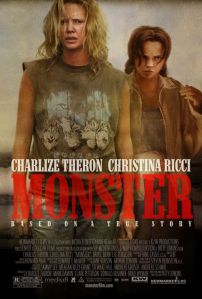
Monster follows the life of Aileen Wuornos (Charlize Theron, now nominated for a Best Actress Oscar), America’s only known female serial killer. In the late 1980s, Wueros was a roadside prostitute flexing her muscles with Florida motorists. She describes “hookin’’” as the only things she’s ever been good at. One day Wuornos has the full intention of taking her own life, but she meets 18-year-old Selby (Christina Ricci) at a lesbian bar and finds a companion. Driven by a growing hatred of men from sexual abuse, Wuorno’s starts killing her johns to try and establish a comfortable life for her and Selby.

Let’’s not mince words; Theron gives one of the best performances I have ever seen in my life. Yes, that’’s right. One of. The. Best. Performances. Ever. This is no exaggeration. I’’m not just throwing out niceties. Theron is completely unrecognizable under a mass of facial prosthetics, 30 extra pounds, fake teeth and a total lack of eyebrows. But this is more than a hollow ploy to attract serious attention to the acting of a pretty face. Theron does more than simple imitation; she fully inhabits the skin of Aileen Wuornos. The closest comparison I can think of is Val Kilmer playing Jim Morrison in The Doors.

Theron is commanding, brave, distressing, ferocious, terrifying, brutal, stirring, mesmerizing and always captivating. It may be a cliché, but you really cannot take your eyes off of her. Her performance is that amazing. To say that Theron in Monster is an acting revelation is perhaps the understatement of the year.

With previous acting roles in Reindeer Games and The Cider House Rules, Theron is usually delegated to “pretty girlfriend” roles (who occasionally shows her breasts). Who in the world thought she had this kind of acting capability? I certainly did not. If Nicole Kidman can win an Oscar for putting on a fake nose and a so-so performance, surely Theron should win an Oscar for her absolute transformation of character and giving the performance of a lifetime.

With this being said, and most likely over said, Monster is by no means a perfect film. Minus the terrific central performance, Monster is more of an everyday profile of a grotesque personality. The film weakly tries to portray Wuornos more as a victim, but by the end of the film, and six murdered men later, sympathy is eradicated as Wuornos transforms into the titular monster. Some supporting characters, like Ricci’’s narrow-minded Christian up bringers, are flat characters bordering on parody. The supporting characters are generally underwritten, especially the male roles that serve as mere cameos in a film dominated by Sapphic love.

Monster is proof positive that human beings will never be phased out by advancing machinery when it comes to acting. Monster boasts one of the greatest acting achievements in recent cinematic history, but it also coasts on sharp cinematography and a moody and ambient score by BT (Go). Monster is a haunting film that you won’t want to blink for fear of taking your eyes off of Theron. She gives an unforgettable tour de force performance that will become legendary.

Nate’s Grade: B

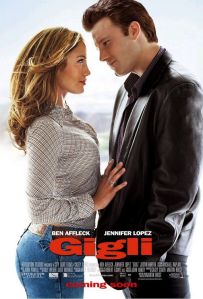
Gigli (2003)

It’s the feel-good movie of the year revolving around a lunkhead mobster (Ben Affleck) and his mentally challenged kipnapee and their attempts to covert a lesbian hitman (Jennifer Lopez) in between her yoga/horrific monologues concerning the superiority of female genitalia. Believe the hype people; Gigli is indeed as bad as they have told you. It’s not even entertainingly bad, like Bulletproof Monk, no folks; Gigli is just mundane and awful. During the entire two hour stretch, which feels much much longer, I kept saying one thing aloud: “How could anyone making this think they were making a goodmovie?” Did they think audiences would find it funny that Affleck’s mother (the mother from My Big Fat Greek Wedding) shows us her big fat Greek behind? Did they really think that a mentally retarded kid (who has an affinity for gangster rap and wishes to travel to the mythical “Baywatch”) would come off as endearing? Well instead it comes across as insulting. And what else is insulting is the laugh-out-loud dialogue Lopez is forced to spit out concerning her attraction for women. I can’t think of any actress that could say the line, “I love my pussy” convincingly. And I’m sure a lot of actresses out there have true affection for it. The writing is just atrocious. And so much else fails as well. The score is a perplexing mix of upbeat jazz and inappropriate string orchestra. I don’t understand what emotions they were going for during scenes in Gigli but a full string orchestra playing music better suited for a real drama does not fit. Maybe it was for a tragedy. In that case, then it’s right on the money. You won’t see a more sloppily executed, horribly acted, painfully written, lazily directed, inept film this year. And what the hell did Christopher Walken walking in have anything to do with anything?

Nate’s Grade: F

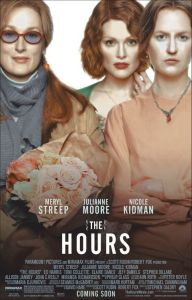
The Hours (2002)

Okay, after watching the Golden Globes award show and seeing ‘The Hours’ crowned with the highest prize, and hearing incessantly about Nicole Kidman’’s fake prosthetic nose in the movie, it was time to venture into that darkened theater and see how good the awards-friendly ‘The Hours’ was. Little did I fully realize what I was getting myself into.

Nicole Kidman plays Virginia Woolf, who is in the midst of writing her novel Mrs. Dalloway, where she proposes to display a woman’s entire life through the events of a single day. Julianne Moore plays Laura Brown, a housewife in 1951 having difficulty adjusting to a domestic life that she feels ill equipped for. Meryl Streep plays Clarissa Vaughan, a gay copy-editor in 2001 planning a party for a poet and former lover (an emaciated Ed Harris), who is suffering from the late stages of AIDS. These three storylines will be juggled as the film progresses, with each woman’s life deeply changing before the end of the day.

The Hours’ is a meandering mess where the jigsaw pieces can be easily identified. The attempt at a resolution for an ending, tying the three storylines together, is handled very clumsily. The film spins on and on that you start to believe the title may be more appropriate than intended. What this movie needed was a rappin’ kangaroo, post haste! The film is wrought with victimization and screams “”Give me an award already!”” Before you know it you’re being bludgeoned to death with what is profoundly the most over serious Lifetime network movie ever assembled. And there’’s nothing fundamentally wrong with Lifetime movies but ‘The Hours’ does not share the sensibilities of its TV” brethren.

Kidman, nose and all, gives a strong performance displaying the torture and frailty of a writer trapped within her own mind but too often relies on wistful staring or icy glares. Moore is effectively demoralized but cannot resonate with such a shallow character. Streep is the least effective of the three and fizzles among an over-stuffed assembly of characters.

The supporting cast is unjustly left for dead. The characters are seen as parody (Toni Collette as Moore’’s un-liberated homemaker neighbor), extraneous (Claire Danes as Streep’’s daughter, Allison Janney as Streep’’s lover, Jeff Daniels as Harris’ ex-lover, you know what, almost anyone in the Streep storyline), one-note (the workmanlike John C. Reilly who plays yet another doting and demystified husband) or merely obnoxious (Moore’’s brat child that refuses to separate from her). It appears ‘The Hours’ is the three lead actress’ game, and everyone else is not invited to play along.

Stephen Daldry’’s direction shows surprising stability and instinct after his art-house pandering ‘Billy Elliot’ showed little. The technical aspects of ‘The Hours’ are quite competent, especially the sharp editing and musical score, which just points out further how slickly hollow and manufactured the film is.

The Hours’ is an over-glossed, morose film that is too self-important for its own good. It sucks the life out of everything. And for all its doom and gloom and tsunami of tears, the only insightful thing ‘The Hours’ is trying to pass off onto the public is that women are more depressed than you think.

Nate’s Grade: C

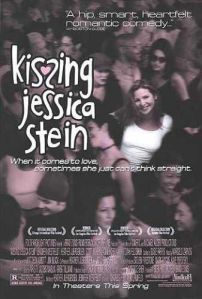
Kissing Jessica Stein (2002)

Kissing Jessica Stein stars Jennifer Westfeldt as the perfectionist title heroine searching for true love in the Big Apple. She answers a personal ad sent by Helen (Heather Juergensen), an art gallery manager trying her hand at women for the first time. What begins in comedic awkwardness turns to the fires of passion. Which leads to much more awkwardness as Jessica attempts to keep her secrets and the true identity of her “friend” from her mother.

Juergensen and Westfeldt wrote the script based on characters they have nurtured for several years, and their comfort level with the material shows. Each gives a wry and charismatic performance, with Westfeldt proving herself an acting revelation. It must be nice for her to have something else to her résumé than being one of the “girls” in Two Guys, A Girl and a Pizza Place.

Kissing Jessica Stein tiptoes a fine line with some characters possibly becoming gay or Jewish stereotypes; however, they never do fall into the abyss of Caricature Land. Tovah Feldshuh, playing Jessica’s mother, might make you wince at the thought that she’d be mired as a Mike Myers “Coffee Talk” portrait. But she has scenes where she shows real tenderness that is very affective.

At times the movie feels a bit too wrapped up in its own precocious-ness. There’s even a standard montage of bad dates that becomes annoying much sooner than it ends. Those looking for deep lesbian issues needn’t apply here. Kissing Jessica Stein hits its targets on a surface level, which can be deemed appropriate for an innocuous romantic comedy. The downer closing 10 minutes seems to come from nowhere and betray the feel of the movie.

The film plays by conventional rules for the most part but these don’t diminish the healthy humor in the least. Kissing Jessica Stein is a charming and fun experience and would serve as a good date movie for prospective couples.

Nate’s Grade: B

Mulholland Drive (2001)

Mulholland Dr. has had a long and winding path to get to the state it is presented today. In the beginning it was 120 minutes of a pilot for ABC, though it was skimmed to 90 for the insertion of commercials. But ABC just didn’t seem to get it and declined to pick up David Lynch’s bizarre pilot. Contacted by the French producers of Lynch’s last film, The Straight Story, it was then financed to be a feature film. Lynch went about regathering his cast and filming an additional twenty minutes of material to be added to the 120-minute pilot. And now Mulholland Dr. has gone on to win the Best Director award at Cannes and Best Picture by the New York Film Critics Association.

Laura Harring plays a woman who survives a car crash one night. It appears just before a speeding car full of reckless teens collided into her limo she was intended to be bumped off. She stumbles across the dark streets of Hollywood and finds shelter in an empty apartment where she rests. Betty Elms (Naomi Watts) is a young girl that just got off the bus to sunny California with aspirations of being a big time movie star. She enters her aunt’s apartment to find a nude woman (Harring) in the shower. She tells Betty her name is Rita after glancing at a hanging poster of Rita Hayworth. Rita is suffering from amnesia and has no idea who she is, or for that fact, why her purse is full of thousands of dollars. Betty eagerly wants to help Rita discover who she is and they set off trying to unravel this mystery.

Across town, young hotshot director Adam Kesher (Justin Theroux) is getting ready to go into production for his new film. He angers his mob producers by refusing to cast their chosen girl for his movie. After some harassment, threats, and a visit by an eyebrow-less cowboy assassin (God bless you David Lynch), he relents.

In the meanwhile, people are tracking the streets looking for Rita. Betty and Rita do some detective work and begin amassing clues to her true identify. As they plunge further into their investigation the two also plunge into the roles of lovers. Rita discovers a mysterious blue box and key in her possession. After a night out with Betty she decides to open it, and just when she does and the audience thinks it has a hold on the film, the camera zooms into the abyss of the box and our whole world is turned upside down.

David Lynch has made a meditation on dreams, for that is at the heart of Mulholland Dr. His direction is swift and careful and his writing is just as precise. The noir archetypes are doing battle with noir expectations. The lesbian love scenes could have been handled to look like late night Cinemax fluff, but instead Lynch’s finesse pays off in creating some truly erotic moments. Despite the population of espresso despising mobsters, wheelchair bound dwarfs, and role-reversal lesbians, the audience knows that it is in hands that they can trust. It’s Lynch back to his glorious incomprehensible roots.

Watts is the true breakthrough of Lynch’s casting and she will surely be seen in more films. Watts has to play many facets of possibly the same character, from starry-eyed perky Nancy Drew to a forceful and embittered lesbian lover.
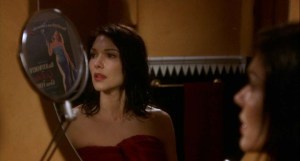
One scene stands out as a perfect example of the talent Watts possesses. Betty has just been shuffled off to an audition for a film and rehearsing with Rita all morning. She’s introduced to her leathery co-star and the directors await her to play out the audition scene of two kids and their forbidden love. As soon as the scene begins Betty vanishes and is totally inhabited by the spirit of her character. She speaks her lines in a breathy, yet whisper-like, voice running over with sensuality but also elements of power. In this moment the characters know, as the audience does, that Betty and Naomi Watts are born movie stars.

It’s not too difficult for a viewer to figure out what portions of the film are from the pilot and what were shot afterwards. I truly doubt if ABC’s standards and practices allows for lesbian sex. The pilot parts seem to have more sheen to them and simpler camera moves, nothing too fancy. The additional footage seems completely opposite and to great effect. Mulholland Dr. has many plot threads that go nowhere or are never touched upon again, most likely parts that were going to be reincorporated with the series.

The truly weirdest part of Mulholland Drive is that the film seems to be working best when it actually is still the pilot. The story is intriguing and one that earns its suspense, mystery, and humor that oozes from this noir heavy dreamscape. The additional twenty minutes of story could be successfully argued one of two ways. It could be said it’s there just to confound an audience and self-indulgent to the good story it abandons. It could also be argued that the ending is meticulously thought out and accentuates the 120 minutes before it with more thought and understanding.

Mulholland Dr. is a tale that would have made an intriguing ongoing television series complete with ripe characters and drama. However, as a movie it still exceeds in entertainment but seems more promising in a different venue.

Nate’s Grade: B

Reviewed 20 years later as part of the “Reviews Re-View: 2001” article.
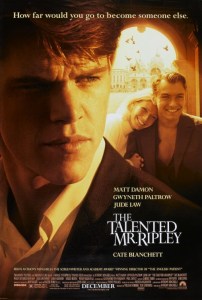
The Talented Mr. Ripley (1999)

Interesting and beautifully filmed and yet the complexities have a vacation-porn feel to them as the story churns further. Excellent acting with all involved as they display the top of their game. Matt Damon is magnetic as the socially murderous Mr. Ripley, and often times a bit frightful. He does what he feels needs to be done once he gets a taste of the good life and wants nothing from leaving it behind. Supporting players such as Jude Law and the oh so talented Phillip Seymour Hoffman contribute solidly and flawlessly. Ripley actually packs more suspense then you would think from the man responsible for one of my most boring theater experiences (I mean of course The English Patient) but wrings true tension and challenges the audience to pull for the bad guy. I must note that the ambiguous ending seems to detract from the impact of the movie. But for many reasons and despite seeing Damon eerily coddle up to a corpse, Ripley is a fine flick with some great characters presented. The more I watch this film the more I enjoy it.

Nate’s Grade: A-

Go (1999)

The sophomore outing of director Doug Liman, the man who put the swinger in Swingers baby, is far from any slump – no it’s more like an achievement. Liman is a man that knows what he wants and an excellent visual artist. Go is a spinning tour-de-force joyride of energetic fun. The movie is down right infectious. It stays in your system for many days, no weeks, after viewing. Consult your physician for proper treatment.

Born in the shadow of Pulp Fiction with the disjointed narrative structure, interlocking plots, retelling of events through different perspectives, and out-of-place editing, Go is the first movie to deserve having the comparisons to Tarantino’s masterpiece of blood and violence. It’s like a child of Fiction, with teens as the main stars and doing some awfully idiotic things mainly because… they’re teenagers. The story of Go is bursting to the seams with clever and embraceable characters, witty and hilarious dialogue, and enough plot twists to keep any viewer frothing at the mouth for more. Again, consult your physician.

The movie reminds me in a way as a American Graffitti or Fast Times at Ridgemont High for the fresh stable load of young talent displayed. Everyone fits nicely and performs excellently, like Timothy Olyphant’s devilishly charming and dangerous turn as a drug dealer, and Taye Diggs who helped get Stella’s groove back and is now the too cool for words friend of a grocery clerk on their trip to Vegas which turns into a comedy of errors. But the standout amongst all the talent is that little delectable Canadian bundle of joy known as Sarah Polley. Playing one of the chief protagonists, she is fascinating and compelling. She takes the role and shines the brightest in a movie filled with equally bright stars. I look forward to seeing what she does in the future.

Set against the L.A. rave scene Go tells the story circling around a 24-hour period of tantric sex, drug deals, a police sting, a lap dance, gay soap stars, and good ole’ chew-able aspirin. The movie is driven by an awesome soundtrack of techno and rock that seems to act like the narrator of our little tale. Go is brisk, breathless, rigorously hip and smart. Finally an INTELLIGENT teen movie. Too bad not too many teens went to see it at the theaters judging from box office scores. I guess they all wanted to see Ryan Phillipe’s ass one more time in Cruel Intentions. But Go is a fascinating trip you’ll want to take over and over and wish the sun would never come back up. Do not pass Go.

Nate’s Grade: A

This movie also revisited and analyzed in the article, “1999: The Greatest Year in Film? A Review Re-View.”