Blog Archives
Lust, Caution (2008)
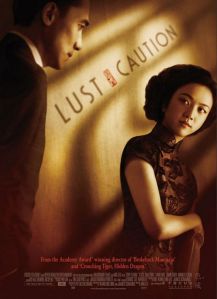 Ang Lee’s period romance is no Brokeback Mountain, though there is a heavy supply of thrusting. Lust, Caution is an NC-17 rated peak into life in China under Japanese occupation in the 1930s. Most of the film follows a school drama club that decides to become freedom fighters. They scheme to murder Chinese officials working with the Japanese government, and one gal (Wei Tang) is tapped to seduce and then kill a high-ranking official. For such a controversial movie, the sex scenes don’t even begin until 90 minutes into the flick (though our undercover heroine is deflowered by her drama club peer for the good of her mission). The movie is exquisitely shot, handsome in its details, and the lead performance by Tang is exceptional, simmering with conflicting emotions and some real sensual heat. The sex scenes doe have an erotic potency to them and they are more explicit than the kinder gentler fare found in typical Hollywood movies that consist of only seeing the slow-motion ecstasy result from a man on top. The offbeat love story gestates too late in the film’s run, leaving little time to delve deeper. Too much of the movie concerns back-story following the drama club’s road to becoming revolutionaries, and while it’s interesting it’s also rather needless on second thought. There’s a nine-minute difference between the R-rated version and the theatrical NC-17 cut; what’s in those nine minutes I do not know since I saw the edited version, but I’ve been told it’s a lot of thrusting. In lusty terms, the movie is heavy on foreplay and too short on a satisfying climax.
Nate’s Grade: B-
Share this:

Mongol (2008)
 Genghis Khan can’t be all bad. The Oscar-nominated foreign film Mongol dares to show the little known softer side to the man that conquered most of the known world in the early 13th century. The film follows the rise of Temudjin (Tadanobu Asano). Mongol has the look and feel of epic adventures of old, the type of stuff Hollywood was churning out at four-hour lengths in the 1960s. The cinematography is excellent and sweeping, the real-life filming locations add great authenticity to the tale, and the acting is universally strong, especially Asano and his stalwart and attractive wife, Börte (Khulan Chuluun). Even though Asano is Japanese he makes a much more convincing Genghis Khan than John Wayne (I advise everyone to skip 1956’s The Conqueror). Most of the film concerns Temudjin’s relationship with his wife and his blood brother, Jamukha (Honglei Sun). Eventually he must defeat his powerful blood brother and consolidate the Mongolian people. The interpersonal relationships between the three principles are surprisingly deft and full of insight. For a two-hour film detailing the life of Genghis Khan, the movie doesn’t resort to many battle sequences. The combat is exhilarating and stylish without ever becoming self-conscious. I read that Mongol is intended to be part one of a trilogy following Genghis Khan, so perhaps there will be more military strategy and battles once he steps off his home turf.
The movie lost me somewhere in its languid middle and never fully regained my attention. The movie starts off well, ends decently enough, but man the time in between gets terribly repetitious. Temudjin is captured. He escapes. He’s captured. He escapes. His wife is captured. He rescues her. I have no idea if all the events the film portrays are necessarily historically accurate as depicted. Even if they are, the filmmakers could have provided a stronger through-line to connect the events and provide a better sense of overall direction. Mongol is certainly a good film but it’s not great. It even feels a tad pre-programmed, like it was constructed for a U.S. audience that has grown accustomed to the likes of Braveheart and other bloody history epics. I’ll keep a passing notice on whether Mongol Part Two (the rise) and Mongol Part Three (the fall) improve upon Part One.
Nate’s Grade: B
Share this:

The Orphanage (2007)
 The haunted house spook sub-genre has mostly delivered fairly pedestrian results (Oh no, it’s only a cat), but let The Orphanage stand as undeniable proof that with patience and talent the haunted house can still be scary as hell. The film takes its time to establish a truly unnerving atmosphere where even genre clichés like creepy kids in creepy masks become compelling and scary. The haunted house usually revolves around some form of a mystery, and The Orphanage is able to tap out an interesting tale that provides plenty of emotional depth. The mystery unravels at a nice pace and the film grows in intensity and dread. Plus, the movie doesn’t spell out everything and respects the viewer’s intelligence. Invariably, this film will be compared to The Others, another superior chiller also from a Spanish filmmaker, especially given the conclusions reached by the end. But debut director Juan Antonio Bayona certainly makes a strong impression with his subtlety and ability to transform conventional creaks and surprises into effective thrills. I’d be happy to sit through more haunted houses if they were all as good as The Orphanage.
Nate’s Grade: A-
Share this:

The Counterfeiters (2007)
 The Oscar-winner for 2007 foreign film is certainly a fine film and a respectable winner, but let’s be honest, the foreign film category was watered down a tad. France nominated Persepolis over The Diving Bell and the Butterfly because a country is only allowed to nominate a single film (sucks to be you, countries with good movies). This rule has resulted in past incidents like Spain nominating Tuesdays in the Sun over Pedro Almodovar’s Talk to Her, which ended up winning the 2002 Best Original Screenplay Oscar despite Spain’s snub. The hard decision by France was moot because Persepolis didn’t make the Academy 2007 shortlist of nine nominees. The biggest snub from that shortlist was Romania’s 4 Months, 3 Weeks, and 2 Days, a harrowing film about two college-aged women seeking an illegal abortion in 1980s communist Romania. It won the Palme d’Or at the Cannes Film Festival and also won the Best Picture award by the European Film Awards (Austria’s The Counterfeiters wasn’t even nominated). Then there was Israel’s amusing and touching film, The Band’s Visit, about an Egyptian band that takes a wrong bus and finds itself in an Israeli town. But the Academy’s foreign films ruled that The Band’s Visit had too much spoken English and therefore could not be ruled as a foreign film. Also left out were Germany’s Edge of Heaven and Spain’s The Orphanage. Nothing against The Counterfeiters but the foreign language field had already snubbed most of the main contenders.
The Counterfeiters is a deeply fascinating true-story about the world’s largest counterfeiting ring. Sal Sorowitsch (Karl Markovics, with a face as hard as flint) is a master forger leading a life of luxury in Berlin until the police capture him and send him to a concentration camp with his fellow Jews. As World War II carries on, the Nazis recruit Sal to lead a team to forge the British pound and the American dollar. The Nazis hope to destabilize their enemies’ economies. Sal is given greater freedoms in the camp and the S.S. officers try to become his chums. But he has to ask himself what his cost his actions will have. He could be prolonging the conflict and actually helping Germany win, but if he doesn’t assist the Nazis then he will surely be murdered as will his team.
Write/director Stefan Ruzowitzky creates great tension from scene to scene but it is the moral dilemmas that stick. What are principles worth? Are they worth dying for? Are they worth endangering others’ lives? The movie takes a docu-drama approach with bobbing handheld camerawork; even the film stock looks like it was soaked in grime for authenticity. And yet I wish The Counterfeiters had chosen to be less enigmatic. The main character is a criminal that keeps his emotions close to the vest, but Ruzowitzky cheats the audience by keeping Sal mostly in his head. The story is filled with factual intrigue and the natural tension given the situation, but after it’s over there isn’t much that’s memorable for a genre that expects more of itself. The Holocaust genre (and let’s not kid ourselves, it is a genre at this point) has some pretty high dramatic expectations and produces films that sear into our brains. The Counterfeiters is a very well told tale with great acting and some interesting character relationships but it can’t fully measure up to other Holocaust parables.
Nate’s Grade: B+
Share this:

The Lives of Others (2006)
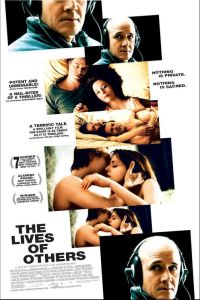 A mesmerizing and piercing human drama that burns into your memory long after it’s over. This Oscar-winner for Best Foreign Film actually deserved to beat out Pan’s Labyrinth. This vastly intriguing, dense, and extremely moving film explores life inside East Germany before the Wall fell, a life not often seen in the movies. The crux of the movie follows a career officer (Ulrich Mühe) in the secret police who has been assigned to eavesdrop on a playwright and his actress girlfriend. It is this assignment that shakes the man’s blind faith in his government, and The Lives of Others becomes nerve-wracking when our silent listener decides to become active in trying to protect his subjects from his boss. This is masterful, artistically illuminating filmmaking with a tight, deeply felt story and superb acting and direction. Germany has been crafting some of the world’s finest cinema as of late, including Oscar-winner Nowhere in Africa and Oscar-nominees Downfall and Sophie Scholl. See this film before Hollywood remakes it and ruins it. Tragically, Mühe died of stomach cancer in July 2007 just as American audiences began to see The Lives of Others and witness the depths of his talent. He will be missed by the world of cinema but his work in The Lives of Others is a lasting testament.
Nate’s Grade: A
Share this:

Black Book (2006)
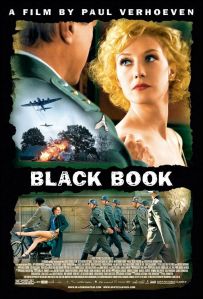 If there’s one thing you can say about Dutch filmmaker Paul Verhoeven, it’s that his films are never boring. He’s shameless when it comes to the amounts of sex and violence he squeezes into his films, and this isn’t typical bouncy violence but cold, serious violence that manage to have whiffs of dark comedy to it. The sex is sleazy and ridiculous, often outpacing the late-night flesh peddlers on Cinemax. I don’t think Verhoeven knows how to do anything subtle, and frankly I wouldn’t want him to. The man is responsible for brawny sci-fi (Total Recall, Robocop), killer lesbians (Basic Instinct), the most subversive mainstream Hollywood movie of the modern era (Starship Troopers is pro-fascism, people), and the most surreal visual effect I have seen in my life – a breast groping itself (Hollow Man). Verhoeven even shows up in person to accept his Razzie award for Worst Director for 1995’s camp classic, Showgirls. This man doesn’t have an off switch. The man makes enjoyable movies, both intentionally and unintentionally.
It’s been a long six years since Verhoeven’s last film and in that time off he’s settled back into his homeland. Black Book (Zwartboek) is a tale loosely based around true stories involving the Dutch resistance in the Nazi-occupied occupied Netherlands. And if there is anyone that can throw in some sex with our good old-fashioned WWII violence, it is Paul Verhoeven.
Rachel (Carice van Houten) is a Jew hiding out in the Netherlands. She and her family is trying to pass out of the country by river when they are ambushed by the guns of a Nazi boat. Rachel is the lone survivor and watches all of her family members get mowed down. She joins the underground resistance movement to find out who betrayed her family. She dyes her hair blonde, both above and below the waist to be thorough, and cuddles up to a stamp-collecting S.S. leader, Ludwig Muntz (Sebastian Koch). She works her way into his trust and along the way uncovers a twisty conspiracy to trick rich Jews into ambushed escapes.
 Black Book is skillfully made and pulpy enough to keep the viewer’s enjoyment level in a good place. From start to finish the movie presents enough trials and setbacks to keep an audience satisfied, and enough sex and violence to meet out the standard Verhoeven quota. Nazi occupation hasn’t been deeply explored from the Dutch point of view, and Verhoeven decides not to make everything so black and white. Muntz is a compassionate S.S. officer that wants to work negotiations with resistance fighters to stop further bloodshed. Rachel deeply falls for him, at the disgust of some of her fellow men at arms. On the other side of the coin, once the Nazis have been toppled there are several Dutch civilians and bureaucrats that can behave just as cruel. Those now with power strike out against those deemed to have sympathized and collaborated with German rule. Verhoeven is making a point that there was good and bad on both sides, which is admirable, though this point has been made better elsewhere. Black Book is filled with various twists and double-crosses, so the audience is involved until the very end. Plus, the sex and violence help too.
There’s terribly little below the surface when it comes to Black Book. It’s a thrilling, unabashedly entertaining movie but nothing beyond a sexed-up, suped-up version of a 1940s behind-enemy-lines potboiler. The characters have little to them beyond basic motivations like greed and lust and revenge, so it all can seem like an empty but high-spirited, fun-filled time at the movies. Verhoeven has never imbued his female roles with much characterization, more often showcasing them as ass-kicking vaginas on legs (whoa, now there’s a mental image for you). Another flaw is how Black Book is structured. We open on a tourist trip to Israel in 1954 and see Rachel teaching a class of schoolchildren. This colossal misstep drains the tension from whenever Rachel is in danger; we already know she has to survive to teach our little ones. [I]Black Book[/I] is a largely fictional take, a collection of various historical pieces and figures, so that means that the outcome for our heroine is not preordained. Rachel very well could die amidst her undercover infiltration, but alas the movie opening in flashback erases this threat.
Van Houten is an enticing screen beauty that brings to mind Hollywood stars of old. She has a very simple, prim, elegant look to her, and a presence that is coy and sensual but far from trashy or vulgar. This helps add traces of believability to a figure that does some incredible acts in the name of God and country. Hollywood would have cast Rachel as a tall, buxom bombshell, but it would all be wrong. If this girl turned heads she would be dead. Van Houten gets thrown through the wringer, and at one point literally shit upon, and she handles it with steely grit. The best moments are when we see how Rachel rebounds from setbacks, when she is forced to break from her resolve and think. Her first encounter with Muntz in a train car is a good example, but even better is how she reacts when Muntz accuses her of dying her hair and being a Jew. She grabs his hands and places them on her hips and finally rests them on her exposed breasts. “Are these Jewish?” she asks. She defuses the situation and lives another day, and it’s perfectly played by a nervous but nervy Van Houten. She makes two plus enjoyable hours even more enjoyable.
 Black Book is clearly and fairly rated R, but part of its rating piqued my curiosity. One of the items that help push the film into the restricted rating is “graphic nudity.” Now, what exactly is graphic nudity? I recall last year’s Babel also getting an R-rating for what was deemed “graphic nudity.” One thing the two films have in common is that they both show quick glimpses of exposed female genitalia. I suppose that the MPAA feels that nudity becomes graphic when we see pubic hair. This confounds me. What about pubic hair turns nudity into an extra, more offensive category of nudity? At the end of the day, it’s just hair, people. I did some quick research and [I]Basic Instinct[/I], infamous for Sharon Stone’s career-making leg crossing, is rated R for mere “strong sexuality.” For the record, when Stone flashes her naughty bits they were bare. So let the record show that hair seems to be the qualifier between what is nudity and what is graphic nudity. Maybe I’ll write a dissertation on this some day.
As for another aside, how freaking cool is the name Zwartboek? It sounds like some fun term I’d come across in the pages of Douglas Adams’ The Hitchhiker’s Guide to the Galaxy. The Dutch language is a tad bizarre for my American ears; it’s sounds like a mixture of English and German, and sometimes it seems like a subtitled sentence is actually direct English. I know I can’t stop saying “zwatboek” around my home in place of gasps and curses.
Black Book is Verhoeven’s first Dutch language film in over 25 years, and it also feels like he’s enjoying movies again after his bad experiences across the Atlantic. I welcome more entertaining Dutch films from their favorite filmmaking son. He may not be he most subtle man behind a camera, but we already have plenty Terrence Mallicks and Gus van Sants to bring confounding contemplation to movies. We need more people like Vanhoeven who know how to please the sense, kick you in the balls, and make you grateful for the experience.
Nate’s Grade: B
Share this:

Pan’s Labyrinth (2006)
 Fantasy has a naturally cheerful tone. Someone did not tell that to Mexican writer/director Guillermo del Toro. The Hellboy director is obsessed with all things creepy, crawly, and gooey, and his films all seem to revel in the things that go squish in the night. Pan’s Labyrinth is a children’s tale not intended for children. It’s more in line with the fairy tales of old that were violent, sickening, and something to strike fear in disobedient kids.
Ofelia (Ivana Baquero) travels with her pregnant mother to live in a cottage along the Spanish countryside. Her mother has remarried The Captain (Sergi Lopez), a brutal officer in the ruling fascist government. He’s a stern and unforgiving man and plotting to eliminate the remaining scattered resistance soldiers. Ofelia discovers a series of stone stairs that lead to an underground labyrinth. Inside is a faun (the titular Pan) who recognizes the spirit of his world’s missing princess inside Ofelia. He gives her tasks to complete that will prove whether or not she can return to the other world.
This is a fabulously dark Alice in Wonderland for a more mature set. Pan’s Labyrinth is very similar to del Toro’s 2002 The Devil’s Backbone, a smart and affecting ghost story set against Spain’s bloody civil war. del Toro has set his supernatural fantasies against some very real and very dangerous backdrops. The Devil’s Backbone was more than just a ghost story, and now Pan’s Labyrinth is more than just a fairy tale. The real world is a violent and cruel place and worthy of a magical escape. However, the fairy tale creatures are not from the Disney school of kinder, gentler folklore. The faun is evasive and prone to outbursts when he/it does not get his hooved way. The other creatures, like a giant slimy toad, are all after their own gain and don’t much care for a little girl’s interference. There is no escape to safety.
 There are plenty of staples commonly found in fairy tales. Ofelia has to complete three tasks before the cycle of the moon. She has to complete trials of courage and prove her purity of heart. The characters look familiar but they definitely don?t behave the same. Pan’s Labyrinth has a continuing sense of dread. People die vicious deaths and the threat of violence is ever present.
The real world segments are just as engaging as the grander flights of fantasy. del Toro spins a very worthy tale of secrecy and suspicion at the dawn of Franco’s Spain. Several members of The Captain’s quarters are aiding the remaining resistance officers and risking their lives to hide their allegiance. It also draws the viewer in because these characters are the kind ones that look after Ofelia, who accidentally stumbles upon their secrets. The Captain is an earthly monster equal to the horrors of the fairy tale world. He has a deadly fixation with wasted time and punctuality (another Alice in Wonderland homage – the ticking pocket watch). Whether he’s torturing or shaving, the man seems peeved in all that he does. He tells the doctor that if a choice must be made, save the baby over the mother. His legacy demands an heir.
del Toro straddles differing genre lines like few artists out there. He has a great love for monster movies and horror but he also has great feel for human drama and a child’s wide-eyed point of view. Ofelia rests her head on her mother’s pregnant belly and speaks to her unborn brother. When her mother is experiencing complications she implores her brother to be gentle. It’s a little action but comes across as so honest and heartfelt from a child. The film is touching and exciting and pretty scary when it wants to be. Pan’s Labyrinth is a genre-bending gem that?s exceptionally well executed. The production design and make-up effects are terrific and lend to the otherworldly feel. The special effects are mostly a mix of practical designs and creepy make-up work, especially with the “Pale Man.” I especially enjoyed how the fawn moved and sounded, all clicks and creaks like he hadn’t moved his bones in ages. del Toro and his movie magicians do an excellent job of transporting you to two distinct worlds.
I could have used more labyrinth in my Pan’s Labyrinth. As it stands, the movie is divided as 15% fantasy world and 85% real world. That?s not enough for me. Maybe I just loved the fantasy elements too much or was expecting more of a live-action Spirited Away. Then again, del Toro has his mind set on an ambiguous ending that will divide the skeptics from the believers. Are there opposing worlds? Is Ofelia just making it up to escape reality? Whether what’s happening is real or not is irrelevant; Ofelia believes it is real. I feel that the movie could have been even greater had it utilized its fantasy side more.
 Take for instance the “Pale Man,” a grotesque monster that has to place its eyeballs in the palms of its hands to see. When Ofelia enters his realm its covered in ancient art showing this faceless creature devouring children. A giant pile of shoes sits in a corner as a constant reminder of the creature’s appetites. However, the creature sits at the head of a table motionless, unless some irresponsible child takes a bite from the illustrious feast of food at the table. Then the “Pale Man” springs to life. The imagery is horrifying but beautifully sickening, and it’s just too regrettable that Pan’s Labyrinth only gives such a memorable monster one single scene. I kept hoping that the movie would revisit the world it had begun establishing, all for not. I thought at least del Toro would have a fascist officer chasing after Ofelia and she would trace a portal back into the “Pale Man’s” world. Then she would escape but the officer would be trapped. He’s take a bite from the feast and then our occularly-challenged friend would go, “Well, you’re a little older than I like, but hey, beggars can’t be choosers.” CRUNCH! You must judge a movie for what it is, not what it could be, but I am certain Pan’s Labyrinth would have been even more remarkable had it just done more with its wild imagination. Oh well.
2006 has been something of a revelatory year for Mexican directors working within the Hollywood system. Alejandro Gonzalez Inarritu released Babel (bleh); Alfonso Curaon released Children of Men (wonderful), and now del Toro’s dark fantasy Pan’s Labyrinth is just starting to get a wider release. The film straddles the lines of genre, touching upon horror, human drama, fairy tale, historical action, and still finds time to be invigorating and moving. The production design and make-up effects do wonders to bring del Toro’s mordant imagination to chilling life. del Toro reigns supreme in the realm of sticky and icky things. Had the film actually spent more time interacting with its twisted fantasy creatures, I would gladly call Pan’s Labyrinth the best film of 2006. But alas we can’t all have our wishes comes true no matter how many fauns we encounter.
Nate’s Grade: A
Share this:

Apocalypto (2006)
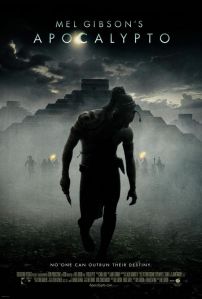 Apocalypto is an action movie set 500 years in the past with a cast of entirely unknown actors, some of who have never acted before. But what does everyone want to talk about? Mel Gibson hates Jews. He’s been in a heap of trouble ever since a DUI where he said some very unkind things about God’s chosen people. He’s made the apology tour and checked into alcohol rehab, the new go-to defense whenever a celebrity screws up. The public finds it hard to separate art from the artist; Frank “It’s a Wonderful Life” Capra was anti-Semitic but few seem to bring that up. Some people have sworn off Gibson thanks to this disgraceful incident. That’s a shame because Apocalypto is brilliantly filmed and Gibson’s finest directing effort yet.
The Mayans seem pretty at ease 500 years ago. We open on a hunting party dividing up a recent kill and playing a prank on one of their members that is having trouble making little Mayans with the wife. Jaguar Paw (Rudy Youngblood) is the son of the tribe?s leader. In the forest they encounter a group of survivors from a different village. They warn of a group of mercenaries that razed their town, killed their people, and took the rest. Jaguar Paw?s father warns not to speak of what they have seen to their people. Fear is contagious, we?re told. That night the same mercenaries attack Jaguar Paw?s village. He scrambles to lower his pregnant wife and young son into a cavern for safety. The surviving men and women are tied up and sent marching. The village?s children are left to fend for themselves and most likely perish without any adults.
 Jaguar Paw and his fellow captives are headed for a Mayan temple. The women are sold into slavery. The men are painted blue and guided to the top of the temple to become sacrifices to an unhappy god. The men are held on a slab, have their hearts cut out, finally then have their heads sliced off and kicked down the stairs. Through a fortunate set of circumstances Jaguar Paw breaks free and races into the forest to return to his family, who is in danger of drowning if the cavern fills with rain water. The mercenaries are not far behind and willing to go to any length to kill Jaguar Paw.
From an anthropological standpoint, Apocalypto is fascinating. Gibson has turned back time and immerses the viewer in a world unseen for 500 years. The details are astounding, and whether they are note-for-note historically accurate or not is inconsequential. You are seeing a living, breathing world right before your eyes. I loved soaking in the new-ness of the experience, seeing how this forgotten world operates, and the power struggles within. These people have great faces, great hulking muscular frames, and great expressions needing to be seen. Gibson has crafted a film that you’ve never seen before, at least with this kind of budget and filmmaking prowess. Apocalypto can quite often be breathtaking to behold. The production design and costumes (yes, there are more than just loin cloths) are incredibly rendered and add greatly to the authenticity and mood. I loved visiting the Mayan temple city (“down town” I guess you could call it) and seeing the different factions intersect, like green painted upper-class harpies being carried around the crowd.
The parallels Gibson puts out there seem tenuous at best. The Mayans have lived beyond their resources, experiencing plague, and feel that the need to pacify the masses, and turnaround their bad luck, is a whole slew of human sacrifices. There’s an Iraq War reference in there if you want to go looking for it and perhaps an ecological one as well. I don’t know if Gibson is using the Mayans as a cautionary example of a society that crumbled. We are treated to an opening quote detailing that no great society can be conquered from outside until it has become corrupt from within. Maybe this is Gibson’s way of telling America to sit up and fly right. Or maybe it’s just an intellectual glob toweled over the blood and guts to make everything seem more meaningful.
The acting is a surprise. Many of these people are really good, especially Youngblood who has a soulful face and a terrific presence onscreen. Gibson creates a great sense of community in the early moments. People feel natural and in touch with their surroundings. Their interaction and the visual shorthand feel like storytelling tricks from classic silent movies. Gibson manages to tell us a lot with little. There are some gut-churning moments, and some of them are because of character. A man from Jaguar Paw’s village hopes his wife did not give up fighting before she perished, because if she did then she will be sent to hell. He pleads that when he dies he might endure the tortures of hell, just so he can be with her again. That hits hard. A cranky mother-in-law also provides a shining emotional moment completely played in solemn silence. A little girl surrounded by crying children tries to assure the adult captives, “They are mine now. I will take care of them.”
 The last hour of the movie is a non-stop foot race as Jaguar Paw valiantly attempts to escape his enemies and return to his swatch of the jungle. There are some fantastic escapes and imagery, like Jaguar Paw outrunning an actual jaguar. The ending is fantastic and a fitting climax for the title. I would have enjoyed just a little shove further, like a new character marveling at some gold trinket Jaguar Paw had gotten from the Mayan temple. “This is gold. Can you tell me where there is more?” he would say. “Tell you?” Jaguar Paw would say in a hearty laugh. “I’ll SHOW you where to get more. Follow me.” The resolution is pretty obvious but left to the imagination. I guess after much derring-do I just prefer more finality with my comeuppance.
This may be about a dead culture and spoken entirely in a dead language, but Gibson’s bloody art house flick is a lively macho action movie at its core. It’s structured exactly like a typical Hollywood action movie, and I don’t know if this adds another level of brilliance to the final product or makes it seem more ordinary taken apart from its historical context. Gibson’s trade is misery. He’s been a martyr onscreen and he prefers to tell stories about the anguished and tortured. Jaguar Paw is beaten, wronged, and has to race against time to save his family. When Jaguar Paw moves onto his own turf he turns his knowledge of the land to turn the tables on his enemies. The movie presents familiar archetypes like the wise father, well-meaning oaf, and impetuous hothead villain, Super Biggest Bad Guy (he does wear the most skull trophies, that has to count for something). The villains are larger than life and have great menace to them. Even better, they’re highly memorable and despicable, and yet they seem to operate within a tribal code of their own honor. They scowl with the best of them.
This familiarity makes viewing Apocalypto less jarring, This is an independent movie high school jocks could enjoy. That may sound dismissive but it’s a compliment. Gibson has great technical skill and after decades of shoot-em-up pictures, he definitely knows how to build and sustain exciting and rewarding action sequences. You know when the bad guys with personality are going to have big deaths, and you know when you see a hunting weapon in Act One that it is going to be put to awesome use in Act Three. The lines of action are well structured and smartly played. When you boil it down, it may just be an action movie, but because of Gibson it’s a good action movie.
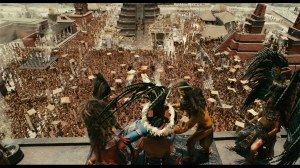 With The Passion of the Christ, I was appalled by the violence, more so how Gibson fell in love with the blood and gore, turning it into pornography. That was the message of The Passion — Jesus sure knew how to take a lickin?. But with Apocalypto, the violence is savage but the appeal of this project is on recreating a world, not sadism. Apocalypto is more interested in opening eyes than shutting them because of nauseating and relentless gore. This isn’t exactly a movie fit for nuns and missionaries, though. Gibson embraces the cruelty of man and showcases some real horrors. The temple sacrifices are fitting and gruesome, but never seem exploitative. There are moments that I wish Gibson would have pulled back, like an extended scene of a jaguar chewing a man’s head or a gusher of blood spritzing out of a man’s temple like a broken sprinkler. I think Gibson loses control of his story and gives in to his own bloodlust in these moments, which serve to take you out of the movie and go, “Ick.”
The violence is also easier to stomach because the audience is more invested in story and character. Everyone that paid a ticket in 2004 knew Jesus was going to die in the end, at least, I really hope they did. That might have been a shocker to a remote few. It was all about witnessing suffering and testing how much you could watch. You felt the pain, all right. Apocalypto, in contrast, is tame and more focused on escape than futility.
After The Passion of the Christ made heaven and earth move at the box office, Gibson can afford to make any movie he wants. If he wants to make a movie about Mayans in Mayan, so be it. At least Gibson knows how to tell a good action story. Apocalypto is beguiling and often breathtaking to behold. The details create a rich environment that feels wholly alive. It’s a typical action movie plucked down in a different historical setting, creating the most unique movie experience of the year. It’s a man’s man independent movie but also manages to hit key emotional notes. I don’t care what he thinks of Jews or anyone else. His art speaks for itself, and Apocalypto is fascinating. It’s an art film for jocks, it’s an action movie for science geeks. Bless you Mel Gibson, you’ve brought us all together in the weirdest way possible.
Nate’s Grade: B+
Share this:

A Very Long Engagement (2004)
 Deep in the heart of WWI trenches, we begin this sprawling tale by narrowing in on five French soldiers. Each man has been accused of self-inflicting a wound to escape service, and each man is sentenced to spend the rest of their likely short lives in No Man’s Land, the stretch of bare land between the two trenches. One of these men is Manech (Gaspard Ulliel), a young country boy engaged to the charming Mathilde (Audrey Tautou). When she learns his fated punishment and fails to hear word from Manech, she steps out to launch her own investigation into the possible whereabouts of Manech or the possible details of her fiancé’s demise. She enlists her family, solicits strangers, and puts ads in newspapers to unravel the truth. Along the way she hears various stories from all sorts of people and attempts to form them into a clear picture of what went on in that trench, good or bad.
A Very Long Engagement could be flippantly described as “Rashomon in a trench,” but from the get-go it grabs you by the lapels and will not let go. Once again, Jeunet tells his story in a criss-crossing narrative. Front and center we learn about each doomed man’s life in snapshot, and while the device has a slight eulogy feel, it’s a fantastic way to show the depth of characters in such brevity. A Very Long Engagement is an immeasurably rich film where each detail is threaded into the film to create a magnificent artistic tapestry beyond compare. The tiniest details in the film like Mathilde’s tuba playing (the only instrument whose sound mimics a distress call), to the mail carrier choosing to slide his bike over gravel just further enhance the vibrant, animated world of Jeunet.
 Jeunet is quite possibly the most visually gifted director working today (he turned down Harry Potter 5). He couldn’t film an ugly shot composition if he tried with all his French might. As expected, A Very Long Engagement is gorgeous to look at. The production design is massively intricate, the cinematography, while computer assisted, has a shimmering radiance to it. This is simply the best looking film of all 2004, Hero be damned. You could pause any second in this film and use it as a glossy postcard. Jeunet has the technical credentials to fasten together complex and beautiful worlds. A Very Long Engagement is a technical marvel and gorgeous to experience.
Tautou, also as expected, is wonderful once more. She’s the anchor of the film and the audience feels every heartbreak and glimmer of hope this talented actress explores. The supporting cast is full of familiar Jeunet players and each performance adds to the richness of the film. They feel like characters and not stock roles or cliches.
There is some difficulty with following the storyline. There are so many subplots built upon other subplots that the film’s momentum takes a bit of a dive in the second act. A Very Long Engagement can also get very confusing when it comes to remembering so many names. There are maybe 30 characters to keep track of and as the subplots mount new characters are added to the pile, including a widow played by a surprisingly fluent Jodie Foster. It’s best to employ some kind of memory trick to keep the many colorful characters of Jeunet’s world straightened.
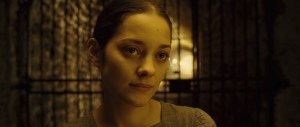 The focus of A Very Long Engagement is on Mathilde’s investigation into what really happened in that trench. She wants to know what happened to her beloved, and as her search picks up steam we get further glimpses of her relationship with Manech. One of my biggest problems I had with 2003’s Cold Mountain was that Jude Law was travailing through hell and back to get back to his beloved Nicole Kidman even though their relationship pre-war lasted as long as a Super Bowl commercial. It’s not that I disbelieve the overpowering nature of love, but I need more from my characters than shifty glances and a quick ejaculation of love (get your mind out of the gutter). Now, in A Very Long Engagement, Jeunet opens by showing the measures Manech will endure to return to his beloved, however, as the film goes on we also see enough peeks into the depths of their relationship beforehand, which dates all the way back to when they were children
A Very Long Engagement forges such a grand and sweeping love story that the audience gets just as immersed as Mathilde about the search for her man. There are so many lovely, intelligent moments between Mathilde and Manech, like their first sexual encounter. Every time Manech lights a new match Mathilde removes an article of clothing until, under the soft light of the newly lit match, she’s nude and blows the match out herself. The characters’ overriding love also taps into small truisms like when Mathilde makes arbitrary games for herself to ensure her love’s safety. (“If I can count to ten before that car passes, then he is alive.”) Mathilde’s faith and devotion are driving her investigation and the audience is behind her 100% of the way, fully invested in this mystery. When we reach our conclusion, I don’t mind telling you I was bawling like a baby.
The film has a merry whimsical tone during its origami-like narrative, but when it hits the trenches the film gets down and dirty. Jeunet shows a fascinating view into the hardships of everyday trench life as well as the machinery of death. Storming the other side’s trench, or “going over the top” as it was called, is seen in all its sordid features. There are hearty splashes of blood and gore that can be jarring.
There’s one terrifying scene in A Very Long Engagement involving the explosion of a makeshift hospital. The hospital is inside a hangar for zeppelins (hydrogen gas) and a missile has crashed into the roof with its nose sticking inside. One of the zeppelins becomes loose and slowly floats to the missile nose with unforgivable certainty. People are running around trying to shield themselves from the inevitable, but it does nothing. The moment is played so agonizingly slow that we become overwhelmed with terror. This was the life of WWI warfare.
 Having said this, the stark war violence doesn’t exactly gel exceedingly well with the whimsical romantic elements. For some, A Very Long Engagement will seem like two very tonally different movies butting heads and intruding upon the other (perhaps Amelie Goes to War?). Sometimes it does take a while to adjust to one tone after spending time with the other. I feel that the emotional investment in the characters and the anticipation of unraveling the mystery serves as thematic glue over the disproportionate tones. Some will feel chaffed by the two stark tones, but I think the power of the love story will conquer most hearts into experiencing the bloodshed of war to earn the shedding of tears by the film’s romance.
Jeunet has re-teamed with Tautou and created another masterpiece. A Very Long Engagement took hold of me from the start and mesmerized me with its beauty, grace, cruelty, excitement, and warmth. This is a great mystery and a great love story with great visuals and great characters. The opposing tones (whimsy vs. violence) won’t work for everyone, and the film takes one too many divergent paths in the middle, but A Very Long Engagement is a film of such startling originality and feeling that it should be treasured. I was floored by what Jeunet had to offer and deeply moved by the time I had to leave the theater. They don’t make them like this much anymore. Now if you’ll excuse me, I have something in my eye.
Nate’s Grade: A
Share this:

Maria Full of Grace (2004)
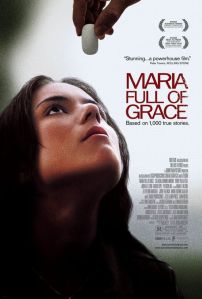 No other actress stood out to me this year as 23-year-old Catalina Sandino Moreno. She plays the movie’s Maria, a Colombian woman who agrees to carry 60-something condoms filled with heroin in her gut to the United States. The first half of the film is unjudegmental and nerve-racking, especially when Maria gets snagged by U.S. customs. The second half revolves around Maria trying to land on her feet in an unfamiliar land. The greatness of Maria Full of Grace relies on debut writer/director Joshua Marston framing his story like camera is an invisible voyeur. The film suggests that Maria is only one of thousands that have turned into drug mules to make ends meet or seek better lives. Maria Full of Grace is startling, immersive, delicate and quietly touching as Maria rediscovers the promise of the American dream.
Nate’s Grade: A


 nathanzoebl
You must be logged in to post a comment.