Blog Archives
Holy Motors (2012)
 I like movies that are different. I like movies that can be hard to understand. Holy Motors, a surreal French film, is both very different and very hard to understand. The movie follows a man as he goes about transforming into nine different characters, each with their own bizarre mission. Is he performing? For whom? Who is behind all this? Does he ever stop assuming false roles? Questions such as these hardly matter in movies such as this. You’re either transported by the lyrical weirdness and unpredictability, or you find it tiresome and much ado about nothing. After a while, I just gave up with this movie. I’m not a fan of weird for weird’s sake and I felt like that was all I got with Holy Motors. I’m sure you could write a doctoral-level thesis decoding this movie, but why waste valuable hours of your life? This movie is nothing but strange imagery that adds up to precious little. I thought the concept of playing roles/manufactured realities was better explored in Charlie Kaufman’s Synecdoche, New York. When a Kaufman movie is more accessible than your film, your name better be David Lynch or you’re in trouble. I’m sure several fans of the obscure and outrageous will find amusement at the sheer randomness with Holy Motors. It’s got martial arts acrobats, Kylie Minogue breaking out into song, magical resurrection, spontaneous band performances, talking cars, and for good measure chimpanzees. I hope you get more out of it than I did. I found the enterprise to be more tedious than titillating, more frustrating than fascinating, and not worth the trouble of fashioning meaning from the discarded puzzle pieces.
Nate’s Grade: C
Share this:

The Intouchables (2012)
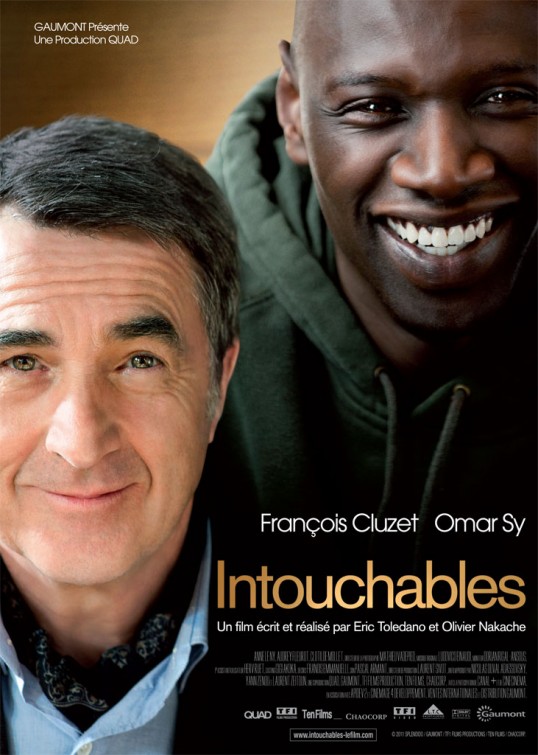 You’d never know it, but the highest-grossing film in Europe last year had nothing to do with super heroes, or sequels, or Hollywood itself. A small French film with the strange title of The Intouchablesmanages to break down just about every European box-office record last fall, sweeping across the continent and winning over hearts of numerous nationalities. The Weinstein Company bought the English-language adaptation rights, but before that gets underway they’re also releasing the original French movie to American audiences. Will subtitle-averse American audiences warm up to the little movie that has proven so hard to resist worldwide?
Philippe (Francois Cluzet) is rich quadriplegic and looking for a new caregiver to his many needs. In walks Driss (Omar Sy), a brash and headstrong man from a very different world: lower class, urban, and black. Philippe responds to the man’s irreverence and gumption and hires Driss on a trial basis. The upper-class lifestyle is like a fantasy to Driss, but the many responsibilities of caring for a man with no feeling below the neck are harder than anticipated. He objects at the very idea of having to manually evacuate the man’s… insides. The two opposites attract and the men become close friends and open one another up to new experiences.
 At its core, The Intouchables is the story of two men and their unlikely friendship. It’s told with enough weight, conviction, and character development that it’s easy to get wrapped up in the movie’s sweeping emotional tide. It’s a familiar tale, essentially that of the coming together of two people from distinctly different walks of life. You’ve seen this type of story before, where the upper class learns to cut loose and embrace life more fully, where the lower-class individual finds a path of dignity and responsibility. It’s been done before but rarely has it been done with such aplomb. Any storyline that involves a quadriplegic man and an inner city youth coming together sounds rife for after-school moralizing and sappy life-lessons. Thankfully, The Intouchables finds an angle that hits the emotional highpoints without tipping over into overt maudlin territory. Phillippe doesn’t want anyone’s pity. What is meant as good intentions can become another handicap; public perception of the individual’s limitations. Like The Diving Bell and the Butterfly, the 2007 inspirational French film about a significantly paralyzed man who could only move his left eye (what is it about French films and paralysis?), The Intouchables brings you into a world few glimpse and shows us what the perseverance of the human spirit can reap. Even a conversation that steers to sexuality can be illuminating and, for concerned male viewers, comforting that even if you can’t feel anything below the neck, the human body can adapt. In this regard, the film is a fascinating look into the life and care of a quadriplegic man (albeit an insanely wealthy one), and the fact that it’s also a moving and winning buddy comedy is yet another virtue. It’s like France’s version of a bromance.
It’s easy to see why The Intouchables has had runaway success in Europe, totaling over $300 million before ever opening in the States. This thing is a born crowd-pleaser. The characters are given room to roam, flesh out, and the interaction between two different men and their growing affection is a natural emotional foundation. We care about these characters, we smile and laugh with their interactions, the way that both men realize they need the other. It’s touching without being cloying and rich with emotional rewards by film’s end. Then there’s the fact that it’s also consistently funny without overplaying the class conflicts. There is an amusing subplot about the nebulous nature of modern art and what qualifies as “art”: the work or the knowledge that it’s from an “artist.” There’s a nice payoff with that one, but most of the humor is character-based, with the jovial Driss bouncing off the staid sarcasm of Philippe. There’s one comic subplot that seems to be hitting the same note time and again — Driss’ dogged romantic pursuit of Philippe’s assistant (Audrey Fleurot). It’s almost forgivable given the immense charms of Sy, but her character gets reduced to little more than a potential love match for Driss’ energetic libido. The humor, buoyant but also sensible, gives the film a defter touch when it comes to the more dramatic moments of loss and isolation and mourning. It’s easy to see why audiences have been falling in love with The Intouchables around the globe; they’re programmed to cry and laugh in equal measure.
And it’s that vague sense of programming that lingers. This is a film that knows exactly what chords to strike and how often. It can be accused of pandering and you’ll be able to guess every point of the plot. You think Driss will get Philippe to finally meet the woman he’s corresponding to for months? You think the upper crust will break from their immaculate stuffy prisons and learn to cut loose, spurned from Driss’ involvement? Do you think Philippe’s bratty teen daughter will learnt to shape up and fly right? Will Driss take a stand and stop his younger sibling from falling under the sway of criminal influences? Will the two men realize they truly need one another’s companionship? The answers are obvious; as are the plot turns and the happy ending, but The Intouchables goes about its business with such mass-appeal precision that you don’t really mind being manipulated. When someone can pull strings this skillfully, and quite transparently, almost daring the audience to resist, I almost admire the manipulation. Unlike Extremely Loud & Incredibly Close, another blatantly manipulative teary adult drama, at least this movie succeeds because we care about the characters rather than just bad things happening to people onscreen. The Intouchables isn’t subtle about its aims, but it is hard to resist a film this beguiling and tender and involving.
 Sy (Micmacs) is the breakout star of the movie. His gregarious, jubilant charisma instantly engenders the character of Driss to the audience. He’s constantly smiling, laughing, and cracking wise, and pushing others to be better. Sy brings such life to the movie that you instantly miss him when he’s gone. Cluzet (Tell No One), a dead ringer for Dustin Hoffman, has the more restrained role, no pun intended. His performance has to be very controlled yet believable, and Cluzet does an admirable job of building a character from the neck up. He’s a wounded man still recovering from the loss of his wife as well as his own crippling fears of loneliness. When these two are together onscreen, that’s when all the movie’s potential problems become a distant memory. The conviction in their big-hearted performances makes all the sentiment easy to swallow.
Several critics have accused the film of being borderline racist. I think the charge of racism is overdone. Just because Driss’ family lives in low-income housing doesn’t mean it’s making some blanket statement about the black experience in France. I suppose some chafe at the energetic, outspoken, and general virility of Driss. But I think critics looking for racist depictions of black males are overlooking the point that Driss had to be outspoken and energetic because Philippe is immobile and reticent. It’s in service of character contrast, not just recapitulating the figure of Loud Outspoken Black Male (a.k.a. the modern-equivalent of the age-old Noble Savage treatment). The significant part of Driss is that he has a sketchy past and comes from a low-income family struggling to get by. His race certainly plays up the contrast between the world of white privilege in France, but it’s not the central difference between these two men. Critics have also brought up the fact that the facts of the true-life story are different than what we see onscreen. Philippe’s caregiver, Abdell Sellou, was a Muslim man from Algeria, not a black man from Senegal. Does this truly bother anybody? Does the man’s heritage and ethnic background drastically alter the relationships formed or the earnest connections made? The movie doesn’t seem to think so and closes with the real-life figures onscreen, showing to each audience member the adaptation differences. Unlike something as racially questionable as The Blind Side, Driss is not rescued by saintly white people; he is an active member in his own self-actualization and not a passive receptor of the benefits of rich white people. With that said, there are still a few moments of ethnic depictions that might make you cringe, like Driss’ reaction to a night out at the hoity-toity opera.
During my viewing, I was reminded most of Scent of a Woman, another down-the-middle buddy comedy about a disabled man and his caregiver learning from one another and pushing beyond their comfort levels. It’s emotional without being too squishy and funny without going overboard, but make no mistake: The Intouchables is just as formulaic as a Hollywood production. The story and conflicts are familiar, the afflictions and backgrounds only differ. It’s feel-good, mass appeal comfort food, and when done this skillfully it’s hard to resist its call (I had a similar reaction to last year’s The Help). Its story of friendship, personal triumph, and all those happy things, but it’s also emotionally manipulative, littered with undeveloped subplots and a few uncomfortable moments of ethnic depictions. Fortunately the shining, vibrant performances from Sy and Cluzet, and their chemistry together, elevate the film’s softer and quasi-pandering sensibilities. It’s the story of two men, and by the end we greatly care for these two men, and their deep friendship and appreciation of one another. The Intouchables is a sly crowd-pleaser that dares you to defy its mass charms. And with actors this good, resistance is futile.
Nate’s Grade: B
Share this:

The Raid: Redemption (2012)
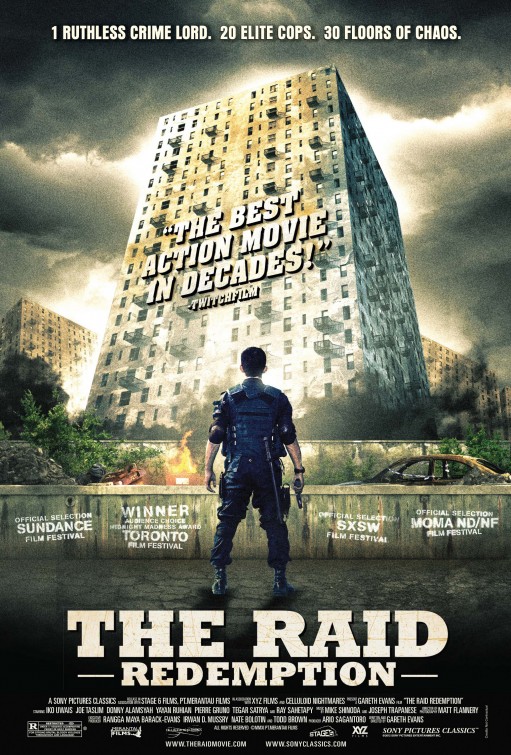 If you’ve been let down by flaccid Hollywood blockbusters in the action department, then give Indonesia’s The Raid: Redemption (part one of a planned trilogy) a try. The movie is like 90 minutes of getting kicked in the face, but in the best possible way. The flimsy premise almost seems like that of a video game. An elite forces police team storms the tenement building of a crime lord. He traps them inside and alerts the unruly residents there will be a reward for whomever takes out the cops. Each floor presents a new level of danger, from machete-wielding gangs to thugs that could show Bruce Lee a thing or two when it comes to wizardly martial arts. When the action is pumping, you feel every electric second of it. Writer/director Gareth Evans uses every part of the buffalo when it comes to action cinema. He kills guys in ways you didn’t know existed. The action is brutal and often relentless, but Evans draws out scenes organically, making fine use of geography. Guys will break through walls, jump down floors, blow up gas tanks, and use everything from filing cabinets to broken doorframes to and florescent light tubes as weapons. It’s a thrill to be able to take in the beautifully balletic choreographed fight sequences; there one that goes on for seven minutes and should already be considered an all-time Top 5 contender in movie history. There’s a fairly pedestrian plot about police corruptions and some family connections, but that’s just gristle. The real meat is the action. It’s so exhilarating and gratifying that the rest is meaningless. The Raid is the best video-game-turned-movie ever, and I don’t even care that it was never a video game. Have you seen these special movies?
Nate’s Grade: B+
Share this:

Miss Bala (2011)
 Miss Bala (Mexico’s foreign film entry for 2011) is an unwavering, startling, and deeply tense movie about one woman’s tragic and unwilling association with a powerful drug cartel. Laura (Stephanie Sigman) wants to be the next Miss Baja California, but she’s unwittingly pulled into a life of crime after she witnesses a gang hit. The cartel ensures that Laura wins the beauty pageant and becomes a courier for them. The movie takes a Lars von Trier approach to storytelling, putting its heroine through a torture chamber of anxiety and terror. This woman only wants to escape the hell she has accidentally found herself a part of, but every attempt to escape, be it going to the police or confessing assassination plots to the intended targets, gets her corralled back into the fray. For Laura, there is no escape. The movie packs a near-constant surge of paranoia, as we fear that at any time something awful will happen. In fact it’s usually only a matter of time. Laura is more a symbol of the collateral damage of Mexico’s billion-dollar drug war than a character, and she kind of becomes a numb zombie by the movie’s latter half, perhaps accepting her doomed fate. Director Gerado Naranjo favors long unwinding takes and handheld cameras, which add a gritty realism and sense of compounding dread to the picture. The movie has an unflinching level of realism to it that makes it all the more haunting, stripping the romanticism from a life of crime. Much like Italy’s heralded crime film Gomorrah, this bleak but impassioned movie shows the inescapable tentacles of organized crime and gives a face to innocents caught in the middle. Miss Bala is a testament to the hidden toll of a nation at war with itself.
Nate’s Grade: B+
Share this:

A Separation (2011)
 When A Separation won the Best Foreign Film Award at the 2012 Oscars, its writer and director, Asghar Farhadi, gave a heartfelt speech where he accepted the award on behalf of a proud people who “respect all cultures,” a country that is much more than portrayed on the news as a Middle Eastern state of agitation and repression. Then the Iranian state-run TV used the opportunity to insult Israel, saying that the Academy “bowed before Iranian culture,” their movie “left behind” the Israeli nominee (Footnote) and “the beginning of the end” of Israel’s influence as it “beats the drums of war.” Sigh. Just when it looks like progress can be made to build cultural bridges. A Separation is a nuanced tale of struggle between tradition, morality, and personal choice. It’s a movie worth taking pride in.
Nader (Peyman Moadi) and Simin (Leila Hatami) are a married couple heading for a divorce. She wants to move to the West. He does not want to leave, especially since he must care for his elderly father who suffers from Alzheimer’s. Simin wants a better life for herself as well as their 11-year-old daughter, Termeh (Sarina Farhadi, the director’s own daughter). Simin does not want to leave without her daughter but cannot get the judge to give her custody without Nader’s approval. Simin has moved back in with her parents. Nader hires a working-class maid, Razieh (Sareh Bayet), to care for his father while he’s away at work. Razieh is working unbeknownst to her husband, who would disapprove but has been unemployed for nine months. Caring for the elderly man is a lot more than she bargained for. At one point, Razieh calls an imam to ask if it is a sin to change the elderly man’s soiled pants. Then one day Nader comes home to find hid father sprawled out on the floor, tied to his bed, and locked in the apartment. When Razieh comes back, she says she had an emergency and keeps it vague. Nader fires her, she demands payment for the day, and he pushes her outside his door. The repercussions of this action will be larger than either could have imagined. Razieh and her husband accuse Nader of intentionally pushing the woman, and when she fell she miscarried her baby. Nader is being tried for murder, but nothing is as clear-cut as what it seems.
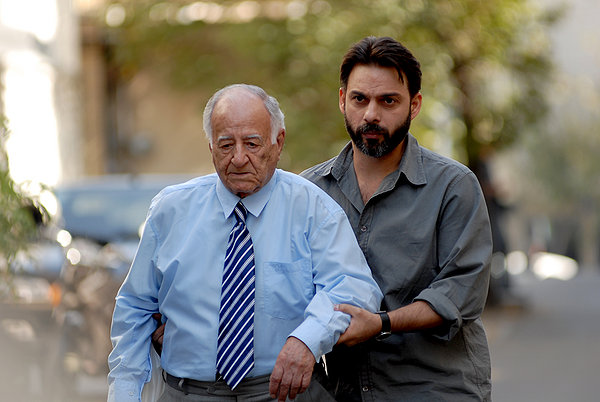 There’s so much to dissect in the intimate, thrilling, and observant little movie about imperfect people living under an imperfect system. It’s far more than the dissolution of a marriage and its impact that has on their family. It’s about the separation of moral relativism, compromises, cultural estrangement, and the concepts of justice in a world brokered by unjust forces. A Separation is really an ongoing court case that ensnares all the characters and brings them down in some degree. The more information we learn, the more we start questioning exactly what we knew about these characters and their circumstances. We’ll get speeches about doing the right thing in the face of opposition, and yet characters will routinely lie to save their own self-interest in the sacrifice of truth. You’re thrown into the middle of this drama and by the end you’ll likely feel exhausted by how emotionally charged the whole thing is. Lots of breathless arguing, lots of teary-eyed emotions, lots of unvarnished pain exposed, and very little in the way of resolution. This is an agonizing film that doesn’t feel the need to kowtow to the hopes of an audience for a happy ending. The lives of these characters are too complicated for tidy resolutions. The open ending, where Nader and Simin await their daughter’s decision over which parent she will live with, feels perfect considering that these people, due to circumstance both personal and political, are resigned to limitations on their happiness.
This is one of those movies where there are no real villains. You can see everybody’s plight and find some reasonable empathy for these people. Initially, the audience sympathy seems to be completely with Nader. He doesn’t want a divorce but feels indebted to taking care of his ailing father. He feels like he cannot abandon his father to live in the West. Simin is more vague about her rationale for wanting to leave the country, though one can only assume that her concern for her daughter is directly tied to the subjugated roles of women in Iran. Otherwise, her daughter is apart of a middle-class family where education is prized. Simin callously says that the old man is so far gone into dementia, why does it matter? The tension becomes whether Nader would rather care for his aged father or secure a brighter future for his daughter. After this opening marital clash in front of a judge, the film mostly follows Nader and his care of his father. When he confronts Razieh and is fuming about how he discovered his father, we’re there with him. Then when he’s accused of murder, a charge we know seems preposterous given what we’ve witnessed, our empathy further aligns with Nader, who we fill is wrongfully accused of something so serious it will wreck his life and family. Then when Simin reappears, and seemingly believes the worst of the story, it feels like she’s using the fraught circumstances to her advantage to force her daughter’s hand into deciding to leave Iran. But then the movie continues and you see that Simin has more at stake, Razieh is a sad woman penned in by circumstances, and Termeh is not the innocent child she appears to be. Your loyalties will be pulled in multiple directions until you ultimately conclude that these aren’t good people or bad people but merely people, fairly relatable and sympathetic.
 A Separation shows a different side to Iran, a side that most Americans don’t see given the news coverage. The Iran on display in the film is a world in conflict. There’s the emerging voice of women conflicting with the male sense of privilege, there’s the conflict between classes illustrated by the stark difference sin living conditions between Nader and Razieh, who must make lengthy commutes just to earn a pittance, the conflict between parents who say they want what is bets for their child but provide her with false choices and use her as a battering ram against the other side, the conflict between a justice system that must stick to the letter of the law and the cases that cannot be so simply defined, the conflict between allegiance and self-interest, the conflict between personal gain and the truth, the conflict of caring for the old versus establishing a life of opportunity for the young, and the conflict between religious faith and daily living. There’s so much going on in this movie that every detail feels telling, ever actor feels rooted is reality, and every new moment further complicates an already messy situation.
A Separation is the kind of meaty drama that Hollywood seems to have forgotten how to make anymore. It’s patient and uncompromising, trusting its audience to wade through nuance and ambiguity rather than be told explicitly how to feel. The complex character work, alarming intimacy, and observational details of a society in relatable turmoil build the foundation of one very enthralling, thrilling, deeply resonant piece of work. A Separation is an example of superior filmmaking and the idea that movies from around the globe, even places that our politicians demagogue as an “axis of evil,” can tell universally human stories. This is a movie that will spark discussion long after it’s over.
Nate’s Grade: A
Share this:

The Secret World of Arrietty (2012)
 This adaptation of Mary Norton’s classic book, The Borrowers, is colorful, imaginative, and the antithesis of what has become the modern-day family film. It’s less antic with its pacing, it has a more somber mood, and the ending is essentially anticlimactic. While commendable on one hand, The Secret World of Arrietty is also a minor work under the tutelage of the brilliant Hayao Miyazaki. Like other Miyazaki works, the film immerses you into an imaginative world where all the details fit. The story itself within that world is a bit low-key. Arrietty is a 13-year-old tiny person, a Borrower, living with her mother and father inside a human being’s home (they refer to people phonetically as “beans”). Her friendship with one of those “beans,” a boy named Shawn, is pleasant and gradual, as she feels she cannot trust the enormous human. I kept waiting for something larger and more significant to happen, but it didn’t. The story feels too slight to justify being the introduction, and likely final, chapter of these characters. The world of Arrietty is beautiful to watch but after a while you’re just watching pretty pictures.
Nate’s Grade: B
Share this:

Tuesday, After Christmas (2011)
 Who knew that Romania, of all places, was the wellspring of tremendous artistic talent? Over the last five years or so, Romania has been home to a burgeoning renaissance of daring, provocative, and naturalistic films, its own New Wave of Eastern-bloc cinema. Some of these gems include The Death of Mr. Lazarescu, 12:08 East of Bucharest, the understated, cerebral Police, Adjective, and the award-winning, grueling abortion drama, 4 Months, 3 Weeks, and 2 Days, winner of the prestigious 2007 Cannes Palme d’Or. Director/co-writer Radu Muntean’s Tuesday, After Christmas is a worthy entry into the ever-growing canon of stupendous Romanian cinema. It and many other of these Romanian renaissance pictures are available via Netflix streaming, so if you’re unfamiliar with these great movies, now is as good a time as any to play catch-up.
Paul (Mimi Branescu) is a middle-aged man coming to a crossroads at his life. He loves two women: Adriana (Mirela Oprisor), his wife of ten years who they share a young daughter, Mara; and Raluca (Maria Popistasu), a dentist in her late 20s. His mistress has accepted her role but wouldn’t mind reaching out to Paul’s daughter. Paul is unhappy with his wife but is he unhappy enough to come clean about his infidelity? Over the course of a few days around Christmas, Paul will decide which woman he will stay with.
 This movie is something of a small miracle in how naturalistic it plays. The dialogue is splendid, reverberating with the rhythms of real speech but also giving weight to the characters, fleshing out personalities, relationships, and penetrating subtext. I was luxuriating in the dialogue and its nuances. To some people Tuesday, After Christmas will be a boring movie, but for me I was on the edge of my seat thanks to the dialogue and characterization. If ever Richard Linklater (Dazed and Confused, Waking Life) were to make a Romanian film, it would be this. Like Linklater’s Before Sunset, watching these actors speak such truthful, personable, revealing dialogue is like listening to birds sing. It’s such a pleasure for the ears. Take the first scene, a sexy, nearly six-minute unbroken shot of a couple in bed. Over the course of those six minutes Muntean (Summer Holiday) and his actors peel away the layers, revealing more and more of these characters and their situation. We can tell from their playful, affectionate, and relaxed manner that they are lovers. Also the fact that they are naked seems rather telling. Then we learn who they are naturally. He pretends to take offense at her admission of other lovers’ penis sizes, and pretends to bite her nipple, which makes her examine his teeth and chide him that smoking harms his teeth. Right there we learn about her sexual past, his mixed feelings about it, their teasing relationship, and her profession. And then, of course, we learn that the man is married and this is the “other woman.” That six-minute scene is near perfection. It sets up the characters, the conflict, and not a single point felt false or contrived. The rest of the movie follows suit, from the mundane moments of married life (the manner of rubbing a spouse’s feet) to the quiet storm of indecision.
There isn’t a wasted line of dialogue or a camera shot in this entire movie. Part of that is because Muntean deals in extremely long takes. There isn’t one camera shot that lasts under a minute; most of the camera shots last for several minutes, some approaching double digits. In other hands, the glacial pace of the camerawork would make the movie feel trapped and stagnate, as I felt watching the clinically dull movie, Shame. Instead, this movie is captivating because of the draw of the characters and the inherent drama/irony presented with the romantic triangle. A dental appointment for Mara becomes an uneasy, squirmy situation of great ironic tension, watching Paul shift uncomfortably and trying to mentally figure out what direction to take as his mistress speaks to his wife. Tuesday, After Christmas feels more like a stage play than anything cinematic, unless you’re counting John Cassavetes or the French New Wave (and why shouldn’t you?). The scene where Paul mulls over whether to tell his wife is more suspenseful than most Hollywood movies. The devastation that follows is heartbreaking but completely absorbing. This tiny Romanian film is so astutely well observed when it comes to human foibles and interaction that the film almost feels like a documentary. The patient, deliberately elongated takes further crystallize this sensation, making us feel like we are inappropriately eavesdropping on some very serious personal drama.
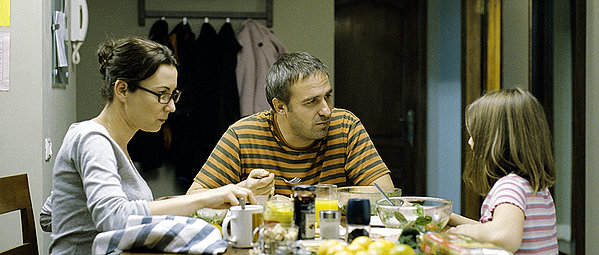 The acting is equally remarkable. For this movie to really work the three actors must step up their game, and all three came to play. First off, Branescue (Outbound) has to do his best to engender empathy because our introduction to the guy is during a romp with his mistress. But in those early moments we see how kind, lively, and peaceful he can be. Maybe this arrangement is good for him, we question. Then we see his interaction with his wife, and they are less lively, as the day-to-day grind of marriage can take its toll, but their interaction is warm, personable, and even through the mundane activity of Christmas shopping, we can piece together their relationship, which doesn’t seem troubled but resting in that comfortable position long-term relationships can plateau. Branescue never comes across as a scheming cad to vilify or a romantic victim. Instead his performance makes him spookily identifiable – this could be anyone. This could be you, assuming “you” are male and possibly living in Romania. The everyday nature of the character and his conflict, and Branescue’s nuanced performance, makes the guy empathetic even when his world is crashing around him and it’s his fault.
The women of Tuesday, After Christmas are also unforgettable. Popistasu (Midnight Man), as the mistress, is mesmerizing, a beautiful woman reminiscent of a Romanian Melanie Laurent (Inglourious Basterds), able to communicate so much with her body language. That first scene with her nude in bed establishes her as a charming, intelligent, rationale ingénue, neither calculating nor flighty. She feels like a real woman, and her relationship with Paul seems to bring out her spark, judging from that sparkling opening sequence. Likewise, Oprisor (Youth without Youth), as the wife, is equally compelling a figure, a woman settled into her marriage and her job and being a mother. Her reaction to Paul’s admission of infidelity is the movie’s dramatic highpoint, and we witness the actress seemingly go through every stage of grief in a manner of minuets, from anger and betrayal to thinking out the next course of action.
I know “Romanian relationship drama” probably doesn’t sound like a rollicking night out at the movies, but Tuesday, After Christmas is such an expertly crafted film, carefully observed, impressively acted, gloriously naturalistic in dialogue and direction, and even humorous. Yes, for a movie about infidelity and the possible explosion of a marriage, there is plenty of humor to be found naturally. You may feel stirring of romantic intimacy with Paul and Raluca, so much so that you too share in Paul’s guilt. You’ll feel the disquiet during that meeting of mistress and wife. You’ll feel the ache when Adriana really lays into Paul, a deserved and withering attack. You’ll understand where every person is coming from. But mostly you’ll feel like you’ve watched a really good movie. Tuesday, After Christmas is richly attuned to the subtleties of human joys, conflict, and reactions, and a movie that will linger with the ring of truth. Don’t be a stranger to Romanian cinema. Start here and work your way back. The rewards are worth it.
Nate’s Grade: A
Share this:

The Artist (2011)
 Ever since it charmed audiences at the Cannes Film Festival, The Artist has been one hot commodity. The Weinstein Company snapped up the film rights though they have a bit of a hard sell. The movie takes place in the era of silent movies and it also happens to be a silent movie itself. Ignoring Mel Brooks’ unsung efforts, asking paying customers to sit through 100 minutes of silence, albeit accompanied by a musical score, may be a risky financial bet. That’s where the appeal of being an award-winner comes into play. The Artist has been racking up awards since Cannes and has been tagged by many as the favorite to take home a Best Picture Oscar. This celebration of the Hollywood of old is a nostalgic trip through the ages, but I’m doubtful that the film is deserving of the gushing admiration. I think this would have been better had it been one of them new-fangled talkies.
In 1927, the biggest star in Hollywood is George Valentin (Jean Dujardin). His latest spy caper is knocking them dead. He’s prancing before a sea of photographers when he bumps into Peppy Miller (Berenice Bejo). He graciously brings her into the act and the two pose for pictures. “Who’s the new girl?” demands the newspaper headlines. Peppy is given her big break as George’s co-star in his spy series. Peppy is a natural and over the course of two years she becomes a bona fide star. Also over those two years Hollywood has undergone a drastic makeover. New “talkies” are all the rage with the public, who now demand to hear their favorite actors speak. George is adamant that talking pictures are only a fad and he plunks his personal fortune to bankroll his directorial debut. The movie is a flop. George is viewed as a has-been; yet Peppy has been keeping a watchful eye on her old friend and waiting for the time to reveal her love for the fallen star.
 The Artist is a completely silent movie except for two key sequences; one of them a nightmare where George hears objects make noise. The film is an unabashed love letter to old Hollywood, and writer/director Michel Hazanavicius makes witty use of the storytelling techniques of the silent era. Much relies on editing and reactions for shaping the narrative. The story, therefore, is broken down to its simplest incarnation. Peppy Miller’s star rises, as George’s grows fainter. Still, The Artist has many recognizable pieces for fans of the silent era. George even has a trusted Jack Russell Terrier at his side, a clever pooch with keen mimicking abilities. There’s a cute moment where Peppy slips her arm into George’s coat hanging on a coat rack and pretends to caress her self as him. It’s a small yet slyly tender moment. It’s not a prerequisite to be well versed on silent cinema, though it helps. While a French film (a foreign designation seems superfluous when it’s silent), the movie was shot in Los Angeles and is stocked with English stars like John Goodman (TV’s Treme) as a film director, James Cromwell (Babe) as George’s dutiful butler, Penelope Ann Miller (Flipped) as George’s unhappy wife, Missi Pyle (Big Fish) as a silent film co-star, Beth Grant (Donnie Darko) as a maid, Ken Davitian (Borat) as a pawnbroker, and Malcolm McDowell (Halloween II) as a dismissive old man in a chair (the role he was bon to play). It almost becomes a side game of cameos.
It’s a sprightly, charming, sometimes enchanting little experiment, but in the end an experiment is all the movie turns out to be. The Artist is no great story; in fact it’s pretty much the 80th rendition of A Star is Born. The transition between silent films and talkies is a subject rife with drama, and a lead character who sees his fame and fortune crumble by being left behind in a changing society, well that should be interesting. What’s surprising to me the most about this film is how little you invest with it. I don’t know if it’s the silent gimmick or just the idle characterization, but I found myself never really engaging with the movie, always a step removed. The characters were nice but I neither celebrated their triumphs nor bemoaned their hardships. The entire affair has such a slight feel to it; the movie is a confection, a sweet treat that melts away instantly after viewing. If you strip away all the old Hollywood nostalgia, there is very little substance here. Praise Hazanavicius for his dedication to silent filmmaking techniques, but let’s be reasonable here because The Artist is a pleasant experiment but nothing more. The characters and story do not bear scrutiny. This story would have been more interesting had the movie been a traditional talky. Alas, we are limited to a handful of title cards with single lines of dialogue and extreme amounts of pantomiming. If you took away the central gimmick, would anyone be interested in this movie? I wanted to be swept away by The Artist after reading all the fawning accolades, but I wasn’t. The commitment of the artists on screen is commendable but the finished product is little more than an amusing trifle of a movie.
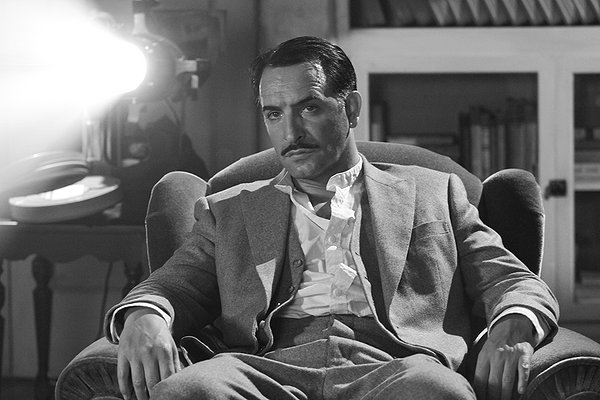 Dujardin (OSS: Lost in Rio) and Bejo (Modern Love) look like they stepped off the screen from an old Hollywood movie, al la Purple Rose of Cairo. Dujardin is a suave presence with great comedic physicality at his disposal. There’s a poignant moment where George, broken down and washed up, looks into a tuxedo store window, seeing his reflection appear above the neck of the tuxedo. He gingerly smiles, wistful of times gone by, and in that sad, face crinkling little moment, Dujardin reveals more about the man behind the flashbulbs than the script ever will. Even without a word spoken, you can tell that Dujardin and Bejo have great chemistry. Bejo, the wife of the director by the way, matches Dujardin note for note in terms of star wattage. She’s got a terrific smile and one of those classic faces for an Age When They Had Faces. It’s a shame that the characters don’t have more interaction.
The Artist is a fine film but ultimately disappointing given the hype. The saddest part about my reaction to The Artist is how little I find myself having to say about this much-ballyhooed silent film. It’s an exercise in nostalgic back-patting, but if you strip away the silent movie gimmick I feel like there’s so little at heart here. I walked away liking the movie, being charmed by the actors but feeling unengaged and mildly indifferent. The threadbare story is too familiar, the characterization is slight, and the movie ultimately becomes light, airy, and insubstantial. The novelty eventually does wear off and you may find yourself adding a mental commentary to the film to fill in the blanks. You’d have to be a Scrooge to resist the film’s whimsy and the talents of the charismatic performers, but I’m scratching my head at the adulation give to The Artist. In a year heavy with reminiscence, The Artist overdoses on feel-good Hollywood nostalgia, and in a down year at the movies, perhaps that’s enough when it comes time for awards.
Nate’s Grade: B
Share this:

Circumstance (2011)
 Despite a slate of quality movies by homegrown filmmakers, Iran is not exactly the most film friendly country conceivable. Governed by a strict set of Islamic moral laws, filmmaking has often been conflated with Western cultural corruption. In 2010, Jafar Panahi, an internationally renowned Iranian filmmaker, was sentenced to six years in prison for nebulous charges of conspiring against ruling forces. He was also banned from making any movies, or even scriptwriting, for 20 years. Just imagine what the country’s moral authority would say about Circumstance, an independent drama about teen lesbians. The controversial movie was filmed in Lebanon and populated with Iranian-born actors living in North America. The movie is, no surprise, banned in Iran.
Atafeh (Nikohl Boosheri) and Shireen (Sarah Kazemy) are two teenage girls living in modern-day Tehran. They are both free-spirited and yearning for the freedoms not afforded under strict Islamic law. They sneak away from their families to go to parties where they drink, smoke, listen to forbidden music, and dance with boys. The two girls’ lives become even more complicated when they start having new feelings for one another. Shireen’s parents are dead and she lives with her traditional uncle, who is looking to marry the girl off. A suitable suitor is Mehran (Reza Sixo Safai), Atafeh’s older brother. Mehran is back after an, unsuccessful, stint in drug rehab and looks to stern religion to guide him. Shireen and Atafeh must keep their love a secret or risk losing everything they hold dear.

Circumstance seems, under the circumstances of geopolitical intolerance, to be casually tagged as “that Iranian lesbian movie,” much like Brokeback Mountain was initially dismissed as that “gay cowboy movie.” In a sense the movie doesn’t rise beyond the sum of its parts, but it does portray an intriguing slice of life hidden from mainstream society. You pretty much expect that things are not going to work out for these star-crossed Iranian girls, but that doesn’t stop you from hoping that they’ll beat the long impossible odds (the girls talk about running off to Dubai where “anything is possible”). The character work can be lacking, sadly. The girls will drift from scene to scene, perhaps metaphorically indicating the limited role of women in this strict environment. Then again it could just be a screenwriting deficiency. There’s enough interest in a secret lesbian romance behind the veil, but the story would have resonated greater had the characters been given greater attention. They seem real; there’s little in the film that seems inauthentic. The girls and their lives of limited options feels pressingly real, I just wanted to buy into their romance more. The friendship is there but the establishment of desire is taken for granted. A couple of sequences with roaming hands do not substitute for laying down character work. By the end of the movie, one of them blithely accepts her destiny as an unhappy subjugated bride, while the other escapes for a life abroad with possibility. The emotional impact of the ending is diminished. We feel sorry for them, but do we feel the ache of tragedy? I could not, and the unreasonably abrupt ending left zero in the way of resolution.
If you’re looking to quicken a few heartbeats, Circumstance should do the trick. Naturally a story about two young women falling for each other has a spark of eroticism. Writer/director Maryam Keshavarz offers a welcomed feminine perspective on budding sensuality. Her camera lingers on close-ups of hands, fingers dancing across goose bumped flesh. The film manages to be erotic without dipping into exploitation; there is only the briefest of partial nudity and the girl-on-girl activity is tastefully portrayed. Keshavarz could have pushed further so that the audience would feel the sense of longing that drives Shireen and Atafeh.
The unrequited lesbian romance is practically a genre unto itself in independent cinema. It’s a natural magnet for drama: suppressed feelings, oppressive regimes forbidding the forbidden love, and the spark of sensuality at the bloom of youth. I would argue that 1999’s Aimee and Jaguar is the best unrequited romance of modern cinema, gay or straight. Like Circumstance, that film dealt with a surprising lesbian romance during a time when homosexuals were persecuted (Germany in World War II). It seems given the terrain that you’d expect Circumstance to walk the line between unrequited lesbian romance and coming of age tale. While not as fully convincing about the sickness that first love can develop, like 2004’s teen lesbian romance My Summer of Love which gave the world Emily Blunt, Circumstance does present an interesting story due to the particular hostilities the girls must evade. Iran is a rather hostile place for women of all stripe, let alone ones with homosexual tendencies. This is, after all, the same country whose leader publically proclaimed that Iran did not have one gay citizen. The pressures to conform are omnipresent. Atafeh and Shireen are detained simply for going out late and wearing makeup in public. I wish the film had gone into greater specifics about the dangers the girls faced, rather then operate on the assumption that their actions would easily fall in the “no-no” category. I don’t consider myself a sadist, but more scenes like the police detention would dial up the peril as well as better articulate the impossibility of their romance.

While not living to its potential as an unrequited romance, Circumstance succeeds in other ways, namely as a showcase of the cultural struggles of modern-day Iran. We get an interesting glimpse into the underground youth culture, showcasing a world that fights for existence where young people will risk their lives for a taste of Western or modern culture. The particulars of this underground scene are not dealt with in any meaningful way; the characters just seem to duck into hidden parties and peel off their street clothes. One of the characters in the film states that everything is political, and just by showing the flourishing underground youth culture Keshavarz has made a political statement. I would have enjoyed more examination on this cultural schism. We see friends of Atafeh discussing the finer qualities of Milk in a hidden video store, discussing the relatability of the human rights message. They even plan on dubbing it over into Farsi and attaching it to a bootleg of the Sex and the City movie for maximum exposure. When this youthful rebellion gets uncovered late in the film, Iranian officials blame a widespread conspiracy involving Israel and the United States to weaken Iran. Circumstance oddly steers clear from showing many consequences of being caught. As a result, the hidden youth culture feels too protected from the country’s powerful Morality Police.
The Mehran character is the movie’s biggest stumbling block. He’s supposed to be an antagonist in some respects, though his long creepy lustful stares don’t seem to amount to much. His transition from failed musical student to religion convert is poorly handled. He’s seen smoking hardcore drugs but then it appears that Mehran is never tempted again with drugs. I assume that, as presented, Mehran has replaced drugs with religion (Karl Marx would nod to himself). The film’s conflict between modernism and theocratic rule is minimally addressed. The fact that the father, an affluent, college-educated middleclass secular man who was a rebel in his youth, is drawn back to religion by the film’s end is hard to swallow without more convincing evidence or commentary. The entire storyline where Mehran secretly spies on his family with hidden videos seems completely superfluous. It’s just another way to make the guy look creepy, which is just piling on. The hidden surveillance, the idea that women are always being scrutinized, could make for an interesting addition, but not as presented.
The two female leads, Boosheri and Kazemy, are both lovely ladies, giving tender, emotional, affecting performances. I just wish that Circumstance were less shallow when it came to its characters and specific plotlines. This unrequited romance is missing some necessary ingredients to work as a movie. The character work and plot can be frustratingly shallow at times, and the obvious peril of being young, female, and gay in Iran is too often left assumed. Circumstance is an interesting cultural document of Iran, but as the “Iranian lesbian movie” it fails to stretch beyond this simplistic branding.
Nate’s Grade: B-
Share this:

Dogtooth (2010)
 Dogtooth is a surprising, sometimes shocking, sometimes maddening vicious little film that serves up dark satire with plenty of tense, incredulous laughter. But make no mistake; this is no comedy in the traditional sense. This Greek flick is deceptively slow-witted, drawing us in to a very different world. The film chronicles the three teenage children (one older brother, two twin sisters) kept at home in isolation by their parents. These kids have been taught to fear the outside world, they have been taught erroneous vocabulary (a “zombie” is a yellow flower; a woman’s privates are known as a “typewriter”), they believe that cats are man-eating beasts, that Frank Sinatra is their grandfather singing to them, their dead little brother lives on the other side of a hedge that they toss food to, and that overhead planes can be plucked from the sky. They even have to get on all fours and bark to scare away intruders. And then there’s a troubling budding sexual element, made considerably more complicated once the woman the father hires to satisfy his son introduces sexual curiosity to the twin sisters. Dogtooth is a detached yet fascinating portrait of one seriously screwed up family, where children are trying to make sense of the limited and sometimes fantastical concepts they’ve learned through severe sheltering. This manufactured artificial world, a satiric swipe at those who believe ignorance to be a suitable protection, is perilous yet believable. Dogtooth raises plenty of questions about the nature of society, parenting, knowledge, responsibility, and identity all in a package of bleak social satire that Luis Bunuel could admire. It may take some effort, but give yourself over to this Greek oddity and enjoy the unique weirdness.
Nate’s Grade: A-


 nathanzoebl
You must be logged in to post a comment.