Blog Archives
The Bye Bye Man (2017)
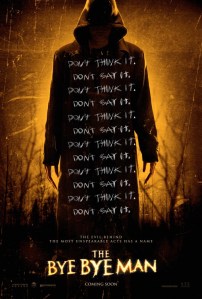 I think La La Land has a shadowy culprit to blame for the big slip-up at the 2017 Academy Awards where it mistakenly was declared Best Picture before the rightful winner, Moonlight, was crowned. Actress Faye Dunaway was the one who spoke aloud the infamous slip-up, but I think she had something else on her mind. She was so preoccupied with trying NOT to think about the Bye Bye Man that she wasn’t fully paying attention to the moment. Fortunately, Moonlight got its rightful due. Unfortunately, The Bye Bye Man exists as a horror film and Dunaway within it. This is a movie whose mantra is “Don’t say it, don’t think it,” all but begging to be forgotten.
If The Bye Bye Man had been the film it appears to be in its opening scene, we might have had an effectively unnerving horror thriller. We watch in a single long take as a distressed man drives home, mutters to himself, and takes out a rifle and systematically kills every person who admits they said “it” or told someone. He goes from person to person, pleading whether they told anyone, and it’s always yes. Then he moves on to kill that person, asking them the same question. It’s an effectively chilling scene and a fantastic way to open a horror movie. And it’s all sadly downhill from there, folks. The rest of the movie is a stupid thriller with stupid teenagers doing stupid things.
 Any power the Bye Bye Man has as a concept, a mimetic virus, is wasted as a goofy Boogeyman knockoff with vague powers and intentions. Apparently, one of the insidious side effects of the Bye Bye Man is his ability to cause erectile dysfunction. After the first night he-who-shall-not-be-named is named, two of our college students talk about trying again and how “that” never happens to them, all but implying the Bye Bye Man was a sexual detriment. Another weirdly defined power is that the Bye Bye Man causes his victims to see hallucinations, though sometimes they’re nightmares like maggots crawling out of eyeballs, and other times they’re fantasy, like a naked friend beckoning for a lustful tryst. One character hears disturbing scratching noises and then visions of people standing buck naked on train tracks (the amount of brief nudity made me recheck that this received a PG-13 rating). “We’re all losing our minds at the same time,” a character bemoans at the 41-minute mark. At one point, the Bye Bye Man sends himself as a GIF, knowing how to reach millennials. I don’t understand why these kids don’t accept that if they see something horrific it’s probably false. They know the Bye Bye Man is terrorizing them with their fears and yet they fall for it every time. When you’re talking with someone and all of a sudden they start seeping blood from every orifice, maybe that should be a clue. If Elliot (Douglas Smith) knows he’s afraid of his girlfriend sleeping with his best friend, then shouldn’t he doubt the voracity of seeing them together after the malevolent force with evil visions has entered his life? What’s the point of scratching “don’t say it, don’t think it” as a preventative measure? That calls more attention to the forbidden item. It’s like in Inception, when they say, “don’t think about elephants,” and invariably that’s what you’re going to think about.
If the Bye Bye Man can make people say its name, then why isn’t it doing this all the time? Why all the hallucinations to drive teens to kill themselves? That seems ultimately counter productive to Bye Bye Man business. Any businessperson will tell you the key to expanding your outreach is through happy customers. Fulfill these people’s wishes and then come to collect later. I can write an entire proposal for the Bye Bye Man to shore up his business. He seems to be doing everything wrong. If the goal of the Bye Bye Man is to spread its name/message, along the same lines of self-preservation through proliferation like the haunted Ring VHS tape, then it needs a more straightforward approach. Let these doomed teenagers know their nightmares will end if they bring in an additional however many new victims. Alas, the Bye Bye Man is painfully unclear (it even has zero references on the Google imitator search) and just another boo spook.
Even for horror movies, the characters can be powerfully boring and meaningless. The entire premise is a group of college kids moving into a house that used to be owned by the crazy guy in the opening flashback. They each take turns seeing things, hearing things, and doing things, some as mundane as scribbling without their direct knowledge. The plot is in a holding pattern that requires characters to repeat the threat over and over. The only setup we have with these characters is one house party so we don’t exactly know what they’re like before they start going crazy. Much of their hallucinatory confusion could be mitigated if they just communicated with one another. “Help, Friend A, I am seeing [this]. Is that what you are seeing as well, Friend A?” It leads to a lot of rash actions for supposed friends. Elliot even refers to his friend as a “jock,” which is a term I don’t think anyone out of high school says. When the police suspect Elliot of foul play once his friends start dying, he is acting completely guilty. He begs Carrie Anne Moss (The Matrix) not to force him to say a certain name or else her kids might be in danger. That sounded like a thinly veiled threat. And then the police let him go!
 The mystery of the Bye Bye Man’s history is the only point of interest in this story, and even that has its limits. The librarian (Cleo King) is hilariously hyper focused on delivering exposition. She even knows the protagonist on a first name basis. I think she lives to tell people about this one weird event in the school’s history. She even calls Elliot on the phone! The librarian reaches out to him, saying, “I’ve had some strange dreams ever since we talked.” She then asks if she can come over to his house later. What kind of relationship does this person forge with students? Dunaway is featured as the wife of the opening killer, and I just felt so sorry for her during every second on screen. She deserves better than this. Somebody go check on Faye Dunaway and make sure she’s okay.
The Bye Bye Man is a horror movie that’s so bad it can be outlandishly funny. It starts off well and deteriorates rapidly, abandoning sense and atmosphere for jumbled scares. There’s an extended bit during a climactic dramatic moment where a father has to convince his daughter to pee out in public. I felt so bad for every actor involved. I’ll even spoil the ending, which made me howl with laughter. A little girl talks about how she saw a table with some writing. “What did the writing say?’ her father asks, and oh no, here we go again you think to yourself. Then a second later the little girl says, “Daddy, you know I can’t read in the dark! What do you think I am, a flashlight?” My God, that moment should have been followed by a rimshot. This half-baked movie opens up a lot more questions than it has the ability to answer. What is the mythology of this character? What’s with the constant train imagery? Why does the Bye Bye Man have a pet dog? Why are the coins a significant part of its Bye Bye motif? And always, if it can simply make people talk, why isn’t it doing this all the time to spread its name? The Bye Bye Man is fun bad but oh is it still bad.
Nate’s Grade: D
Share this:

The Rules of Attraction (2002)
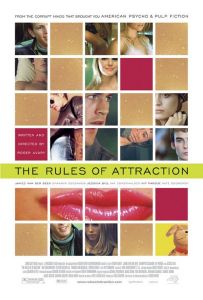 The Rules of Attraction is based on Bret Easton Ellis’ hedonistic 80s novel about boozing coked-out, aloof teenagers and their rampant debauchery. Roger Avary was Quentin Tarantino’s writing partner for years, with an Oscar sitting at home for co-writing Pulp Fiction. As a director Avary lays the visual gloss on thick utilizing camera tricks like split-screens and having entire sequences run backwards. While Ellis’ source material is rather empty, echoing the collegiate friendships bonded over substances or social lubricants, Avary does his best to represent the dazed world of college.
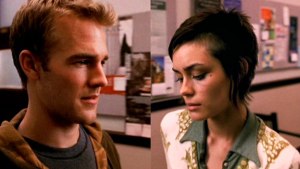 We open with Lauren (Shannyn Sossamon) getting raped by some drunk “townie” while the film buff she had her eyes on videotapes it. She’s just broken up with the bisexual and apathetic Paul (Ian Somerhalder), and both are interested in the sociopath Sean Bateman (James Van Der Beek), a self-described emotional vampire. Lauren keeps a picture book of venereal diseases to ward her from her wayward sexual urges. Her roommate Lara (Jessica Biel) needs no such book. Our introduction of Lara has her dancing down a hall, liquor bottle in each fist, bedding an entire sports team. Some attractions connect, many don’t, but the fun is watching the characters interact in their own seedy yet often hilarious ways.
The best thing that The Rules of Attraction has going for it is its about-face, against-type casting. The film is populated with the WB’s lineup of clear-skinned goody-two-shoes getting a chance to cut loose. Van Der Beek broods like a predatory hawk and bursts with spontaneous rage. Biel sexes it up as a cocaine-addicted harlot who asks if she’s “anorexic skinny” or “bulimic skinny.” Even Fred-Wonder-Years-Savage shows up briefly to shoot up between his toes! The adults of this world are no better than the kids. Eric Stoltz has an extended cameo of a duplicitous professor offering a higher GPA if any coeds are willing to go down on their morals. Swoosie Kurtz and Faye Dunaway show us that pill-popping ditherheads may likely breed drug-addled teenagers.
 Attraction may have the most disturbing suicide I’ve ever witnessed in film. After having her advances rejected a woman slips into the bathtub, razor in hand. The scene is as unsettling as it is because the camera hangs on the poor woman’s face every second and we gradually see the life spill out of her as the music becomes distorted, not letting us escape the discomfort.
Some of Avary’s surface artifice works perfectly, like Victor’s whirlwind account of an entire semester in Europe. Some of the visual fireworks are distractions to the three-person narrative but the film is always alive with energy, even when it’s depressing you. What The Rules of Attraction does get right is the irrational nature of attraction. Each character is trying to fill an inaccessible void with what they think is love but will often settle for sex, drugs, or both. The Rules of Attraction is made up of unlikable, miserable characters that effectively do nothing but find new ways to be miserable. It constantly straddles the line of exploitation and excess but maintains its footing. The movie is entirely vapid but it is indeed an indulgently fun yet depraved ride. If you’re looking for degeneracy instead of life-affirmation, then The Rules of Attraction is your ticket.
Nate’s Grade: B


 nathanzoebl
You must be logged in to post a comment.