Blog Archives
Wicked: For Good (2025)

To paraphrase a famous debate line, I knew Wicked, Wicked was one of my top films of 2024, and you, Wicked: For Good, are no Wicked. Obviously that’s not completely true as For Good is the second half of the adaptation of the popular Broadway musical, of which only the first act compromised the prior movie released a year ago. The problem was that the first Wicked movie felt complete, and had there never been another second after, it would have served as a fitting and even moving portrait of the unknown back-story to the Wicked Witch of the West and the implied propaganda that would taint the perception of the citizens of Oz. The movie was two hours and forty minutes but it felt extremely well-paced and developed. It felt, more or less, complete, even though I know it was only adapting half the musical. In short, it did too good of a job, and now Wicked: For Good suffers as a sequel because what’s left to tell just isn’t as compelling or as emotionally or thematically coherent as its charming predecessor. Plus, all the banger songs were clearly in the first movie.
After the events of the first movie, Elphaba (Cynthia Erivio) has assumed the mantle of the Wicked Witch of the West and is sabotaging the Wizard of Oz’s (Jeff Goldblum) plans at expansion and animal abuse. Glinda (Ariana Grande) is the Wizard’s public ambassador and the “good witch” to inspire the masses, even though she doesn’t possess actual magical abilities. Glinda wishes dearly that Elphaba will change her mind and decide to work with her and the Wizard. However, Elphaba wants to expose corruption, and the Wizard is at the top of her list of the corrupt and powerful needing to be toppled for good.

For Good suffers from the adaptation struggles the 2024 Wicked film was able to avoid. The first movie was an effervescent treat built upon a poignant friendship and some killer songs given the full showstopper visual treatment. It was a vibrant adaptation, and while it expanded upon the stage show significantly, the extra time with the characters felt like breathing space, and it all contributed to what felt to me like an extremely well paced and well developed and arguably complete movie experience. Now the second act of a musical is almost always the shorter of the two, and For Good is about 30 minutes shorter than its predecessor. The filmmakers even added two new songs for Oscar eligibility and further padding, neither of which are winners (more on the songs later in the review). That sense of care is not present in For Good, as characters are frustratingly repeating beats they already worked through. Take for instance Glinda, who begins the first movie as an entitled popular girl used to getting her own way, and by the end of the movie, she’s grown to see the world differently and through her sisterly friendship with Elphaba, she has a more empathetic and grounded perspective. She has already changed for the better, and yet in For Good it feels like the movie kicks her character growth backwards. She has to again learn that maybe the Wizard and others are not the best people in charge just because they are. Wicked is a victim of its own success. The character development and arc was so well realized in the first movie that Glinda feels like she’s repeating lessons she’s already learned. I also don’t buy Elphaba being seriously tempted by the Wizard’s offer of collaboration after all she experienced and learned earlier. It’s irksome to have the characters seem curiously different from where we left them in 2024’s Wicked. There is also a character relationship revelation that I and many others had figured out FROM THE OPENING SCENE of the first movie. Behold, dear reader, For Good doesn’t even address this until the last twenty minutes of the movie and it does absolutely nothing with this revelation. I was flabbergasted.
The biggest time-waster and padding is when Wicked drags The Wizard of Oz characters and plot incidents awkwardly into its own universe. Granted, the entire enterprise is supposed to be the unknown back-story for the villain of The Wizard of Oz which gives it its identity. Except Dorothy and her lot are not essential at all to telling this story, as evident with the sense that the 2024 Wicked could feel complete. Dorothy and her motley crew of locals, some of whom are made up of previously established characters, are given the Rosencrantz and Gildenstern treatment, meaning they’re primarily kept off-screen and incidental. You don’t even see Dorothy’s face once. These characters feel annoyingly tacked-on and inconsequential to the story we’ve already spent three hours with. They’re knowing nods for the audience and they’re also making efforts to better pad out the running time. I don’t fully comprehend their importance in this new retelling. The treacherous Madame Morrible (Michelle Yeoh) sees the presence of Dorothy as an advantageous development, like she can use her as a Chosen One to thwart Elphaba. It’s never remotely explained why this makes sense. Why this person versus any other Oz citizen? Dorothy possesses special shoes but we’ve seen what can be accomplished with them. They’re not really some superpower or a weapon, more an item of personal attachment for Elphaba she would like returned. In this retelling, the entire inclusion of Dorothy and her friends is a means to an end for a public ruse. It might seem odd to say this Wizard of Oz back-story would have been better minus Dorothy but there it is.

Now it’s time to discuss the actual songs for this movie musical. The best known and most popular tunes were all in the first act and thus the first movie. The songs for For Good are a combination of middling ballads and continuation of the leitmotifs and themes of the previous one. There’s perhaps a bigger emotional current when characters bring back melodies and lyrics from the first movie to expand or contrast, like “I’m Not That Girl.” Did you want another song with Goldblum singing? The biggest number is “For Good” where Elphaba and Glinda face off and admit their shared sisterly love for one another, but again this was already established by the end of 2024’s Wicked. It’s more explicitly stated through song but the sentiment was evident to me already. Adding further disappointment, returning director John M. Chu (Into the Heights, Crazy Rich Asians) lacks the same thoughtful staging of the musical numbers in this edition. He is a filmmaker who innately knows how to adapt stage musicals into the medium of film, and he did so splendidly with 2024’s Wicked. With For Good, the staging lacks a real immersion and visual dynamism, often murky or overly saturated, like “No Good Deed” being performed almost entirely with intrusive sunsetting silhouettes dominating the screen. The less engaging songs, added with less engaging visual staging, make the movie feel longer and less jubilant. I don’t know if “For Good” has the intended emotional crescendo simply because this movie isn’t nearly as good.
As a personal note, the 2024 Wicked was the last movie I saw in theaters with my father while he was alive. We were supposed to see Gladiator II together as a family after Thanksgiving but he wasn’t feeling up to it, and then a little more than two weeks later he was unresponsive. I’m happy Wicked was such a pleasant and enjoyable experience for him, but as we left the theater, he asked me, “Wasn’t there supposed to be more?” We had seen the stage show when it toured through our city many years ago, and I remarked that there was going to be a whole second movie adapting the second act of the musical and it was going to be released in a year. He nodded and I felt the silent acknowledgement shared between us: he would not be around to see the conclusion, that it was a future unavailable to him. So it’s hard for me to not have some melancholy feelings with For Good, and I’ll admit maybe that’s influencing my critique.

Wicked: For Good is a frustrating, disappointing extension of what had been a sterling and magical original movie. It doesn’t outright ruin what came before it but confirms for me that 2024’s Wicked could stand on its own. The songs aren’t as good. The staging and visuals aren’t as good. The character development feels repeated and occasionally confounding. The plotting is stretched and unsatisfying. The inclusion of the more direct Wizard of Oz characters feels arbitrary and unnecessary. The actors are still charming and affecting and sing wonderfully, but they’re also unable to defy the gravity of the material they’re stuck with. If you’re a super fan of the source material, albeit the original story by L. Frank Baum, the 1939 Wizard of Oz movie, the Gregory Maguire book, the 2000s stage musical, or even the first movie, you will probably find enough to sing along to and walk away fairly happy. I loved the 2024 Wicked and was left mostly cold at the concluding half but I realize I very well may be a curmudgeonly minority here. My advice would be to consider the 2024 Wicked a complete movie and skip For Good.
Nate’s Grade: C+
Share this:

Lilo & Stitch (2025)/ How to Train Your Dragon (2025)
 Two new live-action remakes are recreating Millennial staples, Lilo & Stitch and How to Train Your Dragon, as transparent facsimiles, and they’re both reasonably fine. If you’ve never watched either animated movie, you’d maybe even call the live-action versions pretty good for your first experiences with these stories. Both movies understand what works essentially from their predecessors and don’t reinvent the wheel. They keep things pretty safe and strict, which translates into pleasant but predictable entertainment for anyone familiar with the originals.
 I don’t even know how to fully review these entries, which is why I’m combining them together. They’re both so thoroughly fine yet one is the highest-grossing movie of 2025 so far, the popularity of which I cannot explain. My conceptual issue with the nature of live-action remakes is the implicit belief that animated films improve when they are brought into a real-world setting. I strongly disagree. Animated movies can be vibrant, stylistic, and exaggerated in such daring and artistically enigmatic ways. Translating that into real-life often strips away that style or liveliness; take for instance how un-expressive and dour the “live-action” Lion King was, a collection of possessed (cursed?) taxidermy. Animation does not require verisimilitude to be entertaining or engaging. I’m also worried over the speed of which these live-action remakes are coming, now refreshing fairly recent movies. Has there been enough distance between now and 2010 to have compelling artistic differences with the original How to Train Your Dragon? Apparently not. When the live-action Moana comes out in 2026, will it be dramatically different or better than the animated version? I strongly doubt it. We need more distance from the original animated movies so the remakes aren’t just slavish yet inferior versions of the originals. There needs to be more than simply a tracing over. I don’t see this ending any time soon considering the commercial rewards, and so the live-action Lilo & Stitch and How to Train Your Dragon continue to be good stories, just unnecessary.
Nate’s Grades: B
Share this:

A Minecraft Movie (2025)

I was fully prepared to dismiss A Minecraft Movie as junk for its target audience, and then a funny thing happened in fact pretty early in the movie: I was laughing. Then I laughed again. Genuine laughter. I’m here to say that the Minecraft movie is not the silly and stupid kid’s movie you may have dreaded. It’s actually a pretty pleasant fantasy adventure movie that, while aimed for kids, can still be enjoyable for like-minded adults looking for some colorful and silly escapism. It’s hip to be square, baby.
Steve (Jack Black) is a guy who loves to create, and mines for whatever reason, and finds a portal to another very cube-centrist world. In this new world, Steve finds friends and freedom, but this is ruined when a nefarious force comes through wanting to conquer this new world as well as Steve’s home world. He sends out help and seals off a portal. Years later, a pair of siblings, Henry (Sebastian Hansen) and Natalie (Emma Myers), move into Steve’s old home and discover his portal, along with an middle-aged arcade game champion and local legend, Garret (Jason Momoa), and realtor, Dawn (Danielle Brooks). These newcomers must adjust to this strange world and defend themselves against zombies, creepers, and other dangers. Fortunately, Steve serves as a valuable guide, but can they all defeat the evil forces?
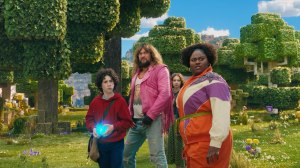
There’s a robust silliness to Minecraft that invites you to not ever take things too seriously and have fun with the vibes. Much like the Super Mario Brothers adaptation, there isn’t really a story to adapt here. There were several moments that felt like it was a satirical parody of the fantasy adventure movie while also working as examples of fantasy adventure tropes. Refreshingly, much of the humor is not derived from fish-out-of-water juxtaposition. This could have easily been a “Well, that happened” kind of nonchalant comedy, holding up the weirdness to scrutiny for easy yuks. It finds better jokes through pushing further than simple observational irony (“My dad says math has been debunked”). It’s good-natured humor that keeps things positive and goofy, channeling the open-sandbox creativity of the video game. Its “be yourself” message is easier to accept than more disingenuous kid’s movie junk like The Emoji Movie. The Minecraft world is presented less as a purchasable video game rather than a new world to explore that rewards exploration (during daylight hours). The very enemy of the movie is a sorceress (voiced by Rachel House) that hates creativity and sees it as a waste in her pursuit of always plundering and hoarding more gold. I might be reaching but there seems even like a possible A.I. reading there, with our giant pig sorceress standing in for tech bros who are trying to eliminate avenues of creativity because all they care about is wealth and cannot understand the appeal of creativity. The movie has several little comic asides that caused me to chuckle and laugh and smile, and I looked over at my adult friend beside me for my screening, and his response was the same. We both had been surprisingly taken by the genial silliness of this movie.
Black (Jumanji) has become a kids’ movie juggernaut thanks to his zany energy and willingness to go above and beyond no matter the request. He’s a charming and delightful performer by nature, whether he’s voicing an animated character or singing a sexually explicit song about all the positions he will execute. He dips out for the first half hour after the exposition dump that opens the movie, but once he’s back on screen, it’s easy to remember there just isn’t another actor like Black. He’s funny and completely bought-in with whatever the movie asks for, but every single line and every single gesture is at a ten. He is selling every second of this movie and I can completely understand why some people just might get overstimulated by Black’s histrionics. You can tell the filmmakers were like, “We want our own version of ‘Peaches’ to go viral,” and so we get three different moments of Black singing original songs. This aspect was the most transparent and contrived decision that felt based upon chasing after the success of another movie popular with the kids. The actor I enjoyed the most was Momoa (Fast X) who has lots of fun undercutting his own masculine image and his character’s over-inflated ego masking his insecurity.
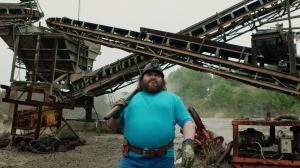
The visuals are bright and enjoyably retro. The Minecraft video game is famously low-grade with its pixelated graphics, more akin to the visual landscape of video games from the 1990s than 2011 when it was first published (it has since become the best-selling video game of all time). Starting with that visual scheme, it allows the movie to be good looking without having to be photo-realistic with its CGI. We have a stylized world to explore that’s full of vibrant colors and characters. This is easily the best looking movie of director Jared Hess’ (Napoleon Dynamite, Nacho Libre) career. His skewed sensibilities work as a nice fit with the comic direction of the movie, and there are some engaging visual arrangements.
Regrettably, this adventure is a bit of a boys-only club. The female half of our adventurers don’t really get the attention that the boys do. Both Natalie and Dawn sit out for long stretches of the movie that I forgot they were in the movie. Usually, these kinds of stories make it so each character has some kind of arc that can be fulfilled by the end, even if it’s minor. I suppose you might be able to argue that Natalie is learning to accept the responsibility of being a parental figure to her younger sibling, and Dawn getting the gumption to quit her job to pursue her dream of running a petting zoo. I’m not keen on bestowing credit for just having a scene at the end where the characters celebrate whatever their goals had been. If you don’t see the work and the development toward those goals, then you don’t get the credit. Why can’t these women have their own adventure that meaningfully connects to the larger plot? Or, even better, why can’t they also go along and contribute to the quest along with all the boys? It’s not like I think the movie is actively trying to downplay the role and importance of women, but it’s also disappointing that there are clear tiers of the characters as far as what kinds of fun and story integration they ultimately earn.
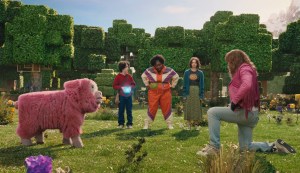
Behold, the Gen Alpha cultural epoch and its name is “chicken jockey.” By now you may have heard of this infamous scene that has caused some theaters to erupt in a calamity of noise, rowdy behavior, and throwing a live chicken at the screen. I even had a theater employee warn our audience before the movie began what is acceptable behavior and how people not abiding by these expectations would be removed from the theater. I’ve been watching movies my entire adult life and other than special screenings for movies intended for audience interaction, like Rocky Horror and The Room, I have never had a theater employee warn me about proper decorum, and this was before the Minecraft movie. It’s astounding. What’s also astounding is how ultimately meaningless this moment is. It’s a baby zombie that falls atop a chicken and rides it, and from what I’m told, this is a very rare occurrence in the game, but I guess it means something more to a generation of fans relishing a rare reference in their favorite game. While I was standing outside the restroom waiting for my own kid to return, a little girl was impatiently asking her father if he was done using the restroom, much to his growing annoyance. “Please hurry. I don’t want to miss the chicken jockey part,” she explained in desperation. I’m happy that this moment seems to be so highly anticipated for millions of fans, but as an outsider, this moment feels so incidental and flimsy that it would be like a generation excitedly waiting for Indiana Jones to lean against one particular wall.
This movie could have been so much worse, and the fact that it’s relatively breezy, funny, and entertaining for non-fans of Minecraft, such as myself, counts as a success in my book. It’s telling that the title is A Minecraft Movie and not The Minecraft Movie. It is but one story in this universe, and given the popularity, it will surely not be The Last Minecraft Movie. Its runaway success at the box-office means we’re probably headed for even more Gen Alpha-centered game adaptations, like some Roblox game you’ve never heard about if you’re over the age of twenty. Hey, it all might work somehow. This one did.
Nate’s Grade: B
Share this:

Moana 2 (2024)
 It’s hard not to see the DNA of its original incarnations as a TV series for Disney Plus, as well as the awkward adjustments to slap this together into a feature film. Unless you’re a super fan of the original Moana who needs any additional content, you’ll likely have a less than impressive response to Moana 2. It feels quite episodic from villains and storylines popping up for small increments of time only to go away and be replaced by a new storyline, to a new batch of characters meant to hold our attention while other main characters, in particular Maui (Dwayne Johnson), sit out for long stretches. The animation is a notable step down as well, and while it’s still pleasing to watch and far from bad, it’s lacking the detail and refinement of the feature team, especially with lighting, as everything in this world lacks shadows with such high key lighting washing everything out. Without Lin-Manuel Miranda returning, it’s obvious the songs will not be nearly as catchy and enchanting, and the tunes for Moana 2 are pretty instantly forgettable. I’m struggling to rethink any melody right now as I write this. It’s hard not to feel like everything is so slight, from the storytelling to the visuals to the songs to the inclusion of the beloved characters from the original. I loved Moana and consider it the best of modern-day Disney, and I’m clearly not alone from the box-office dominance that the sequel was able to achieve. I actually think I would have preferred future Moana adventures as a TV series because the mythology and world has more to explore. But that version of new Moana has been transformed, Frankenstein-style, into a releasable feature film, one that suffers in the transformation into something it’s not suited for. Disney made a billion dollars from this gamut, but the rest of us are left with a Moana 2 that had much further to go.
Nate’s Grade: C
Share this:

Dog Man (2025)
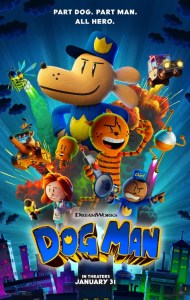 I probably wouldn’t have as much familiarity, and good feelings for the Dog Man series of books had I not become a father to a Dog Man-obsessed kiddo. The silly and imaginative comic books by Dav Pilkey, creator of Captain Underpants, are easy to enjoy with their upbeat tone, sly satire, and whimsical child-like art style. The movie is essentially all that you would want in a Dog Man movie, replaying some of the more famous stories and images and characters from some of the books. Dog Man is born when a police officer and his trusty canine sidekick get into an explosion and have their bodies surgically attached to one another becoming the ultimate crime fighter/man’s best friend. Dog Man has to battle villains like Petey (voiced by Pete Davidson), an evil cat genius, and Flippy (Ricky Gervais), a super intelligent fish with telekinetic powers as well as impress the always harried Chief (Lil Rel Howery). It’s a movie aimed squarely a children without any larger themes beyond life lessons about basic responsibility and empathy, important lessons but ones simplified and aimed at is target audience. The pacing and jokes are swift and the vocal cast is each well suited to the task, with Davidson being an inspired choice for the easily flummoxed and dastardly Petey. The material where Petey makes a child clone of himself and basically learns about parenthood is the best part of the books and could have been explored further in the movie. Still, it’s a low-stakes and goofy movie that mostly succeeds at channeling the appeal of the books. If you’re a Dog Man fan, or the parent to one, then the movie may be everything they wanted, though even at 80 minutes much longer than most bedtime reads.
Nate’s Grade: B-
Share this:

Wicked: Part One (2024)

It’s shocking that it took this long for Wicked to make its way from the Broadway stage to the big screen. The musical, based upon Gregory Maguire’s novel, began in 2003 and while it may have lost out on the biggest Tony Awards that year to Avenue Q (it seems astonishing now but… you just had to be there in 2004, theater kids) the show has been a smash for over two decades, accruing over a billion dollars as the second highest-grossing stage show of all time. As show after show got its turn as a movie, I kept wondering what was taking so long with an obviously mass appealing show like Wicked. It’s the classic Hollywood desire of “same but different,” a reclamation project for none other than the Wicked Witch of the West, retelling her tale from her perspective. Well, Wicked’s time has eventually dawned, and the studio is going to feast upon its protracted wait. Taking a page from the YA adaptation trend that dominated the 2010s, they’ve split the show into two movies, separated by a full year, hoping to better capitalize on the phenomenon. I was wary about Part One being 150 minutes, the same length as the ENTIRE Wicked stage show, but having seen the finished product, and by “finished” I mean one half, I can safely say that Wicked is genuinely fabulous and deftly defies the gravity of expectations.
In the fantasy world of Oz, the green-skinned outcast Elphaba (Cynthia Erivo) is looked at with scorn, derision, and fear. She’s always been different and never fully accepted by her father who blames her for her mother’s death and her younger sister Nessarose (Marissa Bode) being stricken to a wheelchair. Nessa is going to study at Shiz University with all the other up-and-coming coeds of the land of Oz, including Glinda (Arianna Grande), a popular and frivolous preppie gal peppered in pink pastels. Glinda desperately wants to be taken seriously and become a witch, studying magic under the tutelage of the esteemed Madame Morrible (Michelle Yeoh). Instead, Morrible’s fascination falls upon Elphaba after she reveals her tremendous magical ability in a moment of extreme emotion. Now Elphaba is enrolled at the magic school and learning about the way of the world, and she’s stuck with Glinda as her roommate. The two women couldn’t be any more different but over the course of the movie, we’ll uncover how one became Glinda the Good and the other the Wicked Witch of the West.

At two-and-a-half hours long, again the length of both acts of the stage show, Wicked Part One only covers the events of the show’s first act, and yet it feels complete and satisfying and, even most surprising, extremely well paced. It’s hard for me to fathom what could have been lost to get the running time down as each scene adds something valuable to our better understanding of these characters and their progression and the discovery of the larger world. It’s a movie that feels constantly in motion, propelling forward with such winning ebullient energy that it becomes infectious. It’s also not afraid to slow things down, to allow moments to breathe, and to provide further characterization and shading that wasn’t included in the stage show. The adaptation brings the fireworks for the finale and raises the visual stakes and danger in a manner that feels exciting and compellingly cinematic. Considering the resplendent results, I feel I could argue that the movie is actually -here comes the heretical hyperbole, theater kids- an improvement over the stage musical. It makes me even more excited for a bolder, longer, potentially even more emotionally satisfying second part in November 2025.
One of my primary praises for 2021’s In the Heights was that director John M. Chu, who cut his teeth helming the Step Up movies, knows exactly how to adapt musicals to maximize the potential of the big screen. If you’re a fan of musicals, old and new, you’ll find yourself swept away with the scope and intricacy of these large fantasy worlds, the flourishes of costume and production design, as well as the creative choreography making fine use of spaces and the power of film editing. There’s a rousing dance sequence set in a library with shelves that rotate around the room, making the slippery choreography that much more immersive, impressive, and acrobatic. Even big crowd numbers are given the knowing framing and sense of scale to hit their full potential, from the opening rendition of Munchkinland celebrating the death of the Wicked Witch of the West complete with giant burning effigy that would make a Wickerman envious, to the introduction to the City of Oz where it appears every citizen has a jovial role to play in welcoming strangers to their enchanted capital city. Chu’s nimble camerawork allows us to really enjoy the staging and skills of the talent onscreen, bringing a beating sense of vitality we crave from musical theater writ large. Wicked is simply one of the best stage-to-screen adaptations in musical theater history and a joyous experience that allows the viewer sumptuous visuals.
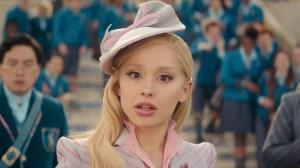
At its core, the story of Wicked is about some pretty resonant themes like self-acceptance, bullying, the fear of what is different or misunderstood, and all of this is built upon an irresistible friendship between Glinda and Elphaba. The rivals-to-allies formula isn’t new but it is tremendously effective and satisfying, especially when both characters are as well drawn and deserving of our empathy as these two ladies. They’re each on a different meaningful character arc for us to chart their personal growth and disillusion with what they’ve been taught is The Way Things Are. One is starting from a disadvantaged position and gaining traction through an outward demonstration of power, and the other is beginning in a position of privilege and becoming humble and more considerate as she acknowledges the challenges of others in a manner that doesn’t have to reconfirm her enviable “goodness.” It just works, and both women are fantastic in their roles. I was on the verge of tears at several points and my heart felt as full as a balloon throughout because of the emotional engagement and heartwarming camaraderie between our two leading ladies. With all its razzle dazzle, Wicked is a story of feminine friendship first and foremost and emotionally rewarding to experience, with the soaring music as a bonus.
Let’s finally talk about the music, a key factor in the enjoyment of any musical, naturally. The music was written by Stephen Schwartz, the Oscar-winning composer for “Colors of the Wind” from Pocahontas as well as “Believe” from The Prince of Egypt. I found his Wicked numbers to range from good to astoundingly good, with catchy ear-worms like “Popular” to the anthemic power and sweep of “Defying Gravity.” The cheeky and toe-tapping “Dancing Through Life” is a showcase for Jonathan Bailey (Bridgerton) and benefits from the aforementioned creative library choreography. “I’m Not That Girl” is a heartbreaking ode to the girls who don’t think of themselves as enough, which is begging for a reappearance in Part Two. The only clunker is “A Sentimental Man” but that’s more the result of the deficiencies of Jeff Goldblum as a singer than the song. I await the reuse of themes and motifs that will make the music even more thematically rich in the eventual Part Two.

Count me as part of the skeptical throng when it was announced that Grande, who hasn’t acted in over ten years, was cast as Glinda. I’m here to say that she is uniformly great. The Glinda role is the more outwardly showy role and thus immediately more memorable. It’s the far more comedic role, in fact the main source of comedy in the show, and Grande has serious comedic chops. Naturally she excels with the singing and its purposeful miasmic bombast, but it’s the subtle comedic styling and the exaggerated physicality that impressed me the most, like a moment of her twirling on the floor as an added dramatic flourish. There’s one scene where she’s just marching up and down a hallway in full exuberance, kicking, dancing, and exploding with joy. I anticipated that Erivo (Bad Times at the El Royale) would be exceptional, and of course the Broadway vet is, as she brings such simmering life to Elphaba. There’s a strength in equal measure to her vulnerability, making the character fully felt. Erivo also delivers during the big moments, like the climax of the movie that can give you goosebumps in hiw it weaves together empowerment and defiance and self-acceptance. Together, the two women are an unbreakable pair of performers and heroes that we’ll want to see triumph over adversity.
After decades of belabored waiting, Wicked finally makes its journey from stage to screen and I must say it was worth every minute. The film, even at only one half, feels complete and richly realized, building upon the strong foundation of the stage show and its numerous winning elements and masterfully translating them to cinema, taking full advantage of the visual possibilities while also expanding upon the story and themes for further enrichment. While born in the early 2000s War on Terror Bush era of politics, Wicked’s themes of anti-immigrant fear-mongering as scapegoats still bears striking resonance today, as do the emerging warnings of fascism in Oz. If you’re a fan of The Wizard of Oz, musical theater, or even just grandiose spectacle that doesn’t dilute grandiose feelings, then step into Wicked and you too will feel like you’re floating on air.
Nate’s Grade: A
Share this:

Harold and the Purple Crayon (2024)
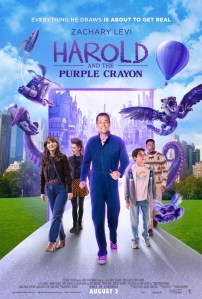 As an elder Millennial, I’ll try and ignore my rising bile for what they did to my boy Harold here, and I’ll simply ask who was this movie for? The big screen adaptation of the classic 1955 children’s book by Crockett Johnson that celebrates the power of imagination is a mishmash of mawkish feel-good family nonsense, fantasy power wish-fulfillment, and grating fish-out-of-water comedic antics. Increasingly missable actor Zachery Levi (Shazam!) plays yet another glorified man-baby, this time as an “adult” Harold who ventures into the Real World to search for his narrator, essentially the god of his purple-hued universe. He befriends a lonely boy with a big imagination and the kid’s single mom (poor Zooey Desceanel) and life lessons are learned while “adult” Harold makes a mess of just about everything as he leaves behind chaos and disaster. Eventually Harold has a full-on wizard duel against a villainous librarian and wannabe published fantasy author played by Jermaine Clement. That’s right, Harold and the Purple Crayon transforms into a magic battle over the fate of the all-powerful ring, I mean crayon. Making matters worse is Levi’s hyperactive schtick that has been growing stale for years and is tiresome and annoying throughout the movie. It’s also quite ironic, and phony, that a movie expressly proclaiming the power of individuality and imagination is so thoroughly and depressingly generic. This should have been animated or left alone, period.
Nate’s Grade: D+
Share this:

Beetlejuice Beetlejuice (2024)
 Usually sequels over thirty years later reek of desperation, trying to rekindle the past while usually only hoping to tickle people’s fading sense of nostalgia. Rare is the 30-year-plus sequel that excels by breaking free of its imitator and making us see the original in a new light. It helps to keep your expectations in check, especially for a project that is so miraculous as the original 1988 Beetlejuice. What a wild movie that was, an introduction to horror comedy for a generation, and a near-perfect balance of creepy, silly, and imaginative. From director Tim Burton’s career-launching sense of style, to Michael Keaton’s electric comedic performance, to Danny Elfman’s outstanding score, to the stop-motion visuals, fun and freaky makeup effects, and you had a madcap movie that felt like a unique discovery. Recreating that is near impossible, but if Beetlejuice Beetlejuice can recreate some of the elements and feelings that made the original what it was, then it can be considered a modestly successful late-stage sequel.
Lyrdia Deetz (Wynona Ryder) has become a long-running host of a paranormal TV talk show connecting people with messages from loved ones from beyond the grave. Her teenage daughter, Astrid (Jenna Ortega), is moody and embarrassed by her mother, feeling that she “sold out.” Mother and daughter return back to Connecticut to attend the funeral of Charles Deetz, Lyrdia’s father. Her pretentious and snippy stepmother, Delia (Catherine O’Hara), is trying to better commune with his spirit, and the entire town has become famous for its spooky seasonal history. Meanwhile, Beetlejuice (Keaton) is trying to avoid his former wife, Delores (Monica Bellucci), who naturally is seeking to obliterate him to ectoplasm. He’s still got his sights set on Lydia, who spurned his marriage hopes, and might be able to manipulate the Deetz family back into his control.
 Beetlejuice Beetlejuice gets the closest to rekindling that lightning-in-a-bottle alchemy from the 1988 original, serving as an appealing and enjoyable sequel. Nothing will ever be as original and wild and such a discovery as that first movie, which serves as a point of entry for many a Millennial fan who discovered that irresistible Tim Burton Neo-Gothic aesthetic. However, it recreates enough of the qualities that stood out about the original. The skewed sense of humor and surreal visuals, as well as goofy slapstick and vibrant imagination about life after death, it’s all such a fertile playground for Burton’s visual charms. The genius of the original was telling a ghost story from the ghost perspective as they learned about how to be better ghosts to try and scare their new living owners away. Given the world of the dead, there’s such tremendous storytelling and world-building possibilities here, explored richly in the animated 90s series for kids. Further stories in this universe have an automatically appealing power, and it’s just nice to watch Burton apply his specific aesthetic again, something fans haven’t really seen since 2007’s Sweeney Todd. I appreciated the weird morbid details and the practical production values; the Alice in Wonderland movies have shown that the “Burton look” isn’t best complimented by massive green screen sets. Having Burton, the “Burton look,” the original actors, with some exceptions (more on that later), and enough of that offbeat, chaotic, morbid tone return is a victory.
Beetlejuice Beetlejuice doesn’t so much alter our understanding of the world of the dead as established; it doesn’t radically rethink the landscape but it doesn’t repeat the same plot events either. I really liked the evolution of the adult Lydia as a jaded TV host. There’s a real dramatic punch to the reality that she sees the dead but has yet to see her deceased husband. She is incapable of reuniting with the man she misses the most, and she doesn’t know why. That yearning, paired with a lingering thematic mystery, can be a palpable storyline to explore. Pair that with some three generations of Deetz women trying to understand one another and work through personal resentments and we have fertile narrative ground. The three women were my favorite part of the movie, and their interactions and reflections on parenting and the challenges of trying to better understand one another are the foundation of the movie’s sense of heart. I really enjoyed the dynamic between the three, significantly upping Delia’s screen time and finding room to give her more dimension, an artist struggling in the wake of her grief. I’m a bit surprised that Ortega’s character isn’t more central to the drama. For all intents and purposes, she’s Lydia 2.0, so butting heads with Lydia 1.0 I guess feels redundant, so the story sends her off to find a cute boy in town and use that as an excuse for several unexpected needle-drop song use. There’s something inherently wrong watching a Tim Burton movie and hearing contemporary music. Imagine the Beetlejuice “Day-O” singalong but to, say, Sabrina Carpenter instead. No.
 Beetlejuice, as a character, is such an exciting agent of chaos, a horny ghost who operates on the same tonal wavelength as a Looney Tunes cartoon character. Even though the original movie is named after the guy, he’s only in the film for approximately twenty percent. Keaton was absolutely incredible in his comedic bravado, creating much of the character through his ad-libs and hair and makeup choices. Keaton is still fantastic in this go-for-broke sort of performance, a performance we’ve seen far less as he’s settled into a respectable dramatic acting career. It’s hard to remember, dear reader, but when Keaton was initially cast for Burton’s Batman, the fan base at the time was up in arms, considering Keaton more of an un-serious funnyman. It would have been easy to have Beetlejuice front and center for the movie, so it’s admirable that Burton and Keaton decided to keep his on-screen appearances short, leaving people wanting more. There’s a late turn of events that pairs Lydia and Beetlejuice together, and I wish this fractious pairing had been the bulk of the movie. The whole enemies-to-uneasy-allies would have put much more emphasis on their character dynamic and the comic combustibility. Still, seeing these characters come back and retain their appeal and personality without obnoxious pandering is welcomed.
The screenwriters find a clever solution for the Jeffrey Jones Dilemma. For those unaware, Jones, who portrayed Lydia’s father in the original, and best known for pugnacious supporting roles in movies like Ferris Bueller’s Day Off, Howard the Duck, and HBO’s Deadwood, was charged with soliciting a child for sexual exploitation. The movie continues with the character of Charles Deetz but without the involvement of Jones. The character gets his top eaten by a shark, so for the rest of the movie he’s a walking half of a corpse with a mumbly voice. It’s a clever way to include the character without the need for the actor.
With that decision to limit the Beetlejuice quotient of Beetlejuice Beetlejuice, it makes for a sloppier movie juggling a few underwritten subplots and side characters. The biggest non-factor is the return of Mrs. Beetlejuice. Here is a powerful antagonist who has the literal ability to suck out the souls of the recently dead and turn them into shriveled husks. She’s seeking vengeance against her ex and tracking him down through the netherworld. And yet, she could be completely eliminated from the movie without really affecting the other storylines. The whole Mrs. Beetlejuice/vengeful ex-wife character feels like a holdover from a different sequel script, clumsily grafted onto this other project, a vestigial artifact of another path not taken. There’s plenty of potential with the concept of the past victims of Beetlejuice coming back to seek retribution, and especially a trail of angry former lovers. It would explore the character’s history more meaningfully than an albeit amusing silent film interlude about how he married her during the era of the Bubonic Plague. We see how he died as a human, but there’s hundreds of years that can be illuminated from his failed schemes and odd jobs. Certainly there could be a whole club of ax-grinding malcontents sharing their mutual hatred of the Ghost with the Most. This character should better reflect Beetlejuice, and instead she’s just a monster on the prowl that eventually gets indifferently cast aside. It feels like Burton was looking for something for Bellucci to portray (Burton and Bellucci have officially been dating since 2023).
 She’s not alone as an antagonistic villain that pops up to provide momentary danger but is also hastily resolved to the point that it raises the question why they were even involved. There are three antagonists, not counting Beetlejuice, that appear throughout to threaten our Deetz family members in Act Three, each of them individually interesting and targeting a different member of the family for ill-gotten gain. Yet each one of these characters is conquered so easily that it nullifies their importance and overall threat. If Beetlejuice could, at any moment, just open a trapdoor to hellfire at a moment’s notice, what danger does any other character pose then? If a sand worm can just appear from nowhere and consume our pesky antagonist, then why can’t this be a convenient solution earlier? The defeats feel arbitrary, which make the antagonists feel arbitrary, which is disappointing considering that we have the full supernatural arsenal of undead possibilities to tap into. I enjoyed these characters for the most part, but it’s hard not to feel like they’re tacked-on and underwritten. The same can be said about Willem Dafoe’s police chief, a former actor who played a chief on TV and now tries to fill the role for real after death. I’m always glad to have more Dafoe in my movies (woefully underrepresented in rom-coms, you cowards!) but he’s just mugging in the corner, waiting for some greater significance or, at minimum, more memorably morbid oddity to perform.
Beetlejuice Beetlejuice is better than a desperate sequel cash-grab, though there are elements, ideas, characters, and jokes that could have been smoothed out, better incorporated, and developed to maximize the potential of the undead setting. It’s an enjoyable throwback for the fans of the original that does manage to tap into enough of those potent elements that made the original so memorable. It’s definitely less edgy and transgressive, maybe even a little too safe given the territory of spooky specters; the entire Soul Train bit felt like a bad Saturday Night Live sketch from the 1980. However, it’s still got enough of the charm and silliness to leave fans, old and new, smiling and wondering where it might go next in its wild world.
Nate’s Grade: B
Share this:

IF (2024)/ The Imaginary (2024)/ Imaginary (2024)
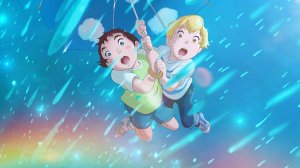
Every so often, I find myself drawn to reviewing movies in pairs, whether it’s because of the same source material (the 2022 Pinoochios), similar perspectives (2018’s BlackkKlansman and Sorry to Bother You), or even diametrically opposed artistic responses to a similar theme (2016’s Manchester by the Sea and Collateral Beauty). However, in my twenty-five years as a fledgling film critic, I don’t think I’ve ever reviewed three movies at the same time for whatever relevancy, yet that is what I find most appropriate for this trio of exceedingly similar films about imaginary friends. Earlier in the year, Blumhouse released Imaginary, their horror-thriller take on an imaginary friend refusing to go away. At the start of the summer, writer/director John Krasinski gave us IF, a live-action fantasy/comedy about imaginary friends finding their former children as adults. And recently, Netflix released an anime movie The Imaginary, a Studio Ghibli-esque fantasy about forgotten imaginary friends trying to find new kids and new homes. I’ve elected to review all three at once and, much like the Pinnochios, declare a winner through different categories.
Begin the critical gauntlet! Bring on the (imaginary) bloodshed!
- PREMISE

Two of these movies went in a sweetly sentimental direction and the other went in the horror direction, so let’s tackle that one first. Imaginary gets at a rarely spoken truth: children can be super creepy. Watch a child hold an involved conversation with some entity that isn’t there, or just stare into the dark and say, so plainly, “That’s where the eyes are watching me,” or any number of personal anecdotes to make you shudder, and you’ll understand the significant horror potential with a malevolent creature that the child can communicate with that adults cannot see. This also lends itself to a low-budget film production as so much of the wicked entity is implicit and unseen. It’s a cost-saving genius when you can just use your, wait for it, imagination. Now Imaginary isn’t the first horror version of this premise, but it deserves points for taking a childhood concept and thinking of an effective way to transform it into a diseased and malignant antagonist, haunting its adult child Jessica (DeWanda Wise) and seeking a new child, likely her youngest step-daughter Alice (Pyper Braun). It then presents its conflict like a curse that the past generation is trying to spare the next generation from suffering through. Of course this also includes getting adults to recognize the threat as they are often dismissing it. Nobody wants to believe that Chauncey the teddy bear is the one urging you to self-harm.
The other two movies take a far more family-friendly approach to their imaginary premises. There’s a lot of shared real estate between The Imaginary and IF. Both are about outdated imaginary friends finding refuge together in a sort of halfway house, a… foster home for imaginary friends (someone should make a cartoon series about that). Both of the movies follow imaginary friends trying to find new children who will accept them and give them a new life. IF briefly follows the possibility of reuniting the forgotten imaginary friends (a.k.a. IFs) with their former owners now grown up into adulthood. This is actually the movie at its best, as the creatures find a renewed sense of purpose and reconnect with a person they cherished but had to let go. For a strange reason, Krasinski only dabbles with this poignant story direction, switching gears to find them new homes with new kids, which serves as another story direction that is also quickly ditched. IF seems to be trying on so many different versions of its premise and then discarding them like the IFs themselves. The Imaginary has more focus on its central predicament, finding new homes before these characters fade away, or worse, get eaten by a cannibalistic imaginary fiend looking to gain more years of his own existence by consuming the life force of his imaginary peers. It also has the urgency of its main character, an imaginary boy named Rudger, hoping that his child wakes up from a car accident, and if so, that she’ll still need him. The other characters are trying to set Rudger up for a life after his child, since they’ve all experienced the same fate and are trying to help him adjust to not just letting go but also being open to a new child. It’s simplified but has plenty to still explore, plus a creepy super villain.
Winner: The Imaginary
2. WORLD-BUILDING

This is what really separates IF from The Imaginary. The world of imaginary figures populated in Kransinski’s movie are cute but their larger world context is unfortunately underdeveloped. This is likely because much of the movie is connected to the personal journey of one twelve-year-old girl, Bea (Cailley Fleming), trying to keep herself busy while her father (Krasinski) undergoes vague “heart surgery.” The IF Coney Island respite feels like a secret nursing home where the discarded friends just kind of hang out. There’s even swimming and painting lessons. There’s no further examination on whether these are only the IFs from this zip code, though Bradley Cooper voices a talking glass of ice water whose child originated in Arizona, so that’s undetermined. I was also hoping for an imaginary friend from decades back, like Franklin Roosevelt or Alexander Hamilton’s imaginary friend, or from other countries. Each character design can say something inherently about their past child creator, what they regarded as fulfilling or lacking from their present. Alas, the world-building is mostly one little girl’s discovery of her new friends and then how they ultimately support her with her family predicament looming over every scene. Seriously, for a father going through major surgery, the family in IF is pretty blase about Bea’s whereabouts. Her grandmother (Fiona Shaw) doesn’t seem too pressed about letting an unattended adolescent run around New York City for hours. Bea’s experience with helping the IFs are reflections of her optimism and hope. It all comes back to her, so the movie chooses to ignore the larger possibilities of its magical unseen world.
The Imaginary feels modeled after the Studio Ghibli movies that have delighted children and adults for generations. Its main character is Rudger, an imaginary friend, and not the child who birthed the imaginary friend, Amanda. That creates a different sense of discovery, as Rudger also learns about the hidden library housing other imaginary friends and the rules. He’s to stare at a bulletin board and await a prospective child he feels a connection to, then holds onto a picture of them to transport into the child’s imaginative play where they can contribute to the creative adventure. However, there are dangers like if you die in the imaginary world, you can die for real, which is never fully explored as a real threat. The imaginary characters are told to stay indoors at night, as they don’t want to run into Mr. Bunting, the cannibalistic antagonist. I got a little lost with the different rules, some of which seemed to be emphasized more or canceling out previous rules, but I appreciated the level of thought given to making its world alive.

This is also where Imaginary begins to get lost in its own hazy imagination. Imagine the bedroom door-hopping mechanic from Monsters Inc. but with the narrative formula of Insidious, and there you have Imaginary. The world of imagination is treated very similarly to a hellish dimensional getaway, much like what happens in Insidious where dad had to retrieve his son in the demon’s phantasmagorical realm. Because the spooky imaginary world relates back to the main character’s childhood, we have a few other characters that have history with this trauma. Jessica’s father Ben has been committed to a hospital and seemed mentally ill, until you realize he rescued his little girl from evil Chauncey and lost his mind in the process. He’s not some lost cause, he’s a hero. Also, there’s a former neighbor and babysitter (Betty Buckely, always welcomed) who is obsessed with childhood psychology and willing to do some extreme things to continue her obsession with Chauncey. It’s at least widening the scope to look at how these traumatic events have impacted other people, not just the little girl bottling up those nightmares. However, beyond the simple explanation of Chauncey existing as a parasite feasting on the imaginative power of children, little else is established about the creature or its own world. At one point, a character relishes the possibility of imagination as a wish-fulfillment service, but why would this evil creature delegate its power? It reminds me of all sorts of other movies where characters side with some apocalyptic power thinking they’ll somehow be the lucky exception.
Winner: The Imaginary
3. CHARACTERS

This is where IF shined the brightest. The little girl is cute and optimistic, a fitting tonal foil to Ryan Reynolds being such a loquaciously sardonic naysayer. She wants to be so helpful, though keeping herself so busy might just be her coping mechanism to try and stop her dreadful encroaching thoughts about the possibility of losing her second parent. Her taking the lead to help the IFs then allows for little episodic asides for the different characters to share their stories and their former creators. Having a protagonist be so driven at being empathetic is a natural conduit for championing the feelings and triumphs of others. It works. Reynolds is still doing his fast-talking cynical schtick, so your mileage will vary how well it continues to appeal. Curiously, I don’t think the character of Blue (voiced by Steve Carell) is fully utilized. He’s a more childlike exaggeration of the character features already provided by Bea’s involvement. Blue resembles the McDonalds’ Grimace, and is outwardly friendly, unafraid of big emotions, and a bit silly, but his elevation in the script as being the primary IF sidekick is arbitrary. The same story could have afforded tapping, say, the excitable unicorn (voiced by Emily Blunt) as the primary sidekick and produce similar results. Again, I think there’s so much that could have been further explored as to the existential requirement of the different imaginary characters, how they represented what their former kids felt they needed. Their exact existence was what a child yearned for (the strong IF to protect the child who is afraid, the squishy lovable IF to comfort a lonely child, etc.).
The characters from The Imaginary fall into general archetypes that any Miyazaki fan will be familiar with. There’s the bossy know-it-all, the excitable goof, the silent contemplative, the wise and warm-hearted authority figure, the dangerous rogue. They all work but it’s the larger themes that resonate more than any specific individual character. Mostly, the conflict is whether Rudger decides to move on from his creator and find a new child/home. He has loyalty and emotional attachment to little Amanda but the reality is that, at some point, she will grow up and he’ll be left behind. Whether that happens now, because she passes away, or years later through becoming an adult, there will be a parting and he will need to consider a new life. The loneliness and melancholy of this existence is ignored through the kooky characters, strange worlds, and pressing points of danger, so the reality of Rudger’s eventual loss is thematically sidelined.

With the Blumhouse Imaginary, the characters are relatively stock types for a supernatural horror mystery. There’s some effort to make it about Jessica trying to ingratiate herself with her new step-children, the oldest who looks at the new mom with great suspicion and resentment. At one point, the old mom serves as a jump scare, hiding in the house; the old mom is mentally ill but the stepdaughter thought, erroneously, that mom was “getting better.” Jessica is trying her best to rise to the challenges of being a parent, but it’s hard when there’s a sneaky ghost trying to emotionally manipulate your youngest to hurt herself. I don’t know why Jessica decided to move her new family back into her childhood home, the source of her trauma, except if you looked at the real estate market, it might have been by far the best deal she could swing. What’s some reawakened childhood trauma when it comes to skipping ballooning mortgage payments? Have you seen interest rates and the price of houses post-pandemic? That’s the real terror for adults.
Winner: IF
4. EMOTIONAL INVOLVEMENT/CONCLUSIONS
Despite what Pixar may have set in stone, it’s not a requirement for a children’s movie to make you cry. I did end up tearing up from two of these movies, and it should likely be obvious which of the three was the outlier. Krasinski’s movie is designed as a big warm hug, complete with soothing, milky light pouring in from every setting. I thought it looked very similar to how Steven Spielberg’s preferred cinematographer, Janusz Kaminski, shoots natural light, and lo and behold Kaminski was the cinematographer for IF (excuse my pat on the back here). Bea’s big emotional moment where she tells her story of adventure to her unconscious father in his hospital bed pulled some heartstrings, but what I felt even more emotionally cathartic were the asides where Bea helps the IFs reunite with their former kids. When an IF is being thought about, they start to glow from within, like happiness radiating out. It was these little moments, like Blossom (voiced by Phoebe Waller-Bridge) getting to dance with Bea’s grandmother like they used to, or the simple act of Blue wishing good feelings to his nervous former-child with a silent shoulder touch and world-clarifying exhale. It was the acknowledgement that these friends, while gone, are still fondly remembered, and that they will always have that connection even if their exact relationship has changed through the years. The Imaginary operates on a similar emotional wave of adults reuniting with their former childhood friends, and it’s that sweet acknowledgement of appreciation and love that hits hardest. It reminded me a little bit of 2001’s Amelie where she’s on a mission to help strangers remember beloved items from the past. The overarching worry about losing her father seems unnecessary as a complication, especially how “heart surgery” is kept so purposely vague and seemingly uneventful until that bedside chat. There is a difference between wanting to protect your kid from the possible trauma and downplaying it to the point where it becomes a strangely superfluous plot device.
I won’t pretend there’s much to get emotional over with the Blumhouse Imaginary, though there is one Act Two twist I thought was simply astounding, but in order to explain I will need to go into spoilers, so you have been warned, dear reader. For a solid hour, we watch Alice play with a teddy bear that she calls Chauncey, the embodiment of her imaginary friend. So far so good. Then after a disturbing session with a child psychologist, the professional shows Jessica her recorded session. This is where we discover that Chauncey the bear… has never been there. Alice has been talking to the unseen entity of Chauncey and Jessica has been the only person who was seeing a teddy bear. That’s right, the twist is that the bear was never there. Bam.
Winner: IF
Three imaginary friend movies and the exploration of the meaning these figures have to children and adults after years removed. I had my quibbles with each movie, but with adjusted expectations, each movie can supply a degree of entertainment. The animation in The Imaginary is gorgeously fluid, so that alone will prove a draw to hand-drawn animation fans such as myself. Krasinski’s family film is gooey at its well-meaning core though it has underdeveloped avenues I wish had been given more articulation and exploration. The Blumhouse Imaginary movie is fairly formulaic but has a couple enjoyable twists and turns, even if they’re ridiculous. There is a potent storytelling reservoir with imaginary friends, both benevolent and malevolent, so I imagine (no pun intended) this won’t be the end of these stories making their way to the big screen.
Nate’s Grades:
Imaginary: C
IF: B
The Imaginary: B
Share this:

Inside Out 2 (2024)

Of all the Pixar hits, 2015’s Inside Out is one of the better movies to develop a sequel for, and thankfully Inside Out 2 is a solid extension from the original. The internal world of Riley’s burgeoning sense of self is so deeply imaginative and creatively rewarding, balancing slapstick and broad humor with a deeper examination of abstract concepts and human psychology (Freud would have loved this movie… or hated it… or just thought about his mother). The unique setting was made so accessible by the nimble screenplay that the viewer was able to learn the rules of this setting and how interconnected the various parts are. While not being as marvelously inventive as its predecessor, nor as poignant (R.I.P. Bing Bong), Inside Out 2 is a heartwarming and reaffirming animated movie that will work for all ages.
Riley is now turning thirteen years old and in the midst of puberty. That means new emotions, and Joy (voiced by Amy Poehler) has to learn to work well with her co-workers, such as Envy, Embarassment, and Ennui. The biggest new addition is Anxiety (voiced by Maya Hawke) who wants to prepare Riley for her life ahead, which seems especially rocky now that Riley knows her two best friends will be going to a different school. A weekend trip to hockey camp becomes Riley’s opportunity to test drive the “new Riley,” the one who impresses the cool older kids and gains their acceptance. This will force Riley to have to determine which set of friends to prioritize, the new or the old, and whether the goofy, kind version can survive to middle school or needs to be snuffed out.

With the sequel, there aren’t any dramatically new wrinkles to the world building already established. We don’t exactly discover any new portions of Riley’s mind, instead choosing to place most of the plot’s emphasis on another long journey back to home base. This time the other core emotions get to stick around with Joy, each of them proving useful during a key moment on the adventure. The externalization of the emotions invites the viewer to feel something toward feelings themselves. When Joy, at her lowest, laments that maybe a hard realization about growing up is that life will simply have less joy, it really hit me. Part of it was just the sad contemplation that accepting adulthood means accepting a life with less happiness, but a big part was teaching this concept to children and being unable to provide them the joy they deserve. Since the 2015 original, my life has gone through different changes and now I watch these movies not just as an individual viewer recalling life as a former adolescent figuring things out, but now I also come from the perspective of a parent with young children, including one turning thirteen. The development of the mind of this little growing person is a heavy responsibility given to people who are, hopefully, up to that very herculean task. We can all try our best, but recognizing limitations is also key. The kids have to have the freedom to be themselves and not pint-sized facsimiles of a parent.
The emotions inside Riley’s mind are featured like internal surrogate parents, tending to the development of Riley’s emotions, morals, and personality. They presumably want what’s best for her, there just happen to be opposing interpretations of what that exactly means, which leads to the majority of conflict with Anxiety. However, there’s also an understanding that Riley has to do things on her own and be able to make mistakes and learn from them. Inside Out 2 is ultimately about accepting the limitations of providing guidance. Joy and Anxiety are both trying to steer Riley down a deliberate path they think is best, but Riley needs to discover her own path rather than have it programmed for her. I appreciated that Anxiety is not treated as some dangerous one-dimensional villain hijacking Riley’s brain. Much like sadness, there is a real psychological purpose for anxiety, to keep us alert and prepared. Now that can certainly go into overdrive, as demonstrated throughout Inside Out 2, including a realistic depiction of a panic attack. It’s about finding balance, though one person’s balance will be inordinately different from another. The stakes may be intentionally low in this movie, all about making the hockey team and being welcomed by the popular girl she may or may not be crushing over (more on that later), but the focus is on the sense of who Riley chooses to be through her life’s inevitable ups and downs. It’s about our response to change as much as it is our response to the presence of anxiety.
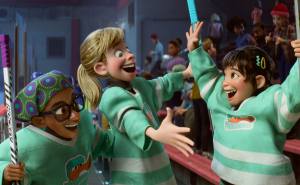
Inside Out 2 also answers a thorny world-building question that the original creators never thought to go into greater detail. It’s established in the 2015 original that even the adults have the same five core emotions manning their brain battle stations: Disgust, Fear, Sadness, Anger, and Joy. So if adults only see these same emotions, what happens to those new puberty emotions? Do they go away? As an adult, do we gradually work through anxiety and embarrassment to the point where they are no longer present (this is where every adult can wryly laugh)? There’s an emotion introduced as Nostalgia, depicted as a kindly grandmother so eager to remember the ways things were. Joy tells Nostalgia to leave, as it’s not time for her to be developed yet until Riley is older. This one moment clears up the world-building question; the emotions don’t leave, they just sit out for periods of time like bench players waiting to be called into the big game. And just like that, it all works and makes sense. I wonder what other new emotions make their appearances later in life. Resentment? Choosing to rather die in authority rather than give up an iota of power to a younger generation? Sorry, that last one was more directed at those stubborn folks clinging to Congressional offices.
There is some sight narrative and thematic redundancy here. The first movie was about learning the importance of accepting sadness as a vital part of the human condition and how we can process our emotional states. It was about Joy learning that not every moment in life can or should be dominated by joy, and that the other emotions are also necessary functions. With the sequel, we have a starting point where Joy is picking and choosing what memories are worthy of being remembered, banishing the “bad moments” to the back of Riley’s mind, forming a cavernous landfill of junked memories. It’s treading some pretty similar ground, prioritizing one set of memories or emotions over others wherein the ultimate lesson is that repression in all forms is unhealthy and robbing one of the necessary tools for self-acceptance and growth. This is further epitomized by a trip to one of these memory vaults where Riley’s Deep Dark Secret is willfully imprisoned. The movie proper never comes back to this self-loathing figure, and the revelation could have really supported the overall message of self-acceptance. Pixar could have done something really special here, like having Riley coming to terms with being bisexual/queer, and that perhaps something we may personally agonize over as a horrifying secret could, once shared, be far from the dreaded life-destroying culprit our minds make it out to be. This would have really worked with the perceived lower stakes of the movie, naturally elevating the ordinary to the profound, as life can often unexpectedly become. Alas, the Deep Dark Secret is just a setup to an underwhelming post-credits joke – womp womp. That’s it? Again, if you’re going to tread the familiar thematic grounds about the dangers of repression, at least give us something bigger to reach than the same lesson that all emotions have a place.

The first Inside Out was a masterpiece. That’s a hard act to follow. This sequel, of which we can all assume there will be more given its billion-dollar box-office, is a solid double to the original’s home run of entertainment. It’s not among their best but it’s one of their better non-Toy Story sequels. Inside Out 2 is a heartwarming winner.
Nate’s Grade: B


 nathanzoebl
You must be logged in to post a comment.